

Initial pulse of Siberian Traps sills as the trigger of the end-Permian mass extinction
Open accessThe DOI matches its Crossref record; 39 of the 39 references it cites were found in a registry or an index; none of the 79 sources its claims cite is checked for support yet.
Abstract
Mass extinction events are short-lived and characterized by catastrophic biosphere collapse and subsequent reorganization. Their abrupt nature necessitates a similarly short-lived trigger, and large igneous province magmatism is often implicated. However, large igneous provinces are long-lived compared to mass extinctions. Therefore, if large igneous provinces are an effective trigger, a subinterval of magmatism must be responsible for driving deleterious environmental effects. The onset of Earth’s most severe extinction, the end-Permian, coincided with an abrupt change in the emplacement style of the contemporaneous Siberian Traps large igneous province, from dominantly flood lavas to sill intrusions. Here we identify the initial emplacement pulse of laterally extensive sills as the critical deadly interval. Heat from these sills exposed untapped volatile-fertile sediments to contact metamorphism, likely liberating the massive greenhouse gas volumes needed to drive extinction. These observations suggest that large igneous provinces characterized by sill complexes are more likely to trigger catastrophic global environmental change than their flood basalt- and/or dike-dominated counterparts.
Overview
CoChat Summary
TL;DR
The paper argues that the initial pulse of laterally extensive Siberian Traps sill emplacement into the volatile-fertile Tunguska basin, beginning at 251.907 ± 0.067 Ma, coincided with the onset of the end-Permian mass extinction and its abrupt negative δ13C excursion. It proposes this short-lived intrusive pulse, rather than the earlier flood lavas or later sills, was the critical trigger of the extinction.
Key findings
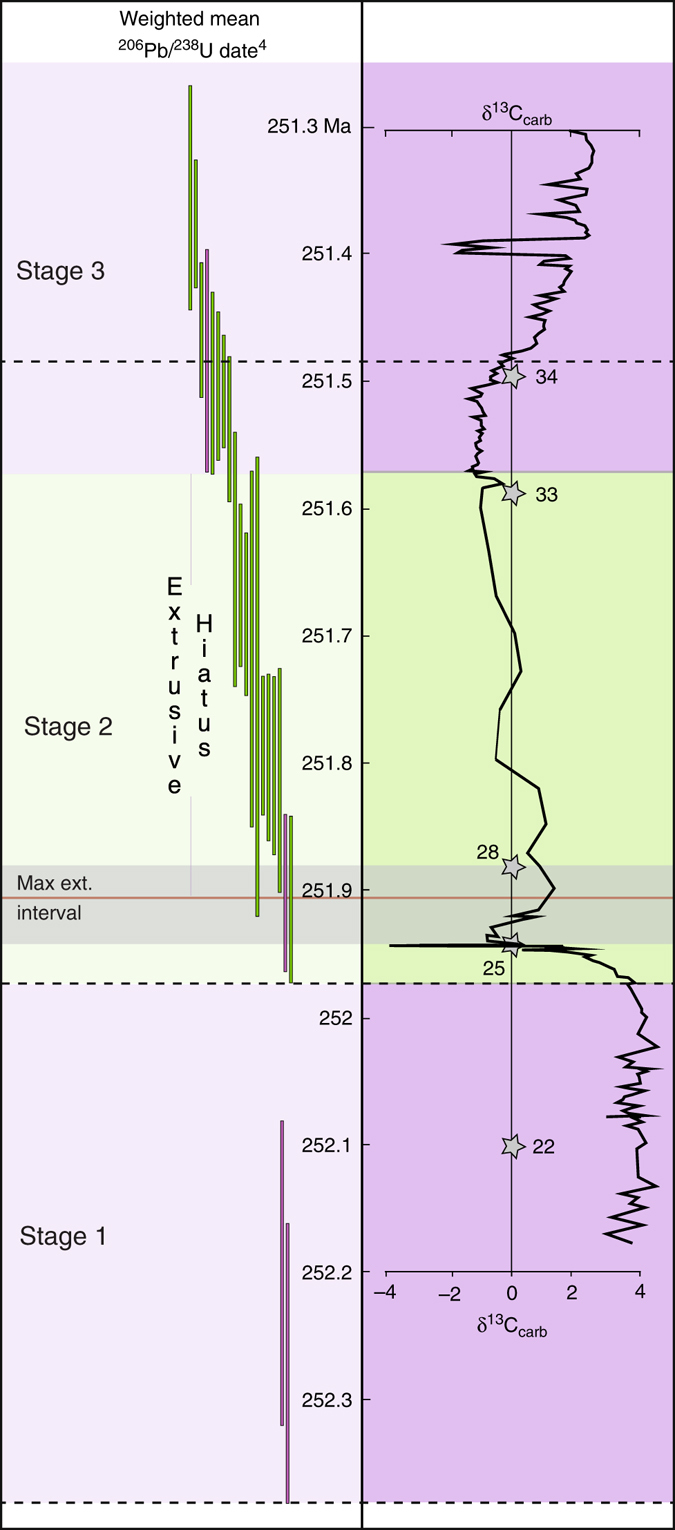
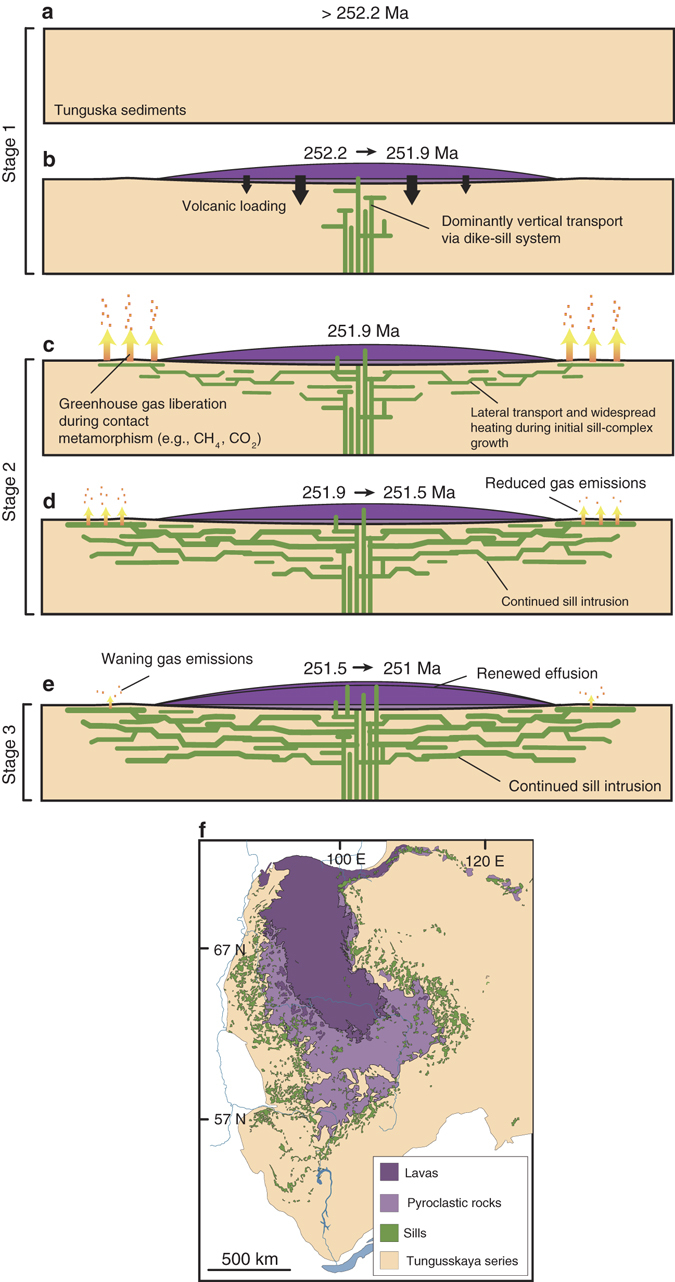
- Siberian Traps magmatism is divided into three stages: Stage 1 began just prior to 252.24 ± 0.1 Ma and emplaced an estimated 2/3 of total lavas (>1 × 10⁶ km³); Stage 2 began at 251.907 ± 0.067 Ma with cessation of extrusion and onset of widespread sill-complex formation over >1.5 × 10⁶ km², ending at 251.483 ± 0.088 Ma after an ~420 ka hiatus; Stage 3 lasted until at least 251.354 ± 0.088 Ma, with a maximum end estimate of 250.2 ± 0.3 Ma.
- The onset of Stage 2, marked by the oldest dated Siberian Traps sills, coincides with the onset of mass extinction at 251.941 ± 0.037 Ma and an abrupt (2–18 kyr) negative δ13C excursion immediately preceding the extinction; all other dated sills postdate these events and are disqualified as the trigger.
- Heat from the initial sill pulse into the Tunguska basin’s evaporite, clastic, carbonate, and hydrocarbon-bearing sediments likely liberated massive greenhouse gases via contact metamorphism; Stage 1 lavas erupted over the ~300 kyr prior to extinction with little biosphere/carbon-cycle instability, and plume-related devolatization inferred at 252.8 Ma postdated the extinction by ~900 ka.
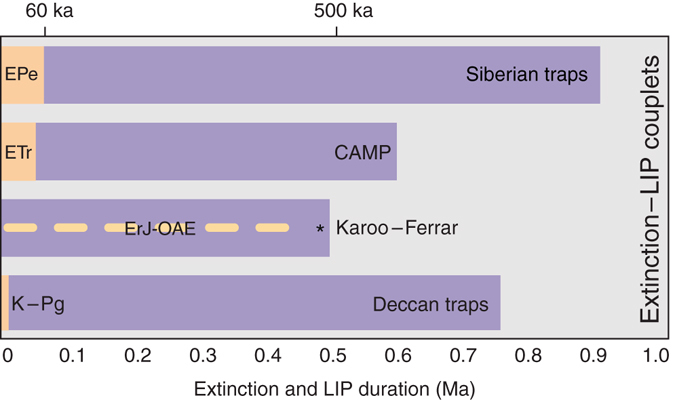
- LIPs characterized by sill complexes are more likely to trigger catastrophic global change than flood basalt- and/or dike-dominated counterparts; the model suggests a limited role for the flood basalt-/dike-dominated Deccan Traps in the K-Pg extinction, shifting burden to the contemporaneous Chicxulub impact, possibly as a shared causal burden.
Methods
- Design: construction of a relative timing framework from published high-resolution U/Pb geochronology and stratigraphic records, building on ref. 4, to identify which Siberian Traps subinterval satisfies the criteria for an extinction trigger.
- Data: published U/Pb zircon dates for Siberian Traps magmatism and the end-Permian extinction, the carbonate carbon isotope record at the Permian-Triassic GSSP, and durations from prior extinction–LIP couplets over the past 300 Myr; no new geochronology is reported, and supporting geochronology is available through refs. 4 and 8.
- Analysis: temporal correlation of magmatic stages with the extinction and δ13C record, plus comparison with other LIP–extinction associations to evaluate which magmatic style and subinterval could drive global environmental change.
Limitations
- Stated: the exact cause for the observed transition from lava eruptions to widespread sill-complex formation is challenging to pinpoint, and the impetus for Stage 3 extrusive magmatism is unclear.
- Stated/evident: the extinction-triggering subinterval of Stage 2 intrusive magmatism is described as currently unidentified, though the authors argue it is the initial pulse; the model relies on existing geochronology and age models rather than new data.
- Evident: the causal link rests on temporal coincidence and inferred contact metamorphism/volatile release; the paper does not quantify gas volumes or directly measure volatile flux from the initial sill pulse.
Model-written summary. Check it against the paper before relying on it.
Integrity signals
Registry
Cites
Statistics
Figures
Verification
Claims the paper makes
0 Valid · 0 Not valid · 48 Not checked · 10 Own results and interpretations
None of the sources cited for this claim have been checked yet.
In the paper
“in some cases, LIP emplacement began hundreds of thousands of years prior to mass extinction, with little to no discernable negative feedback in the biosphere during voluminous eruptions4, 15, 19”
§ Initial pulse of Siberian Traps sills as the trigger of the end-Permian mass extinction > Introduction
What the sources say
- Not checked yetcites [4] Burgess SD Bowring SA High-precision geochronology confirms voluminous magmatism before, during, and after Earth’s most severe extinction Sci. Adv. 2015 1 e1500470 10.1126/sciadv.1500470 26601239 PMC4643808 source
- Not checked yetcites [15] Burgess SD Bowring SA Fleming TH Elliot DH High-precision geochronology links the Ferrar large igneous province with early-Jurassic ocean anoxia and biotic crisis Earth Planet. Sci. Lett. 2015 415 90 99 10.1016/j.epsl.2015.01.037 source
- Not checked yetcites [19] Schoene B U-Pb geochronology of the Deccan Traps and relation to the end-Cretaceous mass extinction Science 2015 347 182 184 10.1126/science.aaa0118 25502315 source
plain- Asserted: passes — The authors put it forward as true.
- Checkable: passes — It can be checked against evidence.
- Load-bearing: passes — The paper’s conclusions depend on it.
- Based: passes — The paper gives a reason why it holds.
In the paper
“A maximum date for the end of stage 3 is estimated at 250.2 ± 0.3 Ma6.”
§ Initial pulse of Siberian Traps sills as the trigger of the end-Permian mass extinction > Results > A relative timing framework
What the sources say
- Not checked yetcites [6] Kamo Rapid eruption of Siberian food-volcanic rocks and evidence for coincidence with the Permian-Triassic boundary and mass extinction at 251Ma Earth Planet. Sci. Lett. 2003 214 75 91 10.1016/S0012-821X(03)00347-9 source
hedged- Asserted: passes — The authors put it forward as true.
- Checkable: passes — It can be checked against evidence.
- Load-bearing: passes — The paper’s conclusions depend on it.
- Based: passes — The paper gives a reason why it holds.
In the paper
“the physiological selectivity of marine extinction patterns11”
§ Initial pulse of Siberian Traps sills as the trigger of the end-Permian mass extinction > Introduction
What the sources say
- Not checked yetcites [11] Knoll AH Bambach RK Payne JL Pruss S Fischer WW Paleophysiology and end-Permian mass extinction Earth Planet. Sci. Lett. 2007 256 295 313 10.1016/j.epsl.2007.02.018 source
plainstates a cause- Asserted: passes — The authors put it forward as true.
- Checkable: passes — It can be checked against evidence.
- Load-bearing: unclear — It is unclear whether the paper’s conclusions depend on it.
- Based: passes — The paper gives a reason why it holds.
In the paper
“Siberian Traps lava eruptions appear to have ceased immediately prior to the extinction”
§ Initial pulse of Siberian Traps sills as the trigger of the end-Permian mass extinction > Results > Identifying the smoking gun
What the sources say
- Not checked yetcites [4] Burgess SD Bowring SA High-precision geochronology confirms voluminous magmatism before, during, and after Earth’s most severe extinction Sci. Adv. 2015 1 e1500470 10.1126/sciadv.1500470 26601239 PMC4643808 source
hedged- Asserted: passes — The authors put it forward as true.
- Checkable: passes — It can be checked against evidence.
- Load-bearing: passes — The paper’s conclusions depend on it.
- Based: passes — The paper gives a reason why it holds.
None of the sources cited for this claim have been checked yet.
In the paper
“rapid introduction of isotopically light carbon into the marine system8, 9”
§ Initial pulse of Siberian Traps sills as the trigger of the end-Permian mass extinction > Introduction
What the sources say
- Not checked yetcites [8] Burgess SD Bowring SA Shen S-Z High-precision timeline for Earth’s most severe extinction Proc. Natl Acad. Sci. 2014 111 3316 3321 10.1073/pnas.1317692111 24516148 PMC3948271 source
- Not checked yetcites [9] Payne JL Large perturbations of the carbon cycle during recovery from the end-permian extinction Science 2004 305 506 509 10.1126/science.1097023 15273391 source
plainstates a cause- Asserted: passes — The authors put it forward as true.
- Checkable: passes — It can be checked against evidence.
- Load-bearing: passes — The paper’s conclusions depend on it.
- Based: passes — The paper gives a reason why it holds.
28 more claims
Create a free account to see all 58 claims and to verify the 79 references still open.
- Probably not a substantial claim. 8
- It may state two separate claims as one. 21
Claims other papers make about this one
Each is checked against this paper’s own text: does it say what the citing paper says it does?
In the citing paper
“For the Siberian Traps, high-resolution U-Pb geochronology (Burgess & Bowring, 2015;Burgess et al., 2017) suggests that the volcanic sequence should be divided into three stages”
From The Magmatic Architecture of Continental Flood Basalts I: Observations From the Deccan Traps (2021) · cites this paper as Burgess et al., 2017
In the citing paper
“More than two thirds of the extrusive volume was erupted in the first stage, which lasted 700 kyr (252.2-251.9 Ma)”
From The Magmatic Architecture of Continental Flood Basalts I: Observations From the Deccan Traps (2021) · cites this paper as Burgess et al., 2017
In the citing paper
“This relationship is not unique for the McMurdo Dry Valleys and has been in multiple CFBs (e.g., Burgess et al., 2017;Hansen et al., 2011;Jerram et al., 2018) and has also been proposed for some CFB associate layered mafic intrusions (e.g., Higgins, 2005, Sept Iles intrusive Suite).”
From The Magmatic Architecture of Continental Flood Basalts I: Observations From the Deccan Traps (2021) · cites this paper as Burgess et al., 2017
Citations
Cites
Lethally Hot Temperatures During the Early Triassic Greenhouse
Sun, Y., Joachimski, M. M., Wignall, P. B., Yan, C., Chen, Y., Jiang, H., Wang, L., & Lai, X. (2012) · Science · doi:10.1126/science.1224126 · Cited by 1,175
Large Perturbations of the Carbon Cycle During Recovery from the End-Permian Extinction
Payne, J. L., Lehrmann, D. J., Wei, J., Orchard, M. J., Schrag, D. P., & Knoll, A. H. (2004) · Science · doi:10.1126/science.1097023 · Cited by 841
Calibrating the End-Permian Mass Extinction
Shen, S.-Z., Crowley, J. L., Wang, Y., Bowring, S. A., Erwin, D. H., Sadler, P. M., Cao, C.-Q., Rothman, D. H., Henderson, C. M., Ramezani, J., et al. (2011) · Science · doi:10.1126/science.1213454 · Cited by 810
Self-citationHigh-precision timeline for Earth’s most severe extinction
Burgess, S. D., Bowring, S., & Shen, S.-Z. (2014) · Proceedings of the National Academy of Sciences · doi:10.1073/pnas.1317692111 · Cited by 732
Self-citationSiberian gas venting and the end-Permian environmental crisis
Svensen, H., Planke, S., Polozov, A. G., Schmidbauer, N., Corfu, F., Podladchikov, Y. Y., & Jamtveit, B. (2009) · Earth and Planetary Science Letters · doi:10.1016/j.epsl.2008.11.015 · Cited by 672
Paleophysiology and end-Permian mass extinction
Knoll, A. H., Bambach, R. K., Payne, J. L., Pruss, S., & Fischer, W. W. (2007) · Earth and Planetary Science Letters · doi:10.1016/j.epsl.2007.02.018 · Cited by 665
On the causes of mass extinctions
Bond, D. P. G., & Grasby, S. E. (2017) · Palaeogeography, Palaeoclimatology, Palaeoecology · doi:10.1016/j.palaeo.2016.11.005 · Cited by 608
Blackburn, T. J., Olsen, P. E., Bowring, S. A., McLean, N. M., Kent, D. V., Puffer, J., McHone, G., Rasbury, E. T., & Et-Touhami, M. (2013) · Science · doi:10.1126/science.1234204 · Cited by 579
Self-citationBurgess, S. D., & Bowring, S. A. (2015) · Science Advances · doi:10.1126/sciadv.1500470 · Cited by 545
Self-citationTime Scales of Critical Events Around the Cretaceous-Paleogene Boundary
Renne, P. R., Deino, A. L., Hilgen, F. J., Kuiper, K. F., Mark, D. F., Mitchell, W. S., Morgan, L. E., Mundil, R., & Smit, J. (2013) · Science · doi:10.1126/science.1230492 · Cited by 545
Cited by
Items 301–400 of 435
Flood basalt buildup warms climate
Kasbohm, J. J. (2022) · Nature Geoscience · doi:10.1038/s41561-022-00944-z · Cited by 5
Ragon, C., Vérard, C., Kasparian, J., Nowak, H., Kustatscher, E., & Brunetti, M. (2025) · Frontiers in Earth Science · doi:10.3389/feart.2025.1520846 · Cited by 5
Pei, Y. (2022) · eDiss (Georg-August-Universität Göttingen) · doi:10.53846/goediss-9160 · Cited by 4
Atmospheric CO2 drawdown during the Emeishan flood basalt volcanism
Shen, J., Zhang, Y. G., Yuan, D., & Xu, Y. (2026) · Nature Communications · doi:10.1038/s41467-026-69600-z · Cited by 4
Karlstrom, L., Murray, K. E., & Reiners, P. W. (2019) · Abstracts with programs - Geological Society of America · doi:10.1130/abs/2019cd-329429 · Cited by 4
Lounejeva, E., Steadman, J. A., Large, R. R., Grice, K., Olin, P., & Belousov, I. A. (2023) · Australian Journal of Earth Sciences · doi:10.1080/08120099.2023.2200476 · Cited by 4
Proteromorphosis in Early Triassic Conodonts
Kılıç, A. M., Guex, J., & Hirsch, F. (2020) · Springer eBooks · doi:10.1007/978-3-030-47279-5_5 · Cited by 4
Sial, A. N., Chen, J., Korte, C., Pandit, M. K., Spangenberg, J. E., Silva‐Tamayo, J. C., de Lacerda, L. D., Ferreira, V. P., Barbosa, J. A., Gaucher, C., et al. (2020) · Stratigraphy & timescales · doi:10.1016/bs.sats.2020.08.011 · Cited by 4
Bacon, K. L., Haworth, M., & McElwain, J. C. (2021) · International Journal of Plant Sciences · doi:10.1086/714279 · Cited by 4
Wu, K. H., Tong, J., Li, H., Tian, L., Zou, Y., Liang, L., & Bi, Z. (2022) · Earth Science-Journal of China University of Geosciences · doi:10.3799/dqkx.2021.196 · Cited by 4
Li, C., Chen, H., Lang, X., Deng, Y., & Wang, Y. (2024) · Geological Journal · doi:10.1002/gj.4986 · Cited by 4
Racki, G., & Pisarzowska, A. (2026) · Palaeogeography Palaeoclimatology Palaeoecology · doi:10.1016/j.palaeo.2026.113832 · Cited by 4
Scoates, J. S., Wall, C. J., Weis, D., Friedman, R. M., Amini, M., & Meurer, W. J. (2019) · Journal of Petrology · doi:10.1093/petrology/egz015 · Cited by 4
Foster, W. J., Godbold, A. L., Brayard, A., Frank, A. B., Grasby, S. E., Twitchett, R. J., & Oji, T. (2022) · PeerJ · doi:10.7717/peerj.14357 · Cited by 4
Gibling, M. R., Jia, R., Gastaldo, R. A., Neveling, J., & Rochín-Bañaga, H. (2023) · Journal of Sedimentary Research · doi:10.2110/jsr.2023.018 · Cited by 4
Zurli, L., Fioraso, M., Perotti, M., Giulio, A. D., Olivetti, V., Pezzoli, S., Corti, V., & Cornamusini, G. (2026) · New Zealand Journal of Geology and Geophysics · doi:10.1002/jgo2.70023 · Cited by 4
Condon, D. J., Whitehouse, M. J., & Horstwood, M. (2020) · Elsevier eBooks · doi:10.1016/b978-0-08-102908-4.00166-1 · Cited by 3
Zhou, K., Gao, R., Liu, H., Lu, J., Guo, R., Zhang, P., Wang, W., Yan, Z., Liu, X., Qian, N., et al. (2026) · Earth-Science Reviews · doi:10.1016/j.earscirev.2026.105526 · Cited by 3
Sen, R., Polacci, M., Hartley, M. E., Burton, M. R., & Gupta, S. (2025) · Journal of Volcanology and Geothermal Research · doi:10.1016/j.jvolgeores.2025.108493 · Cited by 3
Zhang, P., Yang, M., Lu, J., Jiang, Z., Zhou, K., Wu, L., Xu, X., Chen, H., Zhu, X., Guo, Y., et al. (2025) · Earth-Science Reviews · doi:10.1016/j.earscirev.2025.105367 · Cited by 3
Chen, Y., Zhang, Y., Jiang, H., Ogg, J. G., Graziano, S., Huang, K., Zhong, Y., Li, H., & Lai, X. (2025) · Earth-Science Reviews · doi:10.1016/j.earscirev.2025.105313 · Cited by 3
Ozsvárt, P., Foster, W. J., Asatryan, G., Buchwald, S. Z., Correa, M. A. G., Mosočiová, T., Galasso, F., & Zajzon, N. (2026) · Papers in Palaeontology · doi:10.1002/spp2.70090 · Cited by 3
Widmann, P. (2019) · Archive ouverte UNIGE (University of Geneva) · doi:10.13097/archive-ouverte/unige:121676 · Cited by 3
Editorial: How Large Igneous Provinces (LIPs) during the Triassic shaped modern-day ecosystems
Callegaro, S., Corso, J. D., & Song, H. (2023) · Frontiers in Earth Science · doi:10.3389/feart.2023.1302216 · Cited by 3
Balancing Redox Budgets: Mechanisms for Prolonging Anoxia During Major Carbon Burial Events
Newby, S. M., Young, S. A., Them, T. R., Gill, B. C., & Owens, J. D. (2025) · American Journal of Science · doi:10.2475/001c.143665 · Cited by 2
Carbon trapping during contact metamorphism in volcanic basins: example of the Guaymas basin
Cheviet, A., Gonçalves, P., Choulet, F., Galerne, C. Y., Bach, W., Riboulleau, A., Vennemann, T. W., & Buatier, M. D. (2025) · Contributions to Mineralogy and Petrology · doi:10.1007/s00410-025-02262-0 · Cited by 2
Erosion-driven Delayed Warming and Marine Stress prior to the end-Permian Mass Extinction
Li, S., Shen, J., Grossman, E. L., & Zhang, S. (2025) · Nature Communications · doi:10.1038/s41467-026-74636-2 · Cited by 2
PERSISTENT LATE PERMIAN TO EARLY TRIASSIC WARMTH LINKED TO ENHANCED REVERSE WEATHERING
Liu, X.-M., Cao, C., Bataille, C. P., Song, H., Saltzman, M. R., Cramer, K. T., Wu, H., Korte, C., & Zhang, Z. (2022) · Abstracts with programs - Geological Society of America · doi:10.1130/abs/2022am-380868 · Cited by 2
Wu, Q., Nsingi, J. M., Kürschner, W. M., Beaty, B., Planavsky, N. J., Schneebeli‐Hermann, E., Yao, W., Cepin, E., & Cui, Y. (2025) · Global and Planetary Change · doi:10.1016/j.gloplacha.2025.104874 · Cited by 2
Regelous, A., Ćorić, S., Regelous, M., & Teipel, U. (2022) · Cretaceous Research · doi:10.1016/j.cretres.2022.105306 · Cited by 2
Chen, Y., Luo, M., Benton, M. J., Hu, S., Zhang, Q., Ji, C. Y., Huang, J., Kou, Q., Zhou, C., & Wen, W. (2023) · Palaeogeography Palaeoclimatology Palaeoecology · doi:10.1016/j.palaeo.2023.111840 · Cited by 2
de Oliveira, T. M., Pinheiro, F. L., & Kerber, L. R. (2020) · Terrae Didatica · doi:10.20396/td.v16i0.8656060 · Cited by 2
Correlating 300 million years of catastrophes
Ivanov, A. V. (2024) · Earth and Planetary Science Letters · doi:10.1016/j.epsl.2024.119058 · Cited by 2
Continental flood basalts sample oxidized mantle sources
Nicklas, R. W., Day, J. M. D., Trumbull, R. B., Rangwalla, H., & Kelly, S. (2024) · Lithos · doi:10.1016/j.lithos.2024.107697 · Cited by 2
Carbon release from Large Igneous Province magmas estimated from trace element-gas correlations
Black, B. A., & Aiuppa, A. (2023) · Volcanica · doi:10.30909/vol.06.01.129145 · Cited by 2
Yashunsky, Y. V., Alekseev, A. S., Sakharov, B. A., Шкурский, Б. Б., Novikova, S. A., Novikov, I. A., Fedorov, A. V., & Гришин, С. В. (2021) · Stratigraphy and Geological Correlation · doi:10.1134/s086959382202006x · Cited by 2
Elshaafi, A., & Guðmundsson, Á. (2019) · Journal of Volcanology and Geothermal Research · doi:10.1016/j.jvolgeores.2019.06.003 · Cited by 2
Extinct Primates and What They Can Tell Us About Future Extinctions
Frost, S. R. (2025) · Annual Review of Anthropology · doi:10.1146/annurev-anthro-081723-114501 · Cited by 2
He, W., Wu, Y., Zhang, K., Suzuki, N., Xiao, Y., Yang, T., Wu, C., & Huang, Y. (2025) · Earth Science-Journal of China University of Geosciences · doi:10.3799/dqkx.2024.140 · Cited by 2
Rimmer, S. M., Yoksoulian, L. E., & Gröcke, D. R. (2025) · Evolving Earth · doi:10.1016/j.eve.2025.100063 · Cited by 2
Tectonic History and Geological Setting of Asian Russia
Zelenin, E. A., & Garipova, S. (2025) · Doklady Earth Sciences · doi:10.1134/s1028334x25606807 · Cited by 2
Olgafrankite, Ni3Ge, a new mineral as the carrier of siderophile germanium in reduced systems
Верещагин, О. С., Khmelnitskaya, M. O., Kopylova, A. G., Solov’eva, Y. V., Krzhizhanovskaya, M. G., Kasatkin, A. V., Gorelova, L. A., Vlasenko, N. S., & Britvin, S. N. (2025) · American Mineralogist · doi:10.2138/am-2024-9714 · Cited by 2
Marquez, J. A., Penn, J. L., Stockey, R., Boag, T. H., Duncan, M. I., McClure, K. N., Matsumoto, K., Ashing-Giwa, K. F., Noll, C. P., Deutsch, C. A., et al. (2026) · Proceedings of the National Academy of Sciences · doi:10.1073/pnas.2533086123 · Cited by 1
Burger, B. J. (2018) · EarthArXiv (California Digital Library) · doi:10.31223/osf.io/khd9y · Cited by 1
Mass Extinctions and the Paleobotanical Record
Degani-Schmidt, I., Spiekermann, R., Gobo, W. V., & Jasper, A. (2025) · Elsevier eBooks · doi:10.1016/b978-0-443-15750-9.00101-4 · Cited by 1
Algal reorganization in post-crisis Early Triassic oceans revealed by biomarker evidence
Huang, Y., Naafs, B. D. A., Tian, L., Grasby, S. E., Bond, D. P. G., Wignall, P. B., Benton, M. J., & Pancost, R. D. (2025) · Global and Planetary Change · doi:10.1016/j.gloplacha.2025.105208 · Cited by 1
Newby, S. M., Owens, J. D., Young, S. A., & Hammer, Ø. (2026) · Geobiology · doi:10.1111/gbi.70062 · Cited by 1
Zhang, B., Mao, Z., Yuan, Y., Yu, C., Zhang, Z., Tang, X., Shi, Y., & Chen, X. (2022) · Interpretation · doi:10.1190/int-2021-0225.1 · Cited by 1
Marine oolites as proxies for palaeoenvironmental reconstructions during extinction events.
Urban, I. (2023) · Lund University Publications (Lund University) · Cited by 1
Biasi, J. A. (2021) · CaltechTHESIS (California Institute of Technology) · doi:10.7907/hbs7-aw47 · Cited by 1
Ma, H., Wang, Y., Xu, W., & Wang, F. C. (2026) · Geological Society of America Bulletin · doi:10.1130/b38636.1 · Cited by 1
Peng, X., Zhang, K., Chen, Y., Wu, C., Zhang, Z., Zhang, Y., & He, W. (2025) · Palaeogeography Palaeoclimatology Palaeoecology · doi:10.1016/j.palaeo.2025.113318 · Cited by 1
Coupled Hg isotope dynamics reveal eruption pulses across the Permian–Triassic mass extinction
Kaiho, K., Sonke, J. E., Grasby, S. E., & Tian, L. (2026) · Nature Communications · doi:10.1038/s41467-026-74313-4 · Cited by 1
U-Pb Dating of Fossils and Hydrogenic Minerals: Toward Practical Paleontological Chronometry
Rochín-Bañaga, H. (2022) · TSpace (University of Toronto) · Cited by 1
Wei, Z., Huang, Y., Wignall, P. B., Visscher, P. T., Fang, Q., Qiu, X., Liu, D., Zheng, Z., Feng, X., & Chen, Z. (2026) · Global and Planetary Change · doi:10.1016/j.gloplacha.2026.105438 · Cited by 1
Lü, H., Huang, B., Li, M., Zhao, Q. Y., Li, X., Liao, Y., Pei, Z., Xue, Y., Parés, J. M., Zhang, H., et al. (2026) · Proceedings of the National Academy of Sciences · doi:10.1073/pnas.2538105123 · Cited by 1
Ryabov, V. V., ASHCHEPKOV, I. V., Травин, А. В., Ponomarchuk, V. A., Карманов, Н. С., & Roberts, N. M. W. (2025) · Geosystems and Geoenvironment · doi:10.1016/j.geogeo.2025.100374 · Cited by 1
Keshmiri, M., Khanehbad, M., & Rahimi, B. (2026) · International Geology Review · doi:10.1080/00206814.2025.2612209 · Cited by 1
Trigger Effect of an Asteroidal or Cometary Impact at the Permian–Triassic Boundary
Svetsov, V. V., & Shuvalov, V. V. (2019) · Springer proceedings in earth and environmental sciences · doi:10.1007/978-3-030-31970-0_62 · Cited by 1
Decarbonation in contact metamorphism
Xu, C., & ZhenHao, Z. (2022) · Acta Petrologica Sinica · doi:10.18654/1000-0569/2022.05.04 · Cited by 1
The Putorana Plateau: Tectonics, Morphotectonics, and Exodynamics
Shvarev, S. V. (2025) · Doklady Earth Sciences · doi:10.1134/s1028334x25609939 · Cited by 1
Arefifard, S., Algeo, T. J., Zhang, F., & Lin, Y.-B. (2026) · Global and Planetary Change · doi:10.1016/j.gloplacha.2026.105600
Rizza, W. (2024) · San José State University ScholarWorks (San Jose State University) · doi:10.31979/etd.3srz-5ahn
Redox-controlled restructuring of marine microbial ecosystems during oceanic anoxic events
Yokoyama, T., Tajika, E., Watanabe, Y., & Ozaki, K. (2026) · Progress in Earth and Planetary Science · doi:10.1186/s40645-026-00842-7
Kaiho, K. (2022) · Biogeosciences · doi:10.5194/bg-2022-29-ac1
Kaiho, K. (2022) · Biogeosciences · doi:10.5194/bg-2022-29-rc1
Kaiho, K. (2022) · Biogeosciences · doi:10.5194/bg-2022-29-rc2
Kaiho, K. (2022) · Biogeosciences · doi:10.5194/bg-2022-29-ac2
Beltracchi, R. (2022) · San José State University ScholarWorks (San Jose State University) · doi:10.31979/etd.8rrn-9rjc
Depressed chemical weathering inhibited climate stabilization after the end-Permian biocrisis
Wei, G., Zhang, F., Zhang, H., Lin, Y.-B., Yin, Y., Gorgij, M. N., Arefifard, S., Algeo, T. J., von Strandmann, P. A. E. P., Mills, B. J. W., et al. (2026) · Science Advances · doi:10.1126/sciadv.aee6350
NICKEL ISOTOPES LINK SIBERIAN TRAPS AEROSOL PARTICLES TO THE END-PERMIAN MASS EXTINCTION
Wasylenki, L. E., Li, M., Grasby, S. E., Wang, S., Xu, Y., Sun, M., Beauchamp, B., Hu, D., & Shen, Y. (2021) · Abstracts with programs - Geological Society of America · doi:10.1130/abs/2021am-367231
Chen, X., Lu, L., Zongquan, H. U., Liu, W., Liu, W., & He, C. (2026) · ACS Earth and Space Chemistry · doi:10.1021/acsearthspacechem.6c00149
Ju, Q., Lin, Y.-B., Zhang, H., Algeo, T. J., Shen, S., & Zhang, F. (2026) · Geochimica et Cosmochimica Acta · doi:10.1016/j.gca.2026.06.013
Cui, Y., Li, M., Sun, L., Li, D., Zhang, G., Zhang, X., & Shen, Y. (2025) · Palaeogeography Palaeoclimatology Palaeoecology · doi:10.1016/j.palaeo.2025.113523
Herz, S. C., Li, M., Siciliano, A. A., Ostrander, C. M., Nielsen, S. G., Mukerji, T., Grasby, S. E., Altıner, D., Lehrmann, D. J., Bond, D. P. G., et al. (2026) · Science Advances · doi:10.1126/sciadv.aef5669
Extinction: End‐Permian Mass Extinction
Clapham, M. E. (2021) · Wiley eBooks · doi:10.1002/9780470015902.a0029315
A Niche Modelling Approach Adapted to Small Datasets With Permian/Triassic Conodonts as a Case Study
Guenser, P., Pohl, A., Leroy, M., Hülse, D., & Beaugrand, G. (2026) · Journal of Biogeography · doi:10.1111/jbi.70302
Dresow, M. W. (2021) · University of Minnesota Digital Conservancy (University of Minnesota)
Li, S., Zhang, P., Huan-huan, S., Zhong-feng, J., Liu, K., Dong, W.-C., & Wang, Y. (2026) · Journal of Palaeogeography · doi:10.1016/j.jop.2026.100438
Wang, L., Gan, L., Yang, C., Zhao, Y., Xu, H., Yin, R., & Wen, H. (2026) · Geochimica et Cosmochimica Acta · doi:10.1016/j.gca.2026.10.001
Chen, H., Jiang, H., Chen, Y., Guiyue, L., Yuan, Y., & Wu, X. (2026) · Sedimentary Geology · doi:10.1016/j.sedgeo.2026.107181
Zinc isotope evidence for intrusive Siberian Traps magmatism during the end-Permian mass extinction
Li, N., Cao, M., Xiong, G., Lin, Y.-B., Gorgij, M. N., 袁东勋, Wei, G., Algeo, T. J., Zheng, Q.-F., Zhang, H., et al. (2026) · Geochimica et Cosmochimica Acta · doi:10.1016/j.gca.2026.10.027
Biological Impact of Ozone Depletion at the End-Permian: A modeling studyPreprint
Thomas, B. C., & Oberle, J. M. (2019) · arXiv · doi:10.48550/arxiv.1911.10188
Ding, W., Ujiie, K., & Sashida, K. (2020) · Geological Journal · doi:10.1002/gj.3881
Smyrak‐Sikora, A. (2025) · doi:10.5194/egusphere-2024-3912-ac1
Huge volcanic eruption didn’t cause climate change and mass extinction 140 million years ago
Davies, J. H. F. L., da Rocha, B. C., & Greber, N. D. (2021) · The Conversation · doi:10.64628/aam.e4wy5pgaj
Biogenic origins and moonPreprint
Nessenius, E. (2025) · EarthArXiv (California Digital Library) · doi:10.31223/x5s733
Yang, M., Sun, W., Liu, Q., Zhao, H., & Gong, T. (2026) · Journal of Asian Earth Sciences · doi:10.1016/j.jseaes.2026.107352
He, W., Shi, G. R., Zhang, K., Suzuki, N., Wang, H., & Zhang, X.-H. (2023) · New records of the great dying in South China · doi:10.1007/978-981-99-9350-5_5
Hot Spots and Large Igneous Provinces
Bachèlery, P., & Villeneuve, N. (2021) · Elsevier eBooks · doi:10.1016/b978-0-12-818234-5.00168-1
Volcanism driven shift in the Mesoproterozoic carbon cycle and oxygen dynamics
Jiang, Z., Cai, C., Dou, L., Wang, H., Ge, X., & Jiang, L. (2026) · Communications Earth & Environment · doi:10.1038/s43247-026-03798-0
Krishnaswamy, K., Frieling, J., Percival, L. M. E., Littler, K., Reboulet, S., Fendley, I., Mather, T. A., & Robinson, S. A. (2026) · Geochemistry Geophysics Geosystems · doi:10.1029/2026gc012969
Environmental Effects of Volcanic Eruptions over Geological Timescales
Zhou, Y. (2026) · Applied and Computational Engineering · doi:10.54254/2755-2721/2027.ma37729
Oceanic chlorine enrichment preceding end-Permian warming linked to volcanic degassing
Wang, J.-Y., Li, Y., Song, H.-J., Bai, R.-Y., & Li, X.-H. (2026) · Geochimica et Cosmochimica Acta · doi:10.1016/j.gca.2026.04.008
Metadata
- Authors
- Burgess, S. D., Muirhead, J. D., & Bowring, S. A.
- Affiliations
- Volcano Science Center (US)
- Syracuse University (US)
- Massachusetts Institute of Technology (US)
- Corresponding author
- Burgess, S. D.
- Venue
- Nature Communications
- Published
- 2017-07-31
- Volume
- 8
- Issue
- 1
- Pages
- 164-164
- ISSN
- 2041-1723 (ISSN-L)
- PMC
- PMC5537227
- OpenAlex
- W2737540514
- Cited by
- 437
- References
- 39
- Citations by year
- 2026: 43 · 2025: 44 · 2024: 31 · 2023: 39 · 2022: 74 · 2021: 72 · 2020: 59 · 2019: 46 · 2018: 25 · 2017: 4
- FWCI
- 18.64
- Type
- journal article
- Language
- en
- Open access
- gold
- doi.org
- Licence
- cc-by
- creativecommons.org/licenses/by/4.0 (tdm)
- creativecommons.org/licenses/by/4.0 (vor)
- Locations
- Nature Communications (publishedVersion, cc-by)
- Europe PMC (PubMed Central) (publishedVersion, cc-by)
- PubMed Central (publishedVersion, cc-by)
- PubMed (publishedVersion)
- RePEc: Research Papers in Economics (submittedVersion)
- DOAJ (DOAJ: Directory of Open Access Journals) (submittedVersion)
- DSpace@MIT (Massachusetts Institute of Technology) (submittedVersion, cc-by)
- Funders
- U.S. Geological Survey
- Topics
- Physical Sciences › Earth and Planetary Sciences › Paleontology › Paleontology and Stratigraphy of Fossils
- Physical Sciences › Earth and Planetary Sciences › Geochemistry and Petrology › Geological and Geochemical Analysis
- Physical Sciences › Earth and Planetary Sciences › Geology › Geological and Geophysical Studies
- Keywords
- end-Permian mass extinction, Siberian Traps, large igneous provinces, sill emplacement, flood basalts, contact metamorphism, greenhouse gas emissions, global change, Permian-Triassic boundary
- MeSH terms
- Animals, Time Factors, Volcanic Eruptions, History, Ancient, Extinction, Biological
About these checks
Registry, retraction, Cites and statistics results are computed, not judged, with one exception: a printed reference that no index lists is read once by a model before it counts as a citation error. Claims are extracted by a model and kept only when their quote appears verbatim in the text; each cited source is then checked, with a model’s help, for whether it says what the claim relies on. Those verdicts can be wrong — read the claim’s quote and the cited source before relying on one.
A language model drew the claims from the paper on 2026-11-24, under version 3 of the claim definition (model deepseek-v4.1-flash, prompt extract-v3).
A second model labelled each claim on 2026-11-24 (model jev-1.13-20260917, definition revision gold-guideline-v0.2).
Statistics and arithmetic are recomputed, not judged.
Confidence bands are shown only for fields calibrated on our annotated test set. None is calibrated yet, so no band is shown.
What counts as a claim ›How we measure confidence ›How we check this ›
Are you an author, or do you see a problem with this page? Request a review
Data sources
Bibliographic data: Semantic Scholar, OpenAlex, Crossref.
Contains information from the Semantic Scholar Academic Graph Datasets, made available under the ODC Attribution License (ODC-BY 1.0).
Semantic Scholar’s data is described in: Kinney, R., et al. (2023). The Semantic Scholar Open Data Platform. arXiv:2301.10140.
