

Initial pulse of Siberian Traps sills as the trigger of the end-Permian mass extinction
Open accessThe DOI matches its Crossref record; 39 of the 39 references it cites were found in a registry or an index; none of the 79 sources its claims cite is checked for support yet.
Abstract
Mass extinction events are short-lived and characterized by catastrophic biosphere collapse and subsequent reorganization. Their abrupt nature necessitates a similarly short-lived trigger, and large igneous province magmatism is often implicated. However, large igneous provinces are long-lived compared to mass extinctions. Therefore, if large igneous provinces are an effective trigger, a subinterval of magmatism must be responsible for driving deleterious environmental effects. The onset of Earth’s most severe extinction, the end-Permian, coincided with an abrupt change in the emplacement style of the contemporaneous Siberian Traps large igneous province, from dominantly flood lavas to sill intrusions. Here we identify the initial emplacement pulse of laterally extensive sills as the critical deadly interval. Heat from these sills exposed untapped volatile-fertile sediments to contact metamorphism, likely liberating the massive greenhouse gas volumes needed to drive extinction. These observations suggest that large igneous provinces characterized by sill complexes are more likely to trigger catastrophic global environmental change than their flood basalt- and/or dike-dominated counterparts.
Overview
CoChat Summary
TL;DR
The paper argues that the initial pulse of laterally extensive Siberian Traps sill emplacement into the volatile-fertile Tunguska basin, beginning at 251.907 ± 0.067 Ma, coincided with the onset of the end-Permian mass extinction and its abrupt negative δ13C excursion. It proposes this short-lived intrusive pulse, rather than the earlier flood lavas or later sills, was the critical trigger of the extinction.
Key findings
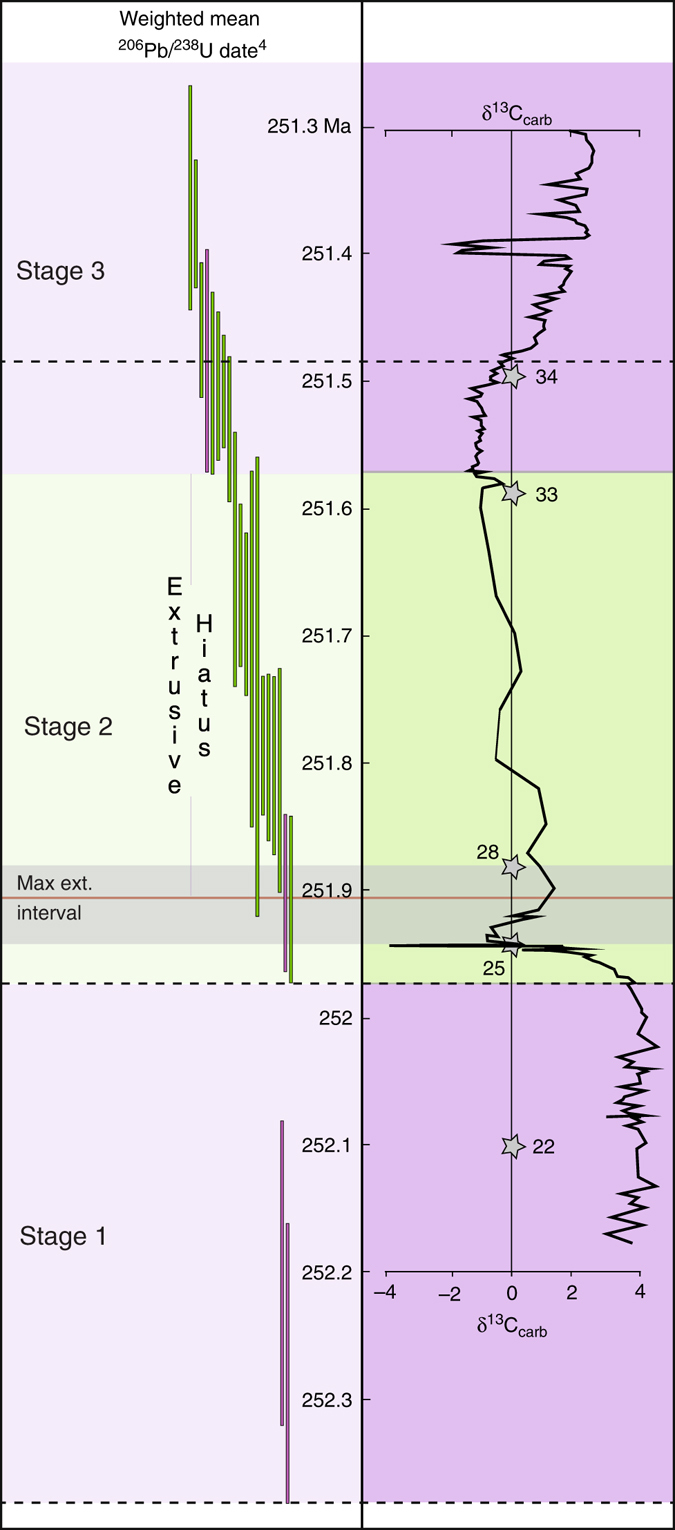
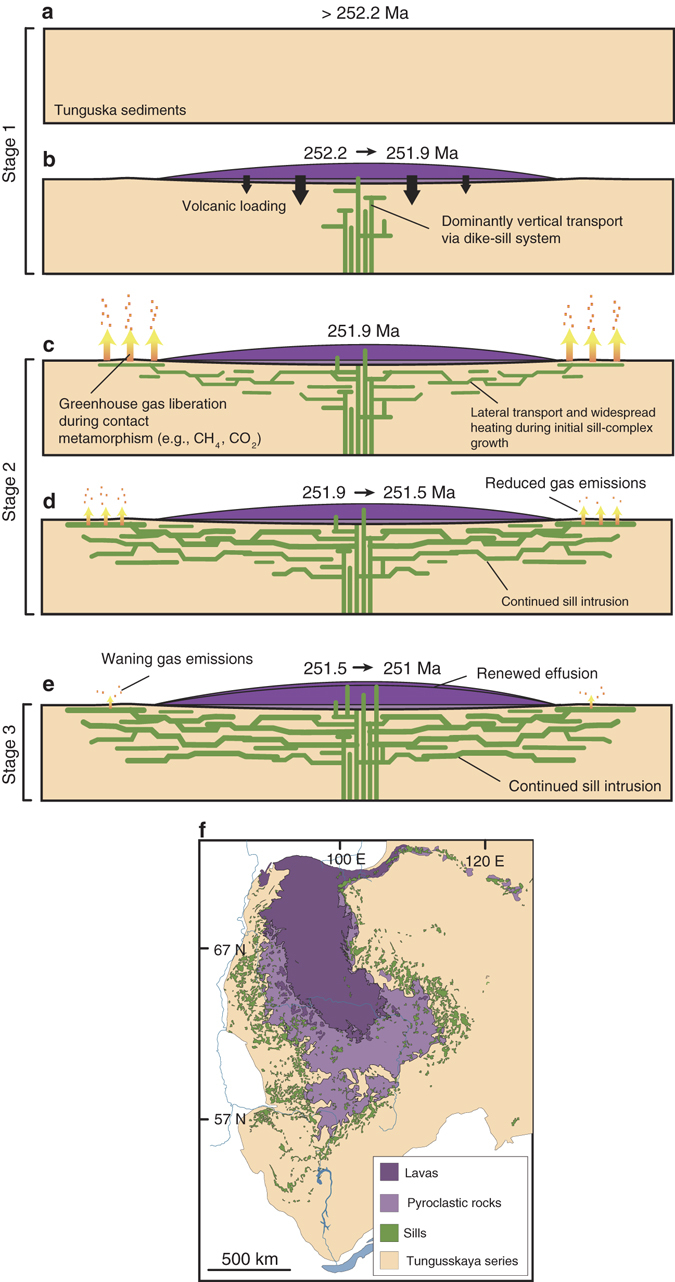
- Siberian Traps magmatism is divided into three stages: Stage 1 began just prior to 252.24 ± 0.1 Ma and emplaced an estimated 2/3 of total lavas (>1 × 10⁶ km³); Stage 2 began at 251.907 ± 0.067 Ma with cessation of extrusion and onset of widespread sill-complex formation over >1.5 × 10⁶ km², ending at 251.483 ± 0.088 Ma after an ~420 ka hiatus; Stage 3 lasted until at least 251.354 ± 0.088 Ma, with a maximum end estimate of 250.2 ± 0.3 Ma.
- The onset of Stage 2, marked by the oldest dated Siberian Traps sills, coincides with the onset of mass extinction at 251.941 ± 0.037 Ma and an abrupt (2–18 kyr) negative δ13C excursion immediately preceding the extinction; all other dated sills postdate these events and are disqualified as the trigger.
- Heat from the initial sill pulse into the Tunguska basin’s evaporite, clastic, carbonate, and hydrocarbon-bearing sediments likely liberated massive greenhouse gases via contact metamorphism; Stage 1 lavas erupted over the ~300 kyr prior to extinction with little biosphere/carbon-cycle instability, and plume-related devolatization inferred at 252.8 Ma postdated the extinction by ~900 ka.
- LIPs characterized by sill complexes are more likely to trigger catastrophic global change than flood basalt- and/or dike-dominated counterparts; the model suggests a limited role for the flood basalt-/dike-dominated Deccan Traps in the K-Pg extinction, shifting burden to the contemporaneous Chicxulub impact, possibly as a shared causal burden.
Methods
- Design: construction of a relative timing framework from published high-resolution U/Pb geochronology and stratigraphic records, building on ref. 4, to identify which Siberian Traps subinterval satisfies the criteria for an extinction trigger.
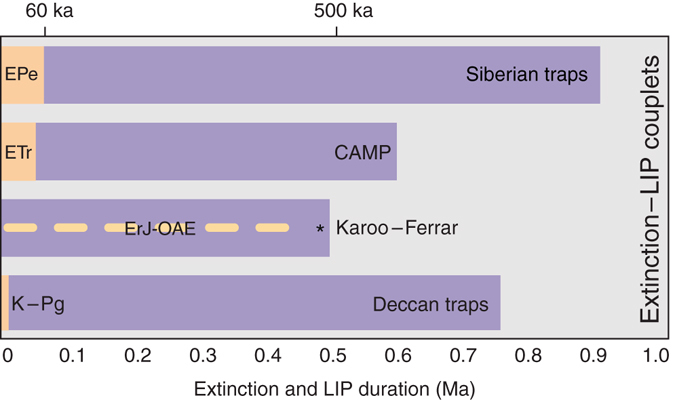
- Data: published U/Pb zircon dates for Siberian Traps magmatism and the end-Permian extinction, the carbonate carbon isotope record at the Permian-Triassic GSSP, and durations from prior extinction–LIP couplets over the past 300 Myr; no new geochronology is reported, and supporting geochronology is available through refs. 4 and 8.
- Analysis: temporal correlation of magmatic stages with the extinction and δ13C record, plus comparison with other LIP–extinction associations to evaluate which magmatic style and subinterval could drive global environmental change.
Limitations
- Stated: the exact cause for the observed transition from lava eruptions to widespread sill-complex formation is challenging to pinpoint, and the impetus for Stage 3 extrusive magmatism is unclear.
- Stated/evident: the extinction-triggering subinterval of Stage 2 intrusive magmatism is described as currently unidentified, though the authors argue it is the initial pulse; the model relies on existing geochronology and age models rather than new data.
- Evident: the causal link rests on temporal coincidence and inferred contact metamorphism/volatile release; the paper does not quantify gas volumes or directly measure volatile flux from the initial sill pulse.
Model-written summary. Check it against the paper before relying on it.
Integrity signals
Registry
Cites
Statistics
Figures
Verification
Claims the paper makes
0 Valid · 0 Not valid · 48 Not checked · 10 Own results and interpretations
None of the sources cited for this claim have been checked yet.
In the paper
“in some cases, LIP emplacement began hundreds of thousands of years prior to mass extinction, with little to no discernable negative feedback in the biosphere during voluminous eruptions4, 15, 19”
§ Initial pulse of Siberian Traps sills as the trigger of the end-Permian mass extinction > Introduction
What the sources say
- Not checked yetcites [4] Burgess SD Bowring SA High-precision geochronology confirms voluminous magmatism before, during, and after Earth’s most severe extinction Sci. Adv. 2015 1 e1500470 10.1126/sciadv.1500470 26601239 PMC4643808 source
- Not checked yetcites [15] Burgess SD Bowring SA Fleming TH Elliot DH High-precision geochronology links the Ferrar large igneous province with early-Jurassic ocean anoxia and biotic crisis Earth Planet. Sci. Lett. 2015 415 90 99 10.1016/j.epsl.2015.01.037 source
- Not checked yetcites [19] Schoene B U-Pb geochronology of the Deccan Traps and relation to the end-Cretaceous mass extinction Science 2015 347 182 184 10.1126/science.aaa0118 25502315 source
plain- Asserted: passes — The authors put it forward as true.
- Checkable: passes — It can be checked against evidence.
- Load-bearing: passes — The paper’s conclusions depend on it.
- Based: passes — The paper gives a reason why it holds.
In the paper
“A maximum date for the end of stage 3 is estimated at 250.2 ± 0.3 Ma6.”
§ Initial pulse of Siberian Traps sills as the trigger of the end-Permian mass extinction > Results > A relative timing framework
What the sources say
- Not checked yetcites [6] Kamo Rapid eruption of Siberian food-volcanic rocks and evidence for coincidence with the Permian-Triassic boundary and mass extinction at 251Ma Earth Planet. Sci. Lett. 2003 214 75 91 10.1016/S0012-821X(03)00347-9 source
hedged- Asserted: passes — The authors put it forward as true.
- Checkable: passes — It can be checked against evidence.
- Load-bearing: passes — The paper’s conclusions depend on it.
- Based: passes — The paper gives a reason why it holds.
In the paper
“the physiological selectivity of marine extinction patterns11”
§ Initial pulse of Siberian Traps sills as the trigger of the end-Permian mass extinction > Introduction
What the sources say
- Not checked yetcites [11] Knoll AH Bambach RK Payne JL Pruss S Fischer WW Paleophysiology and end-Permian mass extinction Earth Planet. Sci. Lett. 2007 256 295 313 10.1016/j.epsl.2007.02.018 source
plainstates a cause- Asserted: passes — The authors put it forward as true.
- Checkable: passes — It can be checked against evidence.
- Load-bearing: unclear — It is unclear whether the paper’s conclusions depend on it.
- Based: passes — The paper gives a reason why it holds.
In the paper
“Siberian Traps lava eruptions appear to have ceased immediately prior to the extinction”
§ Initial pulse of Siberian Traps sills as the trigger of the end-Permian mass extinction > Results > Identifying the smoking gun
What the sources say
- Not checked yetcites [4] Burgess SD Bowring SA High-precision geochronology confirms voluminous magmatism before, during, and after Earth’s most severe extinction Sci. Adv. 2015 1 e1500470 10.1126/sciadv.1500470 26601239 PMC4643808 source
hedged- Asserted: passes — The authors put it forward as true.
- Checkable: passes — It can be checked against evidence.
- Load-bearing: passes — The paper’s conclusions depend on it.
- Based: passes — The paper gives a reason why it holds.
None of the sources cited for this claim have been checked yet.
In the paper
“rapid introduction of isotopically light carbon into the marine system8, 9”
§ Initial pulse of Siberian Traps sills as the trigger of the end-Permian mass extinction > Introduction
What the sources say
- Not checked yetcites [8] Burgess SD Bowring SA Shen S-Z High-precision timeline for Earth’s most severe extinction Proc. Natl Acad. Sci. 2014 111 3316 3321 10.1073/pnas.1317692111 24516148 PMC3948271 source
- Not checked yetcites [9] Payne JL Large perturbations of the carbon cycle during recovery from the end-permian extinction Science 2004 305 506 509 10.1126/science.1097023 15273391 source
plainstates a cause- Asserted: passes — The authors put it forward as true.
- Checkable: passes — It can be checked against evidence.
- Load-bearing: passes — The paper’s conclusions depend on it.
- Based: passes — The paper gives a reason why it holds.
28 more claims
Create a free account to see all 58 claims and to verify the 79 references still open.
- Probably not a substantial claim. 8
- It may state two separate claims as one. 21
Claims other papers make about this one
Each is checked against this paper’s own text: does it say what the citing paper says it does?
In the citing paper
“For the Siberian Traps, high-resolution U-Pb geochronology (Burgess & Bowring, 2015;Burgess et al., 2017) suggests that the volcanic sequence should be divided into three stages”
From The Magmatic Architecture of Continental Flood Basalts I: Observations From the Deccan Traps (2021) · cites this paper as Burgess et al., 2017
In the citing paper
“More than two thirds of the extrusive volume was erupted in the first stage, which lasted 700 kyr (252.2-251.9 Ma)”
From The Magmatic Architecture of Continental Flood Basalts I: Observations From the Deccan Traps (2021) · cites this paper as Burgess et al., 2017
In the citing paper
“This relationship is not unique for the McMurdo Dry Valleys and has been in multiple CFBs (e.g., Burgess et al., 2017;Hansen et al., 2011;Jerram et al., 2018) and has also been proposed for some CFB associate layered mafic intrusions (e.g., Higgins, 2005, Sept Iles intrusive Suite).”
From The Magmatic Architecture of Continental Flood Basalts I: Observations From the Deccan Traps (2021) · cites this paper as Burgess et al., 2017
Citations
Cites
Lethally Hot Temperatures During the Early Triassic Greenhouse
Sun, Y., Joachimski, M. M., Wignall, P. B., Yan, C., Chen, Y., Jiang, H., Wang, L., & Lai, X. (2012) · Science · doi:10.1126/science.1224126 · Cited by 1,175
Large Perturbations of the Carbon Cycle During Recovery from the End-Permian Extinction
Payne, J. L., Lehrmann, D. J., Wei, J., Orchard, M. J., Schrag, D. P., & Knoll, A. H. (2004) · Science · doi:10.1126/science.1097023 · Cited by 841
Calibrating the End-Permian Mass Extinction
Shen, S.-Z., Crowley, J. L., Wang, Y., Bowring, S. A., Erwin, D. H., Sadler, P. M., Cao, C.-Q., Rothman, D. H., Henderson, C. M., Ramezani, J., et al. (2011) · Science · doi:10.1126/science.1213454 · Cited by 810
Self-citationHigh-precision timeline for Earth’s most severe extinction
Burgess, S. D., Bowring, S., & Shen, S.-Z. (2014) · Proceedings of the National Academy of Sciences · doi:10.1073/pnas.1317692111 · Cited by 732
Self-citationSiberian gas venting and the end-Permian environmental crisis
Svensen, H., Planke, S., Polozov, A. G., Schmidbauer, N., Corfu, F., Podladchikov, Y. Y., & Jamtveit, B. (2009) · Earth and Planetary Science Letters · doi:10.1016/j.epsl.2008.11.015 · Cited by 672
Paleophysiology and end-Permian mass extinction
Knoll, A. H., Bambach, R. K., Payne, J. L., Pruss, S., & Fischer, W. W. (2007) · Earth and Planetary Science Letters · doi:10.1016/j.epsl.2007.02.018 · Cited by 665
On the causes of mass extinctions
Bond, D. P. G., & Grasby, S. E. (2017) · Palaeogeography, Palaeoclimatology, Palaeoecology · doi:10.1016/j.palaeo.2016.11.005 · Cited by 608
Blackburn, T. J., Olsen, P. E., Bowring, S. A., McLean, N. M., Kent, D. V., Puffer, J., McHone, G., Rasbury, E. T., & Et-Touhami, M. (2013) · Science · doi:10.1126/science.1234204 · Cited by 579
Self-citationBurgess, S. D., & Bowring, S. A. (2015) · Science Advances · doi:10.1126/sciadv.1500470 · Cited by 545
Self-citationTime Scales of Critical Events Around the Cretaceous-Paleogene Boundary
Renne, P. R., Deino, A. L., Hilgen, F. J., Kuiper, K. F., Mark, D. F., Mitchell, W. S., Morgan, L. E., Mundil, R., & Smit, J. (2013) · Science · doi:10.1126/science.1230492 · Cited by 545
Cited by
A high resolution summary of Cambrian to early Triassic marine invertebrate biodiversity
Fan, J.-X., Shen, S.-Z., Erwin, D. H., Sadler, P. M., MacLeod, N., Cheng, Q.-M., Hou, X.-D., Yang, J., Wang, X.-D., Wang, Y., et al. (2020) · Science · doi:10.1126/science.aax4953 · Cited by 583
Environmental crises at the Permian–Triassic mass extinction
Dal Corso, J., Song, H., Callegaro, S., Chu, D., Sun, Y., Hilton, J., Grasby, S. E., Joachimski, M. M., & Wignall, P. B. (2022) · Nature Reviews Earth & Environment · doi:10.1038/s43017-021-00259-4 · Cited by 212
Schmieder, M., & Kring, D. A. (2020) · Astrobiology · doi:10.1089/ast.2019.2085 · Cited by 205
“…extinction event may have been caused by volcanic activity in large igneous provinces, such as the Emeishan and Siberian Traps in the final stages of the Permian (e.g., Shen et al., 2011; Burgess et al., 2017; Ernst and Youbi, 2017) and potentially other compounding environmental factors.”
BackgroundThresholds of temperature change for mass extinctions
Song, H., Kemp, D. B., Tian, L., Chu, D., Song, H., & Dai, X. (2021) · Nature Communications · doi:10.1038/s41467-021-25019-2 · Cited by 203
A sudden end-Permian mass extinction in South China
Shen, S., Ramezani, J., Chen, J., Cao, C., Erwin, D. H., Zhang, H., Xiang, L., Schoepfer, S. D., Henderson, C. M., Zheng, Q.-F., et al. (2018) · Geological Society of America Bulletin · doi:10.1130/b31909.1 · Cited by 201
Self-citationEvidence for a prolonged Permian–Triassic extinction interval from global marine mercury records
Shen, J., Chen, J., Algeo, T. J., Yuan, S., Feng, Q., Yu, J., Zhou, L., O’Connell, B., & Planavsky, N. J. (2019) · Nature Communications · doi:10.1038/s41467-019-09620-0 · Cited by 193
Vajda, V., McLoughlin, S., Mays, C., Frank, T. D., Fielding, C. R., Tevyaw, A., Lehsten, V., Bocking, M., & Nicoll, R. S. (2020) · Earth and Planetary Science Letters · doi:10.1016/j.epsl.2019.115875 · Cited by 180
Percival, L. M. E., Jenkyns, H. C., Mather, T. A., Dickson, A. J., Batenburg, S. J., Ruhl, M., Hesselbo, S. P., Barclay, R., Jarvis, I., Robinson, S. A., et al. (2018) · American Journal of Science · doi:10.2475/08.2018.01 · Cited by 176
Permian–Triassic mass extinction pulses driven by major marine carbon cycle perturbations
Jurikova, H., Gutjahr, M., Wallmann, K., Flögel, S., Liebetrau, V., Posenato, R., Angiolini, L., Garbelli, C., Brand, U., Wiedenbeck, M., et al. (2020) · Nature Geoscience · doi:10.1038/s41561-020-00646-4 · Cited by 176
Six-fold increase of atmospheric pCO2 during the Permian–Triassic mass extinction
Wu, Y., Chu, D., Tong, J., Song, H., Corso, J. D., Wignall, P. B., Song, H., Du, Y., & Cui, Y. (2021) · Nature Communications · doi:10.1038/s41467-021-22298-7 · Cited by 169
Flood Basalts and Mass Extinctions
Clapham, M. E., & Renne, P. R. (2019) · Annual Review of Earth and Planetary Sciences · doi:10.1146/annurev-earth-053018-060136 · Cited by 165
Cyclostratigraphy and Astrochronology in 2018
Hinnov, L. A. (2018) · Stratigraphy & timescales · doi:10.1016/bs.sats.2018.08.004 · Cited by 159
Mercury anomalies across the Palaeocene–Eocene Thermal Maximum
Jones, M. T., Percival, L. M. E., Stokke, E. W., Frieling, J., Mather, T. A., Riber, L., Schubert, B. A., Schultz, B. P., Tegner, C., Planke, S., et al. (2019) · Climate of the past · doi:10.5194/cp-15-217-2019 · Cited by 148
Placing our current ‘hyperthermal’ in the context of rapid climate change in our geological past
Foster, G. L., Hull, P. M., Lunt, D. J., & Zachos, J. C. (2018) · Philosophical Transactions of the Royal Society A Mathematical Physical and Engineering Sciences · doi:10.1098/rsta.2017.0086 · Cited by 146
Racki, G. (2020) · Global and Planetary Change · doi:10.1016/j.gloplacha.2020.103174 · Cited by 145
Wang, X., Cawood, P. A., Zhao, H., Zhao, L., Grasby, S. E., Chen, Z., Wignall, P. B., Lv, Z., & Han, C. (2018) · Earth and Planetary Science Letters · doi:10.1016/j.epsl.2018.05.044 · Cited by 141
Ernst, R. E., Liikane, D. A., Jowitt, S. M., Buchan, K. L., & Blanchard, J. A. (2019) · Journal of Volcanology and Geothermal Research · doi:10.1016/j.jvolgeores.2019.07.007 · Cited by 139
Mercury evidence of intense volcanic effects on land during the Permian-Triassic transition
Shen, J., Yu, J., Chen, J., Algeo, T. J., Xu, G., Feng, Q., Shi, X., Planavsky, N. J., Shu, W., & Xie, S. (2019) · Geology · doi:10.1130/g46679.1 · Cited by 135
Feng, Z., Wei, H., Guo, Y., He, X.-Y., Sui, Q., Zhou, Y., Liu, H., Gou, X., & Lv, Y. (2020) · Earth-Science Reviews · doi:10.1016/j.earscirev.2020.103153 · Cited by 127
A nutrient control on marine anoxia during the end-Permian mass extinction
Schobben, M., Foster, W. J., Sleveland, A. R. N., Zuchuat, V., Svensen, H. H., Planke, S., Bond, D. P. G., Marcelis, F. H. M., Newton, R. J., Wignall, P. B., et al. (2020) · Nature Geoscience · doi:10.1038/s41561-020-0622-1 · Cited by 123
Joachimski, M. M., Alekseev, A. S., Grigoryan, A., & Gatovsky, Y. А. (2019) · Geological Society of America Bulletin · doi:10.1130/b35108.1 · Cited by 122
Shen, J., Algeo, T. J., Planavsky, N. J., Yu, J., Feng, Q., Song, H., Song, H., Rowe, H., Zhou, L., & Chen, J. (2019) · Earth-Science Reviews · doi:10.1016/j.earscirev.2019.05.010 · Cited by 117
Mays, C., Vajda, V., Frank, T. D., Fielding, C. R., Nicoll, R. S., Tevyaw, A. P., & McLoughlin, S. (2019) · Geological Society of America Bulletin · doi:10.1130/b35355.1 · Cited by 117
Gastaldo, R. A., Kamo, S. L., Neveling, J., GEISSMAN, J. W., Looy, C. V., & Martini, A. M. (2020) · Nature Communications · doi:10.1038/s41467-020-15243-7 · Cited by 114
Ecological disturbance in tropical peatlands prior to marine Permian-Triassic mass extinction
Chu, D., Grasby, S. E., Song, H., Corso, J. D., Wang, Y., Mather, T. A., Wu, Y., Song, H., Shu, W., Tong, J., et al. (2020) · Geology · doi:10.1130/g46631.1 · Cited by 114
Ernst, R. E., Bond, D. P. G., Zhang, S., Buchan, K. L., Grasby, S. E., Youbi, N., El Bilali, H., Bekker, A., & Doucet, L. S. (2021) · Geophysical Monograph Series · doi:10.1002/9781119507444.ch1 · Cited by 108
Johansson, L., Zahirovic, S., & Müller, R. D. (2018) · Geophysical Research Letters · doi:10.1029/2017gl076691 · Cited by 107
Chen, J., & Xu, Y. (2019) · Gondwana Research · doi:10.1016/j.gr.2019.04.008 · Cited by 106
Toxic mercury pulses into late Permian terrestrial and marine environments
Grasby, S. E., Liu, X., Yin, R., Ernst, R. E., & Chen, Z. (2020) · Geology · doi:10.1130/g47295.1 · Cited by 105
Innovation not recovery: dynamic redox promotes metazoan radiations
Wood, R., & Erwin, D. H. (2018) · Biological Reviews · doi:10.1111/brv.12375 · Cited by 101
Ogg, J. G., Chen, Z., Orchard, M. J., & Jiang, H. (2020) · Elsevier eBooks · doi:10.1016/b978-0-12-824360-2.00025-5 · Cited by 99
Percival, L. M. E., Davies, J. H. F. L., Schaltegger, U., Vleeschouwer, D. D., Silva, A. D., & Föllmi, K. B. (2018) · Scientific Reports · doi:10.1038/s41598-018-27847-7 · Cited by 98
Henderson, C. M., Shen, S., Gradstein, F. M., & Agterberg, F. P. (2020) · Elsevier eBooks · doi:10.1016/b978-0-12-824360-2.00024-3 · Cited by 96
Breathless through Time: Oxygen and Animals across Earth’s History
Sperling, E. A., Boag, T. H., Duncan, M. I., Endriga, C. R., Marquez, J. A., Mills, D. B., Monarrez, P. M., Sclafani, J. A., Stockey, R., & Payne, J. L. (2022) · Biological Bulletin · doi:10.1086/721754 · Cited by 95
Global mercury cycle during the end-Permian mass extinction and subsequent Early Triassic recovery
Wang, X., Cawood, P. A., Zhao, H., Zhao, L., Grasby, S. E., Chen, Z., & Zhang, L. (2019) · Earth and Planetary Science Letters · doi:10.1016/j.epsl.2019.02.026 · Cited by 95
Massive and rapid predominantly volcanic CO 2 emission during the end-Permian mass extinction
Cui, Y., Li, M., van Soelen, E. E., Peterse, F., & Kürschner, W. M. (2021) · Proceedings of the National Academy of Sciences · doi:10.1073/pnas.2014701118 · Cited by 95
End-Permian extinction amplified by plume-induced release of recycled lithospheric volatiles
Broadley, M. W., Barry, P. H., Ballentine, C. J., Taylor, L. A., & Burgess, R. (2018) · Nature Geoscience · doi:10.1038/s41561-018-0215-4 · Cited by 93
Shen, J., Chen, J., Algeo, T. J., Feng, Q., Yu, J., Xu, Y., Xu, G., Lei, Y., Planavsky, N. J., & Xie, S. (2020) · Geology · doi:10.1130/g48501.1 · Cited by 91
Pangea B and the Late Paleozoic Ice Age
Kent, D. V., & Muttoni, G. (2020) · Palaeogeography, Palaeoclimatology, Palaeoecology · doi:10.1016/j.palaeo.2020.109753 · Cited by 90
Persistent late Permian to Early Triassic warmth linked to enhanced reverse weathering
Cao, C., Bataille, C. P., Song, H., Saltzman, M. R., Cramer, K. T., Wu, H., Korte, C., Zhang, Z., & Liu, X. (2022) · Nature Geoscience · doi:10.1038/s41561-022-01009-x · Cited by 90
Wang, W.-Q., Garbelli, C., Zhang, F., Zheng, Q.-F., Zhang, Y., Yuan, D., Shi, Y., Chen, B., & Shen, S. (2020) · Earth and Planetary Science Letters · doi:10.1016/j.epsl.2020.116245 · Cited by 89
Kaiho, K., Aftabuzzaman, M., Jones, D. S. J., & Tian, L. (2020) · Geology · doi:10.1130/g48022.1 · Cited by 90
What controls the duration and intensity of ocean anoxic events in the Paleozoic and the Mesozoic?
Reershemius, T., & Planavsky, N. J. (2021) · Earth-Science Reviews · doi:10.1016/j.earscirev.2021.103787 · Cited by 87
Hu, X., Li, J., Han, Z., & Li, Y. X. (2020) · Science China Earth Sciences · doi:10.1007/s11430-019-9604-4 · Cited by 84
Carbonation and Decarbonation Reactions: Implications for Planetary Habitability
Stewart, E. M., Ague, J. J., Ferry, J. M., Schiffries, C. M., Tao, R., Isson, T. T., & Planavsky, N. J. (2019) · American Mineralogist · doi:10.2138/am-2019-6884 · Cited by 83
Radiometric Constraints on the Timing, Tempo, and Effects of Large Igneous Province Emplacement
Kasbohm, J. J., Schoene, B., & Burgess, S. D. (2021) · Geophysical monograph · doi:10.1002/9781119507444.ch2 · Cited by 81
Self-citationFrank, T. D., Fielding, C. R., Winguth, A., Savatic, K., Tevyaw, A. P., Winguth, C., McLoughlin, S., Vajda, V., Mays, C., Nicoll, R. S., et al. (2021) · Geology · doi:10.1130/g48795.1 · Cited by 81
Materials and pathways of the organic carbon cycle through time
Galvez, M. E., Fischer, W. W., Jaccard, S. L., & Eglinton, T. I. (2020) · Nature Geoscience · doi:10.1038/s41561-020-0563-8 · Cited by 80
Cooling-driven oceanic anoxia across the Smithian/Spathian boundary (mid-Early Triassic)
Song, H., Du, Y., Algeo, T. J., Tong, J., Owens, J. D., Song, H., Tian, L., Qiu, H., Zhu, Y.-Y., & Lyons, T. W. (2019) · Earth-Science Reviews · doi:10.1016/j.earscirev.2019.01.009 · Cited by 80
Continental flood basalts drive Phanerozoic extinctions
Green, T., Renne, P. R., & Keller, C. B. (2022) · Proceedings of the National Academy of Sciences · doi:10.1073/pnas.2120441119 · Cited by 77
Astronomical Time Scale for the Mesozoic
Huang, C. (2018) · Stratigraphy & timescales · doi:10.1016/bs.sats.2018.08.005 · Cited by 77
An overview of explosive volcanism on Mars
Brož, P., Bernhardt, H., Conway, S. J., & Parekh, R. A. (2020) · Journal of Volcanology and Geothermal Research · doi:10.1016/j.jvolgeores.2020.107125 · Cited by 74
Botha, J., Huttenlocker, A. K., Smith, R. M. H., Prevec, R., Viglietti, P. A., & MODESTO, S. P. (2019) · Palaeogeography Palaeoclimatology Palaeoecology · doi:10.1016/j.palaeo.2019.109467 · Cited by 74
An evaluation of Deccan Traps eruption rates using geochronologic data
Schoene, B., Eddy, M. P., Keller, C. B., & Samperton, K. M. (2021) · Geochronology · doi:10.5194/gchron-3-181-2021 · Cited by 73
Deep Carbon and the Life Cycle of Large Igneous Provinces
Black, B. A., & GIBSON, S. A. (2019) · Elements · doi:10.2138/gselements.15.5.319 · Cited by 73
Dynamics of the Largest Carbon Isotope Excursion During the Early Triassic Biotic Recovery
Widmann, P., Bucher, H., Leu, M., Vennemann, T. W., Bagherpour, B., Schneebeli‐Hermann, E., Goudemand, N., & Schaltegger, U. (2020) · Frontiers in Earth Science · doi:10.3389/feart.2020.00196 · Cited by 71
Mercury evidence from southern Pangea terrestrial sections for end-Permian global volcanic effects
Shen, J., Chen, J., Yu, J., Algeo, T. J., Smith, R. M. H., Botha, J., Frank, T. D., Fielding, C. R., Ward, P. D., & Mather, T. A. (2023) · Nature Communications · doi:10.1038/s41467-022-35272-8 · Cited by 69
Shallow-water hydrothermal venting linked to the Palaeocene–Eocene Thermal Maximum
Berndt, C., Planke, S., Zarikian, C. A. A., Frieling, J., Jones, M. T., Millett, J., Brinkhuis, H., Bünz, S., Svensen, H. H., Longman, J., et al. (2023) · Nature Geoscience · doi:10.1038/s41561-023-01246-8 · Cited by 68
Lethal microbial blooms delayed freshwater ecosystem recovery following the end-Permian extinction
Mays, C., McLoughlin, S., Frank, T. D., Fielding, C. R., Slater, S. M., & Vajda, V. (2021) · Nature Communications · doi:10.1038/s41467-021-25711-3 · Cited by 62
End-Permian marine extinction due to temperature-driven nutrient recycling and euxinia
Hülse, D., Lau, K., van de Velde, S., Arndt, S., MEYER, K. M., & Ridgwell, A. J. (2021) · Nature Geoscience · doi:10.1038/s41561-021-00829-7 · Cited by 63
An appraisal of the ages of Phanerozoic large igneous provinces
Jiang, Q., Jourdan, F., Olierook, H. K. H., & Merle, R. E. (2023) · Earth-Science Reviews · doi:10.1016/j.earscirev.2023.104314 · Cited by 61
Coupled δ44/40Ca, δ88/86Sr, and 87Sr/86Sr geochemistry across the end-Permian mass extinction event
Wang, J., Jacobson, A. D., Zhang, H., Ramezani, J., Sageman, B. B., Hurtgen, M. T., Bowring, S. A., & Shen, S. (2019) · Geochimica et Cosmochimica Acta · doi:10.1016/j.gca.2019.07.035 · Cited by 61
Self-citationThe stability and collapse of marine ecosystems during the Permian-Triassic mass extinction
Huang, Y., Chen, Z., Roopnarine, P. D., Benton, M. J., Zhao, L., Feng, X., & Li, Z. (2023) · Current Biology · doi:10.1016/j.cub.2023.02.007 · Cited by 61
Zuchuat, V., Sleveland, A. R. N., Twitchett, R. J., Svensen, H. H., Turner, H., Augland, L. E., Jones, M. T., Hammer, Ø., Hauksson, B. Þ., Haflidason, H., et al. (2020) · Palaeogeography Palaeoclimatology Palaeoecology · doi:10.1016/j.palaeo.2020.109732 · Cited by 61
The oxygen cycle and a habitable Earth
Huang, J., Liu, X., Shen, S., Shen, S., Hou, Z., Li, S., Li, C., Yao, L., & Huang, J. (2021) · Science China Earth Sciences · doi:10.1007/s11430-020-9747-1 · Cited by 59
Roopnarine, P. D., Angielczyk, K. D., Weik, A. S., & Dineen, A. A. (2018) · Earth-Science Reviews · doi:10.1016/j.earscirev.2018.10.014 · Cited by 59
Font, E. C., Adatte, T., Andrade, M., Keller, G., Bitchong, A. M., Carvallo, C., Ferreira, J. A., Diogo, Z., & Mirão, J. P. (2017) · Earth and Planetary Science Letters · doi:10.1016/j.epsl.2017.11.055 · Cited by 59
Chen, J., Shen, S., Zhang, Y., Angiolini, L., Gorgij, M. N., Crippa, G., Wang, W., Zhang, H., Yuan, D., Li, X., et al. (2020) · Palaeogeography Palaeoclimatology Palaeoecology · doi:10.1016/j.palaeo.2020.109973 · Cited by 58
Kaiho, K., Miura, M., Tezuka, M., Hayashi, N., Jones, D. S. J., Oikawa, K., Casier, J.-G., Fujibayashi, M., & Chen, Z. (2021) · Global and Planetary Change · doi:10.1016/j.gloplacha.2021.103452 · Cited by 56
Zhu, Z.-C., Liu, Y., Kuang, H., Benton, M. J., Newell, A. J., Xu, H., An, W., Ji, S.-A., Xu, S.-C., Peng, N., et al. (2019) · Scientific Reports · doi:10.1038/s41598-019-53321-z · Cited by 53
Greber, N. D., Davies, J. H. F. L., Gaynor, S. P., Jourdan, F., Bertrand, H., & Schaltegger, U. (2020) · Results in Geochemistry · doi:10.1016/j.ringeo.2020.100005 · Cited by 55
Transient Permian-Triassic euxinia in the southern Panthalassa deep ocean
Grasby, S. E., Bond, D. P. G., Wignall, P. B., Yin, R., Strachan, L. J., & Takahashi, S. (2021) · Geology · doi:10.1130/g48928.1 · Cited by 53
Dying in the Sun: Direct evidence for elevated UV-B radiation at the end-Permian mass extinction
Liu, F., Peng, H., Marshall, J. E. A., Lomax, B. H., Bomfleur, B., Kent, M. S., Fraser, W. T., & Jardine, P. E. (2023) · Science Advances · doi:10.1126/sciadv.abo6102 · Cited by 53
Reconciling early Deccan Traps CO 2 outgassing and pre-KPB global climate
Hernandez Nava, A., Black, B. A., Gibson, S. A., Bodnar, R. J., Renne, P. R., & Vanderkluysen, L. (2021) · Proceedings of the National Academy of Sciences · doi:10.1073/pnas.2007797118 · Cited by 52
Transient ocean oxygenation at end-Permian mass extinction onset shown by thallium isotopes
Newby, S. M., Owens, J. D., Schoepfer, S. D., & Algeo, T. J. (2021) · Nature Geoscience · doi:10.1038/s41561-021-00802-4 · Cited by 46
Conodont calcium isotopic evidence for multiple shelf acidification events during the Early Triassic
Song, H., Song, H., Tong, J., Gordon, G. W., Wignall, P. B., Tian, L., Zheng, W., Algeo, T. J., Liang, L., Bai, R., et al. (2020) · Chemical Geology · doi:10.1016/j.chemgeo.2020.120038 · Cited by 52
Mays, C., & McLoughlin, S. (2022) · Palaios · doi:10.2110/palo.2021.051 · Cited by 51
Interpreting the Carbon Isotope Record of Mass Extinctions
Schobben, M., van de Schootbrugge, B., & Wignall, P. B. (2019) · Elements · doi:10.2138/gselements.15.5.331 · Cited by 51
Davies, J. H. F. L., Marzoli, A., Bertrand, H., Youbi, N., Ernesto, M., Greber, N. D., Ackerson, M., Simpson, G. D. H., Bouvier, A., Baumgartner, L. P., et al. (2021) · Contributions to Mineralogy and Petrology · doi:10.1007/s00410-020-01765-2 · Cited by 50
Metal-induced stress in survivor plants following the end-Permian collapse of land ecosystems
Chu, D., Corso, J. D., Shu, W., Song, H., Wignall, P. B., Grasby, S. E., van de Schootbrugge, B., Zong, K., Wu, Y., & Tong, J. (2021) · Geology · doi:10.1130/g48333.1 · Cited by 50
Moore, N. E., Grunder, A. L., & Bohrson, W. A. (2018) · Geosphere · doi:10.1130/ges01665.1 · Cited by 50
Zhu, Z.-C., Kuang, H., Liu, Y., Benton, M. J., Newell, A. J., Xu, H., An, W., Ji, S.-A., Xu, S.-C., Peng, N., et al. (2020) · Sedimentology · doi:10.1111/sed.12716 · Cited by 47
Kaiho, K., Tanaka, D., Richoz, S., Jones, D. S. J., Saito, R., Kameyama, D., Ikeda, M., Takahashi, S., Aftabuzzaman, M., & Fujibayashi, M. (2022) · Earth and Planetary Science Letters · doi:10.1016/j.epsl.2021.117364 · Cited by 49
Wang, X., Cawood, P. A., Zhao, L., Chen, Z., Lyu, Z., & Ma, B. (2018) · Palaeogeography Palaeoclimatology Palaeoecology · doi:10.1016/j.palaeo.2018.02.011 · Cited by 49
Sial, A. N., Chen, J., de Lacerda, L. D., Korte, C., Spangenberg, J. E., Silva‐Tamayo, J. C., Gaucher, C., Ferreira, V. P., Barbosa, J. A., Pereira, N. S., et al. (2019) · Palaeogeography Palaeoclimatology Palaeoecology · doi:10.1016/j.palaeo.2019.109537 · Cited by 47
Wu, Y., Tong, J., Algeo, T. J., Chu, D., Cui, Y., Song, H., Shu, W., & Du, Y. (2019) · Geological Society of America Bulletin · doi:10.1130/b35228.1 · Cited by 47
Field evidence for coal combustion links the 252 Ma Siberian Traps with global carbon disruption
Elkins-Tanton, L. T., Grasby, S. E., Black, B. A., Veselovskiy, R. V., Ardakani, O. H., & Goodarzi, F. (2020) · Geology · doi:10.1130/g47365.1 · Cited by 47
Nickel isotopes link Siberian Traps aerosol particles to the end-Permian mass extinction
Li, M., Grasby, S. E., Wang, S., Zhang, X., Wasylenki, L. E., Xu, Y., Sun, M., Beauchamp, B., Hu, D., & Shen, Y. (2021) · Nature Communications · doi:10.1038/s41467-021-22066-7 · Cited by 46
Pre-Cenozoic cyclostratigraphy and palaeoclimate responses to astronomical forcing
Vleeschouwer, D. D., Percival, L. M. E., Wichern, N., & Batenburg, S. J. (2024) · Nature Reviews Earth & Environment · doi:10.1038/s43017-023-00505-x · Cited by 46
Pavlov, V. E., Fluteau, F., Latyshev, A. V., Fetisova, A. M., Elkins‐Tanton, L. T., Black, B. A., Burgess, S. D., & Veselovskiy, R. V. (2019) · Geochemistry, Geophysics, Geosystems · doi:10.1029/2018gc007950 · Cited by 46
Self-citationdel Rey, Á., Deckart, K., Planavsky, N. J., Arriagada, C., & Martínez, F. (2019) · Gondwana Research · doi:10.1016/j.gr.2019.05.007 · Cited by 46
Davydov, V. I., Karasev, E., Nurgalieva, N. G., Schmitz, M. D., Будников, И. В., Biakov, A. S., Kuzina, D. M., Silantiev, V. V., Urazaeva, M. N., Zharinova, V. V., et al. (2021) · Palaeogeography Palaeoclimatology Palaeoecology · doi:10.1016/j.palaeo.2021.110432 · Cited by 46
Volcanic CO 2 degassing postdates thermogenic carbon emission during the end-Permian mass extinction
Wu, Y., Cui, Y., Chu, D., Song, H., Tong, J., Corso, J. D., & Ridgwell, A. J. (2023) · Science Advances · doi:10.1126/sciadv.abq4082 · Cited by 44
Shen, J., Zhang, Y., Yang, H., Xie, S., & Pearson, A. (2022) · Nature Geoscience · doi:10.1038/s41561-022-01034-w · Cited by 44
Pre–mass extinction decline of latest Permian ammonoids
Kiessling, W., Schobben, M., Ghaderi, A., Hairapetian, V., Leda, L., & Korn, D. (2018) · Geology · doi:10.1130/g39866.1 · Cited by 44
Stebbins, A. G., Algeo, T. J., Krystyn, L., Rowe, H., Brookfield, M. E., Williams, J. C., Nye, S., & Hannigan, R. E. (2018) · Earth-Science Reviews · doi:10.1016/j.earscirev.2018.09.007 · Cited by 43
The Magmatic Architecture of Continental Flood Basalts I: Observations From the Deccan Traps
Mittal, T., Richards, M. A., & Fendley, I. M. (2021) · Journal of Geophysical Research: Solid Earth · doi:10.1029/2021jb021808 · Cited by 42
“For the Siberian Traps, high-resolution U-Pb geochronology (Burgess & Bowring, 2015; Burgess et al., 2017) suggests that the volcanic sequence should be divided into three stages.”
BackgroundIntensified chemical weathering during Early Triassic revealed by magnesium isotopes
Chen, X., Teng, F., Huang, K., & Algeo, T. J. (2020) · Geochimica et Cosmochimica Acta · doi:10.1016/j.gca.2020.02.035 · Cited by 42
Rahman, M. W., Rimmer, S. M., & Rowe, H. (2018) · International Journal of Coal Geology · doi:10.1016/j.coal.2018.01.003 · Cited by 43
Wang, W.-Q., Katchinoff, J. A. R., Garbelli, C., Immenhauser, A., Zheng, Q.-F., Zhang, Y., Yuan, D., Shi, Y., Wang, J., Planavsky, N. J., et al. (2021) · Earth-Science Reviews · doi:10.1016/j.earscirev.2021.103679 · Cited by 42
Metadata
- Authors
- Burgess, S. D., Muirhead, J. D., & Bowring, S. A.
- Affiliations
- Volcano Science Center (US)
- Syracuse University (US)
- Massachusetts Institute of Technology (US)
- Corresponding author
- Burgess, S. D.
- Venue
- Nature Communications
- Published
- 2017-07-31
- Volume
- 8
- Issue
- 1
- Pages
- 164-164
- ISSN
- 2041-1723 (ISSN-L)
- PMC
- PMC5537227
- OpenAlex
- W2737540514
- Cited by
- 437
- References
- 39
- Citations by year
- 2026: 43 · 2025: 44 · 2024: 31 · 2023: 39 · 2022: 74 · 2021: 72 · 2020: 59 · 2019: 46 · 2018: 25 · 2017: 4
- FWCI
- 18.64
- Type
- journal article
- Language
- en
- Open access
- gold
- doi.org
- Licence
- cc-by
- creativecommons.org/licenses/by/4.0 (tdm)
- creativecommons.org/licenses/by/4.0 (vor)
- Locations
- Nature Communications (publishedVersion, cc-by)
- Europe PMC (PubMed Central) (publishedVersion, cc-by)
- PubMed Central (publishedVersion, cc-by)
- PubMed (publishedVersion)
- RePEc: Research Papers in Economics (submittedVersion)
- DOAJ (DOAJ: Directory of Open Access Journals) (submittedVersion)
- DSpace@MIT (Massachusetts Institute of Technology) (submittedVersion, cc-by)
- Funders
- U.S. Geological Survey
- Topics
- Physical Sciences › Earth and Planetary Sciences › Paleontology › Paleontology and Stratigraphy of Fossils
- Physical Sciences › Earth and Planetary Sciences › Geochemistry and Petrology › Geological and Geochemical Analysis
- Physical Sciences › Earth and Planetary Sciences › Geology › Geological and Geophysical Studies
- Keywords
- end-Permian mass extinction, Siberian Traps, large igneous provinces, sill emplacement, flood basalts, contact metamorphism, greenhouse gas emissions, global change, Permian-Triassic boundary
- MeSH terms
- Animals, Time Factors, Volcanic Eruptions, History, Ancient, Extinction, Biological
About these checks
Registry, retraction, Cites and statistics results are computed, not judged, with one exception: a printed reference that no index lists is read once by a model before it counts as a citation error. Claims are extracted by a model and kept only when their quote appears verbatim in the text; each cited source is then checked, with a model’s help, for whether it says what the claim relies on. Those verdicts can be wrong — read the claim’s quote and the cited source before relying on one.
A language model drew the claims from the paper on 2026-11-24, under version 3 of the claim definition (model deepseek-v4.1-flash, prompt extract-v3).
A second model labelled each claim on 2026-11-24 (model jev-1.13-20260917, definition revision gold-guideline-v0.2).
Statistics and arithmetic are recomputed, not judged.
Confidence bands are shown only for fields calibrated on our annotated test set. None is calibrated yet, so no band is shown.
What counts as a claim ›How we measure confidence ›How we check this ›
Are you an author, or do you see a problem with this page? Request a review
Data sources
Bibliographic data: Semantic Scholar, OpenAlex, Crossref.
Contains information from the Semantic Scholar Academic Graph Datasets, made available under the ODC Attribution License (ODC-BY 1.0).
Semantic Scholar’s data is described in: Kinney, R., et al. (2023). The Semantic Scholar Open Data Platform. arXiv:2301.10140.
