

Direct observation of valley-polarized topological edge states in designer surface plasmon crystals
Open accessThe DOI matches its Crossref record; 54 of the 54 references it cites were found in a registry or an index; 21 of the 33 sources its claims cite were checked for support.
Abstract
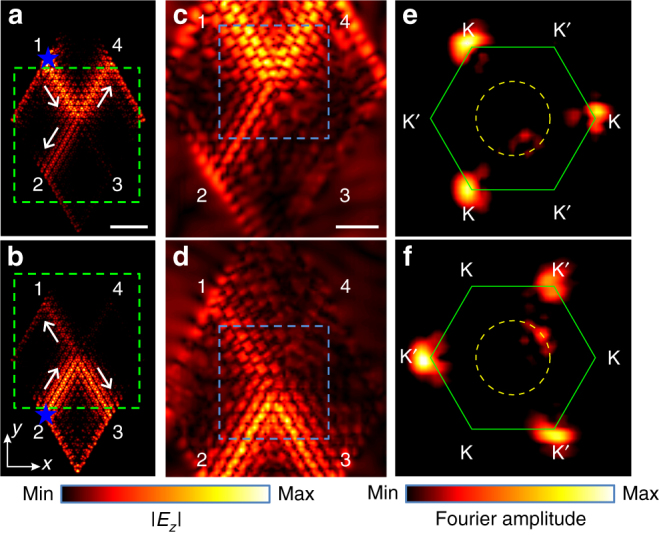
The extensive research of two-dimensional layered materials has revealed that valleys, as energy extrema in momentum space, could offer a new degree of freedom for carrying information. Based on this concept, researchers have predicted valley-Hall topological insulators that could support valley-polarized edge states at non-trivial domain walls. Recently, several kinds of photonic and sonic crystals have been proposed as classical counterparts of valley-Hall topological insulators. However, direct experimental observation of valley-polarized edge states in photonic crystals has remained difficult until now. Here, we demonstrate a designer surface plasmon crystal comprising metallic patterns deposited on a dielectric substrate, which can become a valley-Hall photonic topological insulator by exploiting the mirror-symmetry-breaking mechanism. Topological edge states with valley-dependent transport are directly visualized in the microwave regime. The observed edge states are confirmed to be fully valley-polarized through spatial Fourier transforms. Topological protection of the edge states at sharp corners is also experimentally demonstrated.
Overview
CoChat Summary
## TL;DR
The paper experimentally demonstrates valley-polarized topological edge states in a designer surface plasmon crystal operating in the microwave regime. By breaking mirror symmetry, the authors create a valley-Hall photonic topological insulator and directly visualize valley-dependent transport, including robust propagation through sharp corners.
## Key findings
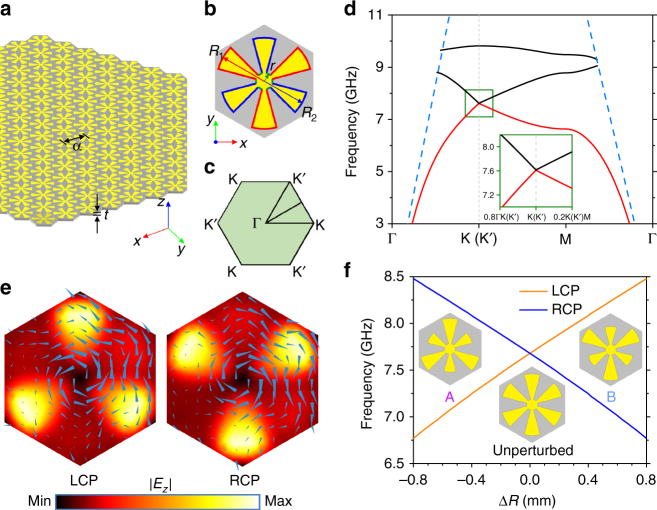
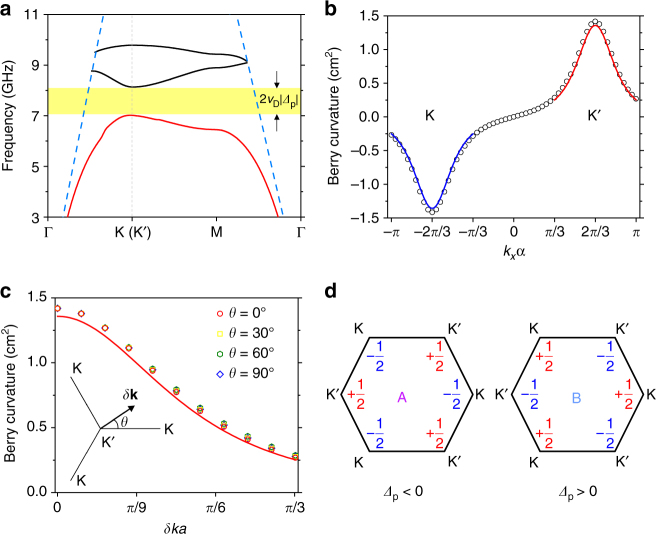
- In the unperturbed triangular-lattice DSP crystal, the first and second bands touch at the K and K′ valleys at the Dirac frequency of 2π × 7.61 GHz; breaking ΓK-mirror symmetry by setting ΔR = ±0.5 mm opens a full bandgap.
- The effective Hamiltonian fit gives v_D = 5.42 × 10^7 m s−1 and Δ_p = ±60.68 m−1 for patterns A and B, and the valley Chern numbers of the first band are ±1/2.
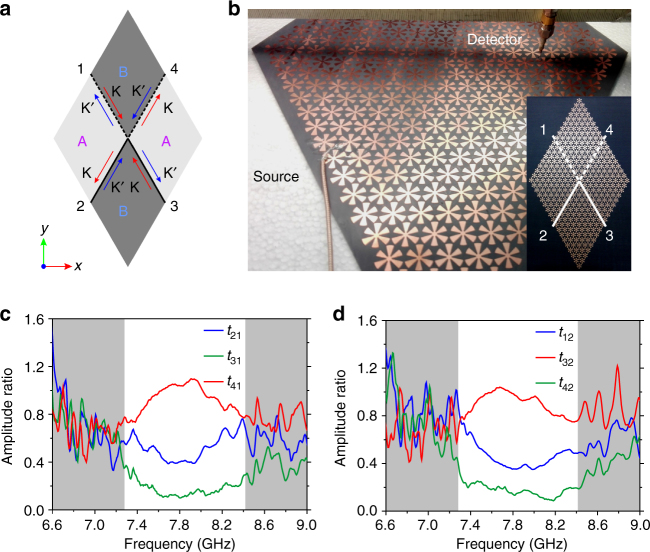
- In the beam-splitter experiment, transports involving opposite valleys are heavily suppressed; within the bandgap, the sum of measured amplitude ratios for same-valley transport is at least 14 dB larger than those involving opposite valleys.
- The measured bandgap of the fabricated sample is 7.28–8.42 GHz, compared with the simulated 7.05–8.12 GHz, a shift of about 3.7% toward higher frequency.
## Methods
- The study uses a triangular-lattice designer surface plasmon crystal on an F4B dielectric substrate (relative permittivity 2.65, thickness 1 mm) with a 35 μm copper layer; mirror-symmetry breaking is introduced by changing the radii R1 and R2.
- The authors analyze the system with an effective k·p Hamiltonian, compute Berry curvature and valley Chern numbers, and perform full-wave FEM simulations in COMSOL.
- Experiments use two monopole antennas, a vector network analyzer, and near-field scans of the Ez component; field maps are recorded 1 mm above the metallic surface with 1 × 1 mm² resolution.
## Limitations
- The paper states that the data supporting the figures and findings are available from the corresponding authors upon request; no public dataset is stated.
- The text makes evident that the work is demonstrated in the microwave regime on a specific DSP geometry, so direct experimental evidence is limited to that platform and frequency range (text-evident).
- The paper notes a 3.7% fabrication-induced frequency shift between measured and simulated bandgaps, indicating sensitivity to fabrication errors (text-evident).
Model-written summary. Check it against the paper before relying on it.
Integrity signals
Registry
Cites
Statistics
Figures
Verification
Claims the paper makes
14 Valid · 1 Not valid · 4 Not checked · 30 Own results and interpretations
Some cited sources support this claim and some don’t — read each source’s verdict below.
In the paper
“Here, we demonstrate a designer surface plasmon crystal comprising metallic patterns deposited on a dielectric substrate, which can become a valley-Hall photonic topological insulator by exploiting the mirror-symmetry-breaking mechanism.”
- Also stated in: § Theoretical modeling and numerical verifications · hedged
“These results indicate that when ΔR is nonzero, the proposed DSP crystal becomes a valley-Hall PTI because of the full bandgap and nontrivial valley Chern numbers16,19.”
§ Direct observation of valley-polarized topological edge states in designer surface plasmon crystals > Abstract
What the sources say
- Disputedcites [16] Ma T Shvets G All-Si valley-Hall photonic topological insulator New J. Phys. 2016 18 025012 10.1088/1367-2630/18/2/025012 sourceExperimental — accuracy not yet measured
Split into 2 atoms — 0 confirmed, 1 partially supported, 1 disputed, 0 misattributed, 0 unverifiable. Expand the claim to see per-atom verdicts.
Checked by a reasoning model — may be wrong.
- Partly supportedcites [19] Chen X-D Zhao F-L Chen M Dong J-W Valley-contrasting physics in all-dielectric photonic crystals: orbital angular momentum and topological propagation Phys. Rev. B 2017 96 020202 10.1103/PhysRevB.96.020202 sourceExperimental — accuracy not yet measured
Split into 2 atoms — 1 confirmed, 1 partially supported, 0 disputed, 0 misattributed, 0 unverifiable. Expand the claim to see per-atom verdicts.
plainstates a cause- Asserted: passes — The authors put it forward as true.
- Checkable: passes — It can be checked against evidence.
- Load-bearing: passes — The paper’s conclusions depend on it.
- Based: passes — The paper gives a reason why it holds.
- Also stated in: § Theoretical modeling and numerical verifications · hedged
The cited sources support only part of this claim — read each source’s verdict below.
In the paper
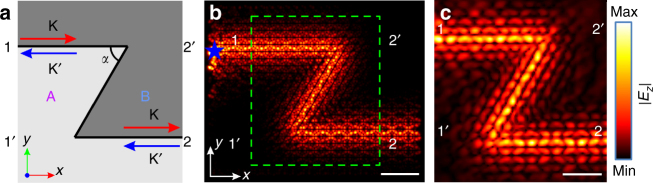
“According to previous theoretical studies, a random arrangement of the unit cells of valley-Hall PTIs only results in a higher-order perturbation O(Δ p 2) between the two circularly polarized states in K/K′ valley, which is usually much smaller than the first-order perturbation v D Δ p caused by breaking ΓK-mirror symmetry16.”
§ Direct observation of valley-polarized topological edge states in designer surface plasmon crystals > Results > Topological protection in a Z-shaped waveguide
What the sources say
- Partly supportedcites [16] Ma T Shvets G All-Si valley-Hall photonic topological insulator New J. Phys. 2016 18 025012 10.1088/1367-2630/18/2/025012 sourceExperimental — accuracy not yet measured
Split into 2 atoms — 0 confirmed, 2 partially supported, 0 disputed, 0 misattributed, 0 unverifiable. Expand the claim to see per-atom verdicts.
plainstates a cause- Asserted: passes — The authors put it forward as true.
- Checkable: passes — It can be checked against evidence.
- Load-bearing: passes — The paper’s conclusions depend on it.
- Based: passes — The paper gives a reason why it holds.
- Partly supported
Every source the paper cites for this claim was checked and supports it.
In the paper
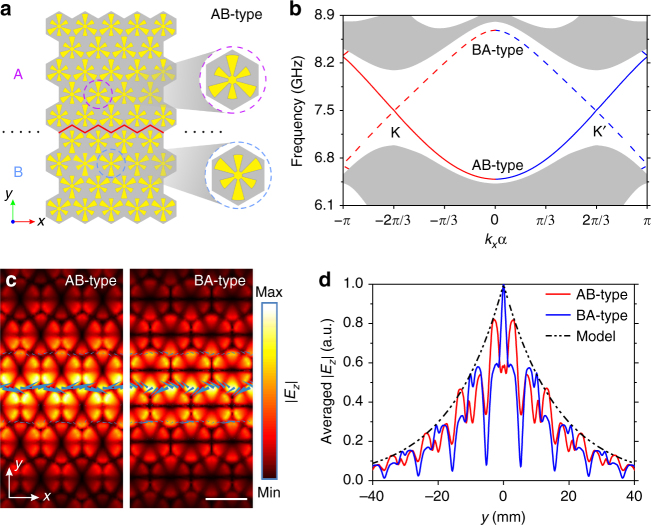
“As expected, gapped edge states are observed in the first bandgap for each domain wall, and they do not connect the first and second bands because time-reversal symmetry is preserved here19.”
§ Direct observation of valley-polarized topological edge states in designer surface plasmon crystals > Results > Bulk-boundary correspondence and valley-polarized topological edge states
What the sources say
- Supportedcites [19] Chen X-D Zhao F-L Chen M Dong J-W Valley-contrasting physics in all-dielectric photonic crystals: orbital angular momentum and topological propagation Phys. Rev. B 2017 96 020202 10.1103/PhysRevB.96.020202 source
The cited paper explains that its valley-dependent edge dispersions are gapped and do not connect the bulk bands because, unlike photonic quantum Hall edge states, they do not arise from broken time-reversal symmetry (p. 8). This supports the explanation attributed to the citation; the observations for each AB- and BA-type wall are presented as the citing authors’ own simulations. (LLM, conf=0.91)
plainstates a cause- Asserted: passes — The authors put it forward as true.
- Checkable: passes — It can be checked against evidence.
- Load-bearing: passes — The paper’s conclusions depend on it.
- Based: passes — The paper gives a reason why it holds.
- Rests on an assumption not shown here.
- Supported
The cited sources support only part of this claim — read each source’s verdict below.
In the paper
“We have also numerically investigated other geometric configurations in which the corner angle α of the topological waveguides varies, and no notable scattering losses are observed in all cases (See Supplementary Fig. 10 for simulated field maps.), even when the corner becomes incompatible with the triangular lattice (α = 30°, 90°, 150°)20.”
§ Direct observation of valley-polarized topological edge states in designer surface plasmon crystals > Results > Topological protection in a Z-shaped waveguide
What the sources say
- Partly supportedcites [20] Lu J Observation of topological valley transport of sound in sonic crystals Nat. Phys. 2016 13 369 374 10.1038/nphys3999 sourceExperimental — accuracy not yet measured
The passage discussing Fig. 4a reports negligible reflection for a zigzag waveguide with two 120° corners, and the Fig. 4 caption describes small bending losses. The copy does not report results for 30°, 90°, or 150° corners, including corners incompatible with the triangular lattice; those specific results are presented in the citing sentence as the citing authors’ own simulations. (LLM, conf=0.86)
plain- Asserted: passes — The authors put it forward as true.
- Checkable: passes — It can be checked against evidence.
- Load-bearing: passes — The paper’s conclusions depend on it.
- Based: passes — The paper gives a reason why it holds.
- Partly supported
Every source the paper cites for this claim was checked and supports it.
In the paper
“Since the underlying mechanism is independent of specific waves, this suppression of scattering losses are also observed for acoustic waves in the topological waveguides made from a valley-Hall STI where the topological bandgap is similarly introduced by breaking the ΓK-mirror symmetry of the unit cell20.”
§ Direct observation of valley-polarized topological edge states in designer surface plasmon crystals > Results > Topological protection in a Z-shaped waveguide
What the sources say
- Supportedcites [20] Lu J Observation of topological valley transport of sound in sonic crystals Nat. Phys. 2016 13 369 374 10.1038/nphys3999 source
Split into 2 atoms — 2 confirmed, 0 partially supported, 0 disputed, 0 misattributed, 0 unverifiable. Expand the claim to see per-atom verdicts.
plainstates a cause- Asserted: passes — The authors put it forward as true.
- Checkable: passes — It can be checked against evidence.
- Load-bearing: unclear — It is unclear whether the paper’s conclusions depend on it.
- Based: passes — The paper gives a reason why it holds.
- Supported
14 more claims · 3 with their cited sources checked
Create a free account to see all 49 claims and to verify the 4 references still open.
- It may state two separate claims as one. 27
- Probably not a substantial claim. 4
- The quote only partly states this claim. 1
Claims other papers make about this one
Each is checked against this paper’s own text: does it say what the citing paper says it does?
The cited source says what the claim attributes to it.
In the citing paper
“Photonic valley systems can be implemented at telecommunication and terahertz wavelengths on a silicon platform [65,66], at subwavelength scales on plasmonic platforms [61,67,68], and they can be used for the development of topological lasers [69-72], which opens the possibilities for many applications.”
From Anyons, Zitterbewegung and dynamical phase transitions in topologically nontrivial systems (2022) · cites this paper as [61]
The cited source says what the claim attributes to it.
In the citing paper
“However, the understanding and development of optical spinorbit interactions [56], photonic pseudospins [57], and valley degrees of freedom[58-65] have offered us new knobs that can be used for manipulation of light in photonic structures, in analogy with parallel advances in electric systems.”
From Anyons, Zitterbewegung and dynamical phase transitions in topologically nontrivial systems (2022) · cites this paper as [61]
Citations
Cites
Mimicking Surface Plasmons with Structured Surfaces
Pendry, J. B., Martín-Moreno, L., & Garcia-Vidal, F. J. (2004) · Science · doi:10.1126/science.1098999 · Cited by 3,276
Observation of unidirectional backscattering-immune topological electromagnetic states
Wang, Z., Chong, Y., Joannopoulos, J. D., & Soljačić, M. (2009) · Nature · doi:10.1038/nature08293 · Cited by 3,123
Emerging Device Applications for Semiconducting Two-Dimensional Transition Metal Dichalcogenides
Jariwala, D., Sangwan, V. K., Lauhon, L. J., Marks, T. J., & Hersam, M. C. (2014) · ACS Nano · doi:10.1021/nn500064s · Cited by 2,753
Schaibley, J. R., Yu, H., Clark, G., Rivera, P., Ross, J. S., Seyler, K. L., Yao, W., & Xu, X. (2016) · Nature Reviews Materials · doi:10.1038/natrevmats.2016.55 · Cited by 2,652
Valley-Contrasting Physics in Graphene: Magnetic Moment and Topological Transport
Xiao, D., Yao, W., & Niu, Q. (2007) · Physical Review Letters · doi:10.1103/physrevlett.99.236809 · Cited by 2,296 · cited 3×
“n of Δp solely determines the frequency order of the LCP and RCP states in the band structure, and their frequency order determines the topological phase of the DSP crystal. The calculation using Eq. (3) is straightforward since Δ p is negative for pattern A and hence positive for pattern B. The calculated valleyChern…”
BackgroundInfluentialThe valley Hall effect in MoS 2 transistors
Mak, K. F., McGill, K. L., Park, J., & McEuen, P. L. (2014) · Science · doi:10.1126/science.1250140 · Cited by 1,915
Imaging topological edge states in silicon photonics
Hafezi, M., Mittal, S., Fan, J., Migdall, A., & Taylor, J. M. (2013) · Nature Photonics · doi:10.1038/nphoton.2013.274 · Cited by 1,715
Valley filter and valley valve in graphene
Rycerz, A., Tworzydło, J., & Beenakker, C. W. J. (2007) · Nature Physics · doi:10.1038/nphys547 · Cited by 1,695
Scheme for Achieving a Topological Photonic Crystal by Using Dielectric Material
Wu, L.-H., & Hu, X. (2015) · Physical Review Letters · doi:10.1103/physrevlett.114.223901 · Cited by 1,648
Robust optical delay lines with topological protection
Hafezi, M., Demler, E. A., Lukin, M. D., & Taylor, J. M. (2011) · Nature Physics · doi:10.1038/nphys2063 · Cited by 1,466
Cited by
Ozawa, T., Price, H. M., Amo, A., Goldman, N., Hafezi, M., Lu, L., Rechtsman, M. C., Schuster, D., Simon, J., Zilberberg, O., et al. (2019) · Reviews of Modern Physics · doi:10.1103/revmodphys.91.015006 · Cited by 3,722
“…fact that valley Hall edge states are not robust against arbitrary spatial disorder at the interface, they can be used to route photons in photonic structures (X. Wu et al., 2017; Noh, Huang, Chen, and Rechtsman, 2018) and to design delay cavities in Si photonics technologies (Ma and Shvets, 2016).”
BackgroundTerahertz topological photonics for on-chip communication
Yang, Y., Yamagami, Y., Yu, X., Pitchappa, P., Webber, J., Zhang, B., Fujita, M., Nagatsuma, T., & Singh, R. (2020) · Nature Photonics · doi:10.1038/s41566-020-0618-9 · Cited by 842
A silicon-on-insulator slab for topological valley transport
He, X.-T., Liang, E.-T., Yuan, J.-J., Qiu, H.-Y., Chen, X.-D., Zhao, F.-L., & Dong, J.-W. (2019) · Nature Communications · doi:10.1038/s41467-019-08881-z · Cited by 631
Robust topologically protected transport in photonic crystals at telecommunication wavelengths
Shalaev, M. I., Walasik, W., Tsukernik, A., Xu, Y., & Litchinitser, N. M. (2019) · Nature Nanotechnology · doi:10.1038/s41565-018-0297-6 · Cited by 624
Electrically pumped topological laser with valley edge modes
Zeng, Y., Chattopadhyay, U., Zhu, B., Qiang, B., Li, J., Jin, Y., Li, L., Davies, A. G., Linfield, E. H., Zhang, B., et al. (2020) · Nature · doi:10.1038/s41586-020-1981-x · Cited by 603
Topologically protected refraction of robust kink states in valley photonic crystals
Gao, F., Xue, H., Yang, Z., Lai, K., Yu, Y., Lin, X., Chong, Y., Shvets, G., & Zhang, B. (2018) · Nature Physics · doi:10.1038/nphys4304 · Cited by 576
Yang, Y., Xu, Y. F., Xu, T., Wang, H.-X., Jiang, J.-H., Hu, X., & Hang, Z. H. (2018) · Physical Review Letters · doi:10.1103/physrevlett.120.217401 · Cited by 493
Recent advances in 2D, 3D and higher-order topological photonics
Kim, M., Jacob, Z., & Rho, J. (2020) · Light: Science & Applications · doi:10.1038/s41377-020-0331-y · Cited by 470
Xue, H., Yang, Y., & Zhang, B. (2022) · Nature Reviews Materials · doi:10.1038/s41578-022-00465-6 · Cited by 450
On-chip valley topological materials for elastic wave manipulation
Yan, M., Lu, J., Li, F., Deng, W., Huang, X., Ma, J., & Liu, Z. (2018) · Nature Materials · doi:10.1038/s41563-018-0191-5 · Cited by 443
Observation of Photonic Topological Valley Hall Edge States
Noh, J., Huang, S., Chen, K. P., & Rechtsman, M. C. (2018) · Physical Review Letters · doi:10.1103/physrevlett.120.063902 · Cited by 437
Zhang, X., Xiao, M., Cheng, Y., Lu, M.-H., & Christensen, J. (2018) · Communications Physics · doi:10.1038/s42005-018-0094-4 · Cited by 357
Experimental Demonstration of Acoustic Chern Insulators
Ding, Y., Peng, Y., Zhu, Y., Fan, X., Yang, J., Liang, B., Zhu, X., Wan, X., & Cheng, J. (2019) · Physical Review Letters · doi:10.1103/physrevlett.122.014302 · Cited by 346
Topological Photonic Crystals: Physics, Designs, and Applications
Tang, G., He, X., Shi, F., Liu, J., Chen, X., & Dong, J. (2022) · Laser & Photonics Reviews · doi:10.1002/lpor.202100300 · Cited by 340
Directional Acoustic Antennas Based on Valley‐Hall Topological Insulators
Zhang, Z., Tian, Y., Wang, Y., Gao, S., Cheng, Y., Liu, X., & Christensen, J. (2018) · Advanced Materials · doi:10.1002/adma.201803229 · Cited by 300
Valley Topological Phases in Bilayer Sonic Crystals
Lu, J., Qiu, C., Deng, W., Huang, X., Li, F., Zhang, F., Chen, S., & Liu, Z. (2018) · Physical Review Letters · doi:10.1103/physrevlett.120.116802 · Cited by 258
Valley-locked waveguide transport in acoustic heterostructures
Wang, M., Zhou, W., Bi, L., Qiu, C., Ke, M., & Liu, Z. (2020) · Nature Communications · doi:10.1038/s41467-020-16843-z · Cited by 195
Topological Insulator Laser Using Valley-Hall Photonic Crystals
Gong, Y., Wong, S., Bennett, A. J., Huffaker, D. L., & Oh, S. S. (2020) · ACS Photonics · doi:10.1021/acsphotonics.0c00521 · Cited by 191
Pseudo-spin–valley coupled edge states in a photonic topological insulator
Kang, Y., Ni, X., Cheng, X., Khanikaev, A. B., & Genack, A. Z. (2018) · Nature Communications · doi:10.1038/s41467-018-05408-w · Cited by 184
Topological Valley Photonics: Physics and Device Applications
Xue, H., Yang, Y., & Zhang, B. (2021) · Advanced Photonics Research · doi:10.1002/adpr.202100013 · Cited by 167
Pseudo-spin–valley coupled edge states in a photonic topological insulator
Kang, Y., Ni, X., Cheng, X., Khanikaev, A. B., & Genack, A. Z. (2018) · RePEc: Research Papers in Economics · Cited by 163
Slow light waveguides in topological valley photonic crystals
Yoshimi, H., Yamaguchi, T., Ota, Y., Arakawa, Y., & Iwamoto, S. (2020) · Optics Letters · doi:10.1364/ol.391764 · Cited by 165
Reprogrammable plasmonic topological insulators with ultrafast control
You, J. W., Ma, Q., Lan, Z., Xiao, Q., Panoiu, N. C., & Cui, T. J. (2021) · Nature Communications · doi:10.1038/s41467-021-25835-6 · Cited by 165
Ni, X., Yves, S., Krasnok, A., & Alù, A. (2023) · Chemical Reviews · doi:10.1021/acs.chemrev.2c00800 · Cited by 191
Spoof Plasmonics: From Metamaterial Concept to Topological Description
Gao, Z., Wu, L., Gao, F., Luo, Y., & Zhang, B. (2018) · Advanced Materials · doi:10.1002/adma.201706683 · Cited by 157
Photonic Topological Valley-Locked Waveguides
Chen, Q., Zhang, L., Chen, F., Yan, Q., Xi, R., Chen, H., & Yang, Y. (2021) · ACS Photonics · doi:10.1021/acsphotonics.1c00029 · Cited by 152
A brief review of topological photonics in one, two, and three dimensions
Lan, Z., Chen, M. L. N., Gao, F., Zhang, S., & Sha, W. E. I. (2022) · Reviews in Physics · doi:10.1016/j.revip.2022.100076 · Cited by 160
Topological Photonic Integrated Circuits Based on Valley Kink States
Ma, J., Xi, X., & Sun, X. (2019) · Laser & Photonics Review · doi:10.1002/lpor.201900087 · Cited by 154
Topological sensor on a silicon chip
Kumar, A., Gupta, M., Pitchappa, P., Tan, Y. J., Wang, N., & Singh, R. (2022) · Applied Physics Letters · doi:10.1063/5.0097129 · Cited by 140
Lasing at topological edge states in a photonic crystal L3 nanocavity dimer array
Han, C., Lee, M., Callard, S., Seassal, C., & Jeon, H. (2019) · Light: Science & Applications · doi:10.1038/s41377-019-0149-7 · Cited by 128
A perspective on topological nanophotonics: Current status and future challenges
Rider, M. S., Palmer, S. J., Pocock, S. R., Xiao, X., Huidobro, P. A., & Giannini, V. (2019) · Journal of Applied Physics · doi:10.1063/1.5086433 · Cited by 134
Topological phononic metamaterials
Zhu, W., Deng, W., Liu, Y., Lu, J., Wang, H., Lin, Z., Huang, X., Jiang, J., & Liu, Z. (2023) · Reports on Progress in Physics · doi:10.1088/1361-6633/aceeee · Cited by 156
Experimental observation of photonic nodal line degeneracies in metacrystals
Gao, W., Yang, B., Tremain, B., Liu, H., Guo, Q., Xia, L., Hibbins, A. P., & Zhang, S. (2018) · Nature Communications · doi:10.1038/s41467-018-03407-5 · Cited by 117
Room-temperature lasing from nanophotonic topological cavities
Smirnova, D., Tripathi, A., Kruk, S., Hwang, M.-S., Kim, H.-R., Park, H.-G., & Kivshar, Y. (2020) · Light: Science & Applications · doi:10.1038/s41377-020-00350-3 · Cited by 113
Valley Kink States and Topological Channel Intersections in Substrate‐Integrated Photonic Circuitry
Zhang, L., Yang, Y., He, M., Wang, H., Yang, Z., Li, E., Gao, F., Zhang, B., Singh, R., Jiang, J., et al. (2019) · Laser & Photonics Review · doi:10.1002/lpor.201900159 · Cited by 131
Photonic crystal for graphene plasmons
Xiong, L., Forsythe, C., Jung, M., McLeod, A. S., Sunku, S., Shao, Y. M., Ni, G. X., Sternbach, A. J., Liu, S., Edgar, J. H., et al. (2019) · Nature Communications · doi:10.1038/s41467-019-12778-2 · Cited by 125
Topological photonic crystals: a review
Wang, H., Gupta, S. K., Xie, B., & Lu, M. (2020) · Frontiers of Optoelectronics · doi:10.1007/s12200-019-0949-7 · Cited by 109
Observation of Protected Photonic Edge States Induced by Real-Space Topological Lattice Defects
Wang, Q., Xue, H., Zhang, B., & Chong, Y. D. (2020) · Physical Review Letters · doi:10.1103/physrevlett.124.243602 · Cited by 110
Electromagnetic‐Dual Metasurfaces for Topological States along a 1D Interface
Bisharat, D. J., & Sievenpiper, D. F. (2019) · Laser & Photonics Review · doi:10.1002/lpor.201900126 · Cited by 108
Valley‐Hall Photonic Topological Insulators with Dual‐Band Kink States
Chen, Q., Zhang, L., He, M., Wang, Z., Lin, X., Gao, F., Yang, Y., Zhang, B., & Chen, H. (2019) · Advanced Optical Materials · doi:10.1002/adom.201900036 · Cited by 99
Topological Valley Transport in Two-dimensional Honeycomb Photonic Crystals
Yang, Y., Jiang, H. W., & Hang, Z. H. (2018) · Scientific Reports · doi:10.1038/s41598-018-20001-3 · Cited by 98
Iwamoto, S., Ota, Y., & Arakawa, Y. (2021) · Optical Materials Express · doi:10.1364/ome.415128 · Cited by 104
Valley-conserved topological integrated antenna for 100-Gbps THz 6G wireless
Jia, R., Kumar, S., Tan, T. C., Kumar, A., Tan, Y. J., Gupta, M., Szriftgiser, P., Alphones, A., Ducournau, G., & Singh, R. (2023) · Science Advances · doi:10.1126/sciadv.adi8500 · Cited by 109
Topological metasurface: from passive toward active and beyond
You, J. W., Lan, Z., Ma, Q., Gao, Z. L., Yang, Y., Gao, F., Xiao, M., & Cui, T. J. (2023) · Photonics Research · doi:10.1364/prj.471905 · Cited by 100
Lasing at Multidimensional Topological States in a Two-Dimensional Photonic Crystal Structure
Han, C., Kang, M., & Jeon, H. (2020) · ACS Photonics · doi:10.1021/acsphotonics.0c00357 · Cited by 85
Liu, J., Shi, F., He, X., Tang, G., Chen, W.-J., Chen, X., & Dong, J. (2021) · Advances in Physics X · doi:10.1080/23746149.2021.1905546 · Cited by 109
Topological beam-splitting in photonic crystals
Makwana, M. P., Craster, R. V., & Guenneau, S. R. L. (2019) · Optics Express · doi:10.1364/oe.27.016088 · Cited by 80
Information metasurfaces and intelligent metasurfaces
Ma, Q., Liu, C., Xiao, Q., Gu, Z., Gao, X., Li, L., & Cui, T. J. (2022) · Photonics Insights · doi:10.3788/pi.2022.r01 · Cited by 86
Recent advances in topological elastic metamaterials
Huang, H., Chen, J., & Huo, S.-Y. (2021) · Journal of Physics Condensed Matter · doi:10.1088/1361-648x/ac27d8 · Cited by 85
Electromagnetic Metamaterials: From Classical to Quantum
You, J. W., Ma, Q., Zhang, L., Liu, C., Zhang, J., Liu, S., & Cui, T. J. (2023) · Electromagnetic Science · doi:10.23919/emsci.2022.0005 · Cited by 84
Asymmetric Topological Valley Edge States on Silicon‐On‐Insulator Platform
Wang, H., Sun, L., He, Y., Tang, G., An, S., Wang, Z., Du, Y., Zhang, Y., Yuan, L., He, X., et al. (2022) · Laser & Photonics Review · doi:10.1002/lpor.202100631 · Cited by 77
Terahertz Band Communications With Topological Valley Photonic Crystal Waveguide
Webber, J. L., Yamagami, Y., Ducournau, G., Szriftgiser, P., Iyoda, K., Fujita, M., Nagatsuma, T., & Singh, R. (2021) · Journal of Lightwave Technology · doi:10.1109/jlt.2021.3107682 · Cited by 83
Nonlinear topological valley Hall edge states arising from type-II Dirac cones
Zhong, H., Xia, S., Zhang, Y., Li, Y., Song, D., Liu, C., & Chen, Z. (2021) · Advanced Photonics · doi:10.1117/1.ap.3.5.056001 · Cited by 75
Designing multidirectional energy splitters and topological valley supernetworks
Makwana, M. P., & Craster, R. V. (2018) · Physical review. B./Physical review. B · doi:10.1103/physrevb.98.235125 · Cited by 68
Midinfrared Plasmonic Valleytronics in Metagate-Tuned Graphene
Jung, M., Fan, Z., & Shvets, G. (2018) · Physical Review Letters · doi:10.1103/physrevlett.121.086807 · Cited by 65
Frequency range dependent topological phases and photonic detouring in valley photonic crystals
Tang, G., Chen, X., Shi, F., Liu, J., Chen, M., & Dong, J. (2020) · Physical review. B./Physical review. B · doi:10.1103/physrevb.102.174202 · Cited by 66
Terahertz topological photonic waveguide switch for on-chip communication
Liu, X., Huang, J., Chen, H., Qian, Z., Ma, J., Sun, X., Fan, S., & Sun, Y. (2022) · Photonics Research · doi:10.1364/prj.451344 · Cited by 67
Pseudomagnetic Fields Enabled Manipulation of On-Chip Elastic Waves
Yan, M., Deng, W., Huang, X., Wu, Y., Yang, Y., Lu, J., Li, F., & Liu, Z. (2021) · Physical Review Letters · doi:10.1103/physrevlett.127.136401 · Cited by 72
Cheng, S.-G., Liu, H., Jiang, H. W., Sun, Q., & Xie, X. C. (2018) · Physical Review Letters · doi:10.1103/physrevlett.121.156801 · Cited by 64
Kim, K., & Om, K. (2021) · Advanced Optical Materials · doi:10.1002/adom.202001865 · Cited by 61
On-chip topological nanophotonic devices
Lu, C., Yuan, H., Zhang, H., Zhao, W. D., Zhang, N., Zheng, Y., Elshahat, S., & Liu, Y. (2022) · Chip · doi:10.1016/j.chip.2022.100025 · Cited by 66
Observation of valley-selective microwave transport in photonic crystals
Ye, L., Yang, Y., Hang, Z. H., Qiu, C., & Liu, Z. (2017) · Applied Physics Letters · doi:10.1063/1.5009597 · Cited by 60
Quantum valley Hall effects and spin-valley locking in topological Kane-Mele circuit networks
Zhu, W., Long, Y., Chen, H., & Ren, J. (2019) · Physical review. B./Physical review. B · doi:10.1103/physrevb.99.115410 · Cited by 57
Topological Corner Modes Induced by Dirac Vortices in Arbitrary Geometry
Wu, X., Meng, Y., Hao, Y., Zhang, R.-Y., Li, J., & Zhang, X. (2021) · Physical Review Letters · doi:10.1103/physrevlett.126.226802 · Cited by 60
Self-citationTopological Valley Hall Edge State Lasing
Zhong, H., Li, Y., Song, D., Kartashov, Y. V., Zhang, Y., Zhang, Y., & Chen, Z. (2020) · Laser & Photonics Review · doi:10.1002/lpor.202000001 · Cited by 72
Guo, Y., Zhang, Z., Pu, M., Huang, Y., Li, X., Ma, X., Xu, M., & Luo, X. (2019) · iScience · doi:10.1016/j.isci.2019.10.019 · Cited by 56
Self-citationA perspective on topological nanophotonics: Current status and future challenges
Rider, M. S., Palmer, S. J., Pocock, S. R., Xiao, X., Arroyo Huidobro, P., & Giannini, V. (2019) · LA Referencia (Red Federada de Repositorios Institucionales de Publicaciones Científicas) · Cited by 54
Reconfigurable topological states in valley photonic crystals
Wu, Y. L., Hu, X., & Gong, Q. (2018) · Physical Review Materials · doi:10.1103/physrevmaterials.2.122201 · Cited by 53
Critical couplings in topological-insulator waveguide-resonator systems observed in elastic waves
Yu, S.-Y., He, C., Sun, X.-C., Wang, H.-F., Wang, J.-Q., Zhang, Z.-D., Xie, B.-Y., Tian, Y., Lu, M.-H., & Chen, Y.-F. (2020) · National Science Review · doi:10.1093/nsr/nwaa262 · Cited by 57
Topological valley-chiral edge states of Lamb waves in elastic thin plates
Wang, J., & Mei, J. (2018) · Applied Physics Express · doi:10.7567/apex.11.057302 · Cited by 60
Plasmon-polaritonic quadrupole topological insulators
Chen, Y., Lin, Z., Chen, H., & Jiang, J. (2020) · Physical review. B./Physical review. B · doi:10.1103/physrevb.101.041109 · Cited by 53
Topologically protected edge states of phoxonic crystals
Xia, B., Fan, H., & Liu, T. (2019) · International Journal of Mechanical Sciences · doi:10.1016/j.ijmecsci.2019.02.037 · Cited by 49
Momentum-space imaging spectroscopy for the study of nanophotonic materials
Zhang, Y., Zhao, M., Wang, J., Liu, W., Wang, B., Hu, S., Lu, G., Chen, A., Cui, J. B., Zhang, W., et al. (2020) · 中国科学通报:英文版 · doi:10.1016/j.scib.2020.12.013 · Cited by 50
Zhao, S., Tian, Z., Shen, C., Yang, S., Xia, J., Li, T., Xie, Z., Zhang, P., Lee, L. P., Cummer, S. A., et al. (2025) · Nature Materials · doi:10.1038/s41563-025-02169-y · Cited by 67
Wei, G., Liu, Z., Wang, L., Song, J., & Xiao, J. (2022) · Photonics Research · doi:10.1364/prj.453803 · Cited by 50
Kang‐Hyok, O., & Kim, K. (2021) · Optics & Laser Technology · doi:10.1016/j.optlastec.2021.107616 · Cited by 56
Observation of Dirac Hierarchy in Three-Dimensional Acoustic Topological Insulators
Yang, L., Wang, Y., Meng, Y., Zhu, Z., Xi, X., Yan, B., Lin, S., Chen, J., Shi, B.-J., Ge, Y., et al. (2022) · Physical Review Letters · doi:10.1103/physrevlett.129.125502 · Cited by 51
Self-citationType-II Dirac Photons at Metasurfaces
Hu, C., Li, Z., Tong, R., Wu, X., Xia, Z., Wang, L., Li, S., Huang, Y., Wang, S., Hou, B., et al. (2018) · Physical Review Letters · doi:10.1103/physrevlett.121.024301 · Cited by 57
Self-citationFrequency dependent wave routing based on dual-band valley-Hall topological photonic crystal
Wei, G., Liu, Z., Zhang, D., & Xiao, J. (2021) · New Journal of Physics · doi:10.1088/1367-2630/abe335 · Cited by 52
Ideal nodal rings of one-dimensional photonic crystals in the visible region
Deng, W., Chen, Z.-M., Li, M.-Y., Guo, C.-H., Tian, Z.-T., Sun, K.-X., Chen, X., Chen, W.-J., & Dong, J. (2022) · Light Science & Applications · doi:10.1038/s41377-022-00821-9 · Cited by 53
Yan, B., Peng, Y., Xie, J., Peng, Y., Shi, A., Li, H., Gao, F., Peng, P., Jiang, J., Liu, J., et al. (2024) · Laser & Photonics Review · doi:10.1002/lpor.202300686 · Cited by 49
From topologically protected coherent perfect reflection to bound states in the continuum
Dai, S., Liu, L., Han, D., & Zi, J. (2018) · Physical review. B./Physical review. B · doi:10.1103/physrevb.98.081405 · Cited by 45
Self-citationTunable topological valley transport in two-dimensional photonic crystals
Wang, Y., Zhang, W., & Zhang, X. (2019) · New Journal of Physics · doi:10.1088/1367-2630/ab3ca3 · Cited by 42
Valley Hall elastic topological insulator with large Chern numbers
Chen, Y., Liu, D., Wu, Y., Yu, P., & Liu, Y. (2022) · International Journal of Mechanical Sciences · doi:10.1016/j.ijmecsci.2022.107884 · Cited by 41
Observation of boundary induced chiral anomaly bulk states and their transport properties
Wang, M., Ma, Q., Liu, S., Zhang, R.-Y., Zhang, L., Ke, M., Liu, Z., & Chan, C. T. (2022) · Nature Communications · doi:10.1038/s41467-022-33447-x · Cited by 51
Plasmonic Modulation of Valleytronic Emission in Two‐Dimensional Transition Metal Dichalcogenides
Deng, M., Wang, X., Chen, J., Li, Z., Xue, M., Zhou, Z., Lin, F., Zhu, X. L., & Fang, Z. (2021) · Advanced Functional Materials · doi:10.1002/adfm.202010234 · Cited by 42
Xu, G., & Skorobogatiy, M. A. (2022) · Journal of Infrared Millimeter and Terahertz Waves · doi:10.1007/s10762-022-00879-x · Cited by 45
Tracking Valley Topology with Synthetic Weyl Paths
Fan, X., Xia, T., Qiu, H., Zhang, Q., & Qiu, C. (2022) · Physical Review Letters · doi:10.1103/physrevlett.128.216403 · Cited by 42
Topological refraction in dual-band valley sonic crystals
Jia, D., Ge, Y., Xue, H., Yuan, S.-Q., Sun, H.-X., Yang, Y., Liu, X., & Zhang, B. (2021) · Physical review. B./Physical review. B · doi:10.1103/physrevb.103.144309 · Cited by 44
Underwater acoustic positioning based on valley-chirality locked beam of sonic system
Zheng, S., Duan, G., & Xia, B. (2020) · International Journal of Mechanical Sciences · doi:10.1016/j.ijmecsci.2020.105463 · Cited by 43
Tunable topological edge and corner states in an all-dielectric photonic crystal
Zhao, Y., Liang, F., Han, J., Wang, X., Zhao, D., & Wang, B. (2022) · Optics Express · doi:10.1364/oe.465461 · Cited by 42
Deep subwavelength control of valley polarized cathodoluminescence in h-BN/WSe2/h-BN heterostructure
Zheng, L., Liu, Z., Liu, D., Wang, X., Li, Y., Jiang, M., Lin, F., Zhang, H., Shen, B., Zhu, X. L., et al. (2021) · Nature Communications · doi:10.1038/s41467-020-20545-x · Cited by 39
Mei, J., Wang, J., Zhang, X., Yu, S., Wang, Z., & Lu, M. (2019) · Physical Review Applied · doi:10.1103/physrevapplied.12.054041 · Cited by 40
Wu, X., Li, X., Zhang, R.-Y., Xiao, X. H., Tian, J., Huang, Y., Wang, S., Hou, B., Chan, C. T., & Wen, W. (2020) · Physical Review Letters · doi:10.1103/physrevlett.124.075501 · Cited by 41
Self-citationManipulating topological valley modes in plasmonic metasurfaces
Proctor, M., Huidobro, P. A., Maier, S. A., Craster, R. V., & Makwana, M. P. (2020) · Nanophotonics · doi:10.1515/nanoph-2019-0408 · Cited by 37
“The existing literature in plasmonics on topological valley effects solely considers one of the three distinct interfaces that are possible [32, 33], specifically type I case, as shown in Table 1.”
BackgroundInfluentialLiu, Y., Wang, H., Fang, W., Han, Q., Liu, D., & Liang, Y. (2021) · Composite Structures · doi:10.1016/j.compstruct.2021.114541 · Cited by 36
Zak phase and topological plasmonic Tamm states in one-dimensional plasmonic crystals
Wang, L., Cai, W., Bie, M., Zhang, X., & Xu, J. (2018) · Optics Express · doi:10.1364/oe.26.028963 · Cited by 37
Planar Optical Cavities Hybridized with Low‐Dimensional Light‐Emitting Materials
Jang, J., Jeong, M., Lee, J., Kim, S., Yun, H., & Rho, J. (2022) · Advanced Materials · doi:10.1002/adma.202203889 · Cited by 40
Topologically protected edge states for out-of-plane and in-plane bulk elastic waves
Huo, S.-Y., Chen, J., & Huang, H. (2018) · Journal of Physics Condensed Matter · doi:10.1088/1361-648x/aab22a · Cited by 36
Topological slow light via coupling chiral edge modes with flatbands
Yu, L., Xue, H., & Zhang, B. (2021) · Applied Physics Letters · doi:10.1063/5.0039839 · Cited by 39
Metadata
- Authors
- Wu, X., Meng, Y., Tian, J., Huang, Y., Xiang, H., Han, D., & Wen, W.
- Affiliations
- Chongqing University (CN)
- University of Hong Kong (HK)
- Corresponding author
- Han, Dezhuan
- Wen, Weijia
- Venue
- Nature Communications
- Published
- 2017-11-03
- Volume
- 8
- Issue
- 1
- Pages
- 1304-1304
- ISSN
- 2041-1723 (ISSN-L)
- PMC
- PMC5670222
- OpenAlex
- W2600702133
- Cited by
- 449
- References
- 52
- Citations by year
- 2026: 35 · 2025: 61 · 2024: 73 · 2023: 55 · 2022: 58 · 2021: 50 · 2020: 39 · 2019: 43 · 2018: 33 · 2017: 2
- FWCI
- 15.69
- Type
- journal article
- Language
- en
- Open access
- gold
- doi.org
- Licence
- cc-by
- creativecommons.org/licenses/by/4.0 (tdm)
- creativecommons.org/licenses/by/4.0 (vor)
- Locations
- Nature Communications (publishedVersion, cc-by)
- PubMed Central (publishedVersion, cc-by)
- PubMed (publishedVersion)
- arXiv (Cornell University) (submittedVersion)
- DOAJ (DOAJ: Directory of Open Access Journals) (submittedVersion)
- DOAJ (DOAJ: Directory of Open Access Journals) (submittedVersion, cc-by-sa)
- Rare & Special e-Zone (The Hong Kong University of Science and Technology) (submittedVersion)
- arXiv (Cornell University)
- Funders
- National Natural Science Foundation of China (91630205, 11574037)
- Special Fund for Agro-scientific Research in the Public Interest (201303045)
- Topics
- Physical Sciences › Physics and Astronomy › Condensed Matter Physics › Topological Materials and Phenomena
- Physical Sciences › Physics and Astronomy › Atomic and Molecular Physics, and Optics › Plasmonic and Surface Plasmon Research
- Physical Sciences › Physics and Astronomy › Acoustics and Ultrasonics › Acoustic Wave Phenomena Research
- Keywords
- photonic topological insulators, valley-dependent transport, mirror symmetry breaking, microwave photonics, topological protection, domain walls
About these checks
Registry, retraction, Cites and statistics results are computed, not judged, with one exception: a printed reference that no index lists is read once by a model before it counts as a citation error. Claims are extracted by a model and kept only when their quote appears verbatim in the text; each cited source is then checked, with a model’s help, for whether it says what the claim relies on. Those verdicts can be wrong — read the claim’s quote and the cited source before relying on one.
The claim verdicts this report counts are experimental: their accuracy is not yet measured.
A language model drew the claims from the paper on 2026-10-10, under version 3 of the claim definition (model deepseek-v4.1-flash, prompt extract-v3).
A second model labelled each claim on 2026-10-10 (model jev-1.13-20260917, definition revision gold-guideline-v0.2).
Cited sources are checked with a language model’s help (gpt-6-sol).
Statistics and arithmetic are recomputed, not judged.
Confidence bands are shown only for fields calibrated on our annotated test set. None is calibrated yet, so no band is shown.
What counts as a claim ›How we measure confidence ›How we check this ›
Are you an author, or do you see a problem with this page? Request a review
Data sources
Bibliographic data: Semantic Scholar, OpenAlex, Crossref.
Contains information from the Semantic Scholar Academic Graph Datasets, made available under the ODC Attribution License (ODC-BY 1.0).
Semantic Scholar’s data is described in: Kinney, R., et al. (2023). The Semantic Scholar Open Data Platform. arXiv:2301.10140.
