

Direct observation of valley-polarized topological edge states in designer surface plasmon crystals
Open accessThe DOI matches its Crossref record; 54 of the 54 references it cites were found in a registry or an index; 21 of the 33 sources its claims cite were checked for support.
Abstract
The extensive research of two-dimensional layered materials has revealed that valleys, as energy extrema in momentum space, could offer a new degree of freedom for carrying information. Based on this concept, researchers have predicted valley-Hall topological insulators that could support valley-polarized edge states at non-trivial domain walls. Recently, several kinds of photonic and sonic crystals have been proposed as classical counterparts of valley-Hall topological insulators. However, direct experimental observation of valley-polarized edge states in photonic crystals has remained difficult until now. Here, we demonstrate a designer surface plasmon crystal comprising metallic patterns deposited on a dielectric substrate, which can become a valley-Hall photonic topological insulator by exploiting the mirror-symmetry-breaking mechanism. Topological edge states with valley-dependent transport are directly visualized in the microwave regime. The observed edge states are confirmed to be fully valley-polarized through spatial Fourier transforms. Topological protection of the edge states at sharp corners is also experimentally demonstrated.
Overview
CoChat Summary
## TL;DR
The paper experimentally demonstrates valley-polarized topological edge states in a designer surface plasmon crystal operating in the microwave regime. By breaking mirror symmetry, the authors create a valley-Hall photonic topological insulator and directly visualize valley-dependent transport, including robust propagation through sharp corners.
## Key findings
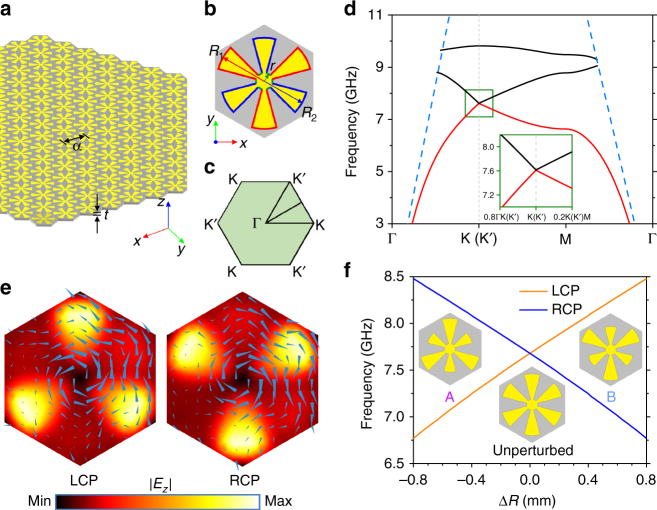
- In the unperturbed triangular-lattice DSP crystal, the first and second bands touch at the K and K′ valleys at the Dirac frequency of 2π × 7.61 GHz; breaking ΓK-mirror symmetry by setting ΔR = ±0.5 mm opens a full bandgap.
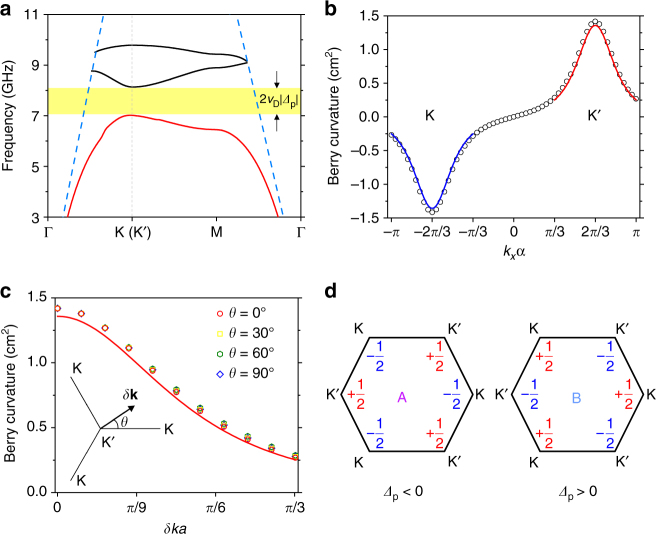
- The effective Hamiltonian fit gives v_D = 5.42 × 10^7 m s−1 and Δ_p = ±60.68 m−1 for patterns A and B, and the valley Chern numbers of the first band are ±1/2.
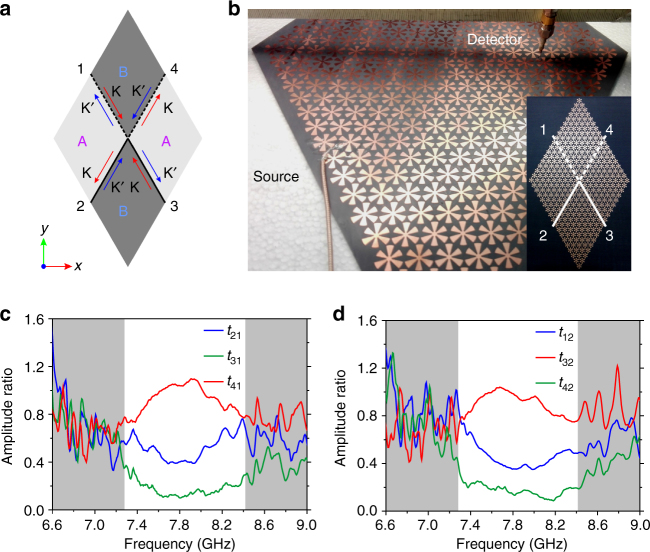
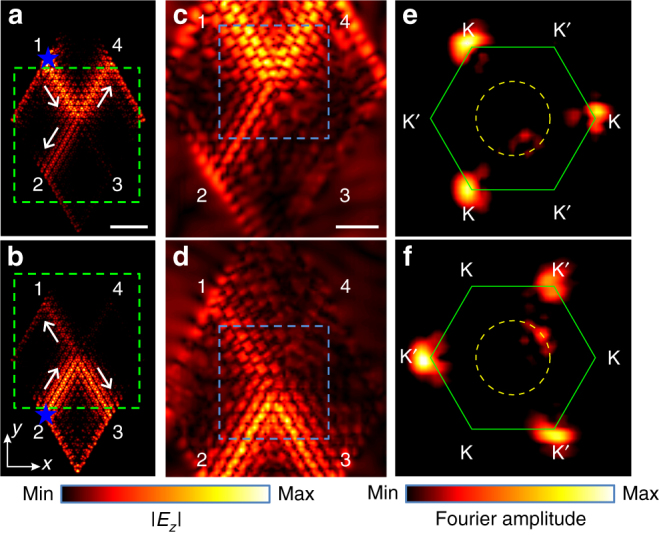
- In the beam-splitter experiment, transports involving opposite valleys are heavily suppressed; within the bandgap, the sum of measured amplitude ratios for same-valley transport is at least 14 dB larger than those involving opposite valleys.
- The measured bandgap of the fabricated sample is 7.28–8.42 GHz, compared with the simulated 7.05–8.12 GHz, a shift of about 3.7% toward higher frequency.
## Methods
- The study uses a triangular-lattice designer surface plasmon crystal on an F4B dielectric substrate (relative permittivity 2.65, thickness 1 mm) with a 35 μm copper layer; mirror-symmetry breaking is introduced by changing the radii R1 and R2.
- The authors analyze the system with an effective k·p Hamiltonian, compute Berry curvature and valley Chern numbers, and perform full-wave FEM simulations in COMSOL.
- Experiments use two monopole antennas, a vector network analyzer, and near-field scans of the Ez component; field maps are recorded 1 mm above the metallic surface with 1 × 1 mm² resolution.
## Limitations
- The paper states that the data supporting the figures and findings are available from the corresponding authors upon request; no public dataset is stated.
- The text makes evident that the work is demonstrated in the microwave regime on a specific DSP geometry, so direct experimental evidence is limited to that platform and frequency range (text-evident).
- The paper notes a 3.7% fabrication-induced frequency shift between measured and simulated bandgaps, indicating sensitivity to fabrication errors (text-evident).
Model-written summary. Check it against the paper before relying on it.
Integrity signals
Registry
Cites
Statistics
Figures
Verification
Claims the paper makes
14 Valid · 1 Not valid · 4 Not checked · 30 Own results and interpretations
Some cited sources support this claim and some don’t — read each source’s verdict below.
In the paper
“Here, we demonstrate a designer surface plasmon crystal comprising metallic patterns deposited on a dielectric substrate, which can become a valley-Hall photonic topological insulator by exploiting the mirror-symmetry-breaking mechanism.”
- Also stated in: § Theoretical modeling and numerical verifications · hedged
“These results indicate that when ΔR is nonzero, the proposed DSP crystal becomes a valley-Hall PTI because of the full bandgap and nontrivial valley Chern numbers16,19.”
§ Direct observation of valley-polarized topological edge states in designer surface plasmon crystals > Abstract
What the sources say
- Disputedcites [16] Ma T Shvets G All-Si valley-Hall photonic topological insulator New J. Phys. 2016 18 025012 10.1088/1367-2630/18/2/025012 sourceExperimental — accuracy not yet measured
Split into 2 atoms — 0 confirmed, 1 partially supported, 1 disputed, 0 misattributed, 0 unverifiable. Expand the claim to see per-atom verdicts.
Checked by a reasoning model — may be wrong.
- Partly supportedcites [19] Chen X-D Zhao F-L Chen M Dong J-W Valley-contrasting physics in all-dielectric photonic crystals: orbital angular momentum and topological propagation Phys. Rev. B 2017 96 020202 10.1103/PhysRevB.96.020202 sourceExperimental — accuracy not yet measured
Split into 2 atoms — 1 confirmed, 1 partially supported, 0 disputed, 0 misattributed, 0 unverifiable. Expand the claim to see per-atom verdicts.
plainstates a cause- Asserted: passes — The authors put it forward as true.
- Checkable: passes — It can be checked against evidence.
- Load-bearing: passes — The paper’s conclusions depend on it.
- Based: passes — The paper gives a reason why it holds.
- Also stated in: § Theoretical modeling and numerical verifications · hedged
The cited sources support only part of this claim — read each source’s verdict below.
In the paper
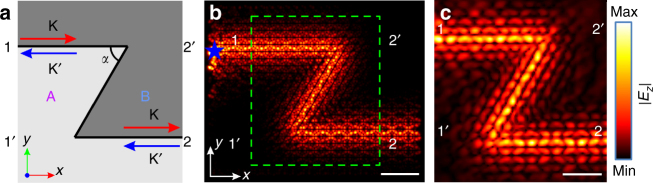
“According to previous theoretical studies, a random arrangement of the unit cells of valley-Hall PTIs only results in a higher-order perturbation O(Δ p 2) between the two circularly polarized states in K/K′ valley, which is usually much smaller than the first-order perturbation v D Δ p caused by breaking ΓK-mirror symmetry16.”
§ Direct observation of valley-polarized topological edge states in designer surface plasmon crystals > Results > Topological protection in a Z-shaped waveguide
What the sources say
- Partly supportedcites [16] Ma T Shvets G All-Si valley-Hall photonic topological insulator New J. Phys. 2016 18 025012 10.1088/1367-2630/18/2/025012 sourceExperimental — accuracy not yet measured
Split into 2 atoms — 0 confirmed, 2 partially supported, 0 disputed, 0 misattributed, 0 unverifiable. Expand the claim to see per-atom verdicts.
plainstates a cause- Asserted: passes — The authors put it forward as true.
- Checkable: passes — It can be checked against evidence.
- Load-bearing: passes — The paper’s conclusions depend on it.
- Based: passes — The paper gives a reason why it holds.
- Partly supported
Every source the paper cites for this claim was checked and supports it.
In the paper
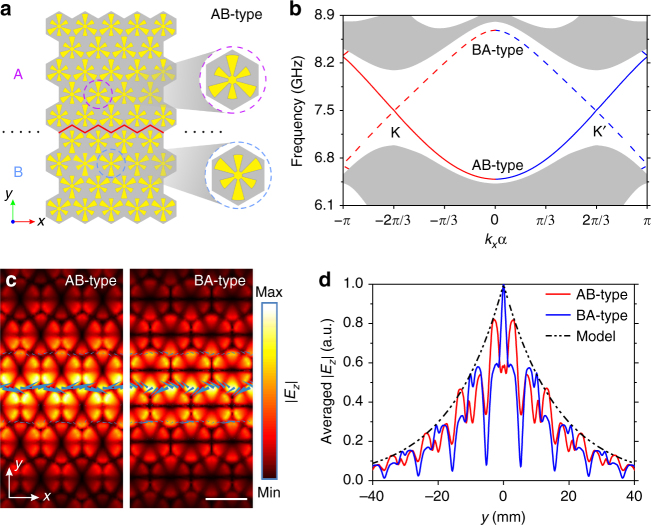
“As expected, gapped edge states are observed in the first bandgap for each domain wall, and they do not connect the first and second bands because time-reversal symmetry is preserved here19.”
§ Direct observation of valley-polarized topological edge states in designer surface plasmon crystals > Results > Bulk-boundary correspondence and valley-polarized topological edge states
What the sources say
- Supportedcites [19] Chen X-D Zhao F-L Chen M Dong J-W Valley-contrasting physics in all-dielectric photonic crystals: orbital angular momentum and topological propagation Phys. Rev. B 2017 96 020202 10.1103/PhysRevB.96.020202 source
The cited paper explains that its valley-dependent edge dispersions are gapped and do not connect the bulk bands because, unlike photonic quantum Hall edge states, they do not arise from broken time-reversal symmetry (p. 8). This supports the explanation attributed to the citation; the observations for each AB- and BA-type wall are presented as the citing authors’ own simulations. (LLM, conf=0.91)
plainstates a cause- Asserted: passes — The authors put it forward as true.
- Checkable: passes — It can be checked against evidence.
- Load-bearing: passes — The paper’s conclusions depend on it.
- Based: passes — The paper gives a reason why it holds.
- Rests on an assumption not shown here.
- Supported
The cited sources support only part of this claim — read each source’s verdict below.
In the paper
“We have also numerically investigated other geometric configurations in which the corner angle α of the topological waveguides varies, and no notable scattering losses are observed in all cases (See Supplementary Fig. 10 for simulated field maps.), even when the corner becomes incompatible with the triangular lattice (α = 30°, 90°, 150°)20.”
§ Direct observation of valley-polarized topological edge states in designer surface plasmon crystals > Results > Topological protection in a Z-shaped waveguide
What the sources say
- Partly supportedcites [20] Lu J Observation of topological valley transport of sound in sonic crystals Nat. Phys. 2016 13 369 374 10.1038/nphys3999 sourceExperimental — accuracy not yet measured
The passage discussing Fig. 4a reports negligible reflection for a zigzag waveguide with two 120° corners, and the Fig. 4 caption describes small bending losses. The copy does not report results for 30°, 90°, or 150° corners, including corners incompatible with the triangular lattice; those specific results are presented in the citing sentence as the citing authors’ own simulations. (LLM, conf=0.86)
plain- Asserted: passes — The authors put it forward as true.
- Checkable: passes — It can be checked against evidence.
- Load-bearing: passes — The paper’s conclusions depend on it.
- Based: passes — The paper gives a reason why it holds.
- Partly supported
Every source the paper cites for this claim was checked and supports it.
In the paper
“Since the underlying mechanism is independent of specific waves, this suppression of scattering losses are also observed for acoustic waves in the topological waveguides made from a valley-Hall STI where the topological bandgap is similarly introduced by breaking the ΓK-mirror symmetry of the unit cell20.”
§ Direct observation of valley-polarized topological edge states in designer surface plasmon crystals > Results > Topological protection in a Z-shaped waveguide
What the sources say
- Supportedcites [20] Lu J Observation of topological valley transport of sound in sonic crystals Nat. Phys. 2016 13 369 374 10.1038/nphys3999 source
Split into 2 atoms — 2 confirmed, 0 partially supported, 0 disputed, 0 misattributed, 0 unverifiable. Expand the claim to see per-atom verdicts.
plainstates a cause- Asserted: passes — The authors put it forward as true.
- Checkable: passes — It can be checked against evidence.
- Load-bearing: unclear — It is unclear whether the paper’s conclusions depend on it.
- Based: passes — The paper gives a reason why it holds.
- Supported
14 more claims · 3 with their cited sources checked
Create a free account to see all 49 claims and to verify the 4 references still open.
- It may state two separate claims as one. 27
- Probably not a substantial claim. 4
- The quote only partly states this claim. 1
Claims other papers make about this one
Each is checked against this paper’s own text: does it say what the citing paper says it does?
The cited source says what the claim attributes to it.
In the citing paper
“Photonic valley systems can be implemented at telecommunication and terahertz wavelengths on a silicon platform [65,66], at subwavelength scales on plasmonic platforms [61,67,68], and they can be used for the development of topological lasers [69-72], which opens the possibilities for many applications.”
From Anyons, Zitterbewegung and dynamical phase transitions in topologically nontrivial systems (2022) · cites this paper as [61]
The cited source says what the claim attributes to it.
In the citing paper
“However, the understanding and development of optical spinorbit interactions [56], photonic pseudospins [57], and valley degrees of freedom[58-65] have offered us new knobs that can be used for manipulation of light in photonic structures, in analogy with parallel advances in electric systems.”
From Anyons, Zitterbewegung and dynamical phase transitions in topologically nontrivial systems (2022) · cites this paper as [61]
Citations
Cites
Mimicking Surface Plasmons with Structured Surfaces
Pendry, J. B., Martín-Moreno, L., & Garcia-Vidal, F. J. (2004) · Science · doi:10.1126/science.1098999 · Cited by 3,276
Observation of unidirectional backscattering-immune topological electromagnetic states
Wang, Z., Chong, Y., Joannopoulos, J. D., & Soljačić, M. (2009) · Nature · doi:10.1038/nature08293 · Cited by 3,123
Emerging Device Applications for Semiconducting Two-Dimensional Transition Metal Dichalcogenides
Jariwala, D., Sangwan, V. K., Lauhon, L. J., Marks, T. J., & Hersam, M. C. (2014) · ACS Nano · doi:10.1021/nn500064s · Cited by 2,753
Schaibley, J. R., Yu, H., Clark, G., Rivera, P., Ross, J. S., Seyler, K. L., Yao, W., & Xu, X. (2016) · Nature Reviews Materials · doi:10.1038/natrevmats.2016.55 · Cited by 2,652
Valley-Contrasting Physics in Graphene: Magnetic Moment and Topological Transport
Xiao, D., Yao, W., & Niu, Q. (2007) · Physical Review Letters · doi:10.1103/physrevlett.99.236809 · Cited by 2,296 · cited 3×
“n of Δp solely determines the frequency order of the LCP and RCP states in the band structure, and their frequency order determines the topological phase of the DSP crystal. The calculation using Eq. (3) is straightforward since Δ p is negative for pattern A and hence positive for pattern B. The calculated valleyChern…”
BackgroundInfluentialThe valley Hall effect in MoS 2 transistors
Mak, K. F., McGill, K. L., Park, J., & McEuen, P. L. (2014) · Science · doi:10.1126/science.1250140 · Cited by 1,915
Imaging topological edge states in silicon photonics
Hafezi, M., Mittal, S., Fan, J., Migdall, A., & Taylor, J. M. (2013) · Nature Photonics · doi:10.1038/nphoton.2013.274 · Cited by 1,715
Valley filter and valley valve in graphene
Rycerz, A., Tworzydło, J., & Beenakker, C. W. J. (2007) · Nature Physics · doi:10.1038/nphys547 · Cited by 1,695
Scheme for Achieving a Topological Photonic Crystal by Using Dielectric Material
Wu, L.-H., & Hu, X. (2015) · Physical Review Letters · doi:10.1103/physrevlett.114.223901 · Cited by 1,648
Robust optical delay lines with topological protection
Hafezi, M., Demler, E. A., Lukin, M. D., & Taylor, J. M. (2011) · Nature Physics · doi:10.1038/nphys2063 · Cited by 1,466
Cited by
Items 401–447 of 447
Dual Topology States in Two-Dimensional Buckybowl Supramolecular Crystal of Sumanene
Ji, H., Liu, M., Guo, J., Geng, J., & Sun, J.-T. (2026) · The Journal of Physical Chemistry Letters · doi:10.1021/acs.jpclett.5c03895
Transparent Topological Meta‐Diplexer via Tightly Confined Valley Surface States
Li, P., Li, P., Lan, Z., Li, Y., Wong, H., & Chen, M. L. N. (2026) · Advanced Science · doi:10.1002/advs.77208
Chunyu, 李. L., Yongjun, 谢. X., & Sai, 陈. C. (2026) · Acta Optica Sinica (Online) · doi:10.3788/aosol260498
Corner States in C 6 Symmetric Photonic Crystals: Origins and Properties
Yao, Y., Zhang, Z., Zhang, H., Shi, Q., & Yang, B. (2025) · Advanced Quantum Technologies · doi:10.1002/qute.202500836 · Cited by 3
Topological rainbow trapping and defect modes in shifted interface channels
Xia, X., Zhang, X., Zhu, W. M., Han, W., Zhang, B., Du, K., Wei, G., & Wang, S. (2026) · Journal of Physics D Applied Physics · doi:10.1088/1361-6463/ae7b50
Substrate-Integrated Topological Valley Photonic Crystals Fed by Transmission Lines
Zhang, X., & Chen, M. L. N. (2025) · Photonics & Electromagnetics Research Symposium - Spring (PIERS-Spring) · doi:10.1109/piers-spring66516.2025.11276837
Design and Analysis of a THz Topological Frequency-Tunable Waveguide based on Valleytronics
Moeini, M., & Ahmadi, V. (2024) · International Symposium on Telecommunications · doi:10.1109/ist64061.2024.10843652
Exceptional points in topological spoof surface plasmon polaritons for index sensing applications
Wei, G., Ma, Z., Gan, Z., Ge, Y., Zhang, X., Wang, B., Liu, Y., Zhu, W. M., Han, W., Du, K., et al. (2026) · Optics Express · doi:10.1364/oe.608462
Chiral anomaly bulk states in acoustic S-graphene with multiple Dirac points
Gou, X.-H., Lai, H., Sun, X., He, C., & Chen, Y.-F. (2026) · Journal of Applied Physics · doi:10.1063/5.0314842
Tunneling-induced fractal transmission in valley Hall waveguides
Shah, T., Marquardt, F., & Peano, V. (2023) · Physical review. B./Physical review. B · doi:10.1103/physrevb.107.054304
Wenshuo, 马. M., Guoxiang, 佀. S., Jiakang, 简. J., & Cuicui, 路. L. (2026) · Infrared and Laser Engineering · doi:10.3788/irla20250483
He, J., Li, Y. H., Fan, Y., Zhao, X., Ding, L., Yuan, X., Ji, B., Hu, J., Liu, L., Su, G., et al. (2025) · Photonics · doi:10.3390/photonics12050488 · Cited by 1
Robust terahertz on-chip topological pathway with single-mode and linear dispersion
He, X., Wang, L., Huang, Z., Xia, C., Gao, X., Yang, Z., & Zhang, Y. (2025) · Optics Express · doi:10.1364/oe.545620
Recent Progress in Semiconductor-based Valley Photonic Crystal Waveguides
Iwamoto, S. (2025) · Journal of the Physical Society of Japan · doi:10.7566/jpsj.94.101001
Topological Edge States in Systems of Spoof Surface Plasmon Polaritons
Xiang, H., & Han, D. (2018) · Cross Strait Radio Science and Wireless Technology Conference (CSRSWTC) · doi:10.1109/csqrwc.2018.8455556
Self-citationTerahertz plasmonic transport in topological valley metal-slabs
Zhou, X., Li, L., Li, H., & Shen, Y. (2025) · Physics Letters A · doi:10.1016/j.physleta.2025.130326 · Cited by 1
Sun, H., Zhuang, Y., He, Y., Shen, S., & Li, Y. (2025) · Photonics · doi:10.3390/photonics12121171 · Cited by 1
Equal power divider based on valley topological insulators
Yang, J., Kou, N., & Yu, S. (2026) · Physics Letters A · doi:10.1016/j.physleta.2026.132015
Zhang, R., Zhong, X., Lin, Z., Qiu, W., & Su, H. (2025) · Optoelectronics Letters · doi:10.1007/s11801-025-4037-5
Wenji, 周. Z., Yajing, 常. C., Jin, 李. L., Ming, 孙. S., Xiaofang, 许. X., Weifeng, 殷. Y., & Bin, 胡. H. (2025) · Laser & Optoelectronics Progress · doi:10.3788/lop250662
Chiral Landau rainbow modulated by in-plane synthetic gauge fields
Li, W., Dai, X., Jiang, L., & Xiang, Y. (2026) · Optics Letters · doi:10.1364/ol.596518 · Cited by 2
Om, K., & Kim, K. (2025) · physica status solidi (b) · doi:10.1002/pssb.202500140
Song, X., Qi, Z., Cheng, Z., Zhang, J., Yang, C., Sun, Y., Hu, G., Li, H., & Yu, X. (2026) · APL Photonics · doi:10.1063/5.0307275
Self‐accelerating topological edge states
Zhang, Z., Kartashov, Y. V., Belić, M. R., Li, Y., & Zhang, Y. (2025) · Nanophotonics · doi:10.1515/nanoph-2025-0268
High-order harmonic generation in uniformly distributed topological edge states
Li, X., Gu, B., Rui, G., He, J., Cui, Y., & Zhan, Q. (2023) · Journal of Optics · doi:10.1088/2040-8986/acbf67
Demonstration of Suppressed Backscattering in Acoustic Valley Hall Topological Insulator
Han, X., Li, L., Hu, Y., & Wang, X. (2020) · IOP Conference Series Earth and Environmental Science · doi:10.1088/1755-1315/571/1/012131
Surface Wave Wavefront Formation with Photonic Graphene and Topological Waveguide
Wen, E., Yang, X., & Sievenpiper, D. F. (2022) · Digest - IEEE Antennas and Propagation Society. International Symposium · doi:10.1109/ap-s/usnc-ursi47032.2022.9887108
A Photonic Topological Insulator Based on a Coupled Plasmonic Nanoparticle Array
Honari-Latifpour, M., & Yousefi, L. (2018) · International Symposium on Telecommunications · doi:10.1109/istel.2018.8661087 · Cited by 1
Chiral states induced by symmetry-breaking in α−T3 lattices: Magnetic field effect
Nascimento, J. P. G., Pereira, J. M., Jr., Filho, R. N. C., Peeters, F. M., Freire, M. M., Lima, W. P., & da Costa, D. R. (2026) · Physica E Low-dimensional Systems and Nanostructures · doi:10.1016/j.physe.2026.116568
Dynamic Phase Modulation of Thz Guided Waves Using Mems-Integrated Valley Photonic Crystals
Zaravashan, H., Hosseininejad, S. E., Bagheri, A., Gradoni, G., & Khalily, M. (2025) · International Conference on Electromagnetics in Advanced Applications (ICEAA) · doi:10.1109/iceaa65662.2025.11305717
Topological magnon-plasmon hybrids
Hirosawa, T., Gunnink, P. M., & Mook, A. (2026) · Physical review. B./Physical review. B · doi:10.1103/9csq-48k7 · Cited by 4
High-efficiency topological waveguides in substrate-integrated valley photonic crystals
Han, J., Liang, F., Zhao, Y., & Wang, B. (2023) · International Conference on Microwave and Millimeter Wave Technology (ICMMT) · doi:10.1109/icmmt58241.2023.10277186
40.2: Programmable topological waveguide via nematic liquid crystals
He, X., & Wang, X. (2023) · SID Symposium Digest of Technical Papers · doi:10.1002/sdtp.16279
Nonlinear control of topological corner and edge states in a loop resonator
Li, X., Rui, G., He, J., & Gu, B. (2023) · Optics Communications · doi:10.1016/j.optcom.2023.130004 · Cited by 1
Realization of Dissipation-Enhanced Topological Valley Transport in Phononic Crystal
Gao, H., Guo, J., Su, Y., Gu, Z., Xue, H., & Zhu, J. (2026) · Physical Review Letters · doi:10.1103/pjlr-6t6w · Cited by 2
Decay dynamics of topological valley-Hall edge states in multicomponent diffusive systems
Tanaka, H., Nakane, J. J., & Funayama, K. (2026) · Applied Physics Letters · doi:10.1063/5.0312464
Taking Inspiration from Quantum-Wave Analogies—Recent Results for Photonic Crystals
Lein, M. (2018) · Springer proceedings in mathematics & statistics · doi:10.1007/978-3-030-01602-9_10
Wave-vector-mismatch-controlled coupling of valley edge states for tunable energy distribution
Wei, G., Wang, S., Zhang, X., Han, W., Du, K., Zhu, W., & Wang, S. (2026) · Physical Review A · doi:10.1103/nvcw-gd3x
Vaheesan, V., Mitchell, K., Navarro‐Cía, M., & Feresidis, A. P. (2025) · Optical Materials Express · doi:10.1364/ome.571378
Anonymous, Nakane, J. J., & Yamakage, A. (2026) · Physical review. B./Physical review. B · doi:10.1103/66ym-fbl9
Transport and lasing in topological photonic systems
Chattopadhyay, U. (2020) · DR-NTU (Nanyang Technological University) · doi:10.32657/10356/146236
Topological non-Hermitian phononic metamaterials
Liang, H., Xi, X., Huang, H., Chen, T., Wang, K., & Zhou, J. (2026) · International Journal of Dynamics and Control · doi:10.1007/s40435-026-02304-w
Topological Large-Area Waveguide and Corner States in Kagome-Lattice Terahertz Photonic Crystals
Zhao, Y., Han, J., Li, J., Hu, H., & Gong, X. (2026) · Photonics · doi:10.3390/photonics13040314
Topological light transport in low-symmetry valley photonic crystals
Chen, H.-X., Liu, M.-D., Fan, Z.-B., & Chen, X. (2024) · Acta Physica Sinica · doi:10.7498/aps.73.20240040 · Cited by 1
Metadata
- Authors
- Wu, X., Meng, Y., Tian, J., Huang, Y., Xiang, H., Han, D., & Wen, W.
- Affiliations
- Chongqing University (CN)
- University of Hong Kong (HK)
- Corresponding author
- Han, Dezhuan
- Wen, Weijia
- Venue
- Nature Communications
- Published
- 2017-11-03
- Volume
- 8
- Issue
- 1
- Pages
- 1304-1304
- ISSN
- 2041-1723 (ISSN-L)
- PMC
- PMC5670222
- OpenAlex
- W2600702133
- Cited by
- 449
- References
- 52
- Citations by year
- 2026: 35 · 2025: 61 · 2024: 73 · 2023: 55 · 2022: 58 · 2021: 50 · 2020: 39 · 2019: 43 · 2018: 33 · 2017: 2
- FWCI
- 15.69
- Type
- journal article
- Language
- en
- Open access
- gold
- doi.org
- Licence
- cc-by
- creativecommons.org/licenses/by/4.0 (tdm)
- creativecommons.org/licenses/by/4.0 (vor)
- Locations
- Nature Communications (publishedVersion, cc-by)
- PubMed Central (publishedVersion, cc-by)
- PubMed (publishedVersion)
- arXiv (Cornell University) (submittedVersion)
- DOAJ (DOAJ: Directory of Open Access Journals) (submittedVersion)
- DOAJ (DOAJ: Directory of Open Access Journals) (submittedVersion, cc-by-sa)
- Rare & Special e-Zone (The Hong Kong University of Science and Technology) (submittedVersion)
- arXiv (Cornell University)
- Funders
- National Natural Science Foundation of China (91630205, 11574037)
- Special Fund for Agro-scientific Research in the Public Interest (201303045)
- Topics
- Physical Sciences › Physics and Astronomy › Condensed Matter Physics › Topological Materials and Phenomena
- Physical Sciences › Physics and Astronomy › Atomic and Molecular Physics, and Optics › Plasmonic and Surface Plasmon Research
- Physical Sciences › Physics and Astronomy › Acoustics and Ultrasonics › Acoustic Wave Phenomena Research
- Keywords
- photonic topological insulators, valley-dependent transport, mirror symmetry breaking, microwave photonics, topological protection, domain walls
About these checks
Registry, retraction, Cites and statistics results are computed, not judged, with one exception: a printed reference that no index lists is read once by a model before it counts as a citation error. Claims are extracted by a model and kept only when their quote appears verbatim in the text; each cited source is then checked, with a model’s help, for whether it says what the claim relies on. Those verdicts can be wrong — read the claim’s quote and the cited source before relying on one.
The claim verdicts this report counts are experimental: their accuracy is not yet measured.
A language model drew the claims from the paper on 2026-10-10, under version 3 of the claim definition (model deepseek-v4.1-flash, prompt extract-v3).
A second model labelled each claim on 2026-10-10 (model jev-1.13-20260917, definition revision gold-guideline-v0.2).
Cited sources are checked with a language model’s help (gpt-6-sol).
Statistics and arithmetic are recomputed, not judged.
Confidence bands are shown only for fields calibrated on our annotated test set. None is calibrated yet, so no band is shown.
What counts as a claim ›How we measure confidence ›How we check this ›
Are you an author, or do you see a problem with this page? Request a review
Data sources
Bibliographic data: Semantic Scholar, OpenAlex, Crossref.
Contains information from the Semantic Scholar Academic Graph Datasets, made available under the ODC Attribution License (ODC-BY 1.0).
Semantic Scholar’s data is described in: Kinney, R., et al. (2023). The Semantic Scholar Open Data Platform. arXiv:2301.10140.
