

The DOI matches its Crossref record; 71 of the 71 references it cites were found in a registry or an index.
Epigenetic targeting of bromodomain protein BRD4 counteracts cancer cachexia and prolongs survival
Open accessAbstract
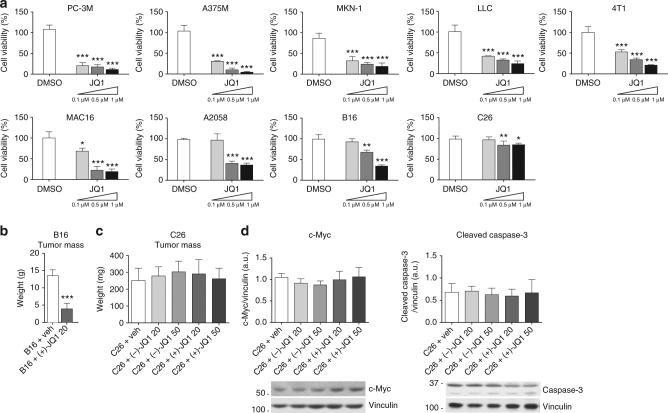
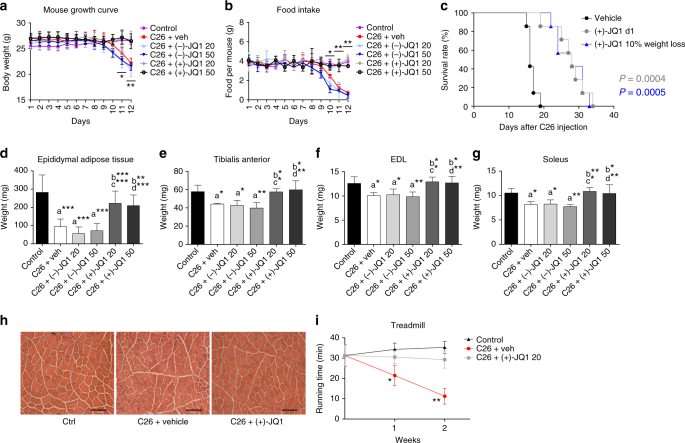
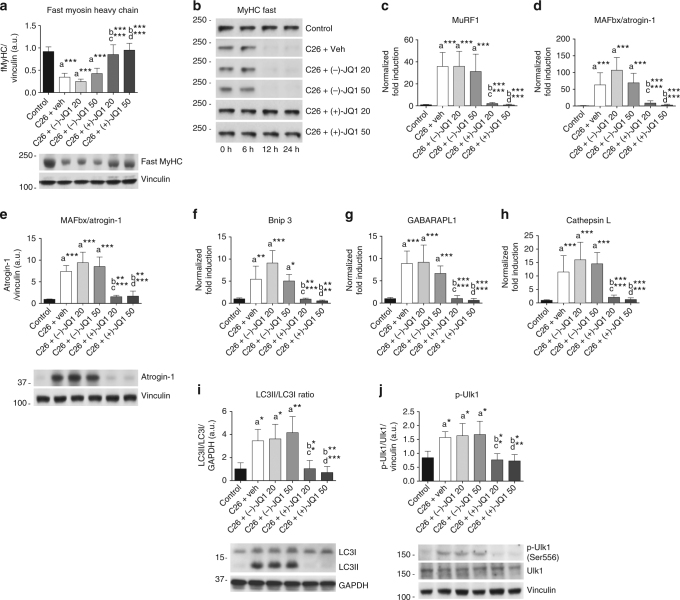
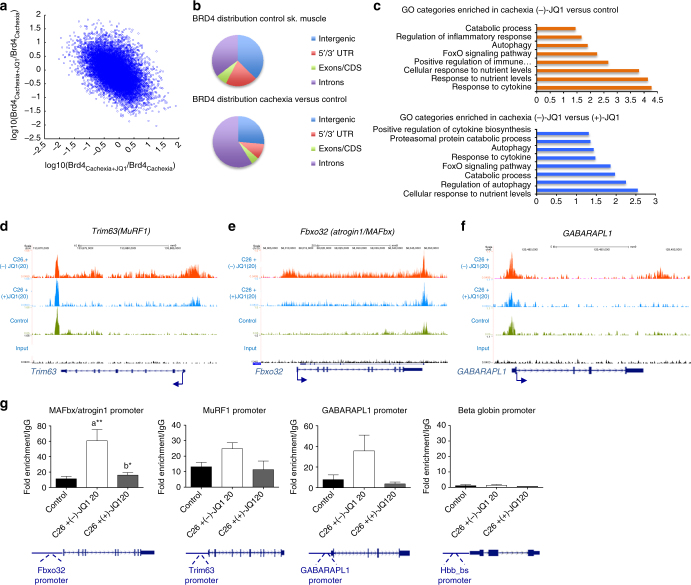
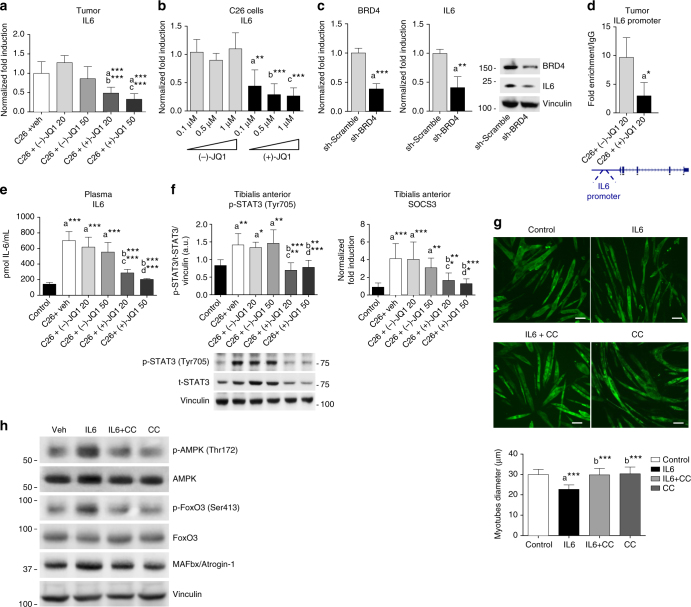
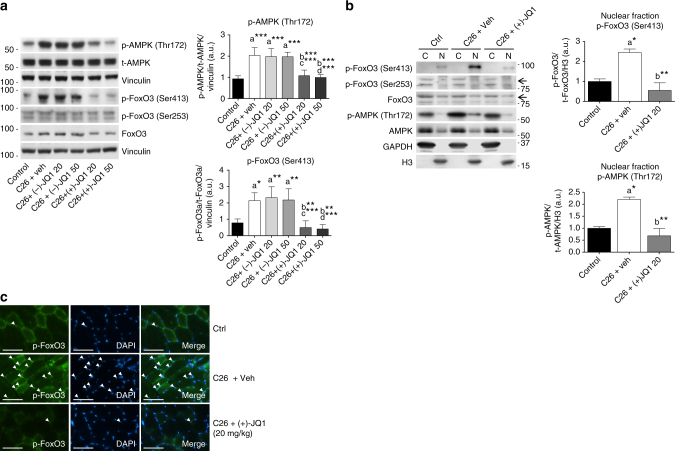
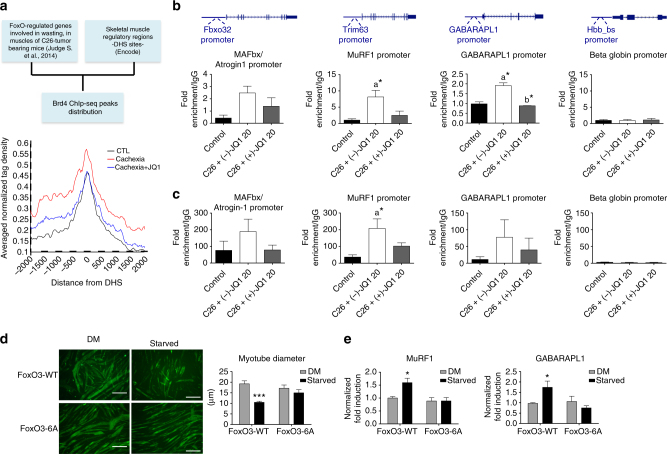
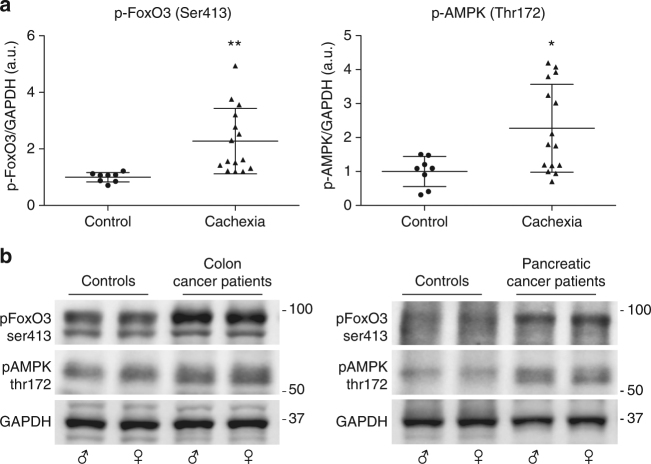
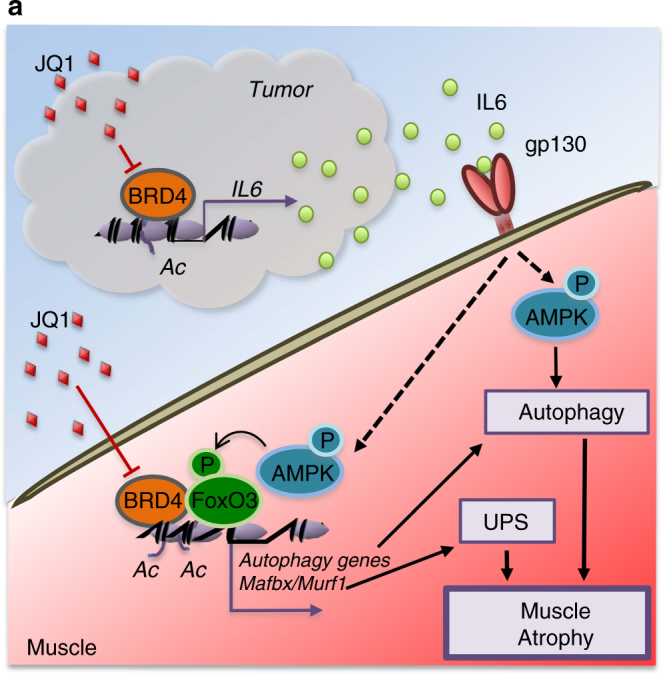
Cancer cachexia is a devastating metabolic syndrome characterized by systemic inflammation and massive muscle and adipose tissue wasting. Although it is responsible for approximately one-third of cancer deaths, no effective therapies are available and the underlying mechanisms have not been fully elucidated. We previously identified the bromodomain and extra-terminal domain (BET) protein BRD4 as an epigenetic regulator of muscle mass. Here we show that the pan-BET inhibitor (+)-JQ1 protects tumor-bearing mice from body weight loss and muscle and adipose tissue wasting. Remarkably, in C26-tumor-bearing mice (+)-JQ1 administration dramatically prolongs survival, without directly affecting tumor growth. By ChIP-seq and ChIP analyses, we unveil that BET proteins directly promote the muscle atrophy program during cachexia. In addition, BET proteins are required to coordinate an IL6-dependent AMPK nuclear signaling pathway converging on FoxO3 transcription factor. Overall, these findings indicate that BET proteins may represent a promising therapeutic target in the management of cancer cachexia.
Overview
The claims and statistics of this paper haven’t been checked yet.
Run the check — free, no account needed. It reads the open-access text and checks the sources it cites.
Integrity signals
Registry
Cites
Statistics
Figures
Verification
Claims the paper makes
The claims and statistics of this paper haven’t been checked yet.
Run the check — free, no account needed. It reads the open-access text and checks the sources it cites.
Claims other papers make about this one
Each is checked against this paper’s own text: does it say what the citing paper says it does?
In the citing paper
“The bromodomain and extra terminal domain (BET) protein BRD4 has been recently shown to be an epigenetic regulator of muscle mass80.”
From Mechanisms of muscle atrophy and hypertrophy: implications in health and disease (2021) · cites this paper as [80]
In the citing paper
“Mechanistically, BET proteins promote an IL6-AMPK-FoxO3 response to enhance protein breakdown.”
From Mechanisms of muscle atrophy and hypertrophy: implications in health and disease (2021) · cites this paper as [80]
In the citing paper
“In fact, the overactivation of AMPK has been linked to cachexia80.”
From Mechanisms of muscle atrophy and hypertrophy: implications in health and disease (2021) · cites this paper as [80]
Self-check
Percentages, sums and reported differences re-computed from the paper’s own numbers.
The self-check needs the paper’s full text.
Citations
Cites
PROTEIN MEASUREMENT WITH THE FOLIN PHENOL REAGENT
Lowry, O. H., Rosebrough, N., Farr, A. L., & Randall, R. (1951) · Journal of Biological Chemistry · doi:10.1016/s0021-9258(19)52451-6 · Cited by 316,394
Model-based Analysis of ChIP-Seq (MACS)
Zhang, Y., Liu, T., Meyer, C. A., Eeckhoute, J., Johnson, D. S., Bernstein, B. E., Nusbaum, C., Myers, R. M., Brown, M., Li, W., et al. (2008) · Genome Biology · doi:10.1186/gb-2008-9-9-r137 · Cited by 18,386
Definition and classification of cancer cachexia: an international consensus
Fearon, K., Strasser, F., Anker, S. D., Bosaeus, I. G., Bruera, E. D., Fainsinger, R. L., Jatoi, A., Loprinzi, C. L., Macdonald, N., Mantovani, G., et al. (2011) · The Lancet Oncology · doi:10.1016/s1470-2045(10)70218-7 · Cited by 6,020
BET Bromodomain Inhibition as a Therapeutic Strategy to Target c-Myc
Delmore, J. E., Issa, G. C., Lemieux, M. E., Rahl, P. B., Shi, J., Jacobs, H. M., Kastritis, E., Gilpatrick, T., Paranal, R. M., Qi, J., et al. (2011) · Cell · doi:10.1016/j.cell.2011.08.017 · Cited by 2,888
RNAi screen identifies Brd4 as a therapeutic target in acute myeloid leukaemia
Zuber, J., Shi, J., Wang, E., Rappaport, A. R., Herrmann, H., Sison, E. A., Magoon, D., Qi, J., Blatt, K., Wunderlich, M., et al. (2011) · Nature · doi:10.1038/nature10334 · Cited by 1,870
Cancer cachexia: understanding the molecular basis
Argilés, J. M. A., Busquets, S., Stemmler, B., & López-Soriano, F. J. (2014) · Nature reviews. Cancer · doi:10.1038/nrc3829 · Cited by 1,567
Suppression of inflammation by a synthetic histone mimic
Nicodeme, E., Jeffrey, K. L., Schaefer, U., Beinke, S., Dewell, S., Chung, C.-W., Chandwani, R., Marazzi, I., Wilson, P., Coste, H., et al. (2010) · Nature · doi:10.1038/nature09589 · Cited by 1,563
Multiple types of skeletal muscle atrophy involve a common program of changes in gene expression
Lecker, S. H., Jagoe, R. T., Gilbert, A., Gomes, M., Baracos, V., Bailey, J., Price, S. R., Mitch, W. E., & Goldberg, A. L. (2004) · The FASEB Journal · doi:10.1096/fj.03-0610com · Cited by 1,539 · cited 2×
“In cachexia-induced muscle atrophy, two main catabolic pathways are activated: the ubiquitin-proteasome degradation system, through transcriptional upregulation of MAFbx/Atrogin-1 and MuRF1 ubiquitin-ligases, and autophagy 13 – 15 .”
Targeting bromodomains: epigenetic readers of lysine acetylation
Filippakopoulos, P., & Knapp, S. (2014) · Nature Reviews Drug Discovery · doi:10.1038/nrd4286 · Cited by 1,298
Self-citationCancer Cachexia: Mediators, Signaling, and Metabolic Pathways
Fearon, K. C. H., Glass, D. J., & Guttridge, D. C. (2012) · Cell Metabolism · doi:10.1016/j.cmet.2012.06.011 · Cited by 1,244
Cited by
Sorted by citations
Mechanisms of muscle atrophy and hypertrophy: implications in health and disease
Sartori, R., Romanello, V., & Sandri, M. (2021) · Nature Communications · doi:10.1038/s41467-020-20123-1 · Cited by 940
Self-citationThe BET family in immunity and disease
Wang, N., Wu, R., Tang, D., & Kang, R. (2021) · Signal Transduction and Targeted Therapy · doi:10.1038/s41392-020-00384-4 · Cited by 295
Signaling Pathways That Control Muscle Mass
Vainshtein, A., & Sandri, M. (2020) · International Journal of Molecular Sciences · doi:10.3390/ijms21134759 · Cited by 222
Self-citationSukocheva, O. A., Maksoud, R., Beeraka, N. M., Madhunapantula, S. V., Sinelnikov, M. Y., Nikolenko, V. N., Неганова, М. Е., Klochkov, S. G., Kamal, M. A., Staines, D., et al. (2021) · Journal of Advanced Research · doi:10.1016/j.jare.2021.11.013 · Cited by 182
Body composition and sarcopenia: The next-generation of personalized oncology and pharmacology?
Hilmi, M., Jouinot, A., Burns, R. G., Pigneur, F., Mounier, R., Gondin, J., Neuzillet, C., & Goldwasser, F. (2018) · Pharmacology & Therapeutics · doi:10.1016/j.pharmthera.2018.12.003 · Cited by 145
Metadata
- Authors
- Segatto, M., Fittipaldi, R., Pin, F., Sartori, R., Dae Ko, K., Zare, H., Fenizia, C., Zanchettin, G., Pierobon, E. S., Hatakeyama, S., Sperti, C., Merigliano, S., Sandri, M., Filippakopoulos, P., Costelli, P., Sartorelli, V., & Caretti, G.
- Affiliations
- University of Milan (IT)
- University of Turin (IT)
- University of Padua (IT)
- National Institutes of Health (US)
- Novartis (Switzerland) (CH)
- University of Oxford (GB)
- Corresponding author
- Caretti, Giuseppina
- ORCID
- Venue
- Nature Communications
- Published
- 2017-11-22
- Volume
- 8
- Issue
- 1
- Pages
- 1707-1707
- ISSN
- 2041-1723 (ISSN-L)
- PMC
- PMC5700099
- OpenAlex
- W2768531312
- Cited by
- 101
- References
- 71
- Citations by year
- 2026: 5 · 2025: 8 · 2024: 5 · 2023: 16 · 2022: 9 · 2021: 15 · 2020: 18 · 2019: 14 · 2018: 11
- FWCI
- 4.80
- Type
- journal article
- Language
- en
- Open access
- gold
- doi.org
- Locations
- Nature Communications (publishedVersion, cc-by)
- Europe PMC (PubMed Central) (publishedVersion, cc-by)
- PubMed Central (publishedVersion, cc-by)
- PubMed (publishedVersion)
- Archivio Istituzionale della Ricerca (Universita Degli Studi Di Milano) (submittedVersion, cc-by)
- IRIS Research product catalog (Sapienza University of Rome) (submittedVersion, cc-by-nc-nd)
- Institutional Research Information System University of Turin (University of Turin) (submittedVersion, cc-by)
- Padua Research Archive (University of Padova) (submittedVersion, cc-by)
- RePEc: Research Papers in Economics (submittedVersion)
- DOAJ (DOAJ: Directory of Open Access Journals) (submittedVersion)
- DOAJ (DOAJ: Directory of Open Access Journals) (submittedVersion, cc-by-sa)
- Archivio Istituzionale della Ricerca - Università degli Studi del Molise (submittedVersion)
- Funders
- Wellcome Trust (106169/Z/14/Z, 095751/Z/11/Z)
- Associazione Italiana per la Ricerca sul Cancro
- Fondazione Italiana per la Ricerca sul Cancro
- National Institutes of Health
- Medical Research Council (MR/N010051/1)
- National Institute of Arthritis and Musculoskeletal and Skin Diseases
- Topics
- Life Sciences › Biochemistry, Genetics and Molecular Biology › Molecular Biology › Muscle Physiology and Disorders
- Health Sciences › Medicine › Physiology (medical) › Nutrition and Health in Aging
- Life Sciences › Biochemistry, Genetics and Molecular Biology › Molecular Biology › Protein Degradation and Inhibitors
- Keywords
- cancer cachexia, BRD4, BET proteins, JQ1, BET inhibitors, muscle atrophy, adipose tissue wasting, interleukin-6, AMPK signaling, FOXO3, epigenetic regulation, survival
- MeSH terms
- Forkhead Box Protein O3, Bromodomain Containing Proteins, Animals, Azepines, Cachexia, Gene Expression Regulation, Humans, Male, Muscular Atrophy, Neoplasms, Experimental, Nuclear Proteins, Transcription Factors, Triazoles, Interleukin-6, Muscle, Skeletal, Cell Cycle Proteins, Epigenesis, Genetic, Cell Line, Tumor, Mice, Metabolic Networks and Pathways, AMP-Activated Protein Kinases
About these checks
Registry, retraction, Cites and statistics results are computed, not judged, with one exception: a printed reference that no index lists is read once by a model before it counts as a citation error. Claims are extracted by a model and kept only when their quote appears verbatim in the text; each cited source is then checked, with a model’s help, for whether it says what the claim relies on. Those verdicts can be wrong — read the claim’s quote and the cited source before relying on one.
Statistics and arithmetic are recomputed, not judged.
Confidence bands are shown only for fields calibrated on our annotated test set. None is calibrated yet, so no band is shown.
What counts as a claim ›How we measure confidence ›How we check this ›
Are you an author, or do you see a problem with this page? Request a review
