

T cell‐targeting nanoparticles focus delivery of immunotherapy to improve antitumor immunity
Open accessThe DOI matches its Crossref record; 48 of the 48 references it cites were found in a registry or an index.
Abstract
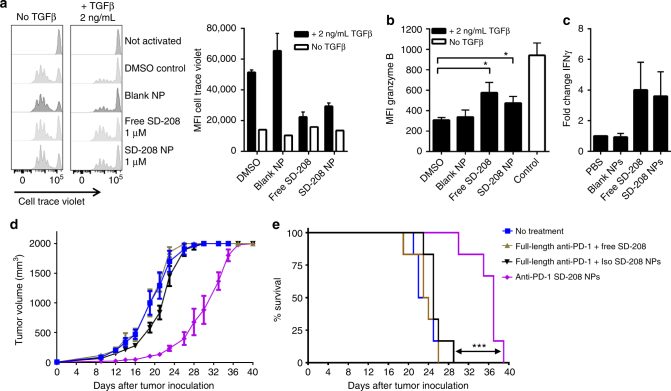
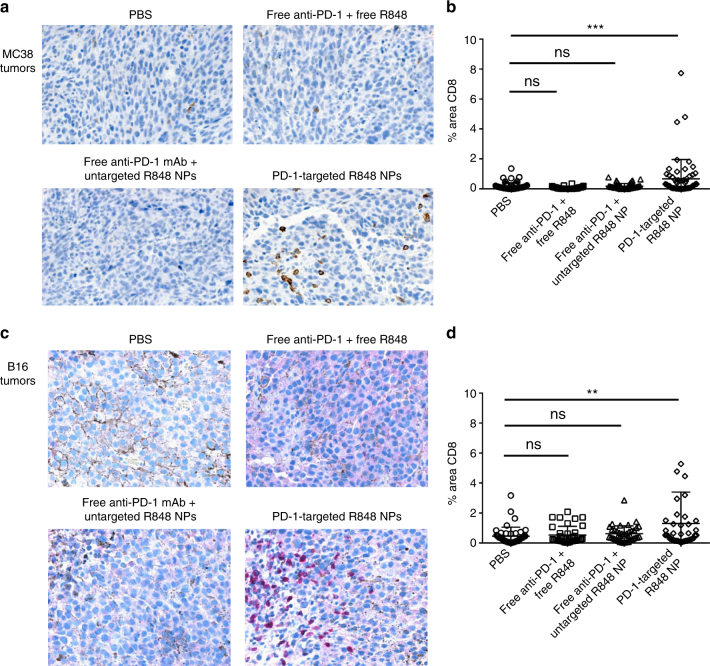
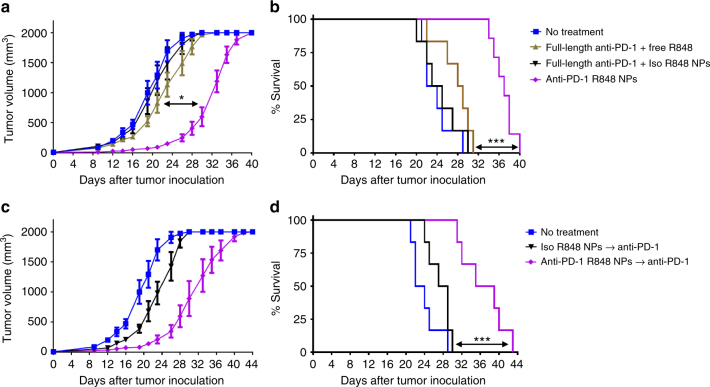
Abstract Targeted delivery of compounds to particular cell subsets can enhance therapeutic index by concentrating their action on the cells of interest. Because attempts to target tumors directly have yielded limited benefit, we instead target endogenous immune cell subsets in the circulation that can migrate actively into tumors. We describe antibody-targeted nanoparticles that bind to CD8 + T cells in the blood, lymphoid tissues, and tumors of mice. PD-1 + T cells are successfully targeted in the circulation and tumor. The delivery of an inhibitor of TGFβ signaling to PD-1-expressing cells extends the survival of tumor-bearing mice, whereas free drugs have no effect at such doses. This modular platform also enables PD-1-targeted delivery of a TLR7/8 agonist to the tumor microenvironment, increasing the proportion of tumor-infiltrating CD8 + T cells and sensitizing tumors to subsequent anti-PD-1. Targeted delivery of immunotherapy to defined subsets of endogenous leukocytes may be superior to administration of free drugs.
Overview
The claims and statistics of this paper haven’t been checked yet.
Free: it reads the open-access text and checks the first 5 claims that cite a source we can check. Create a free account to check every claim.
Integrity signals
Registry
Cites
Statistics
Figures
Verification
Claims the paper makes
The claims and statistics of this paper haven’t been checked yet.
Free: it reads the open-access text and checks the first 5 claims that cite a source we can check. Create a free account to check every claim.
Claims other papers make about this one
Each is checked against this paper’s own text: does it say what the citing paper says it does?
In the citing paper
“Targeting the immunosuppressive TGF‐β signaling in T cells by PLGA nanoparticles enhances antitumor immunity in mice. These nanoparticles bind to T cells and release a TGF‐βR1 inhibitor, SD‐208, that stimulates the potency of CD8+ Teff cells while inhibiting the inhibitory Treg cells in the TME [90].”
From Tumor microenvironment signaling and therapeutics in cancer progression (2023) · cites this paper as [90]
Self-check
Percentages, sums and reported differences re-computed from the paper’s own numbers.
The self-check needs the paper’s full text.
Citations
Cites
PD-1 and PD-L1 Immune Checkpoint Blockade to Treat Breast Cancer
Hartkopf, A. D., Taran, F.-A., Wallwiener, M., Walter, C. B., Krämer, B., Grischke, E.-M., & Brucker, S. Y. (2016) · Breast Care · doi:10.1159/000453569 · Cited by 30,845
Adverse Renal Effects of Immune Checkpoint Inhibitors: A Narrative Review
Wanchoo, R., Karam, S., Uppal, N. N., Barta, V. S., Deray, G., Devoe, C., Launay-Vacher, V., Jhaveri, K. D., & on behalf of Cancer and Kidney International Network Workgroup on Immune Checkpoint Inhibitors (2017) · American Journal of Nephrology · doi:10.1159/000455014 · Cited by 15,256
Intratumor Heterogeneity and Branched Evolution Revealed by Multiregion Sequencing
Gerlinger, M., Rowan, A. J., Horswell, S., Larkin, J., Endesfelder, D., Gronroos, E., Martinez, P., Matthews, N., Stewart, A., Tarpey, P., et al. (2012) · New England Journal of Medicine · doi:10.1056/nejmoa1113205 · Cited by 7,774 · cited 1×
“Adaptation is vital because cytotoxic agents select for resistant cancer clones, as tumors are heterogeneous and evolve when confronted with selection pressure 35 .”
BackgroundHerbst, R. S., Baas, P., Kim, D.-W., Felip, E., Pérez-Gracia, J. L., Han, J.-Y., Molina, J., Kim, J.-H., Arvis, C. D., Ahn, M.-J., et al. (2016) · The Lancet · doi:10.1016/s0140-6736(15)01281-7 · Cited by 6,449
Elements of cancer immunity and the cancer–immune set point
Chen, D. S., & Mellman, I. (2017) · Nature · doi:10.1038/nature21349 · Cited by 5,352 · cited 1×
“It has been suggested that elevated levels of TGF β may foster the development of excessive stromal features that can prevent the penetration of leukocytes into the tumor parenchyma 43 .”
BackgroundCancer immunotherapy comes of age
Mellman, I., Coukos, G., & Dranoff, G. (2011) · Nature · doi:10.1038/nature10673 · Cited by 3,893 · cited 1×
“Cancer immunotherapy can generate a coordinated and proliferative anti-tumor response that has the potential to be applicable across varied cancer types and their underlying mutations 36 .”
BackgroundSeiwert, T. Y., Burtness, B., Mehra, R., Weiss, J., Berger, R., Eder, J. P., Heath, K., McClanahan, T., Lunceford, J., Gause, C., et al. (2016) · The Lancet Oncology · doi:10.1016/s1470-2045(16)30066-3 · Cited by 1,745 · cited 1×
“Pembrolizumab is a fully humanized anti-PD-1 antibody that is approved for the treatment of melanoma 21 , non-small-cell lung cancer 22 , and head and neck cancer 23 .”
BackgroundStimulation of CD25(+)CD4(+) regulatory T cells through GITR breaks immunological self-tolerance
Shimizu, J., Yamazaki, S., Takahashi, T., Ishida, Y., & Sakaguchi, S. (2002) · Nature Immunology · doi:10.1038/ni759 · Cited by 1,729
Prabhakar, U., Maeda, H., Jain, R. K., Sevick-Muraca, E. M., Zamboni, W., Farokhzad, O. C., Barry, S. T., Gabizon, A., Grodzinski, P., & Blakey, D. C. (2013) · Cancer Research · doi:10.1158/0008-5472.can-12-4561 · Cited by 1,485
Nanoparticle uptake: The phagocyte problem
Gustafson, H. H., Holt-Casper, D., Grainger, D. W., & Ghandehari, H. (2015) · Nano Today · doi:10.1016/j.nantod.2015.06.006 · Cited by 1,411
Cited by
Items 401–468 of 468
Cancer Nanomedicine: Special Focus on Cancer Immunotherapy
Tavakolpour, S., & Karami, F. (2020) · Springer eBooks · doi:10.1007/978-3-030-50287-4_26 · Cited by 3
Bakir, M. A., Alkhatib, A. R., Mustafa, A. R., Raddaoui, M., Al-Kattan, W., & Mohammad, K. S. (2026) · Pharmaceutics · doi:10.3390/pharmaceutics18050571 · Cited by 2
Cho, U., Pu, J., Sharma, A., Song, J., You, J. H., Kim, Y., Im, P. W., Park, H. W., Moon, H. E., Myeong, H. S., et al. (2026) · Molecular Cancer · doi:10.1186/s12943-026-02736-0 · Cited by 2
Ejigah, V., Mandala, B., & Akala, E. O. (2022) · PubMed · Cited by 2
Moll, L., & Mailänder, V. (2019) · Nanoscience and technology · doi:10.1007/978-3-030-12461-8_11 · Cited by 2
Flexibility in the Design of Nanomedicine Using Biomimetic Immunomodulatory
Patil, A. S., Masareddy, R. S., & Patil, P. P. (2023) · Springer eBooks · doi:10.1007/978-3-031-35395-6_9 · Cited by 2
Receptor agonist/antagonist-incorporated anticancer nanodrugs: Design, materials, and strategies
Hao, S.-J., Wu, S., Chang, Y.-K., & Wu, F. (2024) · Materials Today · doi:10.1016/j.mattod.2024.11.006 · Cited by 2
Jiang, Y., Sun, X., Chen, Y., Song, D., Zhou, C.-J., Chen, X., Huang, C., Wang, Z., & Li, J. (2025) · Frontiers in Oncology · doi:10.3389/fonc.2025.1514281 · Cited by 2
Quantitative Determination of Intracellular Bond Cleavage
Walker, J. A., Sorkin, M. R., & Alabi, C. A. (2021) · Methods in pharmacology and toxicology · doi:10.1007/978-1-0716-1250-7_14 · Cited by 2
Williams, R. M., Kapadia, C. H., Jaimes, E. A., & Heller, D. A. (2021) · Elsevier eBooks · doi:10.1016/b978-0-12-823318-4.00026-3 · Cited by 2
A nanotherapeutic approach for fighting the odds against the malignant disorders
Saini, S., Dagar, P., Gupta, S., & Kumar, Y. (2023) · Journal of Nanoparticle Research · doi:10.1007/s11051-023-05754-x · Cited by 2
Emerging Vaccine for the Treatment of Cancer Via Nanotechnology
Bose, K. J. C., & Sarwan, J. (2023) · Springer eBooks · doi:10.1007/978-3-031-35395-6_5 · Cited by 3
Nanocapsules for uptake, release and sensing in cells
Thiramanas, R. (2020) · Gutenberg Open Science · doi:10.25358/openscience-3115 · Cited by 2
Feng, B. (2022) · Frontiers in Pharmacology · doi:10.3389/fphar.2022.925673 · Cited by 2
Ji, Y. C., Li, J., Ma, L., Wang, Z., Du, B., Kwan, H. Y., Bian, Z., & Chu, C.-C. (2025) · Nanomaterials · doi:10.3390/nano15131006 · Cited by 1
Cell-Derived Nanocarriers for Monocyte-Mediated Therapeutic Delivery: Concept and Challenges
Yu, S. E., Kim, J., & Sung, H. (2026) · Yonsei Medical Journal · doi:10.3349/ymj.2025.0286 · Cited by 1
Cleemput, J. V., Cock, M. D., Verbeek, R., Burg, E., Eeckhout, B. V. D., Witkowski, W., van Snippenberg, W., Stylianidou, Z., Galetic, E. B., Delporte, M., et al. (2026) · EMBO Molecular Medicine · doi:10.1038/s44321-026-00481-x · Cited by 1
Ghaemi, N. S., Amiri, M., Moharramnejad, M., Yarahmadi, S., Nabavi, J., Kahvand, M., Shahi, M., & Ehsani, A. (2026) · Polymer Bulletin · doi:10.1007/s00289-026-06613-0 · Cited by 1
Prachyathipsakul, T., Gupta, P., Thayumanavan, S., Vijay, S., Kannan, K., & Thayumanavan, S. (2026) · Bioconjugate Chemistry · doi:10.1021/acs.bioconjchem.6c00299 · Cited by 1
CD Receptor and Targeting Strategies
Kotak, D. J., Todke, P. A., Dandekar, P. P., & Devarajan, P. V. (2019) · AAPS advances in the pharmaceutical sciences series · doi:10.1007/978-3-030-29168-6_13 · Cited by 1
Immunotoxicity Testing – In Vitro Cell Culture Models
Rothen‐Rutishauser, B., Drašler, B., & Petri‐Fink, A. (2020) · Molecular and integrative toxicology · doi:10.1007/978-3-030-33962-3_11 · Cited by 1
Dovizio, M., Ballerini, P., Fullone, R., Tacconelli, S., Contursi, A., Patrignani, P., & undefined, U. (2021) · Vide Leaf, Hyderabad eBooks · doi:10.37247/pamol2ed.2.2021.16 · Cited by 1
Surface‐Capped Protein Nanoparticles for Nonviral Gene Delivery
Xhyliu, F., Yao, Y., Ko, Y., Grasman, G., Raymond, J. E., Chang, A., Deng, Y., Dominic, G., Triebwasser, M. P., & Lahann, J. (2026) · Advanced Materials · doi:10.1002/adma.202521796 · Cited by 1
Deb, V. K., Mukherjee, A., Pathak, S., Paul, S., Duttaroy, A. K., & Adhikari, S. (2026) · Frontiers in Bioengineering and Biotechnology · doi:10.3389/fbioe.2026.1775442 · Cited by 1
Cell Membrane-Coated Nanoparticles for Immune Modulation
Kroll, A. V. (2019) · eScholarship (California Digital Library) · Cited by 1
Sangnier, A. P. (2019) · theses.fr (ABES) · doi:10.70675/6b6be052z21dcz48f0z9c9cza41318c93cb3 · Cited by 1
Mottas, I. (2018) · Archive ouverte UNIGE (University of Geneva) · doi:10.13097/archive-ouverte/unige:104911
Injectable, Ultrasound-Responsive Biomaterials as Cancer Vaccines
Shih, T. (2018) · Digital Access to Scholarship at Harvard (DASH) (Harvard University)
Delandre, S. (2020) · Digitale Bibliothek Braunschweig (Verbundzentrale Göttingen (VZG)) · doi:10.24355/dbbs.084-202009280911-0
Reprogramming T Cells to Interrogate Intracellular Disease Signatures
Ho, P. (2019) · eScholarship (California Digital Library)
P3-6-8 子宮筋層中の血管に胎児・羊水成分は羊水塞栓症に特異的であるか?(Group 103 羊水塞栓症,一般演題,公益社団法人日本産科婦人科学会第66回学術講演会)
仲神, 宏., 梶原, 健., 岡垣, 竜., 亀井, 良., 石原, 理., & 板倉, 敦. (2014) · 日本産科婦人科學會雜誌
The use of resiquimod (RSQ) in treatment of melanoma
Tambunlertchai, S., Nejadnik, M. R., Gaine, M. E., Stevens, L., Salem, A. K., & Brogden, N. K. (2021) · doi:10.17077/etd.005812
Yang, W., Zhang, M., Zhang, J., Liu, Y., Ning, J., Yang, J., Zhang, Z., Hou, L., & Chen, X. S. (2021) · SSRN Electronic Journal · doi:10.2139/ssrn.3986126
Different administration routes for nanovectors in cancer immunotherapy
Vaez, A., Amani, A. M., Salehi, M., Zarei‐Behjani, Z., Rezvani, A., Dourtaj, H., Hooshmand-Ardakani, A., & Arabpour, Z. (2024) · Elsevier eBooks · doi:10.1016/b978-0-443-18770-4.00013-5
Targeting Lymph Nodes with a Nanoparticle-Based Drug Delivery System
Singh, L. S., Sumer, P. D. R., Lyngdoh, W., Sharma, A., Lapasam, P., & Debbarma, B. (2024) · International Journal of Zoological Investigations · doi:10.33745/ijzi.2024.v10i01.106
Nanomédicaments pour le traitement de maladies graves et recherches duales
Couvreur, P. (2024) · Comptes Rendus Biologies · doi:10.5802/crbiol.168
Drug Delivery to the Immune System: Immunotherapies and Vaccines
Pal, S., Naveen, D., Mani, B., & Lokeswari, R. (2025) · Methods in pharmacology and toxicology · doi:10.1007/978-1-0716-4554-3_19
Development of Nanoparticles for Use in Immunotherapy: Nanoimmunomodulators (NIMs)
Giorgi, E. D., Montaldo, L., Conti, F., Gualdieri, F., Genovés, S., Díaz, M. E., Desimone, M. F., Guerra, L. N., & Marzi, M. C. D. (2025) · Nanotechnology in the life sciences · doi:10.1007/978-3-031-86508-4_5
Drug Delivery Modalities and Mechanisms
Tam, Y. T., Migliozzi, M. M., Tesar, D. B., Famili, A., Wecksler, A. T., Wichner, S. M., Sreedhara, A., & Shatz-Binder, W. (2025) · Wiley eBooks · doi:10.1002/9781394236145.ch20
Zhou, X., Wei, B., Wang, Y., Liu, M., Guo, X., & Duan, Y. (2025) · Discover Oncology · doi:10.1007/s12672-025-02840-5
Cancer Immunotherapy Advancements Using Nanoparticles
Rajesh, P., Kaur, H., Kumar, A., Das, S., Saxena, J., & Jyoti, A. (2025) · Series in bioengineering · doi:10.1007/978-981-95-0457-2_6
Zhang, T. (2024) · Online Publication Service of Würzburg University (Würzburg University) · doi:10.25972/opus-35865
Lee, N. K., Wang, C.-P. J., Lim, J., Park, W., Kwon, H.-K., Kim, S.-N., Kim, T.-H., & Park, C. G. (2021) · Figshare · doi:10.6084/m9.figshare.15179161
Self-citationT cell engaging nanoparticles towards anti-cancer therapies
Wai, K. (2024) · MacSphere (McMaster University) · doi:10.71548/23358
Nanocarrier-Based Targeted Approaches: To Scavenge ROS-Mediated Inflammation
Sen, S., & Karati, D. (2026) · Springer eBooks · doi:10.1007/978-3-032-11752-6_22
Economic and Healthcare Implications of Nanotechnology in Skin Cancer
Mude, G., Sheikh, M. T., Awatade, S., Singune, S., & Nagdev, S. (2026) · Advances in cancer research · doi:10.1016/bs.acr.2026.01.008
He, Y., & Yeo, Y. (2026) · Wiley Interdisciplinary Reviews Nanomedicine and Nanobiotechnology · doi:10.1002/wnan.70052
Clère-Jehl, R. (2020) · theses.fr (ABES) · doi:10.70675/a65a57a6ze1d1z47baz8fa5zabef17722df4
HITE: HIV Inspired Lipid Nanoparticle Platform for CAR T Cell Engineering
Kim, D. K., Moon, S.-J., Han, E. L., Feng, E., Murray, A. M., Wang, J., Liu, W., Kong, G., June, C. H., & Mitchell, M. J. (2026) · Nano Letters · doi:10.1021/acs.nanolett.5c06317
Li, C., Zhang, P., Zhao, X., Feng, R., Xian, N., Huang, G., Jiang, W., Hu, Z., Zhang, Y., & Ji, N. (2026) · Cancer Immunology Immunotherapy · doi:10.1007/s00262-026-04403-1
Ma, Y., Chen, J., Huang, X., Cai, J., L, G., Qiu, M., & Xia, Y. (2026) · bioRxiv (Cold Spring Harbor Laboratory) · doi:10.64898/2026.05.08.723693
Pensado‐López, A., Sánchez, A. R., & Torres, F. (2025) · Springer handbooks · doi:10.1007/978-3-032-01636-2_25
Hu, W., Chen, Q., Ma, Y., Liu, Y., Qiu, S., Dong, X., Zhu, Z., Wu, X., Du, J., Yanbin, X., et al. (2026) · Journal of Nanobiotechnology · doi:10.1186/s12951-026-04623-8
Epigenetically tunable biomaterials for immune modulation
Foudah, A. I., Ahmad, A., & Alam, A. (2026) · Chinese Chemical Letters · doi:10.1016/j.cclet.2026.113069
Challenges and future horizons in nanomedicine
Sharma, C., Khan, A., Singh, S., Gautam, S., Potdar, P., & Scott, E. (2026) · Elsevier eBooks · doi:10.1016/b978-0-443-36532-4.00012-2
Chen, Z., Vaibavi, S. R., Maricar, S., Liu, Y., Huang, C., Wong, L., Shebanova, A., Ma, Z., Sun, Y., Czarny, B., et al. (2026) · Biomaterials · doi:10.1016/j.biomaterials.2026.124415
Nanotechnology to Engineer the Surface of Immune Cells
Zhang, Z., & King, M. R. (2026) · ACS Nanoscience Au · doi:10.1021/acsnanoscienceau.6c00056
Rituximab-Conjugated DART Nanoformulation for CD20-Targeted Drug Delivery in Non-Hodgkin Lymphoma
Mahmud, M. M., Kong, B., Lee, D., Burgos, E. F. P., Heredia, A., Suk, J. S., & Kim, A. J. (2026) · International Journal of Nanomedicine · doi:10.2147/ijn.s625158
Pang, L., Wang, Z., Jin, Z., Ghonaim, A. H., Zhang, H., You, X., Ning, J., Cao, J., & Liu, Y. (2026) · BMEMat · doi:10.1002/bmm2.70128
Tumor-Activated Carrier-Free Dual-Prodrug Nanoassemblies for Synergistic Chemo-Immunotherapy
Wang, L., Yang, Z., Su, Y., Guanyu, J. I. N., Lin, S., Yu, B., Zhou, H., Zhang, Q., Zhang, S., Bi, Z.-Y., et al. (2026) · Nano Letters · doi:10.1021/acs.nanolett.6c02599
Nanoparticles reshaping graft-versus-host disease landscape
Maia‐Moço, L., Sarmento, B. F. C. C., & Duarte, D. (2026) · Journal of Controlled Release · doi:10.1016/j.jconrel.2026.115415
A MULTI-FACETED APPROACH FOR ADDRESSING POOR DRUG TRANSPORT INTO THE LYMPH NODE
Donzanti, M. J. (2026) · Library, Museums and Press - UDSpace (University of Delaware)
ENGINEERING IMMUNOMODULATORY CAPACITY OF LYMPH NODE-TARGETED DRUG DELIVERY CARRIERS
Ngo, D. (2026) · Library, Museums and Press - UDSpace (University of Delaware)
Internship Reports and Monograph entitled “Strategies of Nanoimmunotherapy in Oncology”.
Maximino, Â. P. (2018) · Portuguese National Funding Agency for Science, Research and Technology (RCAAP Project by FCT)
Makvandi, P., Zamani, S., Fadaie, M., Najafi, M. B., Mofidfar, M., Dana, N., Avazzadeh, A., Mahmoudi, E., Deng, W., Huang, R., et al. (2026) · Acta Pharmaceutica Sinica B · doi:10.1016/j.apsb.2026.10.029
Nanobiomaterial Immunoengineering of Cold Tumors: Overcoming Barriers to Enable Therapeutic Response
Farah, H. S., Hani, T., Patel, P. N., Hanumanthayya, M., Ray, S., Bainsal, N., Urazbaeva, D., & Xusinovna, D. M. (2026) · Immunological Investigations · doi:10.1080/08820139.2026.2763060
Metadata
- Authors
- Schmid, D., Park, C. G., Hartl, C. A., Subedi, N., Cartwright, A. N., Puerto, R. B., Zheng, Y., Maiarana, J., Freeman, G. J., Wucherpfennig, K. W., Irvine, D. J., & Goldberg, M. S.
- Affiliations
- Harvard University (US)
- Dana-Farber Cancer Institute (US)
- Koch Institute for Integrative Cancer Research At MIT (US)
- Howard Hughes Medical Institute (US)
- Corresponding author
- Goldberg, Michael S.
- ORCID
- Venue
- Nature Communications
- Published
- 2017-11-23
- Volume
- 8
- Issue
- 1
- Pages
- 1747-1747
- ISSN
- 2041-1723 (ISSN-L)
- PMC
- PMC5700944
- OpenAlex
- W2768778626
- Cited by
- 449
- References
- 48
- Citations by year
- 2026: 28 · 2025: 39 · 2024: 43 · 2023: 50 · 2022: 66 · 2021: 78 · 2020: 72 · 2019: 54 · 2018: 17
- FWCI
- 14.06
- Type
- journal article
- Language
- en
- Open access
- gold
- doi.org
- Licence
- cc-by
- creativecommons.org/licenses/by/4.0 (tdm)
- creativecommons.org/licenses/by/4.0 (vor)
- Locations
- Nature Communications (publishedVersion, cc-by)
- PubMed Central (publishedVersion, cc-by)
- PubMed (publishedVersion)
- Digital Access to Scholarship at Harvard (DASH) (Harvard University) (submittedVersion, cc-by)
- RePEc: Research Papers in Economics (submittedVersion)
- DOAJ (DOAJ: Directory of Open Access Journals) (submittedVersion, cc-by-sa)
- DSpace@MIT (Massachusetts Institute of Technology) (submittedVersion, cc-by-nc)
- Nature
- Funders
- Melanoma Research Alliance
- Dana-Farber/Harvard Cancer Center
- Topics
- Physical Sciences › Materials Science › Biomaterials › Nanoparticle-Based Drug Delivery
- Health Sciences › Medicine › Oncology › Cancer Immunotherapy and Biomarkers
- Life Sciences › Immunology and Microbiology › Immunology › Immunotherapy and Immune Responses
- Keywords
- antibody-targeted nanoparticles, CD8+ T cells, PD-1, TGF-beta inhibition, TLR7/8 agonist, tumor-infiltrating CD8+ T cells, antitumor immunity, targeted drug delivery, combination immunotherapy, tumor microenvironment
- MeSH terms
- Animals, Female, Humans, Imidazoles, Immunotherapy, Male, Melanoma, Experimental, Membrane Glycoproteins, Mice, Inbred C57BL, Neoplasms, Experimental, Transforming Growth Factor beta, Lymphocytes, Tumor-Infiltrating, Drug Delivery Systems, Mice, Knockout, CD8-Positive T-Lymphocytes, Cell Line, Tumor, Toll-Like Receptor 7, Toll-Like Receptor 8, Mice, Nanoparticles, Tumor Microenvironment, Programmed Cell Death 1 Receptor, Antibodies, Monoclonal, Humanized
About these checks
Registry, retraction, Cites and statistics results are computed, not judged, with one exception: a printed reference that no index lists is read once by a model before it counts as a citation error. Claims are extracted by a model and kept only when their quote appears verbatim in the text; each cited source is then checked, with a model’s help, for whether it says what the claim relies on. Those verdicts can be wrong — read the claim’s quote and the cited source before relying on one.
Statistics and arithmetic are recomputed, not judged.
Confidence bands are shown only for fields calibrated on our annotated test set. None is calibrated yet, so no band is shown.
What counts as a claim ›How we measure confidence ›How we check this ›
Are you an author, or do you see a problem with this page? Request a review
Data sources
Bibliographic data: Semantic Scholar, OpenAlex, Crossref.
Contains information from the Semantic Scholar Academic Graph Datasets, made available under the ODC Attribution License (ODC-BY 1.0).
Semantic Scholar’s data is described in: Kinney, R., et al. (2023). The Semantic Scholar Open Data Platform. arXiv:2301.10140.
