

T cell‐targeting nanoparticles focus delivery of immunotherapy to improve antitumor immunity
Open accessThe DOI matches its Crossref record; 48 of the 48 references it cites were found in a registry or an index.
Abstract
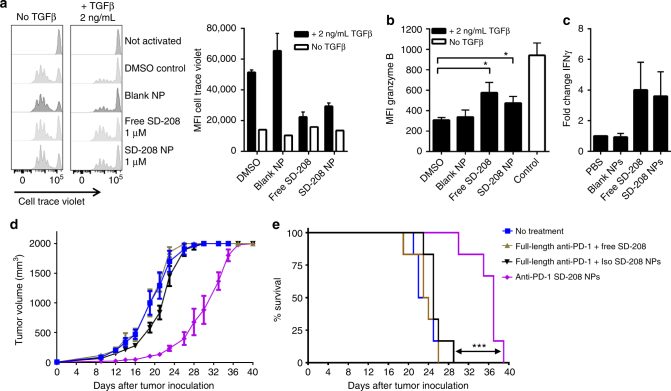
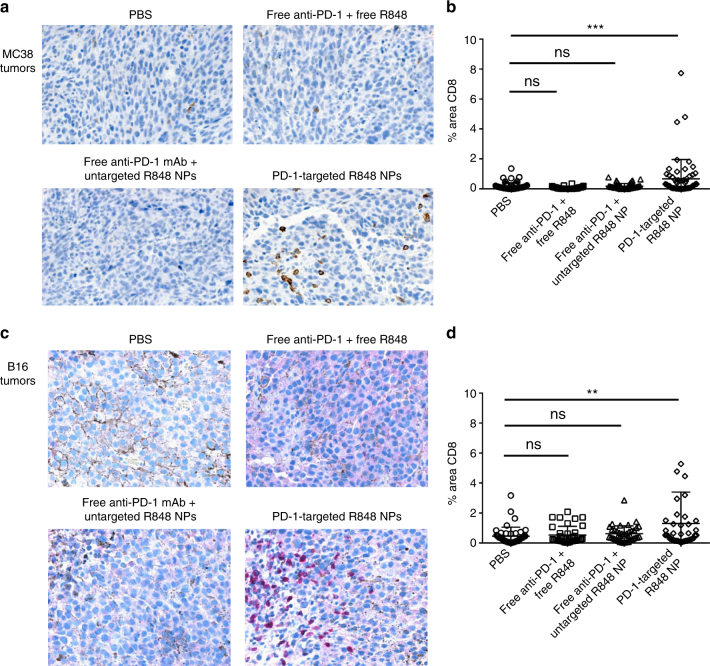
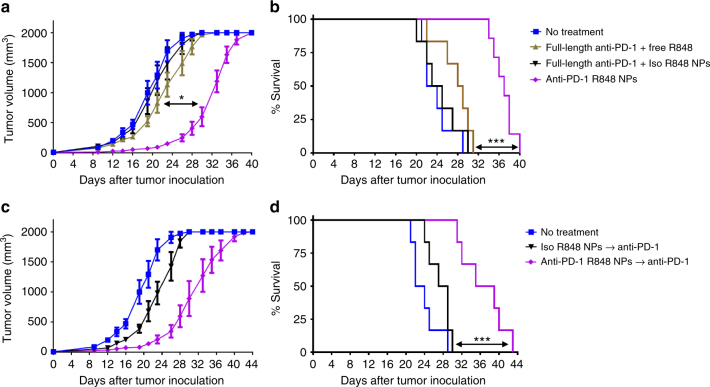
Abstract Targeted delivery of compounds to particular cell subsets can enhance therapeutic index by concentrating their action on the cells of interest. Because attempts to target tumors directly have yielded limited benefit, we instead target endogenous immune cell subsets in the circulation that can migrate actively into tumors. We describe antibody-targeted nanoparticles that bind to CD8 + T cells in the blood, lymphoid tissues, and tumors of mice. PD-1 + T cells are successfully targeted in the circulation and tumor. The delivery of an inhibitor of TGFβ signaling to PD-1-expressing cells extends the survival of tumor-bearing mice, whereas free drugs have no effect at such doses. This modular platform also enables PD-1-targeted delivery of a TLR7/8 agonist to the tumor microenvironment, increasing the proportion of tumor-infiltrating CD8 + T cells and sensitizing tumors to subsequent anti-PD-1. Targeted delivery of immunotherapy to defined subsets of endogenous leukocytes may be superior to administration of free drugs.
Overview
The claims and statistics of this paper haven’t been checked yet.
Free: it reads the open-access text and checks the first 5 claims that cite a source we can check. Create a free account to check every claim.
Integrity signals
Registry
Cites
Statistics
Figures
Verification
Claims the paper makes
The claims and statistics of this paper haven’t been checked yet.
Free: it reads the open-access text and checks the first 5 claims that cite a source we can check. Create a free account to check every claim.
Claims other papers make about this one
Each is checked against this paper’s own text: does it say what the citing paper says it does?
In the citing paper
“Targeting the immunosuppressive TGF‐β signaling in T cells by PLGA nanoparticles enhances antitumor immunity in mice. These nanoparticles bind to T cells and release a TGF‐βR1 inhibitor, SD‐208, that stimulates the potency of CD8+ Teff cells while inhibiting the inhibitory Treg cells in the TME [90].”
From Tumor microenvironment signaling and therapeutics in cancer progression (2023) · cites this paper as [90]
Self-check
Percentages, sums and reported differences re-computed from the paper’s own numbers.
The self-check needs the paper’s full text.
Citations
Cites
PD-1 and PD-L1 Immune Checkpoint Blockade to Treat Breast Cancer
Hartkopf, A. D., Taran, F.-A., Wallwiener, M., Walter, C. B., Krämer, B., Grischke, E.-M., & Brucker, S. Y. (2016) · Breast Care · doi:10.1159/000453569 · Cited by 30,845
Adverse Renal Effects of Immune Checkpoint Inhibitors: A Narrative Review
Wanchoo, R., Karam, S., Uppal, N. N., Barta, V. S., Deray, G., Devoe, C., Launay-Vacher, V., Jhaveri, K. D., & on behalf of Cancer and Kidney International Network Workgroup on Immune Checkpoint Inhibitors (2017) · American Journal of Nephrology · doi:10.1159/000455014 · Cited by 15,256
Intratumor Heterogeneity and Branched Evolution Revealed by Multiregion Sequencing
Gerlinger, M., Rowan, A. J., Horswell, S., Larkin, J., Endesfelder, D., Gronroos, E., Martinez, P., Matthews, N., Stewart, A., Tarpey, P., et al. (2012) · New England Journal of Medicine · doi:10.1056/nejmoa1113205 · Cited by 7,774 · cited 1×
“Adaptation is vital because cytotoxic agents select for resistant cancer clones, as tumors are heterogeneous and evolve when confronted with selection pressure 35 .”
BackgroundHerbst, R. S., Baas, P., Kim, D.-W., Felip, E., Pérez-Gracia, J. L., Han, J.-Y., Molina, J., Kim, J.-H., Arvis, C. D., Ahn, M.-J., et al. (2016) · The Lancet · doi:10.1016/s0140-6736(15)01281-7 · Cited by 6,449
Elements of cancer immunity and the cancer–immune set point
Chen, D. S., & Mellman, I. (2017) · Nature · doi:10.1038/nature21349 · Cited by 5,352 · cited 1×
“It has been suggested that elevated levels of TGF β may foster the development of excessive stromal features that can prevent the penetration of leukocytes into the tumor parenchyma 43 .”
BackgroundCancer immunotherapy comes of age
Mellman, I., Coukos, G., & Dranoff, G. (2011) · Nature · doi:10.1038/nature10673 · Cited by 3,893 · cited 1×
“Cancer immunotherapy can generate a coordinated and proliferative anti-tumor response that has the potential to be applicable across varied cancer types and their underlying mutations 36 .”
BackgroundSeiwert, T. Y., Burtness, B., Mehra, R., Weiss, J., Berger, R., Eder, J. P., Heath, K., McClanahan, T., Lunceford, J., Gause, C., et al. (2016) · The Lancet Oncology · doi:10.1016/s1470-2045(16)30066-3 · Cited by 1,745 · cited 1×
“Pembrolizumab is a fully humanized anti-PD-1 antibody that is approved for the treatment of melanoma 21 , non-small-cell lung cancer 22 , and head and neck cancer 23 .”
BackgroundStimulation of CD25(+)CD4(+) regulatory T cells through GITR breaks immunological self-tolerance
Shimizu, J., Yamazaki, S., Takahashi, T., Ishida, Y., & Sakaguchi, S. (2002) · Nature Immunology · doi:10.1038/ni759 · Cited by 1,729
Prabhakar, U., Maeda, H., Jain, R. K., Sevick-Muraca, E. M., Zamboni, W., Farokhzad, O. C., Barry, S. T., Gabizon, A., Grodzinski, P., & Blakey, D. C. (2013) · Cancer Research · doi:10.1158/0008-5472.can-12-4561 · Cited by 1,485
Nanoparticle uptake: The phagocyte problem
Gustafson, H. H., Holt-Casper, D., Grainger, D. W., & Ghandehari, H. (2015) · Nano Today · doi:10.1016/j.nantod.2015.06.006 · Cited by 1,411
Pneumonitis in Patients Treated With Anti–Programmed Death-1/Programmed Death Ligand 1 Therapy
Naidoo, J., Wang, X., Woo, K. M., Iyriboz, T., Halpenny, D., Cunningham, J., Chaft, J. E., Segal, N. H., Callahan, M. K., Lesokhin, A. M., et al. (2017) · Journal of Clinical Oncology · doi:10.1200/jco.2016.68.2005 · Cited by 1,215 · cited 1×
“Moreover, systemic immune stimulation is often associated with autoimmune-type pathologies, such as colitis and pneumonitis 2, 3 , as the doses required to break immune tolerance to the tumor can invoke undesired host-vs.”
BackgroundHrkach, J., Von Hoff, D., Ali, M. M., Andrianova, E., Auer, J., Campbell, T., De Witt, D., Figa, M., Figueiredo, M., Horhota, A., et al. (2012) · Science Translational Medicine · doi:10.1126/scitranslmed.3003651 · Cited by 1,147
PD-1 identifies the patient-specific CD8+ tumor-reactive repertoire infiltrating human tumors
Gros, A., Robbins, P. F., Yao, X., Li, Y. F., Turcotte, S., Tran, E., Wunderlich, J. R., Mixon, A., Farid, S., Dudley, M. E., et al. (2014) · Journal of Clinical Investigation · doi:10.1172/jci73639 · Cited by 1,111
Association of Pembrolizumab With Tumor Response and Survival Among Patients With Advanced Melanoma
Ribas, A., Hamid, O., Daud, A., Hodi, F. S., Wolchok, J. D., Kefford, R., Joshua, A. M., Patnaik, A., Hwu, W.-J., Weber, J. S., et al. (2016) · JAMA · doi:10.1001/jama.2016.4059 · Cited by 1,069 · cited 1×
“Pembrolizumab is a fully humanized anti-PD-1 antibody that is approved for the treatment of melanoma 21 , non-small-cell lung cancer 22 , and head and neck cancer 23 .”
BackgroundDependency of Colorectal Cancer on a TGF-β-Driven Program in Stromal Cells for Metastasis Initiation
Calon, A., Espinet, E., Palomo-Ponce, S., Tauriello, D. V. F., Iglesias, M., Céspedes, M. V., Sevillano, M., Nadal, C., Jung, P., Zhang, X. H.-F., et al. (2012) · Cancer Cell · doi:10.1016/j.ccr.2012.08.013 · Cited by 1,060
The roles of TGFβ in the tumour microenvironment
Pickup, M., Novitskiy, S., & Moses, H. L. (2013) · Nature Reviews Cancer · doi:10.1038/nrc3603 · Cited by 917
Gros, A., Parkhurst, M. R., Tran, E., Pasetto, A., Robbins, P. F., Ilyas, S., Prickett, T. D., Gartner, J. J., Crystal, J. S., Roberts, I. M., et al. (2016) · Nature Medicine · doi:10.1038/nm.4051 · Cited by 829
Bartlett, D. W., Su, H., Hildebrandt, I. J., Weber, W. A., & Davis, M. E. (2007) · Proceedings of the National Academy of Sciences · doi:10.1073/pnas.0707461104 · Cited by 803
Treatment of the Immune-Related Adverse Effects of Immune Checkpoint Inhibitors: A Review
Friedman, C. F., Proverbs-Singh, T. A., & Postow, M. A. (2016) · JAMA Oncology · doi:10.1001/jamaoncol.2016.1051 · Cited by 802
De Novo Epigenetic Programs Inhibit PD-1 Blockade-Mediated T Cell Rejuvenation
Ghoneim, H. E., Fan, Y., Moustaki, A., Abdelsamed, H. A., Dash, P., Dogra, P., Carter, R., Awad, W., Neale, G., Thomas, P. G., et al. (2017) · Cell · doi:10.1016/j.cell.2017.06.007 · Cited by 781
Therapeutic cell engineering with surface-conjugated synthetic nanoparticles
Stephan, M. T., Moon, J. J., Um, S. H., Bershteyn, A., & Irvine, D. J. (2010) · Nature Medicine · doi:10.1038/nm.2198 · Cited by 750
Self-citationArlauckas, S. P., Garris, C. S., Kohler, R. H., Kitaoka, M., Cuccarese, M. F., Yang, K. S., Miller, M. A., Carlson, J. C., Freeman, G. J., Anthony, R. M., et al. (2017) · Science Translational Medicine · doi:10.1126/scitranslmed.aal3604 · Cited by 669 · cited 1×
“This fi nding may be rather important, as it has recently been shown that anti-PD-1 antibodies (full IgG with intact Fc) are quickly removed from T cells by tumor-associated macrophages, which thereby reduce the ef fi cacy of the immunotherapy 18 .”
BackgroundSelf-citationSharabi, A. B., Nirschl, C. J., Kochel, C. M., Nirschl, T. R., Francica, B. J., Velarde, E., Deweese, T. L., & Drake, C. G. (2015) · Cancer Immunology Research · doi:10.1158/2326-6066.cir-14-0196 · Cited by 658
Development of TGF-β signalling inhibitors for cancer therapy
Yingling, J. M., Blanchard, K. L., & Sawyer, J. S. (2004) · Nature Reviews Drug Discovery · doi:10.1038/nrd1580 · Cited by 549
Durable Cancer Regression Off-Treatment and Effective Reinduction Therapy with an Anti-PD-1 Antibody
Lipson, E. J., Sharfman, W. H., Drake, C. G., Wollner, I., Taube, J. M., Anders, R. A., Xu, H., Yao, S., Pons, A., Chen, L., et al. (2013) · Clinical Cancer Research · doi:10.1158/1078-0432.ccr-12-2625 · Cited by 545
Bragado, P., Estrada, Y., Parikh, F., Krause, S., Capobianco, C., Farina, H. G., Schewe, D. M., & Aguirre-Ghiso, J. A. (2013) · Nature Cell Biology · doi:10.1038/ncb2861 · Cited by 503
The Next Hurdle in Cancer Immunotherapy: Overcoming the Non–T-Cell–Inflamed Tumor Microenvironment
Gajewski, T. F. (2015) · Seminars in Oncology · doi:10.1053/j.seminoncol.2015.05.011 · Cited by 488
Uhl, M., Aulwurm, S., Wischhusen, J., Weiler, M., Ma, J. Y., Almirez, R., Mangadu, R., Liu, Y.-W., Platten, M., Herrlinger, U., et al. (2004) · Cancer Research · doi:10.1158/0008-5472.can-04-1013 · Cited by 414
Impact of protein pre-coating on the protein corona composition and nanoparticle cellular uptake
Mirshafiee, V., Kim, R., Park, S., Mahmoudi, M., & Kraft, M. L. (2016) · Biomaterials · doi:10.1016/j.biomaterials.2015.10.019 · Cited by 316 · cited 1×
“High target speci fi city and avidity were thus achieved in the absence of potential interactions with Fc receptors expressed by phagocytic cells, which are a major means of nanoparticle clearance 15 .”
BackgroundActive targeting of chemotherapy to disseminated tumors using nanoparticle-carrying T cells
Huang, B., Abraham, W. D., Zheng, Y., Bustamante López, S. C., Luo, S. S., & Irvine, D. J. (2015) · Science Translational Medicine · doi:10.1126/scitranslmed.aaa5447 · Cited by 312
Self-citationLoré, K., Betts, M. R., Brenchley, J. M., Kuruppu, J., Khojasteh, S., Perfetto, S., Roederer, M., Seder, R. A., & Koup, R. A. (2003) · The Journal of Immunology · doi:10.4049/jimmunol.171.8.4320 · Cited by 291
P-selectin is a nanotherapeutic delivery target in the tumor microenvironment
Shamay, Y., Elkabets, M., Li, H., Shah, J., Brook, S., Wang, F., Adler, K., Baut, E., Scaltriti, M., Jena, P. V., et al. (2016) · Science Translational Medicine · doi:10.1126/scitranslmed.aaf7374 · Cited by 220
Aurora kinase inhibitor nanoparticles target tumors with favorable therapeutic index in vivo
Ashton, S., Song, Y. H., Nolan, J., Cadogan, E., Murray, J., Odedra, R., Foster, J., Hall, P. A., Low, S., Taylor, P., et al. (2016) · Science Translational Medicine · doi:10.1126/scitranslmed.aad2355 · Cited by 218
Synapse-directed delivery of immunomodulators using T-cell-conjugated nanoparticles
Stephan, M. T., Stephan, S. B., Bak, P., Chen, J., & Irvine, D. J. (2012) · Biomaterials · doi:10.1016/j.biomaterials.2012.04.029 · Cited by 209
Self-citationNakagawa, H., Sido, J. M., Reyes, E. E., Kiers, V., Cantor, H., & Kim, H.-J. (2016) · Proceedings of the National Academy of Sciences · doi:10.1073/pnas.1604765113 · Cited by 176 · cited 1×
“GITR is expressed predominantly by CD4 + Tregs 32 , and agonism of GITR has been shown to increase anti-tumor activity by decreasing the stability of the Treg lineage within tumors, thereby reducing immune suppression 33, 34 .”
BackgroundSchaer, D. A., Budhu, S., Liu, C., Bryson, C., Malandro, N., Cohen, A., Zhong, H., Yang, X., Houghton, A. N., Merghoub, T., et al. (2013) · Cancer Immunology Research · doi:10.1158/2326-6066.cir-13-0086 · Cited by 160
Homet Moreno, B., Zaretsky, J. M., Garcia-Diaz, A., Tsoi, J., Parisi, G., Robert, L., Meeth, K., Ndoye, A., Bosenberg, M., Weeraratna, A. T., et al. (2016) · Cancer Immunology Research · doi:10.1158/2326-6066.cir-16-0060 · Cited by 149
In vivo targeting of adoptively transferred T-cells with antibody- and cytokine-conjugated liposomes
Zheng, Y., Stephan, M. T., Gai, S. A., Abraham, W., Shearer, A., & Irvine, D. J. (2013) · Journal of Controlled Release · doi:10.1016/j.jconrel.2013.05.037 · Cited by 142
Self-citationAhonen, C. L., Gibson, S. J., Smith, R. M., Pederson, L. K., Lindh, J. M., Tomai, M. A., & Vasilakos, J. P. (1999) · Cellular Immunology · doi:10.1006/cimm.1999.1555 · Cited by 131
McHugh, M. D., Park, J. Y., Uhrich, R., Gao, W., Horwitz, D. A., & Fahmy, T. M. (2015) · Biomaterials · doi:10.1016/j.biomaterials.2015.04.003 · Cited by 129
Deliberate removal of T cell help improves virus-neutralizing antibody production
Recher, M., Lang, K. S., Hunziker, L., Freigang, S., Eschli, B., Harris, N. L., Navarini, A. A., Senn, B. M., Fink, K., Lötscher, M., et al. (2004) · Nature Immunology · doi:10.1038/ni1102 · Cited by 116
Park, J., Gao, W., Whiston, R., Strom, T. B., Metcalfe, S., & Fahmy, T. M. (2011) · Molecular Pharmaceutics · doi:10.1021/mp100203a · Cited by 109
Lee, M., Park, C., Lee, Y.-R., Im, S., Song, S., & Lee, C. (2014) · Archives of Pharmacal Research · doi:10.1007/s12272-014-0379-4 · Cited by 82
Self-citationBiotargeted Nanomedicines for Cancer: Six Tenets Before You Begin
Goldberg, M. S., Hook, S. S., Wang, A. Z., Bulte, J. W. M., Patri, A. K., Uckun, F. M., Cryns, V. L., Hanes, J. S., Akin, D., Hall, J. B., et al. (2013) · Nanomedicine · doi:10.2217/nnm.13.3 · Cited by 60
Self-citationT-cell TGF-β signaling abrogation restricts medulloblastoma progression
Gate, D., Danielpour, M., Rodriguez, J., Kim, G. B., Levy, R., Bannykh, S., Breunig, J. J., Kaech, S. M., Flavell, R. A., & Town, T. (2014) · Proceedings of the National Academy of Sciences · doi:10.1073/pnas.1412489111 · Cited by 53
Schmid, D., Fay, F., Small, D. M., Jaworski, J., Riley, J. S., Tegazzini, D., Fenning, C., Jones, D. S., Johnston, P. G., Longley, D. B., et al. (2014) · Molecular Therapy · doi:10.1038/mt.2014.137 · Cited by 45
Self-citationTandon, M., Salamoun, J. M., Carder, E. J., Farber, E., Xu, S., Deng, F., Tang, H., Wipf, P., & Wang, Q. J. (2015) · PLoS ONE · doi:10.1371/journal.pone.0119346 · Cited by 40
Akbari, A., Amanpour, S., Muhammadnejad, S., Ghahremani, M. H., Ghaffari, S. H., Dehpour, A. R., Mobini, G. R., Shidfar, F., Abastabar, M., Khoshzaban, A., et al. (2014) · DARU Journal of Pharmaceutical Sciences · doi:10.1186/2008-2231-22-47 · Cited by 33 · cited 1×
“SD-208 has similarly been administered at doses more than an order of magnitude greater than what was used in these studies in order to achieve therapeutic bene fi t, even necessitating daily 28 or twice daily 29 oral gavage at such doses (at least 50 mg kg − 1 per day).”
Cited by
Engineering precision nanoparticles for drug delivery
Mitchell, M. J., Billingsley, M. M., Haley, R. M., Wechsler, M. E., Peppas, N. A., & Langer, R. (2021) · Nature Reviews Drug Discovery · doi:10.1038/s41573-020-0090-8 · Cited by 7,933
Delivery technologies for cancer immunotherapy
Riley, R. S., June, C. H., Langer, R., & Mitchell, M. J. (2019) · Nature Reviews Drug Discovery · doi:10.1038/s41573-018-0006-z · Cited by 2,607
Targeted drug delivery strategies for precision medicines
Manzari, M. T., Shamay, Y., Kiguchi, H., Rosen, N., Scaltriti, M., & Heller, D. A. (2021) · Nature Reviews Materials · doi:10.1038/s41578-020-00269-6 · Cited by 1,183
Concepts of nanoparticle cellular uptake, intracellular trafficking, and kinetics in nanomedicine
Donahue, N. D., Acar, H., & Wilhelm, S. (2019) · Advanced Drug Delivery Reviews · doi:10.1016/j.addr.2019.04.008 · Cited by 944
Enhancing cancer immunotherapy with nanomedicine
Irvine, D. J., & Dane, E. L. (2020) · Nature Reviews Immunology · doi:10.1038/s41577-019-0269-6 · Cited by 882
Self-citation
Metadata
- Authors
- Schmid, D., Park, C. G., Hartl, C. A., Subedi, N., Cartwright, A. N., Puerto, R. B., Zheng, Y., Maiarana, J., Freeman, G. J., Wucherpfennig, K. W., Irvine, D. J., & Goldberg, M. S.
- Affiliations
- Harvard University (US)
- Dana-Farber Cancer Institute (US)
- Koch Institute for Integrative Cancer Research At MIT (US)
- Howard Hughes Medical Institute (US)
- Corresponding author
- Goldberg, Michael S.
- ORCID
- Venue
- Nature Communications
- Published
- 2017-11-23
- Volume
- 8
- Issue
- 1
- Pages
- 1747-1747
- ISSN
- 2041-1723 (ISSN-L)
- PMC
- PMC5700944
- OpenAlex
- W2768778626
- Cited by
- 449
- References
- 48
- Citations by year
- 2026: 28 · 2025: 39 · 2024: 43 · 2023: 50 · 2022: 66 · 2021: 78 · 2020: 72 · 2019: 54 · 2018: 17
- FWCI
- 14.06
- Type
- journal article
- Language
- en
- Open access
- gold
- doi.org
- Licence
- cc-by
- creativecommons.org/licenses/by/4.0 (tdm)
- creativecommons.org/licenses/by/4.0 (vor)
- Locations
- Nature Communications (publishedVersion, cc-by)
- PubMed Central (publishedVersion, cc-by)
- PubMed (publishedVersion)
- Digital Access to Scholarship at Harvard (DASH) (Harvard University) (submittedVersion, cc-by)
- RePEc: Research Papers in Economics (submittedVersion)
- DOAJ (DOAJ: Directory of Open Access Journals) (submittedVersion, cc-by-sa)
- DSpace@MIT (Massachusetts Institute of Technology) (submittedVersion, cc-by-nc)
- Nature
- Funders
- Melanoma Research Alliance
- Dana-Farber/Harvard Cancer Center
- Topics
- Physical Sciences › Materials Science › Biomaterials › Nanoparticle-Based Drug Delivery
- Health Sciences › Medicine › Oncology › Cancer Immunotherapy and Biomarkers
- Life Sciences › Immunology and Microbiology › Immunology › Immunotherapy and Immune Responses
- Keywords
- antibody-targeted nanoparticles, CD8+ T cells, PD-1, TGF-beta inhibition, TLR7/8 agonist, tumor-infiltrating CD8+ T cells, antitumor immunity, targeted drug delivery, combination immunotherapy, tumor microenvironment
- MeSH terms
- Animals, Female, Humans, Imidazoles, Immunotherapy, Male, Melanoma, Experimental, Membrane Glycoproteins, Mice, Inbred C57BL, Neoplasms, Experimental, Transforming Growth Factor beta, Lymphocytes, Tumor-Infiltrating, Drug Delivery Systems, Mice, Knockout, CD8-Positive T-Lymphocytes, Cell Line, Tumor, Toll-Like Receptor 7, Toll-Like Receptor 8, Mice, Nanoparticles, Tumor Microenvironment, Programmed Cell Death 1 Receptor, Antibodies, Monoclonal, Humanized
About these checks
Registry, retraction, Cites and statistics results are computed, not judged, with one exception: a printed reference that no index lists is read once by a model before it counts as a citation error. Claims are extracted by a model and kept only when their quote appears verbatim in the text; each cited source is then checked, with a model’s help, for whether it says what the claim relies on. Those verdicts can be wrong — read the claim’s quote and the cited source before relying on one.
Statistics and arithmetic are recomputed, not judged.
Confidence bands are shown only for fields calibrated on our annotated test set. None is calibrated yet, so no band is shown.
What counts as a claim ›How we measure confidence ›How we check this ›
Are you an author, or do you see a problem with this page? Request a review
Data sources
Bibliographic data: Semantic Scholar, OpenAlex, Crossref.
Contains information from the Semantic Scholar Academic Graph Datasets, made available under the ODC Attribution License (ODC-BY 1.0).
Semantic Scholar’s data is described in: Kinney, R., et al. (2023). The Semantic Scholar Open Data Platform. arXiv:2301.10140.
