

Dendrogenin A drives LXR to trigger lethal autophagy in cancers
Open accessThe DOI matches its Crossref record; 67 of the 68 references it cites were found in a registry or an index.
Abstract
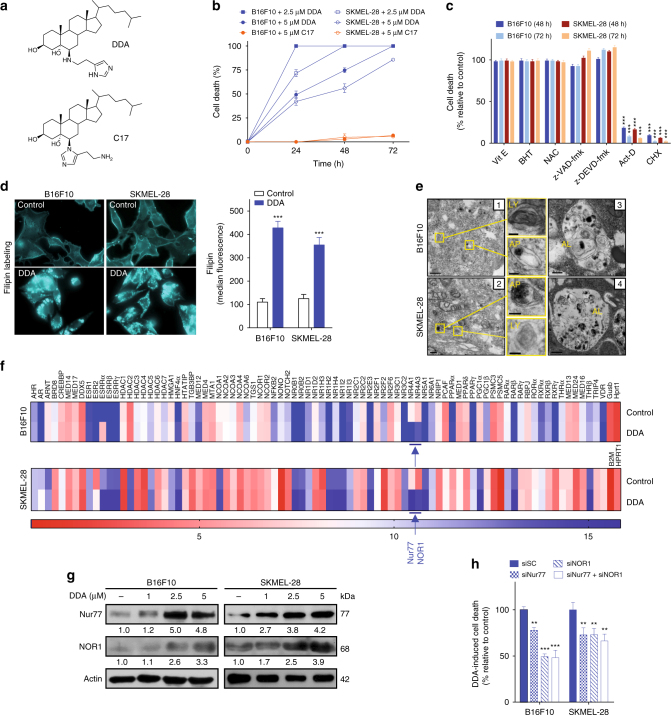
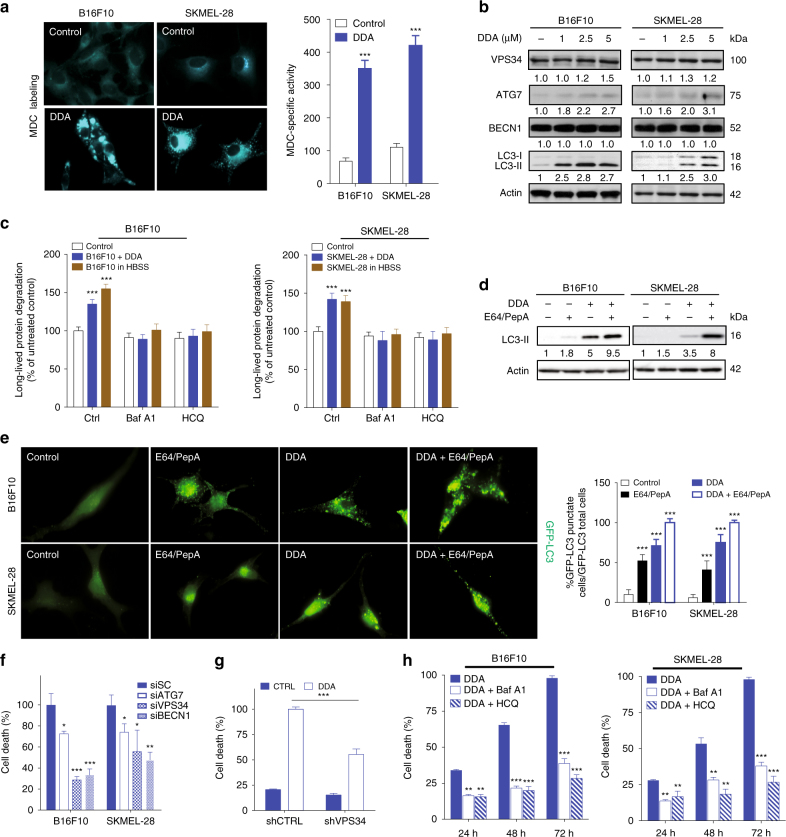
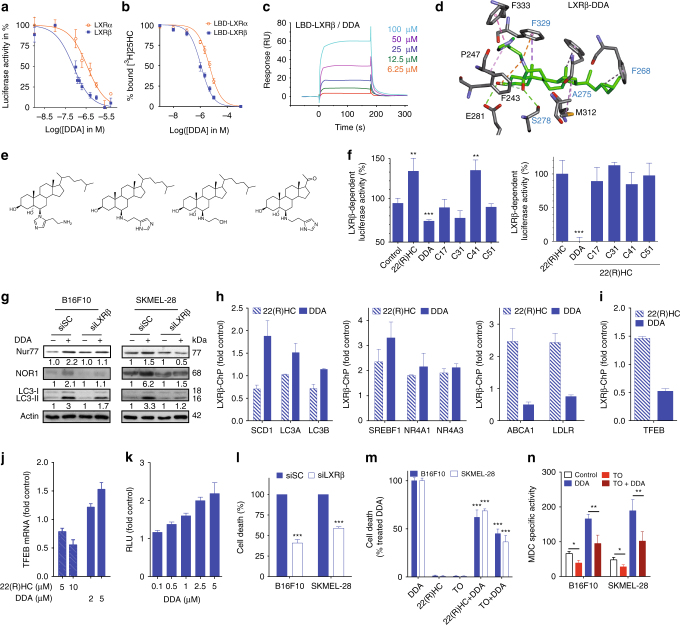
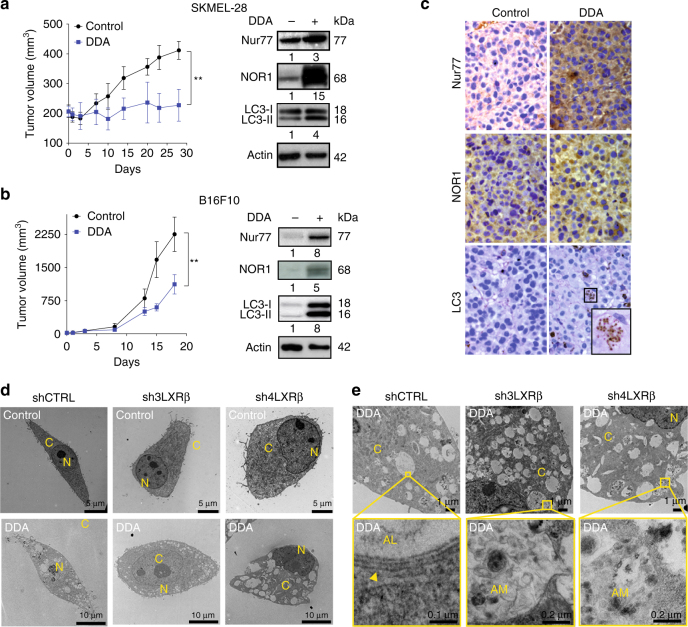
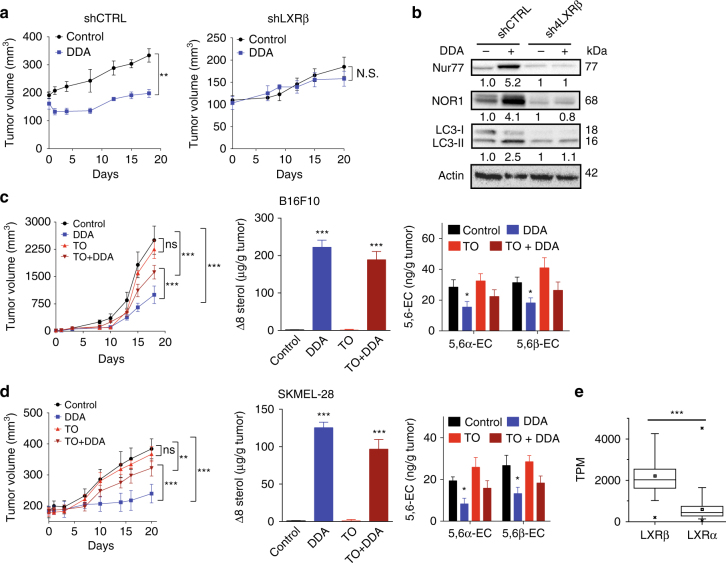
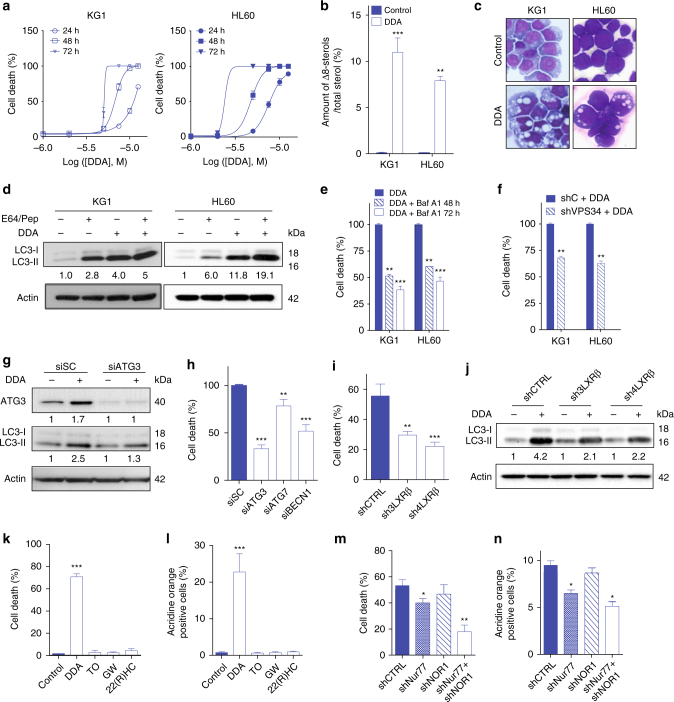
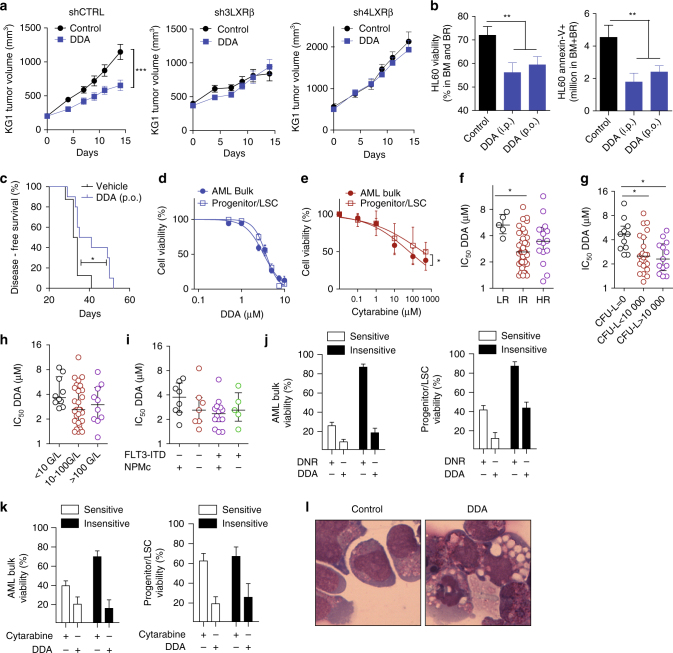
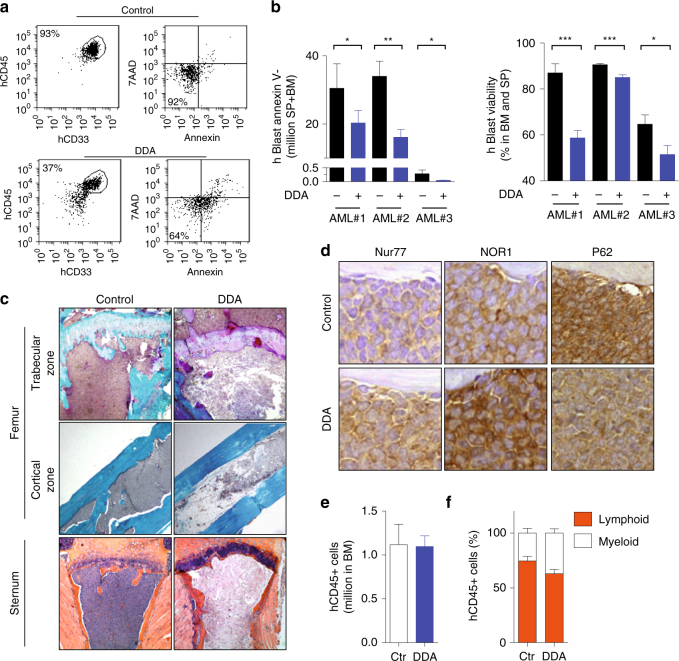
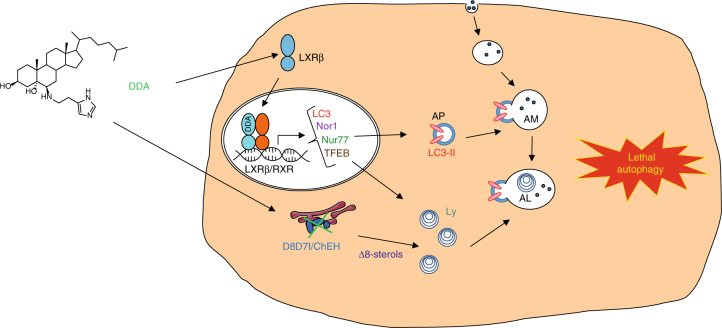
Dendrogenin A (DDA) is a newly discovered cholesterol metabolite with tumor suppressor properties. Here, we explored its efficacy and mechanism of cell death in melanoma and acute myeloid leukemia (AML). We found that DDA induced lethal autophagy in vitro and in vivo, including primary AML patient samples, independently of melanoma Braf status or AML molecular and cytogenetic classifications. DDA is a partial agonist on liver-X-receptor (LXR) increasing Nur77, Nor1, and LC3 expression leading to autolysosome formation. Moreover, DDA inhibited the cholesterol biosynthesizing enzyme 3β-hydroxysterol-Δ 8,7 -isomerase (D8D7I) leading to sterol accumulation and cooperating in autophagy induction. This mechanism of death was not observed with other LXR ligands or D8D7I inhibitors establishing DDA selectivity. The potent anti-tumor activity of DDA, its original mechanism of action and its low toxicity support its clinical evaluation. More generally, this study reveals that DDA can direct control a nuclear receptor to trigger lethal autophagy in cancers.
Overview
The claims and statistics of this paper haven’t been checked yet.
Free: it reads the open-access text and checks the first 5 claims that cite a source we can check. Create a free account to check every claim.
Integrity signals
Registry
Cites
Statistics
Figures
Verification
Claims the paper makes
The claims and statistics of this paper haven’t been checked yet.
Free: it reads the open-access text and checks the first 5 claims that cite a source we can check. Create a free account to check every claim.
Claims other papers make about this one
Each is checked against this paper’s own text: does it say what the citing paper says it does?
The cited source says what the claim attributes to it.
In the citing paper
“Blocking EBP activity has been shown to contribute to the death of tumor cells9,10,17,18.”
From Structural basis for human sterol isomerase in cholesterol biosynthesis and multidrug recognition (2019) · cites this paper as [10]
Self-check
Percentages, sums and reported differences re-computed from the paper’s own numbers.
The self-check needs the paper’s full text.
Citations
Cites
Guidelines for the use and interpretation of assays for monitoring autophagy (3rd edition).
Klionsky, D. J., Abdelmohsen, K., Abe, A., Abedin, M. J., Abeliovich, H., Acevedo Arozena, A., Adachi, H., Adams, C. M., Adams, P. D., Adeli, K., et al. (2016) · Autophagy · doi:10.1080/15548627.2015.1100356 · Cited by 5,894
Methods in Mammalian Autophagy Research
Mizushima, N., Yoshimori, T., & Levine, B. (2010) · Cell · doi:10.1016/j.cell.2010.01.028 · Cited by 4,497 · cited 1×
“To validate the induction of autophagy suggested by TEM analysis, complimentary assays were performed 23, 24 .”
Guidelines for the use and interpretation of assays for monitoring autophagy
Klionsky, D. J., Abdalla, F. C., Abeliovich, H., Abraham, R. T., Acevedo-Arozena, A., Adeli, K., Agholme, L., Agnello, M., Agostinis, P., Aguirre-Ghiso, J. A., et al. (2012) · Autophagy · doi:10.4161/auto.19496 · Cited by 4,330 · cited 4×
“Inhibition of one of the ChEH subunit, D8D7I, and the accumulation of its substrate, zymostenol, has been previously reported to be associated with autophagy 11, 14, 15, 23 .”
InfluentialSelf-consumption: the interplay of autophagy and apoptosis
Mariño, G., Niso-Santano, M., Baehrecke, E. H., & Kroemer, G. (2014) · Nature Reviews Molecular Cell Biology · doi:10.1038/nrm3735 · Cited by 2,172 · cited 1×
“Autophagy is a well established survival mechanism that helps cells to escape to death and is also a mechanism of resistance to chemotherapy and endocrine therapies 22, 23, 48 – 50 .”
Yue, S., Li, J., Lee, S.-Y., Lee, H. J., Shao, T., Song, B., Cheng, L., Masterson, T. A., Liu, X., Ratliff, T. L., et al. (2014) · Cell Metabolism · doi:10.1016/j.cmet.2014.01.019 · Cited by 929 · cited 3×
“RNA expression of the different genes of interest (Supplementary Tables 1, 2) were determined using the ΔΔ CT method, where the difference in the threshold cycle ( Δ CT) values of the target gene and the housekeeping gene for each sample was normalized to the Δ CT value of the untreated sample.”
Napolitano, G., & Ballabio, A. (2016) · Journal of Cell Science · doi:10.1242/jcs.146365 · Cited by 845 · cited 1×
“TFEB is a master transcription factor controlling genes involved in autophagy and lysosome organization and biogenesis 31 – 34 .”
27-Hydroxycholesterol Links Hypercholesterolemia and Breast Cancer Pathophysiology
Nelson, E. R., Wardell, S. E., Jasper, J. S., Park, S., Suchindran, S., Howe, M. K., Carver, N. J., Pillai, R. V., Sullivan, P. M., Sondhi, V., et al. (2013) · Science · doi:10.1126/science.1241908 · Cited by 839 · cited 7×
“To measure the ΔΨm, cells were incubated at 37 °C for 15 min in the presence of 40 nM DiOC6(3) (Molecular Probes) with or without 100 mM carbonyl cyanide m-chlorophenylhydrazone (CCCP).”
InfluentialExploiting the Mutanome for Tumor Vaccination
Castle, J. C., Kreiter, S., Diekmann, J., Löwer, M., van de Roemer, N., de Graaf, J., Selmi, A., Diken, M., Boegel, S., Paret, C., et al. (2012) · Cancer Research · doi:10.1158/0008-5472.can-11-3722 · Cited by 810
To Be or Not to Be? How Selective Autophagy and Cell Death Govern Cell Fate
Green, D. R., & Levine, B. (2014) · Cell · doi:10.1016/j.cell.2014.02.049 · Cited by 693 · cited 1×
“Cancers can upregulate autophagy to survive microenvironmental stress and to increase growth and aggressiveness 18 .”
Burnett, A. K., Hills, R. K., Milligan, D., Kjeldsen, L., Kell, J., Russell, N. H., Yin, J. A. L., Hunter, A., Goldstone, A. H., & Wheatley, K. (2011) · Journal of Clinical Oncology · doi:10.1200/jco.2010.31.4310 · Cited by 657
Research works printed but not linked: 1
- Viennois E Selective liver X receptor modulators (SLiMs): what use in human health? Mol. Cell Endocrinol. 2012 351 129 141 10.1016/j.mce.2011.08.036 21907760 · DOI
Cited by
Lam, S. M., Zhang, C., Wang, Z., Ni, Z., Zhang, S., Yang, S., Huang, X., Mo, L., Li, J., Lee, B., et al. (2021) · Nature Metabolism · doi:10.1038/s42255-021-00425-4 · Cited by 284
Karasinska, J. M., Topham, J. T., Kalloger, S. E., Jang, G. H., Denroche, R. E., Culibrk, L., Williamson, L. M., Wong, H.-L., Lee, M. K. C., O'Kane, G. M., et al. (2020) · Clinical Cancer Research · doi:10.1158/1078-0432.ccr-19-1543 · Cited by 211
“Dendrogenin A is a recently identified cholesterol derivative formed from cholesterol-5,6-epoxides and histamine with LXR activating and antitumor properties (49).”
BackgroundMeyer, N. E., Henkel, L. M., Linder, B., Zielke, S., Tascher, G., Trautmann, S., Geißlinger, G., Münch, C., Fulda, S., Tegeder, I., et al. (2021) · Autophagy · doi:10.1080/15548627.2021.1874208 · Cited by 122
“[5] Segala G, David M, Medina P de, et al.”
BackgroundAutophagy in Cancer Cell Death
Linder, B., & Kögel, D. (2019) · Biology · doi:10.3390/biology8040082 · Cited by 127
“(DDA) induced lethal autophagy, reminiscent of ACD, in myeloma and acute myeloid leukemia in vitro and in vivo [19].”
BackgroundOxysterol research: a brief review
Griffiths, W. J., & Wang, Y. (2019) · Biochemical Society Transactions · doi:10.1042/bst20180135 · Cited by 110
Metadata
- Authors
- Segala, G., David, M., de Medina, P., Poirot, M. C., Serhan, N., Vergez, F., Mougel, A., Saland, E., Carayon, K., Leignadier, J., Caron, N., Voisin, M., Cherier, J., Ligat, L., Lopez, F., Noguer, E., Rives, A., Payré, B., Saati, T. A., Lamaziere, A., Despres, G., Lobaccaro, J.-M., Baron, S., Demur, C., de Toni, F., Larrue, C., Boutzen, H., Thomas, F., Sarry, J.-E., Tosolini, M., Picard, D., Record, M., Récher, C., Poirot, M., & Silvente-Poirot, S.
- Affiliations
- Université Toulouse III - Paul Sabatier (FR)
- Centre Hospitalier Universitaire de Toulouse (FR)
- Inserm (FR)
- Centre National de la Recherche Scientifique (FR)
- Centre de Recherches en Cancérologie de Toulouse (FR)
- University of Geneva (CH)
- Corresponding author
- Poirot, Mathias C.
- Récher, Christian
- ORCID
- Venue
- Nature Communications
- Published
- 2017-12-04
- Volume
- 8
- Issue
- 1
- Pages
- 1903-1903
- ISSN
- 2041-1723 (ISSN-L)
- PMC
- PMC5712521
- OpenAlex
- W2768673582
- Cited by
- 125
- References
- 68
- Citations by year
- 2026: 19 · 2025: 8 · 2024: 9 · 2023: 9 · 2022: 11 · 2021: 16 · 2020: 23 · 2019: 18 · 2018: 12
- FWCI
- 11.36
- Type
- journal article
- Language
- en
- Open access
- gold
- doi.org
- Licence
- cc-by
- creativecommons.org/licenses/by/4.0 (tdm)
- creativecommons.org/licenses/by/4.0 (vor)
- Locations
- Nature Communications (publishedVersion, cc-by)
- Europe PMC (PubMed Central) (publishedVersion, cc-by)
- PubMed Central (publishedVersion, cc-by)
- PubMed (publishedVersion)
- Archive ouverte UNIGE (University of Geneva) (publishedVersion, other-oa)
- HAL (submittedVersion, cc-by)
- RePEc: Research Papers in Economics (submittedVersion)
- DOAJ (DOAJ: Directory of Open Access Journals) (submittedVersion, cc-by-sa)
- Archive ouverte UNIGE (University of Geneva) (submittedVersion, cc-by)
- Funders
- Association pour la Recherche sur le Cancer
- Agence Nationale de la Recherche (ANR-11-RPIB-0015, ANR-11-RPIB-015-02, ANR-11-PHUC-0001, 10-LABX-57, ANR-10LABX-57, ANR-10, ANR-10-LABX)
- Topics
- Life Sciences › Biochemistry, Genetics and Molecular Biology › Cell Biology › Autophagy in Disease and Therapy
- Life Sciences › Biochemistry, Genetics and Molecular Biology › Cancer Research › Cancer, Lipids, and Metabolism
- Life Sciences › Biochemistry, Genetics and Molecular Biology › Biochemistry › Cholesterol and Lipid Metabolism
- Keywords
- liver X receptor, autophagy, melanoma, acute myeloid leukemia, tumor suppressor, nuclear receptor agonists, Nur77, NOR-1, LC3, sterol accumulation, nuclear receptor ligands, anticancer activity
- MeSH terms
- Liver X Receptors, Animals, Antineoplastic Agents, Autophagy, Cholestanols, Humans, Imidazoles, Melanoma, Melanoma, Experimental, Microtubule-Associated Proteins, Leukemia, Myeloid, Acute, Gene Expression, Cell Death, HL-60 Cells, Membrane Transport Proteins, Cell Line, Tumor, Mice, Drug Partial Agonism, Nuclear Receptor Subfamily 4, Group A, Member 1, HEK293 Cells, In Vitro Techniques
About these checks
Registry, retraction, Cites and statistics results are computed, not judged, with one exception: a printed reference that no index lists is read once by a model before it counts as a citation error. Claims are extracted by a model and kept only when their quote appears verbatim in the text; each cited source is then checked, with a model’s help, for whether it says what the claim relies on. Those verdicts can be wrong — read the claim’s quote and the cited source before relying on one.
Statistics and arithmetic are recomputed, not judged.
Confidence bands are shown only for fields calibrated on our annotated test set. None is calibrated yet, so no band is shown.
What counts as a claim ›How we measure confidence ›How we check this ›
Are you an author, or do you see a problem with this page? Request a review
How to cite
Cite CoChat for the checks on this page, and the paper for its own findings.
- This page
- CoChat. (2026). Citation check: Dendrogenin A drives LXR to trigger lethal autophagy in cancers. https://app.cochat.ai/papers/10.1038/s41467-017-01948-9
- The paper
- Segala, G., David, M., de Medina, P., Poirot, M. C., Serhan, N., Vergez, F., Mougel, A., Saland, E., Carayon, K., Leignadier, J., Caron, N., Voisin, M., Cherier, J., Ligat, L., Lopez, F., Noguer, E., Rives, A., Payré, B., Saati, T. A., . . . Silvente-Poirot, S. (2017). Dendrogenin A drives LXR to trigger lethal autophagy in cancers. Nature Communications. https://doi.org/10.1038/s41467-017-01948-9
Data sources
Bibliographic data: Semantic Scholar, OpenAlex, Crossref.
Contains information from the Semantic Scholar Academic Graph Datasets, made available under the ODC Attribution License (ODC-BY 1.0).
Semantic Scholar’s data is described in: Kinney, R., et al. (2023). The Semantic Scholar Open Data Platform. arXiv:2301.10140.
