

Discrete and continuous mechanisms of temporal selection in rapid visual streams
Open accessThe DOI matches its Crossref record; 52 of the 53 references it cites were found in a registry or an index.
Abstract
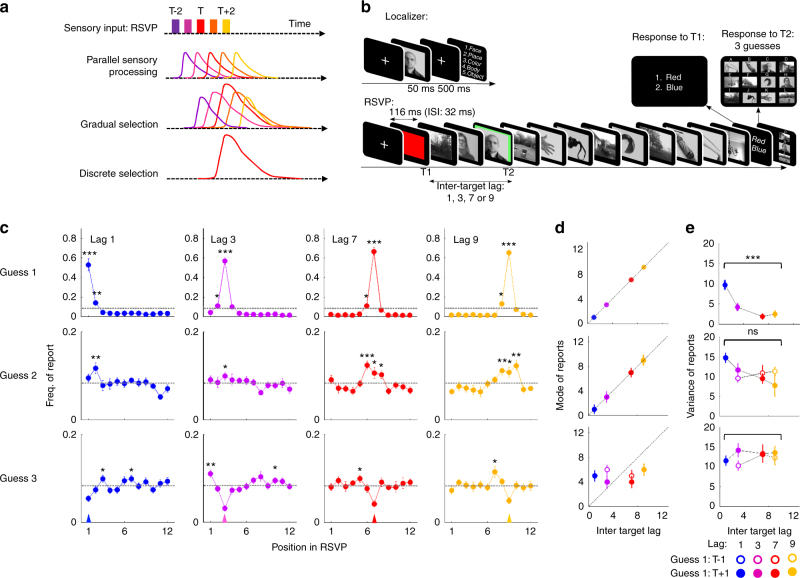
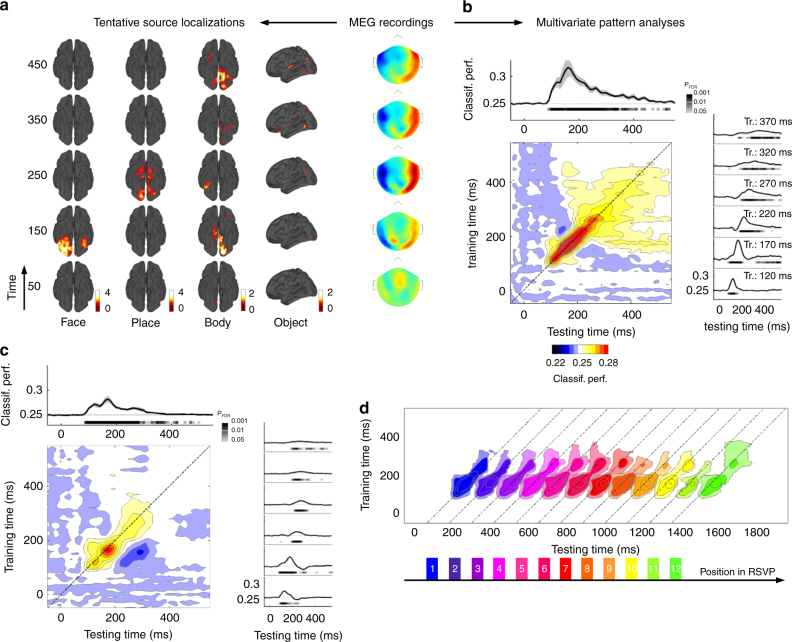
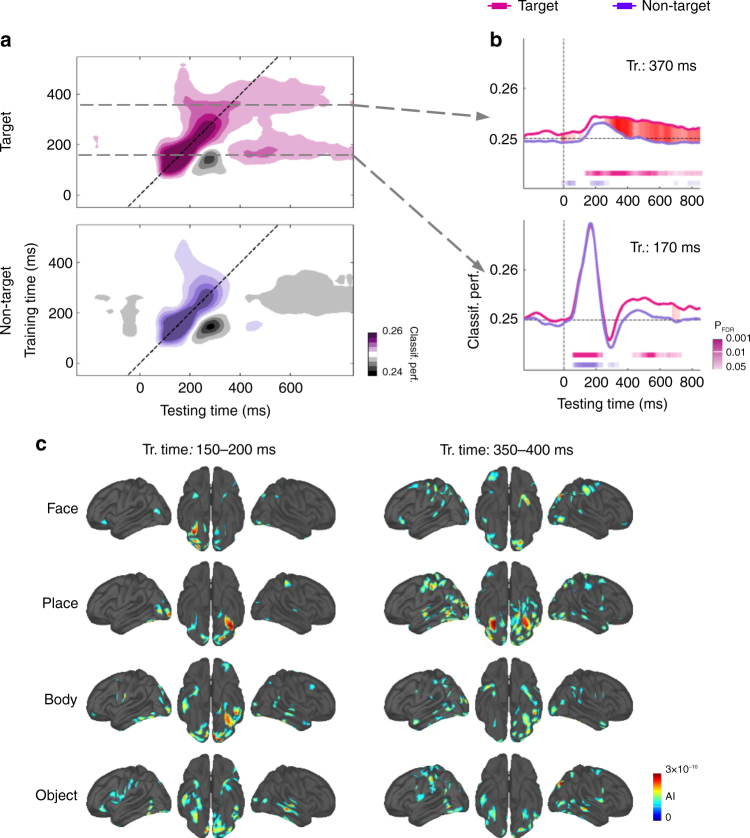
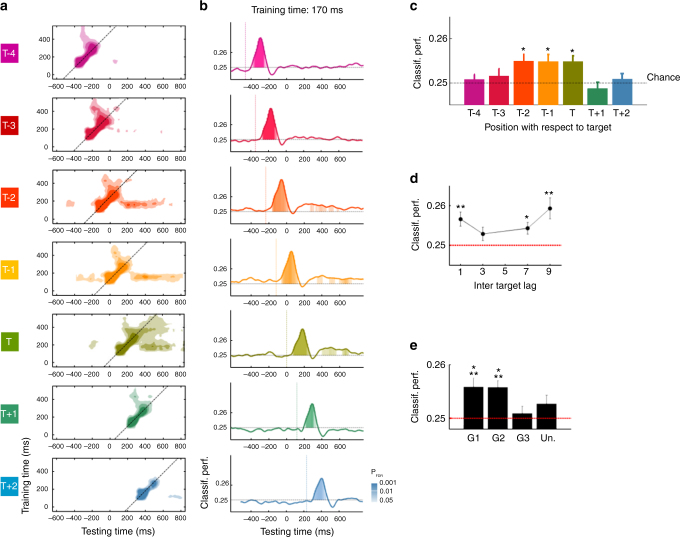
Humans can reliably detect a target picture even when tens of images are flashed every second. Here we use magnetoencephalography to dissect the neural mechanisms underlying the dynamics of temporal selection during a rapid serial visual presentation task. Multivariate decoding algorithms allow us to track the overlapping brain responses induced by each image in a rapid visual stream. The results show that temporal selection involves a sequence of gradual followed by all-or-none stages: (i) all images first undergo the same parallel processing pipeline; (ii) starting around 150 ms, responses to multiple images surrounding the target are continuously amplified in ventral visual areas; (iii) only the images that are subsequently reported elicit late all-or-none activations in visual and parietal areas around 350 ms. Thus, multiple images can cohabit in the brain and undergo efficient parallel processing, but temporal selection also isolates a single one for amplification and report.
Overview
The claims and statistics of this paper haven’t been checked yet.
Free: it reads the open-access text and checks the first 5 claims that cite a source we can check. Create a free account to check every claim.
Integrity signals
Registry
Cites
Statistics
Figures
Verification
Claims the paper makes
The claims and statistics of this paper haven’t been checked yet.
Free: it reads the open-access text and checks the first 5 claims that cite a source we can check. Create a free account to check every claim.
Claims other papers make about this one
Each is checked against this paper’s own text: does it say what the citing paper says it does?
The source backs part of the claim, not all of it — or backs it for a different population, condition or comparison.
In the citing paper
“The first 200 ms of brain activity, corresponding to early perceptual processing, can be fully preserved on trials without conscious perception, particularly under inattention conditions”
From Conscious Processing and the Global Neuronal Workspace Hypothesis (2020) · cites this paper as Marti and Dehaene, 2017
Experimental — accuracy not yet measuredThe source backs part of the claim, not all of it — or backs it for a different population, condition or comparison.
In the citing paper
“Early perceptual processing in the first 200 milliseconds can be similar or even identical between conscious (i.e., reported) and unconscious (i.e., not reported) trials, [67][68][69] but conscious perception is associated with late events, such as the N2/P3b/P300 component of scalp-event-related potentials in humans.6,[70][71][72]”
From An integrative, multiscale view on neural theories of consciousness (2024) · cites this paper as [68]
Experimental — accuracy not yet measured
Self-check
Percentages, sums and reported differences re-computed from the paper’s own numbers.
The self-check needs the paper’s full text.
Citations
Cites
Scikit-learn: Machine Learning in Python
Pedregosa, F., Varoquaux, G., Gramfort, A., Michel, V., Thirion, B., Grisel, O., Blondel, M., Müller, A., Nothman, J., Louppe, G., et al. (2012) · arXiv · doi:10.48550/arxiv.1201.0490 · Cited by 71,016
LIBSVM: A library for support vector machines
Chang, C.-C., & Lin, C.-J. (2011) · ACM Transactions on Intelligent Systems and Technology · doi:10.1145/1961189.1961199 · Cited by 40,918
Cortical Surface-Based Analysis
Dale, A. M., Fischl, B., & Sereno, M. I. (1999) · NeuroImage · doi:10.1006/nimg.1998.0395 · Cited by 10,910
Oostenveld, R., Fries, P., Maris, E., & Schoffelen, J.-M. (2011) · Computational Intelligence and Neuroscience · doi:10.1155/2011/156869 · Cited by 10,323
Fast and robust fixed-point algorithms for independent component analysis
Hyvarinen, A. (1999) · IEEE Transactions on Neural Networks · doi:10.1109/72.761722 · Cited by 6,246 · cited 10×
“Report accuracy–defined as trials where one of the guesses corresponded to T2–strongly decreased with the intertarget Lag (Repeated-measures analysis of variance (ANOVA), N = 15, F(3,42) = 7.”
InfluentialCortical Surface-Based Analysis
Fischl, B., Sereno, M. I., & Dale, A. M. (1999) · NeuroImage · doi:10.1006/nimg.1998.0396 · Cited by 6,147
Brainstorm: A User-Friendly Application for MEG/EEG Analysis
Tadel, F., Baillet, S., Mosher, J. C., Pantazis, D., & Leahy, R. M. (2011) · Computational Intelligence and Neuroscience · doi:10.1155/2011/879716 · Cited by 3,677
The aligned rank transform for nonparametric factorial analyses using only anova procedures
Wobbrock, J. O., Findlater, L., Gergle, D., & Higgins, J. J. (2011) · Proceedings of the SIGCHI Conference on Human Factors in Computing Systems · doi:10.1145/1978942.1978963 · Cited by 2,854
Temporary suppression of visual processing in an RSVP task: An attentional blink?
Raymond, J. E., Shapiro, K. L., & Arnell, K. M. (1992) · Journal of Experimental Psychology: Human Perception and Performance · doi:10.1037//0096-1523.18.3.849 · Cited by 2,260
On the interpretation of weight vectors of linear models in multivariate neuroimaging
Haufe, S., Meinecke, F., Görgen, K., Dähne, S., Haynes, J.-D., Blankertz, B., & Bießmann, F. (2014) · NeuroImage · doi:10.1016/j.neuroimage.2013.10.067 · Cited by 1,389
Cited by
Items 101–128 of 128
Attention, Perception, and Knowledge
Suchy-Dicey, C. (2020) · Cambridge University Press eBooks · doi:10.1017/9781108164238.005 · Cited by 1
Attention, Consciousness, and Habitual Behavior
Suchy-Dicey, C. (2020) · Cambridge University Press eBooks · doi:10.1017/9781108164238.006
The Philosophical Landscape on Attention
Suchy-Dicey, C. (2020) · Cambridge University Press eBooks · doi:10.1017/9781108164238.003
Yao, Y., Wu, Y., Xu, T., & Chen, F. (2021) · Frontiers in Systems Neuroscience · doi:10.3389/fnsys.2021.734660
“For instance, consciously reported target stimuli to display a stronger and more sustained pattern of activation (Marti and Dehaene, 2017).”
BackgroundSuchy-Dicey, C. (2020) · Cambridge University Press eBooks · doi:10.1017/9781108164238.012
Interaction of Human Temporality and External World
Lubashevsky, I., & Plavinska, N. (2021) · Understanding complex systems · doi:10.1007/978-3-030-82612-3_4
Suchy-Dicey, C. (2020) · Cambridge University Press eBooks · doi:10.1017/9781108164238.002
Attention, Mental Causation, and the Self
Suchy-Dicey, C. (2020) · Cambridge University Press eBooks · doi:10.1017/9781108164238.004
The Conceptual History of Top-Down Attention
Suchy-Dicey, C. (2020) · Cambridge University Press eBooks · doi:10.1017/9781108164238.010
Attention, Action, and Responsibility
Suchy-Dicey, C. (2020) · Cambridge University Press eBooks · doi:10.1017/9781108164238.007
Psychologie cognitive expérimentale
Dehaene, S. (2020) · L’annuaire du Collège de France · doi:10.4000/annuaire-cdf.15303 · Cited by 2
Self-citationMental Causation and Its Problems
Suchy-Dicey, C. (2020) · Cambridge University Press eBooks · doi:10.1017/9781108164238.009
Suchy-Dicey, C. (2020) · Cambridge University Press eBooks · doi:10.1017/9781108164238.008
Top-Down Attention and the Brain
Suchy-Dicey, C. (2020) · Cambridge University Press eBooks · doi:10.1017/9781108164238.011
Psychologie cognitive expérimentale
Dehaene, S. (2019) · L’annuaire du Collège de France · doi:10.4000/annuaire-cdf.13997
Self-citationSuchy-Dicey, C. (2020) · Cambridge University Press eBooks · doi:10.1017/9781108164238.013
Carruthers, P. (2019) · Oxford University Press eBooks · doi:10.1093/oso/9780198843702.003.0001
The perceptual nature of illusory object recognitionPreprint
Alilović, J., Lampers, E., Slagter, H. A., & van Gaal, S. (2022) · bioRxiv (Cold Spring Harbor Laboratory) · doi:10.1101/2022.11.16.476617
“(34, 37, 50), would be strongly reduced or even disappear when cross classifying between the sensory localizer and the main perceptual decision task.”
BackgroundMethodInfluentialKimata, A. R., Zheng, B., Watanabe, T., & Asaad, W. F. (2023) · Scientific Reports · doi:10.1038/s41598-023-30748-z
Minimal condition repetitions required in rapid serial visual presentation decoding paradigms
Grootswagers, T. (2023) · Conference on Cognitive Computational Neuroscience (CCN) · doi:10.32470/ccn.2023.1180-0
Carruthers, P. (2019) · Oxford University Press eBooks · doi:10.1093/oso/9780198843702.002.0004
Carruthers, P. (2019) · Oxford University Press eBooks · doi:10.1093/oso/9780198843702.002.0003
Carruthers, P. (2019) · Oxford University Press eBooks · doi:10.1093/oso/9780198843702.002.0006
Aberrant Auditory Prediction Patterns Robustly Characterize TinnitusPreprint
Reisinger, L., Demarchi, G., Obleser, J., Sedley, W., Partyka, M., Schubert, J., Gehmacher, Q., Roesch, S., Suess, N., Trinka, E., et al. (2024) · eLife · doi:10.7554/elife.99757.3
A late meta-stable code of conscious access in the absence of reportPreprint
Hutchinson, B. T., Dehaene, S., Slagter, H. A., & Pitts, M. A. (2026) · bioRxiv (Cold Spring Harbor Laboratory) · doi:10.64898/2026.01.30.702733 · Cited by 2
“We similarly found significant decoding of unseen words in a previous no-report inattentional blindness experiment [31, see also 58].”
Self-citationDirect evidence of inter-target response competition for limited resources in attentional blink
Xu, L., Meng, Z., Chen, Q., & Chen, A. C. A. (2026) · International Journal of Psychophysiology · doi:10.1016/j.ijpsycho.2026.113338
Neural, acoustic and information dynamics (mutually) constrain speech perception
giroud, J. (2021) · theses.fr (ABES) · doi:10.70675/e7d68cbcz88a1z4e9dz8918z60a356de42bb
Menétrey, M. Q., Herzog, M. H., & Pascucci, D. (2026) · PLoS Biology · doi:10.1371/journal.pbio.3003894 · Cited by 2
Metadata
- Authors
- Marti, S., & Dehaene, S.
- Affiliations
- Université Paris-Sud (FR)
- Corresponding author
- Marti, Sébastien
- ORCID
- Dehaene, Stanislas
- Venue
- Nature Communications
- Published
- 2017-12-05
- Volume
- 8
- Issue
- 1
- Pages
- 1955-1955
- ISSN
- 2041-1723 (ISSN-L)
- PMC
- PMC5717232
- OpenAlex
- W2768186777
- Semantic Scholar
- 353956e3e1bcb5bee34cac0546e02f1b3e6d118d
- Cited by
- 127
- References
- 53
- Citations by year
- 2026: 5 · 2025: 5 · 2024: 20 · 2023: 10 · 2022: 9 · 2021: 18 · 2020: 26 · 2019: 26 · 2018: 8
- FWCI
- 9.41
- Type
- journal article
- Language
- en
- Open access
- gold
- doi.org
- Licence
- cc-by
- creativecommons.org/licenses/by/4.0 (tdm)
- creativecommons.org/licenses/by/4.0 (vor)
- Locations
- Nature Communications (publishedVersion, cc-by)
- Europe PMC (PubMed Central) (publishedVersion, cc-by)
- PubMed Central (publishedVersion, cc-by)
- PubMed (publishedVersion)
- RePEc: Research Papers in Economics (submittedVersion)
- DOAJ (DOAJ: Directory of Open Access Journals) (submittedVersion)
- DOAJ (DOAJ: Directory of Open Access Journals) (submittedVersion, cc-by-sa)
- Funders
- Institut National de la Santé et de la Recherche Médicale
- Fondation pour la Recherche Médicale
- Topics
- Life Sciences › Neuroscience › Cognitive Neuroscience › Visual perception and processing mechanisms
- Physical Sciences › Computer Science › Computer Vision and Pattern Recognition › Visual Attention and Saliency Detection
- Life Sciences › Neuroscience › Cognitive Neuroscience › Neural and Behavioral Psychology Studies
- Keywords
- temporal selection, rapid serial visual presentation, target detection, visual attention, parallel computing, ventral visual cortex, parietal cortex, multivariate decoding
- MeSH terms
- Adult, Algorithms, Brain, Female, Humans, Magnetic Resonance Imaging, Male, Parietal Lobe, Photic Stimulation, Visual Cortex, Visual Pathways, Magnetoencephalography, Multivariate Analysis, Young Adult
About these checks
Registry, retraction, Cites and statistics results are computed, not judged, with one exception: a printed reference that no index lists is read once by a model before it counts as a citation error. Claims are extracted by a model and kept only when their quote appears verbatim in the text; each cited source is then checked, with a model’s help, for whether it says what the claim relies on. Those verdicts can be wrong — read the claim’s quote and the cited source before relying on one.
Statistics and arithmetic are recomputed, not judged.
Confidence bands are shown only for fields calibrated on our annotated test set. None is calibrated yet, so no band is shown.
What counts as a claim ›How we measure confidence ›How we check this ›
Are you an author, or do you see a problem with this page? Request a review
Data sources
Bibliographic data: Semantic Scholar, OpenAlex, Crossref.
Contains information from the Semantic Scholar Academic Graph Datasets, made available under the ODC Attribution License (ODC-BY 1.0).
Semantic Scholar’s data is described in: Kinney, R., et al. (2023). The Semantic Scholar Open Data Platform. arXiv:2301.10140.
