

Discrete and continuous mechanisms of temporal selection in rapid visual streams
Open accessThe DOI matches its Crossref record; 52 of the 53 references it cites were found in a registry or an index.
Abstract
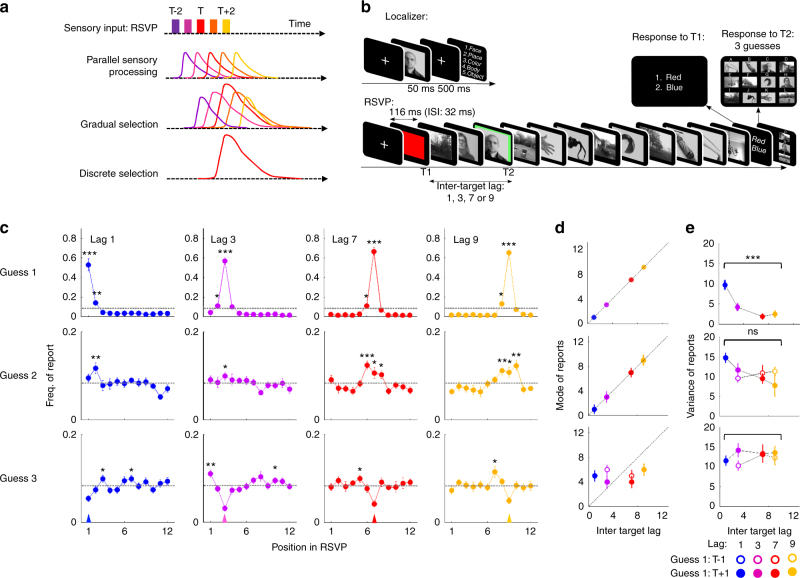
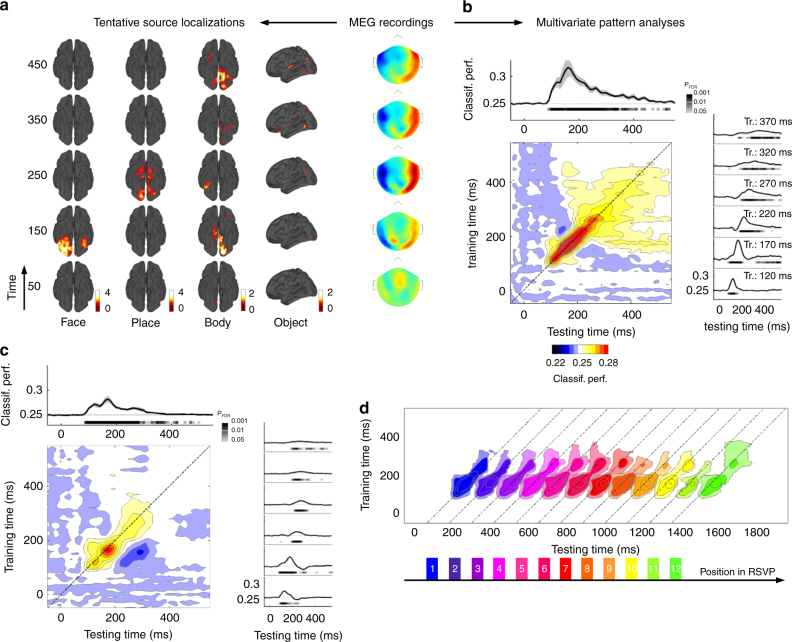
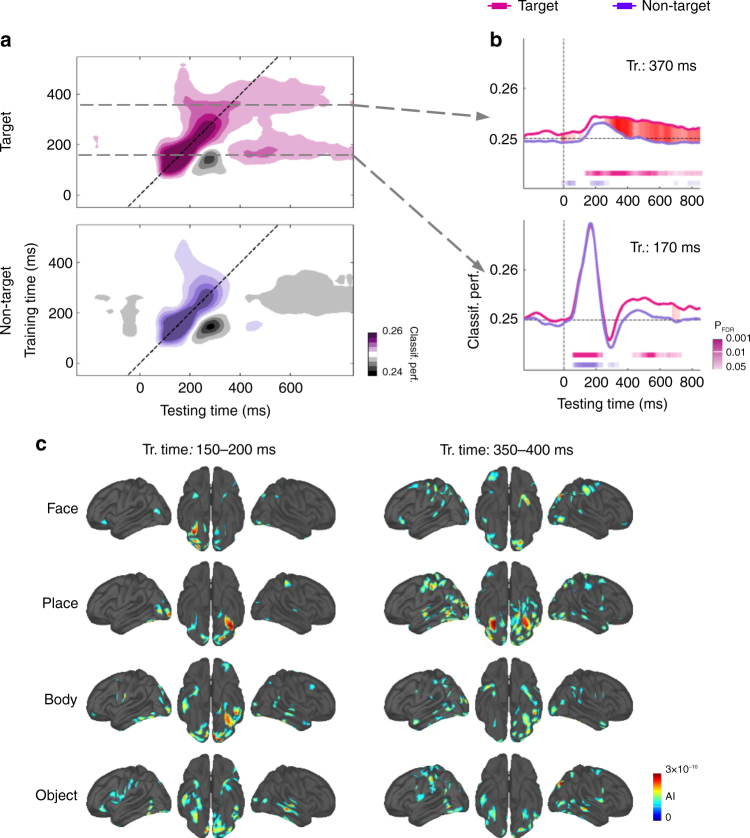
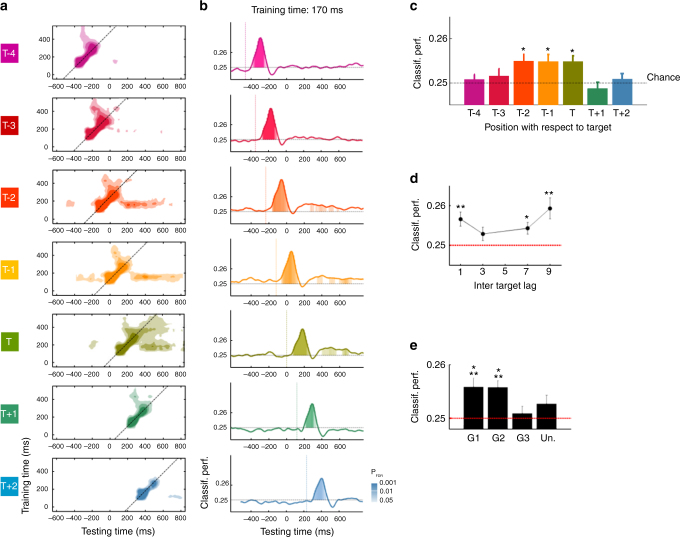
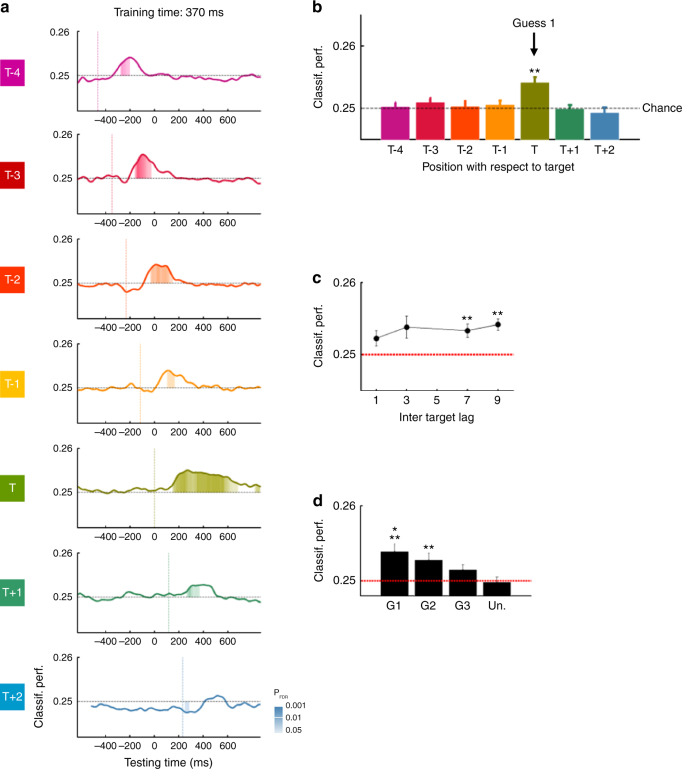
Humans can reliably detect a target picture even when tens of images are flashed every second. Here we use magnetoencephalography to dissect the neural mechanisms underlying the dynamics of temporal selection during a rapid serial visual presentation task. Multivariate decoding algorithms allow us to track the overlapping brain responses induced by each image in a rapid visual stream. The results show that temporal selection involves a sequence of gradual followed by all-or-none stages: (i) all images first undergo the same parallel processing pipeline; (ii) starting around 150 ms, responses to multiple images surrounding the target are continuously amplified in ventral visual areas; (iii) only the images that are subsequently reported elicit late all-or-none activations in visual and parietal areas around 350 ms. Thus, multiple images can cohabit in the brain and undergo efficient parallel processing, but temporal selection also isolates a single one for amplification and report.
Overview
The claims and statistics of this paper haven’t been checked yet.
Free: it reads the open-access text and checks the first 5 claims that cite a source we can check. Create a free account to check every claim.
Integrity signals
Registry
Cites
Statistics
Figures
Verification
Claims the paper makes
The claims and statistics of this paper haven’t been checked yet.
Free: it reads the open-access text and checks the first 5 claims that cite a source we can check. Create a free account to check every claim.
Claims other papers make about this one
Each is checked against this paper’s own text: does it say what the citing paper says it does?
The source backs part of the claim, not all of it — or backs it for a different population, condition or comparison.
In the citing paper
“The first 200 ms of brain activity, corresponding to early perceptual processing, can be fully preserved on trials without conscious perception, particularly under inattention conditions”
From Conscious Processing and the Global Neuronal Workspace Hypothesis (2020) · cites this paper as Marti and Dehaene, 2017
Experimental — accuracy not yet measuredThe source backs part of the claim, not all of it — or backs it for a different population, condition or comparison.
In the citing paper
“Early perceptual processing in the first 200 milliseconds can be similar or even identical between conscious (i.e., reported) and unconscious (i.e., not reported) trials, [67][68][69] but conscious perception is associated with late events, such as the N2/P3b/P300 component of scalp-event-related potentials in humans.6,[70][71][72]”
From An integrative, multiscale view on neural theories of consciousness (2024) · cites this paper as [68]
Experimental — accuracy not yet measured
Self-check
Percentages, sums and reported differences re-computed from the paper’s own numbers.
The self-check needs the paper’s full text.
Citations
Cites
Scikit-learn: Machine Learning in Python
Pedregosa, F., Varoquaux, G., Gramfort, A., Michel, V., Thirion, B., Grisel, O., Blondel, M., Müller, A., Nothman, J., Louppe, G., et al. (2012) · arXiv · doi:10.48550/arxiv.1201.0490 · Cited by 71,016
LIBSVM: A library for support vector machines
Chang, C.-C., & Lin, C.-J. (2011) · ACM Transactions on Intelligent Systems and Technology · doi:10.1145/1961189.1961199 · Cited by 40,918
Cortical Surface-Based Analysis
Dale, A. M., Fischl, B., & Sereno, M. I. (1999) · NeuroImage · doi:10.1006/nimg.1998.0395 · Cited by 10,910
Oostenveld, R., Fries, P., Maris, E., & Schoffelen, J.-M. (2011) · Computational Intelligence and Neuroscience · doi:10.1155/2011/156869 · Cited by 10,323
Fast and robust fixed-point algorithms for independent component analysis
Hyvarinen, A. (1999) · IEEE Transactions on Neural Networks · doi:10.1109/72.761722 · Cited by 6,246 · cited 10×
“Report accuracy–defined as trials where one of the guesses corresponded to T2–strongly decreased with the intertarget Lag (Repeated-measures analysis of variance (ANOVA), N = 15, F(3,42) = 7.”
InfluentialCortical Surface-Based Analysis
Fischl, B., Sereno, M. I., & Dale, A. M. (1999) · NeuroImage · doi:10.1006/nimg.1998.0396 · Cited by 6,147
Brainstorm: A User-Friendly Application for MEG/EEG Analysis
Tadel, F., Baillet, S., Mosher, J. C., Pantazis, D., & Leahy, R. M. (2011) · Computational Intelligence and Neuroscience · doi:10.1155/2011/879716 · Cited by 3,677
The aligned rank transform for nonparametric factorial analyses using only anova procedures
Wobbrock, J. O., Findlater, L., Gergle, D., & Higgins, J. J. (2011) · Proceedings of the SIGCHI Conference on Human Factors in Computing Systems · doi:10.1145/1978942.1978963 · Cited by 2,854
Temporary suppression of visual processing in an RSVP task: An attentional blink?
Raymond, J. E., Shapiro, K. L., & Arnell, K. M. (1992) · Journal of Experimental Psychology: Human Perception and Performance · doi:10.1037//0096-1523.18.3.849 · Cited by 2,260
On the interpretation of weight vectors of linear models in multivariate neuroimaging
Haufe, S., Meinecke, F., Görgen, K., Dähne, S., Haynes, J.-D., Blankertz, B., & Bießmann, F. (2014) · NeuroImage · doi:10.1016/j.neuroimage.2013.10.067 · Cited by 1,389
Cited by
Conscious Processing and the Global Neuronal Workspace Hypothesis
Mashour, G. A., Roelfsema, P., Changeux, J.-P., & Dehaene, S. (2020) · Neuron · doi:10.1016/j.neuron.2020.01.026 · Cited by 1,164
“The first 200 ms of brain activity, corresponding to early perceptual processing, can be fully preserved on trials without conscious perception, particularly under inattention conditions (Marti and Dehaene, 2017; Marti et al., 2015; Sergent et al., 2005).”
BackgroundSelf-citationBifurcation in brain dynamics reveals a signature of conscious processing independent of report
Sergent, C., Corazzol, M., Labouret, G., Stockart, F., Wexler, M., King, J.-R., Meyniel, F., & Pressnitzer, D. (2021) · Nature Communications · doi:10.1038/s41467-021-21393-z · Cited by 200
From ERPs to MVPA Using the Amsterdam Decoding and Modeling Toolbox (ADAM)
Fahrenfort, J. J., van Driel, J., van Gaal, S., & Olivers, C. N. L. (2018) · Frontiers in Neuroscience · doi:10.3389/fnins.2018.00368 · Cited by 176
“Indeed, many researchers now prefer to use multivariate analyses over traditional ERP/ERF analyses based on signals averaged over epochs (Mostert et al., 2015; Kaiser et al., 2016; Wardle et al., 2016; Contini et al., 2017; Marti and Dehaene, 2017; Turner et al., 2017).”
(2019) · doi:10.1093/oso/9780198843702.001.0001 · Cited by 138
The representational dynamics of visual objects in rapid serial visual processing streams
Grootswagers, T., Robinson, A. K., & Carlson, T. A. (2018) · NeuroImage · doi:10.1016/j.neuroimage.2018.12.046 · Cited by 172
“Previous work has shown that, using MEG, it is possible to use decoding to investigate target-related processes in RSVP streams (Marti & Dehaene, 2017; Mohsenzadeh et al., 2018a).”
BackgroundMethodInfluentialHigh-pass filtering artifacts in multivariate classification of neural time series data
van Driel, J., Olivers, C. N. L., & Fahrenfort, J. J. (2021) · Journal of Neuroscience Methods · doi:10.1016/j.jneumeth.2021.109080 · Cited by 150
All in Good Time: Long-Lasting Postdictive Effects Reveal Discrete Perception
Herzog, M. H., Drissi-Daoudi, L., & Doerig, A. (2020) · Trends in Cognitive Sciences · doi:10.1016/j.tics.2020.07.001 · Cited by 126
“Similarly, in RSVP tasks, multiple images can unconsciously cohabit for hundreds of milliseconds, but only the ones that are available for conscious report elicit late activity around 350 ms [43].”
BackgroundAn integrative, multiscale view on neural theories of consciousness
Storm, J. F., Klink, P. C., Aru, J., Senn, W., Goebel, R., Pigorini, A., Avanzini, P., Vanduffel, W., Roelfsema, P. R., Massimini, M., et al. (2024) · Neuron · doi:10.1016/j.neuron.2024.02.004 · Cited by 114
Automatic and feature-specific prediction-related neural activity in the human auditory system
Demarchi, G., Sanchez, G., & Weisz, N. (2019) · Nature Communications · doi:10.1038/s41467-019-11440-1 · Cited by 100
The predictive global neuronal workspace: a formal active inference model of visual consciousness
Whyte, C. J., & Smith, R. (2021) · Progress in Neurobiology · doi:10.1016/j.pneurobio.2020.101918 · Cited by 84
The Predictive Global Neuronal Workspace: A Formal Active Inference Model of Visual Consciousness
Whyte, C. J., & Smith, R. (2020) · doi:10.1101/2020.02.11.944611 · Cited by 84
Suchy-Dicey, C. (2020) · Cambridge University Press eBooks · doi:10.1017/9781108164238 · Cited by 116
van Ede, F., Chekroud, S. R., Stokes, M. G., & Nobre, A. C. (2018) · Nature Communications · doi:10.1038/s41467-018-03960-z · Cited by 81
The influence of image masking on object representations during rapid serial visual presentation
Robinson, A. K., Grootswagers, T., & Carlson, T. A. (2019) · NeuroImage · doi:10.1016/j.neuroimage.2019.04.050 · Cited by 79
King, J.-R., & Wyart, V. (2021) · Journal of Neuroscience · doi:10.1523/jneurosci.2098-20.2021 · Cited by 90
Time consciousness: the missing link in theories of consciousness
Kent, L., & Wittmann, M. (2021) · Neuroscience of Consciousness · doi:10.1093/nc/niab011 · Cited by 71
“More recent experimental work in the GNWT tradition continues this trend by locating discrete all-or-none temporal sampling of visual information at around the 350-ms timescale range (Marti and Dehaene 2017).”
Decoding perceptual awareness across the brain with a no-report fMRI masking paradigm
Hatamimajoumerd, E., Ratan Murty, N. A., Pitts, M., & Cohen, M. A. (2022) · Current Biology · doi:10.1016/j.cub.2022.07.068 · Cited by 66
All-or-none face categorization in the human brain
Retter, T. L., Jiang, F., Webster, M. A., & Rossion, B. (2020) · NeuroImage · doi:10.1016/j.neuroimage.2020.116685 · Cited by 70
Bellet, J., Gay, M., Dwarakanath, A., Jarraya, B., van Kerkoerle, T., Dehaene, S., & Panagiotaropoulos, T. I. (2022) · Neuroscience of Consciousness · doi:10.1093/nc/niac005 · Cited by 55
“We further show that significant information is still present during rapid serial visual presentation (RSVP) when images are presented in streams of 10 images per second, a rate at which access consciousness and post-perceptual processing is challenged (Lawrence 1971; Broadbent and Broadbent 1987; Raymond et al. 1992;…”
BackgroundResultInfluentialSelf-citationCollins, E., Robinson, A. K., & Behrmann, M. (2018) · NeuroImage · doi:10.1016/j.neuroimage.2018.06.080 · Cited by 63
Visual Representations: Insights from Neural Decoding
Robinson, A. K., Quek, G. L., & Carlson, T. A. (2023) · Annual Review of Vision Science · doi:10.1146/annurev-vision-100120-025301 · Cited by 63
Prestimulus feedback connectivity biases the content of visual experiences
Rassi, E., Wutz, A., Müller, N., & Weisz, N. (2019) · Proceedings of the National Academy of Sciences · doi:10.1073/pnas.1817317116 · Cited by 59
“To find out which brain regions contributed most to above-chance decoding performance, we used the weights that the classifier used to separate face reports from vase reports and projected them into source space (39).”
Kang, Y. H., Löffler, A., Jeurissen, D., Zylberberg, A., Wolpert, D. M., & Shadlen, M. N. (2021) · eLife · doi:10.7554/elife.63721 · Cited by 49
“as shown in the rapid serial visual presentation tasks), and conjunction search (Potter, 1976; Treisman and Gelade, 1980; Keysers and Perrett, 2002; Marti et al., 2015; Marti and Dehaene, 2017).”
MethodMoerel, D., Grootswagers, T., Robinson, A. K., Shatek, S. M., Woolgar, A., Carlson, T. A., & Rich, A. N. (2022) · Scientific Reports · doi:10.1038/s41598-022-10687-x · Cited by 53
The offline stream of conscious representations
Sergent, C. (2018) · Philosophical Transactions of the Royal Society B: Biological Sciences · doi:10.1098/rstb.2017.0349 · Cited by 44
Ensemble representations reveal distinct neural coding of visual working memory
Oh, B.-I., Kim, Y., & Kang, M.-S. (2019) · Nature Communications · doi:10.1038/s41467-019-13592-6 · Cited by 44
Comparative psychology without consciousness
Carruthers, P. (2018) · Consciousness and Cognition · doi:10.1016/j.concog.2018.06.012 · Cited by 42
Weaver, M. D., Fahrenfort, J. J., Belopolsky, A. V., & van Gaal, S. (2019) · eNeuro · doi:10.1523/eneuro.0268-18.2018 · Cited by 35
Marsicano, G., Bertini, C., & Ronconi, L. (2024) · Neuroscience & Biobehavioral Reviews · doi:10.1016/j.neubiorev.2024.105795 · Cited by 38
“…might remain largely blind to traditional univariate analysis techniques, which are less sensitive in identifying when the encoding of information content occur over time (Marti and Dehaene, 2017; Mostert et al., 2015; Grootswagers et al., 2017; Fahrenfort et al., 2018; Peelen and Downing, 2023).”
Conscious Perception: Time for an Update?
Salti, M., Harel, A., & Marti, S. (2019) · Journal of Cognitive Neuroscience · doi:10.1162/jocn_a_01343 · Cited by 30
“…processing and machine learning techniques make this goal achievable, and some studies have started to track stimulus representations under conscious and nonconscious conditions (Marti & Dehaene, 2017; Trübutschek et al., 2017; Salti et al., 2015; Charles, King, & Dehaene, 2014; King et al., 2013).”
BackgroundSelf-citationThe neural dynamics underlying prioritisation of task-relevant information
Grootswagers, T., Robinson, A. K., Shatek, S. M., & Carlson, T. A. (2021) · Neurons Behavior Data analysis and Theory · doi:10.51628/001c.21174 · Cited by 34
Hodgson, D. (2019) · Journal of Archaeological Science Reports · doi:10.1016/j.jasrep.2019.02.025 · Cited by 41
The diachronic account of attentional selectivity
Zivony, A., & Eimer, M. (2021) · Psychonomic Bulletin & Review · doi:10.3758/s13423-021-02023-7 · Cited by 33
“…target (which triggered the attentional episode) and the temporally proximal item will be encoded, but also that competitive interactions between them are increased (Keysers & Perrett, 2002; Marti & Dehaene, 2017; Tang et al., 2020; see “Perceptual competition and exclusion from WM” section below).”
Meijs, E. L., Mostert, P., Slagter, H. A., de Lange, F. P., & van Gaal, S. (2019) · Neuroscience of Consciousness · doi:10.1093/nc/niz011 · Cited by 25
“The absence of decoding at later time points when T2 was task-irrelevant furthermore suggests that the representation of target letter identity is not ‘broadcasted’ to higher levels of the cortical hierarchy when this feature is task-irrelevant (Marti and Dehaene 2017).”
BackgroundSelf-face and emotional faces—are they alike?
Żochowska, A., Nowicka, M. M., Wójcik, M. J., & Nowicka, A. (2021) · Social Cognitive and Affective Neuroscience · doi:10.1093/scan/nsab020 · Cited by 28
Neural signatures of visual awareness independent of postperceptual processing
Cohen, M. A., Dembski, C., Ortego, K., Steinhibler, C., & Pitts, M. A. (2024) · Cerebral Cortex · doi:10.1093/cercor/bhae415 · Cited by 30
A measure centrality index for systematic empirical comparison of consciousness theories
Chis-Ciure, R., Melloni, L., & Northoff, G. (2024) · Neuroscience & Biobehavioral Reviews · doi:10.1016/j.neubiorev.2024.105670 · Cited by 22
“Third, based on PFC ’ s workspace neurons, conscious content can be decoded (King et al., 2013, 2016; Marti and Dehaene, 2017; Salti et al., 2015) in different paradigms, e.g., no-report (Bellet et al., 2022; Kapoor et al., 2022).”
MethodEsser, S., Lustig, C., & Haider, H. (2021) · Psychological Research · doi:10.1007/s00426-021-01594-3 · Cited by 34
Temporal dynamics of the neural representation of hue and luminance polarity
Hermann, K. L., Singh, S. R., Rosenthal, I. A., Pantazis, D., & Conway, B. R. (2022) · Nature Communications · doi:10.1038/s41467-022-28249-0 · Cited by 27
Partyka, M., Demarchi, G., Roesch, S., Suess, N., Sedley, W., Schlee, W., & Weisz, N. (2019) · bioRxiv (Cold Spring Harbor Laboratory) · doi:10.1101/869842 · Cited by 18
Prolonged neural encoding of visual information in autism
Marsicano, G., Casartelli, L., Federici, A., Bertoni, S., Vignali, L., Molteni, M., Facoetti, A., & Ronconi, L. (2023) · Autism Research · doi:10.1002/aur.3062 · Cited by 22
“…in its entire time course (Fahrenfort et al., 2017, 2018), providing greater sensitivity to detect characteristics of the neural activity representing specific patterns of information processing which remain largely blind to univariate techniques (Grootswagers et al., 2017; Marti & Dehaene, 2017).”
BackgroundMethodKraft, N. G., Demarchi, G., & Weisz, N. (2020) · eLife · doi:10.7554/elife.55508 · Cited by 22
“These beamformer filters were subsequently multiplied with the aforementioned covariance-corrected classifier weights to obtain ‘informative activity’ (Marti and Dehaene, 2017) in source space (taking the absolute value on source level).”
MethodMechanisms of human dynamic object recognition revealed by sequential deep neural networks
Sörensen, L. K. A., Bohté, S. M., de Jong, D., Slagter, H. A., & Scholte, H. S. (2023) · PLoS Computational Biology · doi:10.1371/journal.pcbi.1011169 · Cited by 24
Roth-Paysen, M.-L., Bröcker, A., Bruchmann, M., & Straube, T. (2022) · NeuroImage · doi:10.1016/j.neuroimage.2022.119652 · Cited by 19
Anticipatory and evoked visual cortical dynamics of voluntary temporal attention
Denison, R. N., Tian, K. J., Heeger, D. J., & Carrasco, M. (2024) · Nature Communications · doi:10.1038/s41467-024-53406-y · Cited by 22
“Forexample,atask-relevantstimulusmay appear at an unpredictable time, eliciting reactive attentional dynamics — as in the attentional blink 7 – 9 — rather than the proactive dynamics of voluntary temporal attention.”
Decoding Images in the Mind’s Eye: The Temporal Dynamics of Visual Imagery
Shatek, S. M., Grootswagers, T., Robinson, A. K., & Carlson, T. A. (2019) · Vision · doi:10.3390/vision3040053 · Cited by 24
“This extended period of decoding after stimulus offset supports recent evidence that multiple representations can co-exist in the brain [48,49].”
BackgroundThe channel capacity of multilevel linguistic features constrains speech comprehension
Giroud, J., Lerousseau, J. P., Pellegrino, F., & Morillon, B. (2021) · Cognition · doi:10.1016/j.cognition.2022.105345 · Cited by 20
Alilović, J., Lampers, E., Slagter, H. A., & van Gaal, S. (2023) · PLoS Biology · doi:10.1371/journal.pbio.3002009 · Cited by 18
“Therefore, we expected that the late square-shaped on-diagonal decoding pattern, possibly related to global ignition [34,37,50], would be strongly reduced or even disappear when cross classifying between the sensory localizer and the main perceptual decision task (Fig 4B).”
BackgroundMethodInfluentialRepresentational dynamics preceding conscious access
Alilović, J., van Moorselaar, D., Graetz, M., van Gaal, S., & Slagter, H. A. (2021) · NeuroImage · doi:10.1016/j.neuroimage.2021.117789 · Cited by 17
Under the Mind's Hood: What We Have Learned by Watching the Brain at Work
Nobre, A. C., & van Ede, F. (2019) · Journal of Neuroscience · doi:10.1523/jneurosci.0742-19.2019 · Cited by 16
“Similar approaches have started to reveal new insights into other dynamic phenomena, such as the attentional blink (Marti and Dehaene, 2017), the matching of mnemonic templates to visual inputs (Myers et al.”
BackgroundBelieving and social interactions: effects on bodily expressions and personal narratives
Seitz, R. J., Angel, H., Paloutzian, R. F., & Taves, A. (2022) · Frontiers in Behavioral Neuroscience · doi:10.3389/fnbeh.2022.894219 · Cited by 18
“This finding corresponds to the notion that perceptual awareness emerges at about 200 ms, with modality-specific negative changes in the brain at 120–200 ms and a later modality-independent positive potential at about 300 ms (Koivisto and Revonsuo, 2010; Marti and Dehaene, 2017; Dembski et al., 2021).”
BackgroundCategorizing objects from MEG signals using EEGNet
Shi, R., Zhao, Y., Cao, Z., Liu, C., Kang, Y., & Zhang, J. (2021) · Cognitive Neurodynamics · doi:10.1007/s11571-021-09717-7 · Cited by 14
“The consistency of our results with previous literature (Dima et al. 2018a, 2018b; Marti and Dehaene 2017; Ramkumar et al. 2013) proved that our common model is effective for compensating for differences between subjects and capturing globally discriminating information.”
BackgroundResultThe nature of neural object representations during dynamic occlusion
Teichmann, L., Moerel, D., Rich, A. N., & Baker, C. I. (2022) · Cortex · doi:10.1016/j.cortex.2022.04.009 · Cited by 15
The neural dynamics underlying prioritisation of task-relevant informationPreprint
Grootswagers, T., Robinson, A. K., Shatek, S. M., & Carlson, T. A. (2020) · bioRxiv (Cold Spring Harbor Laboratory) · doi:10.1101/2020.06.25.172643 · Cited by 11
“These 45 methods also allow to decode the overlapping neural signals evoked by stimuli presented close in time (e.g., 46 Grootswagers et al., 2019a; Marti and Dehaene, 2017; Robinson et al., 2019), even when these stimuli are not 47 task-relevant (Grootswagers et al.”
BackgroundMethodInfluentialLi, W., Zhao, P., Xu, C., Hou, Y., Jiang, W., & Song, A. (2025) · IEEE Transactions on Biomedical Engineering · doi:10.1109/tbme.2025.3568282 · Cited by 17
“Marti and Dehaene [94] studied how brain processes the multiple visual stimuli simultaneously based on MEG using the RSVP paradigm.”
Current controversies in the cognitive science of short-term memory
Shevlin, H. (2020) · Current Opinion in Behavioral Sciences · doi:10.1016/j.cobeha.2020.02.005 · Cited by 16
A Multivariate analysis on evoked components of Chinese semantic congruity: an OP-MEG study with EEG
Wu, H., Liang, X., Wang, R., Ma, Y., Gao, Y., & Ning, X. (2024) · Cerebral Cortex · doi:10.1093/cercor/bhae108 · Cited by 10
Lustig, C., Esser, S., & Haider, H. (2021) · Psychological Research · doi:10.1007/s00426-021-01630-2 · Cited by 17
“A second assumption of the UEH is derived from the Global Workspace theory (Dehaene & Naccache, 2001; Marti & Dehaene, 2017).”
MethodTemporal dynamics of the neural representation of hue and luminance polarityPreprint
Hermann, K. L., Singh, S. R., Rosenthal, I. A., Pantazis, D., & Conway, B. R. (2020) · bioRxiv (Cold Spring Harbor Laboratory) · doi:10.1101/2020.06.17.155713 · Cited by 8
Decoding of the neural representation of the visual RGB color model
Wu, Y., Mao, Y., Feng, K., Wei, D., & Song, L. (2023) · PeerJ Computer Science · doi:10.7717/peerj-cs.1376 · Cited by 9
“The continuous of retinal images needs to be face by the visual system, each of these is related to keeping hundreds of milliseconds of neural activity ( Marti & Dehaene, 2017 ).”
BackgroundMartin, J. G., Cox, P., Scholl, C. A., & Riesenhuber, M. (2019) · PubMed · doi:10.1167/19.12.20 · Cited by 15
Liu, C., Yi, K., Zhang, L., & Zhang, J. (2020) · IEEE Journal of Biomedical and Health Informatics · doi:10.1109/jbhi.2020.3008731 · Cited by 7
Kubota, M., & Zouridakis, G. (2022) · Experimental Brain Research · doi:10.1007/s00221-022-06365-z · Cited by 6
“2020b; MEG: Marti and Dehaene 2017; Kubota et al.”
BackgroundZhou, Y., Yang, B., & Wang, C. (2024) · Neural Networks · doi:10.1016/j.neunet.2024.106313 · Cited by 7
Meng, Z., Chen, Q., Zhou, L., Xu, L., & Chen, A. (2023) · Cerebral Cortex · doi:10.1093/cercor/bhad316 · Cited by 7
The Human Brain encodes a Chronicle of Visual Events at each Instant of TimePreprint
King, J.-R., & Wyart, V. (2019) · bioRxiv (Cold Spring Harbor Laboratory) · doi:10.1101/846576 · Cited by 6
Shared and modality-specific brain networks underlying predictive coding of temporal sequencesPreprint
Bonetti, L., Fernández‐Rubio, G., Rosso, M., Carlomagno, F., Malvaso, A., Greco, A., Kringelbach, M. L., & Vuust, P. (2025) · bioRxiv (Cold Spring Harbor Laboratory) · doi:10.1101/2025.07.16.665207 · Cited by 7
“…is briefly flashed within a sequence of non-target stimuli and recorded the brain activity related to processing each individual item with electroencephalography (EEG) or magnetoencephalography (MEG) (e.g., Grootswagers et al., 2019; King & Wyart, 2021; Marti & Dehaene, 2017; Potter et al., 2014).”
Neural representation of consciously seen and unseen information
Esteban, P. R.-S., González, J. A., & Chica, A. B. (2025) · Scientific Reports · doi:10.1038/s41598-025-92490-y · Cited by 6
Aberrant auditory prediction patterns robustly characterize tinnitusPreprint
Reisinger, L., Demarchi, G., Obleser, J., Sedley, W., Partyka, M., Schubert, J., Gehmacher, Q., Roesch, S., Suess, N., Trinka, E., et al. (2024) · eLife · doi:10.7554/elife.99757 · Cited by 5
“In a final step, we extracted the training decoder weights of relevant pre-stimulus time frames and projected them in the source space in order to localize the informative activity of carrier-frequency processing ( Demarchi et al., 2019 ; Marti and Dehaene, 2017 ).”
Characterising the neural time-courses of food attribute representations
Chae, V. J., Grootswagers, T., Bode, S., & Feuerriegel, D. (2025) · Appetite · doi:10.1016/j.appet.2025.108337 · Cited by 7
Head errors of syntactic dependency increase neuromagnetic mismatch intensities
Kubota, M., Matsuzaki, J., Dan, I., Dan, H., & Zouridakis, G. (2020) · Experimental Brain Research · doi:10.1007/s00221-020-05872-1 · Cited by 4
“In addition, given the distribution of the data and based on previous neuroimaging literature (Auer et al. 2018; Marti and Dehaene 2017; Kubota et al. 2018), we performed a non-parametric test (Dwivedi et al.”
MethodNeural representations of predicted events: Evidence from time-resolved EEG decodingPreprint
Li, A.-S., Theeuwes, J., & van Moorselaar, D. (2024) · eLife · doi:10.7554/elife.95837.1 · Cited by 6
The Representational Dynamics of Sequential Perceptual Averaging
Do, J., Eo, K. Y., James, O., Lee, J., & Kim, Y. (2021) · Journal of Neuroscience · doi:10.1523/jneurosci.0628-21.2021 · Cited by 6
An early effect of the parafoveal preview on post-saccadic processing of English words
Melcher, D., Alaberkyan, A., Anastasaki, C., Liu, X., Deodato, M., Marsicano, G., & Almeida, D. (2024) · Attention Perception & Psychophysics · doi:10.3758/s13414-024-02916-4 · Cited by 3
“…exploiting the greater analysis sensitivity of MVPA technique in unveiling individual pattern of neural activations (Grootswagers et al., 2017; Marti & Dehaene, 2017), we indexed from diagonal decoding analyses the following different key decoding parameters allowing a deeper investigation of…”
Aberrant auditory prediction patterns robustly characterize tinnitus
Reisinger, L., Demarchi, G., Obleser, J., Sedley, W., Partyka, M., Schubert, J., Gehmacher, Q., Roesch, S., Suess, N., Trinka, E., et al. (2024) · eLife · doi:10.7554/elife.99757.4 · Cited by 10
Kubota, M., Pollonini, L., & Zouridakis, G. (2020) · Experimental Brain Research · doi:10.1007/s00221-020-05922-8 · Cited by 3
Rotation-tolerant representations elucidate the time-course of high-level object processing
Moerel, D., Grootswagers, T., Robinson, A. K., Engeler, P., Holcombe, A. O., & Carlson, T. A. (2026) · PLoS ONE · doi:10.1371/journal.pone.0347992 · Cited by 4
“…decoding persists well beyond these times, which could be explained by a combination of the new stimulus not yet reaching particularly high-level representations and possibly multiplexing, wherein successive stimuli are represented by distinct activation patterns that can coexist [53,54].”
Conceptual content in images triggers rapid shifts of covert attentionPreprint
Wyble, B., Hess, M., Flintoft, C. C., & Folk, C. L. (2018) · bioRxiv (Cold Spring Harbor Laboratory) · doi:10.1101/259929 · Cited by 1
Jahanian, M., Joanisse, M. F., Wang, B., & Mohsenzadeh, Y. (2024) · Journal of Neuroscience · doi:10.1523/jneurosci.2214-23.2024 · Cited by 2
Variable Processing Shifts during Perceptual Acceleration: Evidence from Temporal Integration
Wolff, M. J., & Akyürek, E. G. (2025) · Journal of Cognitive Neuroscience · doi:10.1162/jocn.a.2421 · Cited by 3
Decoding visual neural representations by fMRI-based brain activity through contrastive learning
Ren, H., & Huang, M. (2026) · Biomedical Signal Processing and Control · doi:10.1016/j.bspc.2026.110596 · Cited by 1
Animal minds: The state of the art
Carruthers, P. (2019) · Oxford University Press eBooks · doi:10.1093/oso/9780198843702.003.0002 · Cited by 1
Brooke-Wilson, T. (2023) · The Philosophical Review · doi:10.1215/00318108-10294422 · Cited by 5
Analysis and Classification of Event-Related Potentials During Image Observation
Quattrone, D., Santambrogio, F., Scarpellini, A., Sgherzi, F., Poles, I., Clementi, L., & Santambrogio, M. D. (2023) · Annual International Conference of the IEEE Engineering in Medicine and Biology Society (EMBC) · doi:10.1109/embc40787.2023.10340052 · Cited by 1
“Nevertheless, stimuli are all still processed by the visual system and their neural representations can co-occur [8].”
BackgroundFrontal engagement in perceptual integration under low subjective visibility
Bae, J., Jung, K., James, O., Suzuki, S., & Kim, Y. (2024) · NeuroImage · doi:10.1016/j.neuroimage.2024.120984 · Cited by 3
Carruthers, P. (2019) · Oxford University Press eBooks · doi:10.1093/oso/9780198843702.003.0005 · Cited by 1
Kubota, M., Matsuzaki, J., Dan, I., Dan, H., & Zouridakis, G. (2021) · Experimental Brain Research · doi:10.1007/s00221-020-05996-4 · Cited by 1
Neural representations of predicted events: Evidence from time-resolved EEG decodingPreprint
Li, A.-S., Theeuwes, J., & van Moorselaar, D. (2024) · bioRxiv (Cold Spring Harbor Laboratory) · doi:10.1101/2024.01.05.574347 · Cited by 1
“As depicted in Figure 2c, both pattern estimators exhibited little to no evidence of early off-diagonal decoding, which has been associated with the perceptual maintenance of early sensory representations (e.g., Marti & Dehaene, 2017; Meijs et al., 2019; Weaver et al., 2019).”
MethodAn integrative, multiscale view on consciousness theories_Eary version of paper in press in NEURONPreprint
Storm, J. F., Klink, P. C., Aru, J., Senn, W., Goebel, R., Pigorini, A., Avanzini, P., Vanduffel, W., Roelfsema, P. R., Massimini, M., et al. (2024) · doi:10.31234/osf.io/9byzu · Cited by 1
Neural representations of predicted events: Evidence from time-resolved EEG decodingPreprint
Li, A.-S., Theeuwes, J., & van Moorselaar, D. (2024) · eLife · doi:10.7554/elife.95837 · Cited by 4
Aberrant Auditory Prediction Patterns Robustly Characterize TinnitusPreprint
Reisinger, L., Demarchi, G., Obleser, J., Sedley, W., Partyka, M., Schubert, J., Gehmacher, Q., Roesch, S., Suess, N., Trinka, E., et al. (2024) · eLife · doi:10.7554/elife.99757.1 · Cited by 1
Retrospective attention strengthens a report-independent neural signature of visual perceptionPreprint
Li, Y., Wan, X., Mao, M., Jin, L., Cai, Y., & Zhang, X. (2024) · bioRxiv (Cold Spring Harbor Laboratory) · doi:10.1101/2024.11.09.622275 · Cited by 1
Neural evidence for a two-stage model of visual processingPreprint
Menétrey, M. Q., Herzog, M. H., & Pascucci, D. (2024) · bioRxiv (Cold Spring Harbor Laboratory) · doi:10.1101/2024.11.15.623853 · Cited by 1
Zhou, I., Grootswagers, T., Segula, B. J., Robinson, A. K., Shatek, S. M., Whyte, C. J., & Carlson, T. A. (2019) · bioRxiv (Cold Spring Harbor Laboratory) · doi:10.1101/824565
Consciousness in animals: No fact of the matter
Carruthers, P. (2019) · Oxford University Press eBooks · doi:10.1093/oso/9780198843702.003.0007
Carruthers, P. (2019) · Oxford University Press eBooks · doi:10.1093/oso/9780198843702.003.0003
Carruthers, P. (2019) · Oxford University Press eBooks · doi:10.1093/oso/9780198843702.003.0004
Carruthers, P. (2019) · Oxford University Press eBooks · doi:10.1093/oso/9780198843702.003.0008
Carruthers, P. (2019) · Oxford University Press eBooks · doi:10.1093/oso/9780198843702.003.0006
Modelling and Measuring the Predictive Brain
Whyte, C. J. (2020) · The Sydney eScholarship Repository (The University of Sydney)
Metadata
- Authors
- Marti, S., & Dehaene, S.
- Affiliations
- Université Paris-Sud (FR)
- Corresponding author
- Marti, Sébastien
- ORCID
- Dehaene, Stanislas
- Venue
- Nature Communications
- Published
- 2017-12-05
- Volume
- 8
- Issue
- 1
- Pages
- 1955-1955
- ISSN
- 2041-1723 (ISSN-L)
- PMC
- PMC5717232
- OpenAlex
- W2768186777
- Cited by
- 127
- References
- 53
- Citations by year
- 2026: 5 · 2025: 5 · 2024: 20 · 2023: 10 · 2022: 9 · 2021: 18 · 2020: 26 · 2019: 26 · 2018: 8
- FWCI
- 9.41
- Type
- journal article
- Language
- en
- Open access
- gold
- doi.org
- Licence
- cc-by
- creativecommons.org/licenses/by/4.0 (tdm)
- creativecommons.org/licenses/by/4.0 (vor)
- Locations
- Nature Communications (publishedVersion, cc-by)
- Europe PMC (PubMed Central) (publishedVersion, cc-by)
- PubMed Central (publishedVersion, cc-by)
- PubMed (publishedVersion)
- RePEc: Research Papers in Economics (submittedVersion)
- DOAJ (DOAJ: Directory of Open Access Journals) (submittedVersion)
- DOAJ (DOAJ: Directory of Open Access Journals) (submittedVersion, cc-by-sa)
- Funders
- Institut National de la Santé et de la Recherche Médicale
- Fondation pour la Recherche Médicale
- Topics
- Life Sciences › Neuroscience › Cognitive Neuroscience › Visual perception and processing mechanisms
- Physical Sciences › Computer Science › Computer Vision and Pattern Recognition › Visual Attention and Saliency Detection
- Life Sciences › Neuroscience › Cognitive Neuroscience › Neural and Behavioral Psychology Studies
- Keywords
- temporal selection, rapid serial visual presentation, target detection, visual attention, parallel computing, ventral visual cortex, parietal cortex, multivariate decoding
- MeSH terms
- Adult, Algorithms, Brain, Female, Humans, Magnetic Resonance Imaging, Male, Parietal Lobe, Photic Stimulation, Visual Cortex, Visual Pathways, Magnetoencephalography, Multivariate Analysis, Young Adult
About these checks
Registry, retraction, Cites and statistics results are computed, not judged, with one exception: a printed reference that no index lists is read once by a model before it counts as a citation error. Claims are extracted by a model and kept only when their quote appears verbatim in the text; each cited source is then checked, with a model’s help, for whether it says what the claim relies on. Those verdicts can be wrong — read the claim’s quote and the cited source before relying on one.
Statistics and arithmetic are recomputed, not judged.
Confidence bands are shown only for fields calibrated on our annotated test set. None is calibrated yet, so no band is shown.
What counts as a claim ›How we measure confidence ›How we check this ›
Are you an author, or do you see a problem with this page? Request a review
Data sources
Bibliographic data: Semantic Scholar, OpenAlex, Crossref.
Contains information from the Semantic Scholar Academic Graph Datasets, made available under the ODC Attribution License (ODC-BY 1.0).
Semantic Scholar’s data is described in: Kinney, R., et al. (2023). The Semantic Scholar Open Data Platform. arXiv:2301.10140.
