

Discrete and continuous mechanisms of temporal selection in rapid visual streams
Open accessThe DOI matches its Crossref record; 52 of the 53 references it cites were found in a registry or an index.
Abstract
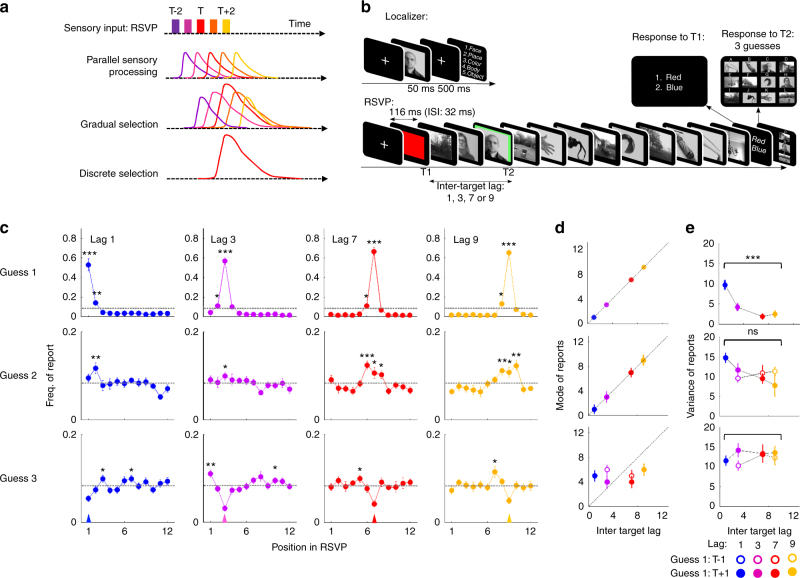
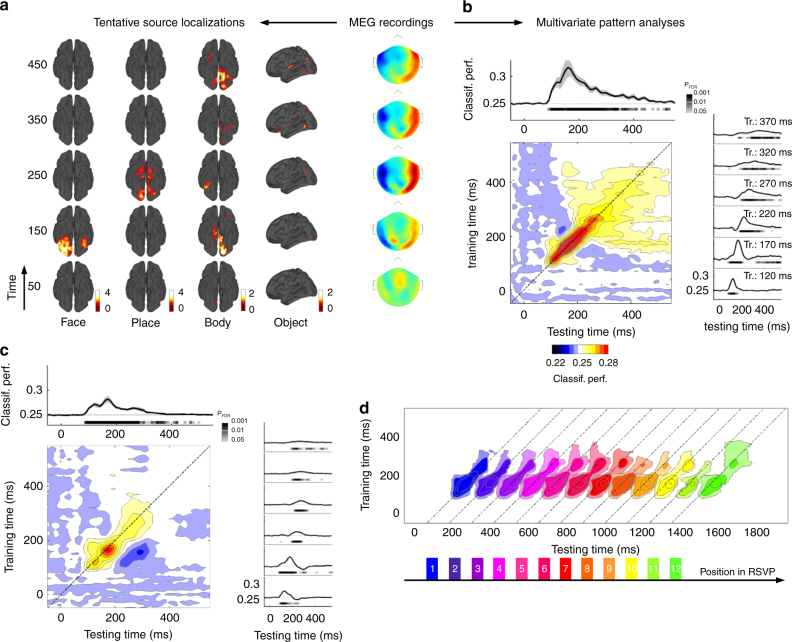
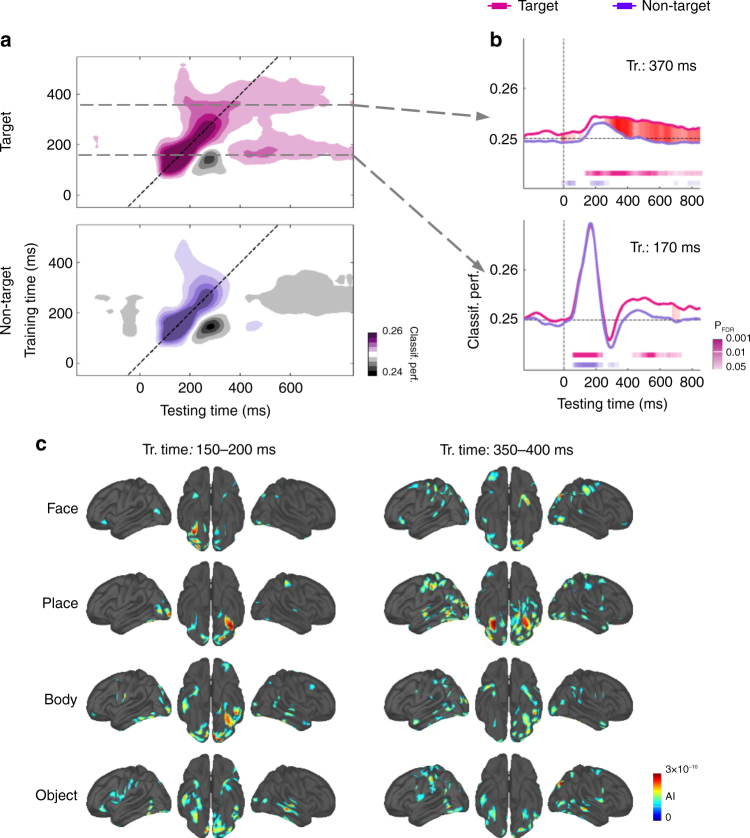
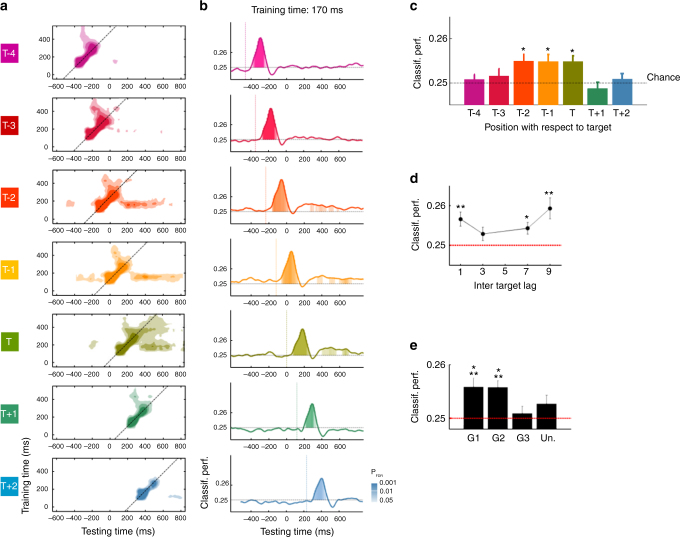
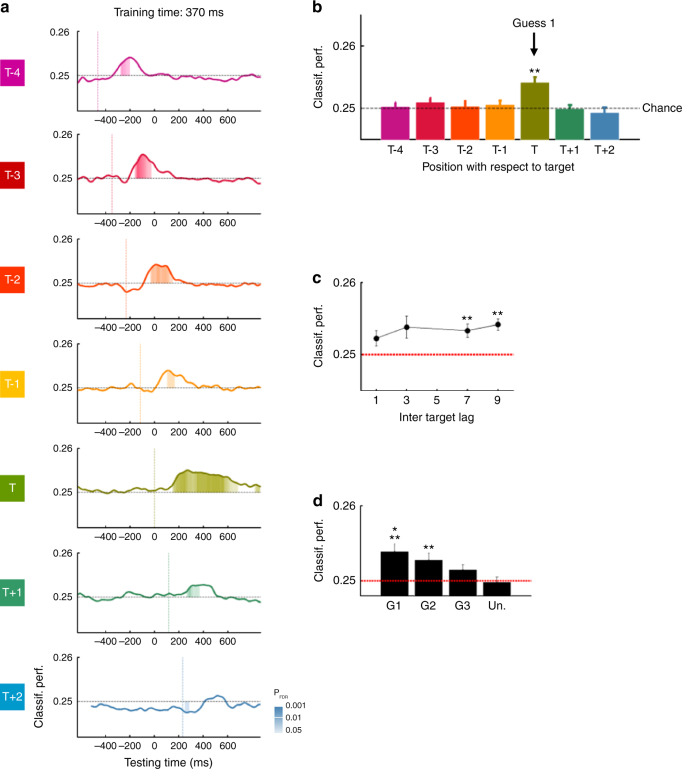
Humans can reliably detect a target picture even when tens of images are flashed every second. Here we use magnetoencephalography to dissect the neural mechanisms underlying the dynamics of temporal selection during a rapid serial visual presentation task. Multivariate decoding algorithms allow us to track the overlapping brain responses induced by each image in a rapid visual stream. The results show that temporal selection involves a sequence of gradual followed by all-or-none stages: (i) all images first undergo the same parallel processing pipeline; (ii) starting around 150 ms, responses to multiple images surrounding the target are continuously amplified in ventral visual areas; (iii) only the images that are subsequently reported elicit late all-or-none activations in visual and parietal areas around 350 ms. Thus, multiple images can cohabit in the brain and undergo efficient parallel processing, but temporal selection also isolates a single one for amplification and report.
Overview
The claims and statistics of this paper haven’t been checked yet.
Free: it reads the open-access text and checks the first 5 claims that cite a source we can check. Create a free account to check every claim.
Integrity signals
Registry
Cites
Statistics
Figures
Verification
Claims the paper makes
The claims and statistics of this paper haven’t been checked yet.
Free: it reads the open-access text and checks the first 5 claims that cite a source we can check. Create a free account to check every claim.
Claims other papers make about this one
Each is checked against this paper’s own text: does it say what the citing paper says it does?
The source backs part of the claim, not all of it — or backs it for a different population, condition or comparison.
In the citing paper
“The first 200 ms of brain activity, corresponding to early perceptual processing, can be fully preserved on trials without conscious perception, particularly under inattention conditions”
From Conscious Processing and the Global Neuronal Workspace Hypothesis (2020) · cites this paper as Marti and Dehaene, 2017
Experimental — accuracy not yet measuredThe source backs part of the claim, not all of it — or backs it for a different population, condition or comparison.
In the citing paper
“Early perceptual processing in the first 200 milliseconds can be similar or even identical between conscious (i.e., reported) and unconscious (i.e., not reported) trials, [67][68][69] but conscious perception is associated with late events, such as the N2/P3b/P300 component of scalp-event-related potentials in humans.6,[70][71][72]”
From An integrative, multiscale view on neural theories of consciousness (2024) · cites this paper as [68]
Experimental — accuracy not yet measured
Self-check
Percentages, sums and reported differences re-computed from the paper’s own numbers.
The self-check needs the paper’s full text.
Citations
Cites
Scikit-learn: Machine Learning in Python
Pedregosa, F., Varoquaux, G., Gramfort, A., Michel, V., Thirion, B., Grisel, O., Blondel, M., Müller, A., Nothman, J., Louppe, G., et al. (2012) · arXiv · doi:10.48550/arxiv.1201.0490 · Cited by 71,016
LIBSVM: A library for support vector machines
Chang, C.-C., & Lin, C.-J. (2011) · ACM Transactions on Intelligent Systems and Technology · doi:10.1145/1961189.1961199 · Cited by 40,918
Cortical Surface-Based Analysis
Dale, A. M., Fischl, B., & Sereno, M. I. (1999) · NeuroImage · doi:10.1006/nimg.1998.0395 · Cited by 10,910
Oostenveld, R., Fries, P., Maris, E., & Schoffelen, J.-M. (2011) · Computational Intelligence and Neuroscience · doi:10.1155/2011/156869 · Cited by 10,323
Fast and robust fixed-point algorithms for independent component analysis
Hyvarinen, A. (1999) · IEEE Transactions on Neural Networks · doi:10.1109/72.761722 · Cited by 6,246 · cited 10×
“Report accuracy–defined as trials where one of the guesses corresponded to T2–strongly decreased with the intertarget Lag (Repeated-measures analysis of variance (ANOVA), N = 15, F(3,42) = 7.”
InfluentialCortical Surface-Based Analysis
Fischl, B., Sereno, M. I., & Dale, A. M. (1999) · NeuroImage · doi:10.1006/nimg.1998.0396 · Cited by 6,147
Brainstorm: A User-Friendly Application for MEG/EEG Analysis
Tadel, F., Baillet, S., Mosher, J. C., Pantazis, D., & Leahy, R. M. (2011) · Computational Intelligence and Neuroscience · doi:10.1155/2011/879716 · Cited by 3,677
The aligned rank transform for nonparametric factorial analyses using only anova procedures
Wobbrock, J. O., Findlater, L., Gergle, D., & Higgins, J. J. (2011) · Proceedings of the SIGCHI Conference on Human Factors in Computing Systems · doi:10.1145/1978942.1978963 · Cited by 2,854
Temporary suppression of visual processing in an RSVP task: An attentional blink?
Raymond, J. E., Shapiro, K. L., & Arnell, K. M. (1992) · Journal of Experimental Psychology: Human Perception and Performance · doi:10.1037//0096-1523.18.3.849 · Cited by 2,260
On the interpretation of weight vectors of linear models in multivariate neuroimaging
Haufe, S., Meinecke, F., Görgen, K., Dähne, S., Haynes, J.-D., Blankertz, B., & Bießmann, F. (2014) · NeuroImage · doi:10.1016/j.neuroimage.2013.10.067 · Cited by 1,389
Coull, J. T., & Nobre, A. C. (1998) · The Journal of Neuroscience · doi:10.1523/jneurosci.18-18-07426.1998 · Cited by 1,269 · cited 1×
“A similar but not significant effect was observed when subjects reported the stimulus T-1 as Guess 1 (Repeated-measures ANOVA, N = 15, F(2,28) = 1.”
Platt, J. C. (2000) · Advances in Large-Margin Classifiers · doi:10.7551/mitpress/1113.003.0008 · Cited by 1,156
Characterizing the dynamics of mental representations: the temporal generalization method
King, J.-R., & Dehaene, S. (2014) · Trends in Cognitive Sciences · doi:10.1016/j.tics.2014.01.002 · Cited by 919
Self-citationTiming of the brain events underlying access to consciousness during the attentional blink
Sergent, C., Baillet, S., & Dehaene, S. (2005) · Nature Neuroscience · doi:10.1038/nn1549 · Cited by 888
Self-citationA Large-Scale Circuit Mechanism for Hierarchical Dynamical Processing in the Primate Cortex
Chaudhuri, R., Knoblauch, K., Gariel, M.-A., Kennedy, H., & Wang, X.-J. (2015) · Neuron · doi:10.1016/j.neuron.2015.09.008 · Cited by 604
Gross, J., Schmitz, F., Schnitzler, I., Kessler, K., Shapiro, K., Hommel, B., & Schnitzler, A. (2004) · Proceedings of the National Academy of Sciences · doi:10.1073/pnas.0404944101 · Cited by 581
Suppression of Interference and Artifacts by the Signal Space Separation Method
Taulu, S., Kajola, M., & Simola, J. (2004) · Brain Topography · doi:10.1023/b:brat.0000032864.93890.f9 · Cited by 541
Detecting meaning in RSVP at 13 ms per picture
Potter, M. C., Wyble, B., Hagmann, C. E., & McCourt, E. S. (2014) · Attention, Perception, & Psychophysics · doi:10.3758/s13414-013-0605-z · Cited by 493
Neuronal correlates of visibility and invisibility in the primate visual system
Macknik, S. L., & Livingstone, M. S. (1998) · Nature Neuroscience · doi:10.1038/393 · Cited by 417
A boost and bounce theory of temporal attention.
Olivers, C. N. L., & Meeter, M. (2008) · Psychological Review · doi:10.1037/a0013395 · Cited by 408 · cited 1×
“2, Repeated-measures ANOVA, N = 15, F(3,36) = 9.”
Sergent, C., & Dehaene, S. (2004) · Psychological Science · doi:10.1111/j.0956-7976.2004.00748.x · Cited by 384
Self-citationMiniussi, C., Wilding, E. L., Coull, J. T., & Nobre, A. C. (1999) · Brain · doi:10.1093/brain/122.8.1507 · Cited by 378
Masking Disrupts Reentrant Processing in Human Visual Cortex
Fahrenfort, J. J., Scholte, H. S., & Lamme, V. A. F. (2007) · Journal of Cognitive Neuroscience · doi:10.1162/jocn.2007.19.9.1488 · Cited by 344
Keysers, C., Xiao, D.-K., Földiák, P., & Perrett, D. I. (2001) · Journal of Cognitive Neuroscience · doi:10.1162/089892901564199 · Cited by 335
Overgaard, M., Rote, J., Mouridsen, K., & Ramsøy, T. Z. (2006) · Consciousness and Cognition · doi:10.1016/j.concog.2006.04.002 · Cited by 329
The simultaneous type, serial token model of temporal attention and working memory.
Bowman, H., & Wyble, B. (2007) · Psychological Review · doi:10.1037/0033-295x.114.1.38 · Cited by 299
Masking Interrupts Figure-Ground Signals in V1
Lamme, V. A. F., Zipser, K., & Spekreijse, H. (2002) · Journal of Cognitive Neuroscience · doi:10.1162/089892902320474490 · Cited by 285
Intermodal Selective Attention in Monkeys. I: Distribution and Timing of Effects across Visual Areas
Mehta, A. D. (2000) · Cerebral Cortex · doi:10.1093/cercor/10.4.343 · Cited by 267
Tuning of the Human Neocortex to the Temporal Dynamics of Attended Events
Besle, J., Schevon, C. A., Mehta, A. D., Lakatos, P., Goodman, R. R., McKhann, G. M., Emerson, R. G., & Schroeder, C. E. (2011) · The Journal of Neuroscience · doi:10.1523/jneurosci.4518-10.2011 · Cited by 257
Brain Mechanisms of Serial and Parallel Processing during Dual-Task Performance
Sigman, M., & Dehaene, S. (2008) · The Journal of Neuroscience · doi:10.1523/jneurosci.0948-08.2008 · Cited by 243
Self-citationHuman cortical mechanisms of visual attention during orienting and search
Corbetta, M., & Shulman, G. L. (1998) · Philosophical Transactions of the Royal Society of London. Series B: Biological Sciences · doi:10.1098/rstb.1998.0289 · Cited by 214 · cited 10×
“Report accuracy–defined as trials where one of the guesses corresponded to T2–strongly decreased with the intertarget Lag (Repeated-measures analysis of variance (ANOVA), N = 15, F(3,42) = 7.”
InfluentialDistributed Fading Memory for Stimulus Properties in the Primary Visual Cortex
Nikolić, D., Häusler, S., Singer, W., & Maass, W. (2009) · PLoS Biology · doi:10.1371/journal.pbio.1000260 · Cited by 202
How parallel is visual processing in the ventral pathway?
Rousselet, G. A., Thorpe, S. J., & Fabre-Thorpe, M. (2004) · Trends in Cognitive Sciences · doi:10.1016/j.tics.2004.06.003 · Cited by 197
Two studies of visual search for word targets with controlled rates of presentation*
Lawrence, D. H. (1971) · Perception & Psychophysics · doi:10.3758/bf03214320 · Cited by 158
Hommel, B., & Akyürek, E. G. (2005) · The Quarterly Journal of Experimental Psychology Section A · doi:10.1080/02724980443000647 · Cited by 156
Sergent, C., & Dehaene, S. (2004) · Journal of Physiology-Paris · doi:10.1016/j.jphysparis.2005.09.006 · Cited by 139
Self-citationTemporal binding errors are redistributed by the attentional blink
Chun, M. M. (1997) · Perception & Psychophysics · doi:10.3758/bf03214207 · Cited by 127 · cited 4×
“2, One-sample t-test, N = 15, t(14) = 2.”
InfluentialA shared cortical bottleneck underlying Attentional Blink and Psychological Refractory Period
Marti, S., Sigman, M., & Dehaene, S. (2012) · NeuroImage · doi:10.1016/j.neuroimage.2011.09.063 · Cited by 120
Self-citationA Temporal Bottleneck in the Language Comprehension Network
Vagharchakian, L., Dehaene-Lambertz, G., Pallier, C., & Dehaene, S. (2012) · Journal of Neuroscience · doi:10.1523/jneurosci.5685-11.2012 · Cited by 114 · cited 1×
“A similar but not significant effect was observed when subjects reported the stimulus T-1 as Guess 1 (Repeated-measures ANOVA, N = 15, F(2,28) = 1.”
Self-citationMarti, S., Sackur, J., Sigman, M., & Dehaene, S. (2010) · Cognition · doi:10.1016/j.cognition.2010.01.003 · Cited by 103
Self-citationTime-Resolved Decoding of Two Processing Chains during Dual-Task Interference
Marti, S., King, J.-R., & Dehaene, S. (2015) · Neuron · doi:10.1016/j.neuron.2015.10.040 · Cited by 90
Self-citationTemporal Selection is Suppressed, Delayed, and Diffused During the Attentional Blink
Vul, E., Nieuwenstein, M., & Kanwisher, N. (2008) · Psychological Science · doi:10.1111/j.1467-9280.2008.02046.x · Cited by 89
Attention as inference: Selection is probabilistic; responses are all-or-none samples.
Vul, E., Hanus, D., & Kanwisher, N. (2009) · Journal of Experimental Psychology: General · doi:10.1037/a0017352 · Cited by 86
Temporal Tuning Properties along the Human Ventral Visual Stream
Gauthier, B., Eger, E., Hesselmann, G., Giraud, A.-L., & Kleinschmidt, A. (2012) · The Journal of Neuroscience · doi:10.1523/jneurosci.2467-12.2012 · Cited by 73
Craston, P., Wyble, B., Chennu, S., & Bowman, H. (2009) · Journal of Cognitive Neuroscience · doi:10.1162/jocn.2009.21036 · Cited by 66
Self-Induced Attentional Blink: A Cause of Errors in Multiple-Target Search
Adamo, S. H., Cain, M. S., & Mitroff, S. R. (2013) · Psychological Science · doi:10.1177/0956797613497970 · Cited by 66
Neurophysiological bases of exponential sensory decay and top-down memory retrieval: a model
Zylberberg, A. (2009) · Frontiers in Computational Neuroscience · doi:10.3389/neuro.10.004.2009 · Cited by 52
Masking interrupts figure-ground signals in V1
Lamme, V. A. F., Zipser, K., & Spekreijse, H. (2010) · Journal of Vision · doi:10.1167/1.3.32 · Cited by 41
Cortical mechanisms of attention in time: neural correlates of the Lag‐1‐sparing phenomenon
Kessler, K., Schmitz, F., Groß, J., Hommel, B., Shapiro, K. L., & Schnitzler, A. (2005) · European Journal of Neuroscience · doi:10.1111/j.1460-9568.2005.04063.x · Cited by 39
Gathercole, S. E., & Broadbent, D. E. (1984) · Memory & Cognition · doi:10.3758/bf03198292 · Cited by 38
From a single decision to a multi-step algorithm
Dehaene, S., & Sigman, M. (2012) · Current Opinion in Neurobiology · doi:10.1016/j.conb.2012.05.006 · Cited by 34
Self-citationKawarasaki, M., Konishi, K., Ohara, M., & Igarashi, T. (2012) · Computer Science and Engineering · doi:10.5923/j.computer.20120202.01 · Cited by 3
Cited by
Conscious Processing and the Global Neuronal Workspace Hypothesis
Mashour, G. A., Roelfsema, P., Changeux, J.-P., & Dehaene, S. (2020) · Neuron · doi:10.1016/j.neuron.2020.01.026 · Cited by 1,164
“The first 200 ms of brain activity, corresponding to early perceptual processing, can be fully preserved on trials without conscious perception, particularly under inattention conditions (Marti and Dehaene, 2017; Marti et al., 2015; Sergent et al., 2005).”
BackgroundSelf-citationBifurcation in brain dynamics reveals a signature of conscious processing independent of report
Sergent, C., Corazzol, M., Labouret, G., Stockart, F., Wexler, M., King, J.-R., Meyniel, F., & Pressnitzer, D. (2021) · Nature Communications · doi:10.1038/s41467-021-21393-z · Cited by 200
From ERPs to MVPA Using the Amsterdam Decoding and Modeling Toolbox (ADAM)
Fahrenfort, J. J., van Driel, J., van Gaal, S., & Olivers, C. N. L. (2018) · Frontiers in Neuroscience · doi:10.3389/fnins.2018.00368 · Cited by 176
“Indeed, many researchers now prefer to use multivariate analyses over traditional ERP/ERF analyses based on signals averaged over epochs (Mostert et al., 2015; Kaiser et al., 2016; Wardle et al., 2016; Contini et al., 2017; Marti and Dehaene, 2017; Turner et al., 2017).”
(2019) · doi:10.1093/oso/9780198843702.001.0001 · Cited by 138
The representational dynamics of visual objects in rapid serial visual processing streams
Grootswagers, T., Robinson, A. K., & Carlson, T. A. (2018) · NeuroImage · doi:10.1016/j.neuroimage.2018.12.046 · Cited by 172
“Previous work has shown that, using MEG, it is possible to use decoding to investigate target-related processes in RSVP streams (Marti & Dehaene, 2017; Mohsenzadeh et al., 2018a).”
BackgroundMethodInfluential
Metadata
- Authors
- Marti, S., & Dehaene, S.
- Affiliations
- Université Paris-Sud (FR)
- Corresponding author
- Marti, Sébastien
- ORCID
- Dehaene, Stanislas
- Venue
- Nature Communications
- Published
- 2017-12-05
- Volume
- 8
- Issue
- 1
- Pages
- 1955-1955
- ISSN
- 2041-1723 (ISSN-L)
- PMC
- PMC5717232
- OpenAlex
- W2768186777
- Cited by
- 127
- References
- 53
- Citations by year
- 2026: 5 · 2025: 5 · 2024: 20 · 2023: 10 · 2022: 9 · 2021: 18 · 2020: 26 · 2019: 26 · 2018: 8
- FWCI
- 9.41
- Type
- journal article
- Language
- en
- Open access
- gold
- doi.org
- Licence
- cc-by
- creativecommons.org/licenses/by/4.0 (tdm)
- creativecommons.org/licenses/by/4.0 (vor)
- Locations
- Nature Communications (publishedVersion, cc-by)
- Europe PMC (PubMed Central) (publishedVersion, cc-by)
- PubMed Central (publishedVersion, cc-by)
- PubMed (publishedVersion)
- RePEc: Research Papers in Economics (submittedVersion)
- DOAJ (DOAJ: Directory of Open Access Journals) (submittedVersion)
- DOAJ (DOAJ: Directory of Open Access Journals) (submittedVersion, cc-by-sa)
- Funders
- Institut National de la Santé et de la Recherche Médicale
- Fondation pour la Recherche Médicale
- Topics
- Life Sciences › Neuroscience › Cognitive Neuroscience › Visual perception and processing mechanisms
- Physical Sciences › Computer Science › Computer Vision and Pattern Recognition › Visual Attention and Saliency Detection
- Life Sciences › Neuroscience › Cognitive Neuroscience › Neural and Behavioral Psychology Studies
- Keywords
- temporal selection, rapid serial visual presentation, target detection, visual attention, parallel computing, ventral visual cortex, parietal cortex, multivariate decoding
- MeSH terms
- Adult, Algorithms, Brain, Female, Humans, Magnetic Resonance Imaging, Male, Parietal Lobe, Photic Stimulation, Visual Cortex, Visual Pathways, Magnetoencephalography, Multivariate Analysis, Young Adult
About these checks
Registry, retraction, Cites and statistics results are computed, not judged, with one exception: a printed reference that no index lists is read once by a model before it counts as a citation error. Claims are extracted by a model and kept only when their quote appears verbatim in the text; each cited source is then checked, with a model’s help, for whether it says what the claim relies on. Those verdicts can be wrong — read the claim’s quote and the cited source before relying on one.
Statistics and arithmetic are recomputed, not judged.
Confidence bands are shown only for fields calibrated on our annotated test set. None is calibrated yet, so no band is shown.
What counts as a claim ›How we measure confidence ›How we check this ›
Are you an author, or do you see a problem with this page? Request a review
Data sources
Bibliographic data: Semantic Scholar, OpenAlex, Crossref.
Contains information from the Semantic Scholar Academic Graph Datasets, made available under the ODC Attribution License (ODC-BY 1.0).
Semantic Scholar’s data is described in: Kinney, R., et al. (2023). The Semantic Scholar Open Data Platform. arXiv:2301.10140.
