

The DOI matches its Crossref record; 70 of the 70 references it cites were found in a registry or an index.
Hippocampal oxytocin receptors are necessary for discrimination of social stimuli
Open accessAbstract
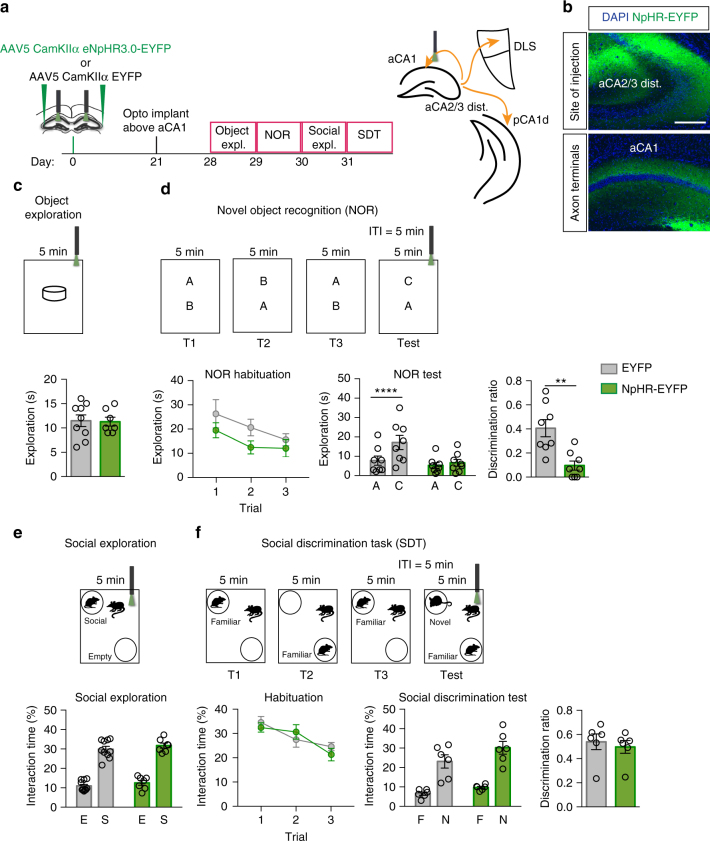
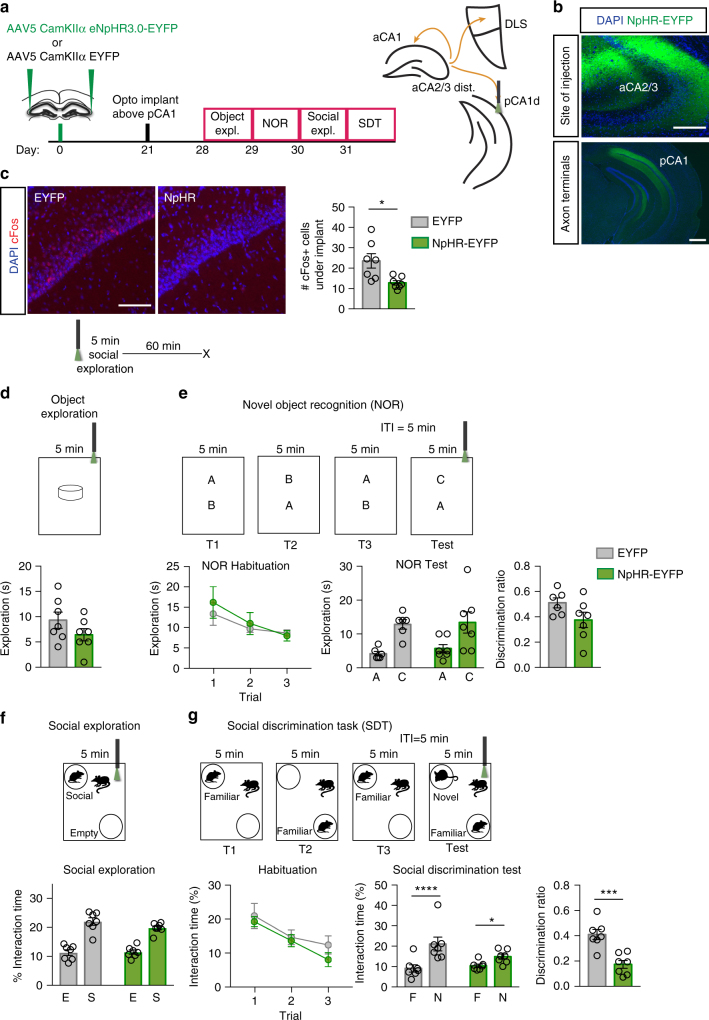
Oxytocin receptor (Oxtr) signaling in neural circuits mediating discrimination of social stimuli and affiliation or avoidance behavior is thought to guide social recognition. Remarkably, the physiological functions of Oxtrs in the hippocampus are not known. Here we demonstrate using genetic and pharmacological approaches that Oxtrs in the anterior dentate gyrus (aDG) and anterior CA2/CA3 (aCA2/CA3) of mice are necessary for discrimination of social, but not non-social, stimuli. Further, Oxtrs in aCA2/CA3 neurons recruit a population-based coding mechanism to mediate social stimuli discrimination. Optogenetic terminal-specific attenuation revealed a critical role for aCA2/CA3 outputs to posterior CA1 for discrimination of social stimuli. In contrast, aCA2/CA3 projections to aCA1 mediate discrimination of non-social stimuli. These studies identify a role for an aDG-CA2/CA3 axis of Oxtr expressing cells in discrimination of social stimuli and delineate a pathway relaying social memory computations in the anterior hippocampus to the posterior hippocampus to guide social recognition.
Overview
The claims and statistics of this paper haven’t been checked yet.
Run the check — free, no account needed. It reads the open-access text and checks the sources it cites.
Integrity signals
Registry
Cites
Statistics
Figures
Verification
Claims the paper makes
The claims and statistics of this paper haven’t been checked yet.
Run the check — free, no account needed. It reads the open-access text and checks the sources it cites.
Claims other papers make about this one
Each is checked against this paper’s own text: does it say what the citing paper says it does?
In the citing paper
“OXTRs in the anterior DG-CA2/ CA3 circuit facilitate social, but not object discrimination (101), and AVP projections from PVN to hippocampus influence recognition of conspecifics as well as spatial features in mice (102).”
From Oxytocin, Vasopressin, and Social Behavior: From Neural Circuits to Clinical Opportunities (2022) · cites this paper as [101]
In the citing paper
“In mice, BNST and MeA AVP cells are active during male sexual behavior (101, 119) and knockdown of AVP within the BNST reduced the number of intromissions and ejaculations in males, but did not alter sexual behavior in females (91).”
From Oxytocin, Vasopressin, and Social Behavior: From Neural Circuits to Clinical Opportunities (2022) · cites this paper as [101]
In the citing paper
“and the well-established role of oxytocin in social behaviors and social recognition (13, 21, 34; 39-44).”
From Social Interaction Elicits Activity in Glutamatergic Neurons in the Posterior Intralaminar Complex of the Thalamus (2024) · cites this paper as [43]
Self-check
Percentages, sums and reported differences re-computed from the paper’s own numbers.
The self-check needs the paper’s full text.
Citations
Cites
Are the Dorsal and Ventral Hippocampus Functionally Distinct Structures?
Fanselow, M. S., & Dong, H.-W. (2010) · Neuron · doi:10.1016/j.neuron.2009.11.031 · Cited by 3,358
Oxytocin and vasopressin in the human brain: social neuropeptides for translational medicine
Meyer-Lindenberg, A., Domes, G., Kirsch, P., & Heinrichs, M. (2011) · Nature Reviews Neuroscience · doi:10.1038/nrn3044 · Cited by 1,688
Oxytocin, vasopressin, and the neurogenetics of sociality
Donaldson, Z. R., & Young, L. J. (2008) · Science · doi:10.1126/science.1158668 · Cited by 1,645
Pattern Separation in the Dentate Gyrus and CA3 of the Hippocampus
Leutgeb, J. K., Leutgeb, S., Moser, M.-B., & Moser, E. I. (2007) · Science · doi:10.1126/science.1135801 · Cited by 1,601
Pattern separation in the hippocampus
Yassa, M. A., & Stark, C. E. L. (2011) · Trends in Neurosciences · doi:10.1016/j.tins.2011.06.006 · Cited by 1,544
Hippocampal synaptic enhancement and information storage within a distributed memory system
McNaughton, B. L., & Morris, R. G. M. (1987) · Trends in Neurosciences · doi:10.1016/0166-2236(87)90011-7 · Cited by 1,304
Social reward requires coordinated activity of nucleus accumbens oxytocin and serotonin
Dölen, G., Darvishzadeh, A., Huang, K. W., & Malenka, R. C. (2013) · Nature · doi:10.1038/nature12518 · Cited by 1,161
Pattern Separation in the Human Hippocampal CA3 and Dentate Gyrus
Bakker, A., Kirwan, C. B., Miller, M. I., & Stark, C. E. L. (2008) · Science · doi:10.1126/science.1152882 · Cited by 1,050
Oxytocin in the Medial Amygdala is Essential for Social Recognition in the Mouse
Ferguson, J. N., Aldag, J. M., Insel, T. R., & Young, L. J. (2001) · The Journal of Neuroscience · doi:10.1523/jneurosci.21-20-08278.2001 · Cited by 1,043
Oxytocin: The Great Facilitator of Life
Lee, H.-J., Macbeth, A. H., Pagani, J., & Young, W. S. (2009) · Progress in Neurobiology · doi:10.1016/j.pneurobio.2009.04.001 · Cited by 1,037
Cited by
Sorted by citations
Oxytocin, Neural Plasticity, and Social Behavior
Froemke, R. C., & Young, L. J. (2021) · Annual Review of Neuroscience · doi:10.1146/annurev-neuro-102320-102847 · Cited by 480
The neural mechanisms and circuitry of the pair bond
Walum, H., & Young, L. J. (2018) · Nature Reviews Neuroscience · doi:10.1038/s41583-018-0072-6 · Cited by 353
A hippocampal circuit linking dorsal CA2 to ventral CA1 critical for social memory dynamics
Meira, T., Leroy, F., Buss, E. W., Oliva, A., Park, J., & Siegelbaum, S. A. (2018) · Nature Communications · doi:10.1038/s41467-018-06501-w · Cited by 310
Oxytocin Signaling in the Central Amygdala Modulates Emotion Discrimination in Mice
Ferretti, V., Maltese, F., Contarini, G., Nigro, M., Bonavia, A., Huang, H., Gigliucci, V., Morelli, G., Scheggia, D., Managò, F., et al. (2019) · Current Biology · doi:10.1016/j.cub.2019.04.070 · Cited by 212
Somatostatin interneurons in the prefrontal cortex control affective state discrimination in mice
Scheggia, D., Managò, F., Maltese, F., Bruni, S., Nigro, M., Dautan, D., Latuske, P., Contarini, G., Gomez-Gonzalo, M., Requie, L. M., et al. (2020) · Nature Neuroscience · doi:10.1038/s41593-019-0551-8 · Cited by 192
Metadata
- Authors
- Raam, T., McAvoy, K. M., Besnard, A., Veenema, A. H., & Sahay, A.
- Affiliations
- Harvard University (US)
- Michigan State University (US)
- Broad Institute (US)
- Corresponding author
- Sahay, Amar
- Venue
- Nature Communications
- Published
- 2017-12-08
- Volume
- 8
- Issue
- 1
- Pages
- 2001-2001
- ISSN
- 2041-1723 (ISSN-L)
- PMC
- PMC5722862
- OpenAlex
- W2772417881
- Cited by
- 292
- References
- 70
- Citations by year
- 2026: 25 · 2025: 35 · 2024: 26 · 2023: 33 · 2022: 48 · 2021: 40 · 2020: 34 · 2019: 25 · 2018: 26
- FWCI
- 33.27
- Type
- journal article
- Language
- en
- Update notices
- correction (2018-02-02)
- Open access
- gold
- doi.org
- Locations
- Nature Communications (publishedVersion, cc-by)
- PubMed Central (publishedVersion, cc-by)
- PubMed (publishedVersion)
- Digital Access to Scholarship at Harvard (DASH) (Harvard University) (submittedVersion, cc-by)
- RePEc: Research Papers in Economics (submittedVersion)
- DOAJ (DOAJ: Directory of Open Access Journals) (submittedVersion)
- DOAJ (DOAJ: Directory of Open Access Journals) (submittedVersion, cc-by-sa)
- Funders
- Ellison Medical Foundation
- National Alliance for Research on Schizophrenia and Depression
- National Institutes of Health
- Harvard Stem Cell Institute
- National Institute on Aging (RF1AG048908)
- National Institute of Mental Health (R01MH104175, R01MH111729)
- Topics
- Life Sciences › Neuroscience › Endocrine and Autonomic Systems › Neuroendocrine regulation and behavior
- Life Sciences › Neuroscience › Cognitive Neuroscience › Memory and Neural Mechanisms
- Life Sciences › Neuroscience › Cellular and Molecular Neuroscience › Neuroscience and Neuropharmacology Research
- Keywords
- oxytocin receptor, hippocampus, social recognition, CA1, population coding, social memory, optogenetic manipulation
- MeSH terms
- Animals, Behavior, Animal, Discrimination, Psychological, Hippocampus, Male, Mice, Inbred C57BL, Neural Pathways, Neurons, Social Behavior, Receptors, Oxytocin, Mice, Knockout, Models, Animal, Mice, Optogenetics
About these checks
Registry, retraction, Cites and statistics results are computed, not judged, with one exception: a printed reference that no index lists is read once by a model before it counts as a citation error. Claims are extracted by a model and kept only when their quote appears verbatim in the text; each cited source is then checked, with a model’s help, for whether it says what the claim relies on. Those verdicts can be wrong — read the claim’s quote and the cited source before relying on one.
Statistics and arithmetic are recomputed, not judged.
Confidence bands are shown only for fields calibrated on our annotated test set. None is calibrated yet, so no band is shown.
What counts as a claim ›How we measure confidence ›How we check this ›
Are you an author, or do you see a problem with this page? Request a review
