

Tectonically-triggered sediment and carbon export to the Hadal zone.
Open accessThe DOI matches its Crossref record; 49 of the 49 references it cites were found in a registry or an index.
Abstract
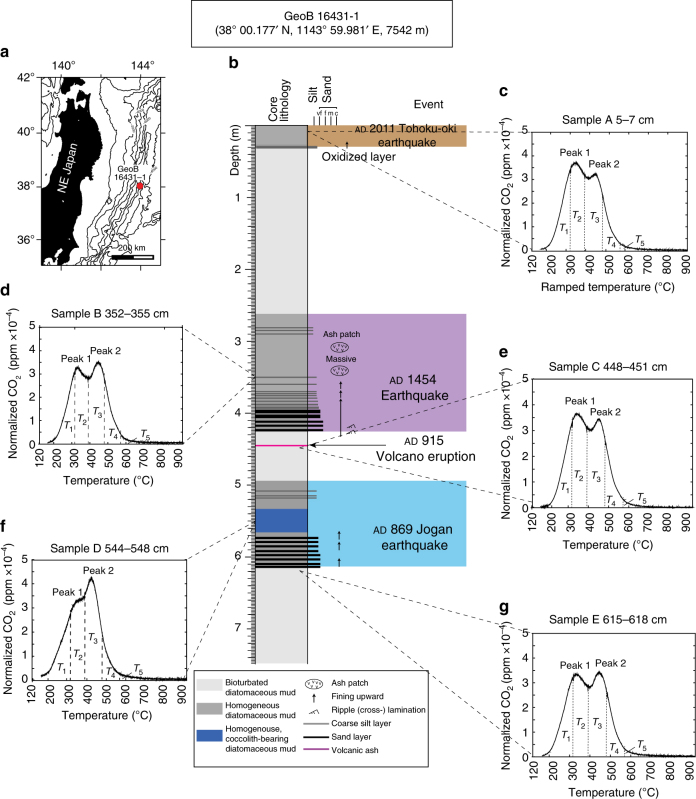
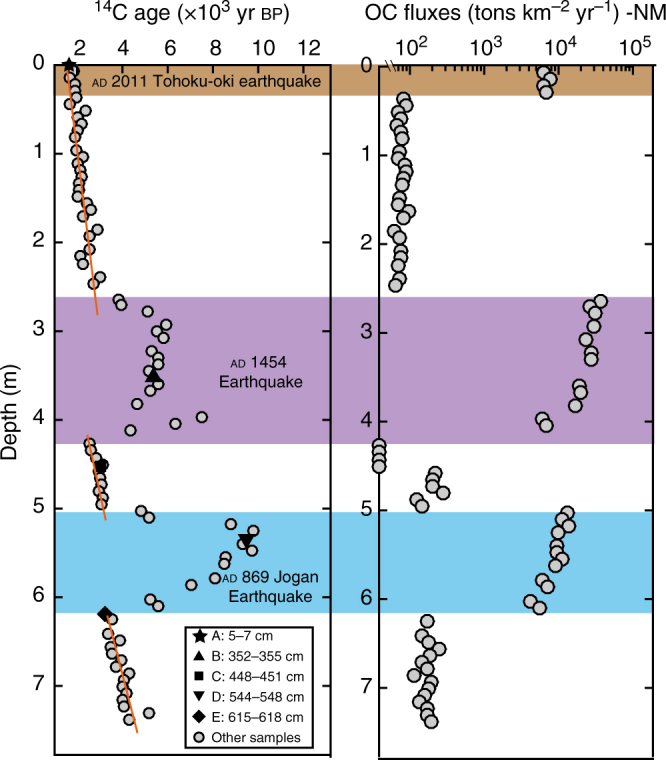
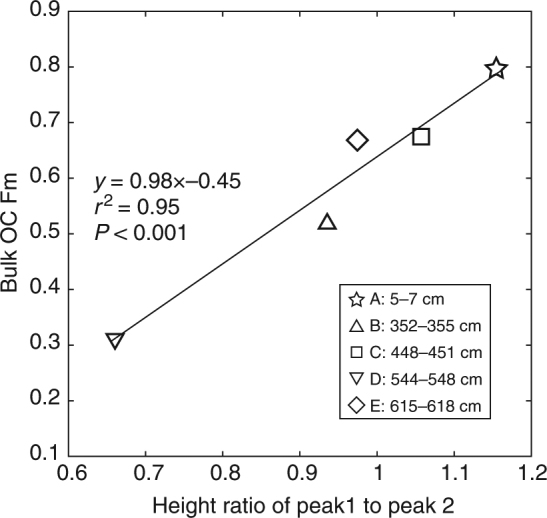
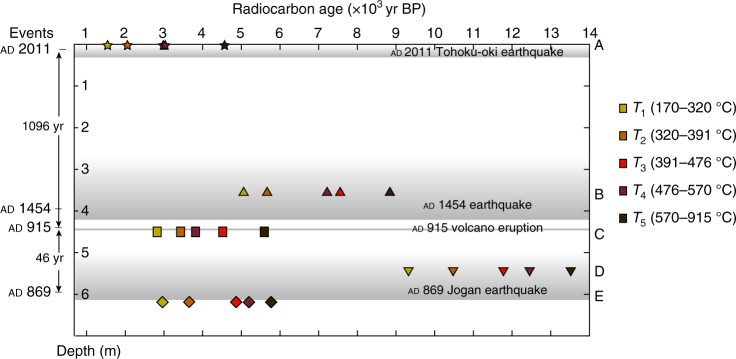
Sediments in deep ocean trenches may contain crucial information on past earthquake history and constitute important sites of carbon burial. Here we present 14 C data on bulk organic carbon (OC) and its thermal decomposition fractions produced by ramped pyrolysis/oxidation for a core retrieved from the >7.5 km-deep Japan Trench. High-resolution 14 C measurements, coupled with distinctive thermogram characteristics of OC, reveal hemipelagic sedimentation interrupted by episodic deposition of pre-aged OC in the trench. Low δ 13 C values and diverse 14 C ages of thermal fractions imply that the latter material originates from the adjacent margin, and the co-occurrence of pre-aged OC with intervals corresponding to known earthquake events implies tectonically triggered, gravity-flow-driven supply. We show that 14 C ages of thermal fractions can yield valuable chronological constraints on sedimentary sequences. Our findings shed new light on links between tectonically driven sedimentological processes and marine carbon cycling, with implications for carbon dynamics in hadal environments.
Overview
The claims and statistics of this paper haven’t been checked yet.
Free: it reads the open-access text and checks the first 5 claims that cite a source we can check. Create a free account to check every claim.
Integrity signals
Registry
Cites
Statistics
Figures
Verification
Claims the paper makes
The claims and statistics of this paper haven’t been checked yet.
Free: it reads the open-access text and checks the first 5 claims that cite a source we can check. Create a free account to check every claim.
Claims other papers make about this one
Each is checked against this paper’s own text: does it say what the citing paper says it does?
The cited source doesn’t support the claim as written.
In the citing paper
“Similar to the 2011 event deposits, the AD 1454 and 869 event deposits also contain relatively young remobilized sediments with high OC content (Bao et al., 2018).”
From Event Stratigraphy in a Hadal Oceanic Trench: The Japan Trench as Sedimentary Archive Recording Recurrent Giant Subduction Zone Earthquakes and Their Role in Organic Carbon Export to the Deep Sea (2019) · cites this paper as Bao et al., 2018
Checked by a reasoning model — may be wrong.
Experimental — accuracy not yet measuredThe source backs part of the claim, not all of it — or backs it for a different population, condition or comparison.
In the citing paper
“recent high-resolution radiocarbon dating constrains the age of the event deposit to the 15th century and thus corroborates the correlation to the AD 1454 Kyotoku earthquake (Bao et al., 2018).”
From Event Stratigraphy in a Hadal Oceanic Trench: The Japan Trench as Sedimentary Archive Recording Recurrent Giant Subduction Zone Earthquakes and Their Role in Organic Carbon Export to the Deep Sea (2019) · cites this paper as Bao et al., 2018
Experimental — accuracy not yet measuredThe source backs part of the claim, not all of it — or backs it for a different population, condition or comparison.
In the citing paper
“As revealed by previous studies by Bao et al. (2018) and Ikehara et al. (2016), bulk organic 14C ages do not represent the actual depositional age of the sediment (age offset in the order of ∼1,600 years)”
From Event Stratigraphy in a Hadal Oceanic Trench: The Japan Trench as Sedimentary Archive Recording Recurrent Giant Subduction Zone Earthquakes and Their Role in Organic Carbon Export to the Deep Sea (2019) · cites this paper as Bao et al., 2018
Experimental — accuracy not yet measuredThe source backs part of the claim, not all of it — or backs it for a different population, condition or comparison.
In the citing paper
“Total organic carbon (TOC) contents within AD 1454 and AD 869 event deposits from the core GeoB16431-1 core are 0.99± 0.26 wt% and 0.65± 0.10 wt%, respectively (Bao et al., 2018).”
From Event Stratigraphy in a Hadal Oceanic Trench: The Japan Trench as Sedimentary Archive Recording Recurrent Giant Subduction Zone Earthquakes and Their Role in Organic Carbon Export to the Deep Sea (2019) · cites this paper as Bao et al., 2018
Experimental — accuracy not yet measuredThe check wasn’t confident either way, so it gives no verdict — never disputed.
In the citing paper
“Bulk OC 14C data of bioturbated sediments overlying the homogenous diatomaceous mud within the core GeoB21817 indicate a mean sedimentation rate of 1.17 (+0.16/-0.12) m/kyr for background sedimentation in the basin JTN08 (Figure 6 and Supplementary Figure S2), which is lower than that in the southernmost basin JTS01 [5.44 (+0.13/-0.09) m/kyr; this study] and upper 2.5 mbsf of JTC02 in the central”
From Event Stratigraphy in a Hadal Oceanic Trench: The Japan Trench as Sedimentary Archive Recording Recurrent Giant Subduction Zone Earthquakes and Their Role in Organic Carbon Export to the Deep Sea (2019) · cites this paper as Bao et al., 2018
Experimental — accuracy not yet measured
Self-check
Percentages, sums and reported differences re-computed from the paper’s own numbers.
The self-check needs the paper’s full text.
Citations
Cites
IntCal13 and Marine13 radiocarbon age calibration curves 0–50,000 years cal BP
Reimer, P. J., Bard, E., Bayliss, A., Beck, J. W., Blackwell, P. G., Ramsey, C. B., Buck, C. E., Cheng, H., Edwards, R. L., Friedrich, M., et al. (2013) · Radiocarbon · doi:10.2458/azu_js_rc.55.16947 · Cited by 14,591
IntCal13とMarine13放射性炭素年代較正曲線0-50,000年cal BP
Reimer, P. J., Bard, É., Bayliss, A., Warren, B. J., Blackwell, P. G., Bronk, R., Buck Caitlin, E., Cheng, H., Lawrence, E. R., Michael, F., et al. (2013) · Radiocarbon · Cited by 5,676
Discussion Reporting of 14 C Data
Stuiver, M., & Polach, H. A. (1977) · Radiocarbon · doi:10.1017/s0033822200003672 · Cited by 5,640
Characterizing aquatic dissolved organic matter.
Leenheer, J. A., & Croué, J.-P. (2003) · PubMed · Cited by 4,891
Sedimentary organic matter preservation: an assessment and speculative synthesis
Hedges, J. I., & Keil, R. G. (1995) · Marine Chemistry · doi:10.1016/0304-4203(95)00008-f · Cited by 2,536
Mineral control of soil organic carbon storage and turnover
Torn, M. S., Trumbore, S. E., Chadwick, O. A., Vitousek, P. M., & Hendricks, D. M. (1997) · Nature · doi:10.1038/38260 · Cited by 1,603
Peer Reviewed: Characterizing Aquatic Dissolved Organic Matter
Leenheer, J. A., & Croué, J.-P. (2003) · Environmental Science & Technology · doi:10.1021/es032333c · Cited by 1,242
Clift, P., & Vannucchi, P. (2004) · Reviews of Geophysics · doi:10.1029/2003rg000127 · Cited by 906
Seismicity and the subduction process
Ruff, L., & Kanamori, H. (1980) · Physics of the Earth and Planetary Interiors · doi:10.1016/0031-9201(80)90117-x · Cited by 501
Hadal trenches: the ecology of the deepest places on Earth
Jamieson, A. J., Fujii, T., Mayor, D. J., Solan, M., & Priede, I. G. (2010) · Trends in Ecology & Evolution · doi:10.1016/j.tree.2009.09.009 · Cited by 432
Research works printed but not linked: 3
- Emerson, S. in Geophysical Monograph Series Vol. 32 (eds Sundquist, E. T. & Broecker, W. S.) 78–87 (AGU, Washington, D. C., 1985).
- Nakatsuka, T., Hosokawa, A., Handa, N., Matsumot, F. & Masuzawa, T. in Dynamics and Characterization of Marine Organic Matter (eds Handa, N., et al.) 169–186 (Springer, 1997).
- Ikehara K Ohkushi K Noda A Danhara T Yamashita T A new local marine reservoir correction for the last deglacial period in the Sanriku region, northern North Pacific, based on radicoarbon dates form the Towada-Hachinohe (To-H) tephra Quternary Res. 2013 52 127 137
Cited by
Items 101–124 of 124
Huang, S., Zhu, L., Jiang, S., Zhai, W., Pan, B., Wu, Z., & Xu, Q. (2023) · Journal of Marine Science and Engineering · doi:10.3390/jmse11081515 · Cited by 1
Resilience of deep-sea benthic communities to turbidity flows following the 2016 Kaikōura Earthquake
Bigham, K. T. (2023) · Open Access Victoria University of Wellington | Te Herenga Waka (Figshare) · doi:10.26686/wgtn.24646104 · Cited by 1
Chen, C., Zhangdong, J., Yang, X., Li, L., Longfei, G., & Fei, Z. (2020) · Journal of Lake Sciences · doi:10.18307/2020.0627
Flores, E., Cantarero, S. I., Ruiz‐Fernández, P., et al. (2021) · Biogeosciences · doi:10.5194/bg-2021-232-rc2
Flores, E. (2021) · Biogeosciences · doi:10.5194/bg-2021-232-ac2
Flores, E., Cantarero, S. I., Ruiz‐Fernández, P., et al. (2021) · Biogeosciences · doi:10.5194/bg-2021-232-rc1
Ikehara, K. (2022) · The Journal of the Geological Society of Japan · doi:10.5575/geosoc.2022.0013
Li, D., Zhao, J., Liu, C., Pan, J., & Hu, J. (2023) · Acta Oceanologica Sinica · doi:10.1007/s13131-022-2043-z
“Thus, the net lateral downslope transport flux ( Netlateral flux) and the proportion of the total OC input flux (Plateral/total) are much higher in the NYT than in the SYT (Table 3).”
BackgroundResultInfluentialIkehara, K. (2023) · The Quaternary Research (Daiyonki-Kenkyu) · doi:10.4116/jaqua.62.2305
Kanamatsu, T., Ikehara, K., & Hsiung, K.-H. (2024) · Figshare · doi:10.6084/m9.figshare.26578262
Ikehara, K., Usami, K., & Kanamatsu, T. (2024) · Figshare · doi:10.6084/m9.figshare.26571520
Girard, F., Alfaro-Lucas, J. M., Baco, A. R., Barry, J. P., Bigham, K. T., Beckmann, L., Brandt, A., Clark, L., Davies, M. A., Drazen, J. C., et al. (2026) · Progress In Oceanography · doi:10.1016/j.pocean.2026.103718
“These conditions not only enhance organic matter but also facilitate the movement of sediments from coastal waters, driving mass wasting, and the accumulation of poorly consolidated, but organic carbon rich sediments on the trench floor (Belyaev, 1972; Jumars and Hessler, 1976; Bao et al., 2018).”
Carbon source, distribution, and burial flux in global hadal trenches
Wei, Y., & Xu, Y. (2026) · Elsevier eBooks · doi:10.1016/b978-0-443-27610-1.00018-1
Trace metal concentrations, distributions and enrichments in the Aleutian Trench
Sindlev, M. B., Glud, R. N., & Canfield, D. E. (2026) · Chemical Geology · doi:10.1016/j.chemgeo.2026.123460
Wang, Y., Liu, M., Cao, Y., Hu, W., Wang, Y., Wang, N., Zhu, L., & Bao, R. (2026) · Analytical Chemistry · doi:10.1021/acs.analchem.6c00100
Self-citationZhu, L., Xiao, W., Wang, Y., Liu, L., Sindlev, M. B., Glud, R. N., & Xu, Y. (2026) · Journal of Geophysical Research Biogeosciences · doi:10.1029/2026jg009789
“…and ongoing subduction frequently induce earthquakes that facilitate downslope transport of sediments from the adjacent shallow seas, making hadal trenches potential depocenters for deep‐sea OC and BC (R. Bao et al., 2018; Itou et al., 2000; Oguri et al., 2022; Turnewitsch et al., 2014).”
Zhang, H., Luo, M., & Duo-fu, C. H. E. N. (2026) · Bulletin of Mineralogy Petrology and Geochemistry · doi:10.3724/j.issn.1007-2802.20260103
Cai, W., Huang, E., Peng, X., Liu, S. M., & Tian, J. (2026) · Paleoceanography and Paleoclimatology · doi:10.1029/2025pa005236
“In addition, trench settings are tectonically active, and earthquake‐triggered sediment remobilization and gravity‐ flow deposition can further rework sediments and introduce pre‐aged material (Bao et al., 2018).”
Postseismic sediment and geochemical fluxes
Wang, J., & Li, G. K. (2026) · Elsevier eBooks · doi:10.1016/b978-0-443-40375-0.00016-5
Umoh, C. D., Liu, J., Xiao, Y., & Zhang, H. (2026) · Deep Sea Research Part I Oceanographic Research Papers · doi:10.1016/j.dsr.2026.104767
Sandy Turbidity Current Acts as a Rusty Carbon Pump at the Shelf Edge
Zhang, Z., Wang, C., Chen, T., Bao, R., Chen, Z., Huang, X., Zhang, Y., & Zou, X. (2026) · Geophysical Research Letters · doi:10.1029/2026gl124581
“…et al., 2018; Smith et al., 2015), our results show that these two regions exhibit relatively low Fe‐OC accumulation rates (Figure 4d; Table S9 in Supporting Information S1) ( p < 0.05), probably attributable to limited Fe‐OC source and inputs (Bao, Strasser, et al., 2018; Placitu et al., 2024).”
InfluentialSelf-citationEarthquake-driven influx of organic matter enhances authigenic carbonate formation in hadal trenches
Liu, Y., Niu, L., Liu, M., Tao, R., Jing, C., Johnson, J. E., Xu, L., Guan, Y., Hu, Y., Luo, M., et al. (2026) · Nature Communications · doi:10.1038/s41467-026-79086-4
Self-citation
Metadata
- Authors
- Bao, R., Strasser, M., McNichol, A. P., Haghipour, N., McIntyre, C., Wefer, G., & Eglinton, T. I.
- Affiliations
- Harvard University (US)
- University of Bremen (DE)
- Woods Hole Oceanographic Institution (US)
- ETH Zurich (CH)
- Corresponding author
- Bao, Rui
- Strasser, Michael
- Eglinton, Timothy I.
- ORCID
- Venue
- Nature Communications
- Published
- 2018-01-09
- Volume
- 9
- Issue
- 1
- Pages
- 121-121
- ISSN
- 2041-1723 (ISSN-L)
- PMC
- PMC5760703
- OpenAlex
- W2782391297
- Semantic Scholar
- cf7668ba930c632d2b0091b6f2f0f056c48366c5
- Cited by
- 115
- References
- 48
- Citations by year
- 2026: 13 · 2025: 15 · 2024: 8 · 2023: 17 · 2022: 11 · 2021: 18 · 2020: 10 · 2019: 20 · 2018: 2
- FWCI
- 11.48
- Type
- journal article
- Language
- en
- Open access
- gold
- doi.org
- Licence
- cc-by
- creativecommons.org/licenses/by/4.0 (tdm)
- creativecommons.org/licenses/by/4.0 (vor)
- Locations
- Nature Communications (publishedVersion, cc-by)
- Europe PMC (PubMed Central) (publishedVersion, cc-by)
- PubMed Central (publishedVersion, cc-by)
- PubMed (publishedVersion)
- ENLIGHTEN (Jurnal Bimbingan dan Konseling Islam) (acceptedVersion, cc-by-sa)
- Digital Access to Scholarship at Harvard (DASH) (Harvard University) (submittedVersion, cc-by)
- RePEc: Research Papers in Economics (submittedVersion)
- Open Access Server of the Woods Hole Scientific Community (Woods Hole Scientific Community) (submittedVersion, cc-by)
- DOAJ (DOAJ: Directory of Open Access Journals) (submittedVersion, cc-by-sa)
- DOAJ (DOAJ: Directory of Open Access Journals) (submittedVersion)
- Repository for Publications and Research Data (ETH Zurich) (submittedVersion, cc-by)
- ETH Zürich Research Collection (cc-by)
- Funders
- National Science Foundation (133481, 200021_140850)
- Deutsche Forschungsgemeinschaft
- Schweizerischer Nationalfonds zur Förderung der Wissenschaftlichen Forschung (140850, 133481, 159064, 200021)
- Tongji University
- Topics
- Physical Sciences › Earth and Planetary Sciences › Earth-Surface Processes › Geological formations and processes
- Physical Sciences › Earth and Planetary Sciences › Atmospheric Science › Geology and Paleoclimatology Research
- Physical Sciences › Earth and Planetary Sciences › Oceanography › Marine Plankton and Biogeochemistry
- Keywords
- Japan Trench, deep-sea trenches, organic carbon, radiocarbon dating, thermal decomposition, carbon export, hadal zone, ocean carbon cycle, gravity-driven flow, sediment provenance, carbon burial, sediment dating, carbon isotopes
About these checks
Registry, retraction, Cites and statistics results are computed, not judged, with one exception: a printed reference that no index lists is read once by a model before it counts as a citation error. Claims are extracted by a model and kept only when their quote appears verbatim in the text; each cited source is then checked, with a model’s help, for whether it says what the claim relies on. Those verdicts can be wrong — read the claim’s quote and the cited source before relying on one.
Statistics and arithmetic are recomputed, not judged.
Confidence bands are shown only for fields calibrated on our annotated test set. None is calibrated yet, so no band is shown.
What counts as a claim ›How we measure confidence ›How we check this ›
Are you an author, or do you see a problem with this page? Request a review
Data sources
Bibliographic data: Semantic Scholar, OpenAlex, Crossref.
Contains information from the Semantic Scholar Academic Graph Datasets, made available under the ODC Attribution License (ODC-BY 1.0).
Semantic Scholar’s data is described in: Kinney, R., et al. (2023). The Semantic Scholar Open Data Platform. arXiv:2301.10140.
