

A transcriptome-wide association study identifies PALMD as a susceptibility gene for calcific aortic valve stenosis
Open accessPublished version of a preprint
The DOI matches its Crossref record; 53 of the 53 references it cites were found in a registry or an index.
Abstract
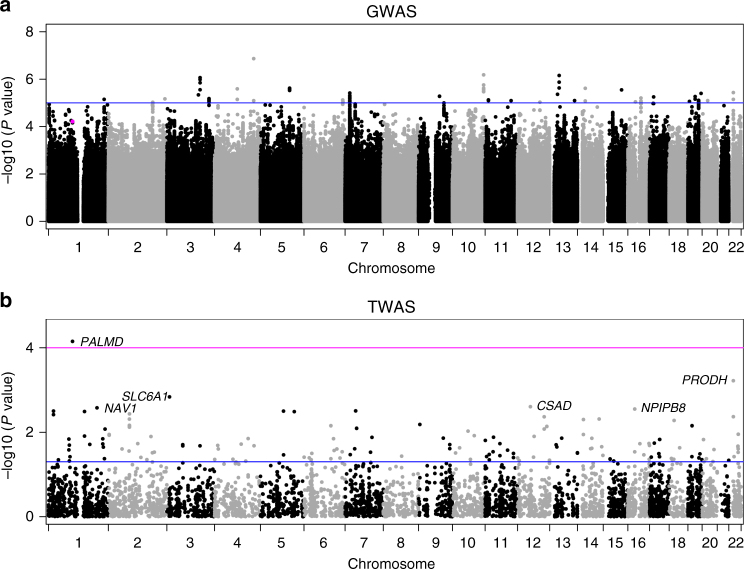
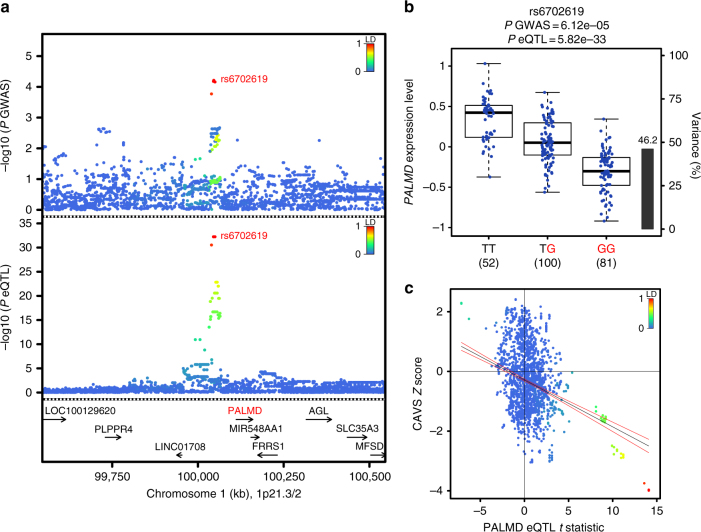
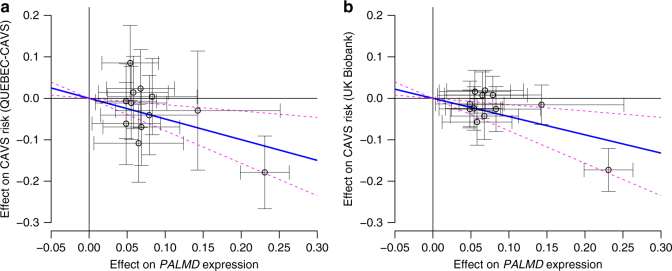
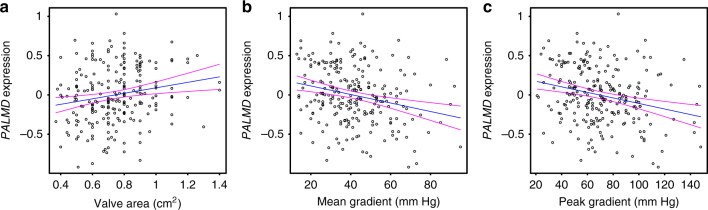
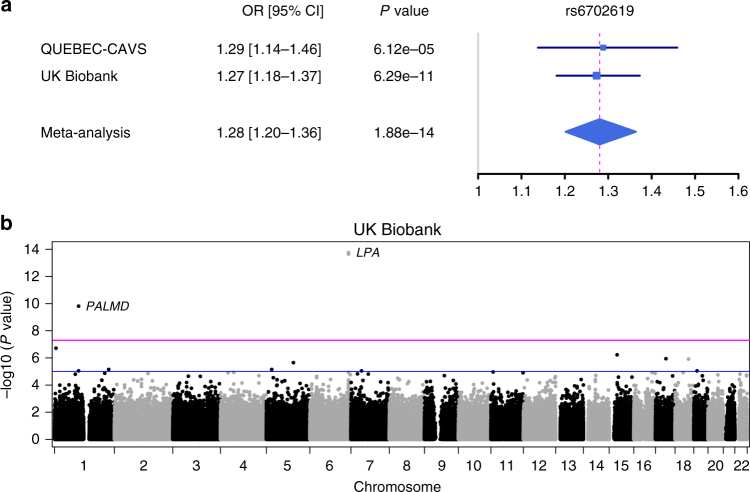
Calcific aortic valve stenosis (CAVS) is a common and life-threatening heart disease and the current treatment options cannot stop or delay its progression. A GWAS on 1009 cases and 1017 ethnically matched controls was combined with a large-scale eQTL mapping study of human aortic valve tissues ( n = 233) to identify susceptibility genes for CAVS. Replication was performed in the UK Biobank, including 1391 cases and 352,195 controls. A transcriptome-wide association study (TWAS) reveals PALMD (palmdelphin) as significantly associated with CAVS. The CAVS risk alleles and increasing disease severity are both associated with decreased mRNA expression levels of PALMD in valve tissues. The top variant identified shows a similar effect and strong association with CAVS ( P = 1.53 × 10 −10 ) in UK Biobank. The identification of PALMD as a susceptibility gene for CAVS provides insights into the genetic nature of this disease, opens avenues to investigate its etiology and to develop much-needed therapeutic options.
Overview
The claims and statistics of this paper haven’t been checked yet.
Free: it reads the open-access text and checks the first 5 claims that cite a source we can check. Create a free account to check every claim.
Integrity signals
Registry
Cites
Statistics
Figures
Verification
Claims the paper makes
The claims and statistics of this paper haven’t been checked yet.
Free: it reads the open-access text and checks the first 5 claims that cite a source we can check. Create a free account to check every claim.
Claims other papers make about this one
Each is checked against this paper’s own text: does it say what the citing paper says it does?
The source backs part of the claim, not all of it — or backs it for a different population, condition or comparison.
In the citing paper
“We also performed a transcriptome-wide association study using expression quantitative trait loci from human aortic valves, discovering 54 new genes for which genetically predicted expression influences the risk of AS.”
From Genomic and transcriptomic analyses of aortic stenosis enhance therapeutic target discovery and disease prediction (2026) · cites this paper as [10]
Experimental — accuracy not yet measuredThe source backs part of the claim, not all of it — or backs it for a different population, condition or comparison.
In the citing paper
“Mendelian randomization showed that lower expression of PALMD in AVs was causally associated with CAVS (Thériault et al., 2018).”
From Enhancer-associated aortic valve stenosis risk locus 1p21.2 alters NFATC2 binding site and promotes fibrogenesis (2021) · cites this paper as Thériault et al., 2018
Experimental — accuracy not yet measuredThe cited source says what the claim attributes to it.
In the citing paper
“The majority of gene associations (82%, 54/66) were newly compared to prior published AS TWAS9–11, among which 48 were at a genome-wide significant locus in our multi-ancestry or European GWAS.”
From Genomic and transcriptomic analyses of aortic stenosis enhance therapeutic target discovery and disease prediction (2026) · cites this paper as [10]
The cited source says what the claim attributes to it.
In the citing paper
“Cis-expression quantitative trait loci (eQTL) in AVs showed that the index variant, which is intergenic, is associated with the expression of PALMD encoding Palmdelphin (PALMD) (Thériault et al., 2018).”
From Enhancer-associated aortic valve stenosis risk locus 1p21.2 alters NFATC2 binding site and promotes fibrogenesis (2021) · cites this paper as Thériault et al., 2018
The cited source says what the claim attributes to it.
In the citing paper
“Genome-wide association studies for calcific aortic valve stenosis (CAVS) previously reported strong signal for noncoding variants at 1p21.2.”
From Enhancer-associated aortic valve stenosis risk locus 1p21.2 alters NFATC2 binding site and promotes fibrogenesis (2021) · cites this paper as Thériault et al., 2018
1 more claim about this paper
Create a free account to see every claim other papers make about this one.
Self-check
Percentages, sums and reported differences re-computed from the paper’s own numbers.
The self-check needs the paper’s full text.
Citations
Cites
A New Equation to Estimate Glomerular Filtration Rate
Levey, A. S., Stevens, L. A., Schmid, C. H., Zhang, Y. (., Castro, A. F., Feldman, H. I., Kusek, J. W., Eggers, P., Van Lente, F., Greene, T., et al. (2009) · Annals of Internal Medicine · doi:10.7326/0003-4819-150-9-200905050-00006 · Cited by 25,603
An integrated encyclopedia of DNA elements in the human genome
The ENCODE Project Consortium (2012) · Nature · doi:10.1038/nature11247 · Cited by 18,072
Sudlow, C., Gallacher, J., Allen, N., Beral, V., Burton, P., Danesh, J., Downey, P., Elliott, P., Green, J., Landray, M., et al. (2015) · PLOS Medicine · doi:10.1371/journal.pmed.1001779 · Cited by 12,728
Second-generation PLINK: rising to the challenge of larger and richer datasets
Chang, C. C., Chow, C. C., Tellier, L. C., Vattikuti, S., Purcell, S. M., & Lee, J. J. (2015) · Gigascience · doi:10.1186/s13742-015-0047-8 · Cited by 12,709
Bowden, J., Davey Smith, G., & Burgess, S. (2015) · International Journal of Epidemiology · doi:10.1093/ije/dyv080 · Cited by 9,816
The Genotype-Tissue Expression (GTEx) pilot analysis: Multitissue gene regulation in humans
The GTEx Consortium, Ardlie, K. G., Deluca, D. S., Segrè, A. V., Sullivan, T. J., Young, T. R., Gelfand, E. T., Trowbridge, C. A., Maller, J. B., Tukiainen, T., et al. (2015) · Science · doi:10.1126/science.1262110 · Cited by 5,062
Burden of valvular heart diseases: a population-based study
Nkomo, V. T., Gardin, J. M., Skelton, T. N., Gottdiener, J. S., Scott, C. G., & Enriquez-Sarano, M. (2006) · The Lancet · doi:10.1016/s0140-6736(06)69208-8 · Cited by 4,881
Giambartolomei, C., Vukcevic, D., Schadt, E. E., Franke, L., Hingorani, A. D., Wallace, C., & Plagnol, V. (2014) · PLoS Genetics · doi:10.1371/journal.pgen.1004383 · Cited by 4,261
Next-generation genotype imputation service and methods
Das, S., Forer, L., Schönherr, S., Sidore, C., Locke, A. E., Kwong, A., Vrieze, S. I., Chew, E. Y., Levy, S., McGue, M., et al. (2016) · Nature Genetics · doi:10.1038/ng.3656 · Cited by 3,808
A reference panel of 64,976 haplotypes for genotype imputation
the Haplotype Reference Consortium (2016) · Nature Genetics · doi:10.1038/ng.3643 · Cited by 2,836
Cited by
Items 101–135 of 135
Precision Medicine for Prosthetic Valve Deterioration
Thanassoulis, G. (2018) · Journal of the American College of Cardiology · doi:10.1016/j.jacc.2018.04.065 · Cited by 3
Xie, C., Niu, Y., Ping, J., Zhang, Q. Y., Zhang, Z., Wang, Y., Yang, C., Zhou, G., & Li, Y. (2021) · Research Square · doi:10.21203/rs.3.rs-465737/v1 · Cited by 4
Han, R., Wang, Z., Zhang, H., Wu, Y., Pan, W., Li, H., Qian, X., Xu, H., Jiang, T., & Chen, W. (2025) · BMC Surgery · doi:10.1186/s12893-025-03383-w · Cited by 2
“In addition, Mendelian randomization studies have further confirmed causal associations of blood pressure, body mass index (BMI), and Lp(a) levels with the risk of CAVD [4–6].”
Harmony in transcripts: a systematic literature review of transcriptome-wide association studies
Mashhour, M. A., Kandil, A. H., Wahed, M. A., & Mabrouk, M. S. (2024) · Journal of Engineering and Applied Science · doi:10.1186/s44147-024-00499-3 · Cited by 2
“By integrating GWAS and eQTL data, Thé-riault et al. [47]were able to determine the underlying molecular factors responsible for calcific aortic valve stenosis.”
MethodClavel, M.-A. A., Côté, N., & Pîbarot, P. (2019) · Springer eBooks · doi:10.1007/978-3-030-23104-0_3 · Cited by 2
Self-citationMatrisome and Immune Pathways Contribute to Extreme Vascular Outcomes in Williams–Beuren Syndrome
Liu, D., Billington, C. J., Raja, N., Wong, Z. C., Levin, M. D., Resch, W., Alba, C., Hupalo, D. N., Biamino, E., Bedeschi, M. F., et al. (2024) · Journal of the American Heart Association · doi:10.1161/jaha.123.031377 · Cited by 2
“Then, by harnessing existing GWAS data on common aortic conditions like aneurysm, 22–28 bicuspid aortic valve, 29,30 calcific valve stenosis, 31–33 and aortic size, 34–37 we examine overlap between the modifier pathways discovered for SVAS and these more commonly studied conditions.”
Autoencoder-Transformed Transcriptome Improves Genotype-Phenotype Association Studies
Li, Q., Bian, J., Weeraman, J., Zhang, Z., Leung, A., Ding, Q.-X., Chekouo, T., Wu, L., Yan, J. Y., Wu, J., et al. (2025) · IEEE Transactions on Computational Biology and Bioinformatics · doi:10.1109/tcbbio.2025.3568376 · Cited by 3
Bäck, M. (2023) · JACC Basic to Translational Science · doi:10.1016/j.jacbts.2023.09.001 · Cited by 2
Disease Drivers in Aortic Stenosis vs Atherosclerosis
Blaser, M. C., & Aïkawa, E. (2024) · JAMA Cardiology · doi:10.1001/jamacardio.2024.3749 · Cited by 1
Tucureanu, M. M., & Mânduțeanu, I. (2025) · Journal of Cellular and Molecular Medicine · doi:10.1111/jcmm.70835 · Cited by 1
“Five replicated genomic regions were previously known as AVD risk loci: PALMD, TEX41, IL6, LPA, FADS [59–62 , Combining GWAS with gene expression from 233 human aortic valve tissues, PALMD (palmdelphin) was identified as a new susceptibility gene for calcific AVS [61].”
Wu, J., Yang, Y., Huang, J., Li, X., Ma, Q., Chen, H., Wang, Y., Lama, E., Qiu, Z., & Zhou, Z. (2026) · Frontiers in Immunology · doi:10.3389/fimmu.2026.1711521 · Cited by 1
Manikpurage, H. D., Bourgault, J., Houessou, U., Paulin, A., Zamani, P., Gagnon, É., Li, Z., Boudreau, D. K., Eslami, A., Voisine, P., et al. (2025) · Communications Medicine · doi:10.1038/s43856-025-00981-w · Cited by 3
Self-citationTarget Discovery in Calcification Through Omics and Systems Approaches
Blaser, M. C., Halu, A., Saddic, L., Aikawa, M., & Aïkawa, E. (2020) · Contemporary cardiology · doi:10.1007/978-3-030-46725-8_23 · Cited by 1
[Infection prevention in Dutch hospitals; results say more than process indicators].
Bonten, M. J. M., Friedrich, A. W., Kluytmans, J. A. J. W., Vandenbroucke‐Grauls, C. M. J. E., Voß, A., & Vos, M. D. (2014) · PubMed · Cited by 1
Yang, Y., Shi, J., Yang, Y., Liu, S., Li, Y., Feng, L., Yan, R., Yao, J., Chen, L., Ding, L., et al. (2025) · bioRxiv (Cold Spring Harbor Laboratory) · doi:10.1101/2025.04.03.646911 · Cited by 1
Personalized precision medicine—Part A: Concepts and relevance in Mendelian disorders
Smith, M. (2020) · Elsevier eBooks · doi:10.1016/b978-0-12-819613-7.00009-8
Differential Mechanisms of Arterial and Valvular Calcification
Rogers, M. A., & Aïkawa, E. (2020) · Contemporary cardiology · doi:10.1007/978-3-030-46725-8_4
Using Machine Learning to Elucidate the Spatial and Genetic Complexity of the Ascending AortaPreprint
Nekoui, M., Pirruccello, J. P., Achille, P. D., Choi, S. H., Friedman, S. F., Nauffal, V. D., Ng, K., Batra, P., Ho, J. E., Philippakis, A., et al. (2021) · medRxiv · doi:10.1101/2021.11.01.21265701
“24,28,29 This agreement lends credence to interesting novel loci, such as aortic root diameter’s association with SNP rs80036911 on MECOM , a gene previously associated with left ventricular trabeculation.”
BackgroundElektronische Koordinaten als Dienstleistung des E-Business.
Lindstädt, H., & Wiegand, M. (2002)
Broberg, M. E., Ampuja, M., Jones, S. E., Ojala, T. H., Rahkonen, O. P., Kivelä, R., Priest, J. R., FinnGen, Ollila, H. M., & Helle, E. (2022) · medRxiv · doi:10.1101/2022.01.07.22268881
Liu, D., Billington, C. J., Raja, N., Wong, Z. C., Levin, M. D., Resch, W., Alba, C., Hupalo, D. N., Biamino, E., Bedeschi, M. F., et al. (2022) · medRxiv · doi:10.1101/2022.09.21.22280107
Risk factors for depresion and anxiety in the patient with aortic valve stenosis
Martínez, E. (2023) · Mexican Journal of Medical Research ICSA · doi:10.29057/mjmr.v11i22.10628
Guo, C., Jardin, B. D., Lin, J., Ambroise, R. L., Wang, Z., Yang, L., Mazumdar, N., Lu, F., Ma, Q., Cao, Y., et al. (2023) · bioRxiv (Cold Spring Harbor Laboratory) · doi:10.1101/2023.12.06.570334
“…in aggravated cardiac injury upon isoproterenol stimulation PALMD modulates the actin cytoskeleton and contributes to aortic valve calcification (Li et al., 2020; Sáinz-Jaspeado et al., 2021; Thériault et al., 2018; Wang et al., 2022), but its role in cardiomyocytes has yet to be determined.”
BackgroundAnousakis‐Vlachochristou, N., Mavroidis, M., Miliotis, M., Makridakis, M., Barla, I., Athanasiadou, D., Alexiou, A., Varela, A., Vatsellas, G., Elsharkawy, S., et al. (2024) · Research Square · doi:10.21203/rs.3.rs-4330270/v1
宋, 彦. (2024) · Advances in Clinical Medicine · doi:10.12677/acm.2024.1472043
Chaparro, D., Mirza, A. M., Balzora, D., Fahong, Y., Dargam, V., Menendez, L., Valentin, A., Chen, I. Y., Ramaswamy, S., & Hutcheson, J. (2025) · bioRxiv (Cold Spring Harbor Laboratory) · doi:10.1101/2025.09.29.679396
Fan, Z., & Lin, F. (2025) · Open Medicine · doi:10.1515/med-2024-1128
Opening Up the Future of Valvular Heart Disease
Messika–Zeitoun, D., Labinaz, M. X., LAU, L. S. W., Tavoosi, A., Grinberg, T., Alfreidi, H., Rashid, M. K., Mulloy, A. J., Thériault-Lauzier, P., Abdel‐Razek, O., et al. (2025) · Canadian Journal of Cardiology · doi:10.1016/j.cjca.2025.12.015 · Cited by 2
Self-citationWu, C., Tan, S., Liu, L., Cheng, S., Li, P., Li, W., Liu, H., Zhang, F., Wang, S., Ning, Y., et al. (2021) · Figshare · doi:10.6084/m9.figshare.13633188
Importance des processus angiogéniques au cours des pathologies valvulaires
Gendron, N. (2018) · theses.fr (ABES) · doi:10.70675/1b7507f9z4714z433bz9a6cz7c689b7f5148
Mapping the genetic landscape of eight common cardiovascular diseasesPreprint
Romero, C., Wightman, D. P., Jurgens, S. J., van Walree, E. S., Corver, M. E., Haydarlou, P., Schipper, M., Bezzina, C. R., Posthuma, D., & van der Sluis, S. (2026) · medRxiv · doi:10.64898/2026.04.26.26351760
Inorganic phosphate beyond a mineral: Signal transduction in multi-organ pathology
Silva, A. L., Freitas, B. B. D. S., Oliveira, P. H. S., de Oliveira-Nascimento, F., Bastos, F. F., & Lacerda‐Abreu, M. A. (2026) · Cellular Signalling · doi:10.1016/j.cellsig.2026.112736
A Multiomics Review of Aortic Stenosis
Treleaven, N., Gillies, S., Zamani, P., Seguin, A.-M., Bossé, Y., Thériault, S., Whitlock, R. P., & Paré, G. (2026) · Journal of the Heart Valve Society · doi:10.1177/30494826261468625
Self-citationZamani, P., Seguin, A.-M., Treleaven, N., Gillies, S., Bossé, Y., Paré, G., Whitlock, R. P., & Thériault, S. (2026) · Journal of the Heart Valve Society · doi:10.1177/30494826261472742 · Cited by 1
Self-citationAortic valve stenosis in 2026: from emerging mechanisms to clinical drug development
Zheng, K. H., Gaillard, É., Kroon, J., Stroes, E. S. G., & Boekholdt, S. M. (2026) · Atherosclerosis · doi:10.1016/j.atherosclerosis.2026.121865
Metadata
- Authors
- Thériault, S., Gaudreault, N., Lamontagne, M., Rosa, M., Boulanger, M.-C., Messika-Zeitoun, D., Clavel, M.-A., Capoulade, R., Dagenais, F., Pibarot, P., Mathieu, P., & Bossé, Y.
- Affiliations
- Institut universitaire de cardiologie et de pneumologie de Québec (CA)
- Corresponding author
- Bossé, Yohan
- ORCID
- Venue
- Nature Communications
- Published
- 2018-03-07
- Volume
- 9
- Issue
- 1
- Pages
- 988-988
- ISSN
- 2041-1723 (ISSN-L)
- PMC
- PMC5840407
- OpenAlex
- W2950772595
- Cited by
- 135
- References
- 53
- Citations by year
- 2026: 8 · 2025: 17 · 2024: 20 · 2023: 15 · 2022: 20 · 2021: 20 · 2020: 16 · 2019: 11 · 2018: 6
- FWCI
- 10.01
- Type
- journal article
- Language
- en
- Open access
- gold
- doi.org
- Licence
- cc-by
- creativecommons.org/licenses/by/4.0 (tdm)
- creativecommons.org/licenses/by/4.0 (vor)
- Locations
- Nature Communications (publishedVersion, cc-by)
- bioRxiv (Cold Spring Harbor Laboratory) (acceptedVersion, other-oa)
- PubMed Central (publishedVersion, cc-by)
- PubMed (publishedVersion)
- RePEc: Research Papers in Economics (submittedVersion)
- Corpus Université Laval (Université Laval) (submittedVersion)
- DOAJ (DOAJ: Directory of Open Access Journals) (submittedVersion)
- DOAJ (DOAJ: Directory of Open Access Journals) (submittedVersion, cc-by-sa)
- Funders
- Heart and Stroke Foundation of Canada
- Institut universitaire de cardiologie et de pneumologie de Québec, Université Laval
- Canadian Institutes of Health Research
- Fonds de Recherche du Québec - Santé
- Medical Research Council (MC_PC_17228)
- Topics
- Health Sciences › Medicine › Cardiology and Cardiovascular Medicine › Cardiac Valve Diseases and Treatments
- Life Sciences › Biochemistry, Genetics and Molecular Biology › Genetics › Genetic Associations and Epidemiology
- Life Sciences › Biochemistry, Genetics and Molecular Biology › Genetics › Genetic Mapping and Diversity in Plants and Animals
- Keywords
- calcific aortic stenosis, susceptibility genes, transcriptome-wide association study, expression quantitative trait loci, aortic valve tissue, gene expression, disease severity, genetic risk variants
- MeSH terms
- Aortic Valve, Aortic Valve Stenosis, Calcinosis, Humans, Membrane Proteins, Disease Progression, Genetic Predisposition to Disease, Genome-Wide Association Study, Transcriptome
About these checks
Registry, retraction, Cites and statistics results are computed, not judged, with one exception: a printed reference that no index lists is read once by a model before it counts as a citation error. Claims are extracted by a model and kept only when their quote appears verbatim in the text; each cited source is then checked, with a model’s help, for whether it says what the claim relies on. Those verdicts can be wrong — read the claim’s quote and the cited source before relying on one.
Statistics and arithmetic are recomputed, not judged.
Confidence bands are shown only for fields calibrated on our annotated test set. None is calibrated yet, so no band is shown.
What counts as a claim ›How we measure confidence ›How we check this ›
Are you an author, or do you see a problem with this page? Request a review
Data sources
Bibliographic data: Semantic Scholar, OpenAlex, Crossref.
Contains information from the Semantic Scholar Academic Graph Datasets, made available under the ODC Attribution License (ODC-BY 1.0).
Semantic Scholar’s data is described in: Kinney, R., et al. (2023). The Semantic Scholar Open Data Platform. arXiv:2301.10140.
