

The DOI matches its Crossref record; 74 of the 74 references it cites were found in a registry or an index.
Dissecting super-enhancer hierarchy based on chromatin interactions
Open accessPublished version of a preprint
Abstract
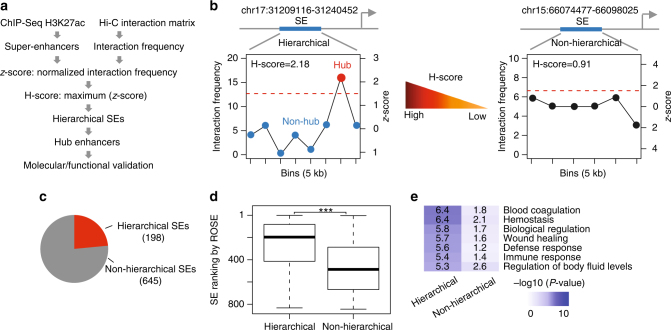
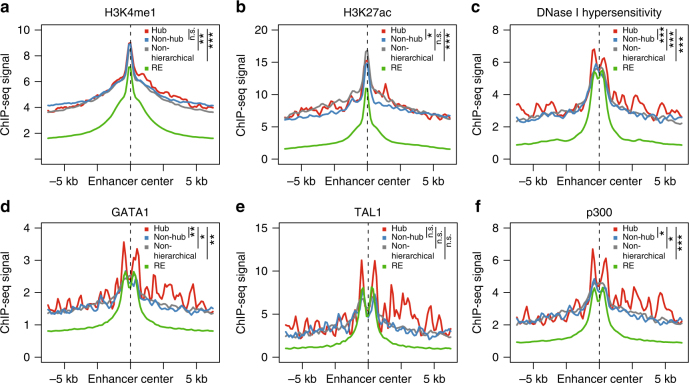
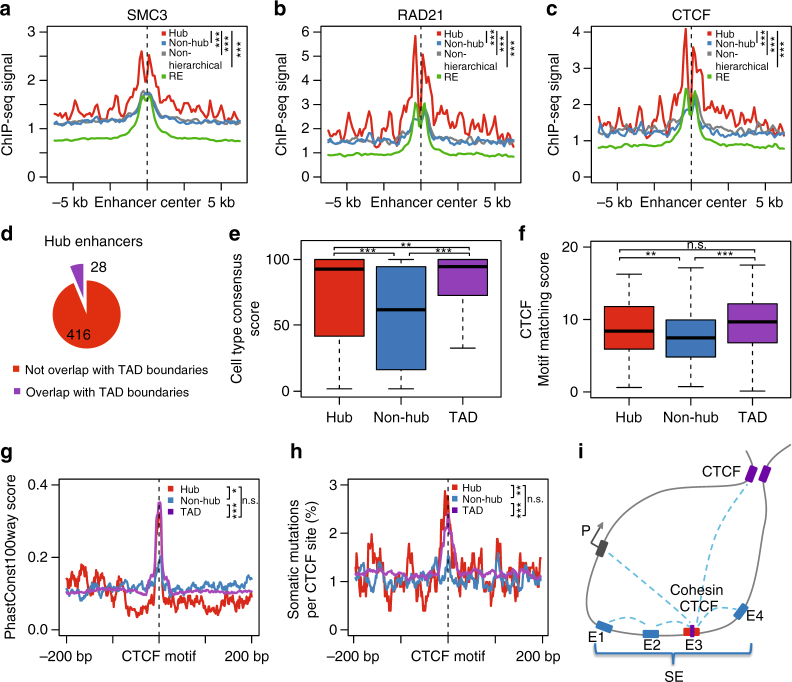
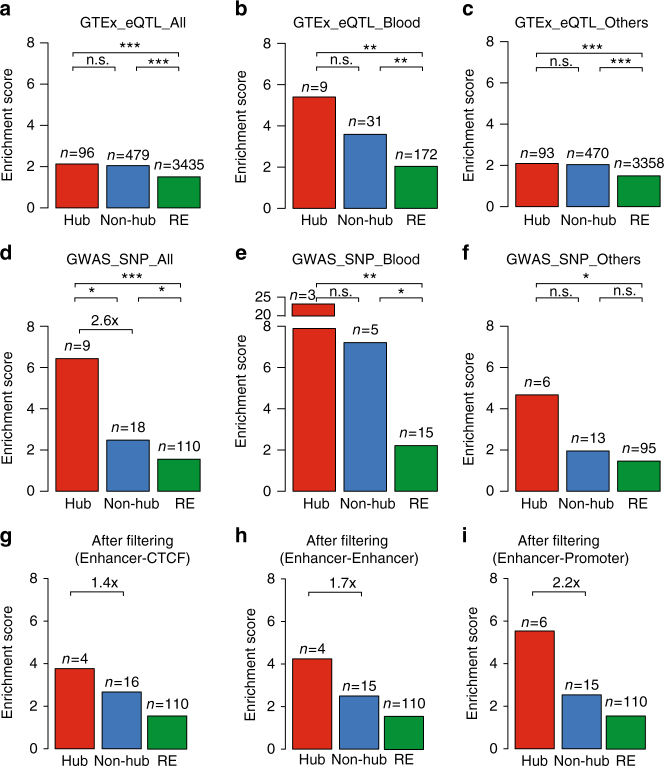
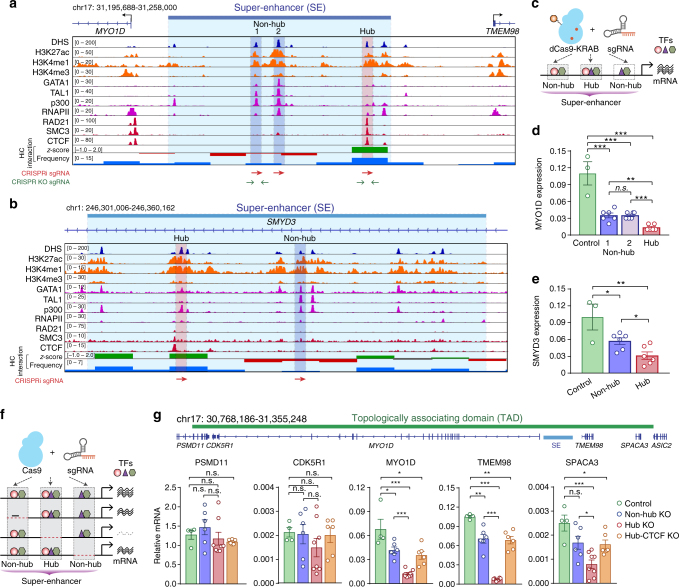
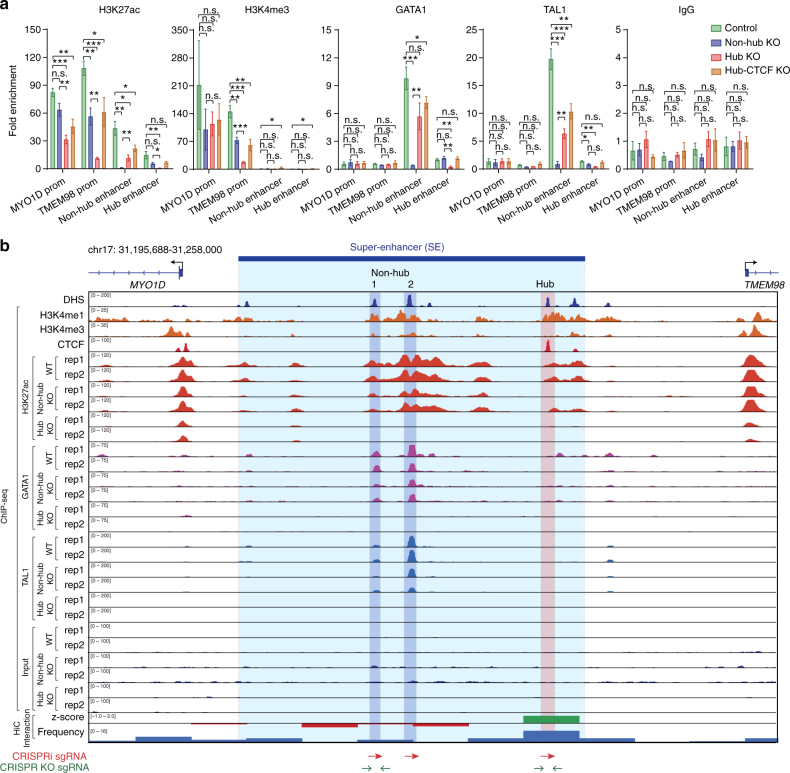
Recent studies have highlighted super-enhancers (SEs) as important regulatory elements for gene expression, but their intrinsic properties remain incompletely characterized. Through an integrative analysis of Hi-C and ChIP-seq data, here we find that a significant fraction of SEs are hierarchically organized, containing both hub and non-hub enhancers. Hub enhancers share similar histone marks with non-hub enhancers, but are distinctly associated with cohesin and CTCF binding sites and disease-associated genetic variants. Genetic ablation of hub enhancers results in profound defects in gene activation and local chromatin landscape. As such, hub enhancers are the major constituents responsible for SE functional and structural organization.
Overview
The claims and statistics of this paper haven’t been checked yet.
Run the check — free, no account needed. It reads the open-access text and checks the sources it cites.
Integrity signals
Registry
Cites
Statistics
Figures
Verification
Claims the paper makes
The claims and statistics of this paper haven’t been checked yet.
Run the check — free, no account needed. It reads the open-access text and checks the sources it cites.
Claims other papers make about this one
Each is checked against this paper’s own text: does it say what the citing paper says it does?
The source backs part of the claim, not all of it — or backs it for a different population, condition or comparison.
In the citing paper
“Review of diverse, albeit incomplete, previous analyses of SEs16,17,19,20,22 suggest that facilitators, as described here, may be relatively common elements in multipartite enhancers.”
From Super-enhancers include classical enhancers and facilitators to fully activate gene expression (2023) · cites this paper as [20]
Experimental — accuracy not yet measuredThe cited source says what the claim attributes to it.
In the citing paper
“When comparing Borzoi, Enformer and a distance-to-TSS baseline on their ability to classify measured positive from negative enhancer–gene interactions in data from previous works60–65, we find that Borzoi has superior average precision (AUPRC) and area under the receiver operating characteristic curve (AUROC) at all distances (Fig. 4c and Extended Data Fig. 5a).”
From Predicting RNA-seq coverage from DNA sequence as a unifying model of gene regulation (2025) · cites this paper as [64]
Self-check
Percentages, sums and reported differences re-computed from the paper’s own numbers.
The self-check needs the paper’s full text.
Citations
Cites
Ultrafast and memory-efficient alignment of short DNA sequences to the human genome.
Langmead, B., Trapnell, C., Pop, M., & Salzberg, S. L. (2009) · Genome Biology · doi:10.1186/gb-2009-10-3-r25 · Cited by 21,849
Model-based Analysis of ChIP-Seq (MACS)
Zhang, Y., Liu, T., Meyer, C. A., Eeckhoute, J., Johnson, D. S., Bernstein, B. E., Nusbaum, C., Myers, R. M., Brown, M., Li, W., et al. (2008) · Genome Biology · doi:10.1186/gb-2008-9-9-r137 · Cited by 18,386
Self-citationAn integrated encyclopedia of DNA elements in the human genome
The ENCODE Project Consortium (2012) · Nature · doi:10.1038/nature11247 · Cited by 18,072
Robinson, J. T., Thorvaldsdóttir, H., Winckler, W., Guttman, M., Lander, E. S., Getz, G., & Mesirov, J. P. (2011) · Nature Biotechnology · doi:10.1038/nbt.1754 · Cited by 15,390
Multiplex Genome Engineering Using CRISPR/Cas Systems
Cong, L., Ran, F. A., Cox, D., Lin, S., Barretto, R., Habib, N., Hsu, P. D., Wu, X., Jiang, W., Marraffini, L. A., et al. (2013) · Science · doi:10.1126/science.1231143 · Cited by 15,339
Heinz, S., Benner, C., Spann, N., Bertolino, E., Lin, Y. C., Laslo, P., Cheng, J. X., Murre, C., Singh, H., & Glass, C. K. (2010) · Molecular Cell · doi:10.1016/j.molcel.2010.05.004 · Cited by 13,382
A 3D Map of the Human Genome at Kilobase Resolution Reveals Principles of Chromatin Looping
Rao, S. S. P., Huntley, M. H., Durand, N. C., Stamenova, E. K., Bochkov, I. D., Robinson, J. T., Sanborn, A. L., Machol, I., Omer, A. D., Lander, E. S., et al. (2014) · Cell · doi:10.1016/j.cell.2014.11.021 · Cited by 9,212
RNA-Guided Human Genome Engineering via Cas9
Mali, P., Yang, L., Esvelt, K. M., Aach, J., Guell, M., DiCarlo, J. E., Norville, J. E., & Church, G. M. (2013) · Science · doi:10.1126/science.1232033 · Cited by 9,210
Comprehensive Mapping of Long-Range Interactions Reveals Folding Principles of the Human Genome
Lieberman-Aiden, E., van Berkum, N. L., Williams, L., Imakaev, M., Ragoczy, T., Telling, A., Amit, I., Lajoie, B. R., Sabo, P. J., Dorschner, M. O., et al. (2009) · Science · doi:10.1126/science.1181369 · Cited by 8,898
Topological domains in mammalian genomes identified by analysis of chromatin interactions
Dixon, J. R., Selvaraj, S., Yue, F., Kim, A., Li, Y., Shen, Y., Hu, M., Liu, J. S., & Ren, B. (2012) · Nature · doi:10.1038/nature11082 · Cited by 6,829
Cited by
Sorted by citations
Activity-by-contact model of enhancer–promoter regulation from thousands of CRISPR perturbations
Fulco, C. P., Nasser, J., Jones, T. R., Munson, G., Bergman, D. T., Subramanian, V., Grossman, S. R., Anyoha, R., Doughty, B. R., Patwardhan, T. A., et al. (2019) · Nature Genetics · doi:10.1038/s41588-019-0538-0 · Cited by 1,111
Cai, Y., Zhang, Y., Loh, Y. P., Tng, J. Q., Lim, M. C., Cao, Z., Raju, A., Lieberman Aiden, E., Li, S., Manikandan, L., et al. (2021) · Nature Communications · doi:10.1038/s41467-021-20940-y · Cited by 321
Self-citationPredicting RNA-seq coverage from DNA sequence as a unifying model of gene regulation
Linder, J., Srivastava, D., Yuan, H., Agarwal, V., & Kelley, D. R. (2025) · Nature Genetics · doi:10.1038/s41588-024-02053-6 · Cited by 265
Diversity and Emerging Roles of Enhancer RNA in Regulation of Gene Expression and Cell Fate
Arnold, P. R., Wells, A. D., & Li, X. C. (2020) · Frontiers in Cell and Developmental Biology · doi:10.3389/fcell.2019.00377 · Cited by 259
Identification of significant chromatin contacts from HiChIP data by FitHiChIP
Bhattacharyya, S., Chandra, V., Vijayanand, P., & Ay, F. (2019) · Nature Communications · doi:10.1038/s41467-019-11950-y · Cited by 238
Metadata
- Authors
- Huang, J., Li, K., Cai, W., Liu, X., Zhang, Y., Orkin, S. H., Xu, J., & Yuan, G.-C.
- Affiliations
- Boston Children's Hospital (US)
- Children's Medical Center (US)
- Harvard University (US)
- Corresponding author
- Xu, Jian
- Yuan, Guo-Cheng
- Venue
- Nature Communications
- Published
- 2018-03-05
- Volume
- 9
- Issue
- 1
- Pages
- 943-943
- ISSN
- 2041-1723 (ISSN-L)
- PMC
- PMC5838163
- OpenAlex
- W2952336494
- Cited by
- 241
- References
- 74
- Citations by year
- 2026: 22 · 2025: 20 · 2024: 22 · 2023: 27 · 2022: 37 · 2021: 43 · 2020: 30 · 2019: 25 · 2018: 14
- FWCI
- 11.38
- Type
- journal article
- Language
- en
- Open access
- gold
- doi.org
- Locations
- Nature Communications (publishedVersion, cc-by)
- bioRxiv (Cold Spring Harbor Laboratory) (acceptedVersion, cc-by)
- PubMed Central (publishedVersion, cc-by)
- PubMed (publishedVersion)
- Digital Access to Scholarship at Harvard (DASH) (Harvard University) (submittedVersion, cc-by)
- RePEc: Research Papers in Economics (submittedVersion)
- DOAJ (DOAJ: Directory of Open Access Journals) (submittedVersion)
- DOAJ (DOAJ: Directory of Open Access Journals) (submittedVersion, cc-by-sa)
- Funders
- American Cancer Society (IRG‐02‐196, 02-196)
- Cancer Prevention and Research Institute of Texas (RR140025)
- University of Texas Southwestern Medical Center
- National Institutes of Health
- National Heart, Lung, and Blood Institute (R01HL119099)
- National Human Genome Research Institute (R01HG009663)
- National Institute of Diabetes and Digestive and Kidney Diseases (K01DK093543, R03DK101665, R01DK111430)
- Topics
- Life Sciences › Biochemistry, Genetics and Molecular Biology › Molecular Biology › Genomics and Chromatin Dynamics
- Life Sciences › Biochemistry, Genetics and Molecular Biology › Molecular Biology › Chromatin Remodeling and Cancer
- Life Sciences › Biochemistry, Genetics and Molecular Biology › Cancer Research › Cancer-related molecular mechanisms research
- Keywords
- super-enhancers, chromatin interactions, cohesin, CTCF binding sites, histone modifications, disease-associated variants, gene activation, chromatin landscape
- MeSH terms
- Gene Editing, CCCTC-Binding Factor, Cohesins, Chromatin, Chromosomal Proteins, Non-Histone, Disease, Enhancer Elements, Genetic, Gene Expression Regulation, Humans, Models, Genetic, Protein Binding, Genetic Variation, Cell Cycle Proteins, K562 Cells, Gene Knockout Techniques, Human Umbilical Vein Endothelial Cells, CRISPR-Cas Systems
About these checks
Registry, retraction, Cites and statistics results are computed, not judged, with one exception: a printed reference that no index lists is read once by a model before it counts as a citation error. Claims are extracted by a model and kept only when their quote appears verbatim in the text; each cited source is then checked, with a model’s help, for whether it says what the claim relies on. Those verdicts can be wrong — read the claim’s quote and the cited source before relying on one.
Statistics and arithmetic are recomputed, not judged.
Confidence bands are shown only for fields calibrated on our annotated test set. None is calibrated yet, so no band is shown.
What counts as a claim ›How we measure confidence ›How we check this ›
Are you an author, or do you see a problem with this page? Request a review
