

The DOI matches its Crossref record; 64 of the 64 references it cites were found in a registry or an index.
Characterizing the replicability of cell types defined by single cell RNA-sequencing data using MetaNeighbor
Open accessPublished version of a preprint
Abstract
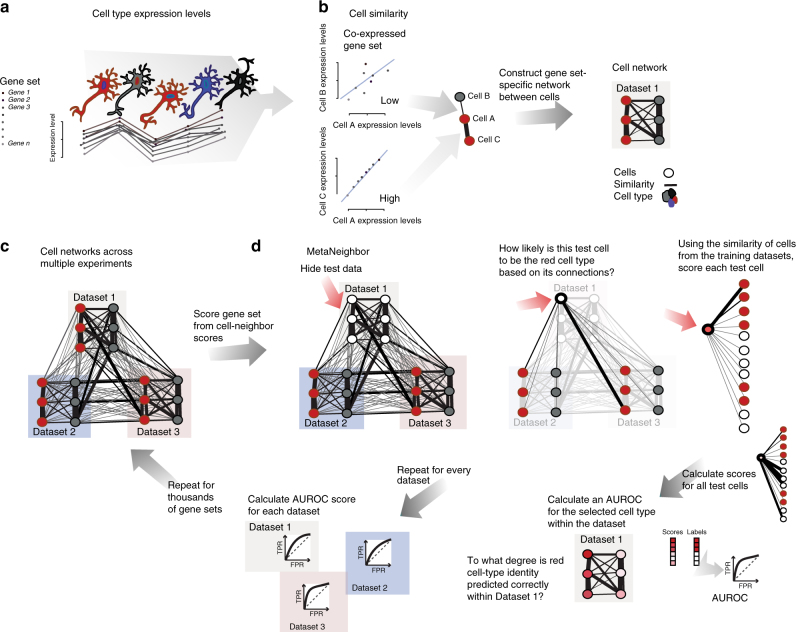
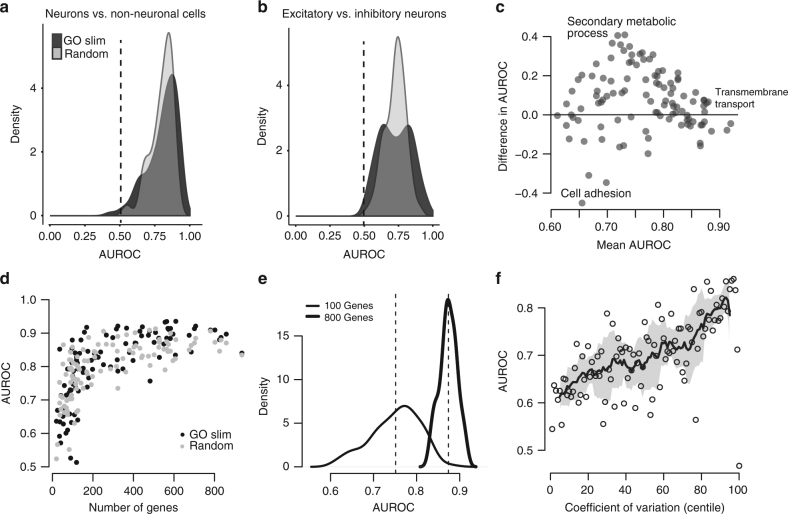
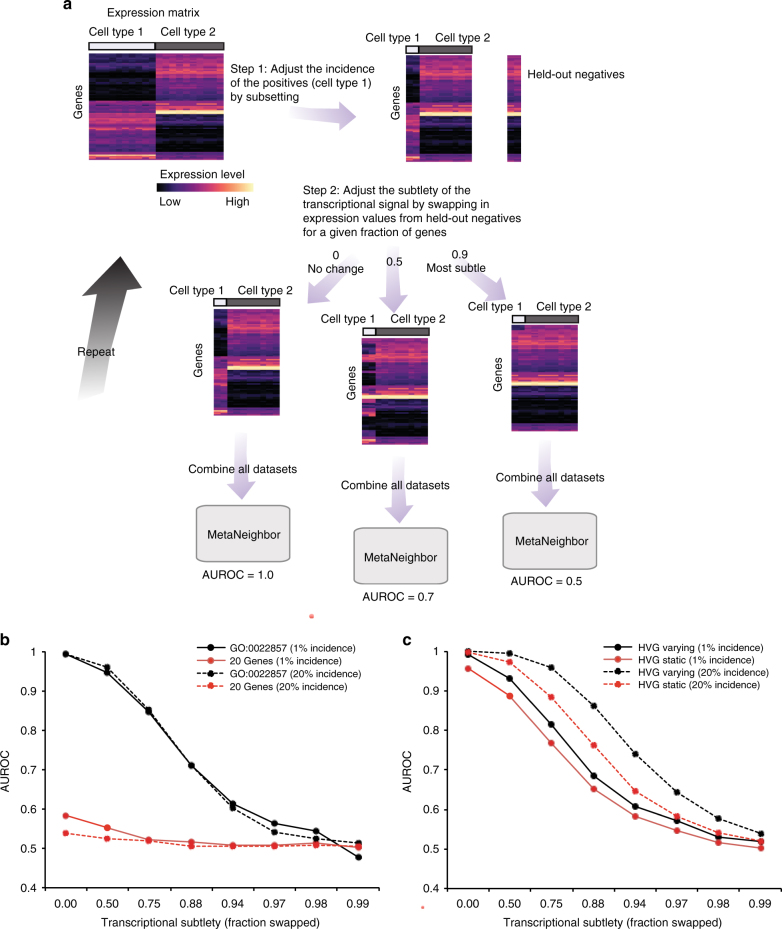
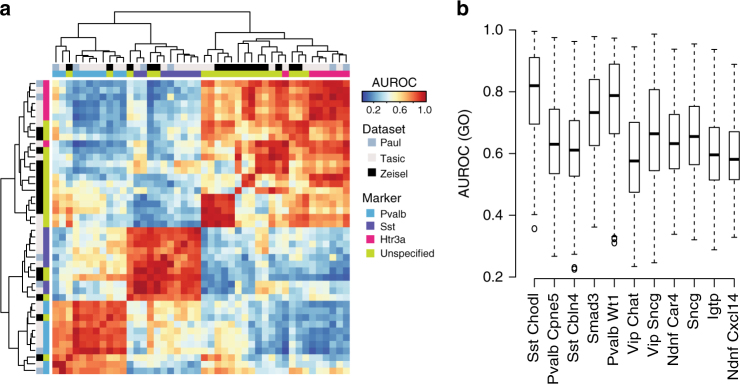
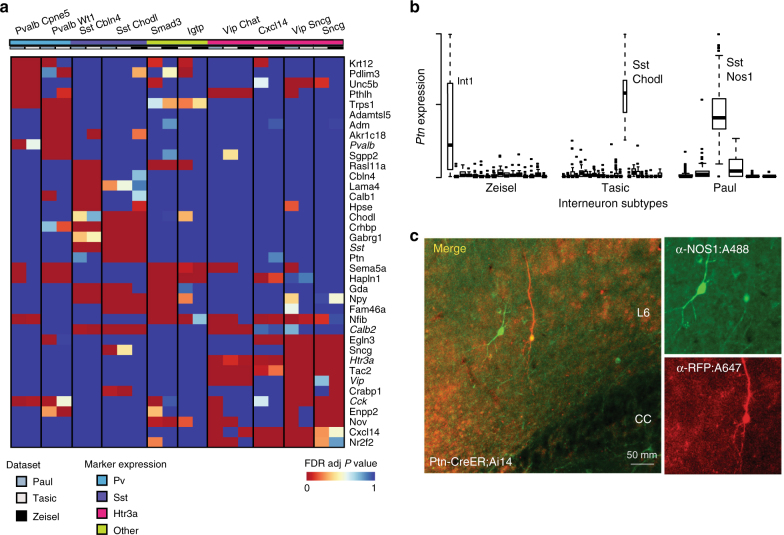
Single-cell RNA-sequencing (scRNA-seq) technology provides a new avenue to discover and characterize cell types; however, the experiment-specific technical biases and analytic variability inherent to current pipelines may undermine its replicability. Meta-analysis is further hampered by the use of ad hoc naming conventions. Here we demonstrate our replication framework, MetaNeighbor, that quantifies the degree to which cell types replicate across datasets, and enables rapid identification of clusters with high similarity. We first measure the replicability of neuronal identity, comparing results across eight technically and biologically diverse datasets to define best practices for more complex assessments. We then apply this to novel interneuron subtypes, finding that 24/45 subtypes have evidence of replication, which enables the identification of robust candidate marker genes. Across tasks we find that large sets of variably expressed genes can identify replicable cell types with high accuracy, suggesting a general route forward for large-scale evaluation of scRNA-seq data.
Overview
The claims and statistics of this paper haven’t been checked yet.
Run the check — free, no account needed. It reads the open-access text and checks the sources it cites.
Integrity signals
Registry
Cites
Statistics
Figures
Verification
Claims the paper makes
The claims and statistics of this paper haven’t been checked yet.
Run the check — free, no account needed. It reads the open-access text and checks the sources it cites.
Claims other papers make about this one
Each is checked against this paper’s own text: does it say what the citing paper says it does?
In the citing paper
“Paul et al.28 applied a supervised machine learning-based algorithm (MetaNeighbour50) to screen the ~620 HGNC (Human Genome Nomenclature Committee) gene families for those whose differential single-cell expression reliably distinguish these PCPs.”
From The diversity of GABAergic neurons and neural communication elements (2019) · cites this paper as [50]
In the citing paper
“A stringent test of cell type replicability uses transcriptomic signatures of a cell type learned from one or more datasets to try to predict the identity of cells in an independent dataset, providing a statistical score (area under the ROC curve) that quantifies the match between clusters (Crow et al., 2018).”
From Single-Cell Sequencing of Brain Cell Transcriptomes and Epigenomes (2021) · cites this paper as Crow et al., 2018
Self-check
Percentages, sums and reported differences re-computed from the paper’s own numbers.
The self-check needs the paper’s full text.
Citations
Cites
Controlling the False Discovery Rate: A Practical and Powerful Approach to Multiple Testing
Benjamini, Y., & Hochberg, Y. (1995) · Journal of the Royal Statistical Society Series B: Statistical Methodology · doi:10.1111/j.2517-6161.1995.tb02031.x · Cited by 109,482
Integrated analysis of single cell transcriptomic data across conditions, technologies, and species
Butler, A., & Satija, R. (2017) · doi:10.1101/164889 · Cited by 13,200
Integrating single-cell transcriptomic data across different conditions, technologies, and species
Butler, A., Hoffman, P., Smibert, P., Papalexi, E., & Satija, R. (2018) · Nature Biotechnology · doi:10.1038/nbt.4096 · Cited by 13,174
Statistical Methods for Research Workers
Fisher, R. A. (1945) · American Journal of Clinical Pathology · doi:10.1093/ajcp/15.11.552b · Cited by 10,883
Highly parallel genome-wide expression profiling of individual cells using nanoliter droplets.
Macosko, E. Z., Basu, A., Satija, R., Nemesh, J., Shekhar, K., Goldman, M., Tirosh, I., Bialas, A. R., Kamitaki, N., Martersteck, E. M., et al. (2015) · Cell · doi:10.1016/j.cell.2015.05.002 · Cited by 7,110
Repeated observation of breast tumor subtypes in independent gene expression data sets
Sørlie, T., Tibshirani, R. J., Parker, J. S., Hastie, T. J., Marron, J. S., Nobel, A. B., Deng, S., Johnsen, H., Pesich, R., Geisler, S. B., et al. (2003) · Proceedings of the National Academy of Sciences · doi:10.1073/pnas.0932692100 · Cited by 5,508
Droplet barcoding for single-cell transcriptomics applied to embryonic stem cells
Klein, A. M., Mazutis, L., Akartuna, I., Tallapragada, N., Veres, A., Li, V., Peshkin, L., Weitz, D. A., & Kirschner, M. W. (2015) · Cell · doi:10.1016/j.cell.2015.04.044 · Cited by 3,356
Cell types in the mouse cortex and hippocampus revealed by single-cell RNA-seq
Zeisel, A., Muñoz-Manchado, A. B., Codeluppi, S., Lönnerberg, P., La Manno, G., Juréus, A., Marques, S., Munguba, H., He, L., Betsholtz, C., et al. (2015) · Science · doi:10.1126/science.aaa1934 · Cited by 3,124
Comparison of Discrimination Methods for the Classification of Tumors Using Gene Expression Data
Dudoit, S., Fridlyand, J., & Speed, T. P. (2002) · Journal of the American Statistical Association · doi:10.1198/016214502753479248 · Cited by 2,671
Batch effects in single-cell RNA-sequencing data are corrected by matching mutual nearest neighbors
Haghverdi, L., Lun, A. T. L., Morgan, M. D., & Marioni, J. C. (2018) · Nature Biotechnology · doi:10.1038/nbt.4091 · Cited by 2,416
Cited by
Sorted by citations
Conserved cell types with divergent features in human versus mouse cortex
Hodge, R. D., Bakken, T. E., Miller, J. A., Smith, K. A., Barkan, E. R., Graybuck, L. T., Close, J. L., Long, B., Johansen, N., Penn, O., et al. (2019) · Nature · doi:10.1038/s41586-019-1506-7 · Cited by 1,775
Challenges in unsupervised clustering of single-cell RNA-seq data
Kiselev, V. Y., Andrews, T. S., & Hemberg, M. (2019) · Nature Reviews Genetics · doi:10.1038/s41576-018-0088-9 · Cited by 1,205
Construction of a human cell landscape at single-cell level
Han, X., Zhou, Z., Fei, L., Sun, H., Wang, R., Chen, Y., Chen, H., Wang, J., Tang, H., Ge, W., et al. (2020) · Nature · doi:10.1038/s41586-020-2157-4 · Cited by 1,087
Altered human oligodendrocyte heterogeneity in multiple sclerosis
Jäkel, S., Agirre, E., Mendanha Falcão, A., van Bruggen, D., Lee, K. W., Knuesel, I., Malhotra, D., ffrench-Constant, C., Williams, A., & Castelo-Branco, G. (2019) · Nature · doi:10.1038/s41586-019-0903-2 · Cited by 854
Efficient integration of heterogeneous single-cell transcriptomes using Scanorama
Hie, B., Bryson, B. D., & Berger, B. (2019) · Nature Biotechnology · doi:10.1038/s41587-019-0113-3 · Cited by 876
Metadata
- Authors
- Crow, M., Paul, A., Ballouz, S., Huang, Z. J., & Gillis, J.
- Affiliations
- Cold Spring Harbor Laboratory (US)
- Corresponding author
- Gillis, Jesse
- Venue
- Nature Communications
- Published
- 2018-02-28
- Volume
- 9
- Issue
- 1
- Pages
- 884-884
- ISSN
- 2041-1723 (ISSN-L)
- PMC
- PMC5830442
- OpenAlex
- W2804847416
- Cited by
- 365
- References
- 59
- Citations by year
- 2026: 51 · 2025: 51 · 2024: 68 · 2023: 45 · 2022: 30 · 2021: 26 · 2020: 44 · 2019: 32 · 2018: 14
- FWCI
- 10.94
- Type
- journal article
- Language
- en
- Open access
- gold
- doi.org
- Locations
- Nature Communications (publishedVersion, cc-by)
- bioRxiv (Cold Spring Harbor Laboratory) (acceptedVersion, cc-by-nc-nd)
- Europe PMC (PubMed Central) (publishedVersion, cc-by)
- PubMed Central (publishedVersion, cc-by)
- PubMed (publishedVersion)
- Cold Spring Harbor Laboratory Institutional Repository (Cold Spring Harbor Laboratory) (acceptedVersion)
- UNSWorks (UNSW Sydney) (submittedVersion, cc-by-nc-nd)
- RePEc: Research Papers in Economics (submittedVersion)
- DOAJ (DOAJ: Directory of Open Access Journals) (submittedVersion)
- DOAJ (DOAJ: Directory of Open Access Journals) (submittedVersion, cc-by-sa)
- Funders
- National Alliance for Research on Schizophrenia and Depression
- Cold Spring Harbor Laboratory
- National Institutes of Health (1f32mh114501-01)
- National Institute of Mental Health (R01MH094705, R01MH109665, R01MH113005, F32-MH114501)
- U.S. National Library of Medicine (R01LM012736)
- Topics
- Life Sciences › Biochemistry, Genetics and Molecular Biology › Molecular Biology › Single-cell and spatial transcriptomics
- Life Sciences › Biochemistry, Genetics and Molecular Biology › Molecular Biology › Gene expression and cancer classification
- Life Sciences › Biochemistry, Genetics and Molecular Biology › Molecular Biology › Genomics and Phylogenetic Studies
- Keywords
- replicability, single-cell RNA sequencing, cell type annotation, meta-analysis, neuronal identity, interneuron subtypes, marker genes, cluster similarity, technical bias
- MeSH terms
- Humans, Neurons, RNA, Sequence Analysis, RNA, Computational Biology, Gene Expression Profiling, Single-Cell Analysis
About these checks
Registry, retraction, Cites and statistics results are computed, not judged, with one exception: a printed reference that no index lists is read once by a model before it counts as a citation error. Claims are extracted by a model and kept only when their quote appears verbatim in the text; each cited source is then checked, with a model’s help, for whether it says what the claim relies on. Those verdicts can be wrong — read the claim’s quote and the cited source before relying on one.
Statistics and arithmetic are recomputed, not judged.
Confidence bands are shown only for fields calibrated on our annotated test set. None is calibrated yet, so no band is shown.
What counts as a claim ›How we measure confidence ›How we check this ›
Are you an author, or do you see a problem with this page? Request a review
