

The DOI matches its Crossref record; 54 of the 54 references it cites were found in a registry or an index.
Genome-wide association study in 176,678 Europeans reveals genetic loci for tanning response to sun exposure
Open accessAbstract
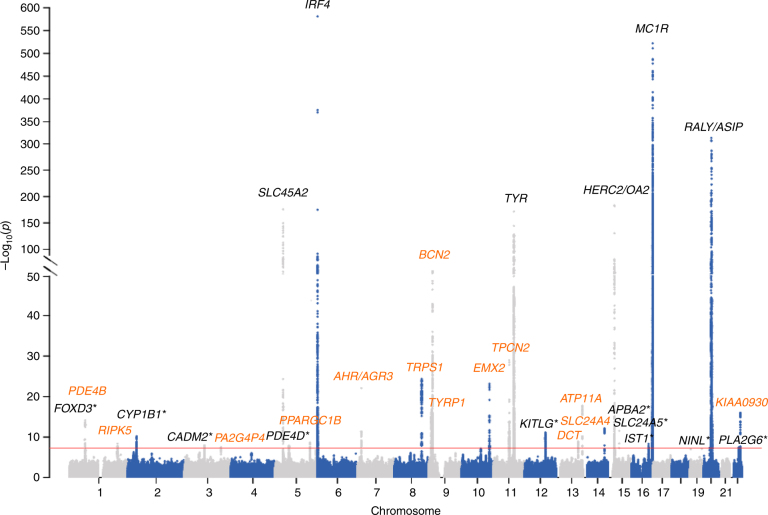
The skin’s tendency to sunburn rather than tan is a major risk factor for skin cancer. Here we report a large genome-wide association study of ease of skin tanning in 176,678 subjects of European ancestry. We identify significant association with tanning ability at 20 loci. We confirm previously identified associations at six of these loci, and report 14 novel loci, of which ten have never been associated with pigmentation-related phenotypes. Our results also suggest that variants at the AHR/AGR3 locus, previously associated with cutaneous malignant melanoma the underlying mechanism of which is poorly understood, might act on disease risk through modulation of tanning ability.
Overview
The claims and statistics of this paper haven’t been checked yet.
Run the check — free, no account needed. It reads the open-access text and checks the sources it cites.
Integrity signals
Registry
Cites
Statistics
Figures
Verification
Claims the paper makes
The claims and statistics of this paper haven’t been checked yet.
Run the check — free, no account needed. It reads the open-access text and checks the sources it cites.
Claims other papers make about this one
Each is checked against this paper’s own text: does it say what the citing paper says it does?
The source backs part of the claim, not all of it — or backs it for a different population, condition or comparison.
In the citing paper
“a high-frequency introgressed haplotype that influences skin pigmentation levels in Europeans (Fig. S15)59,60”
From Quantifying the contribution of Neanderthal introgression to the heritability of complex traits (2021) · cites this paper as [60]
Experimental — accuracy not yet measured
Self-check
Percentages, sums and reported differences re-computed from the paper’s own numbers.
The self-check needs the paper’s full text.
Citations
Cites
PLINK: a tool set for whole-genome association and population-based linkage analyses.
Purcell, S., Neale, B., Todd-Brown, K., Thomas, L., Ferreira, M. A. R., Bender, D., Maller, J., Sklar, P., de Bakker, P. I. W., Daly, M. J., et al. (2007) · The American Journal of Human Genetics · doi:10.1086/519795 · Cited by 34,089
Integrative analysis of 111 reference human epigenomes
Roadmap Epigenomics Consortium, Kundaje, A., Meuleman, W., Ernst, J., Bilenky, M., Yen, A., Heravi-Moussavi, A., Kheradpour, P., Zhang, Z., Wang, J., et al. (2015) · Nature · doi:10.1038/nature14248 · Cited by 6,368
LD Score regression distinguishes confounding from polygenicity in genome-wide association studies
Schizophrenia Working Group of the Psychiatric Genomics Consortium, Bulik-Sullivan, B. K., Loh, P.-R., Finucane, H. K., Ripke, S., Yang, J., Patterson, N., Daly, M. J., Price, A. L., & Neale, B. M. (2015) · Nature Genetics · doi:10.1038/ng.3211 · Cited by 5,559
METAL: fast and efficient meta-analysis of genomewide association scans
Willer, C. J., Li, Y., & Abecasis, G. R. (2010) · Bioinformatics · doi:10.1093/bioinformatics/btq340 · Cited by 5,205
The Genotype-Tissue Expression (GTEx) pilot analysis: Multitissue gene regulation in humans
The GTEx Consortium, Ardlie, K. G., Deluca, D. S., Segrè, A. V., Sullivan, T. J., Young, T. R., Gelfand, E. T., Trowbridge, C. A., Maller, J. B., Tukiainen, T., et al. (2015) · Science · doi:10.1126/science.1262110 · Cited by 5,062
The validity and practicality of sun-reactive skin types I through VI
Fitzpatrick, T. B. (1988) · Archives of Dermatology · doi:10.1001/archderm.1988.01670060015008 · Cited by 4,339
An atlas of genetic correlations across human diseases and traits
ReproGen Consortium, Bulik-Sullivan, B., Psychiatric Genomics Consortium, Genetic Consortium for Anorexia Nervosa of the Wellcome Trust Case Control Consortium 3, Finucane, H. K., Anttila, V., Gusev, A., Day, F. R., Loh, P.-R., Duncan, L., et al. (2015) · Nature Genetics · doi:10.1038/ng.3406 · Cited by 4,255
Genome-wide efficient mixed-model analysis for association studies
Zhou, X., & Stephens, M. (2012) · Nature Genetics · doi:10.1038/ng.2310 · Cited by 3,627
Robust relationship inference in genome-wide association studies
Manichaikul, A., Mychaleckyj, J. C., Rich, S. S., Daly, K., Sale, M., & Chen, W.-M. (2010) · Bioinformatics · doi:10.1093/bioinformatics/btq559 · Cited by 3,541
Merlin—rapid analysis of dense genetic maps using sparse gene flow trees
Abecasis, G. R., Cherny, S. S., Cookson, W., & Cardon, L. R. (2001) · Nature Genetics · doi:10.1038/ng786 · Cited by 3,323
Research works printed but not linked: 1
- Hysi, P. G. et al. A GWAS meta-analysis of more than 300,000 individuals of European ancestry identifies numerous new genetic loci explaining significant portions of hair color variation and heritability. Nat. Genet. In press NG-LE44861R1 (2018).
Cited by
Sorted by citations
Objectives, design and main findings until 2020 from the Rotterdam Study
Ikram, M. A., Brusselle, G., Ghanbari, M., Goedegebure, A., Ikram, M. K., Kavousi, M., Kieboom, B. C. T., Klaver, C. C. W., de Knegt, R. J., Luik, A. I., et al. (2020) · European Journal of Epidemiology · doi:10.1007/s10654-020-00640-5 · Cited by 463
Self-citationLandi, M. T., Bishop, D. T., MacGregor, S., Machiela, M. J., Stratigos, A., Ghiorzo, P., Brossard, M., Calista, D., Choi, J., Fargnoli, M. C., et al. (2020) · Nature Genetics · doi:10.1038/s41588-020-0611-8 · Cited by 239
Self-citationThe journey from melanocytes to melanoma
Centeno, P. P., Pavet, V., & Marais, R. (2023) · Nature reviews. Cancer · doi:10.1038/s41568-023-00565-7 · Cited by 211
Adhikari, K., Mendoza‐Revilla, J., Sohail, A., Fuentes‐Guajardo, M., Lampert, J. E., Chacón-Duque, J. C., Hurtado, M., Villegas, V., Granja, V., Acuña-Alonzo, V., et al. (2019) · Nature Communications · doi:10.1038/s41467-018-08147-0 · Cited by 193
The Genetics of Human Skin and Hair Pigmentation
Pavan, W. J., & Sturm, R. A. (2019) · Annual Review of Genomics and Human Genetics · doi:10.1146/annurev-genom-083118-015230 · Cited by 165
Metadata
- Authors
- Visconti, A., Duffy, D. L., Liu, F., Zhu, G., Wu, W., Chen, Y., Hysi, P. G., Zeng, C., Sanna, M., Iles, M. M., Kanetsky, P. A., Demenais, F., Hamer, M. A., Uitterlinden, A. G., Ikram, M. A., Nijsten, T., Martin, N. G., Kayser, M., Spector, T. D., Han, J., Bataille, V., & Falchi, M.
- Affiliations
- King's College London (GB)
- QIMR Berghofer Medical Research Institute (AU)
- Chinese Academy of Sciences (CN)
- Indiana University Indianapolis (US)
- University of Leeds (GB)
- Moffitt Cancer Center (US)
- Erasmus MC (NL)
- Brigham and Women's Hospital (US)
- Corresponding author
- Falchi, Mario
- ORCID
- Venue
- Nature Communications
- Published
- 2018-05-08
- Volume
- 9
- Issue
- 1
- Pages
- 1684-1684
- ISSN
- 2041-1723 (ISSN-L)
- PMC
- PMC5940788
- OpenAlex
- W2799394553
- Cited by
- 103
- References
- 54
- Citations by year
- 2026: 6 · 2025: 7 · 2024: 15 · 2023: 6 · 2022: 19 · 2021: 11 · 2020: 19 · 2019: 14 · 2018: 5
- FWCI
- 6.79
- Type
- journal article
- Language
- en
- Open access
- gold
- doi.org
- Locations
- Nature Communications (publishedVersion, cc-by)
- Europe PMC (PubMed Central) (publishedVersion, cc-by)
- PubMed Central (publishedVersion, cc-by)
- PubMed (publishedVersion)
- EUR Research Repository (Erasmus University Rotterdam) (publishedVersion, other-oa)
- White Rose Research Online (University of Leeds, The University of Sheffield, University of York) (acceptedVersion)
- Institutional Research Information System University of Turin (University of Turin) (submittedVersion, cc-by)
- EUR Research Repository (Erasmus University Rotterdam) (submittedVersion, other-oa)
- RePub (Erasmus University Rotterdam) (submittedVersion, other-oa)
- RePEc: Research Papers in Economics (submittedVersion)
- DOAJ (DOAJ: Directory of Open Access Journals) (submittedVersion, cc-by-sa)
- DOAJ (DOAJ: Directory of Open Access Journals) (submittedVersion)
- Research Portal (King's College London) (submittedVersion, cc-by)
- IUScholarWorks (Indiana University) (submittedVersion, cc-by)
- Spiral (Imperial College London) (submittedVersion, cc-by-nc-nd)
- Funders
- Wellcome Trust (P01 CA87969, R01 CA49449, 081878/Z/06/Z, UM1 CA186107, 081878, UM1 CA167552)
- QIMR Berghofer Medical Research Institute
- National Institute for Health and Care Research (P01 CA87969, R01 CA49449, NF-SI-0507-10228, UM1 CA167552, UM1 CA186107, NF-SI-0514-10027)
- British Skin Foundation (5044i)
- King's College London
- European Commission (UM1 CA186107, P01 CA87969, UM1 CA167552, R01 CA49449)
- National Natural Science Foundation of China (91651507)
- ZonMw
- Erasmus Universiteit Rotterdam
- Nederlandse Organisatie voor Wetenschappelijk Onderzoek
- National Institutes of Health (5r01ca049449-19, NIH-R01, R01 CA49449, CA-49449, UM1-CA167552, CA-167552, CA186107, CA 87969)
- Medical Research Council (UM1 CA167552, UM1 CA186107, R01 CA49449, P01 CA87969)
- National Health and Medical Research Council (UM1 CA186107, P01 CA87969)
- National Cancer Institute (P01CA087969, R01‐CA049449, UM1CA186107, UM1CA167552, U01CA167552)
- Topics
- Life Sciences › Biochemistry, Genetics and Molecular Biology › Cell Biology › melanin and skin pigmentation
- Life Sciences › Biochemistry, Genetics and Molecular Biology › Genetics › Genetic Associations and Epidemiology
- Health Sciences › Medicine › Dermatology › Skin Protection and Aging
- Keywords
- tanning, sun exposure, skin pigmentation, genetic loci, skin cancer risk, sunburn, cutaneous melanoma, novel genetic variants, European ancestry
- MeSH terms
- Radiation Exposure, Adult, Aged, Carrier Proteins, Chromosome Mapping, Female, United Kingdom, Hair Color, Humans, Male, Melanoma, Middle Aged, Neoplasm Proteins, Neoplasms, Radiation-Induced, Phenotype, Prospective Studies, Risk Factors, Sex Factors, Skin Neoplasms, Sunburn, Receptors, Aryl Hydrocarbon, Genetic Predisposition to Disease, Polymorphism, Single Nucleotide, White People, Genome-Wide Association Study, Suntan, Genetic Loci
About these checks
Registry, retraction, Cites and statistics results are computed, not judged, with one exception: a printed reference that no index lists is read once by a model before it counts as a citation error. Claims are extracted by a model and kept only when their quote appears verbatim in the text; each cited source is then checked, with a model’s help, for whether it says what the claim relies on. Those verdicts can be wrong — read the claim’s quote and the cited source before relying on one.
Statistics and arithmetic are recomputed, not judged.
Confidence bands are shown only for fields calibrated on our annotated test set. None is calibrated yet, so no band is shown.
What counts as a claim ›How we measure confidence ›How we check this ›
Are you an author, or do you see a problem with this page? Request a review
