

Estimating geological CO2 storage security to deliver on climate mitigation
Open accessPublished version of a preprint
The DOI matches its Crossref record; 53 of the 53 references it cites were found in a registry or an index.
Abstract
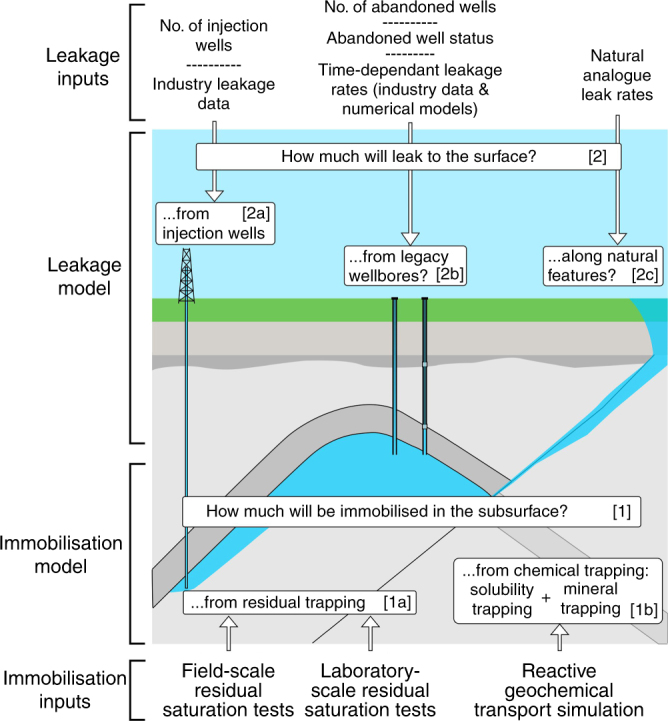
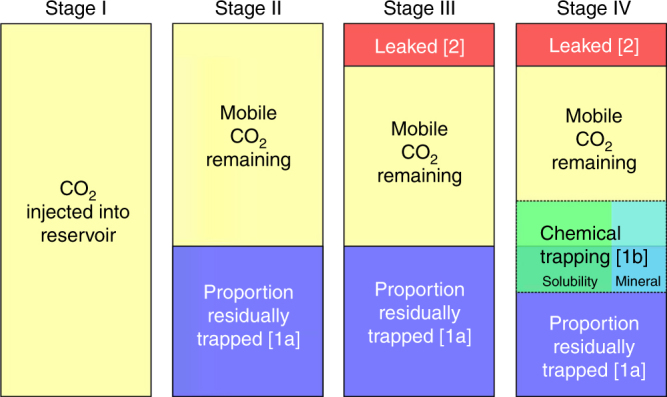
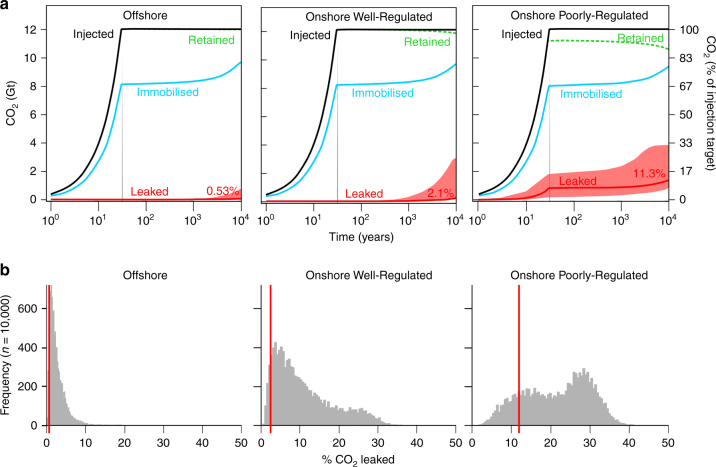
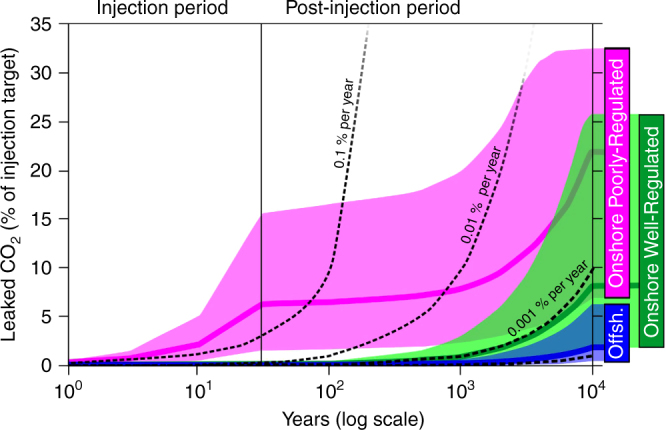
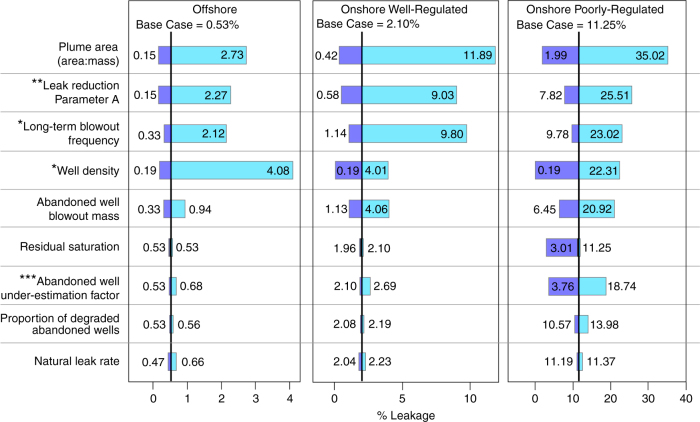
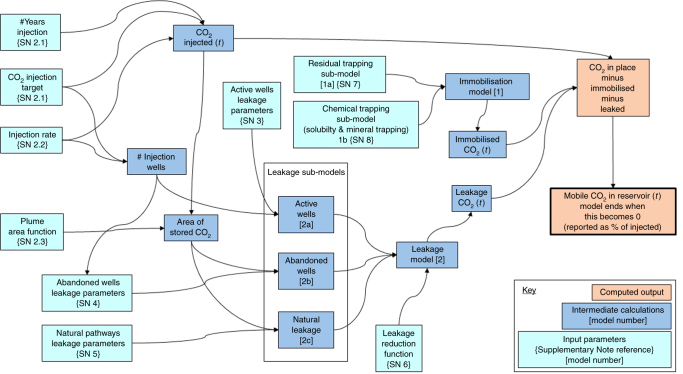
Carbon capture and storage (CCS) can help nations meet their Paris CO 2 reduction commitments cost-effectively. However, lack of confidence in geologic CO 2 storage security remains a barrier to CCS implementation. Here we present a numerical program that calculates CO 2 storage security and leakage to the atmosphere over 10,000 years. This combines quantitative estimates of geological subsurface CO 2 retention, and of surface CO 2 leakage. We calculate that realistically well-regulated storage in regions with moderate well densities has a 50% probability that leakage remains below 0.0008% per year, with over 98% of the injected CO 2 retained in the subsurface over 10,000 years. An unrealistic scenario, where CO 2 storage is inadequately regulated, estimates that more than 78% will be retained over 10,000 years. Our modelling results suggest that geological storage of CO 2 can be a secure climate change mitigation option, but we note that long-term behaviour of CO 2 in the subsurface remains a key uncertainty.
Overview
The claims and statistics of this paper haven’t been checked yet.
Free: it reads the open-access text and checks the first 5 claims that cite a source we can check. Create a free account to check every claim.
Integrity signals
Registry
Cites
Statistics
Figures
Verification
Claims the paper makes
The claims and statistics of this paper haven’t been checked yet.
Free: it reads the open-access text and checks the first 5 claims that cite a source we can check. Create a free account to check every claim.
Claims other papers make about this one
Each is checked against this paper’s own text: does it say what the citing paper says it does?
The source backs part of the claim, not all of it — or backs it for a different population, condition or comparison.
In the citing paper
“Probabilistic modeling of risks associated with leakage suggest that 98% of the CO 2 will be retained in 10,000 years”
From An Overview of the Status and Challenges of CO2 Storage in Minerals and Geological Formations (2019) · cites this paper as Alcalde et al., 2018
Experimental — accuracy not yet measuredThe cited source says what the claim attributes to it.
In the citing paper
“Geological storage, when executed correctly, is considered to be more permanent 22 than storage in the biosphere, which is shorter and subject to human and natural disturbances 23 such as wildfires and pests, as well as changes in climate 24 .”
From The technological and economic prospects for CO2 utilization and removal (2019) · cites this paper as [22]
Self-check
Percentages, sums and reported differences re-computed from the paper’s own numbers.
The self-check needs the paper’s full text.
Citations
Cites
Michael, K., Golab, A., Shulakova, V., Ennis-King, J., Allinson, G., Sharma, S., & Aiken, T. (2010) · International Journal of Greenhouse Gas Control · doi:10.1016/j.ijggc.2009.12.011 · Cited by 727
Nordbotten, J. M., Celia, M. A., & Bachu, S. (2005) · Transport in Porous Media · doi:10.1007/s11242-004-0670-9 · Cited by 671
Relative permeability and trapping of CO2 and water in sandstone rocks at reservoir conditions
Krevor, S. C. M., Pini, R., Zuo, L., & Benson, S. M. (2012) · Water Resources Research · doi:10.1029/2011wr010859 · Cited by 646
Fate of fossil fuel CO2 in geologic time
Archer, D. (2005) · Journal of Geophysical Research: Oceans · doi:10.1029/2004jc002625 · Cited by 620
Monitoring of CO2 injected at Sleipner using time-lapse seismic data
Arts, R., Eiken, O., Chadwick, A., Zweigel, P., van der Meer, L., & Zinszner, B. (2004) · Energy · doi:10.1016/j.energy.2004.03.072 · Cited by 507
Carey, J. W., Wigand, M., Chipera, S. J., WoldeGabriel, G., Pawar, R., Lichtner, P. C., Wehner, S. C., Raines, M. A., & Guthrie, G. D. (2007) · International Journal of Greenhouse Gas Control · doi:10.1016/s1750-5836(06)00004-1 · Cited by 503
Davies, R. J., Almond, S., Ward, R. S., Jackson, R. B., Adams, C., Worrall, F., Herringshaw, L. G., Gluyas, J. G., & Whitehead, M. A. (2014) · Marine and Petroleum Geology · doi:10.1016/j.marpetgeo.2014.03.001 · Cited by 476
Last chance for carbon capture and storage
Scott, V., Gilfillan, S., Markusson, N., Chalmers, H., & Haszeldine, R. S. (2013) · Nature Climate Change · doi:10.1038/nclimate1695 · Cited by 376
Self-citationConvective dissolution of CO2 in saline aquifers: Progress in modeling and experiments
Emami-Meybodi, H., Hassanzadeh, H., Green, C. P., & Ennis-King, J. (2015) · International Journal of Greenhouse Gas Control · doi:10.1016/j.ijggc.2015.04.003 · Cited by 372
Xu, T., Apps, J. A., & Pruess, K. (2003) · Journal of Geophysical Research: Solid Earth · doi:10.1029/2002jb001979 · Cited by 363
Research works printed but not linked: 1
- Metz, B., Davidson, O., de Coninck, H., Loos, M. & Meyer, L. Special Report on Carbon Dioxide Capture and Storage (Cambridge University Press, New York, 2005).
Cited by
Items 401–467 of 467
Low carbon hydrogen in the European Union: A coherent regulatory framework
Bruch, N., & Knodt, M. (2024) · Publication Database PIK (Potsdam Institute for Climate Impact Research (PIK)) · doi:10.48485/pik.2024.012 · Cited by 5
Technological CO2 Mitigation Strategies for the European Transport Sector
Held, M. (2021) · Repository for Publications and Research Data (ETH Zurich) · doi:10.3929/ethz-b-000493340 · Cited by 1
CO2 Sources and Sinks MatricesPreprint
Mason, F., Stokes, G., Fancy, S., & Sick, V. (2023) · Deep Blue (University of Michigan) · doi:10.7302/8087
Hur grönt är ett stadsträd? : ett stadsträds klimatavtryck ur ett livscykelperspektiv
Lind, E. (2020) · Epsilon Archive for Student Projects (University of Southampton)
Geoenvironmental Aspects of Carbon Sequestration Process: An Overview
Pandey, B. K., Santhoshkumar, G., Shukla, C., & Ingale, R. (2025) · Lecture notes in civil engineering · doi:10.1007/978-981-96-8484-7_5
Mundaragi Dinesh, D., & Huda, M. Y. Q. (2025) · DiVA (Digitala Vetenskapliga Arkivet)
A Digital Rock Physics Approach to Quantifying Anisotropy in Carbonate Fault RocksPreprint
Voltolini, M., Smeraglia, L., Billi, A., Carminati, E., Cognini, F., Rossi, M., & Zucali, M. (2025) · SSRN Electronic Journal · doi:10.2139/ssrn.5916059
Zhao, M., Haagenson, R., Gerritsma, M. I., & Hajibeygi, H. (2025) · Advances in Water Resources · doi:10.1016/j.advwatres.2025.105200
Piedade, V. C. P., Oliveira, S. B. D., & de Oliveira, C. H. T. (2026) · International journal of greenhouse gas control · doi:10.1016/j.ijggc.2025.104557
The Brazilian context of underground hydrogen storage: A review and future perspectives
Santos, H., Gomes, J., Gatti, L. M., Alexandrino, C. H., Bueno, V. F. D. S., Corazza, Y. I., Nascimento, Y., Silva, L., Ahón, V. R. R., & Assenheimer, T. (2026) · Journal of Energy Storage · doi:10.1016/j.est.2026.120503 · Cited by 1
Risk factor analysis for advanced underground gas storage in aquifers
Lewandowska-Śmierzchalska, J., Matuła, R., Uliasz‐Misiak, B., & Polański, K. (2026) · Energy · doi:10.1016/j.energy.2026.140202
Zhou, Y., Zhu, Y., & Li, Y. (2026) · SSRN Electronic Journal · doi:10.2139/ssrn.6193502
Nugraha, H. D., Jamaludin, S. N. F., Matsumoto, R., Ohkawa, S., Tomaru, H., Juanda, I., Herawati, I., Astuti, W., & Angkasa, S. (2026) · Scientific Reports · doi:10.1038/s41598-026-39597-y
A Structured Risk Framework for CCS AoR Wells: Qualitative FEPs to Semi-Quantitative Rankings
Abid, K., & Teodoriu, C. (2026) · Energies · doi:10.3390/en19051146
Doughty, C. A., & Omosebi, O. A. (2026) · International journal of greenhouse gas control · doi:10.1016/j.ijggc.2026.104617
Mark‐Moser, M., Bauer, J. R., Martin, A., Morkner, P., Romeo, L., & Rose, K. (2026) · Frontiers in Earth Science · doi:10.3389/feart.2025.1457489
Use of Nanomaterials for Carbon Sequestration in Soil
Chandran, A., & Kumar, A. (2026) · Springer eBooks · doi:10.1007/978-981-96-4489-6_36-1
Contrôles physiques, chimiques et biologiques des flux de gaz à l'interface sol-atmosphère
Alibert, C. (2020) · theses.fr (ABES) · doi:10.70675/c7d0ecd8zf20fz4b9bz86a1z60e1b6624942
Tuning the covalent chemistry of CO2 and polyamines by supramolecular means
Stuardi, F. M. (2021) · theses.fr (ABES) · doi:10.70675/63104fe6z044cz4883z8809z7e07b6df5182
Valorisation of CO2 capture agents for soil decontamination
Tosi, C. (2022) · theses.fr (ABES) · doi:10.70675/7e3291f9zaedbz4369z8ce1z023e310aac1f
Wang, X., Guo, C., Li, C., & He, Q. (2026) · Atmosphere · doi:10.3390/atmos17040394
Wu, X., Chen, H., Liu, H., & SenGupta, A. K. (2026) · Industrial & Engineering Chemistry Research · doi:10.1021/acs.iecr.6c00025
Jeong, J., Do, H.-K., Lim, S., Cho, H., & Jeen, S. (2026) · Applied Geochemistry · doi:10.1016/j.apgeochem.2026.106885
Ashmore, N. A., Król, M., Gilfillan, S., & Molnar, I. L. (2026) · Geoenergy · doi:10.1144/geoenergy2025-048
Self-citationTakai, S., Sanga, T., Shimada, T., & Takeda, S. (2026) · Earth Surface Dynamics · doi:10.5194/esurf-14-417-2026
Wang, J., Tamura, R., Hirano, H., Yagi, M., Tamagawa, T., Salalá, L., Pramudyo, E., & Watanabe, N. (2026) · Communications Earth & Environment · doi:10.1038/s43247-026-03658-x
Direct observation of anomalous CO 2 dispersion in multi-scale porous media
Wu, Q., Zhang, Y., Yang, Y., Yao, J., Yang, Y., Sun, H., Zhang, L., & Zhong, J. (2026) · Lab on a Chip · doi:10.1039/d6lc00244g
Carbon, Capture, Utilisation and Storage in Canada
Woo, O. (2024) · Politika – Undergraduate Journal of International Affairs Politics and Policy · doi:10.18192/politika.8295
Conventional Carbon Capture and Storage (CCS) technologies
Ranjekar, A. M. (2026) · Elsevier eBooks · doi:10.1016/b978-0-443-40517-4.00011-x
Wei, W., Feng, Y., Dang, W., Zhang, F., Guo, S., Zhang, B., Hou, L., & Jiao, Y. (2026) · Renewable and Sustainable Energy Reviews · doi:10.1016/j.rser.2026.117185
Zhang, K., Zheng, S., Hu, Y., Li, Z., Suekane, T., & Zhang, C. (2026) · International Journal of Heat and Mass Transfer · doi:10.1016/j.ijheatmasstransfer.2026.129213
Wenjuan, J., Yu, H., Ji, W., Song, W., Xu, X., Zhang, J., Sun, S., & Wang, H. (2026) · SSRN Electronic Journal · doi:10.2139/ssrn.7038770
Isah, A. (2024) · Research Publication Repository of King Fahd University of Petroleum and Minerals (King Fahd University of Petroleum and Minerals)
Ramachandran, H., de Jonge‐Anderson, I., Widyanita, A., Nicholson, U., Busch, A., Geiger, S., & Doster, F. (2026) · doi:10.31223/x5z79x
Kivi, I. R., Xiaowei, G. A. O., & Krevor, S. C. M. (2026) · Environmental Science & Technology · doi:10.1021/acs.est.6c10305
Kingsport limestone as a CO2 caprock: Performance under prolonged laboratory scCO₂–brine exposure
Elnur, M., Alshibli, K. A., Dygert, N., Lanzirotti, A., Newville, M. G., Zhang, R., Lu, H., & Govindarajan, S. (2026) · Geomechanics for Energy and the Environment · doi:10.1016/j.gete.2026.100866
Jia, Y., Yu, C., Ge, Z., Tang, J., Sun, X., & Fu, W. (2026) · Gas Science and Engineering · doi:10.1016/j.jgsce.2026.205983
Campo, F. P., Dolci, G., Grosso, M., Renforth, P., van der Spek, M. W., Foteinis, S., Zeichen, M. M., Borghesi, R., & Caserini, S. (2026) · International journal of greenhouse gas control · doi:10.1016/j.ijggc.2026.104742 · Cited by 1
Introduction to carbon capture, utilization, and storage
Cao, G., Gao, B., & Baltrušaitis, J. (2026) · Elsevier eBooks · doi:10.1016/b978-0-443-34088-8.00138-5
Oborghayujie, H., & Nwosi-Anele, A. (2026) · SPE Nigeria Annual International Conference and Exhibition · doi:10.2118/235020-ms
Zhang, X., Yuan, W., Xu, Z., Sun, X., Guo, Y., Zhang, T., Jiang, S., & Wang, H. (2026) · Corrosion Communications · doi:10.1016/j.corcom.2026.04.015
al zarafi, A., AlZaabi, A., Chai, R., Bijeljic, B., & Blunt, M. J. (2026) · Advances in Water Resources · doi:10.1016/j.advwatres.2026.105479
Fitri, R. A., Ramdani, M. R., Kurniawidi, D. W., & Saputra, K. (2026) · Socio-economic and Humanistic Aspects for Township and Industry. · doi:10.59535/sehati.v4i3.701
Li, Z., Feng, G., Zhu, H., Zhang, C., & Xu, T. (2026) · SSRN Electronic Journal · doi:10.2139/ssrn.7411331
Geng, W., Chen, K., Zhang, J., Cheng, W., Zhang, Y., Jiang, L., & Song, Y. (2026) · Journal of Hydrology · doi:10.1016/j.jhydrol.2026.136378
Mun, S., Go, W., Mok, J., Kim, S., Jang, H., & Seo, Y. (2026) · Chemical Engineering Journal · doi:10.1016/j.cej.2026.181769
Voorhees, R. V., Romanak, K., Wang, Z., & Hovorka, S. (2026) · International journal of greenhouse gas control · doi:10.1016/j.ijggc.2026.104776
Matos, R. D. A., & Szklo, A. S. (2026) · Resources · doi:10.3390/resources15110143
Stage-specific characteristics of CO2 caprock leakage driven by reservoir-caprock pressure evolution
Wang, N.-H., Lian, W., Lu, Z.-Y., Li, J., Yang, Y., Wu, Y.-X., & Wang, D. (2026) · Petroleum Science · doi:10.1016/j.petsci.2026.09.027
Oliveira, P. R., Pereira, T. C., & Pereira, G. A. G. (2026) · Sustainable Production and Consumption · doi:10.1016/j.spc.2026.09.031
Yao, J., Peng, X., Luo, P., Chen, Z., Jiang, C., & Yuan, W. (2026) · Energies · doi:10.3390/en19194645
Mapping the public evidence base for CO2 storage monitoring and assurance
Sun, J., Shangguan, M., Qin, H., Li, C., Yang, D., Sun, X., Li, Y., Lu, J., Li, H., Li, Y., et al. (2026) · International journal of greenhouse gas control · doi:10.1016/j.ijggc.2026.104804
Accounting for short-term durability in carbon offsettingPreprint
Cabiyo, B., Dolginow, A., & Dees, J. (2026) · doi:10.70212/cdrxiv.2026562.v1
Xue, L., Ma, J., Wang, H., Li, L., & Ma, J. (2026) · Sustainability · doi:10.3390/su181910197
Zhang, Y., Jiang, J., Song, Z., 莫朝平, Xiao, Y., & Li, P. (2026) · SPE Asia Pacific Oil and Gas Conference and Exhibition · doi:10.2118/234489-ms
Alzaabi, A., Chai, R., Ma, Z., Bijeljic, B., & Blunt, M. J. (2026) · SSRN Electronic Journal · doi:10.2139/ssrn.7597576
Park, J., Kim, S., Park, K. T., & Jung, J. C. (2026) · Industrial & Engineering Chemistry Research · doi:10.1021/acs.iecr.6c03191
Olayinka, Y. A., Afolayan, B., Eruteya, O. E., & Opuwari, M. (2026) · Discover Energy · doi:10.1007/s43937-026-00194-9
Barkat, A., Zhang, M., Nedimović, M. R., Niksejel, A., Richards, B., Wach, G. D., Cairns, G., Bosman, K., Thibodeau, J., Ramirez, F. C., et al. (2026) · SSRN Electronic Journal · doi:10.2139/ssrn.7669779
You, J., Cao, J., Shui, Y., Huang, X., & Feng, Z. (2026) · Sustainable Energy Technologies and Assessments · doi:10.1016/j.seta.2026.105539
Coupled hydromechanical controls on CO2 leakage through fractured caprocksPreprint
Vafaie, A., Kivi, I. R., Makhnenko, R. Y., & Vilarrasa, V. (2026) · doi:10.22541/essoar.15011388/v1
Wang, W., Zhou, Y., Chen, Y., Deng, K., Chen, B., Guo, Y., Yang, S., Jiang, F., Chen, D., Wang, Y., et al. (2026) · Fuel · doi:10.1016/j.fuel.2026.141927
OMUDU, R. O., Avwiri, G. O., & Odutola, T. O. (2026) · IOSR Journal of Humanities and Social Science · doi:10.9790/0837-3110011828
Midwest Nuclear Direct Air Capture Final Report
Dunn, J., & Northwestern Univ., E. (2025) · OSTI OAI (U.S. Department of Energy Office of Scientific and Technical Information) · doi:10.2172/17356978
Bridge fuels and climate policy integration: The case of low-carbon hydrogen in the European Union
Bruch, N. (2026) · Energy Policy · doi:10.1016/j.enpol.2026.115688
Balogun, A. I., Gebretsadik, H. T., Balogun, A. O., Abdullahi, S., Mamman, H., Yusuf, J. Y., & Aromoye, I. A. (2026) · Next Energy · doi:10.1016/j.nxener.2026.101175
Metadata
- Authors
- Alcalde, J., Flude, S., Wilkinson, M., Johnson, G., Edlmann, K., Bond, C. E., Scott, V., Gilfillan, S. M. V., Ogaya, X., & Haszeldine, R. S.
- Affiliations
- University of Aberdeen (GB)
- University of Edinburgh (GB)
- Universitat de Barcelona (ES)
- Corresponding author
- Alcalde, Juan
- ORCID
- Venue
- Nature Communications
- Published
- 2018-06-12
- Volume
- 9
- Issue
- 1
- Pages
- 2201-2201
- ISSN
- 2041-1723 (ISSN-L)
- PMC
- PMC5997736
- OpenAlex
- W2797035059
- Semantic Scholar
- 8fa7cd77c0529f59a8bd5cc831b96407cc2cd893
- Cited by
- 442
- References
- 53
- Citations by year
- 2026: 74 · 2025: 97 · 2024: 65 · 2023: 52 · 2022: 47 · 2021: 51 · 2020: 34 · 2019: 17 · 2018: 5
- FWCI
- 13.44
- Type
- journal article
- Language
- en
- Open access
- gold
- doi.org
- Licence
- cc-by
- creativecommons.org/licenses/by/4.0 (tdm)
- creativecommons.org/licenses/by/4.0 (vor)
- Locations
- Nature Communications (publishedVersion, cc-by)
- Europe PMC (PubMed Central) (publishedVersion, cc-by)
- PubMed Central (publishedVersion, cc-by)
- PubMed (publishedVersion)
- Strathprints: The University of Strathclyde institutional repository (University of Strathclyde) (acceptedVersion)
- Aberdeen University Research Archive (Aberdeen University) (submittedVersion)
- EarthArXiv (California Digital Library) (submittedVersion, cc-by)
- RePEc: Research Papers in Economics (submittedVersion)
- DIGITAL.CSIC (Spanish National Research Council (CSIC)) (submittedVersion, cc-by)
- DOAJ (DOAJ: Directory of Open Access Journals) (submittedVersion)
- DOAJ (DOAJ: Directory of Open Access Journals) (submittedVersion, cc-by-sa)
- Edinburgh Research Explorer (University of Edinburgh) (submittedVersion, other-oa)
- EarthArXiv (OSF Preprints) (submittedVersion, cc-by)
- EarthArXiv (OSF Preprints) (submittedVersion)
- Funders
- Scottish Funding Council (EP/P026214/1)
- Horizon 2020 Framework Programme (636811)
- Engineering and Physical Sciences Research Council (EP/K036033/1, EP/P026214/1, H2020, EP/K000446/2)
- Natural Environment Research Council (EP/P026214/1, NE/G015163/1, NE/P019749/1, NE/M007251/1, NE/L008475/1)
- Topics
- Physical Sciences › Environmental Science › Environmental Engineering › CO2 Sequestration and Geologic Interactions
- Physical Sciences › Chemical Engineering › Filtration and Separation › Carbon Dioxide Capture Technologies
- Physical Sciences › Environmental Science › Global and Planetary Change › Climate Change and Geoengineering
- Keywords
- CO2 geological storage, carbon capture and storage, CO2 leakage, storage security, storage regulations, well density, climate change mitigation, Paris Agreement commitments, numerical modeling
About these checks
Registry, retraction, Cites and statistics results are computed, not judged, with one exception: a printed reference that no index lists is read once by a model before it counts as a citation error. Claims are extracted by a model and kept only when their quote appears verbatim in the text; each cited source is then checked, with a model’s help, for whether it says what the claim relies on. Those verdicts can be wrong — read the claim’s quote and the cited source before relying on one.
Statistics and arithmetic are recomputed, not judged.
Confidence bands are shown only for fields calibrated on our annotated test set. None is calibrated yet, so no band is shown.
What counts as a claim ›How we measure confidence ›How we check this ›
Are you an author, or do you see a problem with this page? Request a review
Data sources
Bibliographic data: Semantic Scholar, OpenAlex, Crossref.
Contains information from the Semantic Scholar Academic Graph Datasets, made available under the ODC Attribution License (ODC-BY 1.0).
Semantic Scholar’s data is described in: Kinney, R., et al. (2023). The Semantic Scholar Open Data Platform. arXiv:2301.10140.
