

The DOI matches its Crossref record; 74 of the 74 references it cites were found in a registry or an index.
One-second coherence for a single electron spin coupled to a multi-qubit nuclear-spin environment
Open accessAbstract
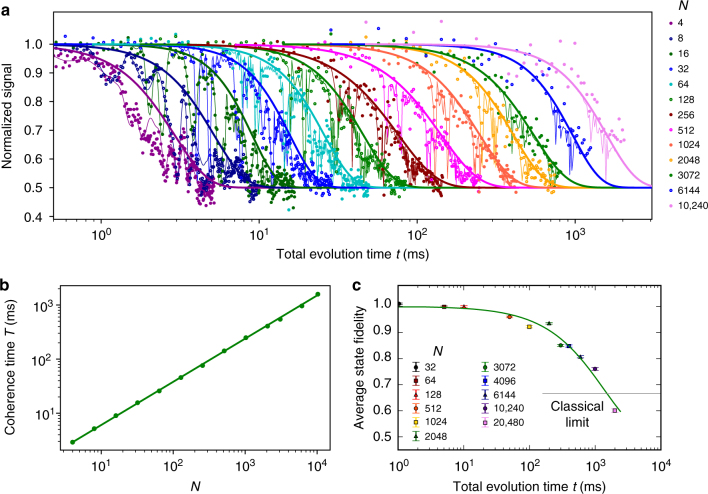
Single electron spins coupled to multiple nuclear spins provide promising multi-qubit registers for quantum sensing and quantum networks. The obtainable level of control is determined by how well the electron spin can be selectively coupled to, and decoupled from, the surrounding nuclear spins. Here we realize a coherence time exceeding a second for a single nitrogen-vacancy electron spin through decoupling sequences tailored to its microscopic nuclear-spin environment. First, we use the electron spin to probe the environment, which is accurately described by seven individual and six pairs of coupled carbon-13 spins. We develop initialization, control and readout of the carbon-13 pairs in order to directly reveal their atomic structure. We then exploit this knowledge to store quantum states in the electron spin for over a second by carefully avoiding unwanted interactions. These results provide a proof-of-principle for quantum sensing of complex multi-spin systems and an opportunity for multi-qubit quantum registers with long coherence times.
Overview
The claims and statistics of this paper haven’t been checked yet.
Free: it reads the open-access text and checks the first 5 claims that cite a source we can check. Create a free account to check every claim.
Integrity signals
Registry
Cites
Statistics
Figures


Verification
Claims the paper makes
The claims and statistics of this paper haven’t been checked yet.
Free: it reads the open-access text and checks the first 5 claims that cite a source we can check. Create a free account to check every claim.
Claims other papers make about this one
Each is checked against this paper’s own text: does it say what the citing paper says it does?
The cited source says what the claim attributes to it.
In the citing paper
“In parallel, the coherence properties of the NV spin have been improved to over a second [147].”
From 2022 Roadmap on integrated quantum photonics (2022) · cites this paper as [147]
Self-check
Percentages, sums and reported differences re-computed from the paper’s own numbers.
The self-check needs the paper’s full text.
Citations
Cites
Loophole-free Bell inequality violation using electron spins separated by 1.3 kilometres
Hensen, B., Bernien, H., Dréau, A. E., Reiserer, A., Kalb, N., Blok, M. S., Ruitenberg, J., Vermeulen, R. F. L., Schouten, R. N., Abellán, C., et al. (2015) · Nature · doi:10.1038/nature15759 · Cited by 2,852
Self-citationNanometre-scale thermometry in a living cell
Kucsko, G., Maurer, P. C., Yao, N. Y., Kubo, M., Noh, H. J., Lo, P. K., Park, H., & Lukin, M. D. (2013) · Nature · doi:10.1038/nature12373 · Cited by 1,951
Decoherence-Free Subspaces for Quantum Computation
Lidar, D. A., Chuang, I. L., & Whaley, K. B. (1998) · Physical Review Letters · doi:10.1103/physrevlett.81.2594 · Cited by 1,858
Coherent Dynamics of Coupled Electron and Nuclear Spin Qubits in Diamond
Childress, L., Gurudev Dutt, M. V., Taylor, J. M., Zibrov, A. S., Jelezko, F., Wrachtrup, J., Hemmer, P. R., & Lukin, M. D. (2006) · Science · doi:10.1126/science.1131871 · Cited by 1,260
NMR techniques for quantum control and computation
Vandersypen, L. M. K., & Chuang, I. L. (2005) · Reviews of Modern Physics · doi:10.1103/revmodphys.76.1037 · Cited by 1,217
Universal Dynamical Decoupling of a Single Solid-State Spin from a Spin Bath
de Lange, G., Wang, Z. H., Ristè, D., Dobrovitski, V. V., & Hanson, R. (2010) · Science · doi:10.1126/science.1192739 · Cited by 802
Solid-state electronic spin coherence time approaching one second
Bar-Gill, N., Pham, L. M., Jarmola, A., Budker, D., & Walsworth, R. L. (2013) · Nature Communications · doi:10.1038/ncomms2771 · Cited by 799
New, compensated Carr-Purcell sequences
Gullion, T., Baker, D. B., & Conradi, M. S. (1990) · Journal of Magnetic Resonance (1969) · doi:10.1016/0022-2364(90)90331-3 · Cited by 724
High-fidelity projective read-out of a solid-state spin quantum register
Robledo, L., Childress, L., Bernien, H., Hensen, B., Alkemade, P. F. A., & Hanson, R. (2011) · Nature · doi:10.1038/nature10401 · Cited by 720
Electron spin coherence exceeding seconds in high-purity silicon
Tyryshkin, A. M., Tojo, S., Morton, J. J. L., Riemann, H., Abrosimov, N. V., Becker, P., Pohl, H.-J., Schenkel, T., Thewalt, M. L. W., Itoh, K. M., et al. (2012) · Nature Materials · doi:10.1038/nmat3182 · Cited by 713
Cited by
Material platforms for spin-based photonic quantum technologies
Atatüre, M., Englund, D., Vamivakas, N., Lee, S.-Y., & Wrachtrup, J. (2018) · Nature Reviews Materials · doi:10.1038/s41578-018-0008-9 · Cited by 766
Quantum repeaters: From quantum networks to the quantum internet
Azuma, K., Economou, S. E., Elkouss, D., Hilaire, P., Jiang, L., Lo, H.-K., & Tzitrin, I. (2023) · Reviews of Modern Physics · doi:10.1103/revmodphys.95.045006 · Cited by 559
Deterministic delivery of remote entanglement on a quantum network
Humphreys, P. C., Kalb, N., Morits, J. P. J., Schouten, R. N., Vermeulen, R. F. L., Twitchen, D. J., Markham, M., & Hanson, R. (2018) · Nature · doi:10.1038/s41586-018-0200-5 · Cited by 546
Self-citationA ten-qubit solid-state spin register with quantum memory up to one minute
Bradley, C. E., Randall, J., Abobeih, M. H., Berrevoets, R. C., Degen, M. J., Bakker, M. A., Markham, M., Twitchen, D. J., & Taminiau, T. H. (2019) · Physical Review X · doi:10.1103/physrevx.9.031045 · Cited by 546
“6 ð 3 Þ × 10 3 s [47] ].”
Self-citationSemiconductor qubits in practice
Chatterjee, A., Stevenson, P., De Franceschi, S., Morello, A., de Leon, N. P., & Kuemmeth, F. (2021) · Nature Reviews Physics · doi:10.1038/s42254-021-00283-9 · Cited by 359
Metadata
- Authors
- Abobeih, M. H., Cramer, J., Bakker, M. A., Kalb, N., Markham, M., Twitchen, D. J., & Taminiau, T. H.
- Affiliations
- QuTech (NL)
- Element Six (United Kingdom) (GB)
- Corresponding author
- Taminiau, T. H.
- Venue
- Nature Communications
- Published
- 2018-06-29
- Volume
- 9
- Issue
- 1
- Pages
- 2552-2552
- ISSN
- 2041-1723 (ISSN-L)
- PMC
- PMC6026183
- OpenAlex
- W2781890679
- Cited by
- 302
- References
- 73
- Citations by year
- 2026: 26 · 2025: 41 · 2024: 38 · 2023: 31 · 2022: 46 · 2021: 43 · 2020: 29 · 2019: 37 · 2018: 10
- FWCI
- 11.10
- Type
- journal article
- Language
- en
- Open access
- gold
- doi.org
- Licence
- cc-by
- creativecommons.org/licenses/by/4.0 (tdm)
- creativecommons.org/licenses/by/4.0 (vor)
- Locations
- Nature Communications (publishedVersion, cc-by)
- Europe PMC (PubMed Central) (publishedVersion, cc-by)
- PubMed Central (publishedVersion, cc-by)
- PubMed (publishedVersion)
- arXiv (Cornell University) (submittedVersion)
- RePEc: Research Papers in Economics (submittedVersion)
- DOAJ (DOAJ: Directory of Open Access Journals) (submittedVersion, cc-by-sa)
- DOAJ (DOAJ: Directory of Open Access Journals) (submittedVersion)
- Research Repository (Delft University of Technology) (submittedVersion)
- Data Archiving and Networked Services (DANS) (submittedVersion, other-oa)
- arXiv (Cornell University)
- Funders
- Nederlandse Organisatie voor Wetenschappelijk Onderzoek (680-47-552)
- Topics
- Physical Sciences › Materials Science › Materials Chemistry › Diamond and Carbon-based Materials Research
- Physical Sciences › Physics and Astronomy › Condensed Matter Physics › Quantum and electron transport phenomena
- Physical Sciences › Chemistry › Spectroscopy › Advanced NMR Techniques and Applications
- Keywords
- nitrogen-vacancy centers, electron spin, carbon-13, spin decoupling, coherence time, quantum sensing, spin pairs, quantum memory
About these checks
Registry, retraction, Cites and statistics results are computed, not judged, with one exception: a printed reference that no index lists is read once by a model before it counts as a citation error. Claims are extracted by a model and kept only when their quote appears verbatim in the text; each cited source is then checked, with a model’s help, for whether it says what the claim relies on. Those verdicts can be wrong — read the claim’s quote and the cited source before relying on one.
Statistics and arithmetic are recomputed, not judged.
Confidence bands are shown only for fields calibrated on our annotated test set. None is calibrated yet, so no band is shown.
What counts as a claim ›How we measure confidence ›How we check this ›
Are you an author, or do you see a problem with this page? Request a review
How to cite
Cite CoChat for the checks on this page, and the paper for its own findings.
- This page
- CoChat. (2026). Citation check: One-second coherence for a single electron spin coupled to a multi-qubit nuclear-spin environment. https://app.cochat.ai/papers/10.1038/s41467-018-04916-z
- The paper
- Abobeih, M. H., Cramer, J., Bakker, M. A., Kalb, N., Markham, M., Twitchen, D. J., & Taminiau, T. H. (2018). One-second coherence for a single electron spin coupled to a multi-qubit nuclear-spin environment. Nature Communications. https://doi.org/10.1038/s41467-018-04916-z
Data sources
Bibliographic data: Semantic Scholar, OpenAlex, Crossref.
Contains information from the Semantic Scholar Academic Graph Datasets, made available under the ODC Attribution License (ODC-BY 1.0).
Semantic Scholar’s data is described in: Kinney, R., et al. (2023). The Semantic Scholar Open Data Platform. arXiv:2301.10140.
