

The DOI matches its Crossref record; 52 of the 52 references it cites were found in a registry or an index.
Human pluripotent reprogramming with CRISPR activators
Open accessPublished version of a preprint
Abstract
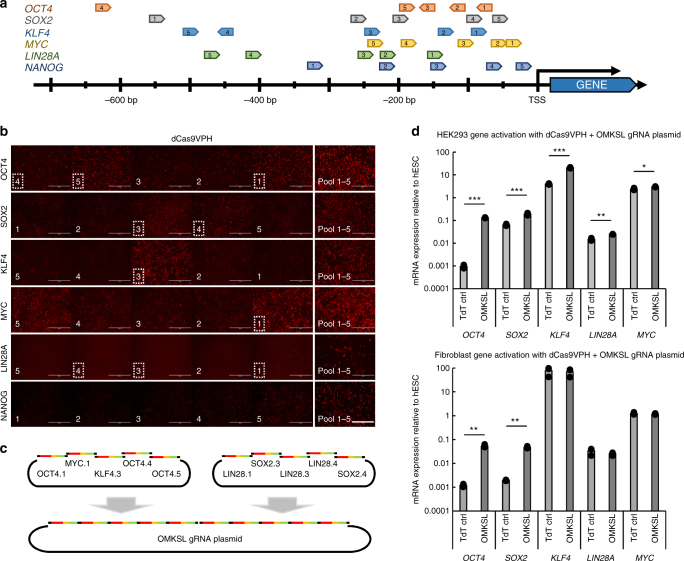
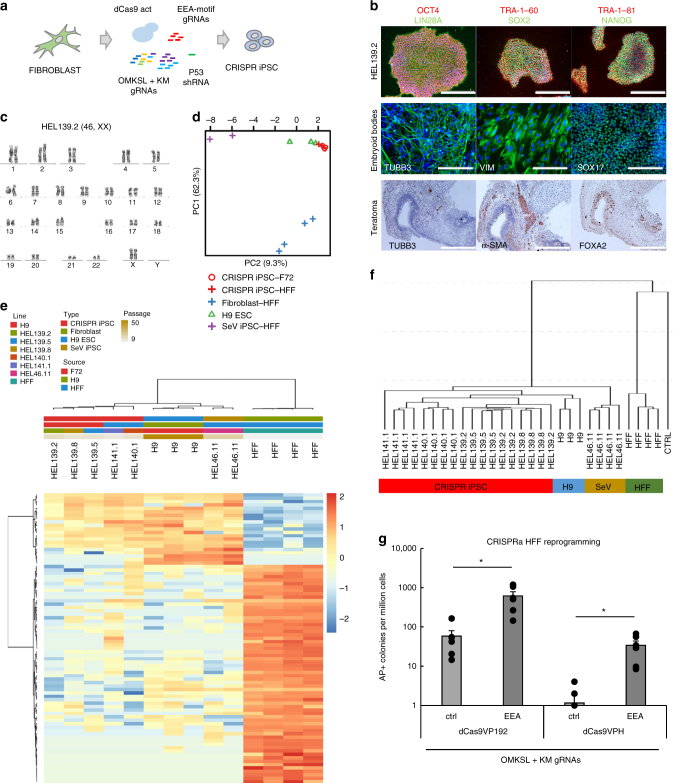
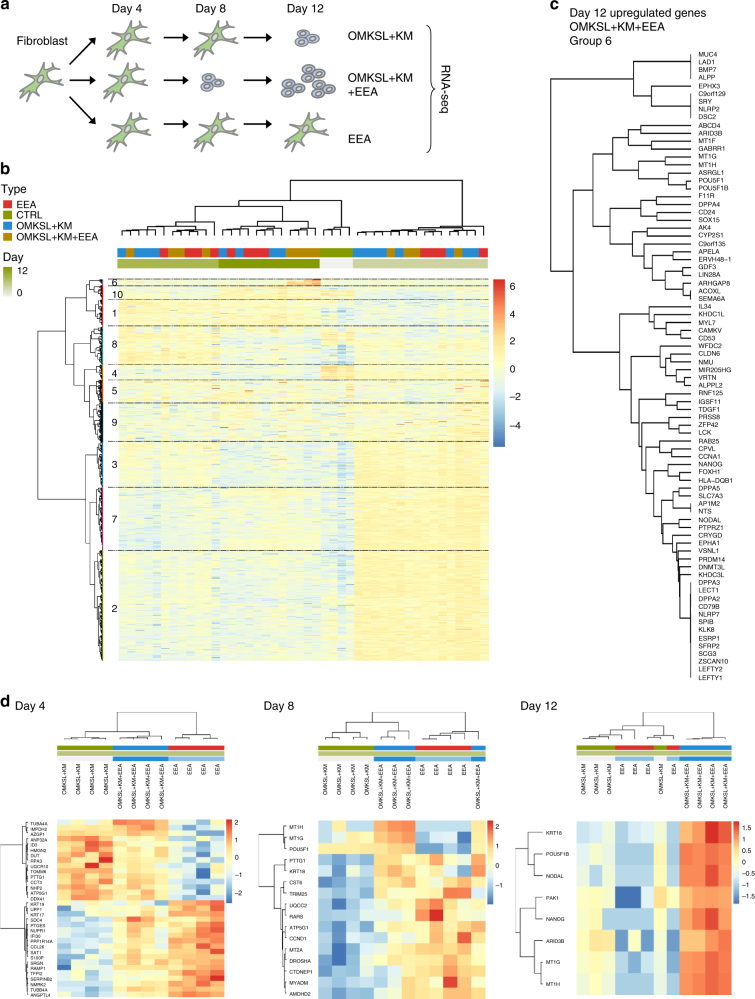
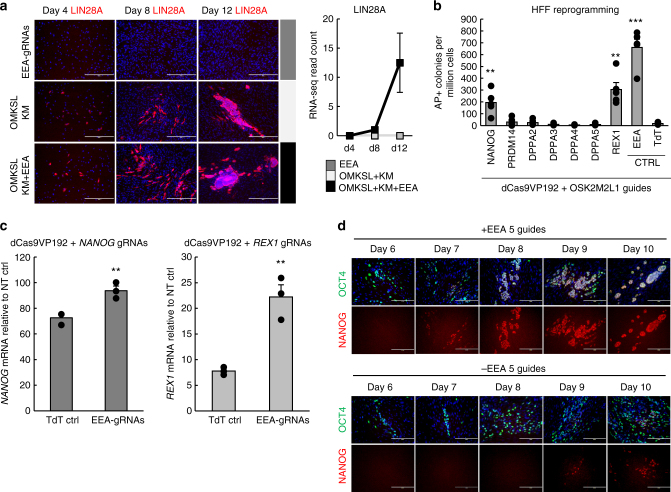
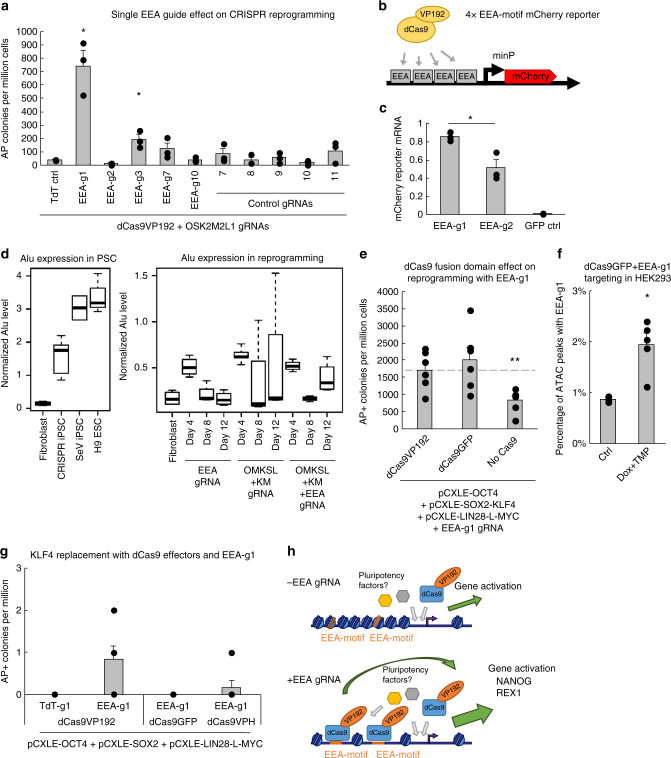
CRISPR-Cas9-based gene activation (CRISPRa) is an attractive tool for cellular reprogramming applications due to its high multiplexing capacity and direct targeting of endogenous loci. Here we present the reprogramming of primary human skin fibroblasts into induced pluripotent stem cells (iPSCs) using CRISPRa, targeting endogenous OCT4 , SOX2 , KLF4 , MYC , and LIN28A promoters. The low basal reprogramming efficiency can be improved by an order of magnitude by additionally targeting a conserved Alu-motif enriched near genes involved in embryo genome activation (EEA-motif). This effect is mediated in part by more efficient activation of NANOG and REX1 . These data demonstrate that human somatic cells can be reprogrammed into iPSCs using only CRISPRa. Furthermore, the results unravel the involvement of EEA-motif-associated mechanisms in cellular reprogramming.
Overview
The claims and statistics of this paper haven’t been checked yet.
Free: it reads the open-access text and checks the first 5 claims that cite a source we can check. Create a free account to check every claim.
Integrity signals
Registry
Cites
Statistics
Figures

Verification
Claims the paper makes
The claims and statistics of this paper haven’t been checked yet.
Free: it reads the open-access text and checks the first 5 claims that cite a source we can check. Create a free account to check every claim.
Claims other papers make about this one
Each is checked against this paper’s own text: does it say what the citing paper says it does?
The check wasn’t confident either way, so it gives no verdict — never disputed.
In the citing paper
“Overall, there was little overlap between CRISPRi and CRISPRa hits, consistent with our previous study comparing parallel CRISPRi and CRISPRa screens in K562 cells4.”
From Genome-wide CRISPRi/a screens in human neurons link lysosomal failure to ferroptosis (2021) · cites this paper as [4]
Experimental — accuracy not yet measuredIn the citing paper
“Here, we present a gain-of-function screening platform in human iPSC-derived neurons based on CRISPR activation (CRISPRa), which can yield complementary biological insights to CRISPRi screens4.”
From Genome-wide CRISPRi/a screens in human neurons link lysosomal failure to ferroptosis (2021) · cites this paper as [4]
Self-check
Percentages, sums and reported differences re-computed from the paper’s own numbers.
The self-check needs the paper’s full text.
Citations
Cites
Takahashi, K., & Yamanaka, S. (2006) · Cell · doi:10.1016/j.cell.2006.07.024 · Cited by 26,673
A Programmable Dual-RNA–Guided DNA Endonuclease in Adaptive Bacterial Immunity
Jinek, M., Chylinski, K., Fonfara, I., Hauer, M., Doudna, J. A., & Charpentier, E. (2012) · Science · doi:10.1126/science.1225829 · Cited by 17,116
Induced Pluripotent Stem Cell Lines Derived from Human Somatic Cells
Yu, J., Vodyanik, M. A., Smuga-Otto, K., Antosiewicz-Bourget, J., Frane, J. L., Tian, S., Nie, J., Jonsdottir, G. A., Ruotti, V., Stewart, R., et al. (2007) · Science · doi:10.1126/science.1151526 · Cited by 10,310
ATAC-seq: a method for assaying chromatin accessibility genome-wide
Buenrostro, J. D., Wu, B., Chang, H. Y., & Greenleaf, W. J. (2015) · Current Protocols in Molecular Biology · doi:10.1002/0471142727.mb2129s109 · Cited by 3,289
Genome-scale transcriptional activation by an engineered CRISPR-Cas9 complex
Konermann, S., Brigham, M. D., Trevino, A. E., Joung, J., Abudayyeh, O. O., Barcena, C., Hsu, P. D., Habib, N., Gootenberg, J. S., Nishimasu, H., et al. (2015) · Nature · doi:10.1038/nature14136 · Cited by 2,825
A more efficient method to generate integration-free human iPS cells
Okita, K., Matsumura, Y., Sato, Y., Okada, A., Morizane, A., Okamoto, S., Hong, H., Nakagawa, M., Tanabe, K., Tezuka, K.-I., et al. (2011) · Nature Methods · doi:10.1038/nmeth.1591 · Cited by 2,061
Hilton, I. B., D'Ippolito, A. M., Vockley, C. M., Thakore, P. I., Crawford, G. E., Reddy, T. E., & Gersbach, C. A. (2015) · Nature Biotechnology · doi:10.1038/nbt.3199 · Cited by 1,885
Highly efficient Cas9-mediated transcriptional programming
Chavez, A., Scheiman, J., Vora, S., Pruitt, B. W., Tuttle, M., P R Iyer, E., Lin, S., Kiani, S., Guzman, C. D., Wiegand, D. J., et al. (2015) · Nature Methods · doi:10.1038/nmeth.3312 · Cited by 1,622
Rational design of highly active sgRNAs for CRISPR-Cas9-mediated gene inactivation
Doench, J. G., Hartenian, E., Graham, D. B., Tothova, Z., Hegde, M., Smith, I., Sullender, M., Ebert, B. L., Xavier, R. J., & Root, D. E. (2014) · Nature Biotechnology · doi:10.1038/nbt.3026 · Cited by 1,617
A flexible R package for nonnegative matrix factorization
Gaujoux, R., & Seoighe, C. (2010) · BMC Bioinformatics · doi:10.1186/1471-2105-11-367 · Cited by 1,547
Cited by
Past, present, and future of CRISPR genome editing technologies
Pacesa, M., Pelea, O., & Jinek, M. (2024) · Cell · doi:10.1016/j.cell.2024.01.042 · Cited by 609
“199–201 Alternatively, fusions with histone-modifying enzymes, such as demethylases or acetylases, can site-specifically alter the epigenetic markers at a particular site and induce active chromatin states to drive gene expression.”
Engineering the next generation of cell-based therapeutics
Bashor, C. J., Hilton, I. B., Bandukwala, H., Smith, D. M., & Veiseh, O. (2022) · Nature Reviews Drug Discovery · doi:10.1038/s41573-022-00476-6 · Cited by 439
Genome-wide CRISPRi/a screens in human neurons link lysosomal failure to ferroptosis
Tian, R., Abarientos, A., Hong, J., Hashemi, S. H., Yan, R., Dräger, N., Leng, K., Nalls, M. A., Singleton, A. B., Xu, K., et al. (2021) · Nature Neuroscience · doi:10.1038/s41593-021-00862-0 · Cited by 414
Genome-wide CRISPRi/a screens in human neurons link lysosomal failure to ferroptosis
Tian, R., Abarientos, A., Hong, J., Hashemi, S. H., Yan, R., Dräger, N., Leng, K., Nalls, M. A., Singleton, A. B., Xu, K., et al. (2020) · doi:10.1101/2020.06.27.175679 · Cited by 414
Poetsch, M. S., Strano, A., & Guan, K. (2022) · Stem Cells · doi:10.1093/stmcls/sxac020 · Cited by 144
Metadata
- Authors
- Weltner, J., Balboa, D., Katayama, S., Bespalov, M., Krjutškov, K., Jouhilahti, E.-M., Trokovic, R., Kere, J., & Otonkoski, T.
- Affiliations
- University of Helsinki (FI)
- Karolinska Institutet (SE)
- Guy's Hospital (GB)
- Corresponding author
- Weltner, Jere
- Kere, Juha
- Otonkoski, Timo
- ORCID
- Venue
- Nature Communications
- Published
- 2018-07-06
- Volume
- 9
- Issue
- 1
- Pages
- 2643-2643
- ISSN
- 2041-1723 (ISSN-L)
- PMC
- PMC6035213
- OpenAlex
- W2765888851
- Cited by
- 181
- References
- 52
- Citations by year
- 2026: 17 · 2025: 18 · 2024: 19 · 2023: 15 · 2022: 24 · 2021: 33 · 2020: 25 · 2019: 24 · 2018: 5
- FWCI
- 7.70
- Type
- journal article
- Language
- en
- Open access
- gold
- doi.org
- Licence
- cc-by
- creativecommons.org/licenses/by/4.0 (tdm)
- creativecommons.org/licenses/by/4.0 (vor)
- Locations
- Nature Communications (publishedVersion, cc-by)
- bioRxiv (Cold Spring Harbor Laboratory) (acceptedVersion)
- Europe PMC (PubMed Central) (publishedVersion, other-oa)
- PubMed Central (publishedVersion, cc-by)
- PubMed (publishedVersion)
- RePEc: Research Papers in Economics (submittedVersion)
- DOAJ (DOAJ: Directory of Open Access Journals) (submittedVersion)
- DOAJ (DOAJ: Directory of Open Access Journals) (submittedVersion, cc-by-sa)
- Työväentutkimus Vuosikirja (submittedVersion)
- Research Portal (King's College London) (submittedVersion, cc-by)
- Funders
- Helsingin Yliopisto
- Tekes (40395/13)
- Jane ja Aatos Erkon Säätiö
- Knut och Alice Wallenbergs Stiftelse (KAW2015, KAW 2015.0096)
- Novo Nordisk
- Sigrid Juséliuksen Säätiö
- Instrumentariumin Tiedesäätiö
- Novo Nordisk Fonden (NNF16OC0021090, NNF15OC0016426)
- Uppsala Multidisciplinary Center for Advanced Computational Science (b2014069)
- Topics
- Life Sciences › Biochemistry, Genetics and Molecular Biology › Molecular Biology › Pluripotent Stem Cells Research
- Life Sciences › Biochemistry, Genetics and Molecular Biology › Molecular Biology › CRISPR and Genetic Engineering
- Life Sciences › Biochemistry, Genetics and Molecular Biology › Molecular Biology › Epigenetics and DNA Methylation
- Keywords
- CRISPR activation, gene activation, cellular reprogramming, induced pluripotent stem cells, dermal fibroblasts, Oct4, SOX2, KLF4, c-Myc, LIN28A, Nanog, Rex1, pluripotency genes
- MeSH terms
- Nanog Homeobox Protein, CRISPR-Associated Protein 9, Kruppel-Like Factor 4, RNA, Guide, CRISPR-Cas Systems, Base Sequence, Embryo, Mammalian, Fibroblasts, Humans, Male, Transcription, Genetic, Gene Expression Regulation, Developmental, Alu Elements, Induced Pluripotent Stem Cells, HEK293 Cells, Neural Stem Cells, Nucleotide Motifs, Clustered Regularly Interspaced Short Palindromic Repeats, Cellular Reprogramming
About these checks
Registry, retraction, Cites and statistics results are computed, not judged, with one exception: a printed reference that no index lists is read once by a model before it counts as a citation error. Claims are extracted by a model and kept only when their quote appears verbatim in the text; each cited source is then checked, with a model’s help, for whether it says what the claim relies on. Those verdicts can be wrong — read the claim’s quote and the cited source before relying on one.
Statistics and arithmetic are recomputed, not judged.
Confidence bands are shown only for fields calibrated on our annotated test set. None is calibrated yet, so no band is shown.
What counts as a claim ›How we measure confidence ›How we check this ›
Are you an author, or do you see a problem with this page? Request a review
How to cite
Cite CoChat for the checks on this page, and the paper for its own findings.
- This page
- CoChat. (2026). Citation check: Human pluripotent reprogramming with CRISPR activators. https://app.cochat.ai/papers/10.1038/s41467-018-05067-x
- The paper
- Weltner, J., Balboa, D., Katayama, S., Bespalov, M., Krjutškov, K., Jouhilahti, E.-M., Trokovic, R., Kere, J., & Otonkoski, T. (2018). Human pluripotent reprogramming with CRISPR activators. Nature Communications. https://doi.org/10.1038/s41467-018-05067-x
Data sources
Bibliographic data: Semantic Scholar, OpenAlex, Crossref.
Contains information from the Semantic Scholar Academic Graph Datasets, made available under the ODC Attribution License (ODC-BY 1.0).
Semantic Scholar’s data is described in: Kinney, R., et al. (2023). The Semantic Scholar Open Data Platform. arXiv:2301.10140.
