

Human pluripotent reprogramming with CRISPR activators
Open accessPublished version of a preprint
The DOI matches its Crossref record; 52 of the 52 references it cites were found in a registry or an index.
Abstract
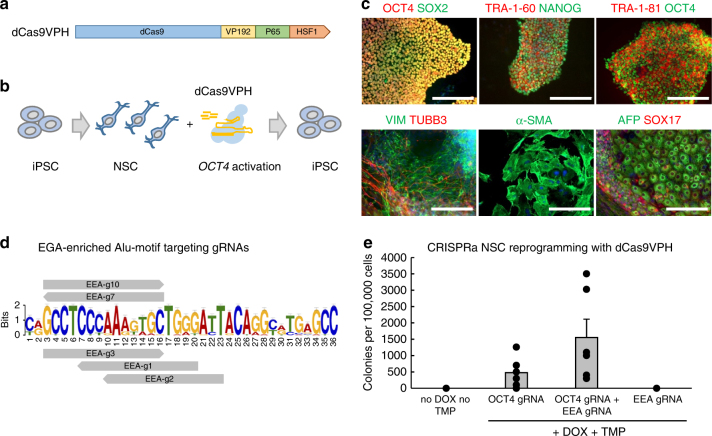
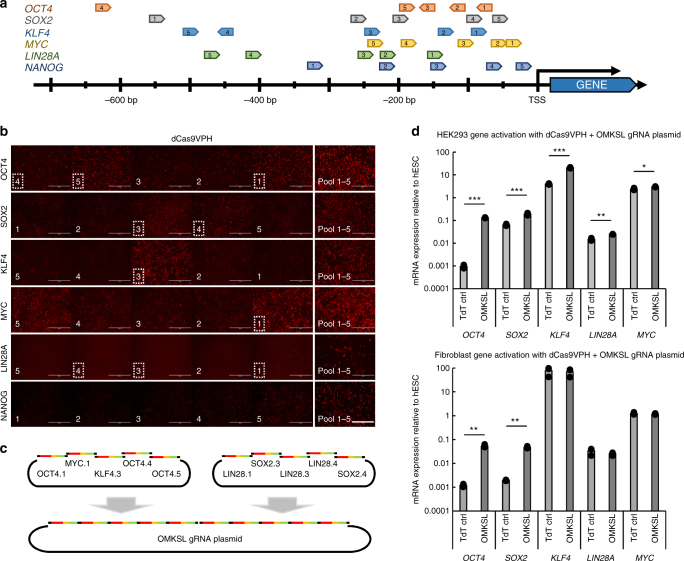
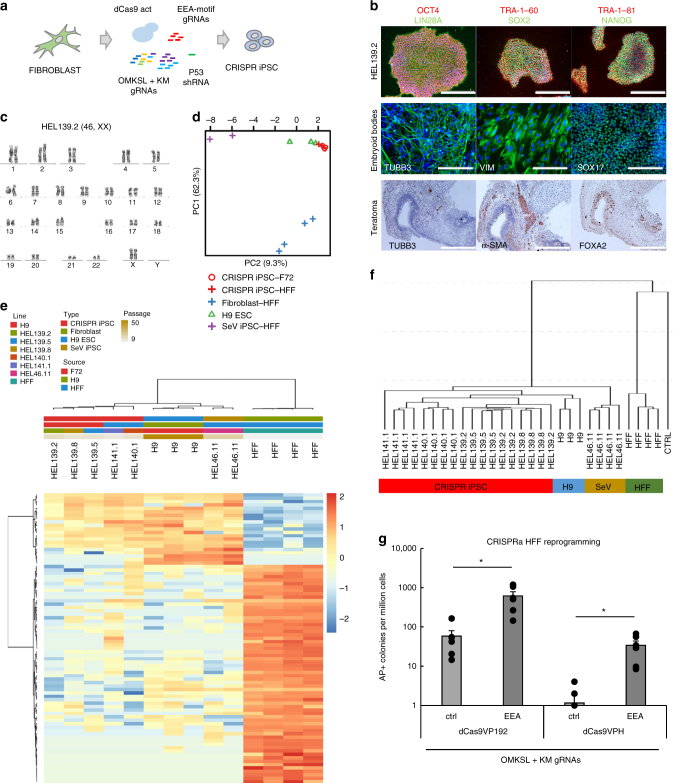
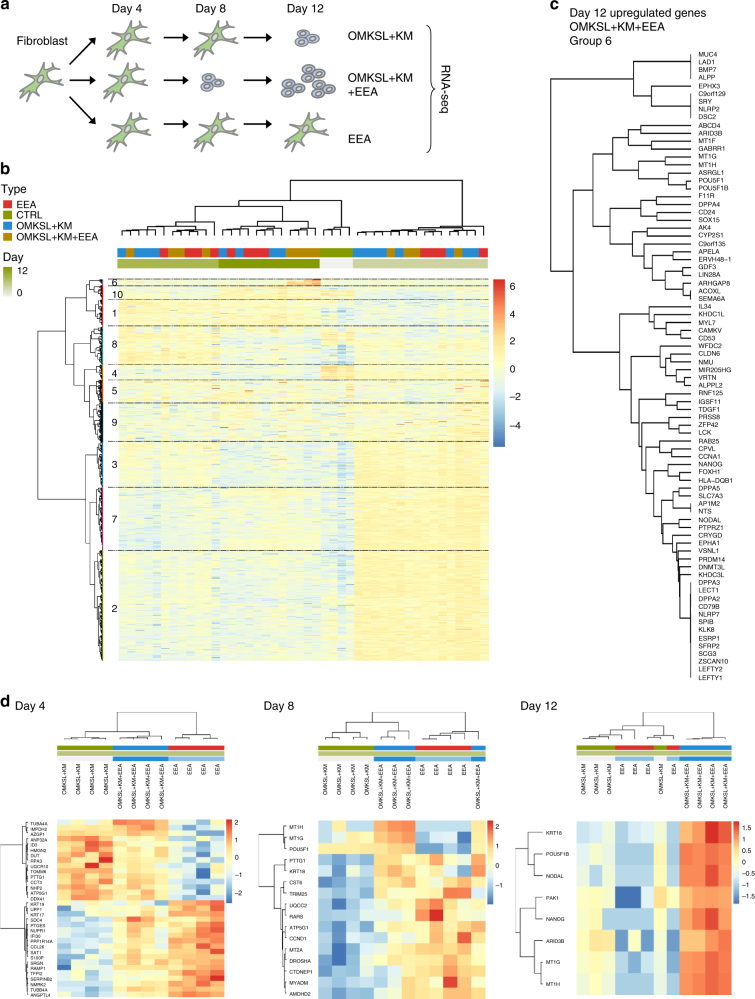
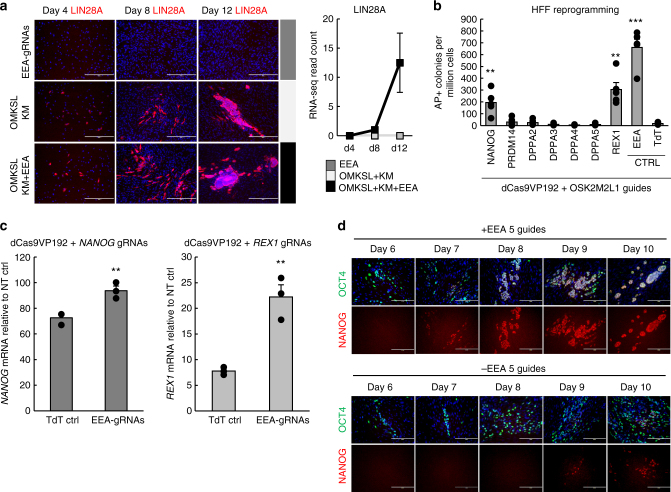
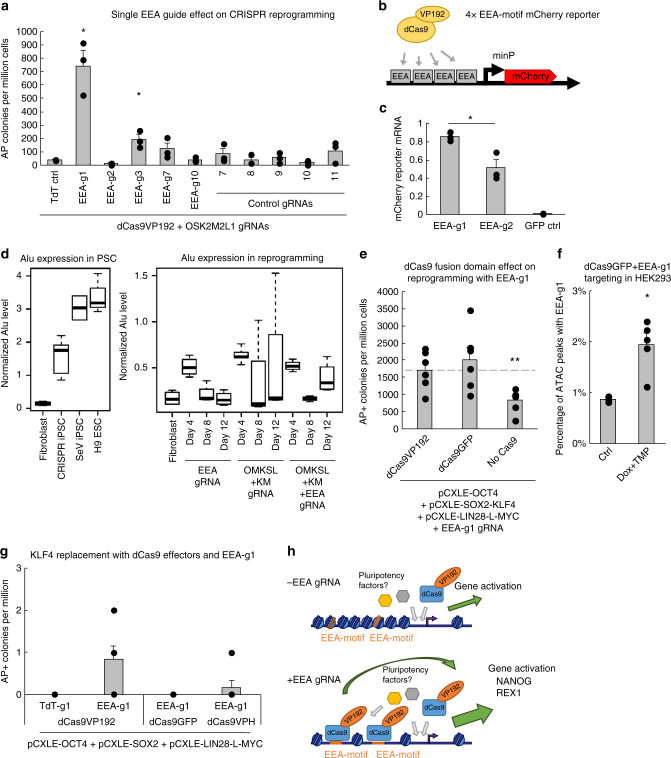
CRISPR-Cas9-based gene activation (CRISPRa) is an attractive tool for cellular reprogramming applications due to its high multiplexing capacity and direct targeting of endogenous loci. Here we present the reprogramming of primary human skin fibroblasts into induced pluripotent stem cells (iPSCs) using CRISPRa, targeting endogenous OCT4 , SOX2 , KLF4 , MYC , and LIN28A promoters. The low basal reprogramming efficiency can be improved by an order of magnitude by additionally targeting a conserved Alu-motif enriched near genes involved in embryo genome activation (EEA-motif). This effect is mediated in part by more efficient activation of NANOG and REX1 . These data demonstrate that human somatic cells can be reprogrammed into iPSCs using only CRISPRa. Furthermore, the results unravel the involvement of EEA-motif-associated mechanisms in cellular reprogramming.
Overview
The claims and statistics of this paper haven’t been checked yet.
Free: it reads the open-access text and checks the first 5 claims that cite a source we can check. Create a free account to check every claim.
Integrity signals
Registry
Cites
Statistics
Figures
Verification
Claims the paper makes
The claims and statistics of this paper haven’t been checked yet.
Free: it reads the open-access text and checks the first 5 claims that cite a source we can check. Create a free account to check every claim.
Claims other papers make about this one
Each is checked against this paper’s own text: does it say what the citing paper says it does?
The check wasn’t confident either way, so it gives no verdict — never disputed.
In the citing paper
“Overall, there was little overlap between CRISPRi and CRISPRa hits, consistent with our previous study comparing parallel CRISPRi and CRISPRa screens in K562 cells4.”
From Genome-wide CRISPRi/a screens in human neurons link lysosomal failure to ferroptosis (2021) · cites this paper as [4]
Experimental — accuracy not yet measuredIn the citing paper
“Here, we present a gain-of-function screening platform in human iPSC-derived neurons based on CRISPR activation (CRISPRa), which can yield complementary biological insights to CRISPRi screens4.”
From Genome-wide CRISPRi/a screens in human neurons link lysosomal failure to ferroptosis (2021) · cites this paper as [4]
Self-check
Percentages, sums and reported differences re-computed from the paper’s own numbers.
The self-check needs the paper’s full text.
Citations
Cites
Takahashi, K., & Yamanaka, S. (2006) · Cell · doi:10.1016/j.cell.2006.07.024 · Cited by 26,673
A Programmable Dual-RNA–Guided DNA Endonuclease in Adaptive Bacterial Immunity
Jinek, M., Chylinski, K., Fonfara, I., Hauer, M., Doudna, J. A., & Charpentier, E. (2012) · Science · doi:10.1126/science.1225829 · Cited by 17,116
Induced Pluripotent Stem Cell Lines Derived from Human Somatic Cells
Yu, J., Vodyanik, M. A., Smuga-Otto, K., Antosiewicz-Bourget, J., Frane, J. L., Tian, S., Nie, J., Jonsdottir, G. A., Ruotti, V., Stewart, R., et al. (2007) · Science · doi:10.1126/science.1151526 · Cited by 10,310
ATAC-seq: a method for assaying chromatin accessibility genome-wide
Buenrostro, J. D., Wu, B., Chang, H. Y., & Greenleaf, W. J. (2015) · Current Protocols in Molecular Biology · doi:10.1002/0471142727.mb2129s109 · Cited by 3,289
Genome-scale transcriptional activation by an engineered CRISPR-Cas9 complex
Konermann, S., Brigham, M. D., Trevino, A. E., Joung, J., Abudayyeh, O. O., Barcena, C., Hsu, P. D., Habib, N., Gootenberg, J. S., Nishimasu, H., et al. (2015) · Nature · doi:10.1038/nature14136 · Cited by 2,825
A more efficient method to generate integration-free human iPS cells
Okita, K., Matsumura, Y., Sato, Y., Okada, A., Morizane, A., Okamoto, S., Hong, H., Nakagawa, M., Tanabe, K., Tezuka, K.-I., et al. (2011) · Nature Methods · doi:10.1038/nmeth.1591 · Cited by 2,061
Hilton, I. B., D'Ippolito, A. M., Vockley, C. M., Thakore, P. I., Crawford, G. E., Reddy, T. E., & Gersbach, C. A. (2015) · Nature Biotechnology · doi:10.1038/nbt.3199 · Cited by 1,885
Highly efficient Cas9-mediated transcriptional programming
Chavez, A., Scheiman, J., Vora, S., Pruitt, B. W., Tuttle, M., P R Iyer, E., Lin, S., Kiani, S., Guzman, C. D., Wiegand, D. J., et al. (2015) · Nature Methods · doi:10.1038/nmeth.3312 · Cited by 1,622
Rational design of highly active sgRNAs for CRISPR-Cas9-mediated gene inactivation
Doench, J. G., Hartenian, E., Graham, D. B., Tothova, Z., Hegde, M., Smith, I., Sullender, M., Ebert, B. L., Xavier, R. J., & Root, D. E. (2014) · Nature Biotechnology · doi:10.1038/nbt.3026 · Cited by 1,617
A flexible R package for nonnegative matrix factorization
Gaujoux, R., & Seoighe, C. (2010) · BMC Bioinformatics · doi:10.1186/1471-2105-11-367 · Cited by 1,547
Cited by
Past, present, and future of CRISPR genome editing technologies
Pacesa, M., Pelea, O., & Jinek, M. (2024) · Cell · doi:10.1016/j.cell.2024.01.042 · Cited by 609
“199–201 Alternatively, fusions with histone-modifying enzymes, such as demethylases or acetylases, can site-specifically alter the epigenetic markers at a particular site and induce active chromatin states to drive gene expression.”
Engineering the next generation of cell-based therapeutics
Bashor, C. J., Hilton, I. B., Bandukwala, H., Smith, D. M., & Veiseh, O. (2022) · Nature Reviews Drug Discovery · doi:10.1038/s41573-022-00476-6 · Cited by 439
Genome-wide CRISPRi/a screens in human neurons link lysosomal failure to ferroptosis
Tian, R., Abarientos, A., Hong, J., Hashemi, S. H., Yan, R., Dräger, N., Leng, K., Nalls, M. A., Singleton, A. B., Xu, K., et al. (2020) · doi:10.1101/2020.06.27.175679 · Cited by 414
Genome-wide CRISPRi/a screens in human neurons link lysosomal failure to ferroptosis
Tian, R., Abarientos, A., Hong, J., Hashemi, S. H., Yan, R., Dräger, N., Leng, K., Nalls, M. A., Singleton, A. B., Xu, K., et al. (2021) · Nature Neuroscience · doi:10.1038/s41593-021-00862-0 · Cited by 414
Wang, C., Lundh, M., Fu, A., Kriszt, R., Huang, T. L., Lynes, M. D., Leiria, L. O., Shamsi, F., Darcy, J., Greenwood, B. P., et al. (2020) · Science Translational Medicine · doi:10.1126/scitranslmed.aaz8664 · Cited by 173
Poetsch, M. S., Strano, A., & Guan, K. (2022) · Stem Cells · doi:10.1093/stmcls/sxac020 · Cited by 144
Transgenic mice for in vivo epigenome editing with CRISPR-based systems
Gemberling, M. P., Siklenka, K., Rodriguez, E., Tonn-Eisinger, K. R., Barrera, A., Liu, F., Kantor, A., Li, L., Cigliola, V., Hazlett, M. F., et al. (2021) · Nature Methods · doi:10.1038/s41592-021-01207-2 · Cited by 140
Dead Cas Systems: Types, Principles, and Applications
Brezgin, S. A., Kostyusheva, A. P., Kostyushev, D. S., & Chulanov, V. (2019) · International Journal of Molecular Sciences · doi:10.3390/ijms20236041 · Cited by 140
CRISPR/Cas-Based Epigenome Editing: Advances, Applications, and Clinical Utility
Goell, J., & Hilton, I. B. (2021) · Trends in biotechnology · doi:10.1016/j.tibtech.2020.10.012 · Cited by 136
Kang, J. G., Park, J. S., Ko, J.-H., & Kim, Y.-S. (2019) · Scientific Reports · doi:10.1038/s41598-019-48130-3 · Cited by 131
CRISPR technologies for stem cell engineering and regenerative medicine
Hsu, M.-N., Chang, Y.-H., Truong, V. A., Lai, P.-L., Nguyen, T. K. N., & Hu, Y.-C. (2019) · Biotechnology Advances · doi:10.1016/j.biotechadv.2019.107447 · Cited by 104
Current approaches in CRISPR-Cas9 mediated gene editing for biomedical and therapeutic applications
Bhattacharjee, G., Gohil, N., Khambhati, K., Mani, I., Maurya, R., Karapurkar, J. K., Gohil, J., Chu, D., Vu‐Thi, H., Alzahrani, K. J., et al. (2022) · Journal of Controlled Release · doi:10.1016/j.jconrel.2022.02.005 · Cited by 96
Alda-Catalinas, C., Bredikhin, D., Hernando-Herraez, I., Santos, F., Kubinyecz, O., Eckersley-Maslin, M. A., Stegle, O., & Reik, W. (2020) · Cell Systems · doi:10.1016/j.cels.2020.06.004 · Cited by 91
Thomas, D., Cunningham, N. J., Shenoy, S., & Wu, J. C. (2021) · Cardiovascular Research · doi:10.1093/cvr/cvab115 · Cited by 90
The Challenges to Advancing Induced Pluripotent Stem Cell-Dependent Cell Replacement Therapy
Moy, A. B., Kamath, A. M., Ternes, S., & Kamath, J. (2023) · Medical Research Archives · doi:10.18103/mra.v11i11.4784 · Cited by 87
Truong, V. A., Hsu, M., Nguyen, N. T. K., Lin, M., Shen, C., Lin, C., & Hu, Y. (2019) · Nucleic Acids Research · doi:10.1093/nar/gkz267 · Cited by 84
Wang, J., Jiang, X., Zhao, L., Zuo, S., Chen, X., Zhang, L., Lin, Z., Zhao, X., Qin, Y., Zhou, X., et al. (2019) · Acta Pharmaceutica Sinica B · doi:10.1016/j.apsb.2019.09.003 · Cited by 84
Human Induced Pluripotent Stem-Cell-Derived Cardiomyocytes as Models for Genetic Cardiomyopathies
Brodehl, A., Ebbinghaus, H., Deutsch, M.-A., Gummert, J. F., Gärtner, A., Ratnavadivel, S., & Milting, H. (2019) · International Journal of Molecular Sciences · doi:10.3390/ijms20184381 · Cited by 78
Hsu, M., Liao, H.-T., Truong, V. A., Huang, K.-L., Yu, F.-J., Chen, H., Nguyen, T. K. N., Макаревич, П. И., Parfyonova, Y. V., & Hu, Y.-C. (2019) · Theranostics · doi:10.7150/thno.36790 · Cited by 77
CRISPR/Cas9 ribonucleoprotein-mediated genome and epigenome editing in mammalian cells
Bloomer, H., Khirallah, J., Li, Y., & Xu, Q. (2021) · Advanced Drug Delivery Reviews · doi:10.1016/j.addr.2021.114087 · Cited by 78
Epigenetic reprogramming of cell identity: lessons from development for regenerative medicine
Basu, A., & Tiwari, V. K. (2021) · Clinical Epigenetics · doi:10.1186/s13148-021-01131-4 · Cited by 72
Epigenome editing for targeted DNA (de)methylation: a new perspective in modulating gene expression
Seem, K., Kaur, S., Kumar, S., & Mohapatra, T. (2024) · Critical Reviews in Biochemistry and Molecular Biology · doi:10.1080/10409238.2024.2320659 · Cited by 69
Danziger, O., Patel, R. S., DeGrace, E. J., Rosen, M. R., & Rosenberg, B. R. (2022) · PLoS Pathogens · doi:10.1371/journal.ppat.1010464 · Cited by 66
Genome-Scale CRISPRa Screen Identifies Novel Factors for Cellular Reprogramming
Yang, J., Rajan, S. S., Friedrich, M., Lan, G., Zou, X., Ponstingl, H., Garyfallos, D. A., Liu, P., Bradley, A., & Metzakopian, E. (2019) · Stem Cell Reports · doi:10.1016/j.stemcr.2019.02.010 · Cited by 66
DUX4 is a multifunctional factor priming human embryonic genome activation
Vuoristo, S., Bhagat, S., Hydén‐Granskog, C., Yoshihara, M., Gawriyski, L. M., Jouhilahti, E., Ranga, V., Tamirat, M. Z., Huhtala, M. T., Kirjanov, I., et al. (2022) · iScience · doi:10.1016/j.isci.2022.104137 · Cited by 67
Self-citationEngineering Biomaterials with Micro/Nanotechnologies for Cell Reprogramming
Fang, J., Hsueh, Y., Soto, J., Sun, W., Wang, J., Gu, Z., Khademhosseini, A., & Li, S. (2020) · ACS Nano · doi:10.1021/acsnano.9b04837 · Cited by 63
Rittiner, J. E., Moncalvo, M., Chiba‐Falek, O., & Kantor, B. (2020) · Frontiers in Molecular Neuroscience · doi:10.3389/fnmol.2020.00148 · Cited by 62
Cell Reprogramming With CRISPR/Cas9 Based Transcriptional Regulation Systems
Шакирова, К. М., Ovchinnikova, V. Y., & Dashinimaev, E. B. (2020) · Frontiers in Bioengineering and Biotechnology · doi:10.3389/fbioe.2020.00882 · Cited by 62
Genomic Instability of iPSCs and Challenges in Their Clinical Applications
Yoshihara, M., Oguchi, A., & Murakawa, Y. (2019) · Advances in experimental medicine and biology · doi:10.1007/978-3-030-31206-0_2 · Cited by 61
In vivo epigenome editing and transcriptional modulation using CRISPR technology
Lau, C., & Suh, Y. (2018) · Transgenic Research · doi:10.1007/s11248-018-0096-8 · Cited by 57
Methods and applications of CRISPR/Cas system for genome editing in stem cells
Yang, G., & Huang, X. (2019) · Cell Regeneration · doi:10.1016/j.cr.2019.08.001 · Cited by 58
Targeting cancer epigenetics with CRISPR-dCAS9: Principles and prospects
Rahman, M. M., & Tollefsbol, T. O. (2020) · Methods · doi:10.1016/j.ymeth.2020.04.006 · Cited by 57
CRISPR-Cas System: The Current and Emerging Translational Landscape
Bhokisham, N., Laudermilch, E., Traeger, L. L., Bonilla, T. D., Ruíz-Estévez, M., & Becker, J. R. (2023) · Cells · doi:10.3390/cells12081103 · Cited by 57
Mahata, B., Cabrera, A., Brenner, D. A., Guerra-Resendez, R. S., Li, J., Goell, J., Wang, K., Guo, Y., Escobar, M., Parthasarathy, A. K., et al. (2023) · Nature Methods · doi:10.1038/s41592-023-02036-1 · Cited by 55
Modeling Psychiatric Disorder Biology with Stem Cells
Das, D., Feuer, K., Wahbeh, M., & Avramopoulos, D. (2020) · Current Psychiatry Reports · doi:10.1007/s11920-020-01148-1 · Cited by 48
Enhanced Cas12a multi-gene regulation using a CRISPR array separator
Magnusson, J. P., Rios, A., Wu, L., & Qi, L. S. (2021) · eLife · doi:10.7554/elife.66406 · Cited by 49
Bakulski, K. M., Blostein, F., & London, S. J. (2023) · Environmental Health Perspectives · doi:10.1289/ehp12956 · Cited by 46
Hazelbaker, D. Z., Beccard, A., Angelini, G., Mazzucato, P., Messana, A., Lam, D., Eggan, K. C., & Barrett, L. E. (2020) · Scientific Reports · doi:10.1038/s41598-020-57500-1 · Cited by 44
Wang, Y., Chen, S., Jiang, Q., Deng, J. V., Cheng, F., Lin, Y., Cheng, L., Ye, Y., Chen, X., Yao, Y., et al. (2020) · Cell Death and Disease · doi:10.1038/s41419-020-2684-9 · Cited by 44
Harjuhaahto, S., Rasila, T. S., Molchanova, S. M., Woldegebriel, R., Kvist, J., Konovalova, S. A., Sainio, M. T., Pennonen, J., Torregrosa‐Muñumer, R., Ibrahim, H., et al. (2020) · Neurobiology of Disease · doi:10.1016/j.nbd.2020.104940 · Cited by 43
Self-citationInduced Pluripotent Stem Cells and Organoids in Advancing Neuropathology Research and Therapies
Pazzin, D. B., Previato, T. T. R., Gonçalves, J. I. B., Zanirati, G., Xavier, F. A. C., DaCosta, J. C., & Marinowic, D. R. (2024) · Cells · doi:10.3390/cells13090745 · Cited by 41
Episomal Induced Pluripotent Stem Cells: Functional and Potential Therapeutic Applications
Wang, A. Y. L., & Loh, C. Y. Y. (2019) · Cell Transplantation · doi:10.1177/0963689719886534 · Cited by 41
CRISPR activation enables high-fidelity reprogramming into human pluripotent stem cells
Sokka, J., Yoshihara, M., Kvist, J., Laiho, L., Warren, A., Stadelmann, C., Jouhilahti, E., Kilpinen, H., Balboa, D., Katayama, S., et al. (2022) · Stem Cell Reports · doi:10.1016/j.stemcr.2021.12.017 · Cited by 40
Self-citationUsing CRISPR to understand and manipulate gene regulation
Akıncı, E., Hamilton, M. C., Khowpinitchai, B., & Sherwood, R. I. (2021) · Development · doi:10.1242/dev.182667 · Cited by 37
Lee, M., Lin, C.-C., Thomas, J. L., Li, J.-A., & Lin, H. (2021) · Materials Today Bio · doi:10.1016/j.mtbio.2020.100091 · Cited by 37
Levy, S., Somasundaram, L., Raj, I. X., Ic-Mex, D., Phal, A., Schmidt, S., Ng, W. I., Mar, D., Decarreau, J. A., Moss, N., et al. (2022) · Cell Reports · doi:10.1016/j.celrep.2022.110457 · Cited by 35
Kovalev, M. A., Mamaeva, N. Y., Kristovskiy, N. V., Feskin, P. G., Vinnikov, R. S., Oleinikov, P. D., Sosnovtseva, A. O., Yakovlev, V. A., Glukhov, G. S., & Shaytan, A. К. (2025) · International Journal of Molecular Sciences · doi:10.3390/ijms26136371 · Cited by 35
Vinel, C., Rosser, G., Guglielmi, L., Constantinou, M., Pomella, N., Zhang, X., Boot, J. R., Jones, T. A., Millner, T. O., Dumas, A. A., et al. (2021) · Nature Communications · doi:10.1038/s41467-021-26297-6 · Cited by 34
Lund, C., Yellapragada, V., Vuoristo, S., Balboa, D., Trova, S., Allet, C., Eskici, N., Pulli, K., Giacobini, P., Tuuri, T., et al. (2020) · Disease Models & Mechanisms · doi:10.1242/dmm.040105 · Cited by 33
Self-citationPark, H., & Kim, J. (2022) · Journal of Pineal Research · doi:10.1111/jpi.12787 · Cited by 33
Nanonetworks in Biomedical Applications
Marzo, J. L., Jornet, J. M., & Pierobon, M. (2019) · Current Drug Targets · doi:10.2174/1389450120666190115152613 · Cited by 33
The Interface of Gene Editing with Regenerative Medicine
Farag, V., Devey, E. A., & Leong, K. W. (2024) · Engineering · doi:10.1016/j.eng.2024.10.019 · Cited by 31
A ride through the epigenetic landscape: aging reversal by reprogramming
Camillo, L. P. D. L., & Quinlan, R. B. A. (2021) · GeroScience · doi:10.1007/s11357-021-00358-6 · Cited by 32
Phylogenetic and mutational analyses of human LEUTX, a homeobox gene implicated in embryogenesis
Katayama, S., Ranga, V., Jouhilahti, E., Airenne, T. T., Johnson, M. S., Mukherjee, K., Bürglin, T. R., & Kere, J. (2018) · Scientific Reports · doi:10.1038/s41598-018-35547-5 · Cited by 31
Self-citationWang, Z., Yu, J., Zhu, W., Hong, X., Xu, Z., Mao, S., Huang, L., Han, P., He, C., Song, C., et al. (2024) · Molecular Cancer · doi:10.1186/s12943-024-02187-5 · Cited by 31
Myogenic Progenitor Cell Lineage Specification by CRISPR/Cas9-Based Transcriptional Activators
Kwon, J. B., Vankara, A., Ettyreddy, A. R., Bohning, J. D., & Gersbach, C. A. (2020) · Stem Cell Reports · doi:10.1016/j.stemcr.2020.03.026 · Cited by 30
Direct reprogramming of somatic cells into induced hepatocytes: Cracking the Enigma code
Rombaut, M., Boeckmans, J., Rodrigues, R. M., van Grunsven, L. A., Vanhaecke, T., & Kock, J. D. (2021) · Journal of Hepatology · doi:10.1016/j.jhep.2021.04.048 · Cited by 29
Strategies for improving the genome-editing efficiency of class 2 CRISPR/Cas system
Wang, L., & Han, H. (2024) · Heliyon · doi:10.1016/j.heliyon.2024.e38588 · Cited by 28
CRISPR/dCas system as the modulator of gene expression
Kazi, T. A., & Biswas, S. R. (2021) · Progress in molecular biology and translational science · doi:10.1016/bs.pmbts.2020.12.002 · Cited by 28
Pushp, P., Nogueira, D. E. S., Rodrigues, C. A. V., Ferreira, F. C., Cabral, J. M. S., & Gupta, M. K. (2020) · Stem Cell Reviews and Reports · doi:10.1007/s12015-020-10061-2 · Cited by 27
Bekhite, M. M., & Schulze, P. C. (2021) · Cells · doi:10.3390/cells10123483 · Cited by 25
Applications of CRISPR-Cas in Bioengineering, Biotechnology, and Translational Research
Lau, C. (2018) · The CRISPR Journal · doi:10.1089/crispr.2018.0026 · Cited by 24
Precision gene editing: The power of CRISPR-Cas in modern genetics
Joo, J. H., Lee, S., & Kim, K. P. (2025) · Molecular Therapy — Nucleic Acids · doi:10.1016/j.omtn.2025.102733 · Cited by 25
Induced Pluripotent Stem Cells: Hope in the Treatment of Diseases, including Muscular Dystrophies
Beghini, D. G., Horita, S. I. M., Cascabulho, C. M., Alves, L. A., & Henriques‐Pons, A. (2020) · International Journal of Molecular Sciences · doi:10.3390/ijms21155467 · Cited by 24
CRISPR Technology and Its Emerging Applications
Zhang, X. E., Ma, D., & Liu, F. (2025) · Genomics Proteomics & Bioinformatics · doi:10.1093/gpbjnl/qzaf034 · Cited by 23
Transcriptional activation with Cas9 activator nanocomplexes rescues Alzheimer's disease pathology
Park, H., Hwang, Y., & Kim, J. (2021) · Biomaterials · doi:10.1016/j.biomaterials.2021.121229 · Cited by 23
Application of Various Delivery Methods for CRISPR/dCas9
Liu, Z., Liao, Z., Chen, Y., Han, L., Yin, Q., & Xiao, H. (2020) · Molecular Biotechnology · doi:10.1007/s12033-020-00258-8 · Cited by 22
Next-generation CRISPR technology for genome, epigenome and mitochondrial editing
Lau, C., Liang, Q., & Zhu, H. (2024) · Transgenic Research · doi:10.1007/s11248-024-00404-x · Cited by 21
Blossom of CRISPR technologies and applications in disease treatment
Liu, H., Wang, L., & Luo, Y. (2018) · Synthetic and Systems Biotechnology · doi:10.1016/j.synbio.2018.10.003 · Cited by 21
RNA-Based Strategies for Cell Reprogramming toward Pluripotency
Bailly, A., Milhavet, O., & Lemaître, J.-M. (2022) · Pharmaceutics · doi:10.3390/pharmaceutics14020317 · Cited by 20
ETV2/ER71 Transcription Factor as a Therapeutic Vehicle for Cardiovascular Disease
Lee, D. H., Kim, T. M., Kim, J. K., & Park, C. (2019) · Theranostics · doi:10.7150/thno.35300 · Cited by 20
Direct cardiac reprogramming comes of age: Recent advance and remaining challenges
Xie, Y., Liu, J., & Li, Q. (2021) · Seminars in Cell and Developmental Biology · doi:10.1016/j.semcdb.2021.07.010 · Cited by 19
Comprehensive characterization of the embryonic factor LEUTX
Gawriyski, L. M., Jouhilahti, E., Yoshihara, M., Fei, L., Weltner, J., Airenne, T. T., Trokovic, R., Bhagat, S., Tervaniemi, M. H., Murakawa, Y., et al. (2023) · iScience · doi:10.1016/j.isci.2023.106172 · Cited by 20
Self-citationInduced Pluripotent Stem Cells as Vasculature Forming Entities
Palladino, A., Mavaro, I., Pizzoleo, C., Felice, E. D., Lucini, C., de Girolamo, P., Netti, P. A., & Attanasio, C. (2019) · Journal of Clinical Medicine · doi:10.3390/jcm8111782 · Cited by 18
Advances in Therapeutic Applications of CRISPR Genome Editing for Spinal Pain Management
Kang, C. Y., Been, K. W., Kang, M. R., Choi, M. S., Kang, R. H., Hur, J. W., & Hur, J. K. (2025) · Neurospine · doi:10.14245/ns.2550462.231 · Cited by 17
Cardiac Tissue Engineering for the Treatment of Myocardial Infarction
Yu, D., Wang, X., & Ye, L. (2021) · Journal of Cardiovascular Development and Disease · doi:10.3390/jcdd8110153 · Cited by 18
Sepponen, K., Lundin, K., Yohannes, D. A., Vuoristo, S., Balboa, D., POUTANEN, M. H., Ohlsson, C., Hustad, S., Bifulco, E., Paloviita, P., et al. (2022) · Differentiation · doi:10.1016/j.diff.2022.08.001 · Cited by 16
Self-citationThe giant titin: how to evaluate its role in cardiomyopathies
Azad, A. J., Poloni, G., Sontayananon, N., Jiang, H., & Gehmlich, K. (2019) · Journal of Muscle Research and Cell Motility · doi:10.1007/s10974-019-09518-w · Cited by 15
Application of induced pluripotent stem cells in the conservation of endangered animals
Lou, J., Li, W., Chen, P., Chen, H., Shakoor, A., Chen, Y., Hua, J., Wang, Y., & Zhang, S. (2025) · Stem Cell Research & Therapy · doi:10.1186/s13287-025-04392-5 · Cited by 14
Somatic cell reprogramming as a tool for neurodegenerative diseases
Ebrahımı, A., Keske, E., Mehdipour, A., Kalan, A. E., & Ghorbani, M. (2019) · Biomedicine & Pharmacotherapy · doi:10.1016/j.biopha.2019.108663 · Cited by 14
Amorós, M. A., Choi, E. S., Cofré, A. H. R., Dokholyan, N. V., & Duzzioni, M. (2022) · Frontiers in Cell and Developmental Biology · doi:10.3389/fcell.2022.962881 · Cited by 13
Li, Q. V., Rosen, B. P., & Huangfu, D. (2019) · WIREs Systems Biology and Medicine · doi:10.1002/wsbm.1464 · Cited by 13
Choudhury, C., Gill, M. K., McAleese, C. E., Butcher, N. J., Ngo, S. T., Steyn, F. J., & Minchin, R. F. (2023) · Pharmacological Reviews · doi:10.1124/pharmrev.123.000835 · Cited by 13
FOXL2 drives the differentiation of supporting gonadal cells in early ovarian development
Danti, L., Lundin, K., Nedeczey-Ruzsák, P., Tuuri, T., & Tapanainen, J. S. (2025) · Reproductive Biology and Endocrinology · doi:10.1186/s12958-025-01377-0 · Cited by 13
Overcoming functional and translational challenges of cellular immunotherapies for solid tumors
Chen, Y.-C., Chen, K., Levine, B. L., & Shah, K. (2026) · Cancer Cell · doi:10.1016/j.ccell.2026.02.002 · Cited by 12
A Guide in Synthetic Biology: Designing Genetic Circuits and Their Applications in Stem Cells
Elnaggar, K. S., Gamal, O., Hesham, N., Ayman, S., Mohamed, N., Moataz, A., Elzayat, E. M., & Hassan, N. (2025) · SynBio · doi:10.3390/synbio3030011 · Cited by 11
Cell and tissue reprogramming: Unlocking a new era in medical drug discovery
Sen, C. K., Friday, A. J., & Roy, S. (2025) · Pharmacological Reviews · doi:10.1016/j.pharmr.2025.100077 · Cited by 11
Dolatshad, H., Tatwavedi, D., Ahmed, D., Tegethoff, J. F., Boultwood, J., & Pellagatti, A. (2018) · Advances in Biological Regulation · doi:10.1016/j.jbior.2018.10.001 · Cited by 11
Generation of Leydig-like cells: approaches, characterization, and challenges
Li, Z., Lu, J.-D., Li, S., Chen, H.-L., & Su, Z. (2022) · Asian Journal of Andrology · doi:10.4103/aja202193 · Cited by 12
DUX4 regulates oocyte to embryo transition in humanPreprint
Vuoristo, S., Hydén‐Granskog, C., Yoshihara, M., Bhagat, S., Gawriyski, L. M., Jouhilahti, E., Damdimopoulos, A., Ranga, V., Tamirat, M. Z., Huhtala, M. T., et al. (2019) · bioRxiv (Cold Spring Harbor Laboratory) · doi:10.1101/732289 · Cited by 11
Self-citationDead Cas(t) light on new life: CRISPRa-mediated reprogramming of somatic cells into neurons
Zhou, M., Cao, Y., Sui, M., Shu, X., Wan, F., & Zhang, B. (2022) · Cellular and Molecular Life Sciences · doi:10.1007/s00018-022-04324-z · Cited by 10
Vojnits, K., Nakanishi, M., Porras, D. P., Kim, Y., Feng, Z., Golubeva, D., & Bhatia, M. (2022) · Molecules · doi:10.3390/molecules27082434 · Cited by 10
Sartori-Maldonado, R., Jalil, S., Keskinen, T., Nieminen, A. I., Hyvönen, M. E., Lapatto, R., & Wartiovaara, K. (2022) · Molecular Genetics and Metabolism Reports · doi:10.1016/j.ymgmr.2022.100863 · Cited by 10
Ghanbarlou, M. M., Abdoli, S., Omid, H., Qazizadeh, L., Bamehr, H., Raigani, M., Shahsavarani, H., Karimipour, M., & Shokrgozar, M. A. (2023) · Magnetochemistry · doi:10.3390/magnetochemistry9030071 · Cited by 10
Lee, M., Lin, C.-C., Thomas, J. L., Chan, C.-K., & Lin, H. (2021) · Nanotechnology · doi:10.1088/1361-6528/abde00 · Cited by 10
Sang, Y., Xu, L., & Bao, Z. (2024) · Molecular Therapy · doi:10.1016/j.ymthe.2024.10.029 · Cited by 9
Human embryo gene editing: God's scalpel or Pandora's box?
Zhou, Q., Zhang, Y., Zou, Y., Yin, T., & Yang, J. (2020) · Briefings in Functional Genomics · doi:10.1093/bfgp/elz025 · Cited by 9
Wu, Y., Lehtonen, Š., Trontti, K., Kauppinen, R., Kettunen, P., Leinonen, V., Laakso, M., Kuusisto, J., Hiltunen, M., Hovatta, I., et al. (2024) · Fluids and Barriers of the CNS · doi:10.1186/s12987-024-00576-y · Cited by 9
Lee, S.-H., Park, B., Lee, Y. J., Ban, K., & Park, H. (2020) · Journal of Tissue Engineering · doi:10.1177/2041731420953413 · Cited by 9
Oocytes, embryos and pluripotent stem cells from a biomedical perspective
Hyttel, P., Pessôa, L. V. D. F., Secher, J. B., Dittlau, K. S., Freude, K., Hall, V. J., Fair, T., Assey, R. J., Laurinčík, J., Callesen, H., et al. (2019) · Animal Reproduction · doi:10.21451/1984-3143-ar2019-0054 · Cited by 8
Metadata
- Authors
- Weltner, J., Balboa, D., Katayama, S., Bespalov, M., Krjutškov, K., Jouhilahti, E.-M., Trokovic, R., Kere, J., & Otonkoski, T.
- Affiliations
- University of Helsinki (FI)
- Karolinska Institutet (SE)
- Guy's Hospital (GB)
- Corresponding author
- Weltner, Jere
- Kere, Juha
- Otonkoski, Timo
- ORCID
- Venue
- Nature Communications
- Published
- 2018-07-06
- Volume
- 9
- Issue
- 1
- Pages
- 2643-2643
- ISSN
- 2041-1723 (ISSN-L)
- PMC
- PMC6035213
- OpenAlex
- W2765888851
- Cited by
- 181
- References
- 52
- Citations by year
- 2026: 17 · 2025: 18 · 2024: 19 · 2023: 15 · 2022: 24 · 2021: 33 · 2020: 25 · 2019: 24 · 2018: 5
- FWCI
- 7.70
- Type
- journal article
- Language
- en
- Open access
- gold
- doi.org
- Licence
- cc-by
- creativecommons.org/licenses/by/4.0 (tdm)
- creativecommons.org/licenses/by/4.0 (vor)
- Locations
- Nature Communications (publishedVersion, cc-by)
- bioRxiv (Cold Spring Harbor Laboratory) (acceptedVersion)
- Europe PMC (PubMed Central) (publishedVersion, other-oa)
- PubMed Central (publishedVersion, cc-by)
- PubMed (publishedVersion)
- RePEc: Research Papers in Economics (submittedVersion)
- DOAJ (DOAJ: Directory of Open Access Journals) (submittedVersion)
- DOAJ (DOAJ: Directory of Open Access Journals) (submittedVersion, cc-by-sa)
- Työväentutkimus Vuosikirja (submittedVersion)
- Research Portal (King's College London) (submittedVersion, cc-by)
- Funders
- Helsingin Yliopisto
- Tekes (40395/13)
- Jane ja Aatos Erkon Säätiö
- Knut och Alice Wallenbergs Stiftelse (KAW2015, KAW 2015.0096)
- Novo Nordisk
- Sigrid Juséliuksen Säätiö
- Instrumentariumin Tiedesäätiö
- Novo Nordisk Fonden (NNF16OC0021090, NNF15OC0016426)
- Uppsala Multidisciplinary Center for Advanced Computational Science (b2014069)
- Topics
- Life Sciences › Biochemistry, Genetics and Molecular Biology › Molecular Biology › Pluripotent Stem Cells Research
- Life Sciences › Biochemistry, Genetics and Molecular Biology › Molecular Biology › CRISPR and Genetic Engineering
- Life Sciences › Biochemistry, Genetics and Molecular Biology › Molecular Biology › Epigenetics and DNA Methylation
- Keywords
- CRISPR activation, gene activation, cellular reprogramming, induced pluripotent stem cells, dermal fibroblasts, Oct4, SOX2, KLF4, c-Myc, LIN28A, Nanog, Rex1, pluripotency genes
- MeSH terms
- Nanog Homeobox Protein, CRISPR-Associated Protein 9, Kruppel-Like Factor 4, RNA, Guide, CRISPR-Cas Systems, Base Sequence, Embryo, Mammalian, Fibroblasts, Humans, Male, Transcription, Genetic, Gene Expression Regulation, Developmental, Alu Elements, Induced Pluripotent Stem Cells, HEK293 Cells, Neural Stem Cells, Nucleotide Motifs, Clustered Regularly Interspaced Short Palindromic Repeats, Cellular Reprogramming
About these checks
Registry, retraction, Cites and statistics results are computed, not judged, with one exception: a printed reference that no index lists is read once by a model before it counts as a citation error. Claims are extracted by a model and kept only when their quote appears verbatim in the text; each cited source is then checked, with a model’s help, for whether it says what the claim relies on. Those verdicts can be wrong — read the claim’s quote and the cited source before relying on one.
Statistics and arithmetic are recomputed, not judged.
Confidence bands are shown only for fields calibrated on our annotated test set. None is calibrated yet, so no band is shown.
What counts as a claim ›How we measure confidence ›How we check this ›
Are you an author, or do you see a problem with this page? Request a review
Data sources
Bibliographic data: Semantic Scholar, OpenAlex, Crossref.
Contains information from the Semantic Scholar Academic Graph Datasets, made available under the ODC Attribution License (ODC-BY 1.0).
Semantic Scholar’s data is described in: Kinney, R., et al. (2023). The Semantic Scholar Open Data Platform. arXiv:2301.10140.
