

Human pluripotent reprogramming with CRISPR activators
Open accessPublished version of a preprint
The DOI matches its Crossref record; 52 of the 52 references it cites were found in a registry or an index.
Abstract
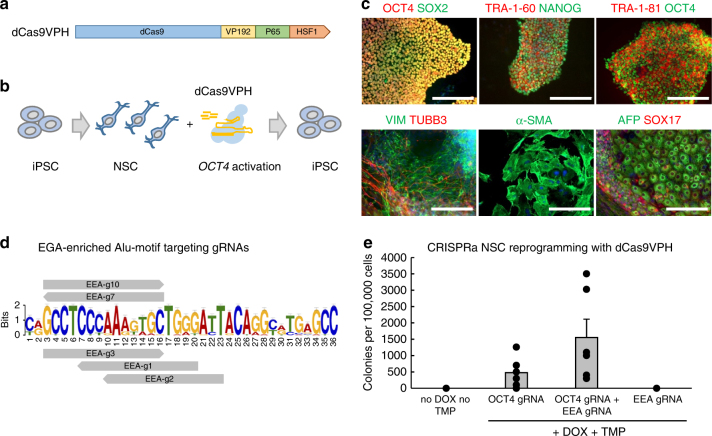
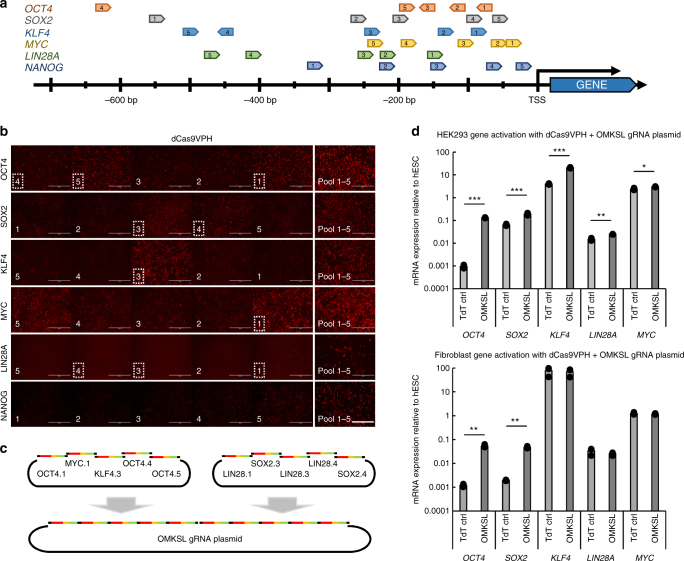
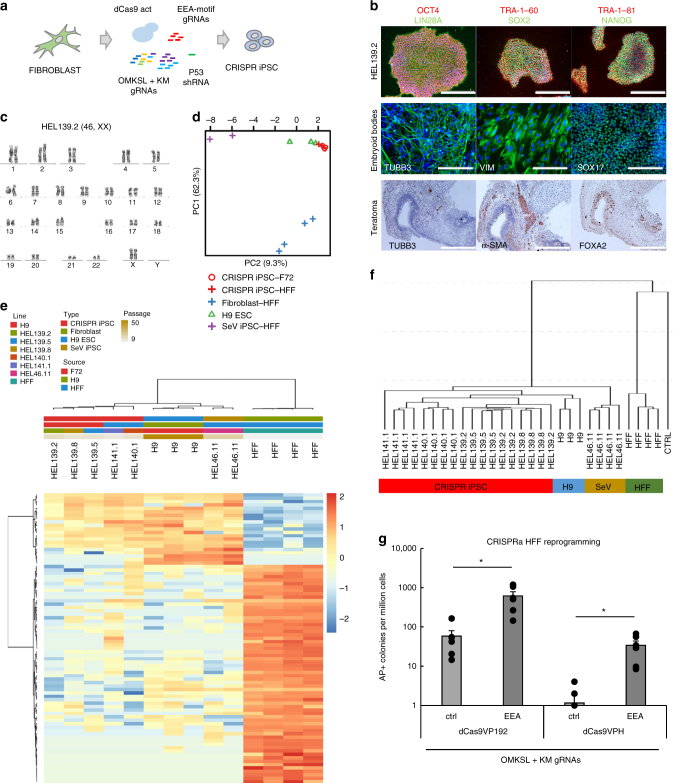
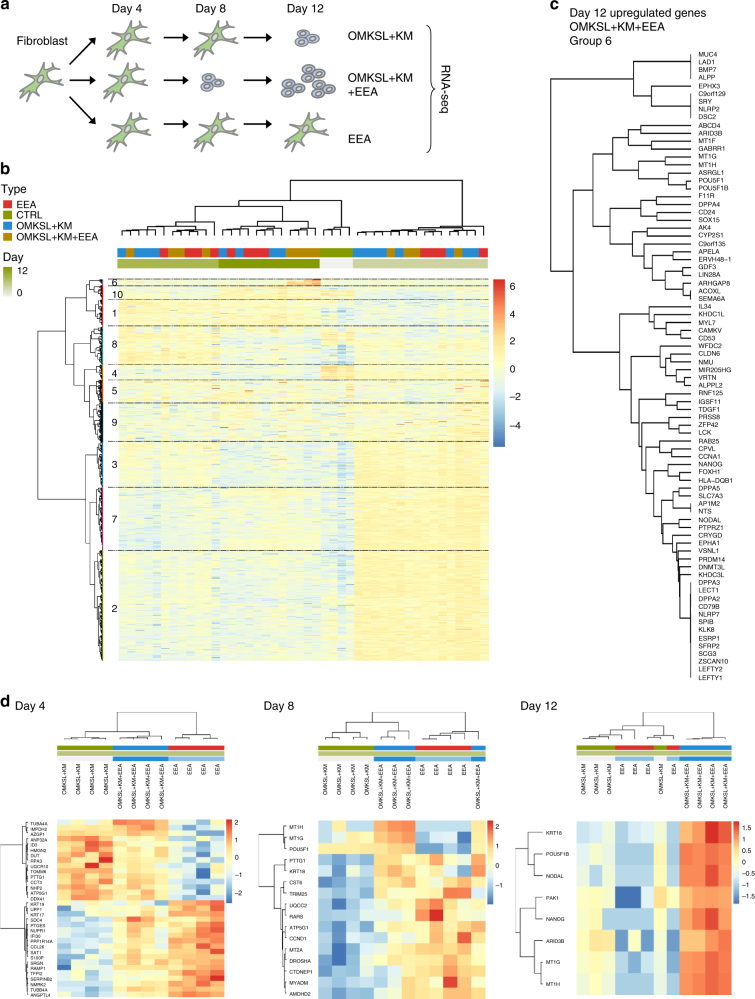
CRISPR-Cas9-based gene activation (CRISPRa) is an attractive tool for cellular reprogramming applications due to its high multiplexing capacity and direct targeting of endogenous loci. Here we present the reprogramming of primary human skin fibroblasts into induced pluripotent stem cells (iPSCs) using CRISPRa, targeting endogenous OCT4 , SOX2 , KLF4 , MYC , and LIN28A promoters. The low basal reprogramming efficiency can be improved by an order of magnitude by additionally targeting a conserved Alu-motif enriched near genes involved in embryo genome activation (EEA-motif). This effect is mediated in part by more efficient activation of NANOG and REX1 . These data demonstrate that human somatic cells can be reprogrammed into iPSCs using only CRISPRa. Furthermore, the results unravel the involvement of EEA-motif-associated mechanisms in cellular reprogramming.
Overview
The claims and statistics of this paper haven’t been checked yet.
Free: it reads the open-access text and checks the first 5 claims that cite a source we can check. Create a free account to check every claim.
Integrity signals
Registry
Cites
Statistics
Figures
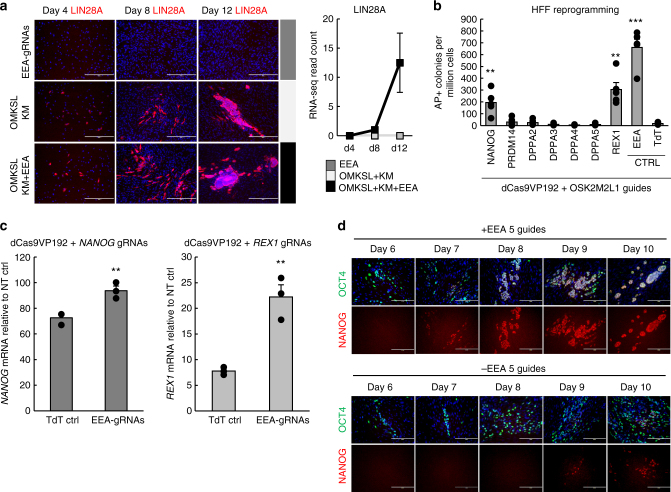
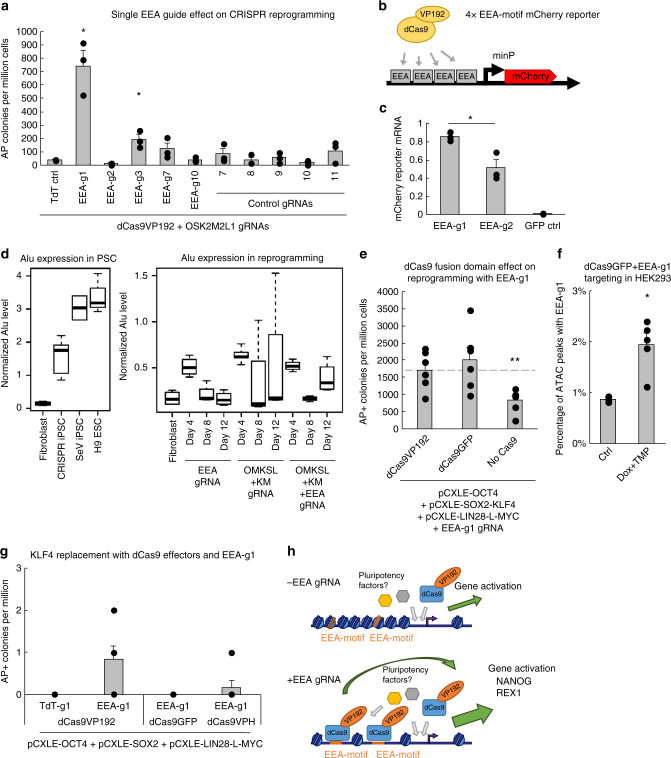
Verification
Claims the paper makes
The claims and statistics of this paper haven’t been checked yet.
Free: it reads the open-access text and checks the first 5 claims that cite a source we can check. Create a free account to check every claim.
Claims other papers make about this one
Each is checked against this paper’s own text: does it say what the citing paper says it does?
The check wasn’t confident either way, so it gives no verdict — never disputed.
In the citing paper
“Overall, there was little overlap between CRISPRi and CRISPRa hits, consistent with our previous study comparing parallel CRISPRi and CRISPRa screens in K562 cells4.”
From Genome-wide CRISPRi/a screens in human neurons link lysosomal failure to ferroptosis (2021) · cites this paper as [4]
Experimental — accuracy not yet measuredIn the citing paper
“Here, we present a gain-of-function screening platform in human iPSC-derived neurons based on CRISPR activation (CRISPRa), which can yield complementary biological insights to CRISPRi screens4.”
From Genome-wide CRISPRi/a screens in human neurons link lysosomal failure to ferroptosis (2021) · cites this paper as [4]
Self-check
Percentages, sums and reported differences re-computed from the paper’s own numbers.
The self-check needs the paper’s full text.
Citations
Cites
Takahashi, K., & Yamanaka, S. (2006) · Cell · doi:10.1016/j.cell.2006.07.024 · Cited by 26,673
A Programmable Dual-RNA–Guided DNA Endonuclease in Adaptive Bacterial Immunity
Jinek, M., Chylinski, K., Fonfara, I., Hauer, M., Doudna, J. A., & Charpentier, E. (2012) · Science · doi:10.1126/science.1225829 · Cited by 17,116
Induced Pluripotent Stem Cell Lines Derived from Human Somatic Cells
Yu, J., Vodyanik, M. A., Smuga-Otto, K., Antosiewicz-Bourget, J., Frane, J. L., Tian, S., Nie, J., Jonsdottir, G. A., Ruotti, V., Stewart, R., et al. (2007) · Science · doi:10.1126/science.1151526 · Cited by 10,310
ATAC-seq: a method for assaying chromatin accessibility genome-wide
Buenrostro, J. D., Wu, B., Chang, H. Y., & Greenleaf, W. J. (2015) · Current Protocols in Molecular Biology · doi:10.1002/0471142727.mb2129s109 · Cited by 3,289
Genome-scale transcriptional activation by an engineered CRISPR-Cas9 complex
Konermann, S., Brigham, M. D., Trevino, A. E., Joung, J., Abudayyeh, O. O., Barcena, C., Hsu, P. D., Habib, N., Gootenberg, J. S., Nishimasu, H., et al. (2015) · Nature · doi:10.1038/nature14136 · Cited by 2,825
A more efficient method to generate integration-free human iPS cells
Okita, K., Matsumura, Y., Sato, Y., Okada, A., Morizane, A., Okamoto, S., Hong, H., Nakagawa, M., Tanabe, K., Tezuka, K.-I., et al. (2011) · Nature Methods · doi:10.1038/nmeth.1591 · Cited by 2,061
Hilton, I. B., D'Ippolito, A. M., Vockley, C. M., Thakore, P. I., Crawford, G. E., Reddy, T. E., & Gersbach, C. A. (2015) · Nature Biotechnology · doi:10.1038/nbt.3199 · Cited by 1,885
Highly efficient Cas9-mediated transcriptional programming
Chavez, A., Scheiman, J., Vora, S., Pruitt, B. W., Tuttle, M., P R Iyer, E., Lin, S., Kiani, S., Guzman, C. D., Wiegand, D. J., et al. (2015) · Nature Methods · doi:10.1038/nmeth.3312 · Cited by 1,622
Rational design of highly active sgRNAs for CRISPR-Cas9-mediated gene inactivation
Doench, J. G., Hartenian, E., Graham, D. B., Tothova, Z., Hegde, M., Smith, I., Sullender, M., Ebert, B. L., Xavier, R. J., & Root, D. E. (2014) · Nature Biotechnology · doi:10.1038/nbt.3026 · Cited by 1,617
A flexible R package for nonnegative matrix factorization
Gaujoux, R., & Seoighe, C. (2010) · BMC Bioinformatics · doi:10.1186/1471-2105-11-367 · Cited by 1,547
Cited by
Items 101–198 of 198
Oocytes, embryos and pluripotent stem cells from a biomedical perspective
Hyttel, P., Pessôa, L. V. D. F., Secher, J. B., Dittlau, K. S., Freude, K., Hall, V. J., Fair, T., Assey, R. J., Laurinčík, J., Callesen, H., et al. (2019) · Animal Reproduction · doi:10.21451/1984-3143-ar2019-0054 · Cited by 8
Sellahewa, S. G., Li, J. Y., & Xiao, Q. (2022) · Journal of Functional Biomaterials · doi:10.3390/jfb14010021 · Cited by 9
Reprogramming of Fibroblasts to Human iPSCs by CRISPR Activators
Weltner, J., & Trokovic, R. (2020) · Methods in molecular biology · doi:10.1007/978-1-0716-1084-8_12 · Cited by 9
Self-citationTranscriptional enhancers in human neuronal differentiation provide clues to neuronal disorders
Yoshihara, M., Coschiera, A., Bachmann, J. A., Pucci, M., Li, H., Bhagat, S., Murakawa, Y., Weltner, J., Jouhilahti, E., Swoboda, P., et al. (2025) · EMBO Reports · doi:10.1038/s44319-025-00372-1 · Cited by 8
Self-citationDey, C., Raina, K., Thool, M., Adhikari, P., Haridhasapavalan, K. K., Sundaravadivelu, P. K., Venkatesan, V., Gogoi, R., Selvaraju, S., & Thummer, R. P. (2021) · Elsevier eBooks · doi:10.1016/b978-0-323-90059-1.00007-5 · Cited by 8
The Progress and Promise of Lineage Reprogramming Strategies for Liver Regeneration
Wang, S., Wang, X., & Wang, Y. (2024) · Cellular and Molecular Gastroenterology and Hepatology · doi:10.1016/j.jcmgh.2024.101395 · Cited by 7
Wu, Y., Zhong, A., Evangelisti, A., Sidharta, M., Huangfu, D., Studer, L., & Zhou, T. (2025) · Stem Cell Reports · doi:10.1016/j.stemcr.2025.102499 · Cited by 7
Thymidylate synthase disruption to limit cell proliferation in cell therapies
Sartori-Maldonado, R., Montaser, H., Soppa, I., Eurola, S., Juutila, J., Balaz, M., Puttonen, H. A. J., Otonkoski, T., Saarimäki‐Vire, J., & Wartiovaara, K. (2024) · Molecular Therapy · doi:10.1016/j.ymthe.2024.06.014 · Cited by 7
Self-citationPiven, O. O., Vaičiulevičiūtė, R., Bernotienė, E., & Dobrzyń, P. (2025) · Acta Physiologica · doi:10.1111/apha.14271 · Cited by 7
Wang, Y., Li, Z., Yang, G., Cai, L., Yang, F., Zhang, Y., Zeng, Y., Ma, Q., & Zeng, F. (2021) · Frontiers in Cell and Developmental Biology · doi:10.3389/fcell.2021.661381 · Cited by 7
Elbasani, E., Falasco, F., Gramolelli, S., Nurminen, V., Günther, T., Weltner, J., Balboa, D., Grundhoff, A. T., Otonkoski, T., & Ojala, P. M. (2020) · Viruses · doi:10.3390/v12090952 · Cited by 7
Self-citationTranscriptional Factors Mediated Reprogramming to Pluripotency
Fatima, N., Rahman, M. S. U., Qasim, M., Ashfaq, U. A., Ahmed, U., & Masoud, M. S. (2023) · Current Stem Cell Research & Therapy · doi:10.2174/1574888x18666230417084518 · Cited by 6
Transdifferentiation Meets Next-generation Biotechnologies
Ke, X., Thakur, A., & Chen, H. J. (2022) · StemJournal · doi:10.3233/stj-200003 · Cited by 6
Magnusson, J. P., Roohani, Y., Stauber, D., Situ, Y., teba, P. A. R. D. C., Sandberg, R., Leskovec, J., & Qi, L. S. (2024) · bioRxiv (Cold Spring Harbor Laboratory) · doi:10.1101/2024.11.04.621938 · Cited by 6
Expression of stem cell markers SALL4, LIN28A, and KLF4 in ameloblastoma
Dias, R. D. A., Balbinot, K. M., Kataoka, M. S. D. S., Júnior, S. D. M. A., & Pinheiro, J. D. J. V. (2023) · Diagnostic Pathology · doi:10.1186/s13000-023-01379-9 · Cited by 6
Moon, S. Y., Zhang, D., Chen, S., Lamey, T. M., Thompson, J. A., McLaren, T. L., Chen, F. K., & McLenachan, S. (2024) · The CRISPR Journal · doi:10.1089/crispr.2023.0065 · Cited by 6
Dead Cas Systems: Types, Principles, and Applications
Brezgin, S. A., Kostyusheva, A. P., Kostyushev, D. S., & Chulanov, V. (2020) · Vide Leaf, Hyderabad eBooks · doi:10.37247/pamb.1.2020.14 · Cited by 5
Application and prospects of high-throughput screening for in vitro neurogenesis
Zhang, S.-Y., Zhao, J., Ni, J.-J., Li, H., Quan, Z., & Qing, H. (2022) · World Journal of Stem Cells · doi:10.4252/wjsc.v14.i6.393 · Cited by 4
Large-scale discovery of neural enhancers for cis-regulation therapiesPreprint
McDiarmid, T. A., Page, N. F., Chardon, F. M., Daza, R. M., Chen, G. T., Kosicki, M., James, L. M., Nourie, H. C., Cintrón, D. L., Lee, A. S., et al. (2025) · bioRxiv (Cold Spring Harbor Laboratory) · doi:10.1101/2025.11.04.686611 · Cited by 4
The application of experimental models for the drug discovery for digestive tumors
Zheng, L., Shuai, W., Liu, Y., Deng, Y., Bao, J., Hu, X., & Wang, G. (2026) · Molecular Cancer · doi:10.1186/s12943-025-02558-6 · Cited by 4
Tailoring Cardiac Synthetic Transcriptional Modulation Towards Precision Medicine
Schoger, E., Lelek, S., Panáková, D., & Zelarayan, L. C. (2022) · Frontiers in Cardiovascular Medicine · doi:10.3389/fcvm.2021.783072 · Cited by 4
iPSCs-Induced Cellular Reprogramming
Muradian, K. K., & Fraifeld, V. E. (2019) · Elsevier eBooks · doi:10.1016/b978-0-12-801238-3.11299-1 · Cited by 4
Kuebler, B., Selvitella, S., Arán, B., Raya, A. A., & Veiga, A. (2026) · Frontiers in Immunology · doi:10.3389/fimmu.2025.1719056 · Cited by 4
Naffaa, M. M. (2026) · Organoid Research · doi:10.36922/or025490038 · Cited by 4
Maturation of Neuronal Activity in Caudalized Human Brain OrganoidsPreprint
Molchanova, S. M., Cherepkova, M. Y., Abdurakhmanova, S., Kuivanen, S. H., Pörsti, E., Pöhö, P., Teppo, J., Saarimäki‐Vire, J., Kvist, J., Balboa, D., et al. (2019) · bioRxiv (Cold Spring Harbor Laboratory) · doi:10.1101/779355 · Cited by 3
Self-citationLek, A., Ma, K., Woodman, K. G., & Lek, M. (2021) · Human Gene Therapy · doi:10.1089/hum.2020.241 · Cited by 3
Clinical translation of epigenome editing technologies
Ma, A. J., Brown, B. H., Kim, S., & Hilton, I. B. (2026) · Current Opinion in Biomedical Engineering · doi:10.1016/j.cobme.2026.100666 · Cited by 3
TIGRa: An ultra-compact programmable activator enabling multiplexed and efficient gene regulation
Liu, Z., Chen, S., Wang, W., Zhang, F., Wang, Q. K., Walkiewicz, G., Hossen, F., Zhou, J., Wang, Y., & Sun, Y. (2026) · Cell stem cell · doi:10.1016/j.stem.2026.07.008 · Cited by 3
Dysregulation of Immune Tolerance to Autologous iPSCs and Their Differentiated Derivatives
Bogomiakova, M. E., Bogomazova, A. N., & Lagarkova, M. A. (2024) · Biochemistry (Moscow) · doi:10.1134/s0006297924050031 · Cited by 3
A systematic screening assay identifies efficient small guide RNAs for CRISPR activation
Arvidsson, E., Lobo, D. D., Sabarese, E., Duarte, F. T., Nobre, R. J., Lundberg, C., & Quintino, L. (2025) · Frontiers in Bioengineering and Biotechnology · doi:10.3389/fbioe.2025.1336313 · Cited by 3
Tavleeva, M. M., Rasova, E. E., Rybak, A. V., Belykh, E. S., Fefilova, E., Pnachina, E. M., & Velegzhaninov, I. O. (2023) · International Journal of Molecular Sciences · doi:10.3390/ijms242417315 · Cited by 3
Induced pluripotent stem cell derivation from myoblasts
Winder, M. L., & Trokovic, R. (2021) · Elsevier eBooks · doi:10.1016/b978-0-12-822135-8.00009-4 · Cited by 3
Self-citationOur posthuman present: thinking through ableism, disability, and untethered norms
Boucher, M. (2022) · Lu Zone Ul (Laurentian University) · Cited by 3
Computer Designed PRC2 Inhibitor, EBdCas9, Reveals Functional TATA boxes in Distal Promoter RegionsPreprint
Levy, S., Somasundaram, L., Raj, I. X., Ic-Mex, D., Schmidt, S., Alghadeer, A., Honkanen, H., Hawkins, R. D., Mathieu, J., Wang, Y., et al. (2020) · bioRxiv (Cold Spring Harbor Laboratory) · doi:10.1101/2020.11.16.385922 · Cited by 2
Reisman, S. J., Zhu, W., Miller, S. E., Halabi, D., Sangvai, N., Crawford, G. E., Gordân, R., & Gersbach, C. A. (2026) · bioRxiv (Cold Spring Harbor Laboratory) · doi:10.64898/2026.02.01.703129 · Cited by 2
Mapping regulators of cell fate determination: Approaches and challenges
Kumar, A., & Mali, P. (2020) · APL Bioengineering · doi:10.1063/5.0004611 · Cited by 2
Qiu, B., & Caiazzo, M. (2025) · bioRxiv (Cold Spring Harbor Laboratory) · doi:10.1101/2025.04.13.648609 · Cited by 2
Generation of an inducible dCas9-SAM human PSC line for endogenous gene activation
Petazzi, P., Gutiérrez‐Agüera, F., Roca-Ho, H., Castaño, J., Bueno, C., Alvarez, N., Forrester, L. M., Sevilla, A., Fidanza, A., & Menéndez, P. R. (2024) · Frontiers in Cell and Developmental Biology · doi:10.3389/fcell.2024.1484955 · Cited by 2
Abujarour, R., Dinella, J., Pribadi, M., Fong, L. K., Denholtz, M., Gutierrez, A., Haynes, M., Mahmood, E., Lee, T. T., Ding, S., et al. (2024) · Future Science OA · doi:10.2144/fsoa-2023-0257 · Cited by 2
An update on clinical applications of iPSCs from a genomic point of view
Yoshihara, M., & Murakawa, Y. (2022) · Elsevier eBooks · doi:10.1016/b978-0-323-99892-5.00001-3 · Cited by 2
An Alternate Approach to Generate Induced Pluripotent Stem Cells with Precise CRISPR/Cas9 Tool
Javaid, N., & Choi, S. (2022) · Stem Cells International · doi:10.1155/2022/4537335 · Cited by 2
CRISPR/Cas System and Stem Cell Editing: Prospects and Possibilities in Veterinary Sciences
Hussain, M. S., & Kumar, M. (2021) · Springer eBooks · doi:10.1007/978-981-16-3464-2_18 · Cited by 2
Agarwal, S. (2025) · Journal of High School Science · doi:10.64336/001c.129931 · Cited by 2
Moderate the MAOA-L Allele Expression with CRISPR/Cas9 SystemPreprint
Nelwan, M. (2017) · SSRN Electronic Journal · doi:10.2139/ssrn.3050912 · Cited by 2
Identification and analysis of genetic and chemical modulators of iron metabolism
Hawula, Z. J. (2021) · Queensland University of Technology · doi:10.5204/thesis.eprints.225904 · Cited by 1
High-fidelity reprogramming into Leydig-like cells by CRISPR activation and paracrine factors
Li, Z., Fan, Y., Xie, C., Liu, J., Guan, X., Li, S., Huang, Y., Zeng, R., Chen, H., & Su, Z. (2022) · PNAS Nexus · doi:10.1093/pnasnexus/pgac179 · Cited by 1
The therapeutic potential of exogenous adult stem cells for the injured central nervous system
Smith, J. A., Braga, A., Hamel, R., Rutigliani, C., Yu, B., Peruzzotti‐Jametti, L., & Pluchino, S. (2020) · Elsevier eBooks · doi:10.1016/b978-0-12-818084-6.00006-4 · Cited by 1
Synthetic transactivator–promoter systems for exogenous gene expression in Chlamydomonas reinhardtii
Kawabe, Y., Akiyama, T., Miyazoe, K., & Kamihira, M. (2026) · Journal of Bioscience and Bioengineering · doi:10.1016/j.jbiosc.2026.02.003 · Cited by 1
Induced Pluripotent Stem Cells in the Era of Precise Genome Editing
Punetha, M., Saini, S., Chaudhary, S., Yadav, P. S., Whitworth, K. M., Green, J. A., Kumar, D., & Kues, W. A. (2023) · Current Stem Cell Research & Therapy · doi:10.2174/1574888x18666230307115326 · Cited by 1
Human Induced Pluripotent Stem (hiPS) Cells: Generation and Applications
Freund, C. M. A. H. (2020) · Learning materials in biosciences · doi:10.1007/978-3-030-43939-2_4 · Cited by 1
Gerlevik, U., Lorenz, P., Lamstaes, A. R., Fischl, H., Xi, S., Saukko‐Paavola, A. J., Murray, S. C., Brown, T., Welch, A., George, C. L., et al. (2026) · Nucleic Acids Research · doi:10.1093/nar/gkag652 · Cited by 1
Krishnamoorthy, V., & Haigh, J. J. (2021) · Re GEN Open · doi:10.1089/regen.2021.0003 · Cited by 1
Computer Designed PRC2 Inhibitor, EBdCas9, Reveals Functional TATA boxes in Distal Promoter RegionsPreprint
Levy, S. (2020) · bioRxiv (Cold Spring Harbor Laboratory) · doi:10.17632/87zz9hytp7 · Cited by 1
Artyuhov, A., Dorovskiy, D. A., Sorokina, A. V., Shakirova, K. M., Momotyuk, E., & Dashinimaev, E. B. (2022) · Molecular Biology · doi:10.1134/s0026893322060048 · Cited by 1
Utilizing CRISPR as a Novel Tool for the Induction of Cell Reprogramming
Gila, F., & Sichani, A. S. (2023) · International Journal of Bioinformatics and Intelligent Computing · doi:10.61797/ijbic.v2i2.235 · Cited by 1
Computer Designed PRC2 Inhibitor, EBdCas9, Reveals Functional TATA Boxes in Distal Promoter RegionsPreprint
Levy, S., Somasundaram, L., Raj, I. X., Ic-Mex, D., Schmidt, S., Alghadeer, A., Honkanen, H., Hawkins, R. D., Mathieu, J., Wang, Y., et al. (2020) · SSRN Electronic Journal · doi:10.2139/ssrn.3748745
The CRISPR/Cas technology landscape: From molecular mechanisms to multidisciplinary applications
Liu, Z., Yang, Y., Li, Z., Li, P., Jia, J., Qiao, X., Su, Y., Qin, Y., Wang, H., Dai, Y., et al. (2026) · Genes & Diseases · doi:10.1016/j.gendis.2026.102484
Ulloa-Navas, M. J., García-Tárraga, P., García‐Verdugo, J. M., & Herranz‐Pérez, V. (2019) · The CRISPR Journal · doi:10.1089/crispr.2019.0032
CRISPR technology and its potential role in treating rare imprinting diseases
Nickl, P., Syding, L. A., & Sedláček, R. (2023) · Principles of Gender-Specific Medicine · doi:10.1016/b978-0-323-88534-8.00044-4
Victorino, J., Rollán, I., Rouco, R., Adan, J., & Manzanares, M. (2021) · bioRxiv (Cold Spring Harbor Laboratory) · doi:10.1101/2021.07.14.452222
CRISPR/Cas9 technologies to manipulate human induced pluripotent stem cells
Jang, H., Moon, J., Kim, N., & Yoon, K. (2021) · Elsevier eBooks · doi:10.1016/b978-0-323-85766-6.00012-7 · Cited by 1
Schoger, E. (2022) · eDiss (Georg-August-Universität Göttingen) · doi:10.53846/goediss-9564
Morrone, M., Valori, C. F., Brambilla, L., & Rossi, D. (2026) · Cells · doi:10.3390/cells15191798
Advances in pluripotent stem cell-derived natural killer cells for cancer immunotherapy
Coffey, M., Yamamoto, K., & Kaufman, D. S. (2021) · Elsevier eBooks · doi:10.1016/b978-0-12-824375-6.00008-4
Dysregulation of immune tolerance to autologous iPSCs and their differentiated derivatives (review)
Bogomiakova, M. E., Bogomazova, A. N., & Lagarkova, M. A. (2024) · Biochemistry (Moscow) · doi:10.31857/s0320972524050036
The Emerging Role of B1 SINE in Pluripotent Reprogramming
Weltner, J., & Trokovic, R. (2023) · Cellular Reprogramming · doi:10.1089/cell.2023.0037
Self-citationChai, T., Wong, A., Yin, Q., von Creytz, I., Weissman, J. S., Saunders, R. A., Prescott, J. B., & Loh, K. M. (2026) · bioRxiv (Cold Spring Harbor Laboratory) · doi:10.64898/2026.03.06.710083
An engineered, compact Cas12m variant for multiplexed gene activation in vivo
Zhang, H., Yang, L., Liu, Y., Han, D., Li, Y., Lin, J., Wang, B., Hu, J., Zhang, Y., Zhang, Y., et al. (2026) · Nature Biotechnology · doi:10.1038/s41587-026-03352-5
Stem Cells: Allogeneic Cells for Cellular Immunotherapy
Jain, K. G., Kumar, A., & Dalela, M. (2025) · Springer eBooks · doi:10.1007/978-3-031-88695-9_14
Manufacture of complex heart tissues: technological advancements and future directions
Zhang, Y. (2021) · AIMS bioengineering · doi:10.3934/bioeng.2021008
Williams, R. L., Allred, J. R., & Blazar, B. R. (2021) · Elsevier eBooks · doi:10.1016/b978-0-12-823884-4.00006-7
Mechano-epigenetic enhancement of CRISPR activation of target genes for cell reprogramming
Song, Y., Wu, Y., Soto, J., Lin, X., Elhajjaoui, N., Abuhanna, K. D., Zhang, Y., Haideri, T., Hu, E., Shin, D. H., et al. (2026) · Matter · doi:10.1016/j.matt.2026.103064
Hwang, R. W., Li, Y. B., Marcotte, R., Costain, W., & Jezierski, A. (2026) · Stem Cell Reports · doi:10.1016/j.stemcr.2026.103116
Varela, M., Ampuja, M., Broberg, M. E., Ranta, A., Talman, V., & Helle, E. (2026) · Stem Cell Reviews and Reports · doi:10.1007/s12015-026-11127-3
CELLULAR REPROGRAMMING: AN APPROACH TO TISSUE ENGINEERING AND NANOTECHNOLOGY
dos Santos, A. Í. L., dos Santos, A. M., Gomes, J. A. D. S., da Silva, J. V., dos Santos, L. M. Q. M., Yara, R., & Amorim, R. V. D. S. (2025) · International Journal of Health Science · doi:10.22533/at.ed.15951525180312
Advances in fish cell reprogramming and Differentiation: A pathway to alternative proteins
Rosero, J. M., Farias, F. D. A., & Bressan, F. F. (2025) · Trends in Food Science & Technology · doi:10.1016/j.tifs.2025.105280
Neurobiological background of male sexual orientationPreprint
Lähteenvuo, M., Räsänen, N., Koskuvi, M., Nieminen, M., Trontti, K., Kauppinen, R., Tuhkala, A., Keskitalo, S., Rõlova, T., Trokovic, R., et al. (2024) · Research Square · doi:10.21203/rs.3.rs-4263623/v1
Self-citationResearch Progress of Cardiac Reprogramming in the Repair of Myocardial Infarction
张, 欣. (2023) · Advances in Clinical Medicine · doi:10.12677/acm.2023.13102155
Tian, R. (2020) · eScholarship (California Digital Library)
Jalkanen, N. (2020) · Helda - University of Helsinki Institutional Repository
Felder, B. (2019) · Digital Library of the University of Innsbruck (University of Innsbruck)
CRISPR Technology: From Bench to Bedside Applications
Ma, X., Li, L., & Sun, Y. (2026) · MedComm · doi:10.1002/mco2.71011
Zhang, Z.-H., Zhang, X.-H., & Jin, Z. (2026) · Stem Cell Research · doi:10.1016/j.scr.2026.103933
Garrote-de-Barros, A., Pérez‐Fernández, J., Arroyo-Barea, A., Bragado-García, I., García-Vicente, R., Ancos-Pintado, R., Velasco‐Estevez, M., Linares, M., Martínez‐López, J., & Hernández‐Sánchez, M. (2026) · bioRxiv (Cold Spring Harbor Laboratory) · doi:10.64898/2026.05.14.724995
Validating Guide RNA Hits For Improving CRISPRa-Reprogramming
Heikkinen, H. (2021) · UTUPub (University of Turku)
Expanding knowledge of the genetic and phenotypic heterogeneity of congenital hyperinsulinism
Hopkins, J. (2024) · Open Research Exeter (University of Exeter)
Stubb, A. (2019) · UTUPub (University of Turku)
Abdullah, U., Kayani, U. S., Niaz, M. K., Zahoor, N., Song, J., Li, B., & Jin, K. (2026) · Poultry Science · doi:10.1016/j.psj.2026.107971
Täiustatud kromosoomanalüüsi meetodid embrüo kvaliteedi ja loote tervise hindamiseks
Yaşar, B. (2026) · DSpace repository (University of Tartu)
Innovative CRISPR-Cas9 Enhances Cell Rejuvenation, Addressing Diseases
Zhang, L. (2025) · Theoretical and Natural Science · doi:10.54254/2753-8818/2025.gu21568
Indusoidut monikykyiset kantasolut aivotutkimuksen välineenä
Kettunen, P., Koskuvi, M., Koıstınaho, J., & Rõlova, T. (2023) · Helda - University of Helsinki Institutional Repository
Setup of human naïve pluripotency reversion protocol to study the function of early embryonic genes
Sokka, J. (2019) · Helda - University of Helsinki Institutional Repository
A REVIEW REPORT ON NANOMEDICINE AND DIABETES
Ravichandran, N. (2021) · International Journal of Engineering Applied Sciences and Technology · doi:10.33564/ijeast.2021.v06i01.026
Golden gate method in biology and medicine
Antipina, M., Li, V. A., Popova, E. E., & Semina, E. V. (2024) · Регенерация органов и тканей. · doi:10.60043/2949-5938-2024-1-16-28
Sumera Zaib, N. F., Fatima, N., Khan, I. A., Shahzadi, K., & Zaib, Z. (2026) · Review journal of neurological & medical sciences review. · doi:10.5281/zenodo.20536366
Smad6-mediated suppression of TGF-β/BMP signaling facilitates oocyte extract-induced reprogramming
Fan, W., Yuan, H.-L., Zhang, Y., Zhao, X., Wang, Q., Bai, X., Pan, X., & Zhu, X. (2026) · Stem Cell Research & Therapy · doi:10.1186/s13287-026-05295-9
Metadata
- Authors
- Weltner, J., Balboa, D., Katayama, S., Bespalov, M., Krjutškov, K., Jouhilahti, E.-M., Trokovic, R., Kere, J., & Otonkoski, T.
- Affiliations
- University of Helsinki (FI)
- Karolinska Institutet (SE)
- Guy's Hospital (GB)
- Corresponding author
- Weltner, Jere
- Kere, Juha
- Otonkoski, Timo
- ORCID
- Venue
- Nature Communications
- Published
- 2018-07-06
- Volume
- 9
- Issue
- 1
- Pages
- 2643-2643
- ISSN
- 2041-1723 (ISSN-L)
- PMC
- PMC6035213
- OpenAlex
- W2765888851
- Semantic Scholar
- 22024609159afa518d7982a43f60d68dafa11954
- Cited by
- 181
- References
- 52
- Citations by year
- 2026: 17 · 2025: 18 · 2024: 19 · 2023: 15 · 2022: 24 · 2021: 33 · 2020: 25 · 2019: 24 · 2018: 5
- FWCI
- 7.70
- Type
- journal article
- Language
- en
- Open access
- gold
- doi.org
- Licence
- cc-by
- creativecommons.org/licenses/by/4.0 (tdm)
- creativecommons.org/licenses/by/4.0 (vor)
- Locations
- Nature Communications (publishedVersion, cc-by)
- bioRxiv (Cold Spring Harbor Laboratory) (acceptedVersion)
- Europe PMC (PubMed Central) (publishedVersion, other-oa)
- PubMed Central (publishedVersion, cc-by)
- PubMed (publishedVersion)
- RePEc: Research Papers in Economics (submittedVersion)
- DOAJ (DOAJ: Directory of Open Access Journals) (submittedVersion)
- DOAJ (DOAJ: Directory of Open Access Journals) (submittedVersion, cc-by-sa)
- Työväentutkimus Vuosikirja (submittedVersion)
- Research Portal (King's College London) (submittedVersion, cc-by)
- Funders
- Helsingin Yliopisto
- Tekes (40395/13)
- Jane ja Aatos Erkon Säätiö
- Knut och Alice Wallenbergs Stiftelse (KAW2015, KAW 2015.0096)
- Novo Nordisk
- Sigrid Juséliuksen Säätiö
- Instrumentariumin Tiedesäätiö
- Novo Nordisk Fonden (NNF16OC0021090, NNF15OC0016426)
- Uppsala Multidisciplinary Center for Advanced Computational Science (b2014069)
- Topics
- Life Sciences › Biochemistry, Genetics and Molecular Biology › Molecular Biology › Pluripotent Stem Cells Research
- Life Sciences › Biochemistry, Genetics and Molecular Biology › Molecular Biology › CRISPR and Genetic Engineering
- Life Sciences › Biochemistry, Genetics and Molecular Biology › Molecular Biology › Epigenetics and DNA Methylation
- Keywords
- CRISPR activation, gene activation, cellular reprogramming, induced pluripotent stem cells, dermal fibroblasts, Oct4, SOX2, KLF4, c-Myc, LIN28A, Nanog, Rex1, pluripotency genes
- MeSH terms
- Nanog Homeobox Protein, CRISPR-Associated Protein 9, Kruppel-Like Factor 4, RNA, Guide, CRISPR-Cas Systems, Base Sequence, Embryo, Mammalian, Fibroblasts, Humans, Male, Transcription, Genetic, Gene Expression Regulation, Developmental, Alu Elements, Induced Pluripotent Stem Cells, HEK293 Cells, Neural Stem Cells, Nucleotide Motifs, Clustered Regularly Interspaced Short Palindromic Repeats, Cellular Reprogramming
About these checks
Registry, retraction, Cites and statistics results are computed, not judged, with one exception: a printed reference that no index lists is read once by a model before it counts as a citation error. Claims are extracted by a model and kept only when their quote appears verbatim in the text; each cited source is then checked, with a model’s help, for whether it says what the claim relies on. Those verdicts can be wrong — read the claim’s quote and the cited source before relying on one.
Statistics and arithmetic are recomputed, not judged.
Confidence bands are shown only for fields calibrated on our annotated test set. None is calibrated yet, so no band is shown.
What counts as a claim ›How we measure confidence ›How we check this ›
Are you an author, or do you see a problem with this page? Request a review
Data sources
Bibliographic data: Semantic Scholar, OpenAlex, Crossref.
Contains information from the Semantic Scholar Academic Graph Datasets, made available under the ODC Attribution License (ODC-BY 1.0).
Semantic Scholar’s data is described in: Kinney, R., et al. (2023). The Semantic Scholar Open Data Platform. arXiv:2301.10140.
