

The DOI matches its Crossref record; 79 of the 79 references it cites were found in a registry or an index.
The origin and adaptive evolution of domesticated populations of yeast from Far East Asia
Open accessAbstract
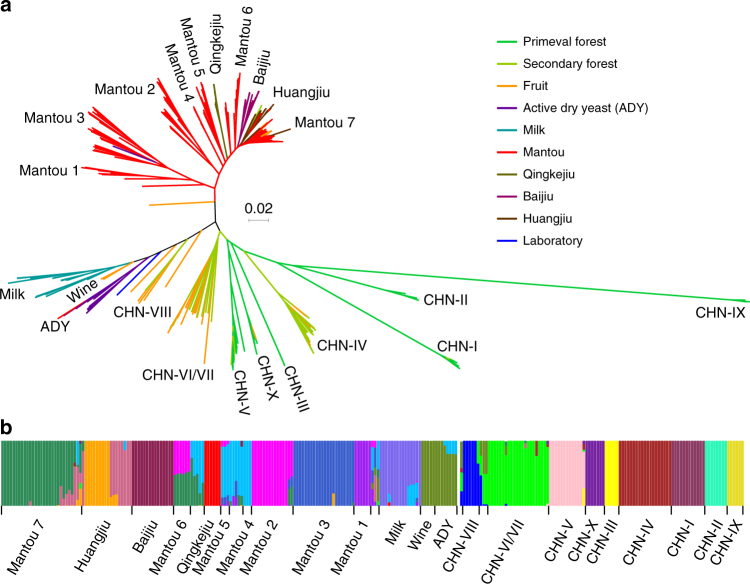
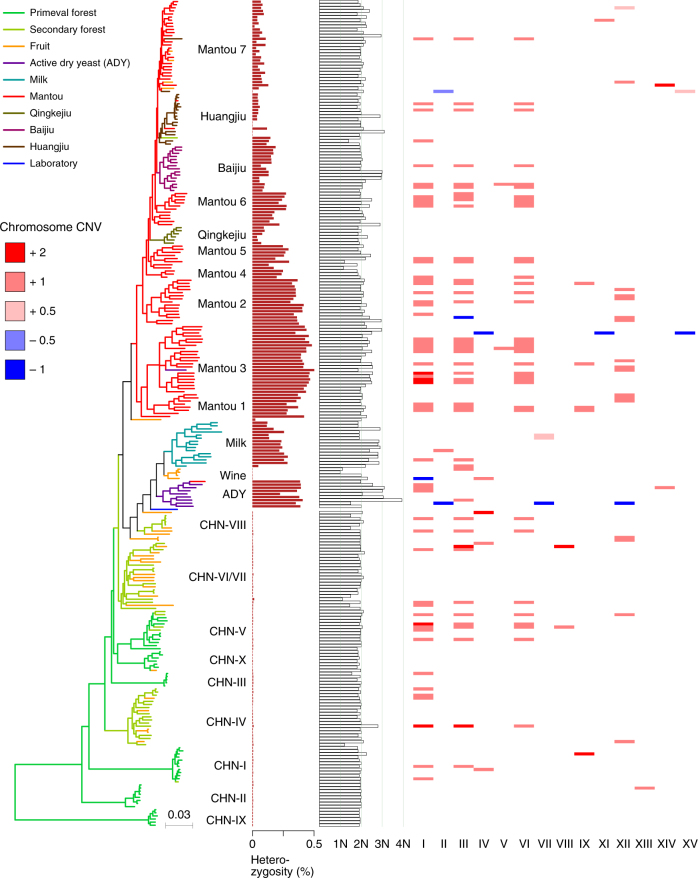
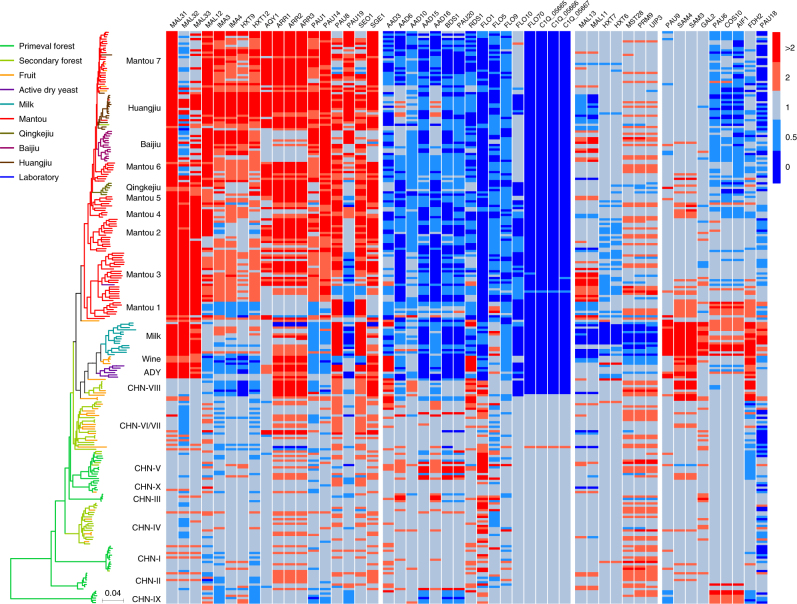
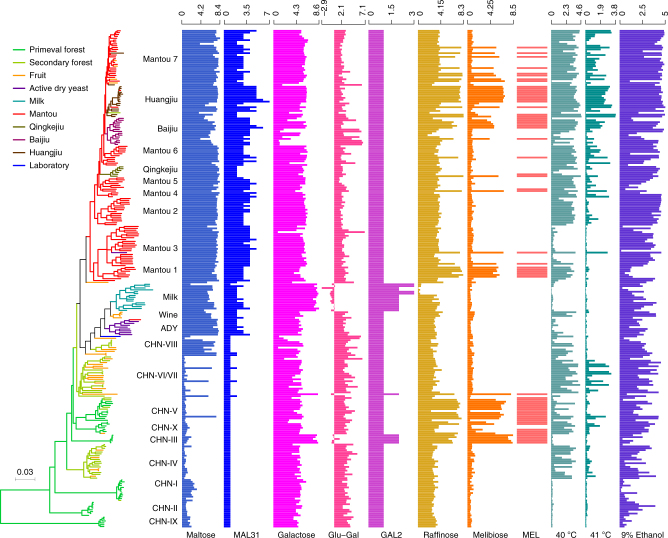
The yeast Saccharomyces cerevisiae has been an essential component of human civilization because of its long global history of use in food and beverage fermentation. However, the diversity and evolutionary history of the domesticated populations of the yeast remain elusive. We show here that China/Far East Asia is likely the center of origin of the domesticated populations of the species. The domesticated populations form two major groups associated with solid- and liquid-state fermentation and appear to have originated from heterozygous ancestors, which were likely formed by outcrossing between diverse wild isolates primitively for adaptation to maltose-rich niches. We found consistent gene expansion and contraction in the whole domesticated population, as well as lineage-specific genome variations leading to adaptation to different environments. We show a nearly panoramic view of the diversity and life history of S. cerevisiae and provide new insights into the origin and evolution of the species.
Overview
The claims and statistics of this paper haven’t been checked yet.
Run the check — free, no account needed. It reads the open-access text and checks the sources it cites.
Integrity signals
Registry
Cites
Statistics
Figures
Verification
Claims the paper makes
The claims and statistics of this paper haven’t been checked yet.
Run the check — free, no account needed. It reads the open-access text and checks the sources it cites.
Claims other papers make about this one
Each is checked against this paper’s own text: does it say what the citing paper says it does?
The cited source says what the claim attributes to it.
In the citing paper
“Our phylogeny (Figure 7C) comprised 424 strains and showed a stratification by food type and geography in accordance with literature. 21,116,120”
From Unexplored microbial diversity from 2,500 food metagenomes and links with the human microbiome. (2024) · cites this paper as [120]
Self-check
Percentages, sums and reported differences re-computed from the paper’s own numbers.
The self-check needs the paper’s full text.
Citations
Cites
Basic local alignment search tool
Altschul, S. F., Gish, W., Miller, W., Myers, E. W., & Lipman, D. J. (1990) · Journal of Molecular Biology · doi:10.1006/jmbi.1990.9999 · Cited by 98,669
Fast gapped-read alignment with Bowtie 2
Langmead, B., & Salzberg, S. L. (2012) · Nature Methods · doi:10.1038/nmeth.1923 · Cited by 56,400
MAFFT Multiple Sequence Alignment Software Version 7: Improvements in Performance and Usability
Katoh, K., & Standley, D. M. (2013) · Molecular Biology and Evolution · doi:10.1093/molbev/mst010 · Cited by 46,209
PLINK: a tool set for whole-genome association and population-based linkage analyses.
Purcell, S., Neale, B., Todd-Brown, K., Thomas, L., Ferreira, M. A. R., Bender, D., Maller, J., Sklar, P., de Bakker, P. I. W., Daly, M. J., et al. (2007) · The American Journal of Human Genetics · doi:10.1086/519795 · Cited by 34,089
RAxML version 8: a tool for phylogenetic analysis and post-analysis of large phylogenies
Stamatakis, A. (2014) · Bioinformatics · doi:10.1093/bioinformatics/btu033 · Cited by 32,291
The Genome Analysis Toolkit: A MapReduce framework for analyzing next-generation DNA sequencing data
McKenna, A., Hanna, M., Banks, E., Sivachenko, A., Cibulskis, K., Kernytsky, A., Garimella, K., Altshuler, D., Gabriel, S., Daly, M., et al. (2010) · Genome Research · doi:10.1101/gr.107524.110 · Cited by 27,895
Cingolani, P., Platts, A., Wang, L. L., Coon, M., Nguyen, T., Wang, L., Land, S. J., Lu, X., & Ruden, D. M. (2012) · Fly · doi:10.4161/fly.19695 · Cited by 11,816
Fast model-based estimation of ancestry in unrelated individuals
Alexander, D. H., Novembre, J., & Lange, K. (2009) · Genome Research · doi:10.1101/gr.094052.109 · Cited by 9,898
Velvet: Algorithms for de novo short read assembly using de Bruijn graphsPreprint
Zerbino, D. R., & Birney, E. (2008) · Genome Research · doi:10.1101/gr.074492.107 · Cited by 9,587
Walker, B. J., Abeel, T., Shea, T., Priest, M., Abouelliel, A., Sakthikumar, S., Cuomo, C. A., Zeng, Q., Wortman, J. R., Young, S., et al. (2014) · PLoS ONE · doi:10.1371/journal.pone.0112963 · Cited by 9,130
Research works printed but not linked: 1
- Naumov, G. I. & Nikonenko, P. E. The East Asia is a probable land of the cultured yeasts Saccharomyces cerevisiae (in Russia). Izv. Sib. Otd. Akad. Nauk SSSR Seriya Biol. Nauk 20, 97–101 (1988).
Cited by
Sorted by citations
Items 201–244 of 244
Watanabe, D., & Hashimoto, W. (2021) · Research Square · doi:10.21203/rs.3.rs-916454/v1 · Cited by 1
Martínez, A. A., Conboy, A., Buskirk, S. W., Marad, D. A., & Lang, G. I. (2022) · bioRxiv (Cold Spring Harbor Laboratory) · doi:10.1101/2022.05.17.492354 · Cited by 1
Dai, Y. L., Shi, G., Chen, M., Chen, G., & Wu, Q. (2022) · bioRxiv (Cold Spring Harbor Laboratory) · doi:10.1101/2022.07.07.499257 · Cited by 1
Aging like fine wine: Mischievous microbes and other factors influencing senescence
Kattner, A. A. (2024) · Biomedical Journal · doi:10.1016/j.bj.2024.100722 · Cited by 1
Footprints of human migration in the population structure of wild wine yeastPreprint
Peña, J. J., da Costa, E. S. F., Ward, A. K., & Bensasson, D. (2024) · bioRxiv (Cold Spring Harbor Laboratory) · doi:10.1101/2024.08.08.607167 · Cited by 1
McNeill, J., Brandt, N. J., Schwarzkopf, E. J., Jimenez, M., & Heil, C. S. (2024) · bioRxiv (Cold Spring Harbor Laboratory) · doi:10.1101/2024.08.28.610152 · Cited by 1
Genomic evidence of an early evolutionary divergence event in wild Saccharomyces cerevisiaePreprint
Bendixsen, D. P., Gettle, N., Gilchrist, C., Zhang, Z., & Stelkens, R. B. (2020) · bioRxiv (Cold Spring Harbor Laboratory) · doi:10.1101/2020.06.03.131607
The Exploration of Nanotoxicological Copper and Interspecific Saccharomyces Hybrids
Winans, M. J. (2020) · The Research Repository @ WVU (West Virginia University) · doi:10.33915/etd.7648
Global effects of ade8 deletion on budding yeast metabolismPreprint
Kokina, A., Tanilas, K., Ozoliņa, Z., Pleiko, K., Shvirksts, K., Vamža, I., & Liepiņš, J. (2021) · bioRxiv (Cold Spring Harbor Laboratory) · doi:10.1101/2021.03.15.435510
Improving cyanobacteria productivity: From theory to assay
Shabestary, K. (2020) · KTH Publication Database DiVA (KTH Royal Institute of Technology)
[A rare clinical form of Marek's Disease (cutaneous form) in ornamental fowl].
Palau-Ribes, F. M., Redmann, T., Hafez, M. H., Kershaw, O., & Lierz, M. (2011) · PubMed
Avaliação da interação entre leveduras isoladas de kombucha e bactérias probióticas
de Oliveira, Í. A. C. L. (2022) · Digital Library of Theses and Dissertations (Universidade de São Paulo) · doi:10.11606/d.9.2022.tde-24082022-161046
Ward, C. M., Onetto, C. A., Heuvel, S. V. D., Cuijvers, K. M., Hale, L. J., & Borneman, A. R. (2023) · bioRxiv (Cold Spring Harbor Laboratory) · doi:10.1101/2023.06.07.544145
"Saccharomyces Cerevisiae and Its Biotechnological Applications"
Al-Falih, A. M. (2021) · Environmental Analysis & Ecology Studies · doi:10.31031/eaes.2021.09.000706
Lukaszewicz, M., Salia, O. I., Hohenlohe, P. A., & Buzbas, E. O. (2024) · Journal of Computational Mathematics and Data Science · doi:10.1016/j.jcmds.2024.100091
Wong, R. W. K., Foo, M., Lay, J. R. S., Wai, T. L. T., Moore, J., Dutreux, F., Molzahn, C. M., Nislow, C., Measday, V., Schacherer, J., et al. (2024) · bioRxiv (Cold Spring Harbor Laboratory) · doi:10.1101/2024.08.26.609787
Iron-enriched Bread: Promoting Heme Production in Saccharomyces cerevisiae using HemQ
Tang, Z., Zhou, Q., & Liu, J. (2025) · Theoretical and Natural Science · doi:10.54254/2753-8818/2024.19990
Advancing Microbial Comparative Genomics Through Tumor-Normal Inspired FrameworkPreprint
Yang, J., & Yang, S. (2025) · bioRxiv (Cold Spring Harbor Laboratory) · doi:10.1101/2025.02.05.636605
Lee, J.-S., Kwon, D.-H., Kim, Y., Lee, S.-H., & Ha, S. (2025) · KSBB Journal · doi:10.7841/ksbbj.2025.40.2.149
Intraspecific Polymorphism of the Yeast Saccharomyces paradoxus: Geographic Populations
Боровкова, А. Н., Tuaeva, A. Y., & Naumova, E. S. (2025) · Microbiology · doi:10.1134/s0026261725601526
CYClones: a highly powered, fully genotyped, eight-parent yeast mapping population
Cromie, G. A., Lo, R. S., Morgan, T. S., Clark, A. E., Ashmead, J., Timour, M. S., Sirr, A., Akey, J. M., & Dudley, A. M. (2026) · G3 Genes Genomes Genetics · doi:10.1093/g3journal/jkag179
Wasp intestinal cues drive yeast toward outbreeding strategies
Abbà, S., Adair, L. D., Barbero, F., Casacci, L. P., Dukovski, I., Font-Verdera, F., Hawtrey, T. J., New, E. J., Nootem, J., Patawanich, P., et al. (2025) · The ISME Journal · doi:10.1093/ismejo/wraf243
Zhang, M.-Z., Xu, J., Callac, P., Chen, M., Wu, Q., Wach, M. P., Mata, G., & Zhao, R.-L. (2023) · Figshare · doi:10.6084/m9.figshare.22626115
Wong, R. W. K., Chandhok, S., Hui, E., & Mayor, T. (2025) · bioRxiv (Cold Spring Harbor Laboratory) · doi:10.64898/2025.12.22.696128
Evaluating Canadian yeast strains for novel new-make spirit applications
Marr, R. A., Cartes, P., Cook, B., & Measday, V. (2026) · FEMS Yeast Research · doi:10.1093/femsyr/foag005
Low-level contamination confounds population genomic analysis
Ward, A. K., da Costa, E. S. F., Shuman, B., Momany, M., & Bensasson, D. (2026) · G3 Genes Genomes Genetics · doi:10.1093/g3journal/jkag021
A postmeiotic route to polyploidyPreprint
Gómez-Muñoz, C., Vittorelli, N., Gaudin, M., Agier, N., Delmas, S., Corbeau, Y., Lagomarsino, M. C., Liti, G., Llorente, B., & Fischer, G. (2026) · bioRxiv (Cold Spring Harbor Laboratory) · doi:10.64898/2026.02.20.706944
D’Angiolo, M. (2021) · theses.fr (ABES) · doi:10.70675/b4a54c23z9d95z4c65zac44z6e1809fed4fe
Dissection of the phenotypic expressivity across a natural population
Caudal, É. (2021) · theses.fr (ABES) · doi:10.70675/ddd2243fz54e9z40b5zb946z3a970db3e679
Species-wide exploration of the complexity, expressivity, and missing heritability of traits
Tsouris, A. (2023) · theses.fr (ABES) · doi:10.70675/6c6263a5z766ez4788z8c6bz08583b39b0c6
Species-wide survey of transcript and protein abundance variation in yeast
Teyssonnière, É. (2023) · theses.fr (ABES) · doi:10.70675/9c5f617cz3bcfz4064z9e8eza0b9f5bca082
Improved identification of Saccharomyces species and hybrids using MALDI-TOF MS
Wang, J.-C., Zhang, X.-H., Shang, Y., & Wang, Q.-M. (2026) · Food Microbiology · doi:10.1016/j.fm.2026.105132
Self-citationInsights from sourdough redefine the domestication landscape of baker’s yeastPreprint
Ruffieux, M., Brandt, N. J., Gutierrez, A., Wolfe, B. E., Dunn, R. R., & Heil, C. S. (2026) · bioRxiv (Cold Spring Harbor Laboratory) · doi:10.64898/2026.04.29.721752
Pandey, A., Murugaiyan, V., Ali, J., Koirala, A., Shrestha, U., Asis, E. J. D., Galang, A. L. A., Robiso, C. J., Mauleon, R., & Frei, M. (2026) · Journal of Hazardous Materials · doi:10.1016/j.jhazmat.2026.142656
Moore, J., Marr, R. A., Montpetit, R., Montpetit, B., & Measday, V. (2026) · Genome Biology and Evolution · doi:10.1093/gbe/evag149
Wine production and varieties: Red, white, and beyond
Rivas, G. A. (2026) · Elsevier eBooks · doi:10.1016/b978-0-443-29192-0.00053-4
Ma, R., Wang, H., Wei, Y., Sun, Y., Xue, J., Qin, Y., Tao, S., & Liu, Y. (2026) · Stress Biology · doi:10.1007/s44154-026-00319-z
Genomic Evidence of Early-Diverging Domesticated Lineages in Norwegian Farmhouse Yeast
Dondrup, M., Martinussen, A. O., Haugland, L. K., Brandenburg, J., Inanli, O., Elameen, A., Dolan, D., Grellscheid, S. N., Hagen, S. B., Schroeder, H., et al. (2026) · Genome Biology and Evolution · doi:10.1093/gbe/evag220
Restriction Factor Control of Ty1 Family LTR-Retrotransposons in Saccharomyces cerevisiae
Beckwith, S. L., & Streeter, M. J. S. (2026) · Viruses · doi:10.3390/v18101154
FAIRsharing Team, Yue, J., & Yue, J. (2025) · FAIRsharing.org · doi:10.25504/fairsharing.ad40a6
COpy Number Variant quantifICation Tool v3.1
Shropshire, W. C., Lermi, N. O., Hanson, B., & Karras, G. I. (2024) · Zenodo (CERN European Organization for Nuclear Research) · doi:10.5281/zenodo.10871209
Metadata
- Authors
- Duan, S.-F., Han, P.-J., Wang, Q.-M., Liu, W.-Q., Shi, J.-Y., Li, K., Zhang, X.-L., & Bai, F.-Y.
- Affiliations
- Chinese Academy of Sciences (CN)
- Corresponding author
- Bai, Feng-Yan
- Venue
- Nature Communications
- Published
- 2018-07-12
- Volume
- 9
- Issue
- 1
- Pages
- 2690-2690
- ISSN
- 2041-1723 (ISSN-L)
- PMC
- PMC6043522
- OpenAlex
- W2812634658
- Cited by
- 244
- References
- 79
- Citations by year
- 2026: 23 · 2025: 26 · 2024: 38 · 2023: 25 · 2022: 34 · 2021: 35 · 2020: 32 · 2019: 27 · 2018: 3
- FWCI
- 8.63
- Type
- journal article
- Language
- en
- Open access
- gold
- doi.org
- Locations
- Nature Communications (publishedVersion, cc-by)
- Europe PMC (PubMed Central) (publishedVersion, other-oa)
- PubMed Central (publishedVersion, cc-by)
- PubMed (publishedVersion)
- RePEc: Research Papers in Economics (submittedVersion)
- DOAJ (DOAJ: Directory of Open Access Journals) (submittedVersion, cc-by-sa)
- DOAJ (DOAJ: Directory of Open Access Journals) (submittedVersion)
- Funders
- National Natural Science Foundation of China (31470150, 91131004, 31461143027)
- Chinese Academy of Sciences (QYZDJ-SSW-SWC013)
- Topics
- Life Sciences › Immunology and Microbiology › Microbiology › Yeasts and Rust Fungi Studies
- Life Sciences › Biochemistry, Genetics and Molecular Biology › Molecular Biology › Fungal and yeast genetics research
- Life Sciences › Biochemistry, Genetics and Molecular Biology › Genetics › Genetic diversity and population structure
- Keywords
- Saccharomyces cerevisiae, domestication, center of origin, adaptive evolution, solid-state fermentation, liquid fermentation, outcrossing, yeast diversity, Far East Asia
- MeSH terms
- Adaptation, Physiological, Asia, Asia, Eastern, Fermentation, Genetics, Population, Phylogeny, Saccharomyces cerevisiae, Genetic Variation, Genome, Fungal, Evolution, Molecular
About these checks
Registry, retraction, Cites and statistics results are computed, not judged, with one exception: a printed reference that no index lists is read once by a model before it counts as a citation error. Claims are extracted by a model and kept only when their quote appears verbatim in the text; each cited source is then checked, with a model’s help, for whether it says what the claim relies on. Those verdicts can be wrong — read the claim’s quote and the cited source before relying on one.
Statistics and arithmetic are recomputed, not judged.
Confidence bands are shown only for fields calibrated on our annotated test set. None is calibrated yet, so no band is shown.
What counts as a claim ›How we measure confidence ›How we check this ›
Are you an author, or do you see a problem with this page? Request a review
