

Precardiac organoids form two heart fields via Bmp/Wnt signaling
Open accessThe DOI matches its Crossref record; 70 of the 72 references it cites were found in a registry or an index.
Abstract
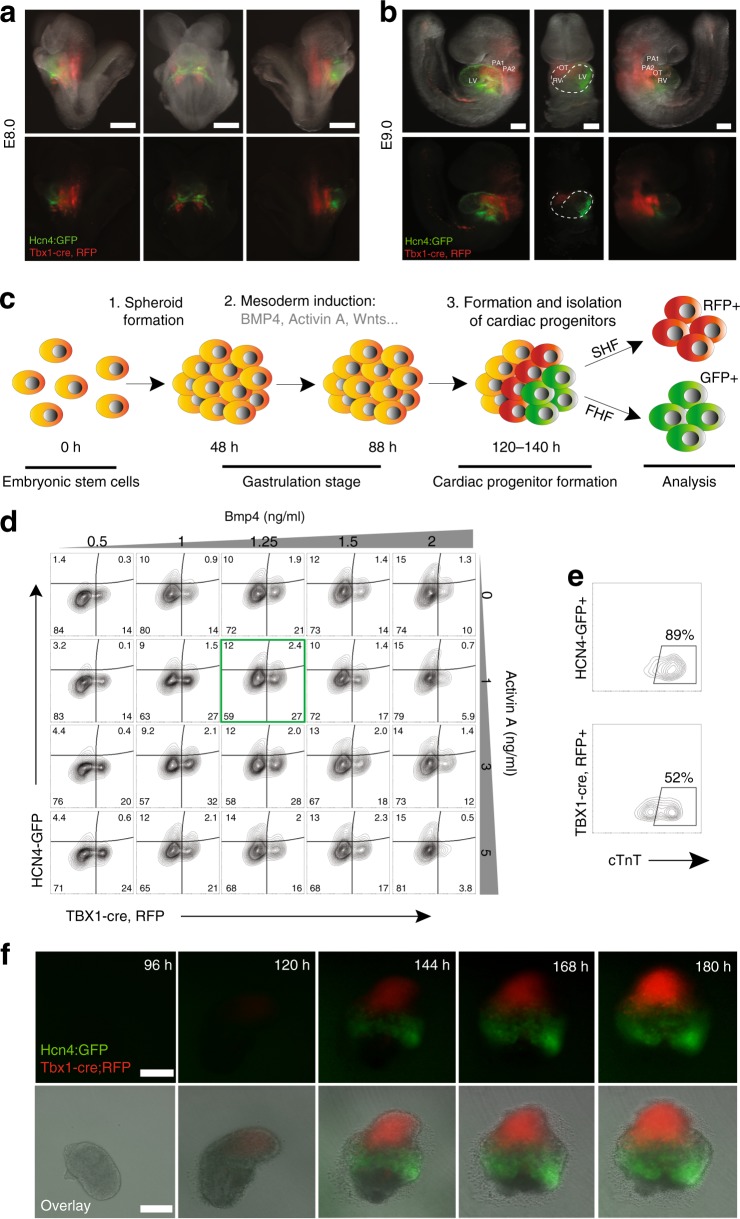
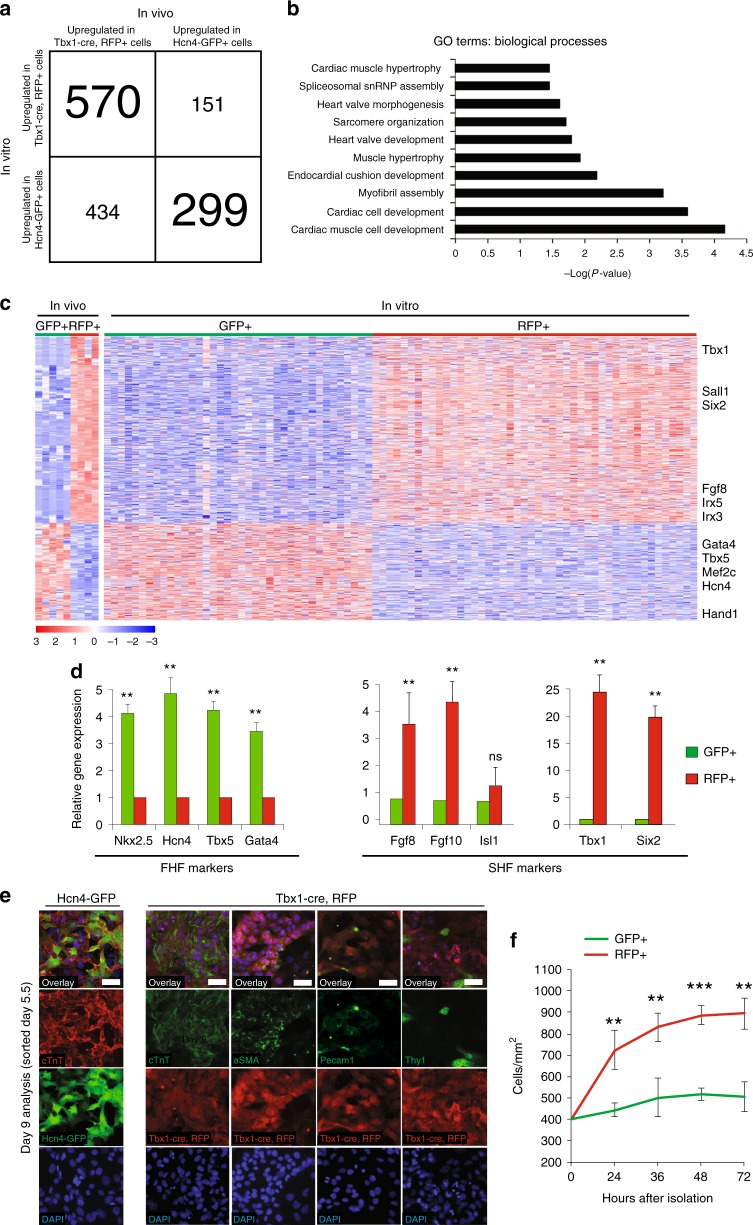
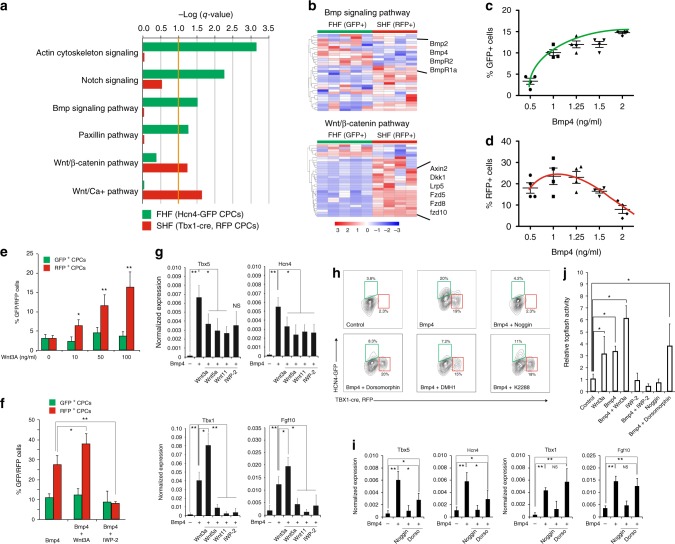
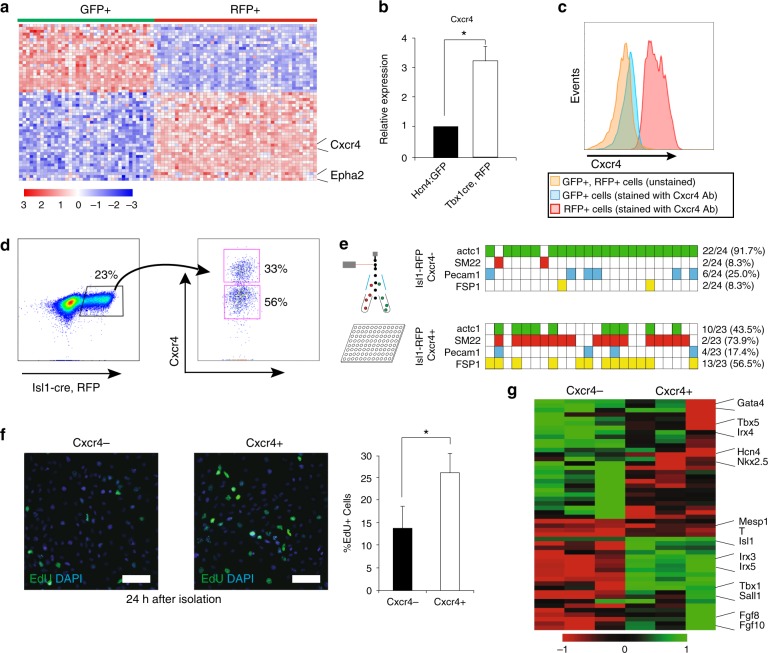
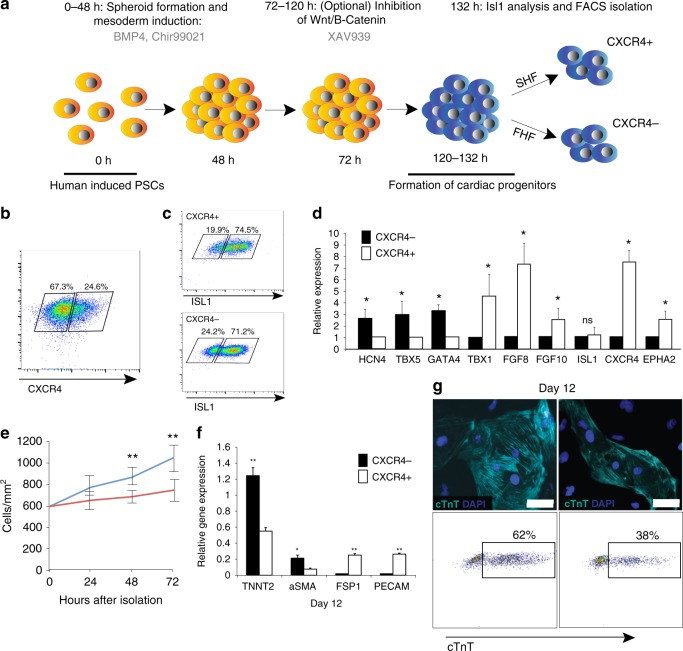
The discovery of the first heart field (FHF) and the second heart field (SHF) led us to understand how cardiac lineages and structures arise during development. However, it remains unknown how they are specified. Here, we generate precardiac spheroids with pluripotent stem cells (PSCs) harboring GFP/RFP reporters under the control of FHF/SHF markers, respectively. GFP+ cells and RFP+ cells appear from two distinct areas and develop in a complementary fashion. Transcriptome analysis shows a high degree of similarities with embryonic FHF/SHF cells. Bmp and Wnt are among the most differentially regulated pathways, and gain- and loss-of-function studies reveal that Bmp specifies GFP+ cells and RFP+ cells via the Bmp/Smad pathway and Wnt signaling, respectively. FHF/SHF cells can be isolated without reporters by the surface protein Cxcr4. This study provides novel insights into understanding the specification of two cardiac origins, which can be leveraged for PSC-based modeling of heart field/chamber-specific disease.
Overview
The claims and statistics of this paper haven’t been checked yet.
Free: it reads the open-access text and checks the first 5 claims that cite a source we can check. Create a free account to check every claim.
Integrity signals
Registry
Cites
Statistics
Figures
Verification
Claims the paper makes
The claims and statistics of this paper haven’t been checked yet.
Free: it reads the open-access text and checks the first 5 claims that cite a source we can check. Create a free account to check every claim.
Claims other papers make about this one
Each is checked against this paper’s own text: does it say what the citing paper says it does?
The source backs part of the claim, not all of it — or backs it for a different population, condition or comparison.
In the citing paper
“The growth factors bone morphogenetic protein 4 (BMP4) and Activin A have frequently been used as alternatives to small molecule-mediated Wnt signaling manipulation, since they are the endogenous morphogens that pattern the early embryonic cardiogenic mesoderm and determine heart field specification in vivo16,39–41.”
From Self-assembling human heart organoids for the modeling of cardiac development and congenital heart disease (2021) · cites this paper as [16]
Experimental — accuracy not yet measuredThe cited source says what the claim attributes to it.
In the citing paper
“These results suggest improved structural organization in the developing organoids under BMP4/ActA, in agreement with previously reported differentiation methods using BMP4 and Activin A alone16.”
From Self-assembling human heart organoids for the modeling of cardiac development and congenital heart disease (2021) · cites this paper as [16]
In the citing paper
“Recently, mouse embryonic stem cells (ESCs) were used to generate precardiac organoids showing distinct heart field specifications16, cardiac crescent-like structures juxtaposed with primitive gut tube17, and atrial and ventricular cardiomyocyte lineages18.”
From Self-assembling human heart organoids for the modeling of cardiac development and congenital heart disease (2021) · cites this paper as [16]
In the citing paper
“Recently, gradient exposures to specific concentrations of BMP4 and Activin A have been studied in the specification of first and second heart field formation16.”
From Self-assembling human heart organoids for the modeling of cardiac development and congenital heart disease (2021) · cites this paper as [16]
Self-check
Percentages, sums and reported differences re-computed from the paper’s own numbers.
The self-check needs the paper’s full text.
Citations
Cites
Trimmomatic: a flexible trimmer for Illumina sequence data
Bolger, A. M., Lohse, M., & Usadel, B. (2014) · Bioinformatics · doi:10.1093/bioinformatics/btu170 · Cited by 65,548
featureCounts: an efficient general purpose program for assigning sequence reads to genomic features
Liao, Y., Smyth, G. K., & Shi, W. (2014) · Bioinformatics · doi:10.1093/bioinformatics/btt656 · Cited by 27,219
HISAT: a fast spliced aligner with low memory requirements
Kim, D., Langmead, B., & Salzberg, S. L. (2015) · Nature Methods · doi:10.1038/nmeth.3317 · Cited by 24,112
HTSeq—a Python framework to work with high-throughput sequencing data
Anders, S., Pyl, P. T., & Huber, W. (2015) · Bioinformatics · doi:10.1093/bioinformatics/btu638 · Cited by 21,464
Induction of Pluripotent Stem Cells from Adult Human Fibroblasts by Defined Factors
Takahashi, K., Tanabe, K., Ohnuki, M., Narita, M., Ichisaka, T., Tomoda, K., & Yamanaka, S. (2007) · Cell · doi:10.1016/j.cell.2007.11.019 · Cited by 20,221
Causal analysis approaches in Ingenuity Pathway Analysis
Krämer, A., Green, J., Pollard, J., & Tugendreich, S. (2014) · Bioinformatics · doi:10.1093/bioinformatics/btt703 · Cited by 5,724
Cre reporter strains produced by targeted insertion of EYFP and ECFP into the ROSA26 locus
Srinivas, S., Watanabe, T., Lin, C.-S., William, C. M., Tanabe, Y., Jessell, T. M., & Costantini, F. (2001) · BMC Developmental Biology · doi:10.1186/1471-213x-1-4 · Cited by 3,121
Large-scale gene function analysis with the PANTHER classification system
Mi, H., Muruganujan, A., Casagrande, J. T., & Thomas, P. D. (2013) · Nature Protocols · doi:10.1038/nprot.2013.092 · Cited by 2,466
Direct reprogramming of fibroblasts into functional cardiomyocytes by defined factors
Ieda, M., Fu, J.-D., Delgado-Olguin, P., Vedantham, V., Hayashi, Y., Bruneau, B. G., & Srivastava, D. (2010) · Cell · doi:10.1016/j.cell.2010.07.002 · Cited by 2,454
Mi, H., Huang, X., Muruganujan, A., Tang, H., Mills, C., Kang, D., & Thomas, P. D. (2017) · Nucleic Acids Research · doi:10.1093/nar/gkw1138 · Cited by 1,874
Cited by
Items 101–137 of 137
Machado, R. S. R., Sachinidis, A., & Futschik, M. E. (2021) · Cells · doi:10.3390/cells10092477 · Cited by 2
“Tgf-β is an important regulator of a wide range of cellular responses during cell differentiation [44], while BMP and WNT signalling pathways contribute, for instance, to specification of the first and second heart field progenitors [45].”
BackgroundAnalysing Genetic Programs of Cell Differentiation to Study Cardiac Cell Diversification
Wu, Z., Shen, S., Sun, Y., Werner, T., Bradford, S. T., & Palpant, N. J. (2022) · Springer eBooks · doi:10.1007/978-3-030-86140-7_8 · Cited by 1
Uncovering the origins and lineage markers of human heart fields
Miyamoto, M., & Kwon, C. (2022) · Cell stem cell · doi:10.1016/j.stem.2022.08.004 · Cited by 3
Self-citationMultidimensional assembly using layer-by-layer deposition for synchronized cardiac macro tissues
Jang, Y., Jung, D. J., Choi, S., Lim, D., Kim, J., Jeong, G. S., Kim, J., & Park, Y. (2020) · RSC Advances · doi:10.1039/d0ra01577f · Cited by 2
Mechanisms and Therapeutic Potential of Human Cardiomyocyte Proliferation
McLane, R. D., Cheruku, A., Williams, A. B., & Karra, R. (2026) · Journal of Cardiovascular Development and Disease · doi:10.3390/jcdd13020074 · Cited by 2
“Iterations that alter the timing and sequence of Wnt modulation, along with the incorporation of additional growth factors, have resulted in organoids with varying amounts of cellular diversity and structural complexity [79,81–83].”
Life-span–dependent transcriptional dynamics of the human heart
Jia, H., Chen, X., Chang, Y., Wang, Y., Lindberg, E. L., Cui, H., Feng, Y., Zhang, N., Zhang, X., Xu, M., et al. (2026) · Science Advances · doi:10.1126/sciadv.aeg2614 · Cited by 2
“In addition, structural and functional differences between the left (LV) and right ventricles (RV) influence development trajectories and stress responses during aging ( 11 , 12 ).”
What’s in a niche? Elucidating the role of the ECM in cell fate commitment
Amel, A., & Alemany, A. (2026) · Current Opinion in Genetics & Development · doi:10.1016/j.gde.2026.102528 · Cited by 1
Chang, X., Gu, M., & Tchieu, J. H. (2022) · Cells · doi:10.3390/cells11030460 · Cited by 1
Liu, Z., Lami, B., Ikonomou, L., & Gu, M. (2023) · Seminars in Perinatology · doi:10.1016/j.semperi.2023.151729 · Cited by 1
Cardiac Progenitor Cells of the First and Second Heart Fields
BUCKINGHAM, M. E., & Kelly, R. G. (2024) · Advances in experimental medicine and biology · doi:10.1007/978-3-031-44087-8_5 · Cited by 1
“For example, the independent emergence of complementary FHF and SHF progenitor populations was followed using fluorescent reporter genes under the control of Tbx1 and Hcn4 regulatory elements in a precardiac organoid model, identifying Cxcr4 as a marker of SHF cells (77).”
In Vitro Models of Cardiovascular Disease: Embryoid Bodies, Organoids and Everything in Between
Stougiannou, T. M., Christodoulou, K. C., & Karangelis, D. (2024) · Biomedicines · doi:10.3390/biomedicines12122714 · Cited by 1
“In addition, Isl1 is often used as a marker for SHF groups [90].”
InfluentialCardiac Outflow tract septation defects in a DiGeorge syndrome model respond to Minoxidil treatmentPreprint
Aurigemma, I., Ferrentino, R., Krishnan, V. P., Lanzetta, O., Angelini, C., Illingworth, E. A., & Baldini, A. (2024) · bioRxiv (Cold Spring Harbor Laboratory) · doi:10.1101/2024.03.18.585569 · Cited by 1
“We used the protocol published by Andersen et al. (2018) with minor modifications because it induces robust expression of the Tbx1 gene at day 6 (d6) of differentiation (Andersen et al., 2018).”
MethodDerivation of cardiomyocyte-propelled motile aggregates from stem cellsPreprint
Ho, C., Glykofrydis, F., Godage, G., Poon, K., Kunnan, M., Swedlund, B., Murillo, S., & Morsut, L. (2025) · bioRxiv (Cold Spring Harbor Laboratory) · doi:10.1101/2025.07.09.663178 · Cited by 1
Yan, Y., Liu, F., Hou, X., Wan, J., Xiong, Q., Zhou, R., & Liao, B. (2020) · PubMed · doi:10.7507/1002-1892.201912087
Tissues & Organs | Biochemistry of Development: Striated Muscle
Chemello, F., Olson, E. N., & Bassel‐Duby, R. (2021) · Elsevier eBooks · doi:10.1016/b978-0-12-819460-7.00090-6
Formation of the Heart and Progenitor Cells
Kokubo, H. (2022) · Japanese Society of Pediatric Cardiology and Cardiac Surgery · doi:10.9794/jspccs.38.75
Human Stem Cell-Derived Cardiac Organoid-Like Structures: Generation and Applications
Giraud, M., Ahmed, S., & Ullrich, N. D. (2023) · Springer eBooks · doi:10.1007/978-981-99-0722-9_15
Pharmacologically inducing regenerative cardiac cells by small molecule drugsPreprint
Zhou, W. X., He, K., Wang, C., Wang, P., Wang, D., Wang, B., Geng, H., Lian, H., Ma, T., Nie, Y., et al. (2024) · eLife · doi:10.7554/elife.93405.1
Molecular directors: non-coding RNA and extracellular vehicle in right ventricle remodeling
Kocken, J. M. M. (2024) · Research Publications (Maastricht University) · doi:10.26481/dis.20240516jk · Cited by 1
Pharmacologically inducing regenerative cardiac cells by small molecule drugsPreprint
Zhou, W. X., He, K., Wang, C., Wang, P., Wang, D., Wang, B., Geng, H., Lian, H., Ma, T., Nie, Y., et al. (2024) · eLife · doi:10.7554/elife.93405.2
Mesendodermal cells fail to contribute to heart formation following blastocyst injection
Li, B., & Kwon, C. (2025) · Biochemistry and Biophysics Reports · doi:10.1016/j.bbrep.2025.102120
“TGFP + MECs were induced through mesoderm differentiation as done previously [15,16].”
Self-citationTaghiyev, Z. T., Arneth, B. M., Altrawy, A., Mohamed, R., Ghazy, A., Hamdy, D., & Sabit, H. (2025) · Elsevier eBooks · doi:10.1016/b978-0-443-29890-5.00001-4
Mechanisms of specific lncRNA function in early cardiac lineage development
Lin, Y. (2024) · Publication Server of Goethe University Frankfurt am Main (Goethe University Frankfurt) · doi:10.21248/gups.92107
Guo, H., Hang, C., Lin, B., Lin, Z., Xiong, H., Zhang, M., Lu, R., Liu, J., Shi, D., Xie, D., et al. (2024) · Figshare · doi:10.6084/m9.figshare.26677310
Guo, H., Hang, C., Lin, B., Lin, Z., Xiong, H., Zhang, M., Lu, R., Liu, J., Shi, D., Xie, D., et al. (2024) · Figshare · doi:10.6084/m9.figshare.26677307
Guo, H., Hang, C., Lin, B., Lin, Z., Xiong, H., Zhang, M., Lu, R., Liu, J., Shi, D., Xie, D., et al. (2024) · Figshare · doi:10.6084/m9.figshare.26677313
Guo, H., Hang, C., Lin, B., Lin, Z., Xiong, H., Zhang, M., Lu, R., Liu, J., Shi, D., Xie, D., et al. (2024) · Figshare · doi:10.6084/m9.figshare.26677298
Guo, H., Hang, C., Lin, B., Lin, Z., Xiong, H., Zhang, M., Lu, R., Liu, J., Shi, D., Xie, D., et al. (2024) · Figshare · doi:10.6084/m9.figshare.26677304
Guo, H., Hang, C., Lin, B., Lin, Z., Xiong, H., Zhang, M., Lu, R., Liu, J., Shi, D., Xie, D., et al. (2024) · Figshare · doi:10.6084/m9.figshare.26677295
Guo, H., Hang, C., Lin, B., Lin, Z., Xiong, H., Zhang, M., Lu, R., Liu, J., Shi, D., Xie, D., et al. (2024) · Figshare · doi:10.6084/m9.figshare.26677301
Chanthra, N., Murphy, S. A., Miyamoto, M., Masuyama, N., Yachie, N., Kwon, C., & Uosaki, H. (2026) · Frontiers in Bioengineering and Biotechnology · doi:10.3389/fbioe.2026.1717996
Self-citationO’Hern, C., Dionise, M., Caywood, S., Sewavi, M.-L., Basrai, H. F., Muniyandi, P., Volmert, B. D., Kostina, A. S., Huang, A., Chalfoun, N. T., et al. (2026) · STAR Protocols · doi:10.1016/j.xpro.2026.104411
Investigating trapezius muscle development in the mouse embryo
Dumas, C. E. (2024) · theses.fr (ABES) · doi:10.70675/7f4ad2ffz52d7z4914za677zae17c215ff98
Yang, H., Zeng, Y., Teng, Y., Zhao, Q., Hou, M., Cheng, Z., & Wang, X. Y. (2026) · Stem Cell Research & Therapy · doi:10.1186/s13287-026-04996-5 · Cited by 1
“This indicates that FHF specification is driven by the BMP/SMAD pathway, whereas SHF specification relies on a non-SMAD-dependent BMP-Wnt signaling cascade [86].”
Song, Y., Li, Y., Mai Nhu, Y., Liu, H., Hong, A., Jain, E., Yang, H., Wang, X. W., & Ma, Z. (2026) · ACS Applied Bio Materials · doi:10.1021/acsabm.6c00364
Son, B., Park, G. Y., Jeong, I., Kim, H., Lee, J., Joo, J., Lee, W., & Park, H. H. (2026) · Materials Today Bio · doi:10.1016/j.mtbio.2026.103529
“By incorporating reprogramming factors into organoid culture systems, researchers can investigate the influence of tissue-specific cues on the efficiency and fidelity of cardiac reprogramming [183,184].”
Vascularized Organoids for Modeling Cardiovascular Diseases: Advances and Challenges
Xiang, H., Yang, Y., & Li, P. (2026) · Organoids · doi:10.3390/organoids5040037
Metadata
- Authors
- Andersen, P., Tampakakis, E., Jimenez, D. V., Kannan, S., Miyamoto, M., Shin, H. K., Saberi, A., Murphy, S., Sulistio, E., Chelko, S. P., & Kwon, C.
- Affiliations
- Johns Hopkins University (US)
- Corresponding author
- Andersen, Peter
- Kwon, Chulan
- ORCID
- Venue
- Nature Communications
- Published
- 2018-08-07
- Volume
- 9
- Issue
- 1
- Pages
- 3140-3140
- ISSN
- 2041-1723 (ISSN-L)
- PMC
- PMC6081372
- OpenAlex
- W2886183186
- Cited by
- 132
- References
- 72
- Citations by year
- 2026: 10 · 2025: 11 · 2024: 20 · 2023: 17 · 2022: 18 · 2021: 29 · 2020: 14 · 2019: 13
- FWCI
- 4.98
- Type
- journal article
- Language
- en
- Open access
- gold
- doi.org
- Licence
- cc-by
- creativecommons.org/licenses/by/4.0 (tdm)
- creativecommons.org/licenses/by/4.0 (vor)
- Locations
- Nature Communications (publishedVersion, cc-by)
- Europe PMC (PubMed Central) (publishedVersion, cc-by)
- PubMed Central (publishedVersion, cc-by)
- PubMed (publishedVersion)
- RePEc: Research Papers in Economics (submittedVersion)
- DOAJ (DOAJ: Directory of Open Access Journals) (submittedVersion, cc-by-sa)
- DOAJ (DOAJ: Directory of Open Access Journals) (submittedVersion)
- Funders
- U.S. Department of Health and Human Services (R01HL111198, R01HD086026)
- American Heart Association (18EIA33890038)
- Heart Rhythm Society
- Johns Hopkins University
- Mirowski Family Foundation
- St. Jude Medical
- National Heart, Lung, and Blood Institute (R01HL111198)
- National Institute of General Medical Sciences (T32GM007309)
- Eunice Kennedy Shriver National Institute of Child Health and Human Development (R01HD086026)
- Topics
- Life Sciences › Biochemistry, Genetics and Molecular Biology › Molecular Biology › Congenital heart defects research
- Life Sciences › Biochemistry, Genetics and Molecular Biology › Molecular Biology › Pluripotent Stem Cells Research
- Life Sciences › Biochemistry, Genetics and Molecular Biology › Molecular Biology › Developmental Biology and Gene Regulation
- Keywords
- heart field, second heart field, first heart field, cardiac specification, BMP signaling, Wnt signaling, Smad signaling, pluripotent stem cells, CXCR4, heart development
- MeSH terms
- Animals, Cell Differentiation, Cell Separation, Crosses, Genetic, Flow Cytometry, Heart, Humans, Myocardium, Organoids, Time Factors, Gene Library, Sequence Analysis, RNA, Gene Expression Regulation, Developmental, Cell Lineage, Bone Morphogenetic Proteins, Receptors, CXCR4, RNA, Small Interfering, Pluripotent Stem Cells, Green Fluorescent Proteins, Mice, Induced Pluripotent Stem Cells, Transcriptome, Wnt Signaling Pathway
About these checks
Registry, retraction, Cites and statistics results are computed, not judged, with one exception: a printed reference that no index lists is read once by a model before it counts as a citation error. Claims are extracted by a model and kept only when their quote appears verbatim in the text; each cited source is then checked, with a model’s help, for whether it says what the claim relies on. Those verdicts can be wrong — read the claim’s quote and the cited source before relying on one.
Statistics and arithmetic are recomputed, not judged.
Confidence bands are shown only for fields calibrated on our annotated test set. None is calibrated yet, so no band is shown.
What counts as a claim ›How we measure confidence ›How we check this ›
Are you an author, or do you see a problem with this page? Request a review
Data sources
Bibliographic data: Semantic Scholar, OpenAlex, Crossref.
Contains information from the Semantic Scholar Academic Graph Datasets, made available under the ODC Attribution License (ODC-BY 1.0).
Semantic Scholar’s data is described in: Kinney, R., et al. (2023). The Semantic Scholar Open Data Platform. arXiv:2301.10140.
