

The DOI matches its Crossref record; 45 of the 45 references it cites were found in a registry or an index.
Conditional control of fluorescent protein degradation by an auxin-dependent nanobody
Open accessPublished version of a preprint
Abstract
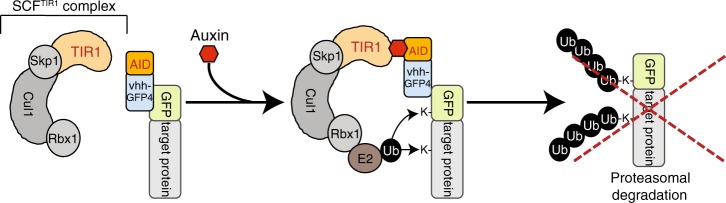
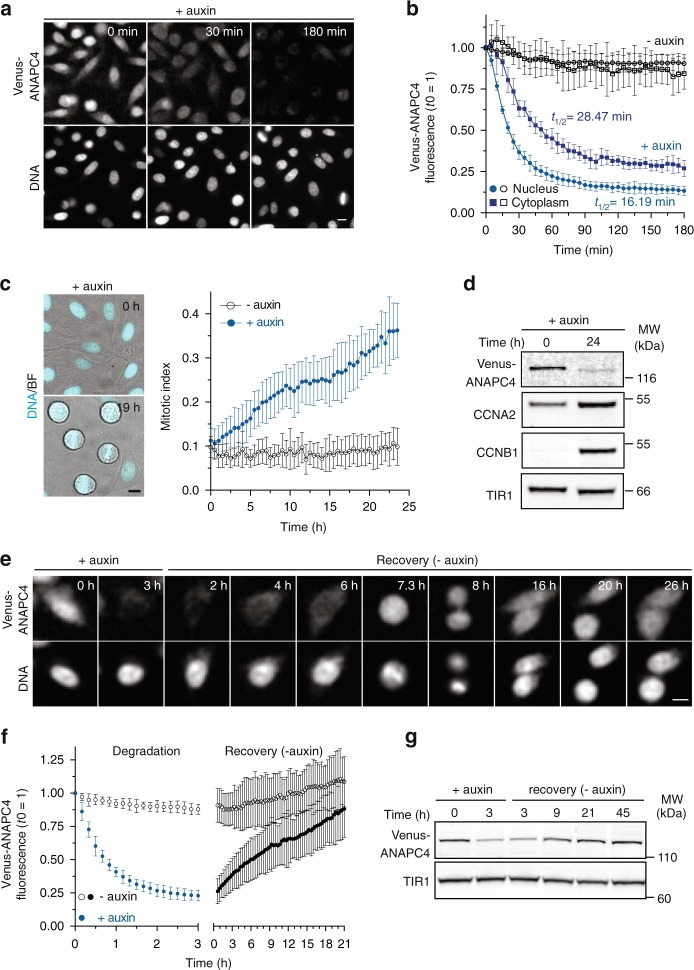
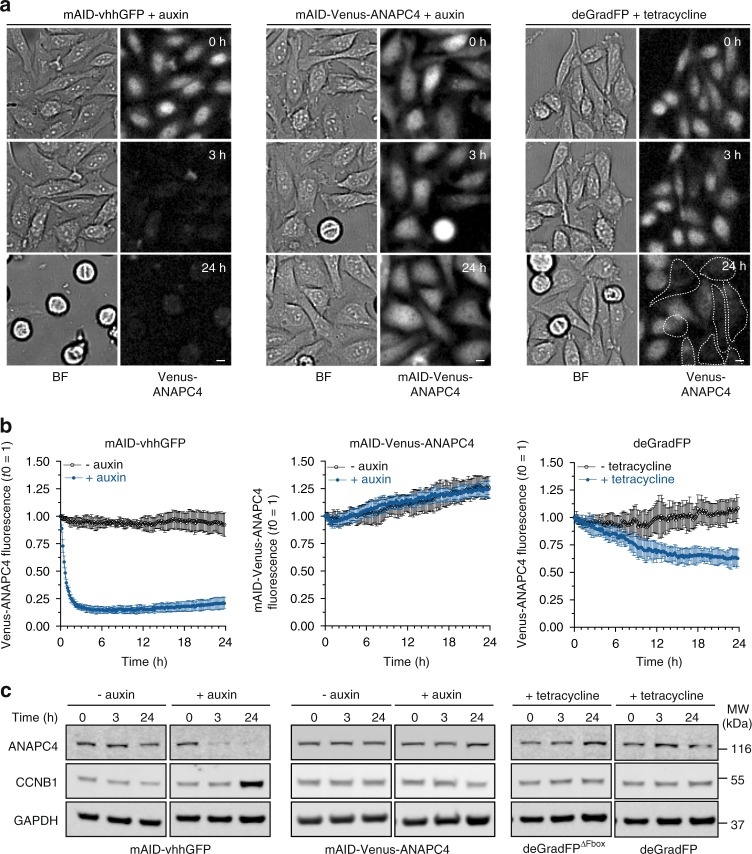
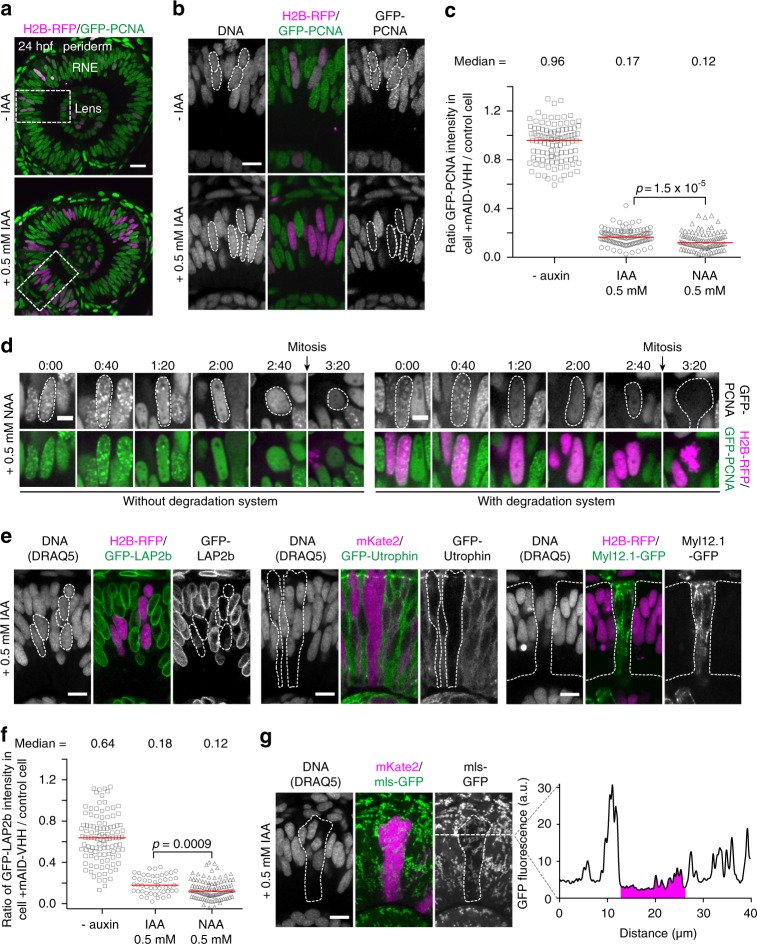
The conditional and reversible depletion of proteins by auxin-mediated degradation is a powerful tool to investigate protein functions in cells and whole organisms. However, its wider applications require fusing the auxin-inducible degron (AID) to individual target proteins. Thus, establishing the auxin system for multiple proteins can be challenging. Another approach for directed protein degradation are anti-GFP nanobodies, which can be applied to GFP stock collections that are readily available in different experimental models. Here, we combine the advantages of auxin and nanobody-based degradation technologies creating an AID-nanobody to degrade GFP-tagged proteins at different cellular structures in a conditional and reversible manner in human cells. We demonstrate efficient and reversible inactivation of the anaphase promoting complex/cyclosome (APC/C) and thus provide new means to study the functions of this essential ubiquitin E3 ligase. Further, we establish auxin degradation in a vertebrate model organism by employing AID-nanobodies in zebrafish.
Overview
The claims and statistics of this paper haven’t been checked yet.
Run the check — free, no account needed. It reads the open-access text and checks the sources it cites.
Integrity signals
Registry
Cites
Statistics
Figures
Verification
Claims the paper makes
The claims and statistics of this paper haven’t been checked yet.
Run the check — free, no account needed. It reads the open-access text and checks the sources it cites.
Claims other papers make about this one
Each is checked against this paper’s own text: does it say what the citing paper says it does?
In the citing paper
“In this case, endogenously GFP-tagged proteins in both human cells and zebrafish could be degraded in an auxin-inducible manner, when co-expressing the AID–anti-GFP nanobody fusion as well as TIR1 [29].”
From Advances in targeted degradation of endogenous proteins (2019) · cites this paper as [29]
Self-check
Percentages, sums and reported differences re-computed from the paper’s own numbers.
The self-check needs the paper’s full text.
Citations
Cites
Fiji: an open-source platform for biological-image analysis
Schindelin, J., Arganda-Carreras, I., Frise, E., Kaynig, V., Longair, M., Pietzsch, T., Preibisch, S., Rueden, C., Saalfeld, S., Schmid, B., et al. (2012) · Nature Methods · doi:10.1038/nmeth.2019 · Cited by 66,890
Sakamoto, K. M., Kim, K. B., Kumagai, A., Mercurio, F., Crews, C. M., & Deshaies, R. J. (2001) · Proceedings of the National Academy of Sciences · doi:10.1073/pnas.141230798 · Cited by 2,609
The Tol2kit: A multisite gateway‐based construction kit for Tol2 transposon transgenesis constructs
Kwan, K. M., Fujimoto, E., Grabher, C., Mangum, B. D., Hardy, M., Campbell, D. S., Parant, J. M., Yost, H. J., Kanki, J. P., & Chien, C.-B. (2007) · Developmental Dynamics · doi:10.1002/dvdy.21343 · Cited by 1,768
An auxin-based degron system for the rapid depletion of proteins in nonplant cells
Nishimura, K., Fukagawa, T., Takisawa, H., Kakimoto, T., & Kanemaki, M. (2009) · Nature Methods · doi:10.1038/nmeth.1401 · Cited by 1,663
Morin, X., Daneman, R., Zavortink, M., & Chia, W. N. (2001) · Proceedings of the National Academy of Sciences · doi:10.1073/pnas.261408198 · Cited by 775
Targeting and tracing antigens in live cells with fluorescent nanobodies
Rothbauer, U., Zolghadr, K., Tillib, S. V., Nowak, D., Schermelleh, L., Gahl, A., Backmann, N., Conrath, K., Muyldermans, S., Cardoso, M. C., et al. (2006) · Nature Methods · doi:10.1038/nmeth953 · Cited by 715
Rapid protein depletion in human cells by auxin-inducible degron tagging with short homology donors
Natsume, T., Kiyomitsu, T., Saga, Y., & Kanemaki, M. T. (2016) · Cell Reports · doi:10.1016/j.celrep.2016.03.001 · Cited by 673
Aurora B-Mediated Abscission Checkpoint Protects against Tetraploidization
Steigemann, P., Wurzenberger, C., Schmitz, M. H. A., Held, M., Guizetti, J., Maar, S., & Gerlich, D. W. (2009) · Cell · doi:10.1016/j.cell.2008.12.020 · Cited by 638
Adhesion Functions in Cell Sorting by Mechanically Coupling the Cortices of Adhering Cells
Maître, J., Berthoumieux, H., Krens, G., Salbreux, G., Jülicher, F., Paluch, E. K., & Heisenberg, C. (2012) · Science · doi:10.1126/science.1225399 · Cited by 624
BAC TransgeneOmics: a high-throughput method for exploration of protein function in mammals
Poser, I., Sarov, M., Hutchins, J. R. A., Hèriché, J.-K., Toyoda, Y., Pozniakovsky, A., Weigl, D., Nitzsche, A., Hegemann, B., Bird, A. W., et al. (2008) · Nature Methods · doi:10.1038/nmeth.1199 · Cited by 605
Cited by
Sorted by citations
Items 101–111 of 111
Nanobody derivatization for molecular study and perturbation of cancer cell invadopodia
Hebbrecht, T. (2020) · Ghent University Academic Bibliography (Ghent University)
An Efficient Approach Toward Drugging Undruggable Targets
Gamo, K., Kitamoto, N., Kanemaki, M. T., & Tominari, Y. (2020) · Royal Society of Chemistry eBooks · doi:10.1039/9781839160691-00167
Goll, M. G. (2020) · Faculty Opinions – Post-Publication Peer Review of the Biomedical Literature · doi:10.3410/f.734564800.793573560
Ogawa, Y., Nishimura, K., Nambo, M., Tsuchiya, Y., Oka, S., Fujimori, T., Ichihara, K., Matsumoto, A., Obara, K., & Kamura, T. (2025) · Communications Biology · doi:10.1038/s42003-025-08912-0
A Constrained Degron Tag Engineered to Enhance Auxin-Inducible Protein Degradation
Han, Z., Alkhadrawi, A. M., Tofani, S., Zhang, W., Chi, L. A., Maruwan, J., Patel, J. S., & Su, W. (2026) · ACS Synthetic Biology · doi:10.1021/acssynbio.5c00970
A nanobody based approach to capture interactomes of dimeric protein complexes in living cells
Sleiman, N. H. (2024) · theses.fr (ABES) · doi:10.70675/633151e1z9a1cz42b0zbcbaz776177601937
Spontaneous neurotransmitter release is regulated by Unc-5Preprint
Vernon, S. W., Ruchti, E., Paolantoni, C., Smith, R. C., Campenhoudt, M. V., & McCabe, B. D. (2026) · bioRxiv (Cold Spring Harbor Laboratory) · doi:10.64898/2026.06.02.729526
Gere-Becker, M., Funk, L.-M., Groeger, M., Kilisch, M., Najafi, P., Koenig, F., Aloisi, F., Song, X., Davis, L. C., Galione, A., et al. (2026) · bioRxiv (Cold Spring Harbor Laboratory) · doi:10.64898/2026.06.30.735531
An MR1-specific nanobody capable of blocking MR1T cell activation
Bates, T. A., Kulicke, C. A., Gurmessa, S. K., Kim, S.-J., Suresh, S., Weinstein, J. B., Hinchliff, A., Burke, J. E., Lewinsohn, D. M., & Tafesse, F. (2026) · The Journal of Immunology · doi:10.1093/jimmun/vkag094
Protein Depletion in Caenorhabditis elegans Using the Auxin-Inducible Degradation System
Ward, J. D. (2026) · Methods in molecular biology · doi:10.1007/978-1-0716-5508-5_12
Shao, M., Zhang, Y., Fu, Z., Zhou, J., Li, P., Li, A., Hong, Y., Shi, D., & Gong, Q. (2026) · Research Square · doi:10.21203/rs.3.rs-10206748/v1
Metadata
- Authors
- Daniel, K., Icha, J., Horenburg, C., Müller, D., Norden, C., & Mansfeld, J.
- Affiliations
- Biotechnologisches Zentrum (DE)
- University of Turku (FI)
- Max Planck Institute of Molecular Cell Biology and Genetics (DE)
- Corresponding author
- Norden, Caren
- Mansfeld, Jörg
- Venue
- Nature Communications
- Published
- 2018-08-17
- Volume
- 9
- Issue
- 1
- Pages
- 3297-3297
- ISSN
- 2041-1723 (ISSN-L)
- PMC
- PMC6098157
- OpenAlex
- W2951829327
- Cited by
- 113
- References
- 45
- Citations by year
- 2026: 9 · 2025: 22 · 2024: 13 · 2023: 9 · 2022: 7 · 2021: 12 · 2020: 23 · 2019: 14 · 2018: 4
- FWCI
- 4.71
- Type
- journal article
- Language
- en
- Open access
- gold
- doi.org
- Locations
- Nature Communications (publishedVersion, cc-by)
- bioRxiv (Cold Spring Harbor Laboratory) (acceptedVersion, cc-by-nc-nd)
- Europe PMC (PubMed Central) (publishedVersion, other-oa)
- PubMed Central (publishedVersion, cc-by)
- PubMed (publishedVersion)
- UTUPub (University of Turku) (submittedVersion, other-oa)
- RePEc: Research Papers in Economics (submittedVersion)
- DOAJ (DOAJ: Directory of Open Access Journals) (submittedVersion)
- DOAJ (DOAJ: Directory of Open Access Journals) (submittedVersion, cc-by-sa)
- MPG.PuRe (Max Planck Society) (submittedVersion)
- Funders
- Deutsche Forschungsgemeinschaft (MA 5831/1-1)
- EC | European Research Council (680042)
- Topics
- Life Sciences › Biochemistry, Genetics and Molecular Biology › Molecular Biology › Protein Degradation and Inhibitors
- Life Sciences › Biochemistry, Genetics and Molecular Biology › Molecular Biology › Ubiquitin and proteasome pathways
- Life Sciences › Biochemistry, Genetics and Molecular Biology › Biophysics › Advanced Fluorescence Microscopy Techniques
- Keywords
- auxin-inducible degron, nanobodies, anti-GFP nanobody, anaphase-promoting complex, E3 ubiquitin ligase, zebrafish, human cells
- MeSH terms
- Animals, Cell Compartmentation, HeLa Cells, Humans, Indoleacetic Acids, Kinetics, Lysine, Recombinant Fusion Proteins, Zebrafish, Green Fluorescent Proteins, Proteolysis, Single-Domain Antibodies, Anaphase-Promoting Complex-Cyclosome
About these checks
Registry, retraction, Cites and statistics results are computed, not judged, with one exception: a printed reference that no index lists is read once by a model before it counts as a citation error. Claims are extracted by a model and kept only when their quote appears verbatim in the text; each cited source is then checked, with a model’s help, for whether it says what the claim relies on. Those verdicts can be wrong — read the claim’s quote and the cited source before relying on one.
Statistics and arithmetic are recomputed, not judged.
Confidence bands are shown only for fields calibrated on our annotated test set. None is calibrated yet, so no band is shown.
What counts as a claim ›How we measure confidence ›How we check this ›
Are you an author, or do you see a problem with this page? Request a review
