

Tree rings reveal globally coherent signature of cosmogenic radiocarbon events in 774 and 993 CE
Open accessThe DOI matches its Crossref record; 42 of the 42 references it cites were found in a registry or an index; 1 of the 35 sources its claims cite were checked for support.
Abstract
Though tree-ring chronologies are annually resolved, their dating has never been independently validated at the global scale. Moreover, it is unknown if atmospheric radiocarbon enrichment events of cosmogenic origin leave spatiotemporally consistent fingerprints. Here we measure the 14 C content in 484 individual tree rings formed in the periods 770–780 and 990–1000 CE. Distinct 14 C excursions starting in the boreal summer of 774 and the boreal spring of 993 ensure the precise dating of 44 tree-ring records from five continents. We also identify a meridional decline of 11-year mean atmospheric radiocarbon concentrations across both hemispheres. Corroborated by historical eye-witness accounts of red auroras, our results suggest a global exposure to strong solar proton radiation. To improve understanding of the return frequency and intensity of past cosmic events, which is particularly important for assessing the potential threat of space weather on our society, further annually resolved 14 C measurements are needed.
Overview
CoChat Summary
TL;DR
Annual ¹⁴C measurements from 484 tree rings across five continents show globally coherent cosmogenic radiocarbon excursions in 774 and 993 CE, independently validating tree-ring dating at annual resolution. The 774 event was stronger and timed to boreal summer, while the 993 event was about half as large and timed to boreal spring.
Key findings
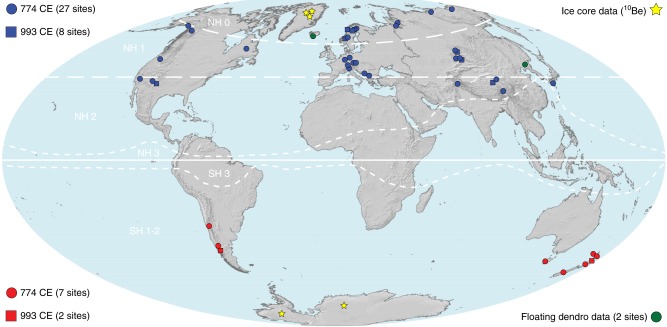
- The COSMIC network measured ¹⁴C in 484 individual tree rings from 44 tree-ring records on five continents, covering 770–780 and 990–1000 CE. Distinct ¹⁴C excursions starting in boreal summer 774 and boreal spring 993 allowed precise dating of all 44 records.
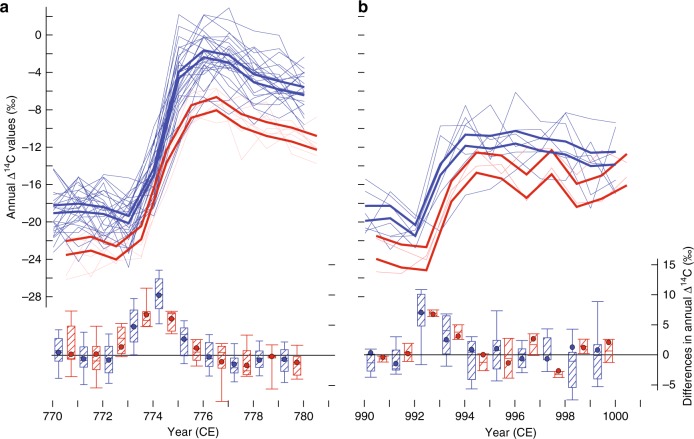
- In the Northern Hemisphere, mean Δ¹⁴C values were −0.1% in 773, 0.4% in 774, 0.95% in 775, and 0.2% in 776; in the Southern Hemisphere, the 774 increase (0.7%) was comparable to 775 (0.6%). The 993 event amplitude was about half that of 774.
- A box model timed the 774 event to June–August 774 CE and the 993 event to February–June 993 CE at 95% confidence. It required an additional 9.6 ± 0.5 × 10²⁶ atoms (3.2 ± 0.2 times annual production) for 774 and 5.3 ± 0.5 × 10²⁶ atoms (1.8 ± 0.2 times annual production) for 993.
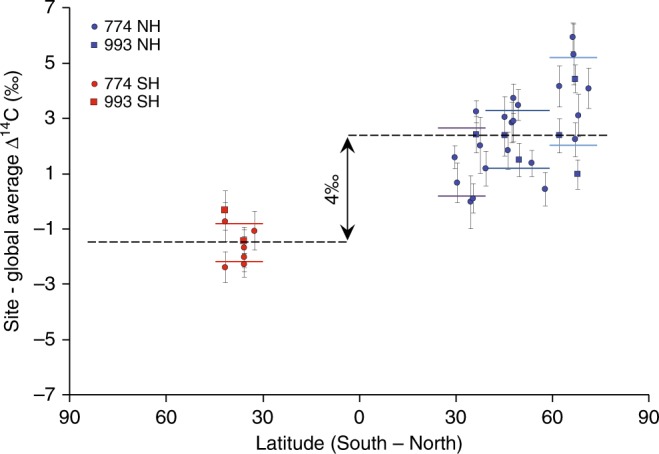
- The study identifies a meridional north–south gradient of declining average ¹⁴C values in each 11-year record, with generally higher mean atmospheric radiocarbon at northern latitudes >60° N.
Methods
- The COSMIC initiative compiled 44 disjunct tree-ring width series from 42° S to 72° N and ~40–4000 m a.s.l., representing 13 genera and four atmospheric radiocarbon zones. A total of 374 rings from 27 NH and 7 SH records covered the 770s CE; 110 rings from 8 NH and 2 SH records covered the 990s CE.
- Wood fibres from each ring were chemically extracted to holocellulose, graphitized, and measured for ¹⁴C with the MICADAS accelerator mass spectrometer at ETH Zurich, using 30–50 mg bulk cellulose per ring.
- A global carbon box model with 11 boxes per hemisphere was fitted to the NH and SH data using a χ² routine to estimate event timing and additional ¹⁴C production.
Limitations
- The paper states that the community-wide voluntary collaboration may introduce biases and errors; sample archiving, identification, and preparation were complicated by samples and scholars changing locations over decades.
- The authors note that biological carry-over effects, species- and site-specific xylogenesis, false rings, missing rings, and one-year inconsistencies in individual samples can affect the precise recording of rapid ¹⁴C increases. They also state that individual measurements from single trees cannot guarantee annual precision, and that the smaller 993 event is less suitable for independent proxy dating than the 774 event.
- The text makes evident that understanding of climate effects on ¹⁴C outgassing, ocean circulation, atmospheric mixing, and the role of ocean extent and winds remains limited, requiring further research.
Model-written summary. Check it against the paper before relying on it.
Integrity signals
Registry
Cites
Statistics
Figures
Verification
Claims the paper makes
1 Valid · 1 Not valid · 19 Not checked · 35 Own results and interpretations
The sources with a verdict support this claim; the rest weren’t checked yet, have no full text we could read, or their verdicts aren’t rated yet.
In the paper
“The lower Δ14C values in the SH most likely reflect different ocean circulation, wind and land–ocean–atmosphere exchanges6,19.”
§ Tree rings reveal globally coherent signature of cosmogenic radiocarbon events in 774 and 993 CE > Results > Cosmogenic radiocarbon signature in 774 CE
What the sources say
- Check pendingcites [6] Braziunas TF Fung IY Stuiver M The preindustrial atmospheric 14CO2 latitudinal gradient as related to exchanges among atmospheric, oceanic, and terrestrial reservoirs Glob. Biogeochem. Cycles 1995 9 565 584 10.1029/95GB01725 source
- Supportedcites [19] Rodgers K Interhemispheric gradient of atmospheric radiocarbon reveals natural variability of Southern Ocean winds Clim. Past. 2011 7 1123 1138 10.5194/cp-7-1123-2011 source
Our copy explains the SH-low/NH-high atmospheric 14C pattern exactly this way: the Discussion (Sect. 4) states 'a relatively simple link between the interhemispheric gradient and surface ocean fluxes of 14CO2 and CO2, dominated by wind-driven changes over the Southern Ocean primarily through their impact on gas exchange', and the Results (Sect. 3) attribute the maximum disequilibrium flux to the Southern Ocean, 'where the most depleted waters come to the surface' (poorly equilibrated surface waters, ~-120‰ vs ~-50‰ in the North Atlantic) over a larger areal extent, with 74% of the total ocean φ_diseq occurring in the SH. Land–ocean–atmosphere exchange is also carried in the model: the Introduction (Sect. 1) concludes 'changes in the interhemispheric gradient are controlled by surface fluxes' after dismissing a stratospheric-production explanation, and Sect. 2.2 adds a terrestrial biospheric disequilibrium flux (7% of the ocean value) to the atmospheric transport model (Fig. 3 shows separate ocean and net-biosphere-production contributions). The hedged 'most likely' in the citing sentence matches the paper's own framing. (LLM, conf=0.85)
hedgedstates a possible cause- Asserted: passes — The authors put it forward as true.
- Checkable: passes — It can be checked against evidence.
- Load-bearing: unclear — It is unclear whether the paper’s conclusions depend on it.
- Based: passes — The paper gives a reason why it holds.
A result the paper reports from its own data — it cites no other source for it, so there is none to check. The quote shows it is in the paper.
In the paper
“Independently of the two cosmogenic events in the 770s and 990s, the mean atmospheric radiocarbon concentration is generally higher at northern latitudes >60° N.”
§ Tree rings reveal globally coherent signature of cosmogenic radiocarbon events in 774 and 993 CE > Discussion
hedgedstates an association- Asserted: passes — The authors put it forward as true.
- Checkable: passes — It can be checked against evidence.
- Load-bearing: passes — The paper’s conclusions depend on it.
- Based: passes — The paper gives a reason why it holds.
A result the paper reports from its own data — it cites no other source for it, so there is none to check. The quote shows it is in the paper.
In the paper
“With 95% confidence, the model times the event, presumed to have been ephemeral, within the boreal growing season (June to August) of 774 CE (Supplementary Fig. 4a; Supplementary Table 4).”
§ Tree rings reveal globally coherent signature of cosmogenic radiocarbon events in 774 and 993 CE > Results > Cosmogenic radiocarbon signature in 774 CE
plain- Asserted: passes — The authors put it forward as true.
- Checkable: passes — It can be checked against evidence.
- Load-bearing: passes — The paper’s conclusions depend on it.
- Based: passes — The paper gives a reason why it holds.
- Rests on 4 assumptions not shown here.
A result the paper reports from its own data — it cites no other source for it, so there is none to check. The quote shows it is in the paper.
In the paper
“The best model/data agreement at the 95% confidence interval suggests it occurred between February and June 993 (Supplementary Fig. 4b; Supplementary Table 4).”
§ Tree rings reveal globally coherent signature of cosmogenic radiocarbon events in 774 and 993 CE > Results > Cosmogenic radiocarbon signature in 993 CE
hedged- Asserted: passes — The authors put it forward as true.
- Checkable: passes — It can be checked against evidence.
- Load-bearing: passes — The paper’s conclusions depend on it.
- Based: passes — The paper gives a reason why it holds.
A result the paper reports from its own data — it cites no other source for it, so there is none to check. The quote shows it is in the paper.
In the paper
“With our box model, an additional 5.3 ± 0.5 (9.6 ± 0.5) 1026 atoms, i.e. 1.8 ± 0.2 (3.2 ± 0.2) times the annual production, are needed to produce the 993 (774) anomaly (Supplementary Fig. 4).”
§ Tree rings reveal globally coherent signature of cosmogenic radiocarbon events in 774 and 993 CE > Results > Cosmogenic radiocarbon signature in 993 CE
plainstates a cause- Asserted: passes — The authors put it forward as true.
- Checkable: passes — It can be checked against evidence.
- Load-bearing: passes — The paper’s conclusions depend on it.
- Based: passes — The paper gives a reason why it holds.
- Rests on 4 assumptions not shown here.
17 more claims
Create a free account to see all 56 claims and to verify the 34 references still open.
- It may state two separate claims as one. 20
- Probably not a substantial claim. 20
Claims other papers make about this one
Each is checked against this paper’s own text: does it say what the citing paper says it does?
The source backs part of the claim, not all of it — or backs it for a different population, condition or comparison.
In the citing paper
“Büntgen et al. (2018) reported offsets between 12 ± 6 and 27 ± 5 14 C yr younger for samples above 65°N measured at ETH.”
From The IntCal20 Northern Hemisphere Radiocarbon Age Calibration Curve (0–55 cal kBP) (2020) · cites this paper as Büntgen et al. (2018)
Experimental — accuracy not yet measuredThe source backs part of the claim, not all of it — or backs it for a different population, condition or comparison.
In the citing paper
“Stuiver and Braziunas (1998) found only a minimal Δ 14 C offset ( -0.3 ± 0.7 ‰ ) for AD 1615 -1715 but an offset of 26 ± 6 14 C yr younger for AD 1545 -1615 for a Siberian larch tree (67°N, 123°E) compared to a tree from Washington state (48°N, 124°W) which is in good agreement with Büntgen et al. (2018).”
From The IntCal20 Northern Hemisphere Radiocarbon Age Calibration Curve (0–55 cal kBP) (2020) · cites this paper as Büntgen et al. 2018
Experimental — accuracy not yet measuredThe source backs part of the claim, not all of it — or backs it for a different population, condition or comparison.
In the citing paper
“The results of a study of the global extent of cosmic events showed only slight differences between trees growing through a range of growth seasons across a range of environments during the years 774 and 993 AD and suggests only a slight latitudinal offset at these times (Büntgen et al. 2018: Fig. 3).”
From The IntCal20 Northern Hemisphere Radiocarbon Age Calibration Curve (0–55 cal kBP) (2020) · cites this paper as Büntgen et al. 2018
Experimental — accuracy not yet measuredThe source backs part of the claim, not all of it — or backs it for a different population, condition or comparison.
In the citing paper
“The new IntCal20 radiocarbon record continues decades of successful practice by employing one calibration curve as an approximation for different regions across the hemisphere.”
From Radiocarbon offsets and old world chronology as relevant to Mesopotamia, Egypt, Anatolia and Thera (Santorini) (2020) · cites this paper as [4]
Experimental — accuracy not yet measuredThe source backs part of the claim, not all of it — or backs it for a different population, condition or comparison.
In the citing paper
“Finally, there are latitude-based variations in 14C levels, but these are regarded as minimal within the mid-latitudes3,4,11.”
From Radiocarbon offsets and old world chronology as relevant to Mesopotamia, Egypt, Anatolia and Thera (Santorini) (2020) · cites this paper as [4]
Experimental — accuracy not yet measured
11 more claims about this paper
Create a free account to see every claim other papers make about this one.
Self-check
Percentages, sums and reported differences re-computed from the paper’s own numbers.
Each contradiction between two passages listed here was confirmed by an independent check.
Rated minor: it would not touch a result — a value no result rests on, a p-value that stays on the same side of the significance level, or a conflict that is clerical, resolved elsewhere in the paper, or outside its own findings.
In the paper
§ Tree rings reveal globally coherent signature of cosmogenic radiocarbon events in 774 and 993 CE > Introduction
“MICADAS)18 was used to measure the 14C content of 30–50 mg bulk cellulose for a total of 484 tree rings.”
§ Tree rings reveal globally coherent signature of cosmogenic radiocarbon events in 774 and 993 CE > Methods > Radiocarbon measurements
“A total of 2–3 mg of cellulose per individual ring sample was wrapped in tin capsules and graphitized in the automated graphitization line “AGE”34,35”
Citations
Cites
Bradley, R. S., & Fritts, H. C. (1978) · Arctic and Alpine Research · doi:10.2307/1550667 · Cited by 4,518
2500 Years of European Climate Variability and Human Susceptibility
Büntgen, U., Tegel, W., Nicolussi, K., McCormick, M., Frank, D., Trouet, V., Kaplan, J. O., Herzig, F., Heussner, K.-U., Wanner, H., et al. (2011) · Science · doi:10.1126/science.1197175 · Cited by 1,451
Self-citationTiming and climate forcing of volcanic eruptions for the past 2,500 years
Sigl, M., Winstrup, M., McConnell, J. R., Welten, K. C., Plunkett, G., Ludlow, F., Büntgen, U., Caffee, M., Chellman, N., Dahl-Jensen, D., et al. (2015) · Nature · doi:10.1038/nature14565 · Cited by 1,325
Self-citationAtmospheric radiocarbon for the period 1950–2010
Hua, Q., Barbetti, M., & Rakowski, A. Z. (2013) · Radiocarbon · doi:10.2458/azu_js_rc.v55i2.16177 · Cited by 1,019
Cooling and societal change during the Late Antique Little Ice Age from 536 to around 660 AD
Büntgen, U., Myglan, V. S., Ljungqvist, F. C., McCormick, M., Di Cosmo, N., Sigl, M., Jungclaus, J., Wagner, S., Krusic, P. J., Esper, J., et al. (2016) · Nature Geoscience · doi:10.1038/ngeo2652 · Cited by 722
Self-citationCarbohydrate sources and sinks in woody plants
Kozlowski, T. T. (1992) · The Botanical Review · doi:10.1007/bf02858600 · Cited by 706
MICADAS: A new compact radiocarbon AMS system
Synal, H.-A., Stocker, M., & Suter, M. (2007) · Nuclear Instruments and Methods in Physics Research Section B: Beam Interactions with Materials and Atoms · doi:10.1016/j.nimb.2007.01.138 · Cited by 704
Self-citationA signature of cosmic-ray increase in AD 774–775 from tree rings in Japan
Miyake, F., Nagaya, K., Masuda, K., & Nakamura, T. (2012) · Nature · doi:10.1038/nature11123 · Cited by 539
Self-citationA revolutionary graphitisation system: Fully automated, compact and simple
Wacker, L., Němec, M., & Bourquin, J. (2010) · Nuclear Instruments and Methods in Physics Research Section B: Beam Interactions with Materials and Atoms · doi:10.1016/j.nimb.2009.10.067 · Cited by 438
Self-citationRadiocarbon – A Unique Tracer of Global Carbon Cycle Dynamics
Levin, I., & Hesshaimer, V. (2000) · Radiocarbon · doi:10.1017/s0033822200053066 · Cited by 411
Research works printed but not linked: 2
- Ushakov, I. A., Mortensen, A. & Ushakov, A. S. Histories of Scientific Insight 396 (Lulu Press, Morrisville, 2007).
- Schulman, E. Dendroclimatic changes in Semiarid America p. 142 (University of Arizona Press, Tucson, 1956).
Cited by
Items 101–200 of 212
In praise of archives (and an open mind)
Büntgen, U., Esper, J., & Oppenheimer, C. (2022) · Communications Earth & Environment · doi:10.1038/s43247-022-00415-8 · Cited by 7
Self-citationticktack: A Python package for carbon box modelling
Sharma, U., Zhang, Q., Dennis, J., & Pope, B. J. S. (2023) · The Journal of Open Source Software · doi:10.21105/joss.05084 · Cited by 6
Patterns in solar activity over the first millennium CE
Wang, J., Dee, M., Pope, B. J. S., Owens, M. J., Brown, D., Lindauer, S., Schwabe, K., Knapp, H., Westphal, T., & Friedrich, R. (2026) · Communications Earth & Environment · doi:10.1038/s43247-025-03120-4 · Cited by 6
Radiocarbon evidence over the apparent grand solar minimum around 400 BCE
Dee, M., Scifo, A., Rohra, T., Joosten, J., Kuitems, M., Vos, W., Manning, S. W., & Westphal, T. (2025) · Radiocarbon · doi:10.1017/rdc.2024.132 · Cited by 6
Dendrochronology and Archaeology
Manning, S. W. (2023) · Wiley eBooks · doi:10.1002/9781119592112.ch3 · Cited by 6
Cyclic sunspot activity during the first millennium CE as reconstructed from radiocarbon
Usoskin, I. G., Solanki, S. K., Krivova, N. A., & Chatzistergos, T. (2026) · Astronomy and Astrophysics · doi:10.1051/0004-6361/202659038 · Cited by 6
Identifying the 993–994 CE Miyake Event in the Oldest Dated Living Tree in Europe
Quarta, G., Filippo, A. D., Calcagnile, L., D’Elia, M., Biondi, F., Saba, E. P., Baliva, M., Vivo, G. D., Schettino, A., & Piovesan, G. (2019) · Radiocarbon · doi:10.1017/rdc.2019.37 · Cited by 6
Jędrzejowski, M., Michczyńska, D. J., Kłusek, M., Michczyński, A., Pawełczyk, F., Piotrowska, N., Heeb, K. W., & Hajdas, I. (2024) · Radiocarbon · doi:10.1017/rdc.2024.49 · Cited by 6
Wang, F. Y., Li, X., Chernyshov, D. O., Hui, C. Y., Zhang, G. Q., & Cheng, K. S. (2019) · The Astrophysical Journal · doi:10.3847/1538-4357/ab55db · Cited by 6
Hessl, A., Richardson, A. D., Filwett, R., Andreu‐Hayles, L., Walker, M. R., Oelkers, R., Robison, A. S., Leshyk, V. O., & Carbone, M. S. (2026) · New Phytologist · doi:10.1111/nph.70868 · Cited by 5
Self-citationΔ 14 C PEAKS APPEARING IN EARLYWOOD AND LATEWOOD TREE RINGS (AD 770–780) IN NORTHEASTERN ARIZONA
Park, J., Southon, J. R., Seo, J., Creasman, P. P., Hong, W., Park, G., & Sung, K. (2020) · Radiocarbon · doi:10.1017/rdc.2020.108 · Cited by 5
Explorations of Extreme Space Weather Events from Stellar Observations and Archival Investigations
Hayakawa, H., Notsu, Y., & Ebihara, Y. (2023) · Springer eBooks · doi:10.1007/978-981-19-7765-7_11 · Cited by 4
Barclay, D. J., Haeussler, P. J., & Witter, R. C. (2023) · Quaternary Science Advances · doi:10.1016/j.qsa.2023.100142 · Cited by 4
THE MIYAKE EVENT IN 993 CE RECORDED IN OAK SUB-ANNUAL TREE RINGS FROM KUJAWY (POLAND)
Rakowski, A. Z., Krąpiec, M., Huels, M. C., Pawlyta, J., & Wiktorowski, D. (2022) · Radiocarbon · doi:10.1017/rdc.2022.54 · Cited by 4
The potential of intra-annual density information for crossdating of short tree-ring series
Raden, M., Mattheis, A., Spiecker, H., Backofen, R., & Kahle, H. (2020) · Dendrochronologia · doi:10.1016/j.dendro.2020.125679 · Cited by 4
Churakova, O. V., SIEGWOLF, R. T. W., Zharkov, М. S., & Saurer, M. M. (2024) · The Science of The Total Environment · doi:10.1016/j.scitotenv.2024.172042 · Cited by 4
Self-citationIdentification of possible Δ14C anomalies since 14 ka BP: A computational intelligence approach
Neocleous, A. C., Azzopardi, G., & Dee, M. (2019) · The Science of The Total Environment · doi:10.1016/j.scitotenv.2019.01.251 · Cited by 4
Barrett, M.-T., Brown, D. M., & Plunkett, G. (2019) · Dendrochronologia · doi:10.1016/j.dendro.2019.03.004 · Cited by 4
Rojas-Badilla, M., LeQuesne, C., Rozas, V., Gipoulou-Zúñiga, T., González‐Reyes, Á., & Copenheaver, C. A. (2023) · Dendrochronologia · doi:10.1016/j.dendro.2023.126113 · Cited by 4
Self-citationQuaternary Geochronological Frameworks
Lane, C. S. (2023) · Wiley eBooks · doi:10.1002/9781119592112.ch1 · Cited by 3
Erdil, P., Kuitems, M., Scifo, A., Brown, D., & Dee, M. (2026) · Radiocarbon · doi:10.1017/rdc.2025.10186 · Cited by 3
Golubenko, K., USOSKIN, I. G., Bard, É., Koldobskiy, S., & Rozanov, E. (2026) · Radiocarbon · doi:10.1017/rdc.2026.10236 · Cited by 3
Edge, D. C., Wanamaker, A. D., Staisch, L., Reynolds, D. J., Holmes, K. L., & Black, B. A. (2022) · Radiocarbon · doi:10.1017/rdc.2022.83 · Cited by 3
A tree-ring cellulose extraction device adapted to radiocarbon analysis
Lin, P., Zhao, Y., Zhang, H., Wieloch, T., Gu, Y., Liang, C., Chen, F., & Lu, H. (2024) · Radiocarbon · doi:10.1017/rdc.2024.83 · Cited by 3
Caveat emptor!—wiggle-matching European wood samples (AD 46–AD 286)
Bayliss, A., Brown, D. M., Dee, M., Marshall, P., & Wacker, L. (2024) · Radiocarbon · doi:10.1017/rdc.2024.54 · Cited by 3
Self-citationHoldaway, R. N., Kennedy, B. M., Duffy, B., Xu, J., & Oppenheimer, C. (2021) · doi:10.5194/gchron-2021-13 · Cited by 3
Self-citationAbsolutely dating the European Neolithic through a rapid 14C excursionPreprint
Maczkowski, A., Pearson, C. L., Francuz, J., Giagkoulis, T., Szidat, S., Wacker, L., Bolliger, M., Kotsakis, K., & Hafner, A. (2023) · Research Square · doi:10.21203/rs.3.rs-3419721/v1 · Cited by 3
Self-citationUSOSKIN, I. G., Koldobskiy, S., Kovaltsov, G. A., Sukhodolov, T., Mishev, A., & Mironova, I. (2021) · International Cosmic Ray Conference · doi:10.22323/1.395.1319 · Cited by 3
Uchikawa, Y., Cowley, L., Hayakawa, H., Willis, D. M., & Stephenson, F. R. (2020) · History of geo- and space sciences · doi:10.5194/hgss-11-81-2020 · Cited by 3
Preiser-Kapeller, J., & Kislinger, E. (2022) · Medieval Worlds · doi:10.1553/medievalworlds_no17_2022s3 · Cited by 2
Arosio, T., Affolter, S., Nicolussi, K., Sigl, M., Ziehmer-Wenz, M. M., Schlüchter, C., Schaad, E., Stähli, R., & Leuenberger, M. C. (2022) · Geosciences · doi:10.3390/geosciences12100371 · Cited by 2
“Tree rings are among the few paleoclimate proxies that provide continuous annual resolution [16] with high dating accuracy [17].”
BackgroundSelf-citationPreiser-Kapeller, J. (2024) · De Medio Aevo · doi:10.5209/dmae.92793 · Cited by 2
Reconstructing Annual Δ 14 C During Miyake Events Using Deciduous and Evergreen Trees
Walker, M. R., Shobe, C. M., Andreu‐Hayles, L., Dey, L., Suran, B., Nachin, B., & Hessl, A. (2025) · Global Biogeochemical Cycles · doi:10.1029/2024gb008423 · Cited by 2
Self-citationHoldaway, R. N., Kennedy, B. M., Duffy, B., Xu, J., & Oppenheimer, C. (2023) · Journal of Volcanology and Geothermal Research · doi:10.1016/j.jvolgeores.2023.107787 · Cited by 2
Self-citationBessonova, V., Gorlanova, L. A., & Hantemirov, R. M. (2024) · Dendrochronologia · doi:10.1016/j.dendro.2024.126271 · Cited by 2
Self-citationComplications and challenges for securing Mediterranean timelines
Manning, S. W. (2020) · Proceedings of the National Academy of Sciences · doi:10.1073/pnas.2006552117 · Cited by 2
The Role of Deposition of Cosmogenic 10Be for the Detectability of Solar Proton Events
Schaar, K., Spiegl, T., Langematz, U., Sato, T., Mekhaldi, F., Kunze, M., Miyake, F., & Yoden, S. (2024) · Journal of Geophysical Research Atmospheres · doi:10.1029/2023jd040463 · Cited by 2
Self-citationDiffuse sunlight and cosmic rays: Missing pieces of the forest growth change attribution puzzle?
Bontemps, J., & Svensmark, H. (2021) · The Science of The Total Environment · doi:10.1016/j.scitotenv.2021.150469 · Cited by 2
Reconstruction of the fluence of extreme solar particle events registered in cosmogenic proxies
Koldobskiy, S., Mekhaldi, F., Kovaltsov, G. A., & USOSKIN, I. G. (2023) · International Cosmic Ray Conference · doi:10.22323/1.444.1324 · Cited by 2
Modorov, M. V., Kukarskih, V. V., Mikhailovskaya, L. N., Komarova, A., Bessonova, V., & Pozolotina, V. N. (2025) · Dendrochronologia · doi:10.1016/j.dendro.2025.126331 · Cited by 2
Self-citationCosmogenic Evidence for Past SEP Events
Miyake, F. (2019) · International Cosmic Ray Conference · doi:10.22323/1.358.0011 · Cited by 2
Self-citationJull, A. T., Панюшкина, И. П., Salzer, M. W., Baisan, C., Molnár, M., Varga, T., Wacker, L., Brehm, N., & Tegel, W. (2020) · arXiv (Cornell University) · doi:10.48550/arxiv.2003.09387 · Cited by 2
Self-citationCarroll, A. L., Philibosian, B. E., Sillett, S. C., Antoine, M. E., & Kozaci, Ö. (2025) · Quaternary Science Advances · doi:10.1016/j.qsa.2025.100283 · Cited by 2
Mazurkin, P. M., & Kudryashova, A. I. (2019) · Успехи современного естествознания (Advances in Current Natural Sciences) · doi:10.17513/use.37249 · Cited by 2
The Pacific Archaeology Radiocarbon Database
Bickler, S. H., Petchey, F., Bickler, G., Mulrooney, M. A., Rieth, T. M., Jennings, R. P., & Bunbury, M. M. E. (2025) · Archaeology in Oceania/Archæology & physical anthropology in Oceania · doi:10.1002/arco.70007 · Cited by 1
Variations in the radiocarbon calibration curves around known and suspected Δ¹⁴C excursions
Pawlyta, J., Rakowski, A. Z., & Krąpiec, M. (2025) · Geochronometria · doi:10.20858/geochr/214060 · Cited by 1
Reassessment of a cosmic ray increase event in 1279/1280 CE using carbon-14 records of tree rings
Miyake, F., Jull, A. J. T., Kimura, K., Molnár, M., Moriya, T., Myglan, V., Панюшкина, И. П., Scifo, A., Takeyama, M., Tokanai, F., et al. (2026) · Philosophical Transactions of the Royal Society A Mathematical Physical and Engineering Sciences · doi:10.1098/rsta.2025.0264 · Cited by 1
Self-citationRadiocarbon production and cosmic radiation events: current state of the evidence
Dee, M., Kuitems, M., Owens, M. J., & Pope, B. J. S. (2026) · Philosophical Transactions of the Royal Society A Mathematical Physical and Engineering Sciences · doi:10.1098/rsta.2025.0262 · Cited by 1
Reply to "Rapid $^{14}$C excursion at 3372-3371 BCE not observed at two different locations"
Wang, F. Y., Yu, H., Zou, Y.-C., Dai, Z. G., & Cheng, K. S. (2020) · arXiv (Cornell University) · doi:10.48550/arxiv.2003.11295 · Cited by 1
Tree physiology is essential for interpreting Miyake events
Uusitalo, J. (2026) · New Phytologist · doi:10.1111/nph.71002 · Cited by 1
Uchikawa, Y., Cowley, L., Hayakawa, H., Willis, D. M., & Stephenson, F. R. (2020) · Durham Research Online (Durham University) · doi:10.48550/arxiv.2003.04192 · Cited by 1
Mazurkin, P. M., & Kudryashova, A. I. (2019) · Успехи современного естествознания (Advances in Current Natural Sciences) · doi:10.17513/use.37215 · Cited by 1
Extreme Space Weather Events Recorded in HistoryPreprint
Hayakawa, H., & Ebihara, Y. (2020) · arXiv (Cornell University) · doi:10.48550/arxiv.2003.06020 · Cited by 1
Mazurkin, P. M., & ., K. A. I. (2019) · Advances In Image and Video Processing · doi:10.14738/aivp.72.6689 · Cited by 1
Methodologies for dating wooden artefacts
Bernabei, M. (2020) · IOP Conference Series Materials Science and Engineering · doi:10.1088/1757-899x/949/1/012017 · Cited by 1
Self-citationSeismic events drive pollution in Japan Trench hadal basins
Trotta, S., Schwarzbauer, J., Michetti, A. M., & Bellanova, P. (2026) · Communications Earth & Environment · doi:10.1038/s43247-026-03401-6
Holdaway, R. N. (2021) · doi:10.5194/gchron-2021-13-ac2
Holdaway, R. N. (2021) · doi:10.5194/gchron-2021-13-ac1
Holdaway, R. N., Kennedy, B. M., Duffy, B., et al. (2021) · doi:10.5194/gchron-2021-13-rc2
Holdaway, R. N., Kennedy, B. M., Duffy, B., et al. (2021) · doi:10.5194/gchron-2021-13-rc1
Lageard, J. G. A. (2022) · Encyclopedia of earth sciences series/Encyclopedia of earth sciences · doi:10.1007/978-3-030-44600-0_41-1
Causes of temporal 14C variations
Burr, G. S. (2023) · Elsevier eBooks · doi:10.1016/b978-0-323-99931-1.00015-5
Archaeological Dendrochronology
Manning, S. W., & Lorentzen, B. (2023) · Elsevier eBooks · doi:10.1016/b978-0-323-90799-6.00159-2
Debris Avalanches in the Northern California Coast Range Triggered by Plate-Boundary Earthquakes
Pearl, J. K., Kelsey, H. M., Angster, S. J., Caldwell, D., Pryor, I., & Sherrod, B. L. (2024) · Bulletin of the Seismological Society of America · doi:10.1785/0120240008
Annual Variations in Radiocarbon Concentration: Implications for Space Weather a nd Chronology
Scifo, A. (2025) · University of Groningen research database (University of Groningen / Centre for Information Technology) · doi:10.33612/diss.1374567837
Radiocarbon changes in the XI century CE in annual tree rings
Rakowski, A. Z., Pawlyta, J., Miyahara, H., Krąpiec, M., Molnár, M., Wiktorowski, D., Minami, M., & Huels, M. C. (2026) · Radiocarbon · doi:10.1017/rdc.2026.10202
Can Solar Cyclic Variability Mimic Extreme Solar Particle (Miyake) Events in Radiocarbon?
USOSKIN, I. G., Miyake, F., & Golubenko, K. (2026) · Journal of Geophysical Research Space Physics · doi:10.1029/2026ja035427
Self-citationRadiocarbon dating with cosmic radiation events: problems and unexplored possibilities
Philippsen, B., Svarva, H. L., & Seiler, M. (2026) · Philosophical Transactions of the Royal Society A Mathematical Physical and Engineering Sciences · doi:10.1098/rsta.2025.0263
Replicating measurements to quantify smaller perturbations in tree-ring 14C records
Frank, D., Brehm, N., Pearson, C. L., Bayliss, A., Nicolussi, K., Giacalone, J., Ramsperger, U., Christl, M., & Wacker, L. (2026) · Philosophical Transactions of the Royal Society A Mathematical Physical and Engineering Sciences · doi:10.1098/rsta.2025.0256
Self-citationRegev, L., Porat, R., Botosh, A., Kalman, Y., Regev, J., Mintz, E., Leibner, U., & Boaretto, E. (2026) · PLoS ONE · doi:10.1371/journal.pone.0352580
Pearson, C. L., Brehm, N., Wacker, L., Brewer, P. W., Sigl, M., Kuniholm, P. I., Nicolussi, K., Salzer, M. W., & Bayliss, A. (2026) · Proceedings of the National Academy of Sciences · doi:10.1073/pnas.2615871123
Self-citation(2022) · Earth system science data · doi:10.5194/essd-2021-422-rc2
Sigl, M. (2022) · Earth system science data · doi:10.5194/essd-2021-422-ac2
Self-citationVolcanic Eruptions in the Holocene: From the 1815 Tambora Eruption to the Deep Past
Kleemann, K. (2026) · Oxford University Press eBooks · doi:10.1093/9780198945239.003.0059
(2022) · Earth system science data · doi:10.5194/essd-2021-422-rc1
Sigl, M. (2022) · Earth system science data · doi:10.5194/essd-2021-422-ac1
Self-citation(2022) · Earth system science data · doi:10.5194/essd-2022-368-cc1
(2023) · Earth system science data · doi:10.5194/essd-2022-368-rc1
(2023) · Earth system science data · doi:10.5194/essd-2022-368-rc2
Thomas, E. R. (2023) · Earth system science data · doi:10.5194/essd-2022-368-ac1
Thomas, E. R. (2023) · Earth system science data · doi:10.5194/essd-2022-368-ac2
Ramírez‐i‐Ollé, M. (2019) · Manchester University Press eBooks · doi:10.7765/9781526140999.00015
Globaler Klimawandel: die Grundlagen
Hauck, M., Leuschner, C., & Homeier, J. (2019) · Springer eBooks · doi:10.1007/978-3-662-59791-0_1
Geometric analysis of variability of radiocarbon abundances and solar activity
Shoji, I., Takata, T., & Mizumoto, Y. (2025) · Astronomy and Computing · doi:10.1016/j.ascom.2025.100971
Early 14 C increase in high-latitude trees at 665–664 BC
Park, J., Uusitalo, J., Hong, W., Park, G., Sung, K., Hackman, T., Helama, S., Mäkinen, H. H., Nöjd, P., & Oinonen, M. (2026) · Radiocarbon · doi:10.1017/rdc.2026.10195
Walker, M. R. (2024) · The Research Repository @ WVU (West Virginia University) · doi:10.33915/etd.12532
Christine, H. Y., Daux, V., Hervé, G., Labidi, K., Phouybanhdyt, B., Thil, F., Villalba, R., & Stolarczyk, T. (2026) · Radiocarbon · doi:10.1017/rdc.2026.10233
Self-citationInstitute for Medieval Research (Hrsg.) (2022) · Medieval Worlds · doi:10.1553/medievalworlds_no17_2022
Miyahara, H., Tokanai, F., Moriya, T., Takeyama, M., Sakurai, H., Horiuchi, K., Ohyama, M., Hotta, H., Miyake, F., Kataoka, R., et al. (2026) · Philosophical Transactions of the Royal Society A Mathematical Physical and Engineering Sciences · doi:10.1098/rsta.2025.0260
Self-citationRevealing a Solar Cycle Resonance through tree-ringsPreprint
Khorchani, A., Touhami, I., Elaieb, M. T., & Khaldi, A. (2022) · Research Square · doi:10.21203/rs.3.rs-2199256/v1
36Cl concentrations from polar ice cores set new constraints on the Carrington event
Mekhaldi, F., Paleari, C. I., Smith, A. M., Aldahan, A., Beer, J., Christl, M., Vockenhuber, C., Hayakawa, H., Curran, M., Erhardt, T., et al. (2026) · Philosophical Transactions of the Royal Society A Mathematical Physical and Engineering Sciences · doi:10.1098/rsta.2025.0257
Self-citationTension in the solar energetic proton paradigm for historical cosmogenic nuclide events
Cliver, E. W., Hudson, H. S., & Fletcher, L. (2026) · Philosophical Transactions of the Royal Society A Mathematical Physical and Engineering Sciences · doi:10.1098/rsta.2025.0291
Heaton, T., Bayliss, A., Blaauw, M., Ramsey, C. B., & Scott, E. M. (2026) · Philosophical Transactions of the Royal Society A Mathematical Physical and Engineering Sciences · doi:10.1098/rsta.2025.0265
Radiocarbon concentration around 774/775 CE in sub-annual tree rings from Kujawy near Kraków
Jędrzejowski, M., Rakowski, A. Z., Miyahara, H., Pawlyta, J., Krąpiec, M., Molnár, M., Huels, M. C., Wiktorowski, D., Minami, M., & Sandoval, J. S. (2026) · Radiocarbon · doi:10.1017/rdc.2026.10296
Tree-ring dating of commercially available alerce boards in Japan
Sano, M., Kami, N., Hakozaki, M., Tokanai, F., & Sakamoto, M. (2026) · Nuclear Instruments and Methods in Physics Research Section B Beam Interactions with Materials and Atoms · doi:10.1016/j.nimb.2026.166032
Li, Y., Jiang, H., Wei, H., & Yihua, R. (2026) · SSRN Electronic Journal · doi:10.2139/ssrn.6916761
3-4-2.歴史に刻まれた巨大宇宙天気現象 (3-4.超巨大フレアと極端宇宙天気現象の可能性)
早川尚志, & 海老原, 祐. (2021) · Institutional Repositories DataBase (IRDB) · doi:10.18999/pstep.2021.3.4.2
Supporting information 1 of Regional Differences in Carbon-14 Data of the 993 CE Cosmic Ray Event
Miyake, F., Hakozaki, M., Kimura, K., Tokanai, F., Nakamura, T., Takeyama, M., & Moriya, T. (2022) · doi:10.3389/fspas.2022.886140.s001
Self-citation(2019) · Journal of Environmental Science Computer Science and Engineering & Technology · doi:10.24214/jecet.a.8.3.28189
Tree rings capture an unruly Sun
Knudsen, M. F. (2021) · Nature Geoscience · doi:10.1038/s41561-020-00676-y
Metadata
- Authors
- Büntgen, U., Wacker, L., Galván, J. D., Arnold, S., Arseneault, D., Baillie, M., Beer, J., Bernabei, M., Bleicher, N., Boswijk, G., Bräuning, A., Carrer, M., Ljungqvist, F. C., Cherubini, P., Christl, M., Christie, D. A., Clark, P. W., Cook, E. R., D’Arrigo, R., Davi, N., Eggertsson, Ó., Esper, J., Fowler, A. M., Gedalof, Z., Gennaretti, F., Grießinger, J., Grissino-Mayer, H., Grudd, H., Gunnarson, B. E., Hantemirov, R., Herzig, F., Hessl, A., Heussner, K.-U., Jull, A. J. T., Kukarskih, V., Kirdyanov, A., Kolář, T., Krusic, P. J., Kyncl, T., Lara, A., LeQuesne, C., Linderholm, H. W., Loader, N. J., Luckman, B., Miyake, F., Myglan, V. S., Nicolussi, K., Oppenheimer, C., Palmer, J., Panyushkina, I., Pederson, N., Rybníček, M., Schweingruber, F. H., Seim, A., Sigl, M., Churakova, O., Speer, J. H., Synal, H.-A., Tegel, W., Treydte, K., Villalba, R., Wiles, G., Wilson, R., Winship, L. J., Wunder, J., Yang, B., & Young, G. H. F.
- Affiliations
- Masaryk University (CZ)
- ETH Zurich (CH)
- Swiss Federal Institute for Forest, Snow and Landscape Research (CH)
- Université du Québec à Rimouski (CA)
- Queen's University Belfast (GB)
- Swiss Federal Institute of Aquatic Science and Technology (CH)
- Istituto per la Valorizzazione del Legno e delle Specie Arboree (IT)
- University of Auckland (NZ)
- Friedrich-Alexander-Universität Erlangen-Nürnberg (DE)
- University of Padua (IT)
- Stockholm University (SE)
- Austral University of Chile (CL)
- University of Vermont (US)
- Lamont-Doherty Earth Observatory (US)
- William Paterson University (US)
- Johannes Gutenberg University Mainz (DE)
- University of Guelph (CA)
- AgroParisTech (FR)
- University of Tennessee at Knoxville (US)
- Swedish Polar Research Secretariat (SE)
- Ural Branch of the Russian Academy of Sciences (RU)
- Bayerisches Landesamt für Denkmalpflege (DE)
- West Virginia University (US)
- Deutsches Archäologisches Institut, Zentrale (DE)
- University of Arizona (US)
- University of Cambridge (GB)
- Czech Academy of Sciences, Global Change Research Institute (CZ)
- University of Gothenburg (SE)
- Swansea University (GB)
- Western University (CA)
- Institute for Space-Earth Environmental Research, Nagoya University (JP)
- Universität Innsbruck (AT)
- UNSW Sydney (AU)
- Harvard University (US)
- University of Freiburg (DE)
- Paul Scherrer Institute (CH)
- University of Geneva (CH)
- Consejo Nacional de Investigaciones Científicas y Técnicas (AR)
- College of Wooster (US)
- Hampshire College (US)
- Chinese Academy of Sciences (CN)
- Corresponding author
- Büntgen, Ulf
- Wacker, Lukas
- ORCID
- Büntgen, Ulf
- Wacker, Lukas
- Arseneault, Dominique
- Beer, Jürg
- Bernabei, Mauro
- Bleicher, Niels
- Boswijk, Gretel
- Bräuning, Achim
- Carrer, Marco
- Ljungqvist, Fredrik Charpentier
- Cherubini, Paolo
- Christl, Marcus
- Christie, Duncan A.
- Clark, Peter W.
- Cook, Edward R.
- Davi, Nicole
- Eggertsson, Ólafur
- Esper, Jan
- Fowler, Anthony M.
- Gedalof, Ze’ev
- Gennaretti, Fabio
- Grießinger, Jussi
- Grudd, Håkan
- Gunnarson, Björn E.
- Hantemirov, Rashit
- Hessl, Amy
- Jull, A. J. Timothy
- Kukarskih, Vladimir
- Kirdyanov, Alexander
- Kolář, Tomáš
- Krusic, Paul J.
- Lara, Antonio
- LeQuesne, Carlos
- Linderholm, Hans W.
- Loader, Neil J.
- Miyake, Fusa
- Nicolussi, Kurt
- Oppenheimer, Clive
- Palmer, Jonathan
- Panyushkina, Irina
- Pederson, Neil
- Rybníček, Michal
- Seim, Andrea
- Sigl, Michael
- Churakova, Olga
- Synal, Hans-Arno
- Tegel, Willy
- Treydte, Kerstin
- Villalba, Ricardo
- Wilson, Rob
- Winship, Lawrence J.
- Yang, Bao
- Young, Giles H. F.
- Venue
- Nature Communications
- Published
- 2018-09-06
- Volume
- 9
- Issue
- 1
- Pages
- 3605-3605
- ISSN
- 2041-1723 (ISSN-L)
- PMC
- PMC6127282
- OpenAlex
- W2889473596
- Semantic Scholar
- c1038ccc65b9fd8598ce7291be0f07ffed0f063c
- Cited by
- 183
- References
- 42
- Citations by year
- 2026: 18 · 2025: 13 · 2024: 13 · 2023: 26 · 2022: 34 · 2021: 25 · 2020: 29 · 2019: 22 · 2018: 3
- FWCI
- 9.62
- Type
- journal article
- Language
- en
- Update notices
- correction (2018-12-17)
- Open access
- gold
- doi.org
- Licence
- cc-by
- creativecommons.org/licenses/by/4.0 (tdm)
- creativecommons.org/licenses/by/4.0 (vor)
- Locations
- Nature Communications (publishedVersion, cc-by)
- Europe PMC (PubMed Central) (publishedVersion, other-oa)
- PubMed Central (publishedVersion, cc-by)
- PubMed (publishedVersion)
- Depositum (Université du Québec en Abitibi-Témiscamingue) (acceptedVersion)
- UA Campus Repository (The University of Arizona) (acceptedVersion, cc-by)
- UNSWorks (University of New South Wales, Sydney, Australia) (submittedVersion, cc-by-nc-nd)
- HAL (submittedVersion, cc-by)
- DORA Eawag (Swiss Federal Institute of Aquatic Science and Technology (Eawag)) (submittedVersion, cc-by)
- DORA PSI (Paul Scherrer Institute) (submittedVersion, cc-by)
- DORA WSL (Swiss Federal Institute for Forest, Snow and Landscape Research) (submittedVersion, cc-by)
- Repository for Publications and Research Data (ETH Zurich) (submittedVersion, cc-by)
- Padua Research Archive (University of Padova) (submittedVersion, cc-by)
- RePEc: Research Papers in Economics (submittedVersion)
- Americanae (AECID Library) (submittedVersion, cc-by-nc-sa)
- DOAJ (DOAJ: Directory of Open Access Journals) (submittedVersion, cc-by-sa)
- DOAJ (DOAJ: Directory of Open Access Journals) (submittedVersion)
- SibFU Digital Repository (Siberian Federal University) (submittedVersion)
- St Andrews Research Repository (St Andrews Research Repository) (submittedVersion, cc-by)
- LA Referencia (Red Federada de Repositorios Institucionales de Publicaciones Científicas) (submittedVersion, cc-by-nc-sa)
- ETH Zürich Research Collection (cc-by)
- Greater South Information System
- Funders
- National Science Foundation (14195)
- Harvard University
- Indiana State University
- Université de Lorraine
- West Virginia University
- Polarforskningssekretariatet
- William Paterson University of New Jersey
- University of St Andrews
- Swansea University
- Branco Weiss Fellowship – Society in Science
- Schweizerischer Nationalfonds zur Förderung der Wissenschaftlichen Forschung (200021L_157187 / 1, 157187, 47809, 54000, 55099, 10964)
- University of New South Wales
- Chinese Academy of Sciences
- Albert-Ludwigs-Universität Freiburg
- Consejo Nacional de Investigaciones Científicas y Técnicas
- Eidgenössische Technische Hochschule Zürich
- Siberian Branch, Russian Academy of Sciences
- Queen's University
- Università degli Studi di Padova
- Paul Scherrer Institut
- AgroParisTech
- Göteborgs Universitet
- Université de Genève
- Ural Branch, Russian Academy of Sciences
- Institut National de la Recherche Agronomique
- Mendelova Univerzita v Brně (61300)
- Stockholms Universitet
- Universidad Austral de Chile
- Masarykova Univerzita
- Siberian Federal University (660041)
- Universität Innsbruck
- Swiss Federal Institute for Forest, Snow and Landscape Research
- Harvard Forest, Harvard University
- Lamont-Doherty Earth Observatory, Columbia University
- Rubenstein School of Environment and Natural Resources, University of Vermont
- Japan Society for the Promotion of Science (16K13802, 16H06005)
- Russian Academy of Sciences
- Eidgenössische Anstalt für Wasserversorgung Abwasserreinigung und Gewässerschutz
- Topics
- Physical Sciences › Earth and Planetary Sciences › Atmospheric Science › Tree-ring climate responses
- Social Sciences › Archeology › Archaeology and ancient environmental studies
- Physical Sciences › Earth and Planetary Sciences › Atmospheric Science › Geology and Paleoclimatology Research
- Keywords
- tree-ring radiocarbon, solar proton events, atmospheric radiocarbon, red aurora, space weather, solar activity
About these checks
Registry, retraction, Cites and statistics results are computed, not judged, with one exception: a printed reference that no index lists is read once by a model before it counts as a citation error. Claims are extracted by a model and kept only when their quote appears verbatim in the text; each cited source is then checked, with a model’s help, for whether it says what the claim relies on. Those verdicts can be wrong — read the claim’s quote and the cited source before relying on one.
A language model drew the claims from the paper on 2026-11-23, under version 3 of the claim definition (model deepseek-v4.1-flash, prompt extract-v3).
A second model labelled each claim on 2026-11-23 (model jev-1.13-20260917, definition revision gold-guideline-v0.2).
Cited sources are checked with a language model’s help (qwen3.8-omni-flash).
Statistics and arithmetic are recomputed, not judged.
Confidence bands are shown only for fields calibrated on our annotated test set. None is calibrated yet, so no band is shown.
What counts as a claim ›How we measure confidence ›How we check this ›
Are you an author, or do you see a problem with this page? Request a review
Data sources
Bibliographic data: Semantic Scholar, OpenAlex, Crossref.
Contains information from the Semantic Scholar Academic Graph Datasets, made available under the ODC Attribution License (ODC-BY 1.0).
Semantic Scholar’s data is described in: Kinney, R., et al. (2023). The Semantic Scholar Open Data Platform. arXiv:2301.10140.
