

Cerebello-thalamo-cortical hyperconnectivity as a state-independent functional neural signature for psychosis prediction and characterization
Open accessThe DOI matches its Crossref record; 70 of the 70 references it cites were found in a registry or an index.
Abstract
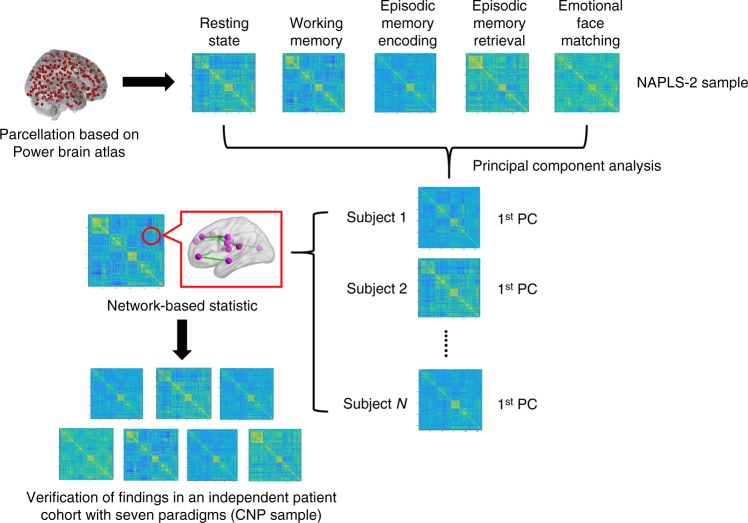
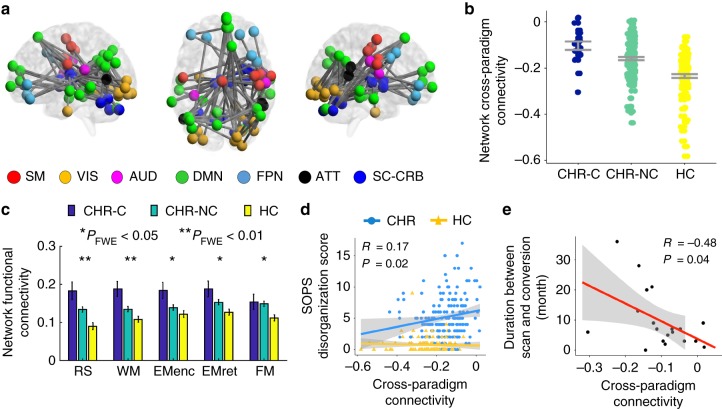
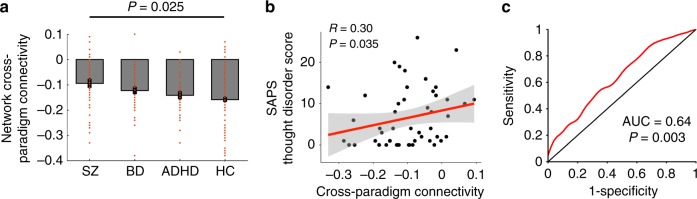
Understanding the fundamental alterations in brain functioning that lead to psychotic disorders remains a major challenge in clinical neuroscience. In particular, it is unknown whether any state-independent biomarkers can potentially predict the onset of psychosis and distinguish patients from healthy controls, regardless of paradigm. Here, using multi-paradigm fMRI data from the North American Prodrome Longitudinal Study consortium, we show that individuals at clinical high risk for psychosis display an intrinsic “trait-like” abnormality in brain architecture characterized as increased connectivity in the cerebello–thalamo–cortical circuitry, a pattern that is significantly more pronounced among converters compared with non-converters. This alteration is significantly correlated with disorganization symptoms and predictive of time to conversion to psychosis. Moreover, using an independent clinical sample, we demonstrate that this hyperconnectivity pattern is reliably detected and specifically present in patients with schizophrenia. These findings implicate cerebello–thalamo–cortical hyperconnectivity as a robust state-independent neural signature for psychosis prediction and characterization.
Overview
The claims and statistics of this paper haven’t been checked yet.
Free: it reads the open-access text and checks the first 5 claims that cite a source we can check. Create a free account to check every claim.
Integrity signals
Registry
Cites
Statistics
Figures
Verification
Claims the paper makes
The claims and statistics of this paper haven’t been checked yet.
Free: it reads the open-access text and checks the first 5 claims that cite a source we can check. Create a free account to check every claim.
Claims other papers make about this one
Each is checked against this paper’s own text: does it say what the citing paper says it does?
In the citing paper
“Cerebral-cerebellum connectivity disruption has been reported in several psychiatric disorders, including psychotic disorders(70), depressive disorder(71), autism(72) and attention-deficit/hyperactivity disorder(73).”
From Functional disruption of cerebello-thalamo-cortical networks in obsessive-compulsive disorder (2020) · cites this paper as [71]
Self-check
Percentages, sums and reported differences re-computed from the paper’s own numbers.
The self-check needs the paper’s full text.
Citations
Cites
Diagnostic and Statistical Manual of Mental Disorders
American Psychiatric Association (2013) · doi:10.1176/appi.books.9780890425596 · Cited by 116,369
Control of goal-directed and stimulus-driven attention in the brain
Corbetta, M., & Shulman, G. L. (2002) · Nature Reviews Neuroscience · doi:10.1038/nrn755 · Cited by 12,881
The Brain's Default Network: Anatomy, Function, and Relevance to Disease
Buckner, R. L., Andrews‐Hanna, J. R., & Schacter, D. L. (2008) · Annals of the New York Academy of Sciences · doi:10.1196/annals.1440.011 · Cited by 9,761
Biological insights from 108 schizophrenia-associated genetic loci
Schizophrenia Working Group of the Psychiatric Genomics Consortium (2014) · Nature · doi:10.1038/nature13595 · Cited by 7,577
Functional Network Organization of the Human Brain
Power, J. D., Cohen, A. L., Nelson, S. M., Wig, G. S., Barnes, K. A., Church, J. A., Vogel, A. C., Laumann, T. O., Miezin, F. M., Schlaggar, B. L., et al. (2011) · Neuron · doi:10.1016/j.neuron.2011.09.006 · Cited by 4,124
The cerebellar cognitive affective syndrome
Schmahmann, J. (1998) · Brain · doi:10.1093/brain/121.4.561 · Cited by 3,230
Network-based statistic: identifying differences in brain networks
Zalesky, A., Fornito, A., & Bullmore, E. T. (2010) · NeuroImage · doi:10.1016/j.neuroimage.2010.06.041 · Cited by 2,750
Scale for the Assessment of Negative Symptoms
Andreasen, N. C. (2014) · PsycTESTS Dataset · doi:10.1037/t12696-000 · Cited by 1,866
Multi-task connectivity reveals flexible hubs for adaptive task control
Cole, M. W., Reynolds, J. R., Power, J. D., Repovs, G., Anticevic, A., & Braver, T. S. (2013) · Nature Neuroscience · doi:10.1038/nn.3470 · Cited by 1,704
Self-citationIntrinsic and task-evoked network architectures of the human brain
Cole, M. W., Bassett, D. S., Power, J. D., Braver, T. S., & Petersen, S. E. (2014) · Neuron · doi:10.1016/j.neuron.2014.05.014 · Cited by 1,564
Cited by
Items 201–211 of 211
Wang, J., Jiang, C., Guo, Z., Chapman, S., Kozhemiako, N., Mylonas, D., Su, Y., Zhou, L., Shen, L., Qin, S., et al. (2024) · Figshare · doi:10.6084/m9.figshare.26011763
Convergent and Divergent Cerebellar Alterations in 22q11.2 Copy Number Variants
Fung, H., O’Hora, K., Bøen, R., Wang, H. R., Amir, C., Schleifer, C. H., Kushan, L., Miranda, B. A., Bondy, E., Mathews, P. J., et al. (2026) · Biological Psychiatry Global Open Science · doi:10.1016/j.bpsgos.2026.100718 · Cited by 2
“These structural abnormalities are consistent with the cognitive dysmetria framework, which proposes that impaired cerebello-thalamo-cortical circuitry underlies psychotic symptomatology (63–66).”
Self-citationEffective Connectivity Identifies Divergent Cerebro-Cerebellar Network Organization in Schizophrenia
Pearson, K., Aberizk, K., An, C., Hodges, G., van Erp, T. G. M., Calhoun, V. D., & Turner, J. A. (2026) · The Cerebellum · doi:10.1007/s12311-026-01983-7
Improvement in psychiatric symptoms after subdural haematoma and decompressive craniotomy
Durgun, O. E., Sivan, M., Sapsford, H., & Haider, J. (2026) · BMJ Case Reports · doi:10.1136/bcr-2025-266529
“9 The injury may have attenuated thalamic drive to cortical areas, creating a paradoxical therapeutic effect akin to a ‘functional disconnection’ from hyperstimulating input.”
Velioğlu, H. A., Gomez, T., Gallego, J. A., Lencz, T., Malhotra, A. K., Rokem, A., & Cao, H. (2026) · Biological Psychiatry Cognitive Neuroscience and Neuroimaging · doi:10.1016/j.bpsc.2026.04.001 · Cited by 2
“This is in high consistency with prior work showing abnormally strong cerebello-thalamo-cortical functional coupling and altered cerebellar-VTA anti-coactivation in psychotic disorders (16,18,25,60).”
Self-citationThe effect of sex on sleep neurophysiology in typical and altered neurodevelopment
Kozhemiako, N., Gong, N. N., & Purcell, S. (2026) · Sleep Medicine · doi:10.1016/j.sleep.2026.109153
Aberizk, K., Ku, B. S., Cao, H., Schleifer, C. H., Addington, J., Bearden, C. E., Cadenhead, K. S., Cannon, T. D., Carrión, R. E., Keshavan, M. S., et al. (2026) · Brain Structure and Function · doi:10.1007/s00429-026-03161-1
“Relative to HCs, people at CHR-P have shown large-scale functional brain network aberrations (Cao et al. 2020), as well as thalamocortical (Cao et al. 2018) and temporal lobe hyperactivity (Davies et al. 2024; Dutt et al. 2015) relative to HCs, so the unsupervised clustering may recover the…”
Self-citationSex-related differences in the cortico-thalamo-cerebellar circuit in patients with schizophrenia
Zhang, Y., Duan, M., Yao, D., Rodríguez-Labrada, R., Luo, C., & He, H. (2026) · Frontiers in Psychiatry · doi:10.3389/fpsyt.2026.1921553
“Given the roles of the cerebellum and visual cortex in sensory integration processing, this fi nding may re fl ect the cerebellum may attempt to correct signal processing deviations in the basal ganglia-cortical circuit by enhancing the integration of erroneous motor prediction signals (36).”
Mamah, D. T., Chen, S., Harms, M. P., Mutiso, V., Dong, F., Musyimi, C. W., Curtis, M., & Ndetei, D. M. (2026) · NeuroImage Clinical · doi:10.1016/j.nicl.2026.104056
“…mode, salience, and frontoparietal networks, as well as thalamic and cerebellar circuits, but with considerable variability across cohorts (Anticevic et al., 2015; Bulbul et al., 2022; Cao et al., 2018; Collin et al., 2020; Del Fabro et al., 2021; Mamah, 2023; Pelletier-Baldelli et al., 2018).”
Stawski, F., & Tofilski, M. (2026) · Synthese · doi:10.1007/s11229-026-05841-1
“Moreover, cerebello-thalamo-cortical hyperconnectivity has been identified as a state-independent neural signature for psychosis prediction (Cao et al., 2018).”
van der Heijden, H. C., Cao, A., van Gool, R., Yekedüz, M. K., Vrolix, L., Barrett, T., Randall, E. T., Golden, M. J., Goldman, M., Lu, B., et al. (2026) · Schizophrenia Research · doi:10.1016/j.schres.2026.09.039
Metadata
- Authors
- Cao, H., Chén, O. Y., Chung, Y., Forsyth, J. K., McEwen, S. C., Gee, D. G., Bearden, C. E., Addington, J., Goodyear, B., Cadenhead, K. S., Mirzakhanian, H., Cornblatt, B. A., Carrión, R. E., Mathalon, D. H., McGlashan, T. H., Perkins, D. O., Belger, A., Seidman, L. J., Thermenos, H., Tsuang, M. T., van Erp, T. G. M., Walker, E. F., Hamann, S., Anticevic, A., Woods, S. W., & Cannon, T. D.
- Affiliations
- Yale University (US)
- University of California, Los Angeles (US)
- University of Calgary (CA)
- University of California San Diego (US)
- Zucker Hillside Hospital (US)
- University of California, San Francisco (US)
- University of North Carolina at Chapel Hill (US)
- Beth Israel Deaconess Medical Center (US)
- Emory University (US)
- Corresponding author
- Cao, Hengyi
- Cannon, Tyrone D.
- ORCID
- Cao, Hengyi
- Chén, Oliver Y.
- Chung, Yoonho
- Forsyth, Jennifer K.
- McEwen, Sarah C.
- Gee, Dylan G.
- Bearden, Carrie E.
- Addington, Jean
- Goodyear, Bradley
- Cadenhead, Kristin S.
- Cornblatt, Barbara A.
- Carrión, Ricardo E.
- Mathalon, Daniel H.
- McGlashan, Thomas H.
- Perkins, Diana O.
- Seidman, Larry J.
- Tsuang, Ming T.
- van Erp, Theo G. M.
- Walker, Elaine F.
- Hamann, Stephan
- Anticevic, Alan
- Woods, Scott W.
- Cannon, Tyrone D.
- Venue
- Nature Communications
- Published
- 2018-09-21
- Volume
- 9
- Issue
- 1
- Pages
- 3836-3836
- ISSN
- 2041-1723 (ISSN-L)
- PMC
- PMC6155100
- OpenAlex
- W2890664143
- Cited by
- 211
- References
- 70
- Citations by year
- 2026: 14 · 2025: 25 · 2024: 35 · 2023: 24 · 2022: 27 · 2021: 22 · 2020: 38 · 2019: 25 · 2018: 1
- FWCI
- 16.92
- Type
- journal article
- Language
- en
- Open access
- gold
- doi.org
- Licence
- cc-by
- creativecommons.org/licenses/by/4.0 (tdm)
- creativecommons.org/licenses/by/4.0 (vor)
- Locations
- Nature Communications (publishedVersion, cc-by)
- Europe PMC (PubMed Central) (publishedVersion, cc-by)
- PubMed Central (publishedVersion, cc-by)
- PubMed (publishedVersion)
- Carolina Digital Repository (University of North Carolina at Chapel Hill) (submittedVersion)
- RePEc: Research Papers in Economics (submittedVersion)
- DOAJ (DOAJ: Directory of Open Access Journals) (submittedVersion, cc-by-sa)
- DOAJ (DOAJ: Directory of Open Access Journals) (submittedVersion)
- eScholarship (California Digital Library) (submittedVersion, cc-by)
- UNC Libraries
- Funders
- Brain and Behavior Research Foundation (27068)
- U.S. Department of Health & Human Services | NIH | National Institute of Mental Health (P50 MH066286, U01 MH066134, U01 MH081944, U01 MH081857, R01 MH076989, R01 U01 MH066069, U01 MH081928, U01 MH081988, U01 MH82022, U01 MH081902)
- Topics
- Health Sciences › Medicine › Psychiatry and Mental health › Schizophrenia research and treatment
- Life Sciences › Neuroscience › Cognitive Neuroscience › Functional Brain Connectivity Studies
- Social Sciences › Psychology › Clinical Psychology › Psychopathy, Forensic Psychiatry, Sexual Offending
- Keywords
- psychosis prediction, clinical high risk for psychosis, schizophrenia, disorganization symptoms, brain network architecture, North American Prodrome Longitudinal Study
- MeSH terms
- Brain, Humans, Magnetic Resonance Imaging, Psychotic Disorders, Schizophrenia, Cohort Studies, Case-Control Studies, Principal Component Analysis, Connectome
About these checks
Registry, retraction, Cites and statistics results are computed, not judged, with one exception: a printed reference that no index lists is read once by a model before it counts as a citation error. Claims are extracted by a model and kept only when their quote appears verbatim in the text; each cited source is then checked, with a model’s help, for whether it says what the claim relies on. Those verdicts can be wrong — read the claim’s quote and the cited source before relying on one.
Statistics and arithmetic are recomputed, not judged.
Confidence bands are shown only for fields calibrated on our annotated test set. None is calibrated yet, so no band is shown.
What counts as a claim ›How we measure confidence ›How we check this ›
Are you an author, or do you see a problem with this page? Request a review
Data sources
Bibliographic data: Semantic Scholar, OpenAlex, Crossref.
Contains information from the Semantic Scholar Academic Graph Datasets, made available under the ODC Attribution License (ODC-BY 1.0).
Semantic Scholar’s data is described in: Kinney, R., et al. (2023). The Semantic Scholar Open Data Platform. arXiv:2301.10140.
