

Stepwise oxygenation of the Paleozoic atmosphere
Open accessThe DOI matches its Crossref record; 79 of the 81 references it cites were found in a registry or an index.
Abstract
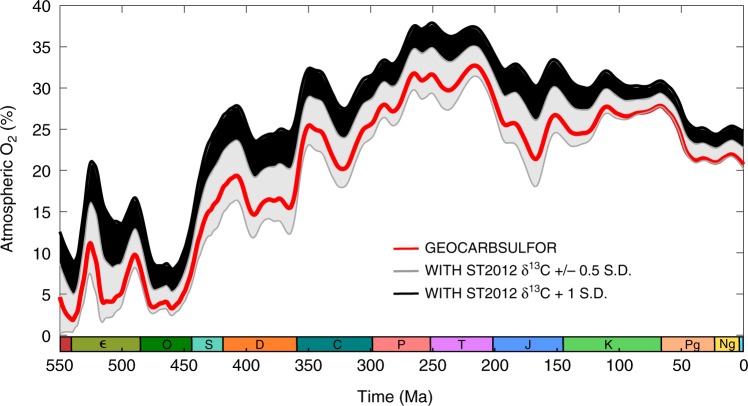
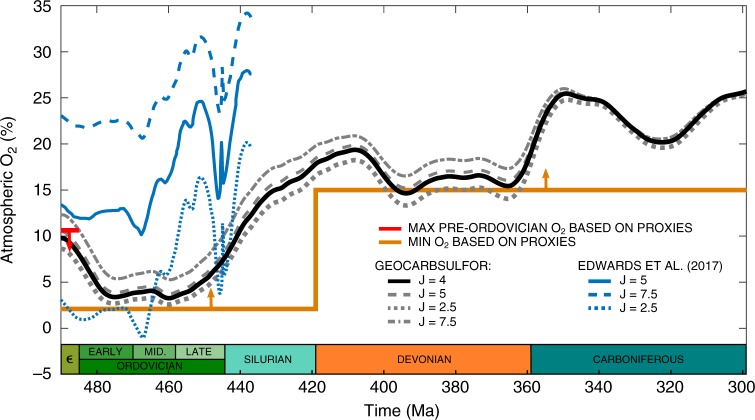
Oxygen is essential for animal life, and while geochemical proxies have been instrumental in determining the broad evolutionary history of oxygen on Earth, much of our insight into Phanerozoic oxygen comes from biogeochemical modelling. The GEOCARBSULF model utilizes carbon and sulphur isotope records to produce the most detailed history of Phanerozoic atmospheric O 2 currently available. However, its predictions for the Paleozoic disagree with geochemical proxies, and with non-isotope modelling. Here we show that GEOCARBSULF oversimplifies the geochemistry of sulphur isotope fractionation, returning unrealistic values for the O 2 sourced from pyrite burial when oxygen is low. We rebuild the model from first principles, utilizing an improved numerical scheme, the latest carbon isotope data, and we replace the sulphur cycle equations in line with forwards modelling approaches. Our new model, GEOCARBSULFOR, produces a revised, highly-detailed prediction for Phanerozoic O 2 that is consistent with available proxy data, and independently supports a Paleozoic Oxygenation Event, which likely contributed to the observed radiation of complex, diverse fauna at this time.
Overview
The claims and statistics of this paper haven’t been checked yet.
Free: it reads the open-access text and checks the first 5 claims that cite a source we can check. Create a free account to check every claim.
Integrity signals
Registry
Cites
Statistics
Figures
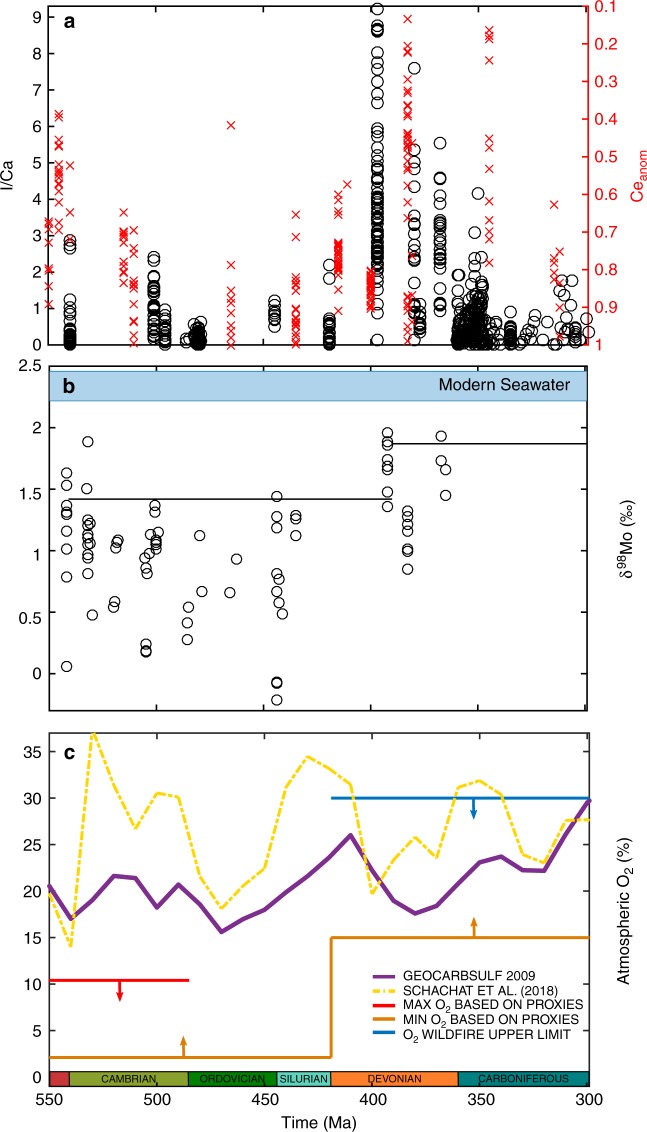
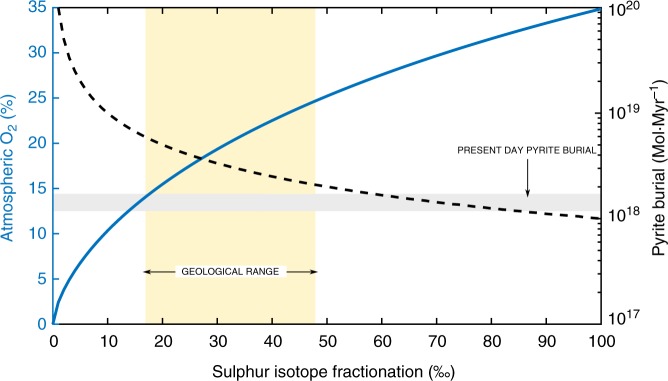
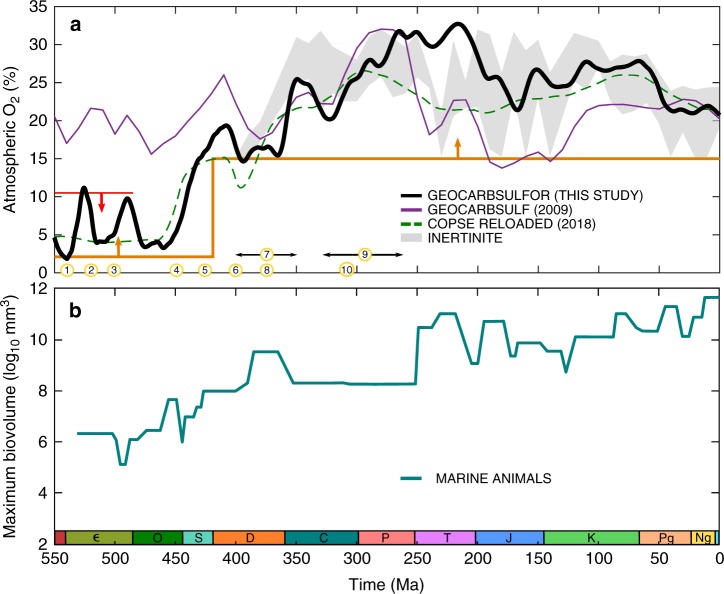
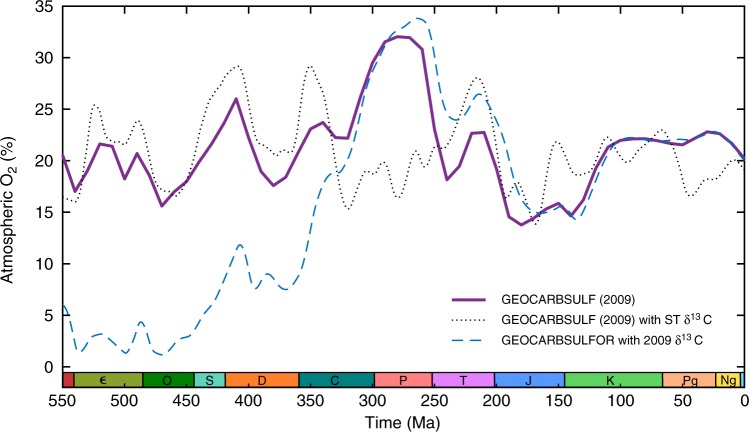
Verification
Claims the paper makes
The claims and statistics of this paper haven’t been checked yet.
Free: it reads the open-access text and checks the first 5 claims that cite a source we can check. Create a free account to check every claim.
Claims other papers make about this one
Each is checked against this paper’s own text: does it say what the citing paper says it does?
The source backs part of the claim, not all of it — or backs it for a different population, condition or comparison.
In the citing paper
“Environmental stress caused by the persistent development of oxygen-deficient conditions in shallow marine realms due to low net atmospheric oxygen production 57 is likely to have been a major contributing factor.”
From Possible links between extreme oxygen perturbations and the Cambrian radiation of animals (2019) · cites this paper as [57]
Experimental — accuracy not yet measured
Self-check
Percentages, sums and reported differences re-computed from the paper’s own numbers.
The self-check needs the paper’s full text.
Citations
Cites
Structural absorption by barbule microstructures of super black bird of paradise feathers
McCoy, D. E., Feo, T., Harvey, T. A., & Prum, R. O. (2018) · Nature Communications · doi:10.1038/s41467-017-02088-w · Cited by 7,424
Shampine, L. F., & Reichelt, M. W. (1997) · SIAM Journal on Scientific Computing · doi:10.1137/s1064827594276424 · Cited by 3,599
The rise of oxygen in Earth's early ocean and atmosphere
Lyons, T. W., Reinhard, C. T., & Planavsky, N. J. (2014) · Nature · doi:10.1038/nature13068 · Cited by 2,810
Self-citationControl of yellow and purple nutsedge in elevated CO2 environments with glyphosate and halosulfuron
Marble, S. C., Prior, S. A., Runion, G. B., & Torbert, H. A. (2015) · Frontiers in Plant Science · doi:10.3389/fpls.2015.00001 · Cited by 1,940
Atmospheric Influence of Earth's Earliest Sulfur Cycle
Farquhar, J., Bao, H., & Thiemens, M. (2000) · Science · doi:10.1126/science.289.5480.756 · Cited by 1,805
Burdige, D. J. (2007) · Chemical Reviews · doi:10.1021/cr050347q · Cited by 1,310
A new model for Proterozoic ocean chemistry
Canfield, D. E. (1998) · Nature · doi:10.1038/24839 · Cited by 1,243
Berner, R. A. (1982) · American Journal of Science · doi:10.2475/ajs.282.4.451 · Cited by 1,200
GEOCARBSULF: A combined model for Phanerozoic atmospheric O2 and CO2
Berner, R. A. (2006) · Geochimica et Cosmochimica Acta · doi:10.1016/j.gca.2005.11.032 · Cited by 1,120 · cited 1×
“Berner, R. A. Addendum to ‘Inclusion of the Weathering of Volcanic Rocks in the GEOCARBSULF Model’: (R. A. Berner, 2006, V. 306, p. 295-302).”
Tracing the stepwise oxygenation of the Proterozoic ocean
Scott, C., Lyons, T. W., Bekker, A., Shen, Y., Poulton, S. W., Chu, X., & Anbar, A. D. (2008) · Nature · doi:10.1038/nature06811 · Cited by 1,098
Self-citation
Research works printed but not linked: 1
- Zopfi J Ferdelman TG Fossing H Thiosulfate, and elemental sulfur in marine sediments Geol. Soc. Am. Spec. Pap. 2004 379 97 116
Cited by
Items 201–255 of 255
The paleoenvironmental evolution of the Cambrian Miaolingian Epoch in South China
Dong, Y., Wang, J., Zhong, Y., Chen, A., Zheng, R., Zhu, P. Y., Zhang, C., Han, Z., & Cui, Y. (2025) · Palaeogeography Palaeoclimatology Palaeoecology · doi:10.1016/j.palaeo.2024.112713 · Cited by 3
The Link between Birds and Dinosaurs: Aves Evolved from Dinosaurs
Moon, Y. S. (2022) · Korean Journal of Poultry Science · doi:10.5536/kjps.2022.49.3.167 · Cited by 3
“초기 트리아식 지구의 산소는 급격하게 감소한 다음 후기 트리아식까지유지한 후 점진적으로 회복되었는데, 지구상에 공룡이 처음 출현한 후 기 트리아식기의 산소 농도는 현재보다 낮은 시기였다 (Berner, 2003; Tanner et al., 2004; Krause et al., 2018).”
Hu, Q., Luo, G., & Li, Y. (2023) · Chinese Science Bulletin (Chinese Version) · doi:10.1360/tb-2023-0109 · Cited by 4
Carbon and sulfur cycling across the Silurian-Devonian boundary in the Qujing Basin, South China
Sun, L., Zhang, X., Zhu, M., Xu, Y., Zhao, W., & Shen, Y. (2024) · Chemical Geology · doi:10.1016/j.chemgeo.2024.121952 · Cited by 2
Huang, T., & Fernández‐Remolar, D. C. (2025) · Minerals · doi:10.3390/min15030203 · Cited by 3
Proteromorphosis in Early Triassic Conodonts
Kılıç, A. M., Guex, J., & Hirsch, F. (2020) · Springer eBooks · doi:10.1007/978-3-030-47279-5_5 · Cited by 4
Astronomically forced organic matter accumulation and climate changes in the Early Cambrian
Wang, J., Hu, Z., Han, Y., Zhou, G., Xie, W., & Wu, S. (2026) · Sedimentology · doi:10.1111/sed.70086 · Cited by 2
“…jumps in primary productivity (Cook & Shergold, 1984, 1986; Brennan et al ., 2004; Cre-veling et al ., 2014); and the UV shielding effect of the ozone layer created conditions for organic matter accumulation and preservation (Kasting, 1987; Berner, 2006; Lyons et al ., 2014; Krause et al ., 2018).”
Earth system instability explains redox paradox during late Cambrian SPICE event
Sheng, K., Li, Z., Zhou, J., Lin, Y.-B., Xiong, G., Ren, G., Chen, Z., Lenton, T. M., Shen, S., & Zhang, F. (2026) · Science Advances · doi:10.1126/sciadv.aeb9224 · Cited by 2
“…sulfate levels inferred from sulfur isotope mass balance, suggesting a high burial ratio of pyrite to gypsum ( 15 ), (iii) the absence of pre–400 Ma charcoal ( 16 ), and (iv) modeling results from inverse [data-driven; GEOCARBSULFOR; ( 17 )] and forward models [process-driven; COPSE; ( 18 , 19 )].”
Self-citationThe spatiotemporal distributions of global paleo-Köppen climate zones during the Mesozoic-Cenozoic
Yu, C., Lunt, D. J., Zhang, L., Hu, L., & Wang, C. (2026) · Earth-Science Reviews · doi:10.1016/j.earscirev.2026.105543 · Cited by 2
Thinking beyond the data: When the sea went dark
Larsen, S. (2021) · Marine Ecology · doi:10.1111/maec.12665 · Cited by 2
Liang, Z., & Tian, S. (2021) · Earth Science-Journal of China University of Geosciences · doi:10.3799/dqkx.2021.091 · Cited by 2
Moreno, F., Mestre, A., & Heredia, S. (2024) · Historical Biology · doi:10.1080/08912963.2023.2300647 · Cited by 3
“…temperature, paleolatitudinal position, global climate, oxygen availability, marine redox conditions, ocean circulation, and sea-level fluctuations, among others (Rasmussen et al. 2016; Edwards et al. 2017; Krause et al. 2018; van de Velde et al. 2018; Stigall et al. 2019; Del Rey et al. 2022).”
Li, Y., Xue, J., Wang, S., Ye, Z., Fang, J., & Li, X. C. (2025) · Geoscience Frontiers · doi:10.1016/j.gsf.2025.102100 · Cited by 2
Rodney, J. B., Andersen, M. B., Stubbs, D., Lissenberg, C. J., Gianola, O., Willbold, M., & Elliott, T. R. (2025) · Earth and Planetary Science Letters · doi:10.1016/j.epsl.2025.119489 · Cited by 3
Zhang, K., Miao, L., Zhang, S., Zhou, Y., & Shields, G. (2025) · Journal of the Geological Society · doi:10.1144/jgs2025-040 · Cited by 3
Self-citationFuture directions for understanding the coevolution of life and oxygen
Alcott, L., Bowyer, F. T., & Agić, H. (2025) · Communications Earth & Environment · doi:10.1038/s43247-025-02689-0 · Cited by 2
“The third stepwise event, the Paleozoic Oxygenation Event (POE; ~450 – 350 Ma 20,21 ), is associated with the rise of the terrestrial biosphere during the mid-Paleozoic 22,23 , and culminated in the oxygenation of the deep ocean and an oxygenated world more reminiscent of the modern day.”
��, Ï., ��, �., ��, �., ��, �., & ��, �. (2019) · SCIENTIA SINICA Terrae · doi:10.1360/sste-2019-0183 · Cited by 1
Wang, H., Zhang, L., Sun, Z., Deng, H., Zhao, G., & Liao, Z. (2025) · Global and Planetary Change · doi:10.1016/j.gloplacha.2025.105036 · Cited by 1
A Multi-Basin Comparison of Paleoredox Conditions During the Mid-Silurian Mulde/Lundgreni Event
Maaleki-Moghadam, M., Lindskog, A., Noble, P. J., Kaljo, D., Hints, O., Goodin, J., Owens, J. D., & Young, S. A. (2025) · Global and Planetary Change · doi:10.1016/j.gloplacha.2025.105085 · Cited by 1
Life on Planet: Its Origin and Expansion Across Earth’s Ecosystem
Sobti, R. C., Sharma, I., Negi, R. K., & Modeel, S. (2026) · Springer eBooks · doi:10.1007/978-981-97-9859-9_2 · Cited by 1
Combined effects of photorespiration and fire strongly regulate atmospheric oxygen levels
Vitali, R., Belcher, C. M., Mills, B. J. W., & Watson, A. J. (2026) · Science Advances · doi:10.1126/sciadv.ady0542 · Cited by 3
“Moreover, many biogeochemical models have been validated using charcoal-based proxies with these previously assumed limits, further compounding this circularity ( 2 , 31 , 32 , 42 , 43 ).”
Self-citationFuture diversity and lifespan of metazoans under global warming and oxygen depletion
Kaiho, K. (2026) · Biogeosciences · doi:10.5194/bg-23-1199-2026 · Cited by 1
“Although these estimates carry substantial uncertainty, they follow the reconstructions of Krause et al. (2018, 2022), supported by Sperling et al. (2015) (Fig.”
Exploring extremophile gas production as a biomarker for early Earth atmospheres
Molina, V., Aguilar, P., Dorador, C., Tregloan-Reed, J., Rojas-Ayala, B., Carcamo, J., Aliaga, Á., & Soto, M. (2026) · International Journal of Astrobiology · doi:10.1017/s1473550425100268 · Cited by 2
“…or aerobic, could have utilized both CO and CO 2 in reversible metabolic reactions, even in this reducing or slightly oxidizing environment, facilitating a slow shift towards an increasingly oxidizing atmosphere (Czaja et al. , 2016; Gutierrez-Preciado et al ., 2018; Krause et al ., 2018).”
Cooling-induced intensification of ocean anoxia in the mid-Paleozoic
Wang, Y., Wignall, P. B., Mills, B. J. W., Dickson, A. J., Loydell, D. K., Xiong, Y., Xu, Z., Peakall, J., & Poulton, S. W. (2026) · Science Advances · doi:10.1126/sciadv.aec8573 · Cited by 2
Self-citationThe evolution of the Earth’s surface iron cycle
Scholz, F., Döetterl, S., & Hardisty, D. S. (2026) · Proceedings of the National Academy of Sciences · doi:10.1073/pnas.2608784123 · Cited by 1
Ju, P., Wang, Z., Chang, C., Zheng, Z., Li, R., Xia, W., Cao, X., Han, Y., Zhao, M., Li, C., et al. (2024) · Palaeogeography Palaeoclimatology Palaeoecology · doi:10.1016/j.palaeo.2024.112506 · Cited by 2
CHUPRYNA, A., Aubineau, J., Bankole, O. M., Fru, E. C., Konhauser, K. O., Nesterovskyi, V. A., Martyshyn, A., Soldatenko, Y., Becker-Kerber, B., Sansjofre, P., et al. (2025) · Comptes Rendus Géoscience · doi:10.5802/crgeos.296 · Cited by 2
Sheffield, S. L., Lam, A. R., & Matzke, N. J. (2020) · Abstracts with programs - Geological Society of America · doi:10.1130/abs/2020am-355924 · Cited by 1
Hydrodynamics as a hidden abiotic factor constraining Ordovician chitinozoan morphological evolution
Zhu, G., Lyu, Q., Du, M., & Wang, W. (2023) · Palaeogeography Palaeoclimatology Palaeoecology · doi:10.1016/j.palaeo.2023.111568 · Cited by 1
Multi-Level Effects of Oxygen Exposure in Endothermic Insects
Wilmsen, S. M. (2022) · University of North Texas Digital Library (University of North Texas) · doi:10.12794/metadc1986787 · Cited by 2
A Historical Perspective on Long‐Term Global Biogeochemical Box Models
Kemeny, P. C., Krause, A., & Kump, L. R. (2025) · Geophysical monograph · doi:10.1002/9781394229185.ch12 · Cited by 3
Self-citationResponse to anonymous referee #2
Huang, J. (2019) · doi:10.5194/essd-2019-36-ac1
Ruban, D. A. (2024) · Geosystems and Geoenvironment · doi:10.1016/j.geogeo.2024.100265 · Cited by 1
Biogeochemical modeling of global nutrient cycling
Ozaki, K. (2024) · Elsevier eBooks · doi:10.1016/b978-0-323-99762-1.00073-5
Comment on egusphere-2024-2579
Edmonsond, S., & Dyer, B. C. (2025) · doi:10.5194/egusphere-2024-2579-rc1
Atmospheric Oxygen and Paleotemperature in the Paleozoic and TriassicPreprint
Giles, P. S. (2025) · SSRN Electronic Journal · doi:10.2139/ssrn.5258508
Global Ocean Cycles of Mg, Si, P, N, C, O2 and Fe
Murray, J. W. (2025) · Oxford University Press eBooks · doi:10.1093/9780191853241.003.0017
Lee, S. A., Żylińska, A., & Collins, R. (2025) · The Ohio Journal of Science · doi:10.18061/ojs.v124i2.9609
Lee, Y. I., Kwon, H., & Kim, M. G. (2025) · Chemical Geology · doi:10.1016/j.chemgeo.2025.123086
Liu, W., Chu, X., Cao, W., & Wan, B. (2025) · Geochimica et Cosmochimica Acta · doi:10.1016/j.gca.2025.11.049
Changes in Phanerozoic atmospheric oxygen on different timescales and their regulating mechanisms
Yan, Y., Yang, M., Li, C., Lu, W., Zhou, X., Du, J., & Tian, J. (2025) · Chinese Science Bulletin (Chinese Version) · doi:10.1360/csb-2025-0331_cn
“…模式 [38] 认为过 去 侏 罗 纪 p O 2 可 能 低 至 12% ( 0.6 PAL ), 但 在 该 模 式 基 础 上 迭 代 的 GEOCARBSULFOR [14] 则给出了与现代大气氧含量相当的侏罗纪 p O 2 。在更短的 时间尺度上,最早的 GEOCARBSULF 模式 [38] 预测新生代 p O 2 整体呈上升趋势, 但同一模式在改变了光合作用碳同位素分馏系数的变化范围后得到了 30 Ma 以 来 p O 2 下降的结论 [46] d Valen [47] 、 Holland [48] 、 Walker [8] [47] 。这背后的本质是深部地球过程对于地表系…”
InfluentialAre Humans Alone in the Cosmos?
Ross, H. N. (2025) · Religions · doi:10.3390/rel16121589
“An even thicker ozone shield such as what formed in Earth’s atmosphere 330 million years ago, when the atmospheric oxygen level reached 20 percent (Krause et al. 2018), screens out all uv-B radiation shorter than 305 nanometers.”
Stagewise oxygenation of the Earth’s atmosphere and oceans
Wang, H., & Li, C. (2026) · The Innovation · doi:10.1016/j.xinn.2026.101353 · Cited by 3
Gao, Y., Poulton, S. W., Li, J., Xiong, Y., Lan, C., & Long, X. (2026) · Precambrian Research · doi:10.1016/j.precamres.2026.108088
Self-citationMonti, D., & Serra, F. (2026) · Lethaia · doi:10.18261/let.59.4.5
Subduction modulated the long-term oxygenation of Earth’s surface
Shi, W., Li, C., Mills, B. J. W., Brown, M., Johnson, T. E., Algeo, T. J., Hou, M., Wang, C., Zhao, M., & Poulton, S. W. (2026) · Proceedings of the National Academy of Sciences · doi:10.1073/pnas.2534056123
Self-citationStacey, J., Wallace, M. W., Hood, A. V. S., & Corlett, H. (2026) · Global and Planetary Change · doi:10.1016/j.gloplacha.2026.105549
Algal δ13C reveals climate changes during the Cambrian Explosion
Chang, C., Zhao, M., Ju, P., Fu, D., Li, R., Guo, J., Huang, K., Wang, M., Cui, L., Yang, Y., et al. (2026) · Nature Communications · doi:10.1038/s41467-026-74516-9
LeRoy, M. A., Gill, B. C., Newby, S. M., Them, T. R., & Owens, J. D. (2026) · Chemical Geology · doi:10.1016/j.chemgeo.2026.123579
Wei, Y., 胡安平, Algeo, T. J., Hu, Q., Shen, A., Liang, F., Li, H., Feng, L., & Zhou, L. (2026) · Chemical Geology · doi:10.1016/j.chemgeo.2026.123740
Tipping points of the ocean oxygen: A dynamical systems perspective
Anonymous, & Petrovskii, S. (2026) · Physical review. E · doi:10.1103/w5c6-wnv8
The evolution of atmospheric oxygen on Earth
Watanabe, Y. (2026) · Elsevier eBooks · doi:10.1016/b978-0-443-15748-6.00031-9
Ashing-Giwa, K. F., Payne, J. L., Bergmann, K., Monarrez, P. M., Gaskell, D. E., Stockey, R., & Sperling, E. A. (2026) · Current Biology · doi:10.1016/j.cub.2026.09.017
Metadata
- Authors
- Krause, A. J., Mills, B. J. W., Zhang, S., Planavsky, N. J., Lenton, T. M., & Poulton, S. W.
- Affiliations
- University of Leeds (GB)
- Yale University (US)
- University of Exeter (GB)
- Corresponding author
- Krause, Alexander J.
- ORCID
- Venue
- Nature Communications
- Published
- 2018-10-04
- Volume
- 9
- Issue
- 1
- Pages
- 4081-4081
- ISSN
- 2041-1723 (ISSN-L)
- PMC
- PMC6172248
- OpenAlex
- W2890860757
- Semantic Scholar
- 9e34e9399602a3b729745855480b5101550bfe8d
- Cited by
- 255
- References
- 81
- Citations by year
- 2026: 21 · 2025: 37 · 2024: 29 · 2023: 44 · 2022: 43 · 2021: 38 · 2020: 24 · 2019: 17 · 2018: 2
- FWCI
- 14.86
- Type
- journal article
- Language
- en
- Open access
- gold
- doi.org
- Licence
- cc-by
- creativecommons.org/licenses/by/4.0 (tdm)
- creativecommons.org/licenses/by/4.0 (vor)
- Locations
- Nature Communications (publishedVersion, cc-by)
- Europe PMC (PubMed Central) (publishedVersion, other-oa)
- PubMed Central (publishedVersion, cc-by)
- PubMed (publishedVersion)
- White Rose Research Online (University of Leeds, The University of Sheffield, University of York) (acceptedVersion)
- RePEc: Research Papers in Economics (submittedVersion)
- DOAJ (DOAJ: Directory of Open Access Journals) (submittedVersion, cc-by-sa)
- DOAJ (DOAJ: Directory of Open Access Journals) (submittedVersion)
- Figshare (submittedVersion, cc-by)
- ORCA Online Research @Cardiff (Cardiff University) (submittedVersion)
- Open Research Exeter (University of Exeter) (submittedVersion, cc-by)
- Funders
- Natural Environment Research Council (NE/L002574/1)
- Topics
- Physical Sciences › Earth and Planetary Sciences › Paleontology › Paleontology and Stratigraphy of Fossils
- Physical Sciences › Earth and Planetary Sciences › Geochemistry and Petrology › Geological and Geochemical Analysis
- Physical Sciences › Environmental Science › Global and Planetary Change › Earth Systems and Cosmic Evolution
- Keywords
- atmospheric oxygenation, sulfur isotope fractionation, pyrite burial, carbon isotope record, biogeochemical modeling, geochemical proxies
About these checks
Registry, retraction, Cites and statistics results are computed, not judged, with one exception: a printed reference that no index lists is read once by a model before it counts as a citation error. Claims are extracted by a model and kept only when their quote appears verbatim in the text; each cited source is then checked, with a model’s help, for whether it says what the claim relies on. Those verdicts can be wrong — read the claim’s quote and the cited source before relying on one.
Statistics and arithmetic are recomputed, not judged.
Confidence bands are shown only for fields calibrated on our annotated test set. None is calibrated yet, so no band is shown.
What counts as a claim ›How we measure confidence ›How we check this ›
Are you an author, or do you see a problem with this page? Request a review
Data sources
Bibliographic data: Semantic Scholar, OpenAlex, Crossref.
Contains information from the Semantic Scholar Academic Graph Datasets, made available under the ODC Attribution License (ODC-BY 1.0).
Semantic Scholar’s data is described in: Kinney, R., et al. (2023). The Semantic Scholar Open Data Platform. arXiv:2301.10140.
