

Stepwise oxygenation of the Paleozoic atmosphere
Open accessThe DOI matches its Crossref record; 79 of the 81 references it cites were found in a registry or an index.
Abstract
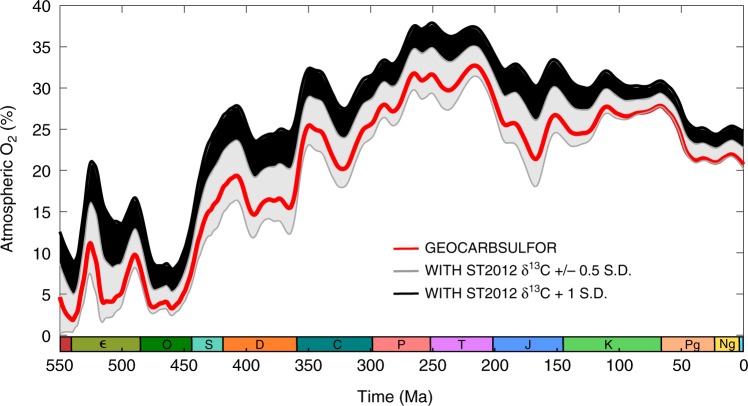
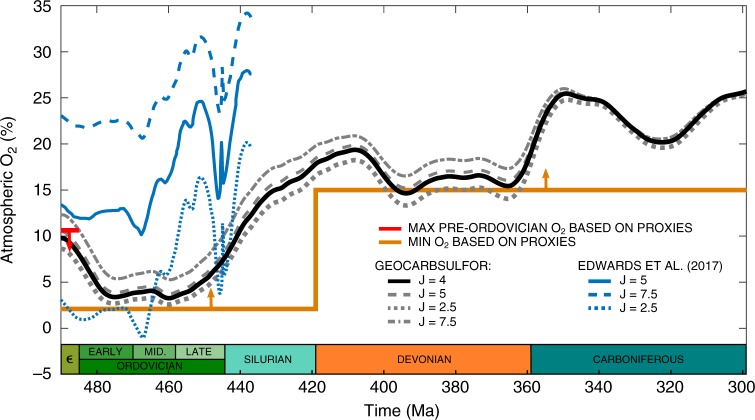
Oxygen is essential for animal life, and while geochemical proxies have been instrumental in determining the broad evolutionary history of oxygen on Earth, much of our insight into Phanerozoic oxygen comes from biogeochemical modelling. The GEOCARBSULF model utilizes carbon and sulphur isotope records to produce the most detailed history of Phanerozoic atmospheric O 2 currently available. However, its predictions for the Paleozoic disagree with geochemical proxies, and with non-isotope modelling. Here we show that GEOCARBSULF oversimplifies the geochemistry of sulphur isotope fractionation, returning unrealistic values for the O 2 sourced from pyrite burial when oxygen is low. We rebuild the model from first principles, utilizing an improved numerical scheme, the latest carbon isotope data, and we replace the sulphur cycle equations in line with forwards modelling approaches. Our new model, GEOCARBSULFOR, produces a revised, highly-detailed prediction for Phanerozoic O 2 that is consistent with available proxy data, and independently supports a Paleozoic Oxygenation Event, which likely contributed to the observed radiation of complex, diverse fauna at this time.
Overview
The claims and statistics of this paper haven’t been checked yet.
Free: it reads the open-access text and checks the first 5 claims that cite a source we can check. Create a free account to check every claim.
Integrity signals
Registry
Cites
Statistics
Figures
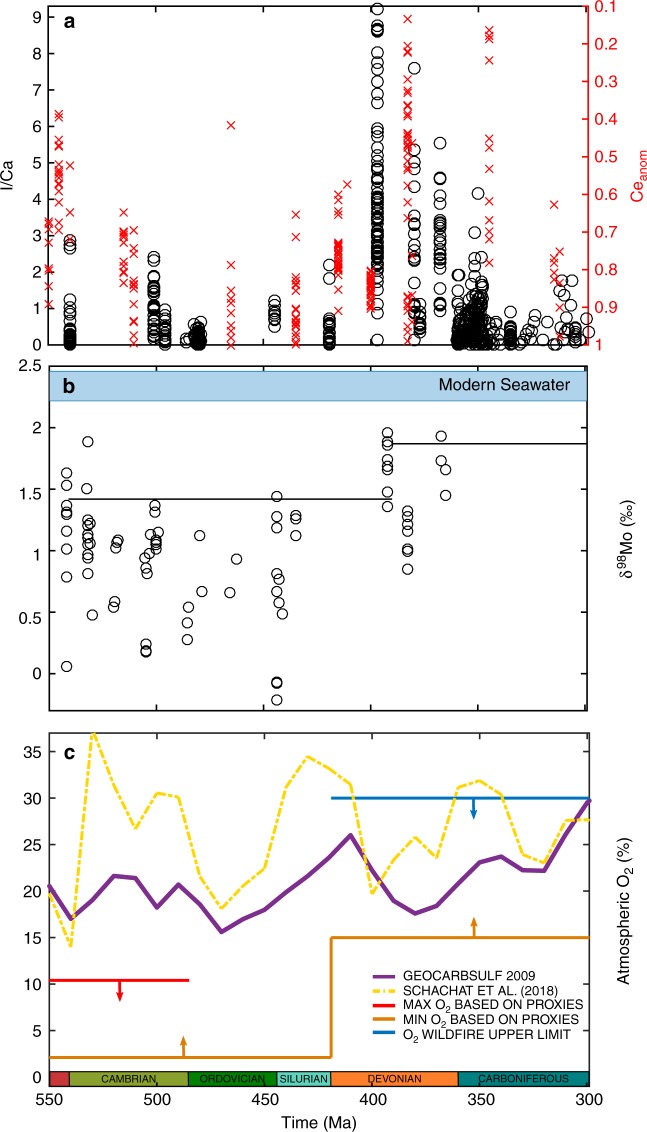
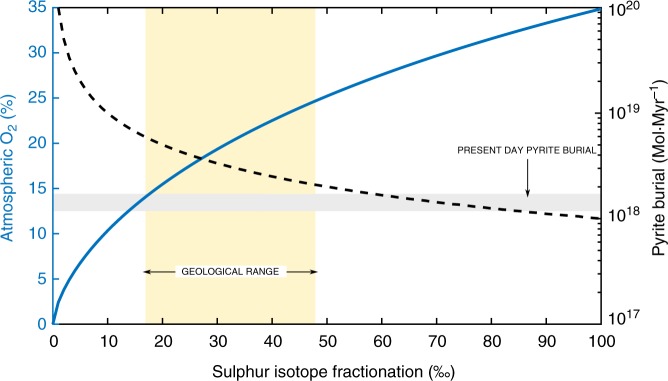
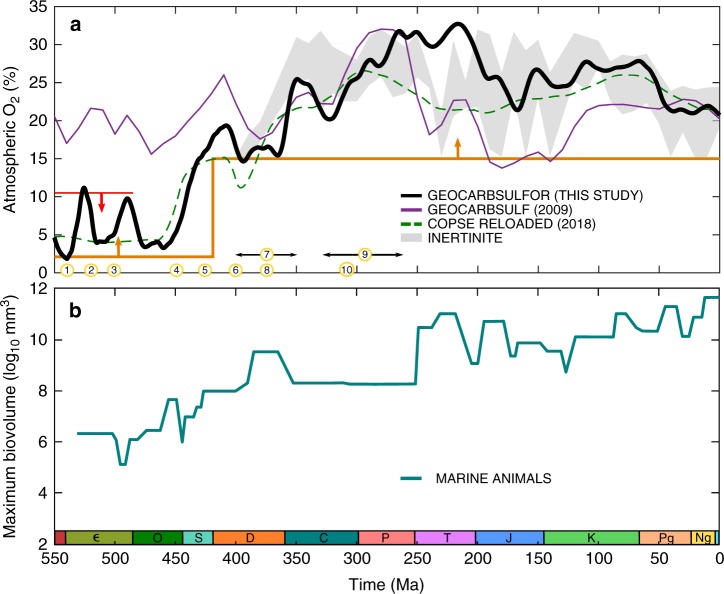
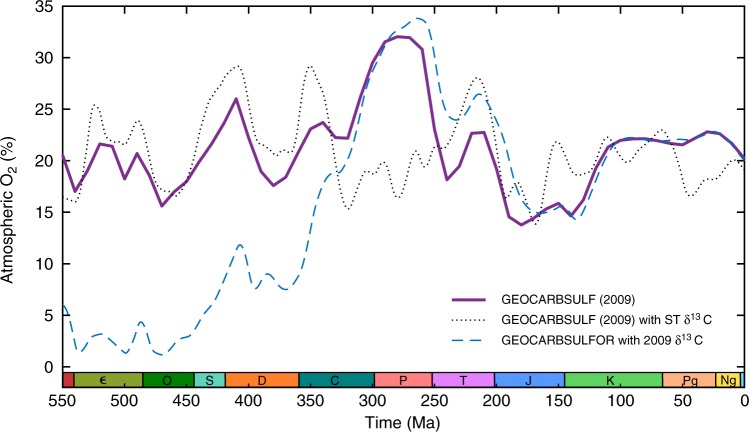
Verification
Claims the paper makes
The claims and statistics of this paper haven’t been checked yet.
Free: it reads the open-access text and checks the first 5 claims that cite a source we can check. Create a free account to check every claim.
Claims other papers make about this one
Each is checked against this paper’s own text: does it say what the citing paper says it does?
The source backs part of the claim, not all of it — or backs it for a different population, condition or comparison.
In the citing paper
“Environmental stress caused by the persistent development of oxygen-deficient conditions in shallow marine realms due to low net atmospheric oxygen production 57 is likely to have been a major contributing factor.”
From Possible links between extreme oxygen perturbations and the Cambrian radiation of animals (2019) · cites this paper as [57]
Experimental — accuracy not yet measured
Self-check
Percentages, sums and reported differences re-computed from the paper’s own numbers.
The self-check needs the paper’s full text.
Citations
Cites
Structural absorption by barbule microstructures of super black bird of paradise feathers
McCoy, D. E., Feo, T., Harvey, T. A., & Prum, R. O. (2018) · Nature Communications · doi:10.1038/s41467-017-02088-w · Cited by 7,424
Shampine, L. F., & Reichelt, M. W. (1997) · SIAM Journal on Scientific Computing · doi:10.1137/s1064827594276424 · Cited by 3,599
The rise of oxygen in Earth's early ocean and atmosphere
Lyons, T. W., Reinhard, C. T., & Planavsky, N. J. (2014) · Nature · doi:10.1038/nature13068 · Cited by 2,810
Self-citationControl of yellow and purple nutsedge in elevated CO2 environments with glyphosate and halosulfuron
Marble, S. C., Prior, S. A., Runion, G. B., & Torbert, H. A. (2015) · Frontiers in Plant Science · doi:10.3389/fpls.2015.00001 · Cited by 1,940
Atmospheric Influence of Earth's Earliest Sulfur Cycle
Farquhar, J., Bao, H., & Thiemens, M. (2000) · Science · doi:10.1126/science.289.5480.756 · Cited by 1,805
Burdige, D. J. (2007) · Chemical Reviews · doi:10.1021/cr050347q · Cited by 1,310
A new model for Proterozoic ocean chemistry
Canfield, D. E. (1998) · Nature · doi:10.1038/24839 · Cited by 1,243
Berner, R. A. (1982) · American Journal of Science · doi:10.2475/ajs.282.4.451 · Cited by 1,200
GEOCARBSULF: A combined model for Phanerozoic atmospheric O2 and CO2
Berner, R. A. (2006) · Geochimica et Cosmochimica Acta · doi:10.1016/j.gca.2005.11.032 · Cited by 1,120 · cited 1×
“Berner, R. A. Addendum to ‘Inclusion of the Weathering of Volcanic Rocks in the GEOCARBSULF Model’: (R. A. Berner, 2006, V. 306, p. 295-302).”
Tracing the stepwise oxygenation of the Proterozoic ocean
Scott, C., Lyons, T. W., Bekker, A., Shen, Y., Poulton, S. W., Chu, X., & Anbar, A. D. (2008) · Nature · doi:10.1038/nature06811 · Cited by 1,098
Self-citation
Research works printed but not linked: 1
- Zopfi J Ferdelman TG Fossing H Thiosulfate, and elemental sulfur in marine sediments Geol. Soc. Am. Spec. Pap. 2004 379 97 116
Cited by
Seawater Temperature and Dissolved Oxygen over the Past 500 Million Years
Song, H., Wignall, P. B., Song, H., Dai, X., & Chu, D. (2019) · Journal of Earth Science · doi:10.1007/s12583-018-1002-2 · Cited by 220
Possible links between extreme oxygen perturbations and the Cambrian radiation of animals
He, T., Zhu, M., Mills, B. J. W., Wynn, P. M., Zhuravlev, A. Y., Tostevin, R., Pogge von Strandmann, P. A. E., Yang, A., Poulton, S. W., & Shields, G. A. (2019) · Nature Geoscience · doi:10.1038/s41561-019-0357-z · Cited by 193
Self-citationMills, B. J. W., Krause, A. J., Scotese, C. R., Hill, D. J., Shields, G. A., & Lenton, T. M. (2019) · Gondwana Research · doi:10.1016/j.gr.2018.12.001 · Cited by 178
“The most recent Earth system box models are powerful predictive tools, used to reconstruct changes in global biogeochemistry and climate for times when proxy estimates are either unavailable or unreliable (Arvidson et al., 2013; Royer et al., 2014; Mills et al., 2016; Lenton et al., 2018; Krause et al., 2018), or used…”
BackgroundSelf-citationStigall, A. L., Edwards, C. T., Freeman, R. L., & Rasmussen, C. M. Ø. (2019) · Palaeogeography, Palaeoclimatology, Palaeoecology · doi:10.1016/j.palaeo.2019.05.034 · Cited by 160
Sedimentary Ce anomalies: Secular change and implications for paleoenvironmental evolution
Zhang, K., & Shields, G. A. (2022) · Earth-Science Reviews · doi:10.1016/j.earscirev.2022.104015 · Cited by 158
Eukaryogenesis and oxygen in Earth history
Mills, D. B., Boyle, R. A., Daines, S. J., Sperling, E. A., Pisani, D., Donoghue, P. C. J., & Lenton, T. M. (2022) · Nature Ecology & Evolution · doi:10.1038/s41559-022-01733-y · Cited by 151
“While oxygen became a permanent feature of the atmosphere during the GOE, modern p O 2 levels were most probably only attained around 420–400 Ma, during the Palaeozoic Era 129,130 (Fig.”
Self-citationStepwise Earth oxygenation is an inherent property of global biogeochemical cycling
Alcott, L. J., Mills, B. J. W., & Poulton, S. W. (2019) · Science · doi:10.1126/science.aax6459 · Cited by 152
Self-citationRichey, J. D., Montañez, I. P., Goddéris, Y., Looy, C. V., Griffis, N. P., & DiMichele, W. A. (2020) · Climate of the past · doi:10.5194/cp-16-1759-2020 · Cited by 162
The redox structure of Ediacaran and early Cambrian oceans and its controls
Li, C., Shi, W., Cheng, M., Jin, C., & Algeo, T. J. (2020) · Science Bulletin · doi:10.1016/j.scib.2020.09.023 · Cited by 140
Global events of the Late Paleozoic (Early Devonian to Middle Permian): A review
Qie, W., Algeo, T. J., Luo, G., & Herrmann, A. D. (2019) · Palaeogeography Palaeoclimatology Palaeoecology · doi:10.1016/j.palaeo.2019.109259 · Cited by 141
Evolution of Atmospheric O2 Through the Phanerozoic, Revisited
Mills, B. J. W., Krause, A. J., Jarvis, I., & Cramer, B. D. (2023) · Annual Review of Earth and Planetary Sciences · doi:10.1146/annurev-earth-032320-095425 · Cited by 132
“Contradictory behavior like this in the early Paleozoic spurred an investigation into the processes responsible, which led to the model revision by Krause et al. (2018) (blue line,Figure 4).”
BackgroundMethodResultInfluentialSelf-citationOxygen-sensing mechanisms across eukaryotic kingdoms and their roles in complex multicellularity
Hammarlund, E. U., Flashman, E., Mohlin, S., & Licausi, F. (2020) · Science · doi:10.1126/science.aba3512 · Cited by 131
“Over the Cambrian andOrdovician periods, when animals diversified and vascular plants originated, geochemical reconstructions estimate that the atmosphere had 2 to 5% or, at most, 10% oxygen (13, 14, 28, 29).”
BackgroundBuatois, L. A., Mángano, M. G., Minter, N. J., Zhou, K., Wisshak, M., Wilson, M. A., & Olea, R. A. (2020) · Science Advances · doi:10.1126/sciadv.abb0618 · Cited by 127
Genomic and fossil windows into the secret lives of the most ancient fungi
Berbee, M. L., Strullu‐Derrien, C., Delaux, P., Strother, P. K., Kenrick, P., Selosse, M., & Taylor, J. W. (2020) · Nature Reviews Microbiology · doi:10.1038/s41579-020-0426-8 · Cited by 116
“During the Ordovician through to the mid Silurian (485–419 Ma), evidence for plant life on land also comes indirectly from spores deposited in shallow estuarine marine sediments 22,83,95 , and from shifts in the geological carbon isotope record possibly attributable to land plant expansion 96 .”
BackgroundCarbonates before skeletons: A database approach
Cantine, M. D., Knoll, A. H., & Bergmann, K. (2019) · Earth-Science Reviews · doi:10.1016/j.earscirev.2019.103065 · Cited by 102
Persistent global marine euxinia in the early Silurian
Stockey, R. G., Cole, D. B., Planavsky, N. J., Loydell, D. K., Frýda, J., & Sperling, E. A. (2020) · Nature Communications · doi:10.1038/s41467-020-15400-y · Cited by 92
Self-citationSpatial continuous integration of Phanerozoic global biogeochemistry and climate
Mills, B. J. W., Donnadieu, Y., & Goddéris, Y. (2021) · Gondwana Research · doi:10.1016/j.gr.2021.02.011 · Cited by 103
“…atmospheric O 2 , marine sulfateconcentration,marinenutrientinventoriesandgeologicalisotope tracers over very long timescales, and they remain at the forefront of investigations into Phanerozoic and late Precambrian climate and biogeo-chemistry (e.g. Krause et al., 2018; Tostevin and Mills, 2020).”
BackgroundMethodSelf-citationNeogene burial of organic carbon in the global ocean
Li, Z., Zhang, Y., Torres, M. A., & Mills, B. J. W. (2023) · Nature · doi:10.1038/s41586-022-05413-6 · Cited by 106
Self-citationHu, D., Li, M., Zhang, X., Turchyn, A. V., Gong, Y., & Shen, Y. (2020) · Nature Communications · doi:10.1038/s41467-020-16228-2 · Cited by 94
A long-term record of early to mid-Paleozoic marine redox change
Sperling, E. A., Melchin, M. J., Fraser, T., Stockey, R. G., Farrell, U. C., Bhajan, L., Brunoir, T. N., Cole, D. B., Gill, B. C., Lenz, A., et al. (2021) · Science Advances · doi:10.1126/sciadv.abf4382 · Cited by 85
Self-citationJain, S., Fang, C., & Achal, V. (2021) · Bioengineered · doi:10.1080/21655979.2021.1979862 · Cited by 94
“[40] Krause AJ, Mills BJW, Zhang S, et al.”
BackgroundContinental configuration controls ocean oxygenation during the Phanerozoic
(2022) · doi:10.1038/s41586-022-05018-z · Cited by 82
What controls the duration and intensity of ocean anoxic events in the Paleozoic and the Mesozoic?
Reershemius, T., & Planavsky, N. J. (2021) · Earth-Science Reviews · doi:10.1016/j.earscirev.2021.103787 · Cited by 89
Self-citationOxygen, temperature and the deep-marine stenothermal cradle of Ediacaran evolution
Boag, T. H., Stockey, R. G., Elder, L. E., Hull, P. M., & Sperling, E. A. (2018) · Proceedings of the Royal Society B: Biological Sciences · doi:10.1098/rspb.2018.1724 · Cited by 76
Servais, T., Cascales-Miñana, B., Harper, D. A. T., Lefebvre, B., Munnecke, A., Wang, W., & Zhang, Y. (2023) · Palaeogeography, Palaeoclimatology, Palaeoecology · doi:10.1016/j.palaeo.2023.111592 · Cited by 74
Marine anoxia linked to abrupt global warming during Earth’s penultimate icehouse
Chen, J., Montañez, I. P., Zhang, S., Isson, T. T., Macarewich, S. I., Planavsky, N. J., Zhang, F., Rauzi, S., Daviau, K., Yao, L., et al. (2022) · Proceedings of the National Academy of Sciences · doi:10.1073/pnas.2115231119 · Cited by 81
Self-citationReconstructing Earth’s atmospheric oxygenation history using machine learning
Chen, G., Cheng, Q., Lyons, T. W., Shen, J., Agterberg, F. P., Huang, N., & Zhao, M. (2022) · Nature Communications · doi:10.1038/s41467-022-33388-5 · Cited by 83
“Following this deoxygenation event, our results suggest a climb to the highest levels of atmospheric O 2 at 0.5 – 0.3Ga , known as the Paleozoic Oxidation Event (POE) 69 , which can also be attributed to an increase of P 2 O 5 concentration in ma fi c rocks (Fig.”
BackgroundInfluentialExtreme variability in atmospheric oxygen levels in the late Precambrian
Krause, A. J., Mills, B. J. W., Merdith, A. S., Lenton, T. M., & Poulton, S. W. (2022) · Science Advances · doi:10.1126/sciadv.abm8191 · Cited by 72
Self-citationThe Evolution Pathway of Ammonia-Oxidizing Archaea Shaped by Major Geological Events
Yang, Y., Zhang, C., Lenton, T. M., Yan, X., Zhu, M., Zhou, M., Tao, J., Phelps, T. J., & Cao, Z. (2021) · Molecular Biology and Evolution · doi:10.1093/molbev/msab129 · Cited by 72
“Models then tend to predict an ongoing rise and peak in atmospheric (and oceanic) oxygenation around 300 Ma at the boundary of the Carboniferous-Permian Periods (Krause et al. 2018; Lenton et al. 2018).”
BackgroundMethodSelf-citationEnergy metabolism in anaerobic eukaryotes and Earth's late oxygenation
Zimorski, V., Mentel, M., Tielens, A. G. M., & Martin, W. F. (2019) · Free Radical Biology and Medicine · doi:10.1016/j.freeradbiomed.2019.03.030 · Cited by 77
Stockey, R. G., Pohl, A., Ridgwell, A., Finnegan, S., & Sperling, E. A. (2021) · Proceedings of the National Academy of Sciences · doi:10.1073/pnas.2101900118 · Cited by 59
“(B) Reconstructions of atmospheric oxygen from biogeochemical models (21, 22, 78) and geochemical proxy records (15, 17).”
BackgroundThe Mesoproterozoic Oxygenation Event
Zhang, S., Wang, H., Wang, X., & Ye, Y. (2021) · Science China Earth Sciences · doi:10.1007/s11430-020-9825-x · Cited by 75
Self-citationRecent Advances in Geochemical Paleo-Oxybarometers
Kendall, B. (2021) · Annual Review of Earth and Planetary Sciences · doi:10.1146/annurev-earth-071520-051637 · Cited by 60
The future lifespan of Earth’s oxygenated atmosphere
Ozaki, K., & Reinhard, C. T. (2021) · Nature Geoscience · doi:10.1038/s41561-021-00693-5 · Cited by 64
Rapid marine oxygen variability: Driver of the Late Ordovician mass extinction
Kozik, N. P., Young, S. A., Newby, S. M., Liu, M., Chen, D., Hammarlund, E. U., Bond, D. P. G., Them, T. R., & Owens, J. D. (2022) · Science Advances · doi:10.1126/sciadv.abn8345 · Cited by 54
Chen, B., Ma, X., Mills, B. J. W., Qie, W., Joachimski, M. M., Shen, S., Wang, C., Xu, H., & Wang, X. (2021) · Earth-Science Reviews · doi:10.1016/j.earscirev.2021.103814 · Cited by 63
Self-citationLeRoy, M. A., Gill, B. C., Sperling, E. A., McKenzie, N. R., & Park, T. S. (2021) · Palaeogeography Palaeoclimatology Palaeoecology · doi:10.1016/j.palaeo.2020.110209 · Cited by 54
“, 2007), but there is also evidence pointing to more persistent deep ocean oxygenation occurring much later in the Paleozoic, possibly as late as the Devonian, in conjunction with the rise of significant vascular land plants communities (Dahl et al., 2010; Krause et al., 2018; Sperling et al., 2015a).”
BackgroundKabanov, P., Hauck, T. E., Gouwy, S. A., Grasby, S. E., & van der Boon, A. (2023) · Earth-Science Reviews · doi:10.1016/j.earscirev.2023.104415 · Cited by 58
Photochemical modelling of atmospheric oxygen levels confirms two stable states
Gregory, B. S., Claire, M. W., & Rugheimer, S. (2021) · Earth and Planetary Science Letters · doi:10.1016/j.epsl.2021.116818 · Cited by 50
“Even for the Phanerozoic, where the continuous presence of animal life indicates relatively high oxygen levels, uncertainty remains (Krause et al., 2018).”
BackgroundThe oxygen cycle and a habitable Earth
Huang, J., Liu, X., Shen, S., Shen, S., Hou, Z., 李, 曙., Li, C., Yao, L., & Huang, J. (2021) · Science China Earth Sciences · doi:10.1007/s11430-020-9747-1 · Cited by 59
Possible link between Earth’s rotation rate and oxygenation
Klatt, J. M., Chennu, A., Arbic, B. K., Biddanda, B. A., & Dick, G. J. (2021) · Nature Geoscience · doi:10.1038/s41561-021-00784-3 · Cited by 45
Mays, C., & McLoughlin, S. (2022) · Palaios · doi:10.2110/palo.2021.051 · Cited by 51
“…estimate only a modest reduction in pO2 from pre-EPE levels, and retention at consistently higher values than modern pO2 for the Early Triassic (Krause et al. 2018; Lenton et al. 2018; Mills et al. 2021), suggesting that oxygen was not the primary limiting factor to fire ignition and spread.”
BackgroundAtmospheric oxygen of the Paleozoic
Brand, U., Davis, A. M., Shaver, K. K., Blamey, N. J. F., Heizler, M. T., & Lécuyer, C. (2021) · Earth-Science Reviews · doi:10.1016/j.earscirev.2021.103560 · Cited by 52
“, 2004), GEOCARBSULF (Berner, 2009), and GEOCARBSULFOR (Krause et al., 2018) models, and for good measure the lower and upper limits of the Wildfire Window (Glasspool and Scott, 2010).”
BackgroundInfluentialSpatio-temporal evolution of ocean redox and nitrogen cycling in the early Cambrian Yangtze ocean
Liu, Y., Magnall, J. M., Gleeson, S. A., Bowyer, F. T., Poulton, S. W., & Zhang, J. (2020) · Chemical Geology · doi:10.1016/j.chemgeo.2020.119803 · Cited by 44
Self-citationThe evolution and spread of sulfur cycling enzymes reflect the redox state of the early Earth
Mateos, K., Chappell, G., Klos, A., Le, B., Boden, J., Stüeken, E., & Anderson, R. (2023) · Science Advances · doi:10.1126/sciadv.ade4847 · Cited by 43
“As a consequence, volcanism was replaced by oxidative weathering as the major source of sulfur to the ocean, and this new sulfur source was predominantly in the form of sulfate, as opposed to volcano-genic SO 2 , dissolved sulfite, and the photochemical products S 8 and sulfate ( 15 ).”
Liu, Z., Selby, D. S., Hackley, P. C., & Over, D. J. (2020) · Geological Society of America Bulletin · doi:10.1130/b35457.1 · Cited by 44
Wong Hearing, T. W., Pohl, A., Williams, M., Donnadieu, Y., Harvey, T. H. P., Scotese, C. R., Sepulchre, P., Franc, A., & Vandenbroucke, T. R. A. (2021) · Nature Communications · doi:10.1038/s41467-021-24141-5 · Cited by 38
Zhang, P., Wang, Y., Zhang, X., Wei, Z., Wang, G., Zhang, T., Ma, H., Wei, J., He, W., Ma, X., et al. (2022) · Gondwana Research · doi:10.1016/j.gr.2022.01.008 · Cited by 43
Elrick, M., Gilleaudeau, G. J., Romaniello, S. J., Algeo, T. J., Morford, J. L., Sabbatino, M., Goepfert, T. J., Cleal, C. J., Cascales‐Miñana, B., & Chernyavskiy, P. (2022) · Earth and Planetary Science Letters · doi:10.1016/j.epsl.2022.117410 · Cited by 48
Silurian wildfire proxies and atmospheric oxygen
Glasspool, I. J., & Gastaldo, R. A. (2022) · Geology · doi:10.1130/g50193.1 · Cited by 42
Pulses of atmosphere oxygenation during the Cambrian radiation of animals
Jiang, L., Zhao, M., Shen, A., Huang, L., Chen, D., & Cai, C. (2022) · Earth and Planetary Science Letters · doi:10.1016/j.epsl.2022.117565 · Cited by 40
Krissansen‐Totton, J., Kipp, M. A., & Catling, D. C. (2021) · Geobiology · doi:10.1111/gbi.12440 · Cited by 38
“…to intermediate oxygen levels in the Proterozoic (Lyons et al., 2014; Planavsky et al., 2014, 2018; Zhang et al., 2016), and a multistep transition starting in the Neoproterozoic and reaching near- modern pO2 by the late Paleozoic (Dahl et al., 2010; Krause et al., 2018; Shields- Zhou & Och, 2011).”
BackgroundInfluentialPost-extinction recovery of the Phanerozoic oceans and biodiversity hotspots
Cermeño, P., García‐Comas, C., Pohl, A., Williams, S. E., Benton, M. J., Chaudhary, C., Gland, G. L., Müller, R. D., Ridgwell, A. J., & Vallina, S. M. (2022) · Nature · doi:10.1038/s41586-022-04932-6 · Cited by 44
Ordovician cyanobacterial calcification: A marine fossil proxy for atmospheric CO2
Liu, L., Liang, L., Wu, Y., Zhou, X., Jia, L., & Riding, R. (2019) · Earth and Planetary Science Letters · doi:10.1016/j.epsl.2019.115950 · Cited by 33
“(Krause et al., 2018), and photosynthetic fractionation effect model”
BackgroundMethodInfluentialWogan, N. F., & Catling, D. C. (2020) · The Astrophysical Journal · doi:10.3847/1538-4357/ab7b81 · Cited by 50
“Disequilibrium increased again to near modern levels with a rise of O2 to near modern levels through the Neoproterozoic and Paleozoic (Krause et al. 2018).”
BackgroundEarly evolution of beetles regulated by the end-Permian deforestation
Zhao, X., Yu, Y., Clapham, M. E., Yan, E., Chen, J., Jarzembowski, E. A., Zhao, X., & Wang, B. (2021) · eLife · doi:10.7554/elife.72692 · Cited by 44
Evaporite weathering and deposition as a long-term climate forcing mechanism
Shields, G., & Mills, B. J. W. (2020) · Geology · doi:10.1130/g48146.1 · Cited by 37
“…the canonical long-term carbon cycle fluxes that are at the heart of current Phanerozoic modelling frameworks (Berner, 2006; Lenton et al., 2018; Krause et al., 2018), whereby carbon is supplied to the surface system via tectonic degassing; silicate and carbonate weathering are dependent on…”
Self-citationEdiacaran–Cambrian bioturbation did not extensively oxygenate sediments in shallow marine ecosystems
Cribb, A. T., van de Velde, S. J., Berelson, W. M., Bottjer, D. J., & Corsetti, F. A. (2023) · Geobiology · doi:10.1111/gbi.12550 · Cited by 35
“…sensitive (shallowing > 1 cm) to small increases in low biodiffusion coefficients at very low organic matter fluxes and near modern bottom- water oxygen concentrations ([O2,BW] = 0.28 mM), which are unlikely boundary conditions for the late Ediacaran or Terreneuvian (Krause et al., 2018).”
BackgroundMethodResultInfluentialMercury isotopes show vascular plants had colonized land extensively by the early Silurian
Yuan, W., Liu, M., Chen, D., Xing, Y., Spicer, R. A., Chen, J., Them, T. R., Wang, X., Li, S., Guo, C., et al. (2023) · Science Advances · doi:10.1126/sciadv.ade9510 · Cited by 38
Global ocean redox changes before and during the Toarcian Oceanic Anoxic Event
Kunert, A., & Kendall, B. (2023) · Nature Communications · doi:10.1038/s41467-023-36516-x · Cited by 30
Uranium isotope evidence for extensive shallow water anoxia in the early Tonian oceans
Zhang, F., Stockey, R., Xiao, S., Shen, S., Dahl, T. W., Wei, G., Cao, M., Li, Z., Kang, J., Cui, Y., et al. (2022) · Earth and Planetary Science Letters · doi:10.1016/j.epsl.2022.117437 · Cited by 29
Self-citationImpact of global climate cooling on Ordovician marine biodiversity
Ontiveros, D. E., Beaugrand, G., Lefèbvre, B., Marcilly, C. M., Servais, T., & Pohl, A. (2023) · Nature Communications · doi:10.1038/s41467-023-41685-w · Cited by 31
Bacteria-Induced Calcite Precipitation for Engineering and Environmental Applications
Baidya, P., Dahal, B. K., Pandit, A., & Joshi, D. R. (2023) · Advances in Materials Science and Engineering · doi:10.1155/2023/2613209 · Cited by 31
“xanthus are prevalent in all habitats and depend solely on amino acids for energy [89].”
BackgroundOcean redox changes from the latest Permian to Early Triassic recorded by chromium isotopes
Fang, Z., He, X., Zhang, G., Zhang, X., Shen, Y., & Qin, L. (2021) · Earth and Planetary Science Letters · doi:10.1016/j.epsl.2021.117050 · Cited by 33
Climate windows of opportunity for plant expansion during the Phanerozoic
Gurung, K., Field, K. J., Batterman, S. A., Goddéris, Y., Yannick Donnadieu, A., Porada, P., Taylor, L. L., & Mills, B. J. W. (2022) · Nature Communications · doi:10.1038/s41467-022-32077-7 · Cited by 31
“Γ * is the CO 2 compensation point given by: where pO 2 isthe ambient partial pressure of O 2 (Pa) taken from Krause et al. 51 (Table S2), and p i is the intracellular partial pressure of CO 2 (Pa) calculated using p a , is the ambient partial pressure of CO 2 and λ , a positive parameter that…”
MethodSelf-citationLiu, M., Chen, D., Zhou, X., Tang, D., Them, T. R., & Jiang, M. (2019) · Global and Planetary Change · doi:10.1016/j.gloplacha.2019.103032 · Cited by 27
Modeled physiological mechanisms for observed changes in the late Paleozoic plant fossil record
Richey, J. D., Montañez, I. P., White, J. D., DiMichele, W. A., Matthaeus, W. J., Poulsen, C. J., Macarewich, S. I., & Looy, C. V. (2020) · Palaeogeography Palaeoclimatology Palaeoecology · doi:10.1016/j.palaeo.2020.110056 · Cited by 30
Maffre, P., Goddéris, Y., Pohl, A., Donnadieu, Y., Carretier, S., & Hir, G. L. (2022) · American Journal of Science · doi:10.2475/03.2022.02 · Cited by 34
Two-billion-year transitional oxygenation of the Earth's surface
Wang, H., Li, C., Peng, Y., Zhang, J., Cheng, M., Cao, X., Qie, W., Zhang, Z., Dodd, M. S., Hou, M., et al. (2025) · Nature · doi:10.1038/s41586-025-09471-4 · Cited by 27
“The brief shift of Δ′ 17 O sulfate during the Jurassic is consistent with a phase of slightly reduced p O 2 , as also suggested by previous biogeochemical model studies 7,15 (Fig.”
Life on the Edge: The Cambrian Marine Realm and Oxygenation
Pruss, S. B., & Gill, B. C. (2023) · Annual Review of Earth and Planetary Sciences · doi:10.1146/annurev-earth-031621-070316 · Cited by 32
“Atmospheric oxygen was well below modern levels [less than 10% of the modern (Krause et al. 2018, Lenton et al. 2018)], and that would have translated into lower dissolved oxygen concentrations in shallow and deeper marine waters.”
BackgroundWong, T. E., Cui, Y., Royer, D. L., & Keller, K. M. (2021) · Nature Communications · doi:10.1038/s41467-021-23543-9 · Cited by 26
Koehler, M. C., Stüeken, E. E., Hillier, S., & Prave, A. R. (2019) · Palaeogeography Palaeoclimatology Palaeoecology · doi:10.1016/j.palaeo.2019.109321 · Cited by 27
Pieńkowski, G., Hesselbo, S. P., Barbacka, M., & Leng, M. J. (2020) · Earth-Science Reviews · doi:10.1016/j.earscirev.2020.103383 · Cited by 30
Oxygenation of the Baltoscandian shelf linked to Ordovician biodiversification
Lindskog, A., Young, S. A., Bowman, C. N., Kozik, N. P., Newby, S. M., Eriksson, M. E., Pettersson, J., Molin, E., & Owens, J. D. (2023) · Nature Geoscience · doi:10.1038/s41561-023-01287-z · Cited by 28
“…other parts of the world, but we note that our results agree with broadly correlative global redox proxy datasets 16,32 and models of atmospheric oxygen 14,17 that collectively suggest increasing oxygen during the late Floian–early Darriwilian and a decrease in the late Darriwilian (Fig.”
BackgroundResultHarnessing hypoxia as an evolutionary driver of complex multicellularity
Hammarlund, E. U. (2020) · Interface Focus · doi:10.1098/rsfs.2019.0101 · Cited by 29
White, J. D., Montañez, I. P., Wilson, J. P., Poulsen, C. J., McElwain, J. C., DiMichele, W. A., Hren, M. T., Macarewich, S. I., Richey, J. D., & Matthaeus, W. J. (2020) · American Journal of Science · doi:10.2475/09.2020.01 · Cited by 29
Yin, J., Li, H., & Xiao, K. (2023) · Minerals · doi:10.3390/min13040547 · Cited by 30
Zhang, L., Algeo, T. J., Zhao, L., Chen, Z., Zhang, Z., & Li, C. (2022) · Global and Planetary Change · doi:10.1016/j.gloplacha.2022.103798 · Cited by 23
Declining metal availability in the Mesozoic seawater reflected in phytoplankton succession
Zhang, Q., Bendif, E. M., Zhou, Y., Nevado, B., Shafiee, R. T., & Rickaby, R. E. M. (2022) · Nature Geoscience · doi:10.1038/s41561-022-01053-7 · Cited by 27
Freeze tolerance influenced forest cover and hydrology during the Pennsylvanian
Matthaeus, W. J., Macarewich, S. I., Richey, J. D., Wilson, J. P., McElwain, J. C., Montañez, I. P., DiMichele, W. A., Hren, M. T., Poulsen, C. J., & White, J. D. (2021) · Proceedings of the National Academy of Sciences · doi:10.1073/pnas.2025227118 · Cited by 25
“For both scenarios, atmospheric oxygen was set to 28%, which is considered a maximum pO2 for this period based on recent modeling (96).”
MethodCalcium Isotopic Constraints on the Transition From Aragonite Seas to Calcite Seas in the Cambrian
Wei, G., Hood, A. V. S., Planavsky, N. J., Li, D., Ling, H., & Tarhan, L. G. (2022) · Global Biogeochemical Cycles · doi:10.1029/2021gb007235 · Cited by 23
Self-citationLam, A. R., Sheffield, S. L., & Matzke, N. J. (2020) · Paleobiology · doi:10.1017/pab.2020.24 · Cited by 25
Legitimacy and limitations of valuing the oxygen production of ecosystems
Chen, H., Costanza, R., & Kubiszewski, I. (2022) · Ecosystem Services · doi:10.1016/j.ecoser.2022.101485 · Cited by 21
Shan, H., Liu, J., Ding, X., Chen, X., Yu, X., Liu, Z., & Xu, Z. (2022) · Earth and Planetary Science Letters · doi:10.1016/j.epsl.2022.117874 · Cited by 23
Paleo-redox context of the Mid-Devonian Appalachian Basin and its relevance to biocrises
He, R., Lu, W., Junium, C. K., Straeten, C. A. V., & Lu, Z. (2019) · Geochimica et Cosmochimica Acta · doi:10.1016/j.gca.2019.12.019 · Cited by 25
Li, W.-P., Zhao, Y.-Y., Zhao, M.-Y., Zha, X.-P., & Zheng, Y.-F. (2019) · Scientific Reports · doi:10.1038/s41598-019-47142-3 · Cited by 19
No Furongian Biodiversity Gap: Evidence from South China
Deng, Y., Fan, J., Yang, S., Shi, Y., Lu, Z., Xu, H., Sun, Z., Zhao, F., & Hou, Z.-S. (2022) · Palaeogeography Palaeoclimatology Palaeoecology · doi:10.1016/j.palaeo.2023.111492 · Cited by 19
Shen, W., Zhao, Q., Uhl, D., Wang, J., & Sun, Y. (2023) · Palaeogeography Palaeoclimatology Palaeoecology · doi:10.1016/j.palaeo.2023.111781 · Cited by 21
Why the Early Paleozoic was intrinsically prone to marine extinction
Pohl, A., Stockey, R., Dai, X., Yohler, R. M., Hir, G. L., Hülse, D., Brayard, A., Finnegan, S., & Ridgwell, A. J. (2023) · Science Advances · doi:10.1126/sciadv.adg7679 · Cited by 24
“%) in our baseline and constant SST simulations, but varied according to ( 28 ) in our p O 2 experiments (Fig.”
InfluentialCrustal carbonate build-up as a driver for Earth’s oxygenation
Alcott, L., Walton, C. R., Planavsky, N. J., Shorttle, O., & Mills, B. J. W. (2024) · Nature Geoscience · doi:10.1038/s41561-024-01417-1 · Cited by 28
“With the rise of land plants O 2 is regulated close to present day levels 3,4 .”
Self-citationInstability in the geological regulation of Earth’s climate
Hülse, D., & Ridgwell, A. J. (2025) · Science · doi:10.1126/science.adh7730 · Cited by 28
Saito, R., Kaiho, K., Tian, L., & Takahashi, S. (2023) · Earth and Planetary Science Letters · doi:10.1016/j.epsl.2023.118194 · Cited by 18
A Systems Approach to Understanding How Plants Transformed Earth's Environment in Deep Time
Matthaeus, W. J., Macarewich, S. I., Richey, J. D., Montañez, I. P., McElwain, J. C., White, J. D., Wilson, J. P., & Poulsen, C. J. (2023) · Annual Review of Earth and Planetary Sciences · doi:10.1146/annurev-earth-080222-082017 · Cited by 23
Kozik, N. P., Young, S. A., Ahlberg, P., Lindskog, A., & Owens, J. D. (2023) · Global and Planetary Change · doi:10.1016/j.gloplacha.2023.104183 · Cited by 20
Fang, X. M., Li, W., Zhang, J., Song, Y., & Zhang, Y. (2020) · Palaeogeography Palaeoclimatology Palaeoecology · doi:10.1016/j.palaeo.2020.109991 · Cited by 18
Yang, X., Mao, J., Zhang, Z., Robbins, L. J., Planavsky, N. J., Jiang, Z., Duan, S., & Chen, Z. (2020) · Geochimica et Cosmochimica Acta · doi:10.1016/j.gca.2020.09.017 · Cited by 24
Self-citationAdiatma, Y., Saltzman, M. R., Young, S. A., Griffith, E. M., Kozik, N. P., Edwards, C. T., Leslie, S. A., & Bancroft, A. M. (2019) · Palaeogeography Palaeoclimatology Palaeoecology · doi:10.1016/j.palaeo.2019.109341 · Cited by 19
Dataset of Phanerozoic continental climate and Köppen–Geiger climate classes
Pohl, A., Hearing, T. W. W., Franc, A., Sepulchre, P., & Scotese, C. R. (2022) · Data in Brief · doi:10.1016/j.dib.2022.108424 · Cited by 23
“[10] , and vegetation after refs [21–23] and references therein.”
BackgroundMethodSeawater signatures of Ordovician climate and environment
Young, S. A., Edwards, C. T., Ainsaar, L., Lindskog, A., & Saltzman, M. R. (2023) · Geological Society London Special Publications · doi:10.1144/sp532-2022-258 · Cited by 21
Low atmospheric CO2 levels before the rise of forested ecosystems
Dahl, T. W., Harding, M. A. R., Brugger, J., Feulner, G., Norrman, K., Lomax, B. H., & Junium, C. K. (2022) · Nature Communications · doi:10.1038/s41467-022-35085-9 · Cited by 21
Metadata
- Authors
- Krause, A. J., Mills, B. J. W., Zhang, S., Planavsky, N. J., Lenton, T. M., & Poulton, S. W.
- Affiliations
- University of Leeds (GB)
- Yale University (US)
- University of Exeter (GB)
- Corresponding author
- Krause, Alexander J.
- ORCID
- Venue
- Nature Communications
- Published
- 2018-10-04
- Volume
- 9
- Issue
- 1
- Pages
- 4081-4081
- ISSN
- 2041-1723 (ISSN-L)
- PMC
- PMC6172248
- OpenAlex
- W2890860757
- Semantic Scholar
- 9e34e9399602a3b729745855480b5101550bfe8d
- Cited by
- 255
- References
- 81
- Citations by year
- 2026: 21 · 2025: 37 · 2024: 29 · 2023: 44 · 2022: 43 · 2021: 38 · 2020: 24 · 2019: 17 · 2018: 2
- FWCI
- 14.86
- Type
- journal article
- Language
- en
- Open access
- gold
- doi.org
- Licence
- cc-by
- creativecommons.org/licenses/by/4.0 (tdm)
- creativecommons.org/licenses/by/4.0 (vor)
- Locations
- Nature Communications (publishedVersion, cc-by)
- Europe PMC (PubMed Central) (publishedVersion, other-oa)
- PubMed Central (publishedVersion, cc-by)
- PubMed (publishedVersion)
- White Rose Research Online (University of Leeds, The University of Sheffield, University of York) (acceptedVersion)
- RePEc: Research Papers in Economics (submittedVersion)
- DOAJ (DOAJ: Directory of Open Access Journals) (submittedVersion, cc-by-sa)
- DOAJ (DOAJ: Directory of Open Access Journals) (submittedVersion)
- Figshare (submittedVersion, cc-by)
- ORCA Online Research @Cardiff (Cardiff University) (submittedVersion)
- Open Research Exeter (University of Exeter) (submittedVersion, cc-by)
- Funders
- Natural Environment Research Council (NE/L002574/1)
- Topics
- Physical Sciences › Earth and Planetary Sciences › Paleontology › Paleontology and Stratigraphy of Fossils
- Physical Sciences › Earth and Planetary Sciences › Geochemistry and Petrology › Geological and Geochemical Analysis
- Physical Sciences › Environmental Science › Global and Planetary Change › Earth Systems and Cosmic Evolution
- Keywords
- atmospheric oxygenation, sulfur isotope fractionation, pyrite burial, carbon isotope record, biogeochemical modeling, geochemical proxies
About these checks
Registry, retraction, Cites and statistics results are computed, not judged, with one exception: a printed reference that no index lists is read once by a model before it counts as a citation error. Claims are extracted by a model and kept only when their quote appears verbatim in the text; each cited source is then checked, with a model’s help, for whether it says what the claim relies on. Those verdicts can be wrong — read the claim’s quote and the cited source before relying on one.
Statistics and arithmetic are recomputed, not judged.
Confidence bands are shown only for fields calibrated on our annotated test set. None is calibrated yet, so no band is shown.
What counts as a claim ›How we measure confidence ›How we check this ›
Are you an author, or do you see a problem with this page? Request a review
Data sources
Bibliographic data: Semantic Scholar, OpenAlex, Crossref.
Contains information from the Semantic Scholar Academic Graph Datasets, made available under the ODC Attribution License (ODC-BY 1.0).
Semantic Scholar’s data is described in: Kinney, R., et al. (2023). The Semantic Scholar Open Data Platform. arXiv:2301.10140.
