

DRUG-seq for miniaturized high-throughput transcriptome profiling in drug discovery
Open accessThe DOI matches its Crossref record; 34 of the 35 references it cites were found in a registry or an index.
Abstract
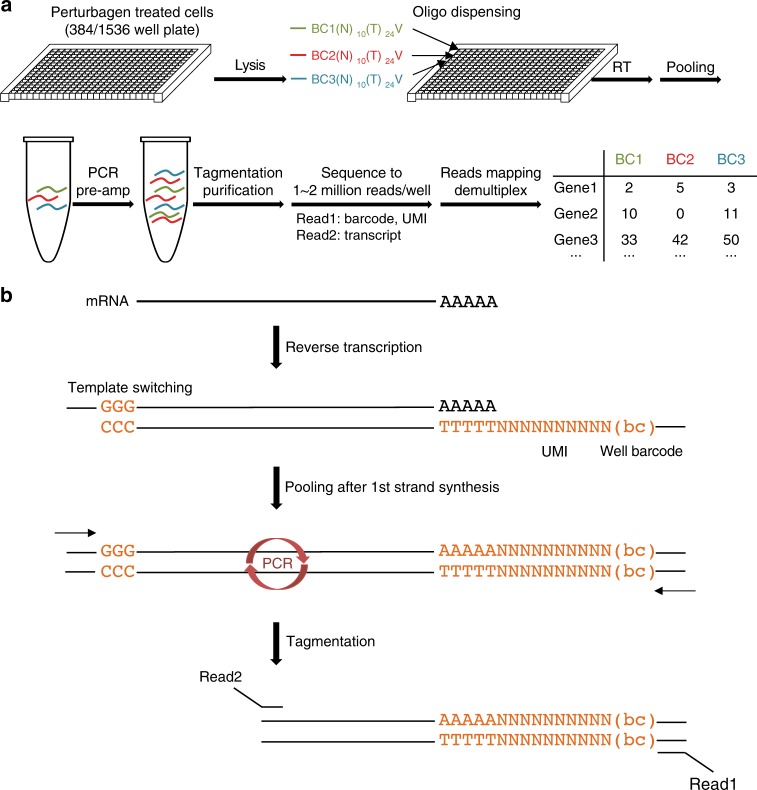
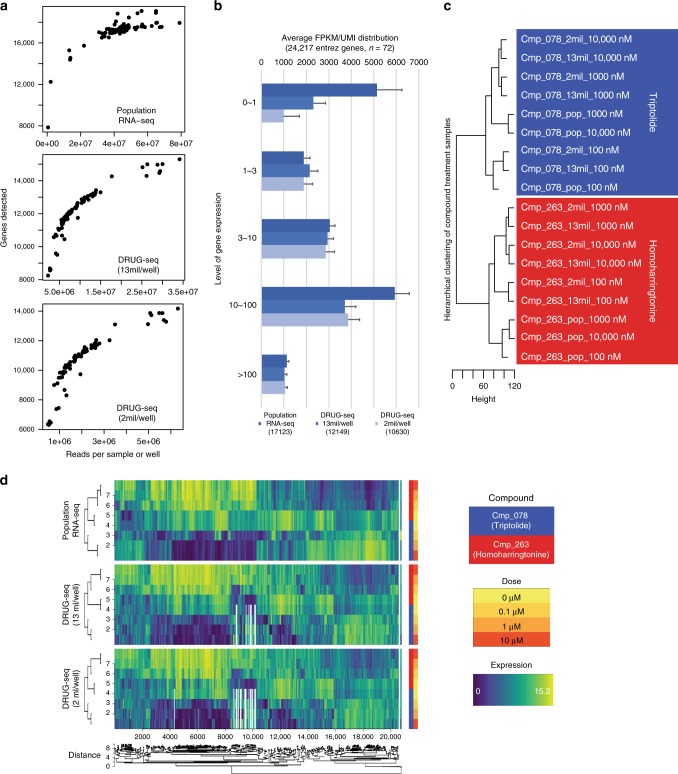
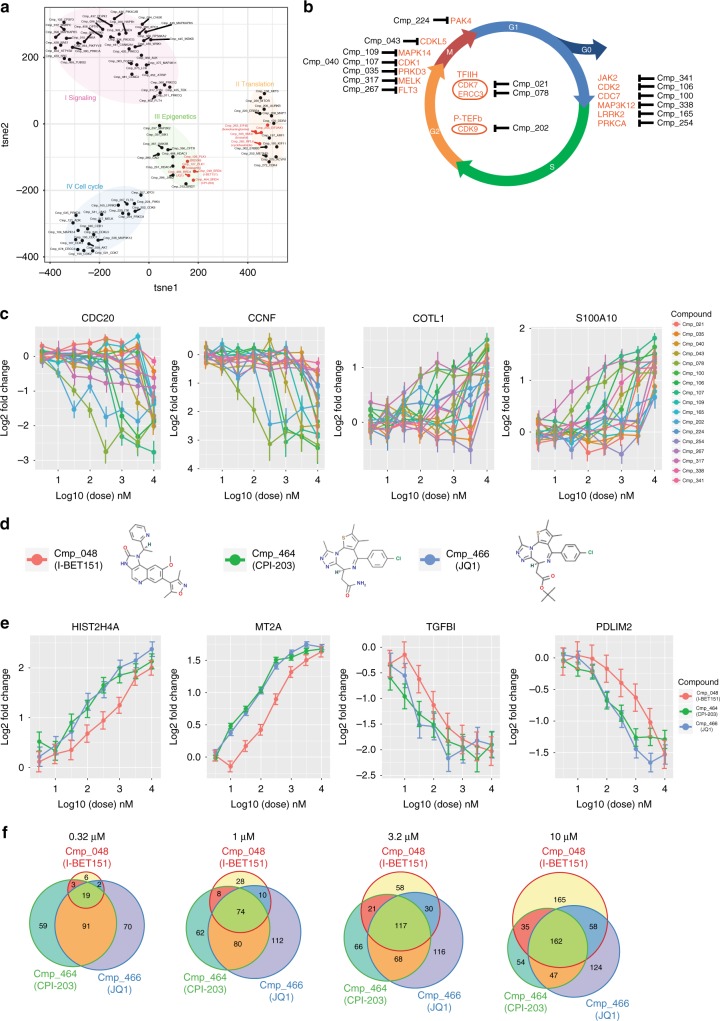
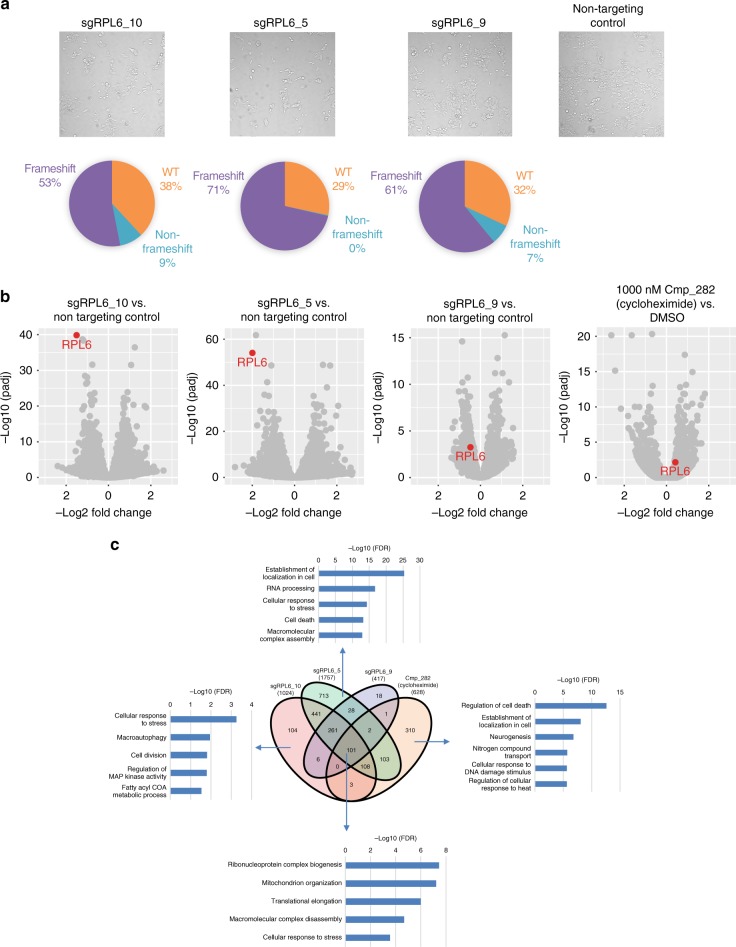
Here we report Digital RNA with pertUrbation of Genes (DRUG-seq), a high-throughput platform for drug discovery. Pharmaceutical discovery relies on high-throughput screening, yet current platforms have limited readouts. RNA-seq is a powerful tool to investigate drug effects using transcriptome changes as a proxy, yet standard library construction is costly. DRUG-seq captures transcriptional changes detected in standard RNA-seq at 1/100 th the cost. In proof-of-concept experiments profiling 433 compounds across 8 doses, transcription profiles generated from DRUG-seq successfully grouped compounds into functional clusters by mechanism of actions (MoAs) based on their intended targets. Perturbation differences reflected in transcriptome changes were detected for compounds engaging the same target, demonstrating the value of using DRUG-seq for understanding on and off-target activities. We demonstrate DRUG-seq captures common mechanisms, as well as differences between compound treatment and CRISPR on the same target. DRUG-seq provides a powerful tool for comprehensive transcriptome readout in a high-throughput screening environment.
Overview
The claims and statistics of this paper haven’t been checked yet.
Free: it reads the open-access text and checks the first 5 claims that cite a source we can check. Create a free account to check every claim.
Integrity signals
Registry
Cites
Statistics
Figures
Verification
Claims the paper makes
The claims and statistics of this paper haven’t been checked yet.
Free: it reads the open-access text and checks the first 5 claims that cite a source we can check. Create a free account to check every claim.
Claims other papers make about this one
Each is checked against this paper’s own text: does it say what the citing paper says it does?
In the citing paper
“Perturbation modelling is underpinned by systematic databases of biological response to treatment (e.g. Connectivity Map [2], L1000, DRUG-seq [3]) and leverages the significant potential of machine learning (ML) to make predictive models, e.g., molecular targets or IC50 values.”
From A mini-review on perturbation modelling across single-cell omic modalities (2024) · cites this paper as [3]
Self-check
Percentages, sums and reported differences re-computed from the paper’s own numbers.
The self-check needs the paper’s full text.
Citations
Cites
Moderated estimation of fold change and dispersion for RNA-seq data with DESeq2
Love, M. I., Huber, W., & Anders, S. (2014) · Genome Biology · doi:10.1186/s13059-014-0550-8 · Cited by 95,106
STAR: ultrafast universal RNA-seq aligner
Dobin, A., Davis, C. A., Schlesinger, F., Drenkow, J., Zaleski, C., Jha, S., Batut, P., Chaisson, M., & Gingeras, T. R. (2013) · Bioinformatics · doi:10.1093/bioinformatics/bts635 · Cited by 51,709
Meta-analysis in clinical trials
DerSimonian, R., & Laird, N. (1986) · Controlled Clinical Trials · doi:10.1016/0197-2456(86)90046-2 · Cited by 39,552
(2008) · Journal of Machine Learning Research · Cited by 33,051
RSEM: accurate transcript quantification from RNA-Seq data with or without a reference genome
Li, B., & Dewey, C. N. (2011) · BMC Bioinformatics · doi:10.1186/1471-2105-12-323 · Cited by 22,179
Lamb, J., Crawford, E. D., Peck, D., Modell, J. W., Blat, I. C., Wrobel, M. J., Lerner, J., Brunet, J.-P., Subramanian, A., Ross, K. N., et al. (2006) · Science · doi:10.1126/science.1132939 · Cited by 5,257
A Next Generation Connectivity Map: L1000 Platform and the First 1,000,000 Profiles
Subramanian, A., Narayan, R., Corsello, S. M., Peck, D. D., Natoli, T. E., Lu, X., Gould, J., Davis, J. F., Tubelli, A. A., Asiedu, J. K., et al. (2017) · Cell · doi:10.1016/j.cell.2017.10.049 · Cited by 3,515
Impact of high-throughput screening in biomedical research
Macarron, R., Banks, M. N., Bojanic, D., Burns, D. J., Cirovic, D. A., Garyantes, T., Green, D. V. S., Hertzberg, R. P., Janzen, W. P., Paslay, J. W., et al. (2011) · Nature Reviews Drug Discovery · doi:10.1038/nrd3368 · Cited by 1,364
Opportunities and challenges in phenotypic drug discovery: an industry perspective
Moffat, J. G., Vincent, F., Lee, J. A., Eder, J., & Prunotto, M. (2017) · Nature Reviews Drug Discovery · doi:10.1038/nrd.2017.111 · Cited by 939
Initiation of a G2/M checkpoint after ultraviolet radiation requires p38 kinase
Bulavin, D. V., Higashimoto, Y., Popoff, I. J., Gaarde, W. A., Basrur, V., Potapova, O., Appella, E., & Fornace, A. J. (2001) · Nature · doi:10.1038/35075107 · Cited by 532
Gordon, A. (1999) · C&H/CRC Monographs on Statistics & Applied Probability · doi:10.1201/9781584888536 · Cited by 510
An overview of Cdk1-controlled targets and processes
Enserink, J. M., & Kolodner, R. D. (2010) · Cell Division · doi:10.1186/1747-1028-5-11 · Cited by 421
Dual kinase-bromodomain inhibitors for rationally designed polypharmacology
Ciceri, P., Müller, S., O'Mahony, A., Fedorov, O., Filippakopoulos, P., Hunt, J. P., Lasater, E. A., Pallares, G., Picaud, S., Wells, C., et al. (2014) · Nature Chemical Biology · doi:10.1038/nchembio.1471 · Cited by 338
Reconstitution of the Transcription Factor TFIIH
Tirode, F., Busso, D., Coin, F., & Egly, J.-M. (1999) · Molecular Cell · doi:10.1016/s1097-2765(00)80177-x · Cited by 301
Shiroguchi, K., Jia, T. Z., Sims, P. A., & Xie, X. S. (2012) · Proceedings of the National Academy of Sciences · doi:10.1073/pnas.1118018109 · Cited by 276
Wells, M. F., Salick, M. R., Wiskow, O., Ho, D. J., Worringer, K. A., Ihry, R. J., Kommineni, S., Bilican, B., Klim, J. R., Hill, E. J., et al. (2016) · Cell Stem Cell · doi:10.1016/j.stem.2016.11.011 · Cited by 269
Self-citationWang, S. E., Xiang, B., Guix, M., Olivares, M. G., Parker, J., Chung, C. H., Pandiella, A., & Arteaga, C. L. (2008) · Molecular and Cellular Biology · doi:10.1128/mcb.00787-08 · Cited by 165
Walter, J. C. (2000) · Journal of Biological Chemistry · doi:10.1074/jbc.m008107200 · Cited by 151
Neganova, I., Vilella, F., Atkinson, S. P., Lloret, M., Passos, J. F., von Zglinicki, T., O'Connor, J.-E., Burks, D., Jones, R., Armstrong, L., et al. (2011) · Stem Cells · doi:10.1002/stem.620 · Cited by 140
MELK—a conserved kinase: functions, signaling, cancer, and controversy
Ganguly, R., Mohyeldin, A., Thiel, J., Kornblum, H. I., Beullens, M., & Nakano, I. (2015) · Clinical and Translational Medicine · doi:10.1186/s40169-014-0045-y · Cited by 140
Brusatol overcomes chemoresistance through inhibition of protein translation
Harder, B., Tian, W., La Clair, J. J., Tan, A., Ooi, A., Chapman, E., & Zhang, D. D. (2017) · Molecular Carcinogenesis · doi:10.1002/mc.22609 · Cited by 136
PLATE-Seq for genome-wide regulatory network analysis of high-throughput screens
Bush, E. C., Ray, F., Alvarez, M. J., Realubit, R., Li, H., Karan, C., Califano, A., & Sims, P. A. (2017) · Nature Communications · doi:10.1038/s41467-017-00136-z · Cited by 107
RASL‐seq for Massively Parallel and Quantitative Analysis of Gene Expression
Li, H., Qiu, J., & Fu, X. (2012) · Current Protocols in Molecular Biology · doi:10.1002/0471142727.mb0413s98 · Cited by 105
Connectivity Map-based discovery of parbendazole reveals targetable human osteogenic pathway
Brum, A. M., van de Peppel, J., van der Leije, C. S., Schreuders-Koedam, M., Eijken, M., van der Eerden, B. C. J., & van Leeuwen, J. P. T. M. (2015) · Proceedings of the National Academy of Sciences · doi:10.1073/pnas.1501597112 · Cited by 98
Garriga, J., Bhattacharya, S., Calbó, J., Marshall, R. M., Truongcao, M. M., Haines, D. S., & Graña, X. (2003) · Molecular and Cellular Biology · doi:10.1128/mcb.23.15.5165-5173.2003 · Cited by 93
BRD4 Structure–Activity Relationships of Dual PLK1 Kinase/BRD4 Bromodomain Inhibitor BI-2536
Chen, L., Yap, J. L., Yoshioka, M., Lanning, M. E., Fountain, R. N., Raje, M., Scheenstra, J. A., Strovel, J. W., & Fletcher, S. (2015) · ACS Medicinal Chemistry Letters · doi:10.1021/acsmedchemlett.5b00084 · Cited by 91
Bild, A., & Febbo, P. G. (2005) · Proceedings of the National Academy of Sciences · doi:10.1073/pnas.0507477102 · Cited by 65
Nekrasova, T., & Minden, A. (2011) · Journal of Cellular Biochemistry · doi:10.1002/jcb.23092 · Cited by 46
CDKL5 localizes at the centrosome and midbody and is required for faithful cell division
Barbiero, I., Valente, D., Chandola, C., Magi, F., Bergo, A., Monteonofrio, L., Tramarin, M., Fazzari, M., Soddu, S., Landsberger, N., et al. (2017) · Scientific Reports · doi:10.1038/s41598-017-05875-z · Cited by 41
Deeds, L., Teodorescu, S., Chu, M., Yu, Q., & Chen, C.-Y. (2003) · Journal of Biological Chemistry · doi:10.1074/jbc.m306854200 · Cited by 36
Chen, Z., Cao, Z., Zhang, W., Gu, M., Zhou, Z., Li, B., Li, J., Tan, E., & Zeng, L. (2017) · Human Molecular Genetics · doi:10.1093/hmg/ddx337 · Cited by 34
Odgerel, T., Kikuchi, J., Wada, T., Shimizu, R., Futaki, K., Kano, Y., & Furukawa, Y. (2007) · Oncogene · doi:10.1038/sj.onc.1210980 · Cited by 32
Chen, J., Shen, Q. “., Labow, M., & Gaither, L. A. (2011) · Cancer Research · doi:10.1158/0008-5472.can-10-3761 · Cited by 32
Daviau, A., Couture, J.-P., & Blouin, R. (2011) · Biochemical and Biophysical Research Communications · doi:10.1016/j.bbrc.2011.08.086 · Cited by 12
Cited by
MULTI-seq: sample multiplexing for single-cell RNA sequencing using lipid-tagged indices
McGinnis, C. S., Patterson, D. M., Winkler, J., Conrad, D. N., Hein, M. Y., Srivastava, V., Hu, J. L., Murrow, L. M., Weissman, J. S., Werb, Z., et al. (2019) · Nature Methods · doi:10.1038/s41592-019-0433-8 · Cited by 643
Massively multiplex chemical transcriptomics at single-cell resolution
Srivatsan, S. R., McFaline-Figueroa, J. L., Ramani, V., Saunders, L., Cao, J., Packer, J., Pliner, H. A., Jackson, D. L., Daza, R. M., Christiansen, L., et al. (2020) · Science · doi:10.1126/science.aax6234 · Cited by 401
Image-based profiling for drug discovery: due for a machine-learning upgrade?
Chandrasekaran, S. N., Ceulemans, H., Boyd, J. D., & Carpenter, A. E. (2021) · Nature Reviews Drug Discovery · doi:10.1038/s41573-020-00117-w · Cited by 389
Cancer cell heterogeneity and plasticity: A paradigm shift in glioblastoma
Yabo, Y. A., Niclou, S. P., & Golebiewska, A. (2022) · Neuro-Oncology · doi:10.1093/neuonc/noab269 · Cited by 306
Machine learning identifies candidates for drug repurposing in Alzheimer’s disease
Rodriguez, S., Hug, C., Todorov, P., Moret, N., Boswell, S. A., Evans, K., Zhou, G., Johnson, N. T., Hyman, B. T., Sorger, P. K., et al. (2021) · Nature Communications · doi:10.1038/s41467-021-21330-0 · Cited by 299
Metadata
- Authors
- Ye, C., Ho, D. J., Neri, M., Yang, C., Kulkarni, T., Randhawa, R., Henault, M., Mostacci, N., Farmer, P., Renner, S., Ihry, R., Mansur, L., Keller, C. G., McAllister, G., Hild, M., Jenkins, J., & Kaykas, A.
- Affiliations
- Blueprint Medicines (United States) (US)
- Novartis Institutes for BioMedical Research (CH)
- Corresponding author
- Kaykas, Ajamete
- ORCID
- Venue
- Nature Communications
- Published
- 2018-10-17
- Volume
- 9
- Issue
- 1
- Pages
- 4307-4307
- ISSN
- 2041-1723 (ISSN-L)
- PMC
- PMC6192987
- OpenAlex
- W2896822135
- Cited by
- 222
- References
- 35
- Citations by year
- 2026: 26 · 2025: 47 · 2024: 29 · 2023: 31 · 2022: 33 · 2021: 19 · 2020: 24 · 2019: 12 · 2018: 1
- FWCI
- 4.98
- Type
- journal article
- Language
- en
- Open access
- gold
- doi.org
- Licence
- cc-by
- creativecommons.org/licenses/by/4.0 (tdm)
- creativecommons.org/licenses/by/4.0 (vor)
- Locations
- Nature Communications (publishedVersion, cc-by)
- Europe PMC (PubMed Central) (publishedVersion, cc-by)
- PubMed Central (publishedVersion, cc-by)
- PubMed (publishedVersion)
- RePEc: Research Papers in Economics (submittedVersion)
- DOAJ (DOAJ: Directory of Open Access Journals) (submittedVersion)
- DOAJ (DOAJ: Directory of Open Access Journals) (submittedVersion, cc-by-sa)
- Topics
- Life Sciences › Biochemistry, Genetics and Molecular Biology › Molecular Biology › Single-cell and spatial transcriptomics
- Life Sciences › Pharmacology, Toxicology and Pharmaceutics › Drug Discovery › Computational Drug Discovery Methods
- Life Sciences › Biochemistry, Genetics and Molecular Biology › Molecular Biology › Genomics and Phylogenetic Studies
- Keywords
- gene expression profiling, high-throughput screening, drug discovery, gene perturbation, off-target effects
- MeSH terms
- Cell Line, Humans, Sequence Analysis, RNA, Gene Expression Profiling, Drug Discovery, High-Throughput Screening Assays, Clustered Regularly Interspaced Short Palindromic Repeats
About these checks
Registry, retraction, Cites and statistics results are computed, not judged, with one exception: a printed reference that no index lists is read once by a model before it counts as a citation error. Claims are extracted by a model and kept only when their quote appears verbatim in the text; each cited source is then checked, with a model’s help, for whether it says what the claim relies on. Those verdicts can be wrong — read the claim’s quote and the cited source before relying on one.
Statistics and arithmetic are recomputed, not judged.
Confidence bands are shown only for fields calibrated on our annotated test set. None is calibrated yet, so no band is shown.
What counts as a claim ›How we measure confidence ›How we check this ›
Are you an author, or do you see a problem with this page? Request a review
Data sources
Bibliographic data: Semantic Scholar, OpenAlex, Crossref.
Contains information from the Semantic Scholar Academic Graph Datasets, made available under the ODC Attribution License (ODC-BY 1.0).
Semantic Scholar’s data is described in: Kinney, R., et al. (2023). The Semantic Scholar Open Data Platform. arXiv:2301.10140.
