

Cortical population activity within a preserved neural manifold underlies multiple motor behaviors
Open accessPublished version of a preprint
The DOI matches its Crossref record; 94 of the 95 references it cites were found in a registry or an index, and 1 are not checked yet.
Abstract
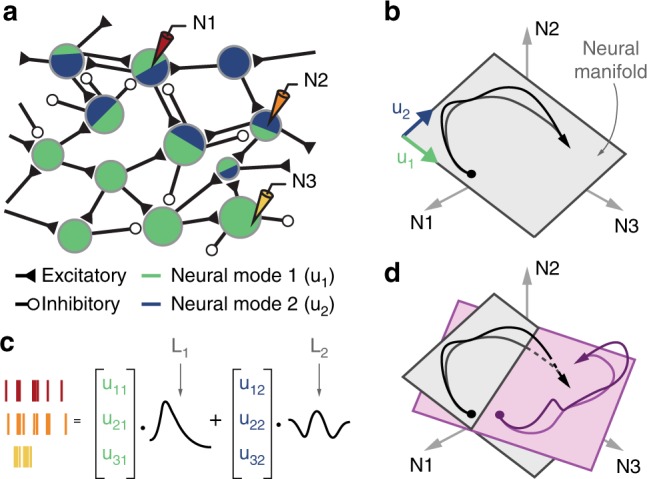
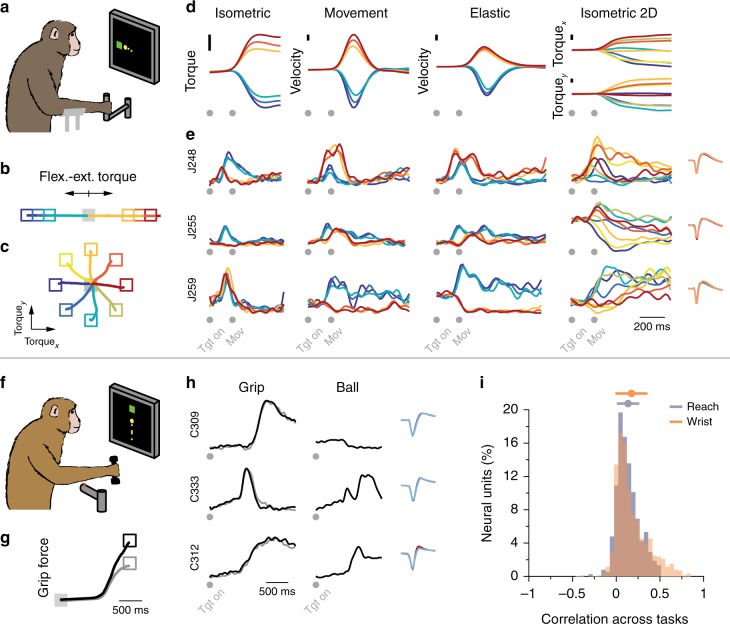
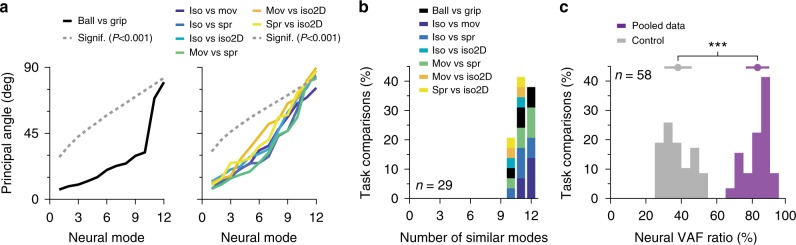
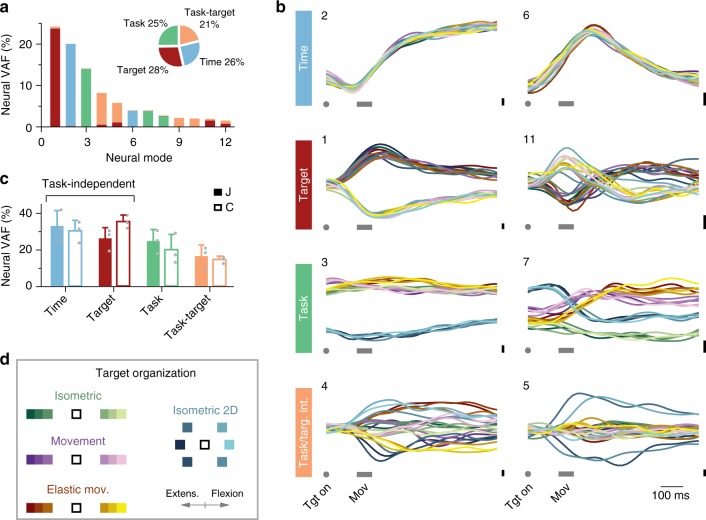
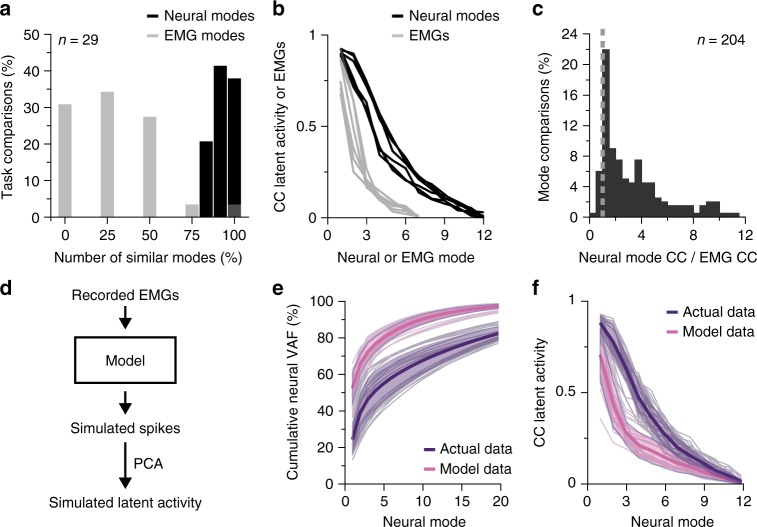
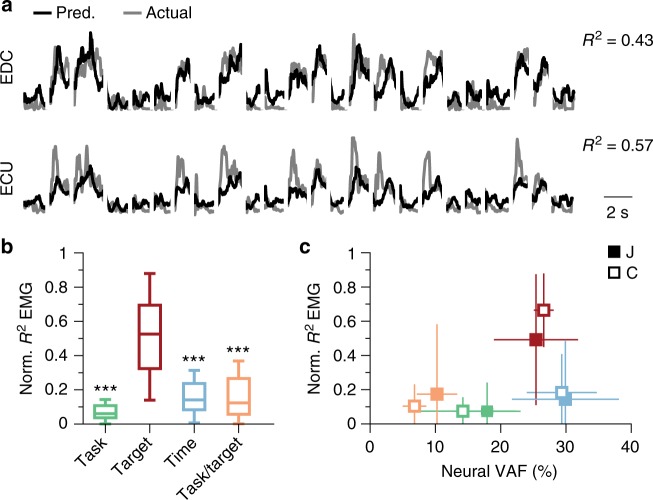
Populations of cortical neurons flexibly perform different functions; for the primary motor cortex (M1) this means a rich repertoire of motor behaviors. We investigate the flexibility of M1 movement control by analyzing neural population activity during a variety of skilled wrist and reach-to-grasp tasks. We compare across tasks the neural modes that capture dominant neural covariance patterns during each task. While each task requires different patterns of muscle and single unit activity, we find unexpected similarities at the neural population level: the structure and activity of the neural modes is largely preserved across tasks. Furthermore, we find two sets of neural modes with task-independent activity that capture, respectively, generic temporal features of the set of tasks and a task-independent mapping onto muscle activity. This system of flexibly combined, well-preserved neural modes may underlie the ability of M1 to learn and generate a wide-ranging behavioral repertoire.
Overview
The claims and statistics of this paper haven’t been checked yet.
Free: it reads the open-access text and checks the first 5 claims that cite a source we can check. Create a free account to check every claim.
Integrity signals
Registry
Cites
Statistics
Figures
Verification
Claims the paper makes
The claims and statistics of this paper haven’t been checked yet.
Free: it reads the open-access text and checks the first 5 claims that cite a source we can check. Create a free account to check every claim.
Self-check
Percentages, sums and reported differences re-computed from the paper’s own numbers.
The self-check needs the paper’s full text.
Citations
Cites
1 retracted
RETRACTED: A mathematical model explains saturating axon guidance responses to molecular gradients
Nguyen, H., Dayan, P., Pujic, Z., Cooper-White, J., & Goodhill, G. J. (2016) · eLife · doi:10.7554/elife.12248 · Cited by 1,221
RetractedGeorgopoulos, A., Kalaska, J., Caminiti, R., & Massey, J. (1982) · The Journal of Neuroscience · doi:10.1523/jneurosci.02-11-01527.1982 · Cited by 2,130
Context-dependent computation by recurrent dynamics in prefrontal cortex
Mante, V., Sussillo, D., Shenoy, K. V., & Newsome, W. T. (2013) · Nature · doi:10.1038/nature12742 · Cited by 1,847
Neural population dynamics during reaching
Churchland, M. M., Cunningham, J. P., Kaufman, M. T., Foster, J. D., Nuyujukian, P., Ryu, S. I., & Shenoy, K. V. (2012) · Nature · doi:10.1038/nature11129 · Cited by 1,626
Descending Pathways in Motor Control
Lemon, R. N. (2008) · Annual Review of Neuroscience · doi:10.1146/annurev.neuro.31.060407.125547 · Cited by 1,599
A century of trends in adult human height
NCD Risk Factor Collaboration (NCD-RisC) (2016) · eLife · doi:10.7554/elife.13410 · Cited by 1,558
Control of Locomotion in Bipeds, Tetrapods, and Fish
Grillner, S. (1981) · Comprehensive Physiology · doi:10.1002/cphy.cp010226 · Cited by 1,365
Neuroscience Needs Behavior: Correcting a Reductionist Bias
Krakauer, J. W., Ghazanfar, A. A., Gomez-Marin, A., MacIver, M. A., & Poeppel, D. (2017) · Neuron · doi:10.1016/j.neuron.2016.12.041 · Cited by 1,358
LAWRENCE, D. G., & KUYPERS, H. G. J. M. (1968) · Brain · doi:10.1093/brain/91.1.1 · Cited by 1,285
Relation of pyramidal tract activity to force exerted during voluntary movement.
Evarts, E. V. (1968) · Journal of Neurophysiology · doi:10.1152/jn.1968.31.1.14 · Cited by 1,249
Research works printed but not linked: 1
- Elsayed G Cunningham JP Structure in neural population recordings: significant or epiphenomenal? Nat. Neurosci. 2017 25 1 14 PMC5577566 28783140
Cited by
Computation Through Neural Population Dynamics
Vyas, S., Golub, M. D., Sussillo, D., & Shenoy, K. V. (2020) · Annual Review of Neuroscience · doi:10.1146/annurev-neuro-092619-094115 · Cited by 671
“…2018), how activity from one brain region affects another (e.g., Semedo et al. 2019), or how population covariance structure changes across tasks (e.g.,Gallego et al. 2018), further headway will likely require recording neural activity from many more of the brain regions involved in a given task.”
BackgroundHigh-dimensional geometry of population responses in visual cortex
Stringer, C., Pachitariu, M., Steinmetz, N., Carandini, M., & Harris, K. D. (2019) · Nature · doi:10.1038/s41586-019-1346-5 · Cited by 594
Long-term stability of cortical population dynamics underlying consistent behavior
Gallego, J. A., Perich, M. G., Chowdhury, R. H., Solla, S. A., & Miller, L. E. (2020) · Nature Neuroscience · doi:10.1038/s41593-019-0555-4 · Cited by 405
“The dimensionality of the manifold for each brain region (M1: 10; PMd: 15; S1: 8) was selected based on previous studies 5,22 .”
InfluentialSelf-citationLearnable latent embeddings for joint behavioural and neural analysis
Schneider, S., Lee, J. H., & Mathis, M. W. (2023) · Nature · doi:10.1038/s41586-023-06031-6 · Cited by 348
Attractor and integrator networks in the brain
Khona, M., & Fiete, I. R. (2022) · Nature Reviews Neuroscience · doi:10.1038/s41583-022-00642-0 · Cited by 306
“Motor cortical trajectories Finally, recordings of motor cortical activity during stereotyped primate arm movements reveal the existence of stable low-dimensional trajectories [84, 222, 223, 224, 225], similar to the trajectories in state space originally characterized in olfactory circuit responses to odors [226].”
Background
Metadata
- Authors
- Gallego, J. A., Perich, M. G., Naufel, S. N., Ethier, C., Solla, S. A., & Miller, L. E.
- Affiliations
- Northwestern University (US)
- Corresponding author
- Miller, Lee E.
- ORCID
- Venue
- Nature Communications
- Published
- 2018-10-12
- Volume
- 9
- Issue
- 1
- Pages
- 4233-4233
- ISSN
- 2041-1723 (ISSN-L)
- PMC
- PMC6185944
- OpenAlex
- W2896846197
- Cited by
- 413
- References
- 91
- Citations by year
- 2026: 88 · 2025: 75 · 2024: 70 · 2023: 43 · 2022: 50 · 2021: 29 · 2020: 31 · 2019: 17 · 2018: 8
- FWCI
- 9.90
- Type
- journal article
- Language
- en
- Open access
- gold
- doi.org
- Licence
- cc-by
- creativecommons.org/licenses/by/4.0 (tdm)
- creativecommons.org/licenses/by/4.0 (vor)
- Locations
- Nature Communications (publishedVersion, cc-by)
- bioRxiv (Cold Spring Harbor Laboratory) (submittedVersion, cc-by-nd)
- Europe PMC (PubMed Central) (publishedVersion, cc-by)
- PubMed Central (publishedVersion, cc-by)
- PubMed (publishedVersion)
- RePEc: Research Papers in Economics (submittedVersion)
- DOAJ (DOAJ: Directory of Open Access Journals) (submittedVersion)
- Funders
- EC | Seventh Framework Programme (FP7-PEOPLE-2013-IOF-627384)
- U.S. Department of Health & Human Services | NIH | National Institute of Neurological Disorders and Stroke (F31-NS092356, NS053603)
- U.S. Department of Health & Human Services | NIH | NICHD | National Center for Medical Rehabilitation Research (T32-HD07418)
- Center for Selective C-H Functionalization, National Science Foundation (DGE-1324585)
- Fonds de Recherche du Québec - Santé (22343)
- Topics
- Life Sciences › Neuroscience › Cognitive Neuroscience › Motor Control and Adaptation
- Life Sciences › Neuroscience › Cognitive Neuroscience › Neural dynamics and brain function
- Life Sciences › Neuroscience › Cognitive Neuroscience › Memory and Neural Mechanisms
- Keywords
- primary motor cortex, neural population activity, neural manifolds, wrist kinematics, reach-to-grasp
- MeSH terms
- Animals, Macaca mulatta, Male, Motor Cortex, Neurons, Psychomotor Performance, Wrist, Hand Strength
About these checks
Registry, retraction, Cites and statistics results are computed, not judged, with one exception: a printed reference that no index lists is read once by a model before it counts as a citation error. Claims are extracted by a model and kept only when their quote appears verbatim in the text; each cited source is then checked, with a model’s help, for whether it says what the claim relies on. Those verdicts can be wrong — read the claim’s quote and the cited source before relying on one.
Statistics and arithmetic are recomputed, not judged.
Confidence bands are shown only for fields calibrated on our annotated test set. None is calibrated yet, so no band is shown.
What counts as a claim ›How we measure confidence ›How we check this ›
Are you an author, or do you see a problem with this page? Request a review
Data sources
Bibliographic data: Semantic Scholar, OpenAlex, Crossref.
Contains information from the Semantic Scholar Academic Graph Datasets, made available under the ODC Attribution License (ODC-BY 1.0).
Semantic Scholar’s data is described in: Kinney, R., et al. (2023). The Semantic Scholar Open Data Platform. arXiv:2301.10140.
