

Cortical population activity within a preserved neural manifold underlies multiple motor behaviors
Open accessPublished version of a preprint
The DOI matches its Crossref record; 94 of the 95 references it cites were found in a registry or an index, and 1 are not checked yet.
Abstract
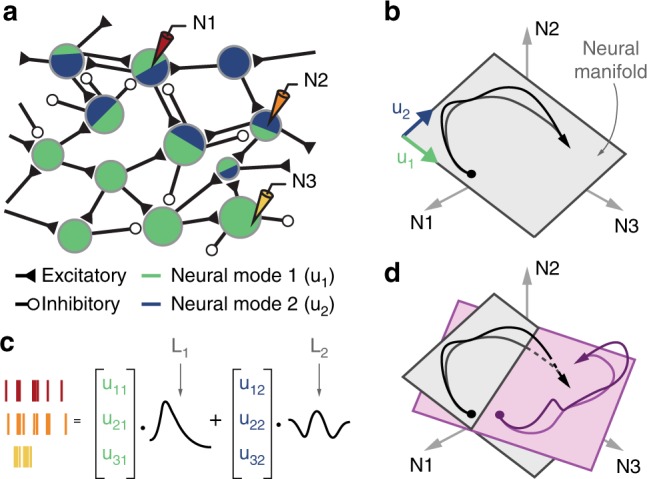
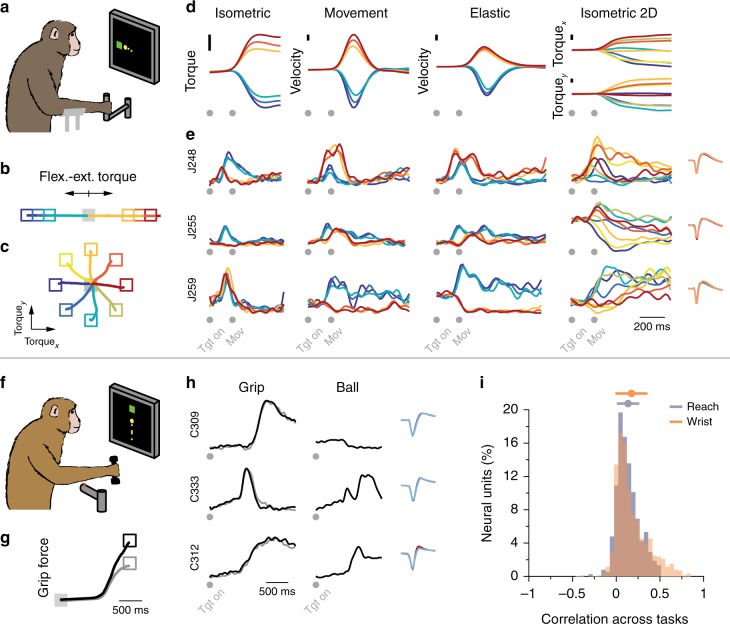
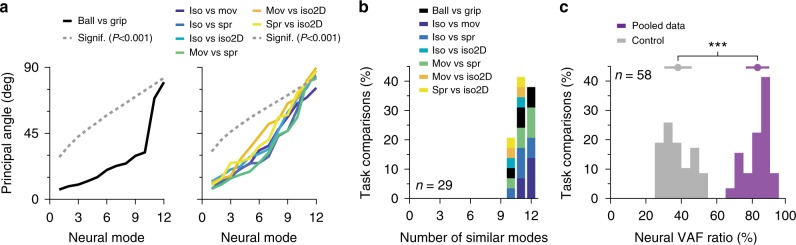
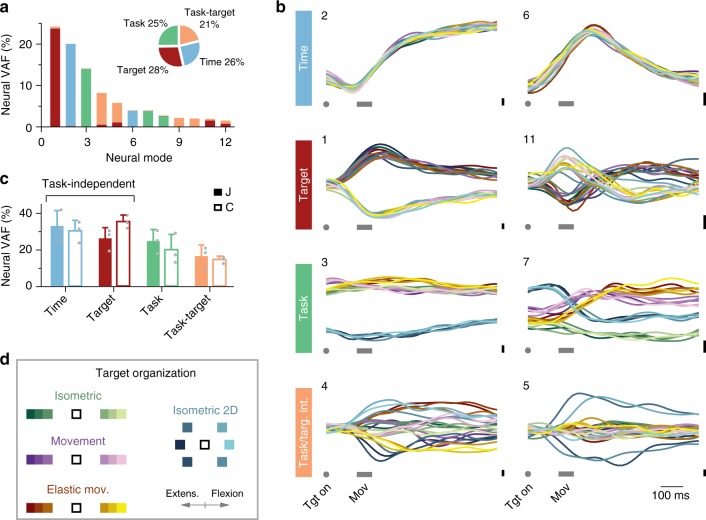
Populations of cortical neurons flexibly perform different functions; for the primary motor cortex (M1) this means a rich repertoire of motor behaviors. We investigate the flexibility of M1 movement control by analyzing neural population activity during a variety of skilled wrist and reach-to-grasp tasks. We compare across tasks the neural modes that capture dominant neural covariance patterns during each task. While each task requires different patterns of muscle and single unit activity, we find unexpected similarities at the neural population level: the structure and activity of the neural modes is largely preserved across tasks. Furthermore, we find two sets of neural modes with task-independent activity that capture, respectively, generic temporal features of the set of tasks and a task-independent mapping onto muscle activity. This system of flexibly combined, well-preserved neural modes may underlie the ability of M1 to learn and generate a wide-ranging behavioral repertoire.
Overview
The claims and statistics of this paper haven’t been checked yet.
Free: it reads the open-access text and checks the first 5 claims that cite a source we can check. Create a free account to check every claim.
Integrity signals
Registry
Cites
Statistics
Figures
Verification
Claims the paper makes
The claims and statistics of this paper haven’t been checked yet.
Free: it reads the open-access text and checks the first 5 claims that cite a source we can check. Create a free account to check every claim.
Self-check
Percentages, sums and reported differences re-computed from the paper’s own numbers.
The self-check needs the paper’s full text.
Citations
Cites
1 retracted
RETRACTED: A mathematical model explains saturating axon guidance responses to molecular gradients
Nguyen, H., Dayan, P., Pujic, Z., Cooper-White, J., & Goodhill, G. J. (2016) · eLife · doi:10.7554/elife.12248 · Cited by 1,221
RetractedGeorgopoulos, A., Kalaska, J., Caminiti, R., & Massey, J. (1982) · The Journal of Neuroscience · doi:10.1523/jneurosci.02-11-01527.1982 · Cited by 2,130
Context-dependent computation by recurrent dynamics in prefrontal cortex
Mante, V., Sussillo, D., Shenoy, K. V., & Newsome, W. T. (2013) · Nature · doi:10.1038/nature12742 · Cited by 1,847
Neural population dynamics during reaching
Churchland, M. M., Cunningham, J. P., Kaufman, M. T., Foster, J. D., Nuyujukian, P., Ryu, S. I., & Shenoy, K. V. (2012) · Nature · doi:10.1038/nature11129 · Cited by 1,626
Descending Pathways in Motor Control
Lemon, R. N. (2008) · Annual Review of Neuroscience · doi:10.1146/annurev.neuro.31.060407.125547 · Cited by 1,599
A century of trends in adult human height
NCD Risk Factor Collaboration (NCD-RisC) (2016) · eLife · doi:10.7554/elife.13410 · Cited by 1,558
Control of Locomotion in Bipeds, Tetrapods, and Fish
Grillner, S. (1981) · Comprehensive Physiology · doi:10.1002/cphy.cp010226 · Cited by 1,365
Neuroscience Needs Behavior: Correcting a Reductionist Bias
Krakauer, J. W., Ghazanfar, A. A., Gomez-Marin, A., MacIver, M. A., & Poeppel, D. (2017) · Neuron · doi:10.1016/j.neuron.2016.12.041 · Cited by 1,358
LAWRENCE, D. G., & KUYPERS, H. G. J. M. (1968) · Brain · doi:10.1093/brain/91.1.1 · Cited by 1,285
Relation of pyramidal tract activity to force exerted during voluntary movement.
Evarts, E. V. (1968) · Journal of Neurophysiology · doi:10.1152/jn.1968.31.1.14 · Cited by 1,249
Research works printed but not linked: 1
- Elsayed G Cunningham JP Structure in neural population recordings: significant or epiphenomenal? Nat. Neurosci. 2017 25 1 14 PMC5577566 28783140
Cited by
Computation Through Neural Population Dynamics
Vyas, S., Golub, M. D., Sussillo, D., & Shenoy, K. V. (2020) · Annual Review of Neuroscience · doi:10.1146/annurev-neuro-092619-094115 · Cited by 671
“…2018), how activity from one brain region affects another (e.g., Semedo et al. 2019), or how population covariance structure changes across tasks (e.g.,Gallego et al. 2018), further headway will likely require recording neural activity from many more of the brain regions involved in a given task.”
BackgroundHigh-dimensional geometry of population responses in visual cortex
Stringer, C., Pachitariu, M., Steinmetz, N., Carandini, M., & Harris, K. D. (2019) · Nature · doi:10.1038/s41586-019-1346-5 · Cited by 594
Long-term stability of cortical population dynamics underlying consistent behavior
Gallego, J. A., Perich, M. G., Chowdhury, R. H., Solla, S. A., & Miller, L. E. (2020) · Nature Neuroscience · doi:10.1038/s41593-019-0555-4 · Cited by 405
“The dimensionality of the manifold for each brain region (M1: 10; PMd: 15; S1: 8) was selected based on previous studies 5,22 .”
InfluentialSelf-citationLearnable latent embeddings for joint behavioural and neural analysis
Schneider, S., Lee, J. H., & Mathis, M. W. (2023) · Nature · doi:10.1038/s41586-023-06031-6 · Cited by 348
Attractor and integrator networks in the brain
Khona, M., & Fiete, I. R. (2022) · Nature Reviews Neuroscience · doi:10.1038/s41583-022-00642-0 · Cited by 306
“Motor cortical trajectories Finally, recordings of motor cortical activity during stereotyped primate arm movements reveal the existence of stable low-dimensional trajectories [84, 222, 223, 224, 225], similar to the trajectories in state space originally characterized in olfactory circuit responses to odors [226].”
BackgroundNeural population geometry: An approach for understanding biological and artificial neural networks
Chung, S., & Abbott, L. F. (2021) · Current Opinion in Neurobiology · doi:10.1016/j.conb.2021.10.010 · Cited by 270
The population doctrine in cognitive neuroscience
Ebitz, R. B., & Hayden, B. Y. (2021) · Neuron · doi:10.1016/j.neuron.2021.07.011 · Cited by 249
Bayesian Computation through Cortical Latent Dynamics
Sohn, H., Narain, D., Meirhaeghe, N., & Jazayeri, M. (2019) · Neuron · doi:10.1016/j.neuron.2019.06.012 · Cited by 231
Causes and consequences of representational drift
Rule, M. E., O’Leary, T., & Harvey, C. D. (2019) · Current Opinion in Neurobiology · doi:10.1016/j.conb.2019.08.005 · Cited by 227
Geometry of sequence working memory in macaque prefrontal cortex
Xie, Y., Hu, P., Li, J., Chen, J., Song, W., Wang, X.-J., Yang, T., Dehaene, S., Tang, S., Min, B., et al. (2022) · Science · doi:10.1126/science.abm0204 · Cited by 225
Degenhart, A. D., Bishop, W. E., Oby, E. R., Tyler-Kabara, E. C., Chase, S. M., Batista, A. P., & Yu, B. M. (2020) · Nature Biomedical Engineering · doi:10.1038/s41551-020-0542-9 · Cited by 212
Modeling behaviorally relevant neural dynamics enabled by preferential subspace identification
Sani, O. G., Abbaspourazad, H., Wong, Y. T., Pesaran, B., & Shanechi, M. M. (2020) · Nature Neuroscience · doi:10.1038/s41593-020-00733-0 · Cited by 207
Preserved neural dynamics across animals performing similar behaviour
Safaie, M., Chang, J. C., Park, J., Miller, L. E., Dudman, J. T., Perich, M. G., & Gallego, J. Á. (2023) · Nature · doi:10.1038/s41586-023-06714-0 · Cited by 194
“To this end, we compared our results to our previous study on the relationship of neural population activity underlying different but related wrist manipulation or reach-to-grasp tasks in monkeys 33 (Extended Data Fig.”
InfluentialSelf-citationA Neural Population Mechanism for Rapid Learning
Perich, M. G., Gallego, J. A., & Miller, L. E. (2018) · Neuron · doi:10.1016/j.neuron.2018.09.030 · Cited by 188
Self-citationA neural manifold view of the brain
Perich, M. G., Narain, D., & Gallego, J. Á. (2025) · Nature Neuroscience · doi:10.1038/s41593-025-02031-z · Cited by 179
“…dynamics underlying neural population activity have been described in many species—from invertebrates 25–28 to fish 29–31 and mammals 10,12,32–43 , and even humans 44–47 —in all corners of cortex—from sensory 48,49 to cognitive and associative 10,19,39,40,46,50–52 to motor 32,36,53,54…”
Self-citationIndependent generation of sequence elements by motor cortex
Zimnik, A. J., & Churchland, M. M. (2021) · Nature Neuroscience · doi:10.1038/s41593-021-00798-5 · Cited by 170
Preparatory activity and the expansive null-space
Churchland, M. M., & Shenoy, K. V. (2024) · Nature reviews. Neuroscience · doi:10.1038/s41583-024-00796-z · Cited by 165
“At the same time, the nervous sys-tem may reuse computations (and thus factors) when possible 159,160,166 , limiting the total number of occupied dimensions.”
Russo, A. A., Khajeh, R., Bittner, S. R., Perkins, S. M., Cunningham, J. P., Abbott, L. F., & Churchland, M. M. (2020) · Neuron · doi:10.1016/j.neuron.2020.05.020 · Cited by 158
Representational drift: Emerging theories for continual learning and experimental future directions
Driscoll, L. N., Duncker, L., & Harvey, C. D. (2022) · Current Opinion in Neurobiology · doi:10.1016/j.conb.2022.102609 · Cited by 158
“While few neurons maintain their activity patterns over weeks, population level statistics such as the fraction of task-correlated neurons and the overall activity levels in the population remain largely unchanged [8,14,15,10,11,12,13].”
BackgroundThe Brain Abstracted: Simplification in the History and Philosophy of Neuroscience
Chirimuuta, M. (2024) · The MIT Press eBooks · doi:10.7551/mitpress/13804.001.0001 · Cited by 136
Neural Data Transformer 2: Multi-context Pretraining for Neural Spiking Activity
Ye, J., Collinger, J. L., Wehbe, L., & Gaunt, R. (2023) · neural information processing systems · doi:10.52202/075280-3523 · Cited by 131
Principles of Corticocortical Communication: Proposed Schemes and Design Considerations
Kohn, A., Jasper, A. I., Semedo, J. D., Gokcen, E., Machens, C. K., & Yu, B. M. (2020) · Trends in Neurosciences · doi:10.1016/j.tins.2020.07.001 · Cited by 122
Flexible neural control of motor units
Marshall, N. J., Glaser, J. I., Trautmann, E. M., Amematsro, E. A., Perkins, S. M., Shadlen, M. N., Abbott, L. F., Cunningham, J. P., & Churchland, M. M. (2022) · Nature Neuroscience · doi:10.1038/s41593-022-01165-8 · Cited by 107
Estimating the dimensionality of the manifold underlying multi-electrode neural recordings
Altan, E., Solla, S. A., Miller, L. E., & Perreault, E. J. (2021) · PLoS Computational Biology · doi:10.1371/journal.pcbi.1008591 · Cited by 107
“First, we created d signals by randomly selecting (d x M) samples from an empirical distribution of firing rates that we obtained from multi-electrode array recordings of neural activity in the macaque primary motor cortex (M1) made while the monkey was performing a center-out task [41].”
BackgroundMethodInfluentialSelf-citationStable task information from an unstable neural population
Rule, M. E., Loback, A. R., Raman, D. V., Driscoll, L. N., Harvey, C. D., & O'Leary, T. (2020) · eLife · doi:10.7554/elife.51121 · Cited by 106
Neural correlates of sparse coding and dimensionality reduction
Beyeler, M., Rounds, E. L., Carlson, K. D., Dutt, N., & Krichmar, J. L. (2019) · PLOS Computational Biology · doi:10.1371/journal.pcbi.1006908 · Cited by 104
Integrated neural dynamics of sensorimotor decisions and actions
Thura, D., Cabana, J., Feghaly, A., & Cisek, P. (2022) · PLoS Biology · doi:10.1371/journal.pbio.3001861 · Cited by 104
Latent Factors and Dynamics in Motor Cortex and Their Application to Brain–Machine Interfaces
Pandarinath, C., Ames, K. C., Russo, A. A., Farshchian, A., Miller, L. E., Dyer, E. L., & Kao, J. C. (2018) · The Journal of Neuroscience · doi:10.1523/jneurosci.1669-18.2018 · Cited by 103
Self-citationShaping dynamics with multiple populations in low-rank recurrent networks
Beiran, M., Dubreuil, A., Valente, A., Mastrogiuseppe, F., & Ostojic, S. (2021) · Neural Computation · doi:10.1162/neco_a_01381 · Cited by 92
“…space (Machens, Romo, & Brody, 2010; Mante, Sussillo, Shenoy, & Newsome, 2013; Rigotti et al., 2013; Gao, Gan-guli, Battaglia, & Schnitzer, 2015; Gallego et al., 2018; Chaisangmongkon, Swaminathan, Freedman, & Wang, 2017; Wang, Narain, Hosseini, & Jaza-yeri, 2018; Sohn, Narain, Meirhaeghe, &…”
BackgroundNeural Algorithms and Circuits for Motor Planning
Inagaki, H., Chen, S., Daie, K., Finkelstein, A., Fontolan, L., Romani, S., & Svoboda, K. (2022) · Annual Review of Neuroscience · doi:10.1146/annurev-neuro-092021-121730 · Cited by 88
Independent representations of ipsilateral and contralateral limbs in primary motor cortex
Heming, E. A., Cross, K. P., Takei, T., Cook, D. J., & Scott, S. H. (2019) · eLife · doi:10.7554/elife.48190 · Cited by 88
Dynamic representations in networked neural systems
Ju, H., & Bassett, D. S. (2020) · Nature Neuroscience · doi:10.1038/s41593-020-0653-3 · Cited by 87
Going beyond primary motor cortex to improve brain–computer interfaces
Gallego, J. Á., Makin, T. R., & McDougle, S. D. (2022) · Trends in Neurosciences · doi:10.1016/j.tins.2021.12.006 · Cited by 83
“This excess information will make M1 decoders susceptible to slight changes in context [53], such as the user ’ s internal attentional state [10], and can thus contribute to generalization failures.”
BackgroundSelf-citationRule, M. E., & O’Leary, T. (2022) · Proceedings of the National Academy of Sciences · doi:10.1073/pnas.2106692119 · Cited by 79
Decoding brain states on the intrinsic manifold of human brain dynamics across wakefulness and sleep
Rué‐Queralt, J., Stevner, A. B. A., Tagliazucchi, E., Laufs, H., Kringelbach, M. L., Deco, G., & Atasoy, S. (2021) · Communications Biology · doi:10.1038/s42003-021-02369-7 · Cited by 79
Inferring brain-wide interactions using data-constrained recurrent neural network models
Perich, M. G., Arlt, C., Soares, S., Zhou, S., Beirán, M., Andalman, A. S., Benster, T., Young, M. E., Mosher, C. P., Minxha, J., et al. (2026) · Neuron · doi:10.1016/j.neuron.2026.07.016 · Cited by 77
Self-citationThe lure of misleading causal statements in functional connectivity researchPreprint
Mehler, D. M., & Kording, K. P. (2018) · arXiv (Cornell University) · doi:10.48550/arxiv.1812.03363 · Cited by 75
Williamson, R. C., Doiron, B., Smith, M. A., & Yu, B. M. (2019) · Current Opinion in Neurobiology · doi:10.1016/j.conb.2018.12.009 · Cited by 74
“, [14, 15,20,28,29]), demixed principal component analysis [30], factor 41 analysis [16,19,31], Gaussian-process factor analysis [32], latent factor analysis via dynamical 42 systems [33], tensor component analysis [34], and more (see [25] for a review).”
MethodHu, Y., & Sompolinsky, H. (2022) · PLoS Computational Biology · doi:10.1371/journal.pcbi.1010327 · Cited by 73
“Many recent experimental studies have observed a low dimensional dynamics of neurons in the brain [45, 15], and theoretical investigations have illustrated the importance of having a low dimensionality for brain function and computation [14], such as when representing stimuli [12] and generating motor outputs [15].”
Unexpected complexity of everyday manual behaviors
Yan, Y., Goodman, J. M., Moore, D. D., Solla, S. A., & Bensmaia, S. J. (2020) · Nature Communications · doi:10.1038/s41467-020-17404-0 · Cited by 73
Self-citationAbbaspourazad, H., Choudhury, M., Wong, Y. T., Pesaran, B., & Shanechi, M. M. (2021) · Nature Communications · doi:10.1038/s41467-020-20197-x · Cited by 71
The hidden repertoire of brain dynamics and dysfunction
McIntosh, A. R., & Jirsa, V. (2019) · Network Neuroscience · doi:10.1162/netn_a_00107 · Cited by 71
“There already exists a growing body of work that characterizes neurophysiological data by using dimensionality reduction techniques, which is a step toward defining low-dimensional manifolds that constrain network flows (Gallego et al., 2018).”
BackgroundEarly selection of task-relevant features through population gating
Barbosa, J., Proville, R. D., Rodgers, C. C., DeWeese, M. R., Ostojic, S., & Boubenec, Y. (2023) · Nature Communications · doi:10.1038/s41467-023-42519-5 · Cited by 69
“For the multi-area network simulations (see below), we estimated the communication subspaces using Canonical Correlation Analyses (CCA), which is a common approach for aligning neural representations 53 – 55 and more recently to study multi-area interactions 22,23 .”
Neural manifold under plasticity in a goal driven learning behaviour
Feulner, B., & Clopath, C. (2021) · PLoS Computational Biology · doi:10.1371/journal.pcbi.1008621 · Cited by 68
Emerging imaging methods to study whole-brain function in rodent models
Markicevic, M., Savvateev, I., Grimm, C., & Zerbi, V. (2021) · Translational Psychiatry · doi:10.1038/s41398-021-01575-5 · Cited by 65
Grid-cell modules remain coordinated when neural activity is dissociated from external sensory cues
Waaga, T., Agmon, H., Normand, V. A., Nagelhus, A., Gardner, R. J., Moser, M., Moser, E. I., & Burak, Y. (2022) · Neuron · doi:10.1016/j.neuron.2022.03.011 · Cited by 64
Abbaspourazad, H., Erturk, E., Pesaran, B., & Shanechi, M. M. (2023) · Nature Biomedical Engineering · doi:10.1038/s41551-023-01106-1 · Cited by 61
“Many studies have shown that neural population activity can be summarized with a considerably lower-dimensional latent manifold structure 1,3–13,15,71–73 , often using linear dimensionality reduction meth-ods 1,3,4,6,8–13, 15, 71, 73 .”
InfluentialJiang, X., Saggar, H., Ryu, S. I., Shenoy, K. V., & Kao, J. C. (2020) · Cell Reports · doi:10.1016/j.celrep.2020.108006 · Cited by 60
Motor cortical dynamics are shaped by multiple distinct subspaces during naturalistic behaviorPreprint
Perich, M. G., Conti, S., Badi, M., Bogaard, A. R., Barra, B., Rajan, K., Bloch, J., Courtine, G., Micera, S., Capogrosso, M., et al. (2020) · bioRxiv (Cold Spring Harbor Laboratory) · doi:10.1101/2020.07.30.228767 · Cited by 56
Self-citationNatraj, N., Silversmith, D. B., Chang, E. F., & Ganguly, K. (2021) · Neuron · doi:10.1016/j.neuron.2021.10.002 · Cited by 54
“Across movements and subjects, the 45D gLFOh manifold captured a median of 58.02% of the neural VAF (SD range 51%–65.1%).”
BackgroundMethodResultInfluentialNonlinear manifolds underlie neural population activity during behaviourPreprint
Fortunato, C., Bennasar-Vázquez, J., Park, J., Chang, J. C., Miller, L. E., Dudman, J. T., Perich, M. G., & Gallego, J. Á. (2023) · bioRxiv (Cold Spring Harbor Laboratory) · doi:10.1101/2023.07.18.549575 · Cited by 53
“As expected 11,14,16,21,53 , a large portion of the variance in the neural data was captured by relatively few neural modes (principal components in the case of PCA; gray trace in Figure 2C, and Figure S1).”
InfluentialSelf-citationNeural population dynamics of human working memory
Li, H.-H., & Curtis, C. E. (2023) · Current Biology · doi:10.1016/j.cub.2023.07.067 · Cited by 52
Brain–Machine Interfaces: Closed-Loop Control in an Adaptive System
Sorrell, E., Rule, M. E., & O’Leary, T. (2021) · Annual Review of Control Robotics and Autonomous Systems · doi:10.1146/annurev-control-061720-012348 · Cited by 51
Neural implementations of Bayesian inference
Sohn, H., & Narain, D. (2021) · Current Opinion in Neurobiology · doi:10.1016/j.conb.2021.09.008 · Cited by 51
High-performing neural network models of visual cortex benefit from high latent dimensionality
Elmoznino, E., & Bonner, M. F. (2024) · PLOS Computational Biology · doi:10.1371/journal.pcbi.1011792 · Cited by 49
Strong and weak principles of neural dimension reduction
Humphries, M. D. (2021) · Neurons Behavior Data analysis and Theory · doi:10.51628/001c.24619 · Cited by 49
“Sowecancompareactivity between the same circuit in different conditions [102]; so we can compare activity in the same circuit between different animals [17].”
BackgroundAdversarial Domain Adaptation for Stable Brain-Machine Interfaces
Farshchian, A., Gallego, J. A., Cohen, J. P., Bengio, Y., Miller, L. E., & Solla, S. A. (2018) · arXiv · doi:10.48550/arxiv.1810.00045 · Cited by 48
“This well established approach, involving only linear algebra, has been successfully applied to the analysis of M1 neural data (Sussillo et al., 2015; Gallego et al., 2018; Russo et al., 2018).”
MethodSelf-citationThe quest for interpretable models of neural population activity
Whiteway, M. R., & Butts, D. A. (2019) · Current Opinion in Neurobiology · doi:10.1016/j.conb.2019.07.004 · Cited by 47
“This approach has been useful for understanding how well experimental variables are represented within a neural population across a wide range of experimental paradigms, including motor control [26,27], context-dependent sensory integration [28], delayed match-to-category tasks [29 ] and the neural representation of t…”
BackgroundAligning latent representations of neural activity
Dabagia, M., Kording, K. P., & Dyer, E. L. (2022) · Nature Biomedical Engineering · doi:10.1038/s41551-022-00962-7 · Cited by 47
Cortico-cerebellar coordination facilitates neuroprosthetic control
Abbasi, A., Rangwani, R., Bowen, D., Fealy, A. W., Danielsen, N. P., & Gulati, T. (2024) · Science Advances · doi:10.1126/sciadv.adm8246 · Cited by 46
Neuroethology of natural actions in freely moving monkeys
Lanzarini, F., Maranesi, M., Rondoni, E. H., Albertini, D., Ferretti, E., Lanzilotto, M., Micera, S., Mazzoni, A., & Bonini, L. (2025) · Science · doi:10.1126/science.adq6510 · Cited by 45
Bridging neuronal correlations and dimensionality reduction
Umakantha, A., Morina, R., Cowley, B. R., Snyder, A. C., Smith, M. A., & Yu, B. M. (2021) · Neuron · doi:10.1016/j.neuron.2021.06.028 · Cited by 44
Vahidi, P., Sani, O. G., & Shanechi, M. M. (2024) · Proceedings of the National Academy of Sciences · doi:10.1073/pnas.2212887121 · Cited by 44
“Prior work has found similarities in static projections of neural activity (49, 50) across subjects (50) or tasks (49), but these prior works have not modeled temporal dynamics (e.g., eigenvalues) and have not disentangled the effect of task instruction input dynamics on the observed similarity.”
BackgroundFlexible control of sequence working memory in the macaque frontal cortex
Chen, J., Zhang, C., Hu, P., Min, B., & Wang, L. (2024) · Neuron · doi:10.1016/j.neuron.2024.07.024 · Cited by 44
“43 Given subspaces a and b as well as the associated two-dimensional bases W a and W b , to compute PA between them, we performed the singular value decomposition onto W Tb W a such that W W a = P b CP ; where P a and P b are 2 3 2 orthogonal matrices and C is a 2 3 2 diagonal matrix whose elements…”
MethodKhazali, M. F., Brandt, A., Reinacher, P. C., Kahana, M. J., Jacobs, J., Schulze‐Bonhage, A., & Kunz, L. (2024) · bioRxiv (Cold Spring Harbor Laboratory) · doi:10.1101/2024.10.12.618011 · Cited by 44
“This finding indicates that selectivity for temporal positions is not based on anatomical clusters, as observed in sensory and motor modalities ( 15 – 17 ).”
BackgroundNetwork Analysis of Time Series: Novel Approaches to Network Neuroscience
Varley, T. F., & Sporns, O. (2022) · Frontiers in Neuroscience · doi:10.3389/fnins.2021.787068 · Cited by 43
Wang, T., Chen, Y., & Cui, H. (2022) · Neuroscience Bulletin · doi:10.1007/s12264-022-00832-x · Cited by 43
“It has been reported that a consistent neural manifold serves as the base for multiple motor behaviors [65], implying the possibility of a few basic sets of neural modes shared by the neural population.”
BackgroundLearning leaves a memory trace in motor cortex
Losey, D. M., Hennig, J. A., Oby, E. R., Golub, M. D., Sadtler, P. T., Quick, K. M., Ryu, S. I., Tyler‐Kabara, E. C., Batista, A. P., Yu, B. M., et al. (2024) · Current Biology · doi:10.1016/j.cub.2024.03.003 · Cited by 43
The Representation of Finger Movement and Force in Human Motor and Premotor Cortices
Flint, R. D., Tate, M. C., Li, K., Templer, J. W., Rosenow, J. M., Pandarinath, C., & Slutzky, M. W. (2020) · eNeuro · doi:10.1523/eneuro.0063-20.2020 · Cited by 42
“Also, Gallego et al. (2018) also showed that there were some differences in local M1 neuronal ensemble activity between kinematic and kinetic cursor control tasks.”
BackgroundSelectivity considered harmful: evaluating the causal impact of class selectivity in DNNsPreprint
Leavitt, M. L., & Morcos, A. S. (2020) · arXiv (Cornell University) · doi:10.48550/arxiv.2003.01262 · Cited by 42
“CCA has been used in a number of recent studies to analyze and compare representations in (and between) biological and neural networks (Sussillo et al., 2015; Smith et al., 2015; Raghu et al., 2017; Morcos et al., 2018a; Gallego et al., 2018).”
MethodBounds, H. A., Sadahiro, M., Hendricks, W. D., Gajowa, M. A., Gopakumar, K., Quintana, D. S., Tasic, B., Daigle, T. L., Zeng, H., Oldenburg, I. A., et al. (2023) · Cell Reports · doi:10.1016/j.celrep.2023.112909 · Cited by 41
Drifting neuronal representations: Bug or feature?
Masset, P., Qin, S., & Zavatone-Veth, J. A. (2022) · Biological Cybernetics · doi:10.1007/s00422-021-00916-3 · Cited by 40
Kobler, R. J., Sburlea, A. I., Mondini, V., Hirata, M., & Müller-Putz, G. (2020) · Journal of Neural Engineering · doi:10.1088/1741-2552/abb3b3 · Cited by 40
“Studying multiple tasks with different dynamics could help to disentangle cursor (arm/finger) and target related effects [105].”
BackgroundAlbertini, D., Lanzilotto, M., Maranesi, M., & Bonini, L. (2021) · Journal of Neurophysiology · doi:10.1152/jn.00296.2021 · Cited by 40
“We quantified the similarity in the neural population codes among tasks by computing the residual variance obtained after projecting the neural trajectory of one task onto the neural subspace of another (26).”
MethodPopulation codes enable learning from few examples by shaping inductive bias
Bordelon, B., & Pehlevan, C. (2022) · eLife · doi:10.7554/elife.78606 · Cited by 39
Bush, N. E., & Ramirez, J. (2024) · Nature Neuroscience · doi:10.1038/s41593-023-01520-3 · Cited by 38
“Growing adoption of large-scale population recording and analysis techniques has driven widespread appreciation of low-dimensional patterns as a ubiquitous feature of neural circuits 49,53 .”
Beyond dimension reduction: stable electric fields emerge from and allow representational drift
Pinotsis, D. A., & Miller, E. K. (2022) · NeuroImage · doi:10.1016/j.neuroimage.2022.119058 · Cited by 37
Tackling the subsampling problem to infer collective properties from limited data
Levina, A., Priesemann, V., & Zierenberg, J. (2022) · Nature Reviews Physics · doi:10.1038/s42254-022-00532-5 · Cited by 37
Global organization of neuronal activity only requires unstructured local connectivity
Dahmen, D., Layer, M., Deutz, L., Dąbrowska, P. A., Voges, N., von Papen, M., Brochier, T. G., Riehle, A., Diesmann, M., Grün, S., et al. (2022) · eLife · doi:10.7554/elife.68422 · Cited by 37
Loriette, C., Amengual, J. L., & Hamed, S. B. (2022) · Frontiers in Neuroscience · doi:10.3389/fnins.2022.811736 · Cited by 36
Pun, T. K., Khoshnevis, M., Hosman, T., Wilson, G. H., Kapitonava, A., Kamdar, F. B., Henderson, J. M., Simeral, J. D., Vargas-Irwin, C. E., Harrison, M. T., et al. (2024) · Communications Biology · doi:10.1038/s42003-024-06784-4 · Cited by 35
“T11 had to perform a center-out task with a click which may be qualitatively different enough from the random target pursuit task that T5 performed.”
Guo, L. T., Kondapavulur, S., Lemke, S. M., Won, S. J., & Ganguly, K. (2021) · Cell Reports · doi:10.1016/j.celrep.2021.109370 · Cited by 34
“CCA has been used in various neuroscience studies to extract correlated population activity between two areas (Sussillo et al., 2015; Gallego et al., 2018; Semedo et al., 2019; Veuthey et al., 2020).”
MethodCross, K. P., Heming, E. A., Cook, D. J., & Scott, S. H. (2020) · Journal of Neuroscience · doi:10.1523/jneurosci.0730-20.2020 · Cited by 34
Bachschmid-Romano, L., Hatsopoulos, N. G., & Brunel, N. (2023) · eLife · doi:10.7554/elife.77690 · Cited by 34
Decoding and encoding (de)mixed population responses
Keemink, S. W., & Machens, C. K. (2019) · Current Opinion in Neurobiology · doi:10.1016/j.conb.2019.09.004 · Cited by 34
An emerging view of neural geometry in motor cortex supports high-performance decoding
Perkins, S. M., Amematsro, E. A., Cunningham, J. P., Wang, Q., & Churchland, M. M. (2025) · eLife · doi:10.7554/elife.89421 · Cited by 33
Cortical Control of Virtual Self-Motion Using Task-Specific Subspaces
Schroeder, K. E., Perkins, S. M., Wang, Q., & Churchland, M. M. (2021) · Journal of Neuroscience · doi:10.1523/jneurosci.2687-20.2021 · Cited by 33
Emergence of an Invariant Representation of Texture in Primate Somatosensory Cortex
Lieber, J. D., & Bensmaïa, S. J. (2019) · Cerebral Cortex · doi:10.1093/cercor/bhz305 · Cited by 33
On 1/n neural representation and robustness
Nassar, J., Sokół, P., Chung, S., Harris, K. D., & Park, I. M. (2020) · neural information processing systems · doi:10.48550/arxiv.2012.04729 · Cited by 33
“The neuroscience community has advanced several normative theories, which include optimal coding [4], sparse coding [17, 35], as well a host of experimental data and statistical models [8, 18, 20, 22, 42] – resulting in, often conflicting, arguments in support of the prevalence of both low-dimensional and high-dimensi…”
BackgroundBeyond linear regression: mapping models in cognitive neuroscience should align with research goals
Ivanova, A. A., Schrimpf, M., Anzellotti, S., Zaslavsky, N., Fedorenko, E. G., & Işık, L. (2022) · Neurons Behavior Data analysis and Theory · doi:10.51628/001c.37507 · Cited by 32
Mang, J., Xu, Z., Qi, Y., & Zhang, T. (2023) · Frontiers in Neurorobotics · doi:10.3389/fnbot.2023.1271967 · Cited by 32
Han, Y., Huang, K., Chen, K., Pan, H., Ju, F., Long, Y., Gao, G., Wu, R., Wang, A., Wang, L., et al. (2021) · Neuroscience Bulletin · doi:10.1007/s12264-021-00778-6 · Cited by 31
Towards a dynamical understanding of microstate analysis of M/EEG data
Jajcay, N., & Hlinka, J. (2023) · NeuroImage · doi:10.1016/j.neuroimage.2023.120371 · Cited by 31
Holton, E., Braun, L., Thompson, J. A. F., Grohn, J., & Summerfield, C. (2025) · Nature Human Behaviour · doi:10.1038/s41562-025-02318-y · Cited by 31
Evidence for an effector-independent action system from people born without hands
Liu, Y., Vannuscorps, G., Caramazza, A., & Striem-Amit, E. (2020) · Proceedings of the National Academy of Sciences · doi:10.1073/pnas.2017789117 · Cited by 31
The motor cortex uses active suppression to sculpt movement
Griffin, D. M., & Strick, P. L. (2020) · Science Advances · doi:10.1126/sciadv.abb8395 · Cited by 31
Neural coding of intended and executed grasp force in macaque areas AIP, F5, and M1
Intveld, R. W., Dann, B., Michaels, J. A., & Scherberger, H. (2018) · Scientific Reports · doi:10.1038/s41598-018-35488-z · Cited by 30
Latent learning drives sleep-dependent plasticity in distinct CA1 subpopulations
Guo, W., Zhang, J. J., Newman, J. P., & Wilson, M. A. (2024) · Cell Reports · doi:10.1016/j.celrep.2024.115028 · Cited by 30
Higher-dimensional neural representations predict better episodic memory
Sheng, J., Zhang, L., Liu, C., Liu, J., Feng, J., Zhou, Y., Hu, H., & Xue, G. (2022) · Science Advances · doi:10.1126/sciadv.abm3829 · Cited by 30
Neural manifolds in V1 change with top-down signals from V4 targeting the foveal region
Morales-Gregorio, A., Kurth, A. C., Ito, J., Kleinjohann, A., Barthélemy, F. V., Brochier, T., Grün, S., & van Albada, S. J. (2024) · Cell Reports · doi:10.1016/j.celrep.2024.114371 · Cited by 28
Metadata
- Authors
- Gallego, J. A., Perich, M. G., Naufel, S. N., Ethier, C., Solla, S. A., & Miller, L. E.
- Affiliations
- Northwestern University (US)
- Corresponding author
- Miller, Lee E.
- ORCID
- Venue
- Nature Communications
- Published
- 2018-10-12
- Volume
- 9
- Issue
- 1
- Pages
- 4233-4233
- ISSN
- 2041-1723 (ISSN-L)
- PMC
- PMC6185944
- OpenAlex
- W2896846197
- Cited by
- 413
- References
- 91
- Citations by year
- 2026: 88 · 2025: 75 · 2024: 70 · 2023: 43 · 2022: 50 · 2021: 29 · 2020: 31 · 2019: 17 · 2018: 8
- FWCI
- 9.90
- Type
- journal article
- Language
- en
- Open access
- gold
- doi.org
- Licence
- cc-by
- creativecommons.org/licenses/by/4.0 (tdm)
- creativecommons.org/licenses/by/4.0 (vor)
- Locations
- Nature Communications (publishedVersion, cc-by)
- bioRxiv (Cold Spring Harbor Laboratory) (submittedVersion, cc-by-nd)
- Europe PMC (PubMed Central) (publishedVersion, cc-by)
- PubMed Central (publishedVersion, cc-by)
- PubMed (publishedVersion)
- RePEc: Research Papers in Economics (submittedVersion)
- DOAJ (DOAJ: Directory of Open Access Journals) (submittedVersion)
- Funders
- EC | Seventh Framework Programme (FP7-PEOPLE-2013-IOF-627384)
- U.S. Department of Health & Human Services | NIH | National Institute of Neurological Disorders and Stroke (F31-NS092356, NS053603)
- U.S. Department of Health & Human Services | NIH | NICHD | National Center for Medical Rehabilitation Research (T32-HD07418)
- Center for Selective C-H Functionalization, National Science Foundation (DGE-1324585)
- Fonds de Recherche du Québec - Santé (22343)
- Topics
- Life Sciences › Neuroscience › Cognitive Neuroscience › Motor Control and Adaptation
- Life Sciences › Neuroscience › Cognitive Neuroscience › Neural dynamics and brain function
- Life Sciences › Neuroscience › Cognitive Neuroscience › Memory and Neural Mechanisms
- Keywords
- primary motor cortex, neural population activity, neural manifolds, wrist kinematics, reach-to-grasp
- MeSH terms
- Animals, Macaca mulatta, Male, Motor Cortex, Neurons, Psychomotor Performance, Wrist, Hand Strength
About these checks
Registry, retraction, Cites and statistics results are computed, not judged, with one exception: a printed reference that no index lists is read once by a model before it counts as a citation error. Claims are extracted by a model and kept only when their quote appears verbatim in the text; each cited source is then checked, with a model’s help, for whether it says what the claim relies on. Those verdicts can be wrong — read the claim’s quote and the cited source before relying on one.
Statistics and arithmetic are recomputed, not judged.
Confidence bands are shown only for fields calibrated on our annotated test set. None is calibrated yet, so no band is shown.
What counts as a claim ›How we measure confidence ›How we check this ›
Are you an author, or do you see a problem with this page? Request a review
Data sources
Bibliographic data: Semantic Scholar, OpenAlex, Crossref.
Contains information from the Semantic Scholar Academic Graph Datasets, made available under the ODC Attribution License (ODC-BY 1.0).
Semantic Scholar’s data is described in: Kinney, R., et al. (2023). The Semantic Scholar Open Data Platform. arXiv:2301.10140.
