

Action sharpens sensory representations of expected outcomes
Open accessThe DOI matches its Crossref record; 35 of the 35 references it cites were found in a registry or an index.
Abstract
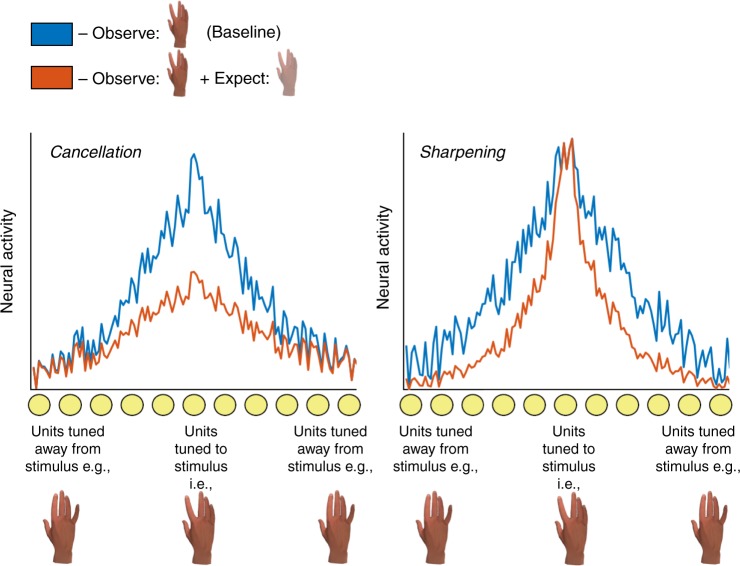
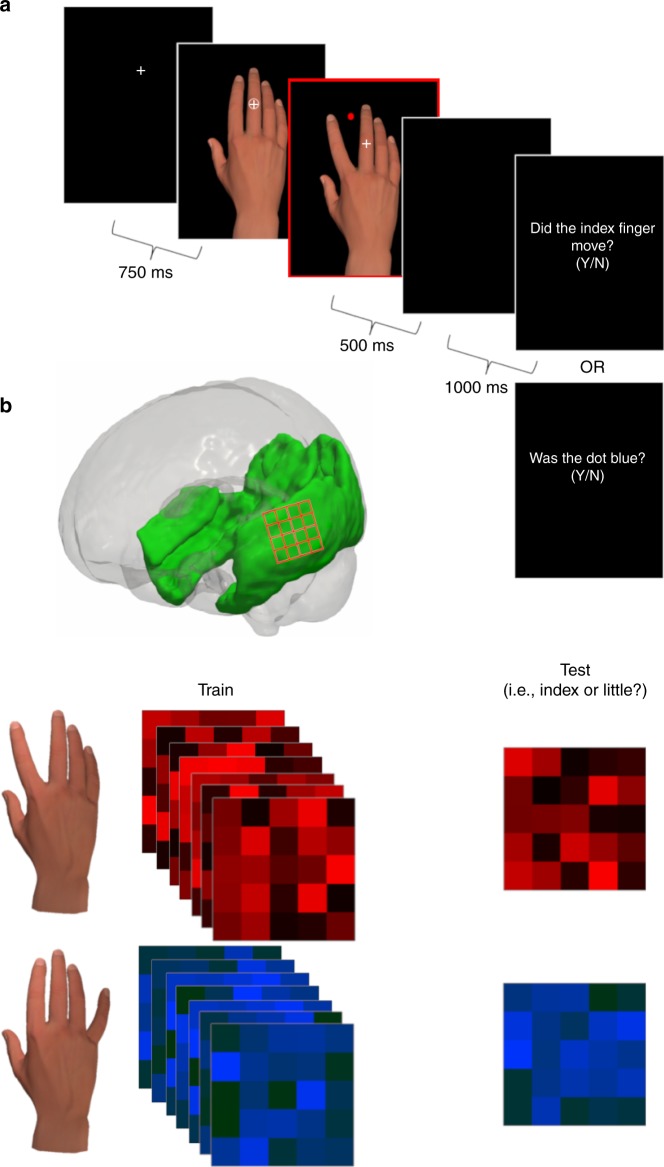
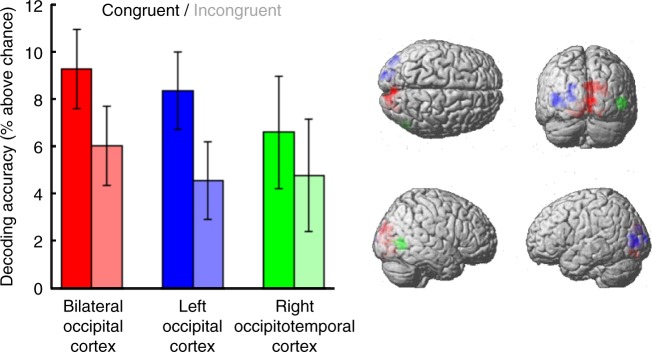
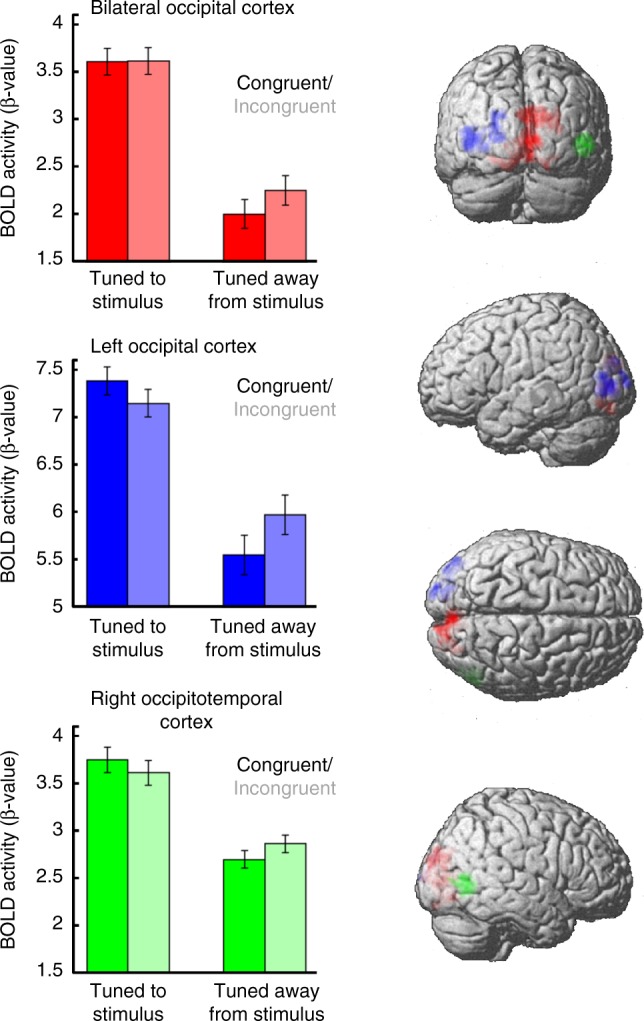
When we produce actions we predict their likely consequences. Dominant models of action control suggest that these predictions are used to ‘cancel’ perceptual processing of expected outcomes. However, normative Bayesian models of sensory cognition developed outside of action propose that rather than being cancelled, expected sensory signals are represented with greater fidelity (sharpened). Here, we distinguished between these models in an fMRI experiment where participants executed hand actions (index vs little finger movement) while observing movements of an avatar hand. Consistent with the sharpening account, visual representations of hand movements (index vs little finger) could be read out more accurately when they were congruent with action and these decoding enhancements were accompanied by suppressed activity in voxels tuned away from, not towards, the expected stimulus. Therefore, inconsistent with dominant action control models, these data show that sensorimotor prediction sharpens expected sensory representations, facilitating veridical perception of action outcomes.
Overview
The claims and statistics of this paper haven’t been checked yet.
Free: it reads the open-access text and checks the first 5 claims that cite a source we can check. Create a free account to check every claim.
Integrity signals
Registry
Cites
Statistics
Figures
Verification
Claims the paper makes
The claims and statistics of this paper haven’t been checked yet.
Free: it reads the open-access text and checks the first 5 claims that cite a source we can check. Create a free account to check every claim.
Claims other papers make about this one
Each is checked against this paper’s own text: does it say what the citing paper says it does?
The source backs part of the claim, not all of it — or backs it for a different population, condition or comparison.
In the citing paper
“others have found that this global suppression is attributable to the suppression of neurons tuned away from the expected stimulus feature, while the representation of the expected stimulus is actually sharpened”
From Evaluating the neurophysiological evidence for predictive processing as a model of perception (2020) · cites this paper as [112]
Experimental — accuracy not yet measured
Self-check
Percentages, sums and reported differences re-computed from the paper’s own numbers.
The self-check needs the paper’s full text.
Citations
Cites
James, W. (1913) · Henry Holt and Company eBooks · doi:10.1037/11059-000 · Cited by 25,226
A theory of cortical responses.
Friston, K. (2005) · Philosophical Transactions of the Royal Society B: Biological Sciences · doi:10.1098/rstb.2005.1622 · Cited by 4,578
The principles of psychology, Vol I.
James, W. (1890) · doi:10.1037/10538-000 · Cited by 4,514
An internal model for sensorimotor integration
Wolpert, D. M., Ghahramani, Z., & Jordan, M. I. (1995) · Science · doi:10.1126/science.7569931 · Cited by 3,553
Cluster failure: why fMRI inferences for spatial extent have inflated false-positive rates
Eklund, A., Nichols, T. E., & Knutsson, H. (2016) · Proceedings of the National Academy of Sciences · doi:10.1073/pnas.1602413113 · Cited by 3,487
The Theory of Event Coding (TEC): A framework for perception and action planning
Hommel, B., Müsseler, J., Aschersleben, G., & Prinz, W. (2001) · Behavioral and Brain Sciences · doi:10.1017/s0140525x01000103 · Cited by 3,091
Using confidence intervals in within-subject designs
Loftus, G. R., & Masson, M. E. J. (1994) · Psychonomic Bulletin & Review · doi:10.3758/bf03210951 · Cited by 2,448
Information-based functional brain mapping
Kriegeskorte, N., Goebel, R., & Bandettini, P. (2006) · Proceedings of the National Academy of Sciences · doi:10.1073/pnas.0600244103 · Cited by 2,113
Bar, M. (2004) · Nature Reviews Neuroscience · doi:10.1038/nrn1476 · Cited by 1,613
Central cancellation of self-produced tickle sensation
Blakemore, S.-J., Wolpert, D. M., & Frith, C. D. (1998) · Nature Neuroscience · doi:10.1038/2870 · Cited by 1,467
Cited by
Items 101–167 of 167
Neural Evidence for Action-Related Somatosensory Predictions
Moran, C., Hogendoorn, H., & Landau, A. N. (2026) · Journal of Neuroscience · doi:10.1523/jneurosci.0889-25.2026 · Cited by 2
“Recent fMRI work, using a similar design, found higher decoding for congruent versus incongruent action-e ff ects in the occipital and occipitotemporal cortex, indicating a sharp-ened representation driven by expectation (Yon et al., 2018).”
Visuomotor Memory Is Not Bound to Visual Motion
Warburton, M., Campagnoli, C., Mon-Williams, M. A., Mushtaq, F., & Morehead, J. R. (2025) · Journal of Neuroscience · doi:10.1523/jneurosci.1884-24.2025 · Cited by 2
“The speci fi c fea- turesthatmakesensoryinformationrelevantfortheseinternalmod-els,andthereforewhatsensoryfeedbackchangesmightdelineate context-speci fi c internal models, is generally unclear.”
Cortical candidates for self-other distinction based on visual and action cues: Where do we stand?Preprint
Limanowski, J. (2025) · PsyArXiv (OSF Preprints) · doi:10.31234/osf.io/jpbz2_v1 · Cited by 2
Hu, M., & Chait, M. (2026) · bioRxiv (Cold Spring Harbor Laboratory) · doi:10.64898/2026.01.09.698639 · Cited by 2
“By continuously optimizing these internal representations, the brain can allocate cognitive and neural resources efficiently, supporting adaptive perception and action in a dynamically changing environment (3,10–15).”
Sixty years of predictive perception
Ward, E. K., & Press, C. (2023) · Cortex · doi:10.1016/j.cortex.2023.11.003 · Cited by 1
Self-citationCMDdemux: an efficient single cell demultiplexing method
Wang, J., Chen, L., Brown, D. V., Chiu, C. Y. H., & Speed, T. P. (2026) · Nucleic Acids Research · doi:10.1093/nar/gkag360 · Cited by 1
Forward and backward prediction in learning and perception
de Lange, F. P., & Press, C. (2025) · Current Opinion in Neurobiology · doi:10.1016/j.conb.2025.103144 · Cited by 3
Self-citationAction modulates visual detection and metacognitive sensitivity
Tagami, U., & Imaizumi, S. (2026) · Acta Psychologica · doi:10.1016/j.actpsy.2026.106632 · Cited by 1
Keck, J., Bachmann, J., Munzert, J., Hegele, M., & Krüger, B. (2026) · NeuroImage · doi:10.1016/j.neuroimage.2026.122139 · Cited by 2
Meng, J., Li, X., Zhao, Y., Li, R., Xu, M., & Ming, D. (2023) · Brain Sciences · doi:10.3390/brainsci13040610 · Cited by 1
Huang, L., Shen, S., Sun, Y., Ou, S., Zhang, R., de Lange, F. P., & Zhang, X. (2025) · eLife · doi:10.1101/2024.08.26.609781 · Cited by 2
Misprediction Sensitivity Is Diminished for Action-effects Resulting from Stimulus-driven Movement
Harrison, A. W., Christensen, B. K., & Whitford, T. J. (2025) · Journal of Cognitive Neuroscience · doi:10.1162/jocn_a_02321 · Cited by 1
Suzuishi, Y., Chang, A. Y.-C., & Wen, W. (2024) · bioRxiv (Cold Spring Harbor Laboratory) · doi:10.1101/2024.10.07.616960 · Cited by 1
Dissociable dynamic effects of expectation during statistical learningPreprint
McDermott, H. H., Martino, F. D., Schwiedrzik, C. M., & Auksztulewicz, R. (2026) · eLife · doi:10.7554/elife.103689.3 · Cited by 1
Diffuse predictions stabilize and reshape the neural code during working memory encodingPreprint
Ataseven, N., Özdemir, Ş., Kruijne, W., Schneider, D. A., & Akyürek, E. G. (2026) · bioRxiv (Cold Spring Harbor Laboratory) · doi:10.64898/2026.02.23.707359 · Cited by 1
Shaping the perceptual representation of observed human action through prediction.
McDonough, K. L. (2019) · PEARL (University of Plymouth) · doi:10.24382/1034
Experience Dependent Sensorimotor Functioning in Adults with Severe Autism Spectrum Disorder
Oulton, J. (2019) · Liverpool John Moores University · doi:10.24377/ljmu.t.00011673 · Cited by 1
Towards a model of human body perception
Gandolfo, M. (2020) · Radboud Repository (Radboud University)
Decoding the content of cross-modal influences in the brain
Bailey, K. (2020) · UEA Digital Repository (University of East Anglia)
McDonough, K. L., Costantini, M., Hudson, M., Ward, E., & Bach, P. (2020) · Journal of Experimental Psychology Human Perception & Performance · doi:10.1037/xhp0000745.supp
Sense of Agency Enhances Visual Signal Detection and Metacognitive SensitivityPreprint
Tagami, U., & Imaizumi, S. (2023) · SSRN Electronic Journal · doi:10.2139/ssrn.4354282
Editor's evaluation: Action does not enhance but attenuates predicted touch
Ahmed, A. A. (2023) · eLife · doi:10.7554/elife.90912.sa0
Rapid re-weighting of sensory inputs and predictions in visual perceptionPreprint
Turner, W., Kwon, O., Kim, M. J. B., & Hogendoorn, H. (2024) · PsyArXiv (OSF Preprints) · doi:10.31234/osf.io/98rb6
Sensory Attenuation related to Action-effect Prediction and the Sense of Agency
Lindner, E. (2024) · eDiss (Georg-August-Universität Göttingen) · doi:10.53846/goediss-10709
Cognitive and neural mechanisms of linguistic influence on perception.
Slivac, K., Hagoort, P., & Flecken, M. (2025) · Psychological Review · doi:10.1037/rev0000546
“…f t h e i nd i v i du a l u s e r a nd i s no t t o b e d i ss e m i n a t e d b r o a d l y . using nonlinguistic stimuli (Kok & de Lange, 2014; Kok et al., 2012; Martens & Gruber, 2012; Yon et al., 2018; Zhang & Sejnowski, 1999), it has yet to be tested in studies with linguistic labels as cues.”
Predictive processing for sensory and action neural representationsPreprint
Iwama, G. Y., Breska, A., & Helfrich, R. F. (2025) · bioRxiv (Cold Spring Harbor Laboratory) · doi:10.1101/2025.03.26.645167
“Notably, some studies have provided contradictory results, such as weaker representations of expected visual stimuli (Richter et al., 2018), or enhanced representations of sensory signals when they were congruent with hand movements (Yon et al., 2018).”
Rapid re-weighting of sensory inputs and predictions in visual perceptionPreprint
Turner, W., Kwon, O., Kim, M. J. B., & Hogendoorn, H. (2025) · PsyArXiv (OSF Preprints) · doi:10.31234/osf.io/98rb6_v2
Ntikas, M., Parrotta, E., Fouragnan, E. F., Ganis, G., & Bach, P. (2025) · PsyArXiv (OSF Preprints) · doi:10.31234/osf.io/tfxh8_v1
Center-surround inhibition by expectation: a neuro-computational accountPreprint
Huang, L., Shen, S., Sun, Y., Ou, S., Zhang, R., de Lange, F. P., & Zhang, X. (2025) · eLife · doi:10.7554/elife.107301.1
Active inference and speech motor control: a review and theoryPreprint
Bradshaw, A. R., Press, C., & Davis, M. H. (2025) · PsyArXiv (OSF Preprints) · doi:10.31234/osf.io/eq4kh_v2
Self-citationMasanga, J. O., Bartz, P., Villani, G. H., Grullón‐Penkova, I. F., Bachelot, B., & Lasky, J. R. (2025) · bioRxiv (Cold Spring Harbor Laboratory) · doi:10.1101/2025.08.11.669667
Rapid Reweighting of Sensory Inputs and Predictions in Visual Perception
Turner, W., Kwon, O., Kim, M. J., & Hogendoorn, H. (2025) · Neural Computation · doi:10.1162/neco.a.26
The effects of action-based predictions in early visual cortex
van Kemenade, B. M., & Muckli, L. F. (2026) · iScience · doi:10.1016/j.isci.2026.117074
“Unlike Yon et al., 14 who compared expected and unexpected action outcomes (all self-generated), we compared self-generated and externally generated stimuli, both of which were expected and temporally predictable.”
‘Big Isotopic Data’ link millet consumption under Lombard rule in early medieval northern ItalyPreprint
Cocozza, C. (2025) · bioRxiv (Cold Spring Harbor Laboratory) · doi:10.1101/2025.08.28.672877
Motyka, P., Schwartzman, D. J., Seth, A. K., & Suzuki, K. (2025) · Consciousness and Cognition · doi:10.1016/j.concog.2025.103934
Center-surround inhibition by expectation: a neuro-computational accountPreprint
Huang, L., Shen, S., Sun, Y., Ou, S., Zhang, R., de Lange, F. P., & Zhang, X. (2025) · eLife · doi:10.7554/elife.107301.2
Attention and Explicit Knowledge Drive Predictive Sharpening in Early Visual Cortex
Sabio‐Albert, M., Richter, D., Fuentemilla, L., & Pérez-Bellido, A. (2026) · Journal of Cognitive Neuroscience · doi:10.1162/jocn.a.2689
Dissociable dynamic effects of expectation during statistical learningPreprint
McDermott, H. H., Martino, F. D., Schwiedrzik, C. M., & Auksztulewicz, R. (2025) · eLife · doi:10.7554/elife.103689.2
Huang, L., Shen, S., Sun, Y., Ou, S., Zhang, R., de Lange, F. P., & Zhang, X. (2025) · eLife · doi:10.7554/elife.107301.3.sa3
Sensory attenuation scales with the strength of action-outcome coupling: A psychophysical study
Paire, A., Nguyen, L., de Araujo, H. G., Vergilino‐Perez, D., & Paeye, C. (2026) · Cognition · doi:10.1016/j.cognition.2026.106631
Chung, K. H. L. (2023) · UNSWorks (University of New South Wales, Sydney, Australia) · doi:10.26190/unsworks/24885 · Cited by 1
Prediction throughout visual cortex: How statistical regularities shape sensory processing
Richter, D. (2021) · Radboud Repository (Radboud University) · Cited by 1
Neural Mechanisms of Preparation in Expectation and Selective Attention
González Peñalver, J. M. (2024) · Institutional Repository of the University of Granada (University of Granada) · Cited by 1
eLife Assessment: Dissociable dynamic effects of expectation during statistical learning
Press, C. (2026) · eLife · doi:10.7554/elife.103689.4.sa0
Self-citationSensory Experience and Motor Signals Shape Auditory Processing in an Independent Manner
Buaron, B., & Mukamel, R. (2026) · European Journal of Neuroscience · doi:10.1111/ejn.70462
“Neural models suggest that predictions modulate the responsiveness and tuning of stimulus-selective neurons, such that their activity is more selective towards the expected event (Summerfield and de Lange 2014; Yon et al. 2018).”
Sequential prioritization of expected and unexpected information in visual processingPreprint
Alink, A., Becker, J., & Blank, H. (2026) · bioRxiv (Cold Spring Harbor Laboratory) · doi:10.64898/2026.03.23.713176 · Cited by 2
Etude de l'influence des processus prédictifs sur la perception visuelle subjective
Rossel, P. (2023) · theses.fr (ABES) · doi:10.70675/83d02a65z92c7z43adza63ez56c54bdc9370
Relation entre agentivité et intégration visuo- vestibulaire dans la perception du mouvement propre
Rineau, A.-L. (2023) · theses.fr (ABES) · doi:10.70675/a1c7ca7ez4b22z4a1cza705z229a4d571cde
Dissociable dynamic effects of expectation during statistical learning
McDermott, H. H., Martino, F. D., Schwiedrzik, C. M., & Auksztulewicz, R. (2026) · Refubium (Universitätsbibliothek der Freien Universität Berlin) · doi:10.17169/refubium-51982
Sensorimotor Coupling Modulates Perceived Time and Agency Across Visual Perspectives
Imaizumi, S., Lai, G., Seth, A. K., & Suzuki, K. (2026) · Collabra Psychology · doi:10.1525/collabra.164266
Violating statistical structure impairs detection of deviant and incidental events
Ward, E. K., Simpson, N., & Press, C. (2026) · iScience · doi:10.1016/j.isci.2026.116383
Self-citationSearching for visuomotor matches versus mismatches biases confidence and visual sampling strategies
Yi, J., Wang, Z., Wang, P., & Limanowski, J. (2026) · Royal Society Open Science · doi:10.1098/rsos.252114
Rideaux, R., Hu, Z., Chidley, K., Cloos, M. A., Schwarzkopf, D. S., & Mattingley, J. B. (2026) · bioRxiv (Cold Spring Harbor Laboratory) · doi:10.64898/2026.07.05.736624
Vetter, P., Mesquita, T., & Badde, S. (2026) · Cognition · doi:10.1016/j.cognition.2026.106646
Boredom and the representation of information content in the neocortexPreprint
Seiler, J. P.-H., Eppler, J.-B., Seifpour, S., Wiese, L. C., Bergmann, T. O., Müller‐Dahlhaus, F., Tuescher, O., & Rumpel, S. (2026) · bioRxiv (Cold Spring Harbor Laboratory) · doi:10.64898/2026.07.09.737454
How do expectations shape actions?
Straube, B. (2026) · Trends Open · doi:10.1016/j.treopn.2026.06.017
Lageman, J., Kikumoto, A., Badre, D., Fahrenfort, J. J., & Slagter, H. A. (2026) · bioRxiv (Cold Spring Harbor Laboratory) · doi:10.64898/2026.07.24.740508
“Prior work on action-outcome predictions has shown that expected sensory consequences of actions can be decoded from neural activity prior to action onset ( 26 , 30 – 36 ).”
Quirmbach, F., Helmert, J. R., Pannasch, S., Dix, A., & Limanowski, J. (2026) · Psychophysiology · doi:10.1111/psyp.70373
“Finally, to ensure that participants were paying attention to the predictive cues (and therefore able to generate visuomotor predictions), we included “catch trials”, in which participants had to indicate if the mapping of the virtual hand matched the cue's predictions (cf. Yon et al. 2018).”
Martins, S. A. (2026) · Global perspectives in applied sport and performance psychology. · doi:10.1007/978-3-032-24615-8_6
Maronati, C. (n.d.) · Institutional Research Information System University of Turin (University of Turin)
Prior visual context accelerates the emergence of object representationsPreprint
Clarke, A., Gu, Y., & Krugliak, A. (2026) · bioRxiv (Cold Spring Harbor Laboratory) · doi:10.64898/2026.10.15.759465
Holstein, T., Sarrazin, J.-C., Berberian, B., & Desantis, A. (2026) · NeuroImage · doi:10.1016/j.neuroimage.2026.122293
Late Integration of Prior Expectations during Precision-Weighted Perceptual Decisions
Gastrell, T., Rangelov, D., & Mattingley, J. B. (2026) · Journal of Neuroscience · doi:10.1523/jneurosci.0612-26.2026
Peer review history of High-level visual prediction errors in early visual cortex (part 4)
Richter, D., Kietzmann, T. C., & de Lange, F. P. (2024) · doi:10.1371/journal.pbio.3002829.r004
Supporting information 1 of Motor engagement enhances incidental memory for task-irrelevant items
Shimane, D., Tanaka, T., Watanabe, K., & Tanaka, K. (2022) · doi:10.3389/fpsyg.2022.914877.s001
Metadata
- Authors
- Yon, D., Gilbert, S. J., de Lange, F. P., & Press, C.
- Affiliations
- University of London (GB)
- University College London (GB)
- Corresponding author
- Yon, Daniel
- Venue
- Nature Communications
- Published
- 2018-10-16
- Volume
- 9
- Issue
- 1
- Pages
- 4288-4288
- ISSN
- 2041-1723 (ISSN-L)
- PMC
- PMC6191413
- OpenAlex
- W2895865647
- Cited by
- 145
- References
- 35
- Citations by year
- 2026: 25 · 2025: 22 · 2024: 22 · 2023: 20 · 2022: 13 · 2021: 15 · 2020: 18 · 2019: 10
- FWCI
- 14.55
- Type
- journal article
- Language
- en
- Open access
- gold
- doi.org
- Licence
- cc-by
- creativecommons.org/licenses/by/4.0 (tdm)
- creativecommons.org/licenses/by/4.0 (vor)
- Locations
- Nature Communications (publishedVersion, cc-by)
- Europe PMC (PubMed Central) (publishedVersion, cc-by)
- PubMed Central (publishedVersion, cc-by)
- PubMed (publishedVersion)
- BIROn (Birkbeck, University of London) (acceptedVersion)
- Goldsmiths (University of London) (acceptedVersion)
- RePEc: Research Papers in Economics (submittedVersion)
- DOAJ (DOAJ: Directory of Open Access Journals) (submittedVersion)
- DOAJ (DOAJ: Directory of Open Access Journals) (submittedVersion, cc-by-sa)
- UCL Discovery (University College London) (submittedVersion)
- Radboud Repository (Radboud University) (submittedVersion)
- Radboud Repository (Radboud University) (submittedVersion, other-oa)
- Funders
- James S. McDonnell Foundation
- Wellcome Trust
- Leverhulme Trust (RPG‐2016‐105)
- Nederlandse Organisatie voor Wetenschappelijk Onderzoek
- Economic and Social Research Council (1368177)
- H2020 European Research Council (678286)
- Topics
- Social Sciences › Psychology › Social Psychology › Action Observation and Synchronization
- Life Sciences › Neuroscience › Cognitive Neuroscience › Motor Control and Adaptation
- Life Sciences › Neuroscience › Cognitive Neuroscience › Embodied and Extended Cognition
- Keywords
- sensorimotor prediction, Bayesian models of perception, action control, sensorimotor integration
- MeSH terms
- Adult, Brain, Female, Fingers, Humans, Magnetic Resonance Imaging, Male, Models, Neurological, Movement, Perception, Photic Stimulation, Nontherapeutic Human Experimentation, Support Vector Machine
About these checks
Registry, retraction, Cites and statistics results are computed, not judged, with one exception: a printed reference that no index lists is read once by a model before it counts as a citation error. Claims are extracted by a model and kept only when their quote appears verbatim in the text; each cited source is then checked, with a model’s help, for whether it says what the claim relies on. Those verdicts can be wrong — read the claim’s quote and the cited source before relying on one.
Statistics and arithmetic are recomputed, not judged.
Confidence bands are shown only for fields calibrated on our annotated test set. None is calibrated yet, so no band is shown.
What counts as a claim ›How we measure confidence ›How we check this ›
Are you an author, or do you see a problem with this page? Request a review
Data sources
Bibliographic data: Semantic Scholar, OpenAlex, Crossref.
Contains information from the Semantic Scholar Academic Graph Datasets, made available under the ODC Attribution License (ODC-BY 1.0).
Semantic Scholar’s data is described in: Kinney, R., et al. (2023). The Semantic Scholar Open Data Platform. arXiv:2301.10140.
