

Action sharpens sensory representations of expected outcomes
Open accessThe DOI matches its Crossref record; 35 of the 35 references it cites were found in a registry or an index.
Abstract
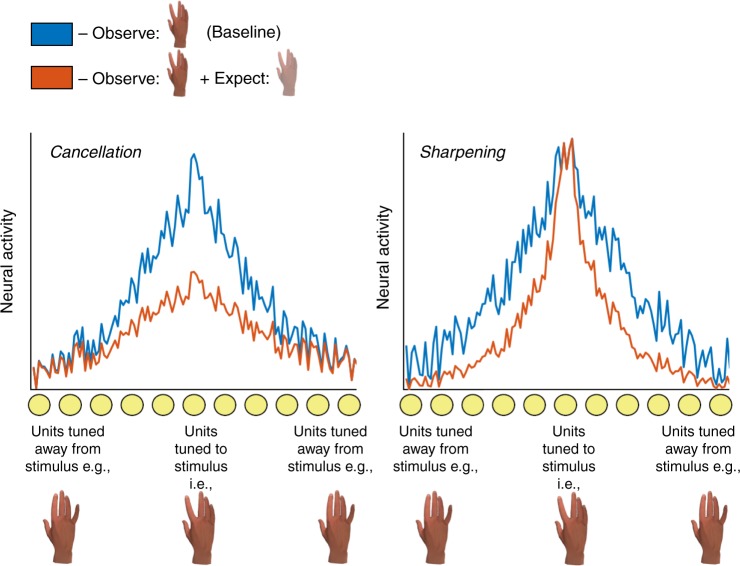
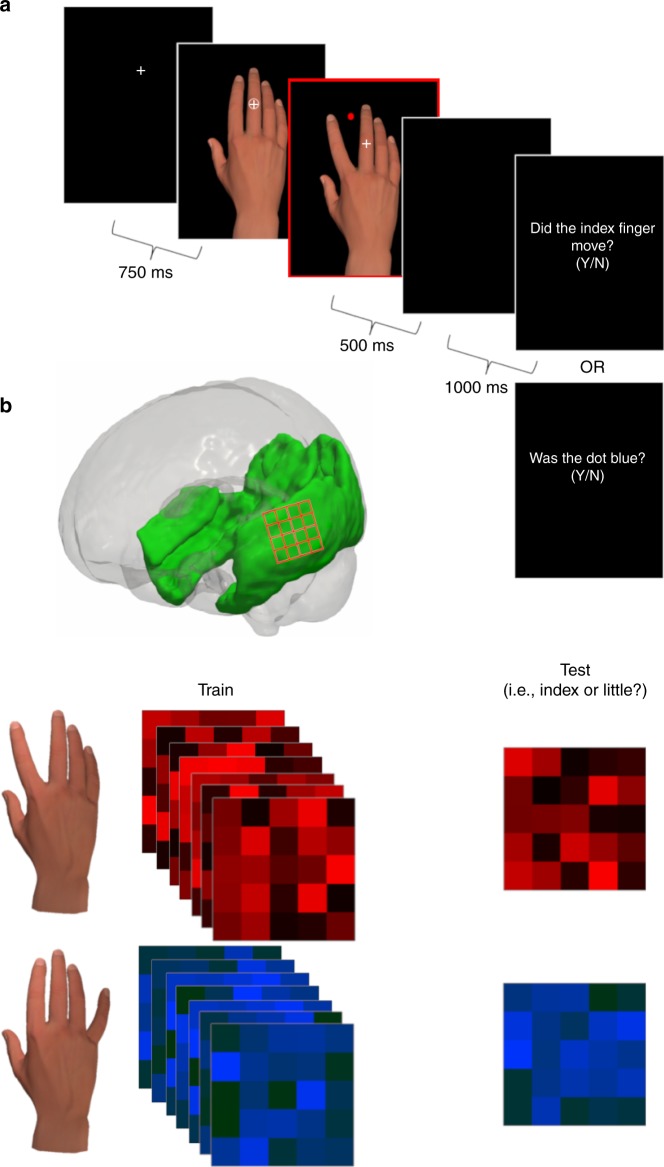
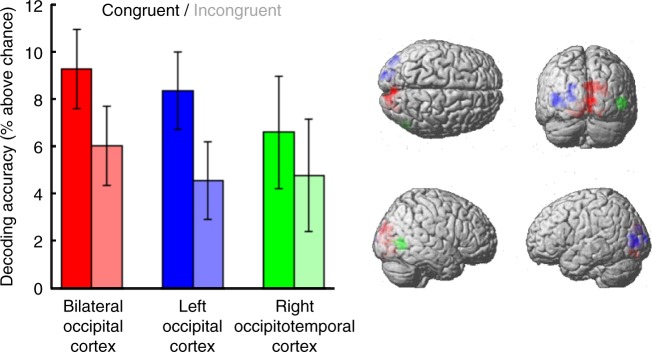
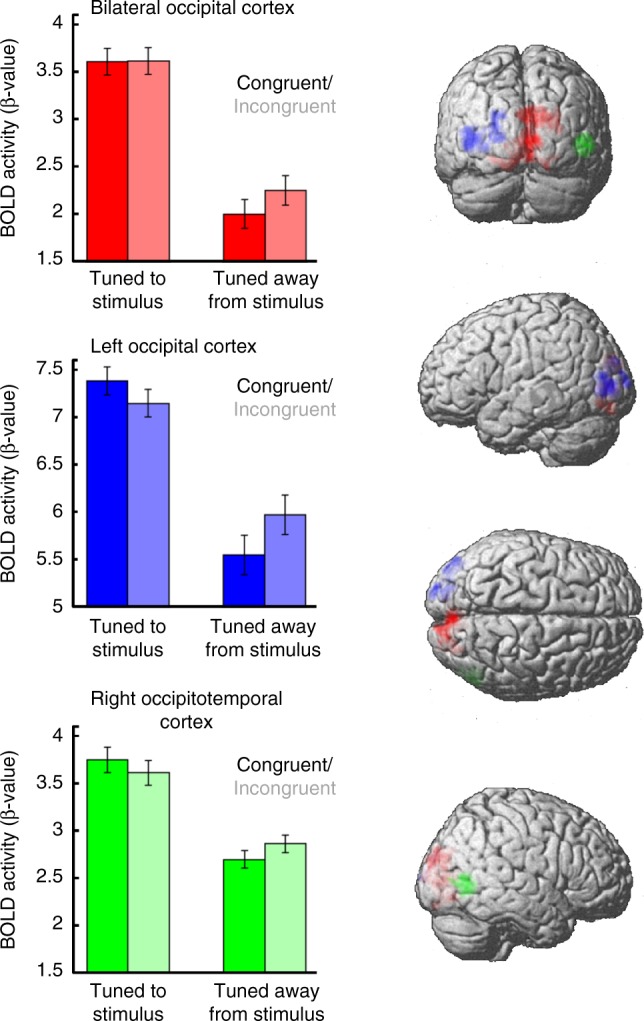
When we produce actions we predict their likely consequences. Dominant models of action control suggest that these predictions are used to ‘cancel’ perceptual processing of expected outcomes. However, normative Bayesian models of sensory cognition developed outside of action propose that rather than being cancelled, expected sensory signals are represented with greater fidelity (sharpened). Here, we distinguished between these models in an fMRI experiment where participants executed hand actions (index vs little finger movement) while observing movements of an avatar hand. Consistent with the sharpening account, visual representations of hand movements (index vs little finger) could be read out more accurately when they were congruent with action and these decoding enhancements were accompanied by suppressed activity in voxels tuned away from, not towards, the expected stimulus. Therefore, inconsistent with dominant action control models, these data show that sensorimotor prediction sharpens expected sensory representations, facilitating veridical perception of action outcomes.
Overview
The claims and statistics of this paper haven’t been checked yet.
Free: it reads the open-access text and checks the first 5 claims that cite a source we can check. Create a free account to check every claim.
Integrity signals
Registry
Cites
Statistics
Figures
Verification
Claims the paper makes
The claims and statistics of this paper haven’t been checked yet.
Free: it reads the open-access text and checks the first 5 claims that cite a source we can check. Create a free account to check every claim.
Claims other papers make about this one
Each is checked against this paper’s own text: does it say what the citing paper says it does?
The source backs part of the claim, not all of it — or backs it for a different population, condition or comparison.
In the citing paper
“others have found that this global suppression is attributable to the suppression of neurons tuned away from the expected stimulus feature, while the representation of the expected stimulus is actually sharpened”
From Evaluating the neurophysiological evidence for predictive processing as a model of perception (2020) · cites this paper as [112]
Experimental — accuracy not yet measured
Self-check
Percentages, sums and reported differences re-computed from the paper’s own numbers.
The self-check needs the paper’s full text.
Citations
Cites
James, W. (1913) · Henry Holt and Company eBooks · doi:10.1037/11059-000 · Cited by 25,226
A theory of cortical responses.
Friston, K. (2005) · Philosophical Transactions of the Royal Society B: Biological Sciences · doi:10.1098/rstb.2005.1622 · Cited by 4,578
The principles of psychology, Vol I.
James, W. (1890) · doi:10.1037/10538-000 · Cited by 4,514
An internal model for sensorimotor integration
Wolpert, D. M., Ghahramani, Z., & Jordan, M. I. (1995) · Science · doi:10.1126/science.7569931 · Cited by 3,553
Cluster failure: why fMRI inferences for spatial extent have inflated false-positive rates
Eklund, A., Nichols, T. E., & Knutsson, H. (2016) · Proceedings of the National Academy of Sciences · doi:10.1073/pnas.1602413113 · Cited by 3,487
The Theory of Event Coding (TEC): A framework for perception and action planning
Hommel, B., Müsseler, J., Aschersleben, G., & Prinz, W. (2001) · Behavioral and Brain Sciences · doi:10.1017/s0140525x01000103 · Cited by 3,091
Using confidence intervals in within-subject designs
Loftus, G. R., & Masson, M. E. J. (1994) · Psychonomic Bulletin & Review · doi:10.3758/bf03210951 · Cited by 2,448
Information-based functional brain mapping
Kriegeskorte, N., Goebel, R., & Bandettini, P. (2006) · Proceedings of the National Academy of Sciences · doi:10.1073/pnas.0600244103 · Cited by 2,113
Bar, M. (2004) · Nature Reviews Neuroscience · doi:10.1038/nrn1476 · Cited by 1,613
Central cancellation of self-produced tickle sensation
Blakemore, S.-J., Wolpert, D. M., & Frith, C. D. (1998) · Nature Neuroscience · doi:10.1038/2870 · Cited by 1,467
Perceiving is believing: a Bayesian approach to explaining the positive symptoms of schizophrenia
Fletcher, P. C., & Frith, C. D. (2009) · Nature Reviews Neuroscience · doi:10.1038/nrn2536 · Cited by 1,462
Abnormalities in the awareness and control of action
Frith, C. D., Blakemore, S.-J., & Wolpert, D. M. (2000) · Philosophical Transactions of the Royal Society of London. Series B: Biological Sciences · doi:10.1098/rstb.2000.0734 · Cited by 1,200
Detecting activations in PET and fMRI: levels of inference and power
Friston, K. J., Holmes, A., Poline, J.-B., Price, C. J., & Frith, C. D. (1996) · NeuroImage · doi:10.1006/nimg.1996.0074 · Cited by 1,148
Vision as Bayesian inference: analysis by synthesis?
Yuille, A., & Kersten, D. (2006) · Trends in Cognitive Sciences · doi:10.1016/j.tics.2006.05.002 · Cited by 849
Expectation in perceptual decision making: neural and computational mechanisms
Summerfield, C., & de Lange, F. P. (2014) · Nature Reviews Neuroscience · doi:10.1038/nrn3838 · Cited by 832
Less Is More: Expectation Sharpens Representations in the Primary Visual Cortex
Kok, P., Jehee, J. F. M., & de Lange, F. P. (2012) · Neuron · doi:10.1016/j.neuron.2012.04.034 · Cited by 798
BLAKEMORE, S.-J., SMITH, J., STEEL, R., JOHNSTONE, E. C., & FRITH, C. D. (2000) · Psychological Medicine · doi:10.1017/s0033291799002676 · Cited by 497
Stimulus Predictability Reduces Responses in Primary Visual Cortex
Alink, A., Schwiedrzik, C. M., Kohler, A., Singer, W., & Muckli, L. (2010) · The Journal of Neuroscience · doi:10.1523/jneurosci.3730-10.2010 · Cited by 435
Computational principles of sensorimotor control that minimize uncertainty and variability
Bays, P. M., & Wolpert, D. M. (2007) · The Journal of Physiology · doi:10.1113/jphysiol.2006.120121 · Cited by 359
Prior expectations induce prestimulus sensory templates
Kok, P., Mostert, P., & de Lange, F. P. (2017) · Proceedings of the National Academy of Sciences · doi:10.1073/pnas.1705652114 · Cited by 340
The lateral occipitotemporal cortex in action
Lingnau, A., & Downing, P. E. (2015) · Trends in Cognitive Sciences · doi:10.1016/j.tics.2015.03.006 · Cited by 324
A Dual Role for Prediction Error in Associative Learning
den Ouden, H. E. M., Friston, K. J., Daw, N. D., McIntosh, A. R., & Stephan, K. E. (2009) · Cerebral Cortex · doi:10.1093/cercor/bhn161 · Cited by 306 · cited 1×
“The remaining third of trials were no move trials (16), where participants observed index or little abductions without moving themselves.”
BackgroundThe neural correlates of perceiving one's own movements
Leube, D. (2003) · NeuroImage · doi:10.1016/j.neuroimage.2003.07.033 · Cited by 272
Preliminary Observations on Tickling Oneself
WEISKRANTZ, L., ELLIOTT, J., & DARLINGTON, C. (1971) · Nature · doi:10.1038/230598a0 · Cited by 268
Expectations accelerate entry of visual stimuli into awareness
Pinto, Y., van Gaal, S., de Lange, F. P., Lamme, V. A. F., & Seth, A. K. (2015) · Journal of Vision · doi:10.1167/15.8.13 · Cited by 159
Allefeld, C., Görgen, K., & Haynes, J.-D. (2016) · NeuroImage · doi:10.1016/j.neuroimage.2016.07.040 · Cited by 157
Decoding the yellow of a gray banana
Bannert, M. M., & Bartels, A. (2013) · Current Biology · doi:10.1016/j.cub.2013.09.016 · Cited by 146
Prior object-knowledge sharpens properties of early visual feature-detectors
Teufel, C., Dakin, S. C., & Fletcher, P. C. (2018) · Scientific Reports · doi:10.1038/s41598-018-28845-5 · Cited by 119
Modulation of somatosensory processing by action
Shergill, S. S., White, T. P., Joyce, D. W., Bays, P. M., Wolpert, D. M., & Frith, C. D. (2013) · NeuroImage · doi:10.1016/j.neuroimage.2012.12.043 · Cited by 99
Feature-Based Attention and Feature-Based Expectation
Summerfield, C., & Egner, T. (2016) · Trends in Cognitive Sciences · doi:10.1016/j.tics.2016.03.008 · Cited by 98
Feature expectation heightens visual sensitivity during fine orientation discrimination
Cheadle, S., Egner, T., Wyart, V., Wu, C., & Summerfield, C. (2015) · Journal of Vision · doi:10.1167/15.14.14 · Cited by 76
Kontaris, I., Wiggett, A. J., & Downing, P. E. (2009) · Neuropsychologia · doi:10.1016/j.neuropsychologia.2009.07.012 · Cited by 66
Stanley, J., & Miall, R. C. (2006) · NeuroImage · doi:10.1016/j.neuroimage.2006.08.043 · Cited by 65
Switch-Independent Task Representations in Frontal and Parietal Cortex
Loose, L. S., Wisniewski, D., Rusconi, M., Goschke, T., & Haynes, J. (2017) · Journal of Neuroscience · doi:10.1523/jneurosci.3656-16.2017 · Cited by 58
Shape perception enhances perceived contrast: evidence for excitatory predictive feedback?
Han, B., & VanRullen, R. (2016) · Scientific Reports · doi:10.1038/srep22944 · Cited by 29
Cited by
Evaluating the neurophysiological evidence for predictive processing as a model of perception
Walsh, K. S., McGovern, D. P., Clark, A., & O'Connell, R. G. (2020) · Annals of the New York Academy of Sciences · doi:10.1111/nyas.14321 · Cited by 333
The Perceptual Prediction Paradox
Press, C., Kok, P., & Yon, D. (2020) · Trends in Cognitive Sciences · doi:10.1016/j.tics.2019.11.003 · Cited by 246
Self-citationPredictive processing as a systematic basis for identifying the neural correlates of consciousness
Hohwy, J., & Seth, A. (2020) · Philosophy and the Mind Sciences · doi:10.33735/phimisci.2020.ii.64 · Cited by 170
Prior expectations evoke stimulus-specific activity in the deep layers of the primary visual cortex
Aitken, F., Menelaou, G., Warrington, O., Koolschijn, R. S., Corbin, N., Callaghan, M. F., & Kok, P. (2020) · PLOS Biology · doi:10.1371/journal.pbio.3001023 · Cited by 138
Precision control for a flexible body representation
Limanowski, J. (2021) · Neuroscience & Biobehavioral Reviews · doi:10.1016/j.neubiorev.2021.10.023 · Cited by 119
Metadata
- Authors
- Yon, D., Gilbert, S. J., de Lange, F. P., & Press, C.
- Affiliations
- University of London (GB)
- University College London (GB)
- Corresponding author
- Yon, Daniel
- Venue
- Nature Communications
- Published
- 2018-10-16
- Volume
- 9
- Issue
- 1
- Pages
- 4288-4288
- ISSN
- 2041-1723 (ISSN-L)
- PMC
- PMC6191413
- OpenAlex
- W2895865647
- Cited by
- 145
- References
- 35
- Citations by year
- 2026: 25 · 2025: 22 · 2024: 22 · 2023: 20 · 2022: 13 · 2021: 15 · 2020: 18 · 2019: 10
- FWCI
- 14.55
- Type
- journal article
- Language
- en
- Open access
- gold
- doi.org
- Licence
- cc-by
- creativecommons.org/licenses/by/4.0 (tdm)
- creativecommons.org/licenses/by/4.0 (vor)
- Locations
- Nature Communications (publishedVersion, cc-by)
- Europe PMC (PubMed Central) (publishedVersion, cc-by)
- PubMed Central (publishedVersion, cc-by)
- PubMed (publishedVersion)
- BIROn (Birkbeck, University of London) (acceptedVersion)
- Goldsmiths (University of London) (acceptedVersion)
- RePEc: Research Papers in Economics (submittedVersion)
- DOAJ (DOAJ: Directory of Open Access Journals) (submittedVersion)
- DOAJ (DOAJ: Directory of Open Access Journals) (submittedVersion, cc-by-sa)
- UCL Discovery (University College London) (submittedVersion)
- Radboud Repository (Radboud University) (submittedVersion)
- Radboud Repository (Radboud University) (submittedVersion, other-oa)
- Funders
- James S. McDonnell Foundation
- Wellcome Trust
- Leverhulme Trust (RPG‐2016‐105)
- Nederlandse Organisatie voor Wetenschappelijk Onderzoek
- Economic and Social Research Council (1368177)
- H2020 European Research Council (678286)
- Topics
- Social Sciences › Psychology › Social Psychology › Action Observation and Synchronization
- Life Sciences › Neuroscience › Cognitive Neuroscience › Motor Control and Adaptation
- Life Sciences › Neuroscience › Cognitive Neuroscience › Embodied and Extended Cognition
- Keywords
- sensorimotor prediction, Bayesian models of perception, action control, sensorimotor integration
- MeSH terms
- Adult, Brain, Female, Fingers, Humans, Magnetic Resonance Imaging, Male, Models, Neurological, Movement, Perception, Photic Stimulation, Nontherapeutic Human Experimentation, Support Vector Machine
About these checks
Registry, retraction, Cites and statistics results are computed, not judged, with one exception: a printed reference that no index lists is read once by a model before it counts as a citation error. Claims are extracted by a model and kept only when their quote appears verbatim in the text; each cited source is then checked, with a model’s help, for whether it says what the claim relies on. Those verdicts can be wrong — read the claim’s quote and the cited source before relying on one.
Statistics and arithmetic are recomputed, not judged.
Confidence bands are shown only for fields calibrated on our annotated test set. None is calibrated yet, so no band is shown.
What counts as a claim ›How we measure confidence ›How we check this ›
Are you an author, or do you see a problem with this page? Request a review
Data sources
Bibliographic data: Semantic Scholar, OpenAlex, Crossref.
Contains information from the Semantic Scholar Academic Graph Datasets, made available under the ODC Attribution License (ODC-BY 1.0).
Semantic Scholar’s data is described in: Kinney, R., et al. (2023). The Semantic Scholar Open Data Platform. arXiv:2301.10140.
