

Structure and pro-toxic mechanism of the human Hsp90/PPIase/Tau complex
Open accessThe DOI matches its Crossref record; 78 of the 78 references it cites were found in a registry or an index.
Abstract
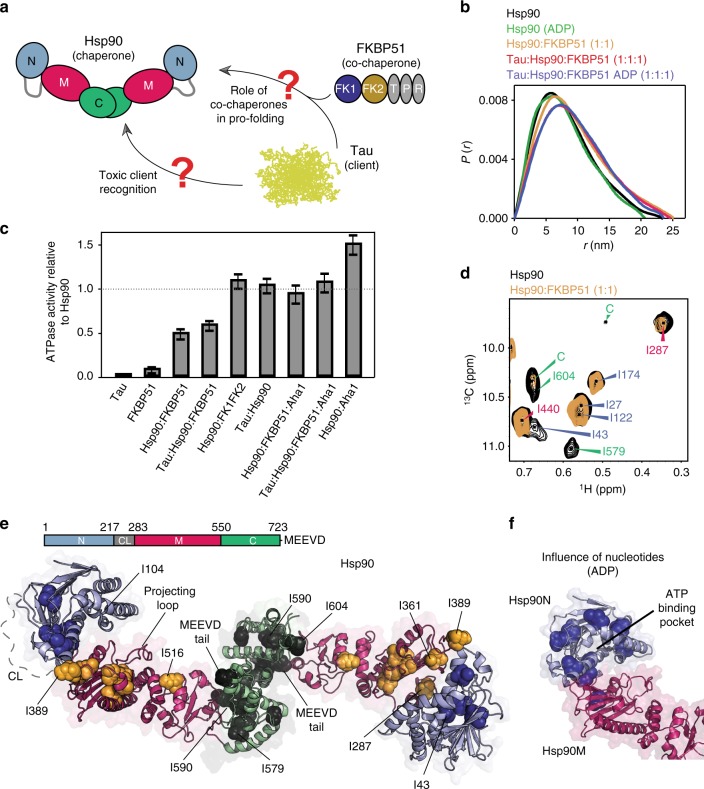
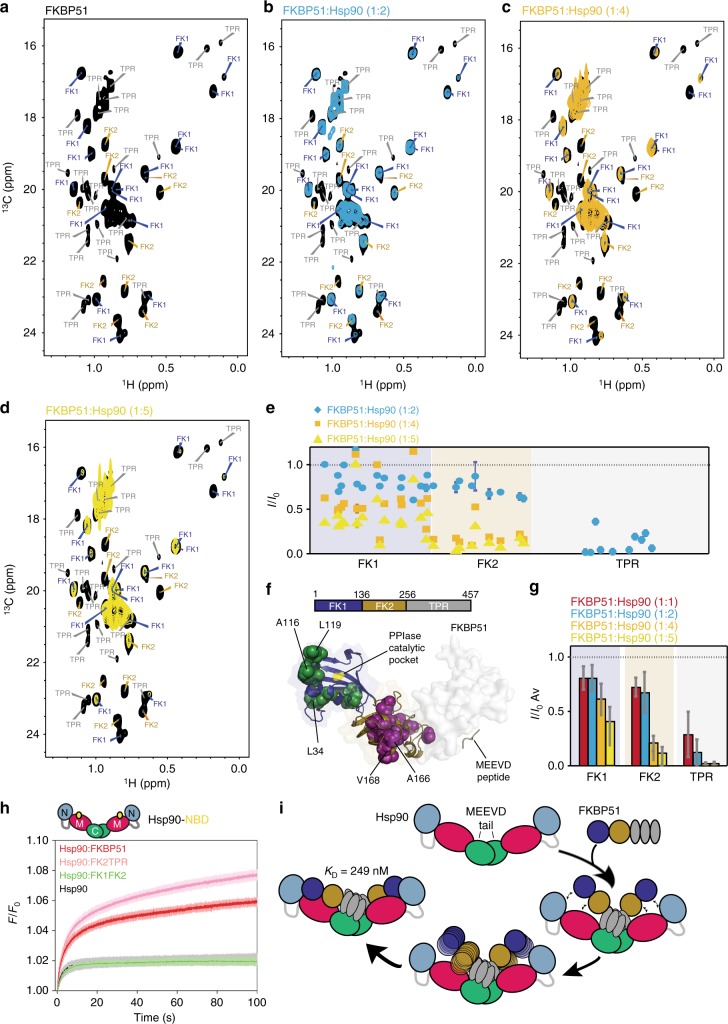
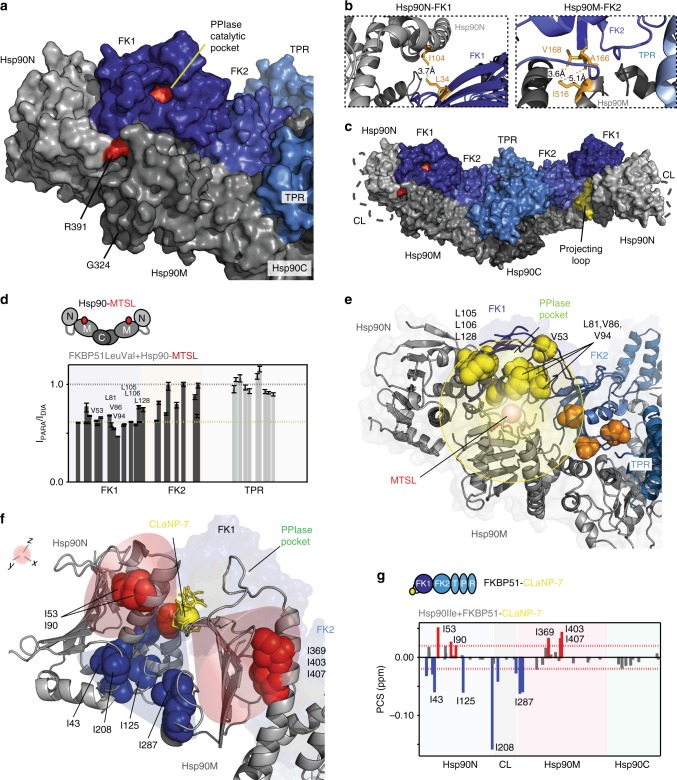
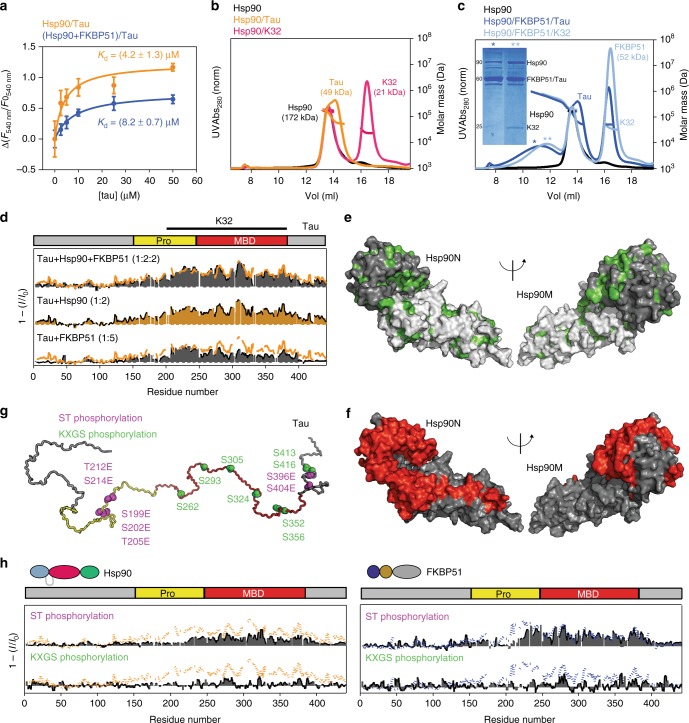
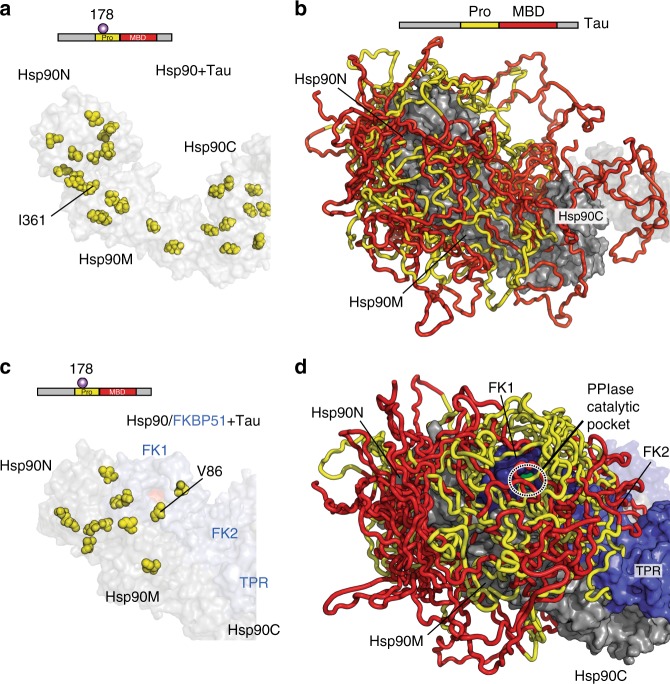
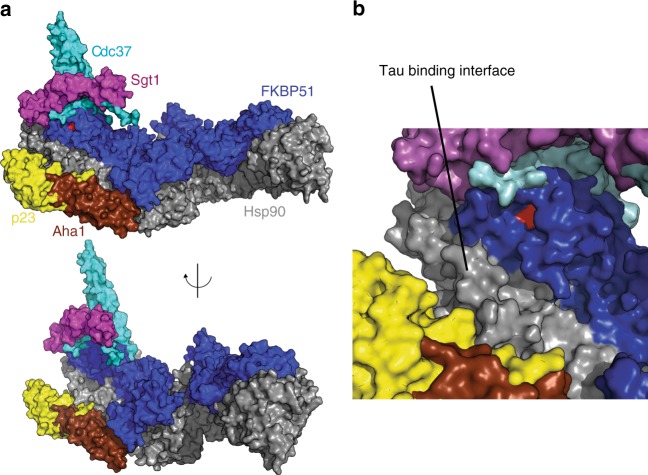
The molecular chaperone Hsp90 is critical for the maintenance of cellular homeostasis and represents a promising drug target. Despite increasing knowledge on the structure of Hsp90, the molecular basis of substrate recognition and pro-folding by Hsp90/co-chaperone complexes remains unknown. Here, we report the solution structures of human full-length Hsp90 in complex with the PPIase FKBP51, as well as the 280 kDa Hsp90/FKBP51 complex bound to the Alzheimer’s disease-related protein Tau. We reveal that the FKBP51/Hsp90 complex, which synergizes to promote toxic Tau oligomers in vivo, is highly dynamic and stabilizes the extended conformation of the Hsp90 dimer resulting in decreased Hsp90 ATPase activity. Within the ternary Hsp90/FKBP51/Tau complex, Hsp90 serves as a scaffold that traps the PPIase and nucleates multiple conformations of Tau’s proline-rich region next to the PPIase catalytic pocket in a phosphorylation-dependent manner. Our study defines a conceptual model for dynamic Hsp90/co-chaperone/client recognition.
Overview
The claims and statistics of this paper haven’t been checked yet.
Free: it reads the open-access text and checks the first 5 claims that cite a source we can check. Create a free account to check every claim.
Integrity signals
Registry
Cites
Statistics
Figures
Verification
Claims the paper makes
The claims and statistics of this paper haven’t been checked yet.
Free: it reads the open-access text and checks the first 5 claims that cite a source we can check. Create a free account to check every claim.
Claims other papers make about this one
Each is checked against this paper’s own text: does it say what the citing paper says it does?
The cited source says what the claim attributes to it.
In the citing paper
“By NMR, Hsp90 is identified to interact with tau transiently in the apo state and function as a scaffold in complex with FKBP51”
From The structure of an Hsp90-immunophilin complex reveals cochaperone recognition of the client maturation state (2021) · cites this paper as Oroz et al., 2018
Self-check
Percentages, sums and reported differences re-computed from the paper’s own numbers.
The self-check needs the paper’s full text.
Citations
Cites
Neuropathological stageing of Alzheimer-related changes.
Braak, H., & Braak, E. (1991) · Acta Neuropathologica · doi:10.1007/bf00308809 · Cited by 16,123
NMRPipe: A multidimensional spectral processing system based on UNIX pipes
Delaglio, F., Grzesiek, S., Vuister, G., Zhu, G., Pfeifer, J., & Bax, A. (1995) · Journal of Biomolecular NMR · doi:10.1007/bf00197809 · Cited by 15,965
Molecular chaperones in protein folding and proteostasis
Hartl, F. U., Bracher, A., & Hayer-Hartl, M. (2011) · Nature · doi:10.1038/nature10317 · Cited by 3,381
Protein Misfolding, Amyloid Formation, and Human Disease: A Summary of Progress Over the Last Decade
Chiti, F., & Dobson, C. M. (2017) · Annual Review of Biochemistry · doi:10.1146/annurev-biochem-061516-045115 · Cited by 2,629
Tau in physiology and pathology
Wang, Y., & Mandelkow, E. (2016) · Nature Reviews Neuroscience · doi:10.1038/nrn.2015.1 · Cited by 2,251
Self-citationClassification of Intrinsically Disordered Regions and Proteins
van der Lee, R., Buljan, M., Lang, B., Weatheritt, R. J., Daughdrill, G. W., Dunker, A. K., Fuxreiter, M., Gough, J., Gsponer, J., Jones, D. T., et al. (2014) · Chemical Reviews · doi:10.1021/cr400525m · Cited by 2,174
HSP90 at the hub of protein homeostasis: emerging mechanistic insights
Taipale, M., Jarosz, D. F., & Lindquist, S. (2010) · Nature Reviews Molecular Cell Biology · doi:10.1038/nrm2918 · Cited by 1,818
Molecular Chaperones and Protein Quality Control
Bukau, B., Weissman, J., & Horwich, A. (2006) · Cell · doi:10.1016/j.cell.2006.04.014 · Cited by 1,557
Schopf, F. H., Biebl, M. M., & Buchner, J. (2017) · Nature Reviews Molecular Cell Biology · doi:10.1038/nrm.2017.20 · Cited by 1,540
The HADDOCK web server for data-driven biomolecular docking
de Vries, S. J., van Dijk, M., & Bonvin, A. M. J. J. (2010) · Nature Protocols · doi:10.1038/nprot.2010.32 · Cited by 1,400
Cited by
Items 101–110 of 110
Tay, B. Q., Soltau, C. P., Adams, M. N., Bottle, S. E., & Richard, D. J. (2026) · Biochemical Pharmacology · doi:10.1016/j.bcp.2026.118042
Grabinska-Rogala, A., & Gestwicki, J. E. (2026) · Topics in medicinal chemistry · doi:10.1007/7355_2026_190
Alanazi, S. M., Al‐kuraishy, H. M., Alexiou, A. T., Papadakis, M., Faheem, S. A., & Batiha, G. E. (2026) · Progress in Neuro-Psychopharmacology and Biological Psychiatry · doi:10.1016/j.pnpbp.2026.111834
AHA1 Regulates Aβ Production via Modulation of APP Abundance and γ‐Secretase Assembly
Noorani, A. A., Islam, S., Filip, E., Catalfano, K. C., Paswan, S. K., Nagarajan, V., Wilkins, H., Blagg, B. S. J., Zou, K., & Wolfe, M. S. (2026) · Journal of Neurochemistry · doi:10.1111/jnc.70544
BindingDB Entry 50010920: Bioinspired Hybrid Fluorescent Ligands for the FK1 Domain of FKBP52.
BindingDB (2021) · UC San Diego · doi:10.7270/q2qc0735
Zhang, X., Xu, H., Guo, W., Wang, H.-L., Sun, Z.-H., Liu, Y., Xiao, H.-L., Ji, J., & Sun, X. (2026) · Stroke · doi:10.1161/strokeaha.126.056196
Owens, T. W., Schaefer, K., Peters-Clarke, T. M., Wells, J. A., & Agard, D. A. (2026) · bioRxiv (Cold Spring Harbor Laboratory) · doi:10.64898/2026.08.27.747592
Saraç, M., Kaffy, J., Peqini, K., Vanoni, C., Wetjen, A., Singh, L., Brandt, R., Campanacci, V., Gigant, B., Giraud, F., et al. (2026) · Organic & Biomolecular Chemistry · doi:10.1039/d6ob00187d
Isei, M. O., Crockett, M., Chen, E., Rodwell-Bullock, J., Carroll, T., Girardi, P. A., Nehrke, K., & Johnson, G. V. W. (2025) · doi:10.1371/journal.pone.0307358.r004
Metadata
- Authors
- Oroz, J., Chang, B. J., Wysoczanski, P., Lee, C.-T., Pérez-Lara, Á., Chakraborty, P., Hofele, R. V., Baker, J. D., Blair, L. J., Biernat, J., Urlaub, H., Mandelkow, E., Dickey, C. A., & Zweckstetter, M.
- Affiliations
- Consejo Superior de Investigaciones Científicas (ES)
- Max Planck Institute for Biophysical Chemistry (DE)
- German Center for Neurodegenerative Diseases (DE)
- University of South Florida (US)
- Center of Advanced European Studies and Research (DE)
- Universitätsmedizin Göttingen (DE)
- Corresponding author
- Zweckstetter, Markus
- ORCID
- Venue
- Nature Communications
- Published
- 2018-10-31
- Volume
- 9
- Issue
- 1
- Pages
- 4532-4532
- ISSN
- 2041-1723 (ISSN-L)
- PMC
- PMC6208366
- OpenAlex
- W2898525239
- Cited by
- 100
- References
- 78
- Citations by year
- 2026: 10 · 2025: 18 · 2024: 5 · 2023: 19 · 2022: 17 · 2021: 8 · 2020: 12 · 2019: 9 · 2018: 2
- FWCI
- 2.83
- Type
- journal article
- Language
- en
- Open access
- gold
- doi.org
- Licence
- cc-by
- creativecommons.org/licenses/by/4.0 (tdm)
- creativecommons.org/licenses/by/4.0 (vor)
- Locations
- Nature Communications (publishedVersion, cc-by)
- Europe PMC (PubMed Central) (publishedVersion, other-oa)
- PubMed Central (publishedVersion, cc-by)
- PubMed (publishedVersion)
- RePEc: Research Papers in Economics (submittedVersion)
- DIGITAL.CSIC (Spanish National Research Council (CSIC)) (submittedVersion, cc-by)
- DOAJ (DOAJ: Directory of Open Access Journals) (submittedVersion, cc-by-sa)
- DOAJ (DOAJ: Directory of Open Access Journals) (submittedVersion)
- DZNE Pub (submittedVersion, cc-by)
- GoeScholar The Publication Server of the Georg-August-Universität Göttingen (Georg-August-Universität Göttingen) (submittedVersion, cc-by)
- MPG.PuRe (Max Planck Society) (submittedVersion, cc-by)
- MPG.PuRe (Max Planck Society) (submittedVersion, other-oa)
- MPG.PuRe (Max Planck Society) (submittedVersion)
- Funders
- EC | European Research Council (787679 - LLPS-NMR)
- Deutsche Forschungsgemeinschaft (SFB860/B2, SFB860/A10)
- U.S. Department of Health & Human Services | National Institutes of Health (R01 NS073899, R01 MH103848)
- Topics
- Life Sciences › Biochemistry, Genetics and Molecular Biology › Molecular Biology › Heat shock proteins research
- Life Sciences › Neuroscience › Cellular and Molecular Neuroscience › Alzheimer's disease research and treatments
- Life Sciences › Biochemistry, Genetics and Molecular Biology › Molecular Biology › Protein Structure and Dynamics
- Keywords
- HSP90, FKBP51, tau protein, molecular chaperones, substrate recognition, tau oligomers, Alzheimer's disease, ATPase activity, conformational dynamics, proline-rich region, phosphorylation, co-chaperones, solution structure
- MeSH terms
- Tacrolimus Binding Protein 5, Humans, Models, Molecular, Magnetic Resonance Spectroscopy, Phosphorylation, Protein Binding, Protein Conformation, tau Proteins, HSP90 Heat-Shock Proteins, Tacrolimus Binding Proteins, Biocatalysis
About these checks
Registry, retraction, Cites and statistics results are computed, not judged, with one exception: a printed reference that no index lists is read once by a model before it counts as a citation error. Claims are extracted by a model and kept only when their quote appears verbatim in the text; each cited source is then checked, with a model’s help, for whether it says what the claim relies on. Those verdicts can be wrong — read the claim’s quote and the cited source before relying on one.
Statistics and arithmetic are recomputed, not judged.
Confidence bands are shown only for fields calibrated on our annotated test set. None is calibrated yet, so no band is shown.
What counts as a claim ›How we measure confidence ›How we check this ›
Are you an author, or do you see a problem with this page? Request a review
Data sources
Bibliographic data: Semantic Scholar, OpenAlex, Crossref.
Contains information from the Semantic Scholar Academic Graph Datasets, made available under the ODC Attribution License (ODC-BY 1.0).
Semantic Scholar’s data is described in: Kinney, R., et al. (2023). The Semantic Scholar Open Data Platform. arXiv:2301.10140.
