

The DOI matches its Crossref record; 57 of the 57 references it cites were found in a registry or an index.
Multifunctional sequence-defined macromolecules for chemical data storage.
Open accessAbstract
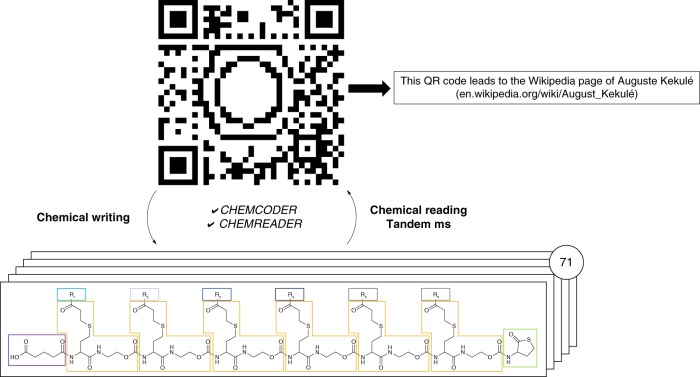
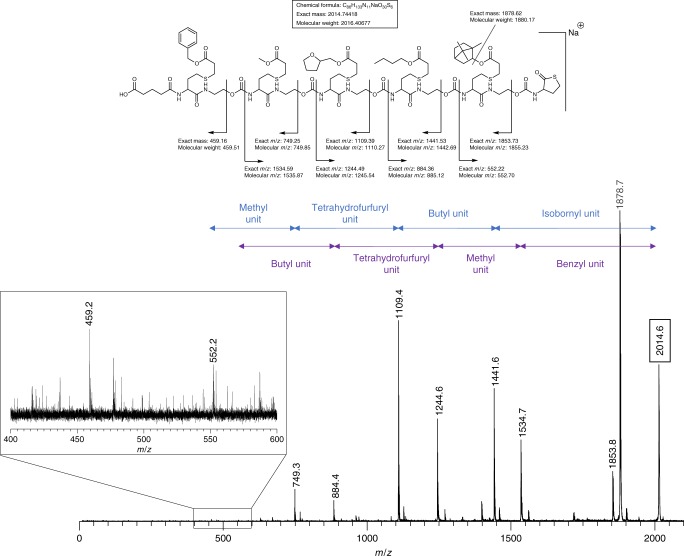
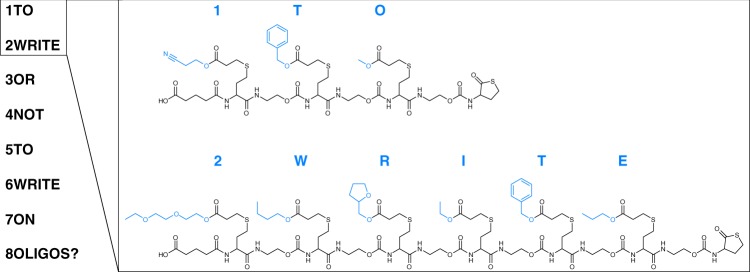
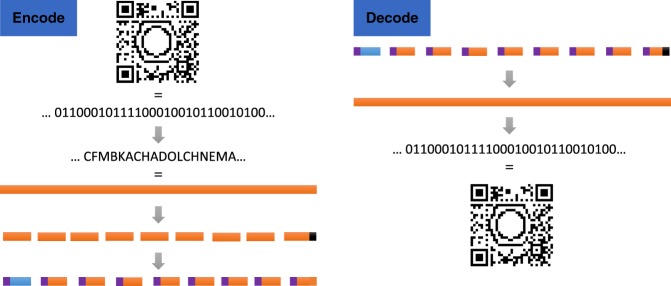
Sequence-defined macromolecules consist of a defined chain length (single mass), end-groups, composition and topology and prove promising in application fields such as anti-counterfeiting, biological mimicking and data storage. Here we show the potential use of multifunctional sequence-defined macromolecules as a storage medium. As a proof-of-principle, we describe how short text fragments (human-readable data) and QR codes (machine-readable data) are encoded as a collection of oligomers and how the original data can be reconstructed. The amide-urethane containing oligomers are generated using an automated protecting-group free, two-step iterative protocol based on thiolactone chemistry. Tandem mass spectrometry techniques have been explored to provide detailed analysis of the oligomer sequences. We have developed the generic software tools Chemcoder for encoding/decoding binary data as a collection of multifunctional macromolecules and Chemreader for reconstructing oligomer sequences from mass spectra to automate the process of chemical writing and reading.
Overview
The claims and statistics of this paper haven’t been checked yet.
Run the check — free, no account needed. It reads the open-access text and checks the sources it cites.
Integrity signals
Registry
Cites
Statistics
Figures
Verification
Claims the paper makes
The claims and statistics of this paper haven’t been checked yet.
Run the check — free, no account needed. It reads the open-access text and checks the sources it cites.
Claims other papers make about this one
Each is checked against this paper’s own text: does it say what the citing paper says it does?
In the citing paper
“This extra dimension allows the molecular data storage to be an ultra-high-density storage technology outpacing the traditional planner media which are only two-dimensional (2D)”
From Large-Scale de Novo Oligonucleotide Synthesis for Whole-Genome Synthesis and Data Storage: Challenges and Opportunities (2021) · cites this paper as Martens et al., 2018
Self-check
Percentages, sums and reported differences re-computed from the paper’s own numbers.
The self-check needs the paper’s full text.
Citations
Cites
Next-generation DNA sequencing
Shendure, J., & Ji, H. (2008) · Nature Biotechnology · doi:10.1038/nbt1486 · Cited by 4,509
Next-Generation Digital Information Storage in DNA
Church, G. M., Gao, Y., & Kosuri, S. (2012) · Science · doi:10.1126/science.1226355 · Cited by 1,441
Lutz, J., Ouchi, M., Liu, D. R., & Sawamoto, M. (2013) · Science · doi:10.1126/science.1238149 · Cited by 1,419
Zuckermann, R. N., Kerr, J. M., Kent, S. B. H., & Moos, W. H. (1992) · Journal of the American Chemical Society · doi:10.1021/ja00052a076 · Cited by 1,279
Towards Practical, High-Capacity, Low-Maintenance Information Storage in Synthesized DNA
Goldman, N., Bertone, P., Chen, S., Dessimoz, C., LeProust, E. M., Sipos, B., & Birney, E. (2013) · Nature · doi:10.1038/nature11875 · Cited by 1,220
From precision polymers to complex materials and systems
Lutz, J., Lehn, J., Meijer, E. W., & Matyjaszewski, K. A. (2016) · Nature Reviews Materials · doi:10.1038/natrevmats.2016.24 · Cited by 970
Hiding messages in DNA microdots
Clelland, C. T., Risca, V. I., & Bancroft, C. (1999) · Nature · doi:10.1038/21092 · Cited by 642
Sustainability Challenges of Phosphorus and Food: Solutions from Closing the Human Phosphorus Cycle
Childers, D. L., Corman, J. R., Edwards, M., & Elser, J. J. (2011) · BioScience · doi:10.1525/bio.2011.61.2.6 · Cited by 546
Programmable chemical controllers made from DNA
Chen, Y.-J., Dalchau, N., Srinivas, N., Phillips, A., Cardelli, L., Soloveichik, D., & Seelig, G. (2013) · Nature Nanotechnology · doi:10.1038/nnano.2013.189 · Cited by 490
Rapid and quantitative one-pot synthesis of sequence-controlled polymers by radical polymerization
Gody, G., Maschmeyer, T., Zetterlund, P. B., & Perrier, S. (2013) · Nature Communications · doi:10.1038/ncomms3505 · Cited by 472
Cited by
Sorted by citations
Items 101–180 of 180
Köhler, J. M. (2021) · Encyclopedia · doi:10.3390/encyclopedia1030051 · Cited by 13
Dominique, N. L., Jensen, I. M., Kaur, G., Kotseos, C. Q., Boggess, B., Jenkins, D. M., & Camden, J. P. (2023) · Angewandte Chemie International Edition · doi:10.1002/anie.202219182 · Cited by 12
Wang, V., Park, S. B., Lee, S. J., Koo, M. B., & Kim, K. T. (2024) · Journal of the American Chemical Society · doi:10.1021/jacs.4c13528 · Cited by 12
Shuluk, J. R., Wight, C. D., Howard, J. R., King, M. E., Moor, S. R., DeHoog, R. J., Dahlhauser, S. D., Eberlin, L. S., & Anslyn, E. V. (2025) · JACS Au · doi:10.1021/jacsau.4c01070 · Cited by 13
Aksakal, S., Aksakal, R., & Becer, C. R. (2021) · doi:10.1002/9783527823819.ch7 · Cited by 12
Zhang, L., Krause, T. B., Deol, H., Pandey, B., Xiao, Q., Park, H. M., Iverson, B. L., Law, D., & Anslyn, E. V. (2024) · Chemical Science · doi:10.1039/d3sc06189b · Cited by 11
Nagao, M., Yamaguchi, A., Matsubara, T., Hoshino, Y., Sato, T., & Miura, Y. (2021) · Biomacromolecules · doi:10.1021/acs.biomac.1c01483 · Cited by 11
Transformation of Thioester‐Initiated Star Polymers into Linear Arms via Native Chemical Ligation
Aksakal, S., Aksakal, R., & Becer, C. R. (2019) · Macromolecular Rapid Communications · doi:10.1002/marc.201900247 · Cited by 11
Maron, E., Kochovski, Z., Zuckermann, R. N., & Börner, H. G. (2020) · ACS Macro Letters · doi:10.1021/acsmacrolett.9b00977 · Cited by 11
Encoding Information into Polyethylene Glycol Using an Alcohol-Isocyanate “Click” Reaction
Nagy, L., Kuki, Á., Nagy, T., Vadkerti, B., Erdélyi, Z., Kárpáti, L., Zsuga, M., & Kéki, S. (2020) · International Journal of Molecular Sciences · doi:10.3390/ijms21041318 · Cited by 11
Shotgun Sequencing of 512‐mer Copolyester Allows Random Access to Stored Information
Jang, H., Chu, H., Noh, H., & Kim, K. T. (2024) · Angewandte Chemie International Edition · doi:10.1002/anie.202415124 · Cited by 10
Celasun, S., Maron, E., & Börner, H. G. (2019) · Macromolecular Bioscience · doi:10.1002/mabi.201900244 · Cited by 10
Charles, L., Mondal, T., Greff, V., Razzini, M., Monnier, V., Burel, A., Carapito, C., & Lutz, J. (2020) · Rapid Communications in Mass Spectrometry · doi:10.1002/rcm.8815 · Cited by 10
Cascaded encryption/decryption using digital polymer toward high-level information security
Shi, Q., Miao, T., Lu, J., Hu, L., Huang, X., Wang, Z., Piao, M., Huang, Z., & Zhang, Z. (2023) · Giant · doi:10.1016/j.giant.2023.100172 · Cited by 10
Precision Sequence‐Defined Polymers: From Sequencing to Biological Functions
Shi, Q., Zhang, Z., & Liu, S. (2023) · Angewandte Chemie · doi:10.1002/ange.202313370 · Cited by 10
Wetzel, K. S., & Meier, M. A. R. (2019) · Polymer Chemistry · doi:10.1039/c9py00438f · Cited by 9
Peplau, S., Neubert, T. J., Balasubramanian, K., Polleux, J., & Börner, H. G. (2023) · Macromolecular Rapid Communications · doi:10.1002/marc.202300300 · Cited by 9
Launay, K., Amalian, J., Laurent, E., Oswald, L., Ouahabi, A. A., Burel, A., Dufour, F., Carapito, C., Jean-Louis, C., Lutz, J., et al. (2020) · Angewandte Chemie · doi:10.1002/ange.202010171 · Cited by 10
Balinskiy, M., & Khitun, A. G. (2024) · npj Spintronics · doi:10.1038/s44306-023-00005-0 · Cited by 8
Maity, P., Bisht, A. S., Deepak, D., & Roy, R. K. (2025) · ACS Macro Letters · doi:10.1021/acsmacrolett.4c00823 · Cited by 8
Molecular Circuit-Controlled Nanoparticle Folders for Programmable DNA Information Access
Wu, R., Zhang, Y., Teng, J., Zhang, Q., & Zhang, C. (2025) · ACS Nano · doi:10.1021/acsnano.4c13882 · Cited by 8
Sequence-defined main-chain photoswitching macromolecules with odd-even-effect-controlled properties
Thai, L. D., Kammerer, J. A., Golberg, D. V., Mutlu, H., & Barner‐Kowollik, C. (2024) · Chem · doi:10.1016/j.chempr.2024.10.008 · Cited by 7
Electrochemical sequencing of sequence-defined ferrocene-containing oligourethanes
Pandey, B., Muralidharan, B., Ma, T., Pant, A., Onorato, M., Johnson, K. A., Dodabalapur, A., Pasupathy, P., & Anslyn, E. V. (2025) · Chem · doi:10.1016/j.chempr.2025.102571 · Cited by 7
Tsuji, S., Nagai, Y., Ono, T., Shimakoshi, H., & Hoshino, Y. (2026) · ACS Macro Letters · doi:10.1021/acsmacrolett.6c00050 · Cited by 7
Damage and Repair in Informational Poly( N ‐substituted urethane)s
Mondal, T., Charles, L., & Lutz, J. (2020) · Angewandte Chemie · doi:10.1002/ange.202008864 · Cited by 7
Selective Bond Cleavage in Informational Poly(Alkoxyamine Phosphodiester)s
Cavallo, G., Jean-Louis, C., Gigmès, D., Charles, L., & Lutz, J. (2020) · Macromolecular Rapid Communications · doi:10.1002/marc.202000215 · Cited by 7
Rewritable Macromolecular Data Storage with Automated Read‐out
Soete, M., Bruycker, K. D., & Prez, F. D. (2022) · Angewandte Chemie · doi:10.1002/ange.202116718 · Cited by 7
Exploring the sequence space of unknown oligomers and polymers
Doran, D., Clarke, E., Keenan, G., Carrick, E., Mathis, C., & Cronin, L. (2021) · Cell Reports Physical Science · doi:10.1016/j.xcrp.2021.100685 · Cited by 6
Huang, X., Yang, Z., Yang, X., Liang, Z., Zhong, Q., Hu, L., Huang, Z., & Zhang, Z. (2024) · ACS Macro Letters · doi:10.1021/acsmacrolett.4c00360 · Cited by 6
Erasable and rewritable digital polymers based on oligo(γ-butyrolactone)s
Liang, Z., Huang, X., Yang, X., Duan, S., Feng, A., Huang, Z., & Zhang, Z. (2026) · Giant · doi:10.1016/j.giant.2026.100387 · Cited by 5
High density information storage through isotope ratio encoding
Sőregi, P., Zwillinger, M., Vágó, L., Csékei, M., & Kotschy, A. (2024) · Chemical Science · doi:10.1039/d4sc03519d · Cited by 5
Von Peptiden lernen: eine Strategie für das Design funktionaler Präzisionspolymer‐Sequenzen
Maron, E., Swisher, J. H., Haven, J. J., Meyer, T. Y., Junkers, T., & Börner, H. G. (2019) · Angewandte Chemie · doi:10.1002/ange.201902217 · Cited by 5
Oligopeptide-based molecular labelling of (bio)degradable polyester biomaterials
Rydz, J., Duale, K., Sikorska, W., Musioł, M., Janeczek, H., Marcinkowski, A., Siwy, M., Adamus, G., Mielczarek, P., Silberring, J., et al. (2024) · International Journal of Biological Macromolecules · doi:10.1016/j.ijbiomac.2024.131561 · Cited by 5
Digital dendrimer: a new horizon of information-containing polymers
Liu, S. (2019) · Science China Chemistry · doi:10.1007/s11426-019-9510-8 · Cited by 5
1H PFG‐NMR Diffusion Study on a Sequence‐Defined Macromolecule: Confirming Monodispersity
Guo, X., Wetzel, K. S., Solleder, S. C., Spann, S., Meier, M. A. R., Wilhelm, M., Luy, B., & Guthausen, G. (2019) · Macromolecular Chemistry and Physics · doi:10.1002/macp.201900155 · Cited by 5
Shen, H., Leng, X., Han, L., Liu, P., Li, C., Zhang, S., Lei, L., Ma, H., & Li, Y. (2020) · Polymer Chemistry · doi:10.1039/d0py01108h · Cited by 5
The Utility of Chain-End Degradation for De Novo Sequencing of Sequence-Defined Oligourethanes
Shuluk, J. R., Fargher, H. A., & Anslyn, E. V. (2026) · Accounts of Chemical Research · doi:10.1021/acs.accounts.5c00900 · Cited by 4
Konrad, W., Fengler, C., Putwa, S., & Barner‐Kowollik, C. (2019) · Angewandte Chemie · doi:10.1002/ange.201901933 · Cited by 4
Berg, M.-T., Mertens, C., Prez, F. D., Kühne, T. D., Herberg, A., & Kuckling, D. (2020) · RSC Advances · doi:10.1039/d0ra06419j · Cited by 4
Shen, H., Han, L., Ma, H., Liu, P., Yang, L., Li, C., Ma, Y., Peng, Z., & Yang, L. (2020) · Polymer Chemistry · doi:10.1039/c9py01859j · Cited by 4
Information-Based Design of Polymeric Drug Formulation Additives
Arias, S., Maron, E., & Börner, H. G. (2020) · Biomacromolecules · doi:10.1021/acs.biomac.0c01284 · Cited by 4
Shotgun Sequencing of 512‐mer Copolyester Allows Random Access to Stored Information
Jang, H., Chu, H., Noh, H., & Kim, K. T. (2024) · Angewandte Chemie · doi:10.1002/ange.202415124 · Cited by 3
Circularity in Sequence-Controlled Copolyamides Enabled by Regioselective Enzymatic Hydrolysis
Dishner, I. T., Bourgery, C., Carper, D. L., Cooper, C. J., Cahill, J. F., Mehta, J. M., Yakubov, S., Zhang, H.-H., Ogbonna, N. D., Damron, J. T., et al. (2026) · Journal of the American Chemical Society · doi:10.1021/jacs.6c03466 · Cited by 5
Macromolecular Information Transfer
Samokhvalova, S., & Lutz, J. (2023) · Angewandte Chemie · doi:10.1002/ange.202300014 · Cited by 3
CMOS Capacitive Dry DNA Storage Monitoring: Design, Implementation and Experimental Results
Tabrizi, H. O., Forouhi, S., Ghafar-Zadeh, M., Farhanieh, O., Shaffaf, T., Magierowski, S., & Ghafar‐Zadeh, E. (2022) · IEEE Sensors Journal · doi:10.1109/jsen.2022.3148576 · Cited by 3
Dendritic Quaternary‐Encoded Oligourethanes for Data Encryption
Shi, Q., Zhou, X. G., Xu, J., Zhang, J., Wang, N., Zhang, G., Hu, J., & Liu, S. (2022) · Angewandte Chemie · doi:10.1002/ange.202214695 · Cited by 3
Complex Sequence‐Defined Heteropolymers Enable Controlled Film Growth in Layer‐By‐Layer Assembly
Barman, R., Tschopp, M., Charles, L., Decher, G., Félix, O., & Lutz, J. (2024) · Macromolecular Rapid Communications · doi:10.1002/marc.202400482 · Cited by 2
Double Porphyrin Cage Compounds
Stout, K., Peters, T. P. J., Mabesoone, M. F. J., Visschers, F. L. L., Meijer, E. M., Klop, J., van den Berg, J., White, P. B., Rowan, A. E., Nolte, R. J. M., et al. (2020) · European Journal of Organic Chemistry · doi:10.1002/ejoc.202001211 · Cited by 3
Sequencing of Uniform Multifunctional Oligoesters via Random Chain Cleavages
Soete, M., & Prez, F. D. (2022) · Angewandte Chemie · doi:10.1002/ange.202202819 · Cited by 3
Xu, L., Nakahata, M., Kamon, Y., & Hashidzume, A. (2023) · Journal of Polymer Science · doi:10.1002/pol.20230760 · Cited by 3
Photoresponsive DNA steganography for secure information transmission by nanopore
Hu, Z., Wang, J., Liu, S.-C., Wang, J.-H., Ma, H., Yang, C. C. C.-C., Ying, Y., Yan, F., & Long, Y.-T. (2026) · National Science Review · doi:10.1093/nsr/nwag196 · Cited by 2
Iterative Click-Addition Process for Urethane-based 1st-5th Dendrons
Inayama, S., & Hayashi, S. (2024) · ACS Applied Polymer Materials · doi:10.1021/acsapm.4c01618 · Cited by 2
Reading and writing data by using self-immolative, sequence-defined oligourethanes
Barnes, J. C. (2021) · Chem · doi:10.1016/j.chempr.2021.05.012 · Cited by 2
Secret messaging with endogenous chemistry
Kennedy, E., Geiser, J. D., Arcadia, C. E., Weber, P. M., Rose, C., Rubenstein, B. M., & Rosenstein, J. K. (2021) · Scientific Reports · doi:10.1038/s41598-021-92987-2 · Cited by 2
Sequence‐Encoded RAFT Oligomers and Polymers
Haven, J. J., Neve, J. D., & Junkers, T. (2021) · Wiley eBooks · doi:10.1002/9783527821358.ch17 · Cited by 2
Mass Spectrometry Directed Structural Elucidation of Isomeric [2 + 2] Photocycloadducts
Do, P. T., Richardson, B., Brydon, S. C., Fulloon, T. M., Blanksby, S. J., Frisch, H., & Poad, B. L. J. (2025) · Analytical Chemistry · doi:10.1021/acs.analchem.4c05228 · Cited by 1
Efficient Solution‐Phase Synthesis of Sequence‐Defined Oligourethanes with Precise Chirality Control
Sharma, A., Samanta, T., & Cybińska, J. (2025) · Macromolecular Rapid Communications · doi:10.1002/marc.202500378 · Cited by 1
Chellamuthu, K., Ravi, S., Mahesh, N., Jegadeesan, Y., Sukumaran, A., Haripriyan, J., Nair, B. G., Ramani, P., Shanmugaraju, S., & Nanjan, P. (2025) · ACS Applied Bio Materials · doi:10.1021/acsabm.5c01901 · Cited by 1
Internal Dynamics of Pyrene-Labeled Polyamines Probed by Pyrene Excimer Formation (PEF)
Frasca, F., Lloyd, R., & Duhamel, J. (2026) · Macromolecules · doi:10.1021/acs.macromol.5c02331 · Cited by 1
Magnonic combinatorial memory for high-density data storage
Balinskiy, M., Júlio, P., Vargas, J., Balaguer, D., & Khitun, A. G. (2026) · Journal of Applied Physics · doi:10.1063/5.0311046 · Cited by 1
Berg, M.-T., Herberg, A., & Kuckling, D. (2022) · International Journal of Polymer Analysis and Characterization · doi:10.1080/1023666x.2022.2100968 · Cited by 1
Dominique, N. L., Jensen, I. M., Kaur, G., Kotseos, C. Q., Boggess, B., Jenkins, D. M., & Camden, J. P. (2023) · Angewandte Chemie · doi:10.1002/ange.202219182 · Cited by 1
Synthesis of Stereocontrolled Polyurethanes with Defined Monomer Order by Step-economy ApproachPreprint
Sharma, A., Cwynar, P., Gupta, V., & Szweda, R. (2023) · ChemRxiv · doi:10.26434/chemrxiv-2023-xxcfb · Cited by 1
Digitalisierung: Moleküle für 007
Frölich, M., & Meier, M. A. R. (2019) · Nachrichten aus der Chemie · doi:10.1002/nadc.20194083430
Czy plastik może rozpocząć nową erę w archiwizacji danych?
Lizak, A., & Szweda, R. (2022) · Archeion · doi:10.4467/26581264arc.22.014.16667
Comby‐Zerbino, C., Lutz, J., MacAleese, L., & Charles, L. (2025) · Rapid Communications in Mass Spectrometry · doi:10.1002/rcm.10016
Jäck, N., & Hartmann, L. (2025) · Macromolecular Rapid Communications · doi:10.1002/marc.202500073
Flors, V., Cerveró, R., Tinajero, C., Sans, V., & Vicent, C. (2025) · The Analyst · doi:10.1039/d5an00353a
Ito, S., Matsumoto, K., Sato, H., & Watanabe, H. (2025) · Journal of Polymer Science · doi:10.1002/pol.20250364
NAD+ metabolism as a target for anti-aging
Uchida, H., & Nakagawa, T. (2025) · Folia Pharmacologica Japonica · doi:10.1254/fpj.24072
Discrete Patterned Functional Polymeric Nanostructures via Controlled Biaxial Iterative Synthesis
Chen, B., Yu, L. J., Song, K., Quan, X., Liu, Y., Wang, Y., Shi, T., Zhou, Y., Zhu, X., & Dong, R. (2025) · Nano Letters · doi:10.1021/acs.nanolett.5c05630
Synthesis of new alkoxyamine spacers for the elaboration of encoded polymers
Launay, K. (2020) · theses.fr (ABES) · doi:10.70675/b32012b4zca6az4075z86f4zd547cd9d0ab8
Zhao, B., Cai, S., & Gao, C. (2026) · Analytical Methods · doi:10.1039/d6ay00324a
Magnonic Combinatorial Memory based on a network of coupled active ring circuitsPreprint
Balinskiy, M., Júlio, P., Vargas, J., Balaguer, D., Greenstein, J., & Khitun, A. G. (2026) · Research Square · doi:10.21203/rs.3.rs-9452981/v1
Blockiness reduces the packing of styrene/methyl methacrylate copolymers
Dalpatbhai, P. Y., Nayar, D., & Patra, T. K. (2026) · Soft Matter · doi:10.1039/d6sm00227g
Contraction upon Bond Cleavage in Dynamic Polymer Networks
Kronenberger, S., Lochmaier, E. C., Fairbanks, B. D., Jayaraman, A., & Bowman, C. N. (2026) · Macromolecules · doi:10.1021/acs.macromol.6c02149
Data storage with amino acid sequences
Zhou, Y., Ng, C. C. A., & Yao, Z. (2026) · Trends in biotechnology · doi:10.1016/j.tibtech.2026.09.021
Metadata
- Authors
- Martens, S., Landuyt, A., Espeel, P., Devreese, B., Dawyndt, P., & Du Prez, F.
- Affiliations
- Ghent University (BE)
- Venue
- Nature Communications
- Published
- 2018-10-26
- Volume
- 9
- Issue
- 1
- Pages
- 4451-4451
- ISSN
- 2041-1723 (ISSN-L)
- PMC
- PMC6203848
- OpenAlex
- W2897696420
- Cited by
- 180
- References
- 57
- Citations by year
- 2026: 12 · 2025: 15 · 2024: 15 · 2023: 23 · 2022: 27 · 2021: 25 · 2020: 36 · 2019: 27
- FWCI
- 9.01
- Type
- journal article
- Language
- en
- Open access
- gold
- doi.org
- Locations
- Nature Communications (publishedVersion, cc-by)
- Europe PMC (PubMed Central) (publishedVersion, other-oa)
- PubMed Central (publishedVersion, cc-by)
- PubMed (publishedVersion)
- Ghent University Academic Bibliography (Ghent University) (publishedVersion, other-oa)
- Ghent University Academic Bibliography (Ghent University) (submittedVersion, cc-by)
- RePEc: Research Papers in Economics (submittedVersion)
- DOAJ (DOAJ: Directory of Open Access Journals) (submittedVersion)
- DOAJ (DOAJ: Directory of Open Access Journals) (submittedVersion, cc-by-sa)
- Funders
- Fonds Wetenschappelijk Onderzoek (EOS-project 30650939)
- Topics
- Physical Sciences › Chemistry › Organic Chemistry › Advanced Polymer Synthesis and Characterization
- Physical Sciences › Chemistry › Organic Chemistry › Supramolecular Chemistry and Complexes
- Physical Sciences › Chemistry › Organic Chemistry › Chemical Synthesis and Analysis
- Keywords
- oligomers, QR codes, text encoding, protecting group-free synthesis, tandem mass spectrometry, data reconstruction
About these checks
Registry, retraction, Cites and statistics results are computed, not judged, with one exception: a printed reference that no index lists is read once by a model before it counts as a citation error. Claims are extracted by a model and kept only when their quote appears verbatim in the text; each cited source is then checked, with a model’s help, for whether it says what the claim relies on. Those verdicts can be wrong — read the claim’s quote and the cited source before relying on one.
Statistics and arithmetic are recomputed, not judged.
Confidence bands are shown only for fields calibrated on our annotated test set. None is calibrated yet, so no band is shown.
What counts as a claim ›How we measure confidence ›How we check this ›
Are you an author, or do you see a problem with this page? Request a review
