

Closed-loop functional optogenetic stimulation
Open accessThe DOI matches its Crossref record; 37 of the 38 references it cites were found in a registry or an index.
Abstract
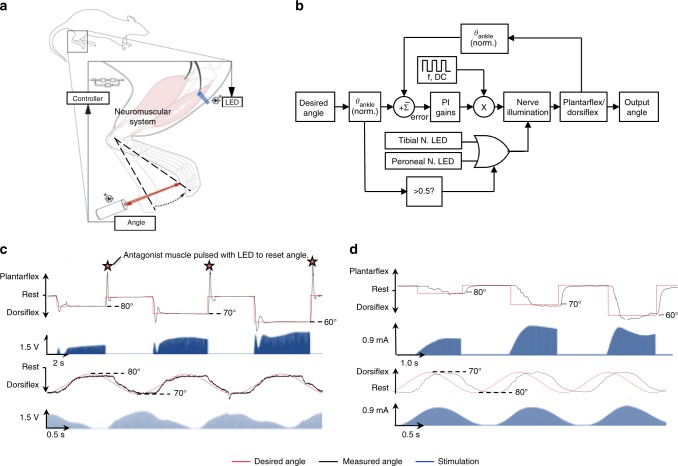
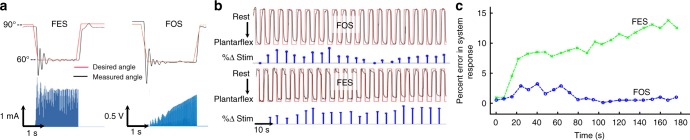
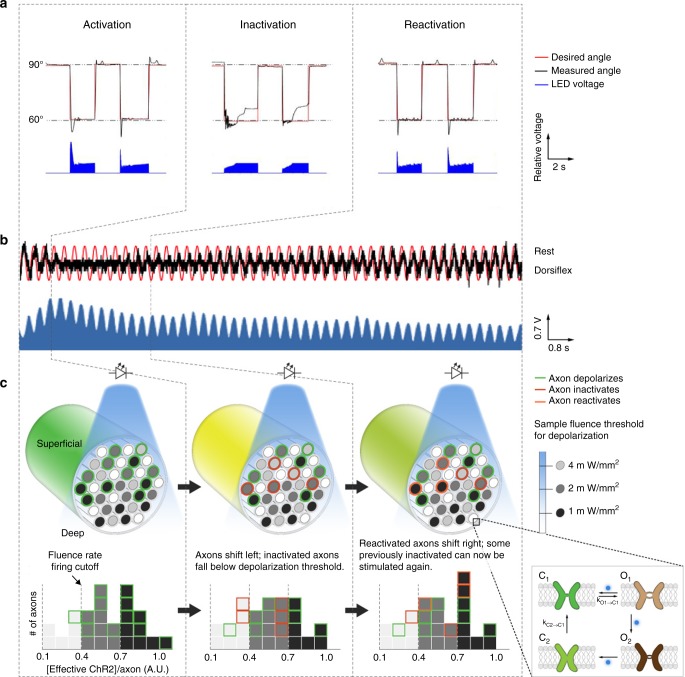
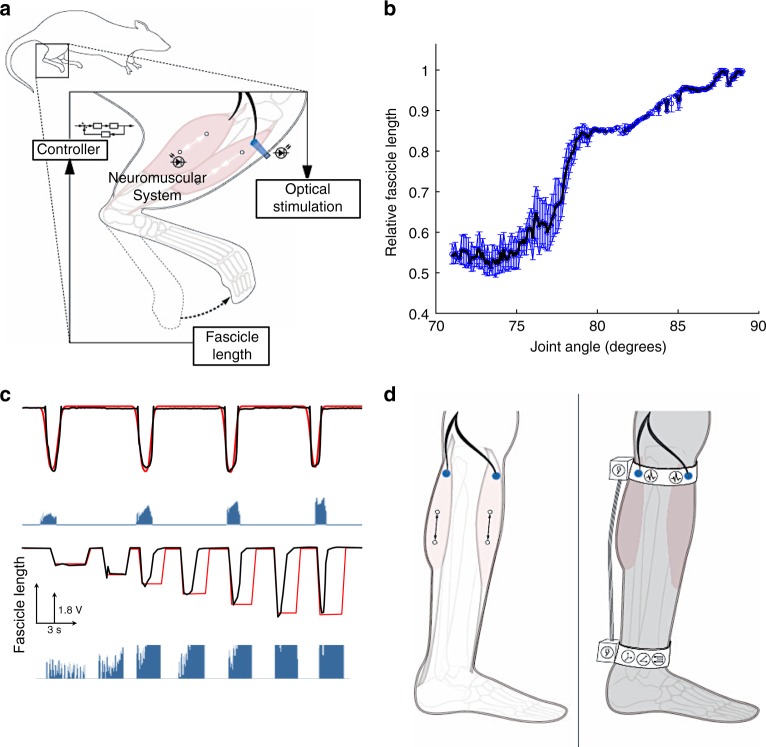
Optogenetics has been used to orchestrate temporal- and tissue-specific control of neural tissues and offers a wealth of unique advantages for neuromuscular control. Here, we establish a closed-loop functional optogenetic stimulation (CL-FOS) system to control ankle joint position in murine models. Using the measurement of either joint angle or fascicle length as a feedback signal, we compare the controllability of CL-FOS to closed-loop functional electrical stimulation (CL-FES) and demonstrate significantly greater accuracy, lower rise times and lower overshoot percentages. We demonstrate orderly recruitment of motor units and reduced fatigue when performing cyclical movements with CL-FOS compared with CL-FES. We develop and investigate a 3-phase, photo-kinetic model to elucidate the underlying mechanisms for temporal variations in optogenetically activated neuromusculature during closed-loop control experiments. Methods and insights from this study lay the groundwork for the development of closed-loop optogenetic neuromuscular stimulation therapies and devices for peripheral limb control.
Overview
The claims and statistics of this paper haven’t been checked yet.
Free: it reads the open-access text and checks the first 5 claims that cite a source we can check. Create a free account to check every claim.
Integrity signals
Registry
Cites
Statistics
Figures
Verification
Claims the paper makes
The claims and statistics of this paper haven’t been checked yet.
Free: it reads the open-access text and checks the first 5 claims that cite a source we can check. Create a free account to check every claim.
Claims other papers make about this one
Each is checked against this paper’s own text: does it say what the citing paper says it does?
The cited source says what the claim attributes to it.
In the citing paper
“Stimulation holds tremendous promise for prosthetic information feedback[86,515] and rehabilitation.[329,516,517]”
From Flexible Electronics and Devices as Human–Machine Interfaces for Medical Robotics (2022) · cites this paper as [515]
The check wasn’t confident either way, so it gives no verdict — never disputed.
In the citing paper
“Common substrate materials include PI and hydrogel, which can remain chemically inert in vivo while also providing sufficient dielectric strength to prevent discharge breakdown.”
From Flexible Electronics and Devices as Human–Machine Interfaces for Medical Robotics (2022) · cites this paper as [515]
Experimental — accuracy not yet measuredThe check wasn’t confident either way, so it gives no verdict — never disputed.
In the citing paper
“Afferents and efferent projections from the spinal grey matter also carry somatosensory and motorial information.[515]”
From Flexible Electronics and Devices as Human–Machine Interfaces for Medical Robotics (2022) · cites this paper as [515]
Experimental — accuracy not yet measured
Self-check
Percentages, sums and reported differences re-computed from the paper’s own numbers.
The self-check needs the paper’s full text.
Citations
Cites
Millisecond-timescale, genetically targeted optical control of neural activity
Boyden, E. S., Zhang, F., Bamberg, E., Nagel, G., & Deisseroth, K. (2005) · Nature Neuroscience · doi:10.1038/nn1525 · Cited by 4,861
Channelrhodopsin-2, a directly light-gated cation-selective membrane channel
Nagel, G., Szellas, T., Huhn, W., Kateriya, S., Adeishvili, N., Berthold, P., Ollig, D., Hegemann, P., & Bamberg, E. (2003) · Proceedings of the National Academy of Sciences · doi:10.1073/pnas.1936192100 · Cited by 2,663
BioelectromagnetismPrinciples and Applications of Bioelectric and Biomagnetic Fields
Malmivuo, J., & Plonsey, R. (1995) · doi:10.1093/acprof:oso/9780195058239.001.0001 · Cited by 1,834
Functional Electrical Stimulation for Neuromuscular Applications
Peckham, P. H., & Knutson, J. S. (2005) · Annual Review of Biomedical Engineering · doi:10.1146/annurev.bioeng.6.040803.140103 · Cited by 784
A neural interface provides long-term stable natural touch perception
Tan, D. W., Schiefer, M. A., Keith, M. W., Anderson, J. R., Tyler, J., & Tyler, D. J. (2014) · Science Translational Medicine · doi:10.1126/scitranslmed.3008669 · Cited by 751
The Microbial Opsin Family of Optogenetic Tools
Zhang, F., Vierock, J., Yizhar, O., Fenno, L. E., Tsunoda, S., Kianianmomeni, A., Prigge, M., Berndt, A., Cushman, J., Polle, J., et al. (2011) · Cell · doi:10.1016/j.cell.2011.12.004 · Cited by 509
Modeling the Spatiotemporal Dynamics of Light and Heat Propagation for In Vivo Optogenetics
Stujenske, J. M., Spellman, T., & Gordon, J. A. (2015) · Cell Reports · doi:10.1016/j.celrep.2015.06.036 · Cited by 383
Proprioception from a neurally controlled lower-extremity prosthesis
Clites, T. R., Carty, M. J., Ullauri, J. B., Carney, M. E., Mooney, L. M., Duval, J.-F., Srinivasan, S. S., & Herr, H. M. (2018) · Science Translational Medicine · doi:10.1126/scitranslmed.aap8373 · Cited by 233
Self-citationOrderly recruitment of motor units under optical control in vivo
Llewellyn, M. E., Thompson, K. R., Deisseroth, K., & Delp, S. L. (2010) · Nature Medicine · doi:10.1038/nm.2228 · Cited by 217
Arcourt, A., Gorham, L., Dhandapani, R., Prato, V., Taberner, F. J., Wende, H., Gangadharan, V., Birchmeier, C., Heppenstall, P. A., & Lechner, S. G. (2017) · Neuron · doi:10.1016/j.neuron.2016.11.027 · Cited by 213
Research works printed but not linked: 1
- Maimon BE Transdermal optogenetic peripheral nerve stimulation J. Neural Eng. 2017 14 034002 10.1088/1741-2552/aa5e20 28157088 · DOI · Paper page
Cited by
Flexible Electronics and Devices as Human–Machine Interfaces for Medical Robotics
Heng, W., Solomon, S., & Gao, W. (2022) · Advanced Materials · doi:10.1002/adma.202107902 · Cited by 609
Soft Sensors and Actuators for Wearable Human–Machine Interfaces
Park, J., Lee, Y., Cho, S., Choe, A., Yeom, J., Ro, Y. G., Kim, J., Kang, D.-H., Lee, S., & Ko, H. (2024) · Chemical Reviews · doi:10.1021/acs.chemrev.3c00356 · Cited by 272
Restoration of sensory information via bionic hands
Bensmaia, S. J., Tyler, D. J., & Micera, S. (2020) · Nature Biomedical Engineering · doi:10.1038/s41551-020-00630-8 · Cited by 257
Optophysiology: Illuminating cell physiology with optogenetics
Tan, P., He, L., Huang, Y., & Zhou, Y. (2022) · Physiological Reviews · doi:10.1152/physrev.00021.2021 · Cited by 155
A Comprehensive Review of Emerging Trends and Innovative Therapies in Epilepsy Management
Ghosh, S., Sinha, J. K., Ghosh, S. K., Sharma, H., Bhaskar, R., & Narayanan, K. B. (2023) · Brain Sciences · doi:10.3390/brainsci13091305 · Cited by 111
“Optogenetics research can inspire the development of novel closed-loop neurostimulation systems [225].”
BackgroundCho, Y. U., Lee, J. Y., Jeong, U., Park, S., Lim, S. L., Kim, K. Y., Jang, J. W., Park, J. H., Kim, H. W., Shin, H., et al. (2021) · Advanced Functional Materials · doi:10.1002/adfm.202105568 · Cited by 90
Nuckols, R. W., Dick, T. J. M., Beck, O. N., & Sawicki, G. S. (2020) · Scientific Reports · doi:10.1038/s41598-020-60360-4 · Cited by 90
Multifunctional hydrogel electronics for closed-loop antiepileptic treatment
Qu, J., Xie, K., Chen, S., He, X., Wang, Y., Chamberlin, M., Zhao, X. J., Zhu, G., Xu, C., & Shi, P. (2024) · Science Advances · doi:10.1126/sciadv.adq9207 · Cited by 83
The Roles of Optogenetics and Technology in Neurobiology: A Review
Chen, W., Li, C., Liang, W., Li, Y., Zou, Z., Xie, Y., Liao, Y., Lin, Y., Lin, Q., Huang, M., et al. (2022) · Frontiers in Aging Neuroscience · doi:10.3389/fnagi.2022.867863 · Cited by 91
“Steinbeck et al. (2015) induced rapid and reversible reactivation of motor defects in mice that had recovered from Parkinson’s motor defects induced by injury (Figure 3).”
BackgroundNeurostimulation for Stroke Rehabilitation
Ting, W. K., Fadul, F. A.-R., Fecteau, S., & Éthier, C. (2021) · Frontiers in Neuroscience · doi:10.3389/fnins.2021.649459 · Cited by 71
“For motor recovery, the most common PAS experiments have combined TMS over the motor cortex and non-invasive electrical stimulation of the spinal cord or peripheral nerves (Stefan et al., 2000; Castel-Lacanal et al., 2007).”
BackgroundSun, L., Du, Y., Yu, H., Wei, H., Xu, W., & Xu, W. (2022) · Research · doi:10.34133/2022/9851843 · Cited by 62
Integrating bioelectronics with cell-based synthetic biology
Rivnay, J., Raman, R., Robinson, J. T., Schreib, C. C., Cohen‐Karni, T., Galloway, K. E., & Veiseh, O. (2025) · Nature Reviews Bioengineering · doi:10.1038/s44222-024-00262-6 · Cited by 70
“…tissue movement and using this information to modulate upstream neural control of muscle has been demonstrated in vivo for bioelectronic applications in prosthetics 117 , providing an ample knowledge base to drive future advances in closed-loop feedback control of engineered bioactuators.”
Madhav, M. S., & Cowan, N. J. (2020) · Annual Review of Control Robotics and Autonomous Systems · doi:10.1146/annurev-control-060117-104856 · Cited by 57
Multifunctional Biomedical Devices with Closed‐Loop Systems for Precision Therapy
Leng, Y., & Sun, R. (2025) · Advanced Healthcare Materials · doi:10.1002/adhm.202500860 · Cited by 51
Erfani, R., Marefat, F., Nag, S., & Mohseni, P. (2019) · IEEE Journal of Solid-State Circuits · doi:10.1109/jssc.2019.2956883 · Cited by 43
“Hence, the C–WPT technique can be suitable for powering biomedical implants with high power budgets, such as those for multichannel nerve/muscle stimulation with milliampere-range currents in peripheral/autonomic applications [16]–[20], as well as those with multiple lightemitting diodes with milliampere-range driving…”
MethodState-space optimal feedback control of optogenetically driven neural activity
Bolus, M. F., Willats, A. A., Rozell, C. J., & Stanley, G. B. (2020) · Journal of Neural Engineering · doi:10.1088/1741-2552/abb89c · Cited by 52
Mechanoneural interfaces for bionic integration
Shu, T., Herrera-Arcos, G., Taylor, C. R., & Herr, H. (2024) · Nature Reviews Bioengineering · doi:10.1038/s44222-024-00151-y · Cited by 47
“…tools, such as muscle-implanted target tracking for efferent control 62,159,162,184,189,190 and optogenetic stimulation for afferent feedback 194 , will also need to be considered under the same framework to determine whether a revisional procedure to upgrade MIs can provide worthwhile…”
BackgroundSelf-citationNew era of optogenetics: from the central to peripheral nervous system
Xu, X., Mee, T., & Jia, X. (2020) · Critical Reviews in Biochemistry and Molecular Biology · doi:10.1080/10409238.2020.1726279 · Cited by 32
“It can also induce specific behaviors, such as control of the joint angle, feeding, and bladder activity (Srinivasan et al. 2018; Zhang Z et al. 2018; Mickle et al. 2019).”
BackgroundLu, Q. L., Wang, Z., Bai, S., Wang, Y., Liao, C., Sun, Y., Zhang, Y., Li, W., & Mei, Q. (2023) · Journal of the American Chemical Society · doi:10.1021/jacs.2c13762 · Cited by 31
Towards the clinical translation of optogenetic skeletal muscle stimulation
Gundelach, L. A., Hüser, M. A., Beutner, D., Ruther, P., & Bruegmann, T. (2020) · Pflügers Archiv - European Journal of Physiology · doi:10.1007/s00424-020-02387-0 · Cited by 30
“It has recently been suggested that lower fatigue development could also be due to the photo-kinetic behavior of the optogenetic system [141].”
BackgroundImproving scalability in systems neuroscience
Chen, Z. S., & Pesaran, B. (2021) · Neuron · doi:10.1016/j.neuron.2021.03.025 · Cited by 29
Zhao, Z., Cea, C., Gelinas, J. N., & Khodagholy, D. (2021) · Proceedings of the National Academy of Sciences · doi:10.1073/pnas.2022659118 · Cited by 26
Closed-loop optogenetic neuromodulation enables high-fidelity fatigue-resistant muscle control
Herrera-Arcos, G., Song, H., Yeon, S. H., Ghenand, O., Gutierrez-Arango, S., Sinha, S., & Herr, H. (2024) · Science Robotics · doi:10.1126/scirobotics.adi8995 · Cited by 24
“The variability between animals could be explained by the difference in the number of motor units expressing the opsin, different expression levels ( 25 , 37 ), and slight changes in optical illumination.”
BackgroundMethodResultInfluentialSelf-citationThe Agonist-antagonist Myoneural Interface
Herr, H., & Carty, M. J. (2021) · Techniques in Orthopaedics · doi:10.1097/bto.0000000000000552 · Cited by 22
Self-citationMaterials and System Design for Self‐Decision Bioelectronic Systems
Zeng, Q., Liu, H., Zhang, Y., Zheng, Y., Ding, X., Zhu, M., Shi, G., Wang, Y., Haick, H., & Zhang, M. (2026) · Advanced Materials · doi:10.1002/adma.202521164 · Cited by 33
Kubota, S., Sidikejiang, W., Kudo, M., Inoue, K., Umeda, T., Takada, M., & Seki, K. (2019) · The Journal of Physiology · doi:10.1113/jp278292 · Cited by 20
“…tropism for DRG neurons with medium-to-large-diameter afferents Earlier studies showed that individual AAV vector serotypes have different tissue tropisms (Zincarelli et al. 2008; Srivastava, 2016), which allows gene transfer to DRG neurons in a cell type-specific manner (Mason et al. 2010).”
BackgroundBansal, H., Gupta, N., & Roy, S. (2020) · Neuroscience · doi:10.1016/j.neuroscience.2020.09.022 · Cited by 19
Closed-loop optogenetic control of cell biology enables outcome-driven microscopy
Passmore, J. B., Rates, A., Schröder, J., van Laarhoven, M. T. P., Hellebrekers, V. J. W., van Hoef, H. G., Geurts, A., van Straaten, W., Nijenhuis, W., Berger, F., et al. (2025) · Nature Communications · doi:10.1038/s41467-025-67848-5 · Cited by 20
Brain modeling for control: A review
Acharya, G., Ruf, S. F., & Nozari, E. (2022) · Frontiers in Control Engineering · doi:10.3389/fcteg.2022.1046764 · Cited by 19
“One strategy that has been demonstrated is to let u(t) modulate certain parameters of the optogenetic input, such as the amplitude of a light intensity square-wave pulse while fixing other parameters such as frequency and duty cycle (Srinivasan et al., 2018).”
BackgroundJin, S., Choi, H., Son, D., & Shin, M. (2025) · Nature Protocols · doi:10.1038/s41596-025-01184-2 · Cited by 18
Guo, C., Wang, A., Cheng, H., & Chen, L. (2022) · Journal of Neurochemistry · doi:10.1111/jnc.15711 · Cited by 15
Shon, A., Brakel, K., Hook, M. A., & Park, H. (2021) · IEEE Transactions on Biomedical Engineering · doi:10.1109/tbme.2021.3054564 · Cited by 11
Tokutake, K., Takeuchi, M., Kurimoto, S., Saeki, S., Asami, Y., Onaka, K., Saeki, M., Aoyama, T., Hasegawa, Y., & Hirata, H. (2022) · International Journal of Molecular Sciences · doi:10.3390/ijms23158760 · Cited by 11
“In previous studies, neurostimulators used in healthy rat limbs showed step responses of 200–250 s [14,15].”
MethodKnapman, F. L., Cohen, E. M., Kulaga, T., Lovell, N. H., Lisowski, L., McMullan, S., Burke, P. G. R., & Bilston, L. E. (2023) · SLEEP · doi:10.1093/sleep/zsad226 · Cited by 10
Behavioral optogenetics in nonhuman primates; a psychological perspective
Afraz, A. (2023) · Current Research in Neurobiology · doi:10.1016/j.crneur.2023.100101 · Cited by 8
Phase-adaptive brain stimulation of striatal D1 medium spiny neurons in dopamine-depleted mice
Kim, Y.-C., Jung, D., Oya, M., Kennedy, M., Lence, T., Alberico, S. L., & Narayanan, N. S. (2022) · Scientific Reports · doi:10.1038/s41598-022-26347-z · Cited by 8
When neuromodulation met control theory
Guidotti, R., Basti, A., Pieramico, G., D’Andrea, A., Makkinayeri, S., Pettorruso, M., Roine, T., Ziemann, U., Ilmoniemi, R. J., Romani, G. L., et al. (2025) · Journal of Neural Engineering · doi:10.1088/1741-2552/ad9958 · Cited by 10
“The cost of flexibility is the difficulty in realizing effective closed-loop systems despite recent progress that has been made using PID controllers [165].”
Gastrointestinal neuroprosthesis for motility and metabolic neuromodulation
Srinivasan, S. S., Antonini, M., Alshareef, A. A., Sahasrabudhe, A., Jenkins, J. A., Ishida, K., Kuosmanen, J. L. P., Hayward, A. M., Min, S., Langer, R., et al. (2025) · Nature Communications · doi:10.1038/s41467-025-62413-6 · Cited by 9
Self-citationVisual Feedback Control of a Rat Ankle Angle Using a Wirelessly Powered Two-Channel Neurostimulator
Takeuchi, M., Watanabe, K., Ishihara, K., Miyamoto, T., Tokutake, K., Saeki, S., Aoyama, T., Hasegawa, Y., Kurimoto, S., & Hirata, H. (2020) · Sensors · doi:10.3390/s20082210 · Cited by 7
“reported the closed-loop functional optogenetic stimulation (FOS) and FES of rat leg [29].”
BackgroundMethodLee, J. Y., Kim, T., Cho, S., Shin, J. H., Yeo, W., Kim, T. S., & Yu, K. J. (2025) · Bioactive Materials · doi:10.1016/j.bioactmat.2025.02.006 · Cited by 11
“Furthermore, they enable real-time diagnostics and treatment through closed-loop multifunctional capabilities [85,86] and ensure long-term stable operation with fully implantable systems [87 – 89].”
Engineering optical tools for remotely controlled brain stimulation and regeneration
Rodrigues, A. F., Rebelo, C., Reis, T., Simões, S. M. N., Bernardino, L. I., Peça, J., & Ferreira, L. (2023) · Biomaterials Science · doi:10.1039/d2bm02059a · Cited by 6
Optogenetics: Pinpoint Light on Precise Neuromodulation
Guo, J., Yeung, K., Jiang, C., Duan, L., Han, X., & Qiao, W. (2025) · IEEE Reviews in Biomedical Engineering · doi:10.1109/rbme.2025.3624697 · Cited by 5
“For instance, a closed-loop optogenetic system precisely controlled skeletomuscular movement through the activation of peroneal or tibial nerves [18].”
Transducer Materials for Wireless Neuromodulation
Sun, X., Liu, S., Zhe, Y., Wang, H., & Zhang, X. (2025) · Advanced Functional Materials · doi:10.1002/adfm.202526238 · Cited by 6
Zhou, M., Yan, B., Yang, F., Chen, C., Wang, F., Xu, C., Jiang, T., Li, K., Xie, Y., Zheng, H., et al. (2025) · Nature Communications · doi:10.1038/s41467-025-63746-y · Cited by 5
Closed‐Loop Optogenetic Modulation of Neural Activities in Freely Moving Mice with Multimodal Fibers
Du, M., Zheng, J., Huang, Y., Wang, X., Qi, Y., Qiu, J., Huang, L., Ren, C., Yu, Z., & Zhou, S. (2023) · Advanced Optical Materials · doi:10.1002/adom.202302044 · Cited by 5
Optogenetic Control of Muscles: Potential Uses and Limitations
Cohen, E. M., Knapman, F. L., & Bilston, L. E. (2023) · Human Gene Therapy · doi:10.1089/hum.2022.236 · Cited by 5
“8 Both transcutaneous and implanted stimulation approaches face the challenge of illuminating muscles whose volumes are several orders of magnitude greater than rodents, where most research has been done to date.”
InfluentialTrack-Control, an automatic video-based real-time closed-loop behavioral control toolboxPreprint
Zhang, G., Shen, L., Li, Z., Tao, H. W., & Zhang, L. I. (2019) · bioRxiv (Cold Spring Harbor Laboratory) · doi:10.1101/2019.12.11.873372 · Cited by 8
“For example, ankle position triggered optogenetic stimulation has been studied to potentially restore motor function in paralysis (Srinivasan et al., 2018).”
BackgroundMethodLi, E., Yan, R., Qiao, H., Sun, J., Zou, P., Chang, J., Li, S., Ma, Q., Zhang, R., & Liao, B. (2023) · Heliyon · doi:10.1016/j.heliyon.2023.e23960 · Cited by 6
Gupta, P. K., & Murphy, T. H. (2025) · eLife · doi:10.7554/elife.105070.1 · Cited by 4
Real-time closed-loop feedback system for mouse mesoscale cortical signal and movement control
Gupta, P. K., & Murphy, T. H. (2026) · eLife · doi:10.7554/elife.105070 · Cited by 2
Liang, C., Guo, J., Qiao, W., & Lee, S. J. (2026) · Bioactive Materials · doi:10.1016/j.bioactmat.2026.02.020 · Cited by 10
Knapman, F. L., Cohen, E. M., Kulaga, T., Lovell, N. H., Lisowski, L., Burke, P. G. R., & Bilston, L. E. (2025) · Molecular Therapy — Methods & Clinical Development · doi:10.1016/j.omtm.2025.101559 · Cited by 2
Editorial: Advances in rehabilitation intervention after limb amputation
Crandell, D. M., Lozano‐Calderón, S. A., & Mayerson, J. L. (2023) · Frontiers in Rehabilitation Sciences · doi:10.3389/fresc.2023.1149001 · Cited by 2
“Cutting-edge advances in magnetomicrometry (4) and optogenetics (5) may further enhance myoelectric control.”
BackgroundRetinal supplementation augments optogenetic stimulation efficacy in vivo
Srinivasan, S. S., Schelhaas, B., Maimon, B. E., Song, H., & Herr, H. (2019) · Journal of Neural Engineering · doi:10.1088/1741-2552/ab1e22 · Cited by 1
Self-citationGhorbani, A., Nazari, M. H. S., Akbari, F., Fatahi, Z., Haghparast, A., Dragahi, L., Latifi, H., & Zibaii, M. I. (2019) · Conference on Lasers and Electro-Optics Europe & European Quantum Electronics Conference (CLEO/Europe-EQEC) · doi:10.1109/cleoe-eqec.2019.8871649 · Cited by 1
“Closed-loop optogenetics system compares the neural signals with a predefined value at every moment and then decides what to do to achieve the desired value by optical stimulation [1].”
BackgroundNeuromodulation for functional restoration: recent advances and future perspectives
Zhang, J. (2021) · International Journal of Radiology & Radiation Therapy · doi:10.15406/ijrrt.2021.08.00305 · Cited by 1
GPe Astrocytes and Prototypic Neurons Selectively Represent Routine FormationPreprint
Yang, M. A., Hong, S., Kang, S., Lee, J., Song, M. R., Lee, S. W., & Choi, D. (2022) · Research Square · doi:10.21203/rs.3.rs-2286086/v1
Takeuchi, M., Tokutake, K., Miyamoto, T., Ito, N., Aoyama, T., Kurimoto, S., Hirata, H., & Hasegawa, Y. (2023) · IEEE International Conference on Cyborg and Bionic Systems (CBS) · doi:10.1109/cbs55922.2023.10115376
“However, conventional FES generally showed only on/off movements of the legs or arms, while only a few studies showed feedback control of body movements [11], [18], [19].”
BackgroundA guiding light for stimulating paralyzed muscles
Williams, J. J. (2024) · Science Robotics · doi:10.1126/scirobotics.ado9987
Moravec, E. M., & Williams, J. J. (2024) · Annual International Conference of the IEEE Engineering in Medicine and Biology Society (EMBC) · doi:10.1109/embc53108.2024.10782792 · Cited by 1
Sudhakar, R. (2022) · University of North Texas Digital Library (University of North Texas) · doi:10.12794/metadc1944254
Yang, M. A., Kang, S., Hong, S., Lee, J., Bormann, N. L., Lee, S. W., & Choi, D. (2025) · eNeuro · doi:10.1523/eneuro.0552-24.2025 · Cited by 1
“To address this, future studies should employ techniques like closed-loop optogenetics (Grosenick et al., 2015; Srinivasan et al., 2018).”
Gupta, P. K., & Murphy, T. H. (2026) · eLife · doi:10.7554/elife.105070.2
Mondragón-González, S. L. (2019) · theses.fr (ABES) · doi:10.70675/e78705daz18a9z4695zac41zadeb07ee7c37
Lau, J., Gaudreau, S. F., Palacek, K. K., Spendiff, S., Bui, T. V., & Lochmüller, H. (2026) · bioRxiv (Cold Spring Harbor Laboratory) · doi:10.64898/2026.05.30.728923
Knapman, F. L., Shklovskaya, E., Swain, R., Turner, A. J., Lovell, N. H., Lisowski, L., Cistulli, P. A., Burke, P. G. R., & Bilston, L. E. (2026) · Research Square · doi:10.21203/rs.3.rs-10146411/v1
Identification of Optical H-Reflex Activation Using Optogenetic Tibial Nerve Stimulation
Moravec, E. M., & Williams, J. J. (2025) · International IEEE/EMBS Conference on Neural Engineering · doi:10.1109/ner61569.2025.11589047
Quantitative performance comparison of peripheral nerve implants over five months post-implantationPreprint
Tsai, D., Qin, P., Xie, Y., Lovell, N. H., & Guo, T. (2026) · Research Square · doi:10.21203/rs.3.rs-10110637/v1
Metadata
- Authors
- Srinivasan, S. S., Maimon, B. E., Diaz, M., Song, H., & Herr, H. M.
- Affiliations
- Harvard–MIT Division of Health Sciences and Technology (US)
- MIT Media Lab (US)
- Corresponding author
- Srinivasan, Shriya S.
- Herr, Hugh M.
- Venue
- Nature Communications
- Published
- 2018-12-13
- Volume
- 9
- Issue
- 1
- Pages
- 5303-5303
- ISSN
- 2041-1723 (ISSN-L)
- PMC
- PMC6294002
- OpenAlex
- W2905338839
- Cited by
- 68
- References
- 38
- Citations by year
- 2026: 5 · 2025: 13 · 2024: 8 · 2023: 10 · 2022: 10 · 2021: 8 · 2020: 8 · 2019: 6
- FWCI
- 2.50
- Type
- journal article
- Language
- en
- Open access
- gold
- doi.org
- Licence
- cc-by
- creativecommons.org/licenses/by/4.0 (tdm)
- creativecommons.org/licenses/by/4.0 (vor)
- Locations
- Nature Communications (publishedVersion, cc-by)
- Europe PMC (PubMed Central) (publishedVersion, other-oa)
- PubMed Central (publishedVersion, cc-by)
- PubMed (publishedVersion)
- DSpace@MIT (Massachusetts Institute of Technology) (submittedVersion, cc-by-nc)
- RePEc: Research Papers in Economics (submittedVersion)
- DOAJ (DOAJ: Directory of Open Access Journals) (submittedVersion)
- DOAJ (DOAJ: Directory of Open Access Journals) (submittedVersion, cc-by-sa)
- Topics
- Life Sciences › Neuroscience › Cellular and Molecular Neuroscience › Neuroscience and Neural Engineering
- Life Sciences › Neuroscience › Cellular and Molecular Neuroscience › Photoreceptor and optogenetics research
- Physical Sciences › Engineering › Biomedical Engineering › Muscle activation and electromyography studies
- Keywords
- functional electrical stimulation, neuromuscular stimulation, motor unit recruitment, muscle fatigue, feedback control
- MeSH terms
- Animals, Ankle Joint, Electric Stimulation, Feedback, Mice, Transgenic, Movement, Rats, Inbred F344, Peripheral Nervous System, Muscle, Skeletal, Mice, Rats, Optogenetics
About these checks
Registry, retraction, Cites and statistics results are computed, not judged, with one exception: a printed reference that no index lists is read once by a model before it counts as a citation error. Claims are extracted by a model and kept only when their quote appears verbatim in the text; each cited source is then checked, with a model’s help, for whether it says what the claim relies on. Those verdicts can be wrong — read the claim’s quote and the cited source before relying on one.
Statistics and arithmetic are recomputed, not judged.
Confidence bands are shown only for fields calibrated on our annotated test set. None is calibrated yet, so no band is shown.
What counts as a claim ›How we measure confidence ›How we check this ›
Are you an author, or do you see a problem with this page? Request a review
Data sources
Bibliographic data: Semantic Scholar, OpenAlex, Crossref.
Contains information from the Semantic Scholar Academic Graph Datasets, made available under the ODC Attribution License (ODC-BY 1.0).
Semantic Scholar’s data is described in: Kinney, R., et al. (2023). The Semantic Scholar Open Data Platform. arXiv:2301.10140.
