CoChat

Surface diffusion-limited lifetime of silver and copper nanofilaments in resistive switching devices

Open access

The DOI matches its Crossref record; 61 of the 62 references it cites were found in a registry or an index.

Abstract

Silver/copper-filament-based resistive switching memory relies on the formation and disruption of a metallic conductive filament (CF) with relatively large surface-to-volume ratio. The nanoscale CF can spontaneously break after formation, with a lifetime ranging from few microseconds to several months, or even years. Controlling and predicting the CF lifetime enables device engineering for a wide range of applications, such as non-volatile memory for data storage, tunable short/long term memory for synaptic neuromorphic computing, and fast selection devices for crosspoint arrays. However, conflictive explanations for the CF retention process are being proposed. Here we show that the CF lifetime can be described by a universal surface-limited self-diffusion mechanism of disruption of the metallic CF. The surface diffusion process provides a new perspective of ion transport mechanism at the nanoscale, explaining the broad range of reported lifetimes, and paving the way for material engineering of resistive switching device for memory and computing applications.

Overview

The claims and statistics of this paper haven’t been checked yet.

Free: it reads the open-access text and checks the first 5 claims that cite a source we can check. Create a free account to check every claim.

A few free checks a day · papers already verified open instantly · results are public

Integrity signals

Registry

Crossref · 10.1038/s41467-018-07979-0

Cites

61 of 61 references verified0 citation errors · 0 not checkable

Statistics

Figures

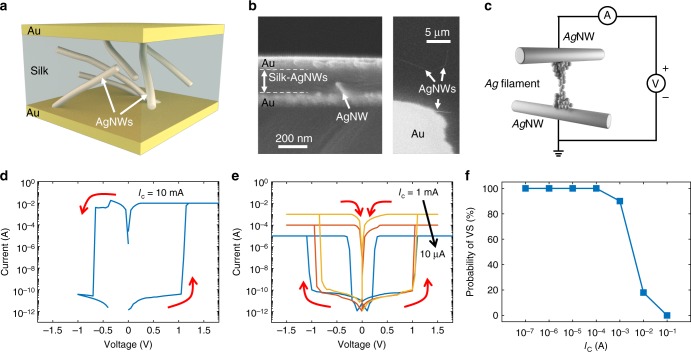
Fig. 1 Volatile and non-volatile switching of RS devices. a Schematic structure of a RS device based on Ag NWs. Bottom and top Au layers act as contact pads, Ag NWs act as effective bottom and top electrodes for the CF formation, and silk acts as insulating switching layer. b Sectional (left) and top planar (right) SEM views of the RS device. c Illustration of the metallic CF formation between two Ag NWs. A metallic CF can be formed in response to the application of a large voltage to the electrodes. In non-volatile switching, the CF can remain in the connected state for a relatively long time until another voltage pulse induces its disconnection. On the other hand, in the case of volatile switching, the CF retracts back to the electrodes immediately after set transition. d I–V characteristics for non-volatile switching for a high compliance current IC = 10 mA. When a positive sweep voltage is applied, the current increases sharply, indicating the formation of the metallic CF. The compliance current IC across the device controls the size of the formed CF. After the positive voltage sweeps back to zero, the device still remains in the low resistance state. As a negative voltage is applied, the device switches to the high resistance state indicating CF disruption. e I–V characteristics for volatile switching of the device at low IC. When a positive sweep voltage is applied, the current increases sharply indicating CF formation. However, the device quickly switches back to its original high resistance state after the forcing voltage is swept to zero. Bidirectional volatile switching is observed, as the application of a negative voltage also generates a metastable CF. f Probability for volatile switching (VS) as a function of IC, indicating the transition from volatile switching to non-volatile switching at increasing IC
Fig. 1 Volatile and non-volatile switching of RS devices. a Schematic structure of a RS device based on Ag NWs. Bottom and top Au layers act as contact pads, Ag NWs act as effective bottom and top electrodes for the CF formation, and silk acts as insulating switching layer. b Sectional (left) and top planar (right) SEM views of the RS device. c Illustration of the metallic CF formation between two Ag NWs. A metallic CF can be formed in response to the application of a large voltage to the electrodes. In non-volatile switching, the CF can remain in the connected state for a relatively long time until another voltage pulse induces its disconnection. On the other hand, in the case of volatile switching, the CF retracts back to the electrodes immediately after set transition. d I–V characteristics for non-volatile switching for a high compliance current IC = 10 mA. When a positive sweep voltage is applied, the current increases sharply, indicating the formation of the metallic CF. The compliance current IC across the device controls the size of the formed CF. After the positive voltage sweeps back to zero, the device still remains in the low resistance state. As a negative voltage is applied, the device switches to the high resistance state indicating CF disruption. e I–V characteristics for volatile switching of the device at low IC. When a positive sweep voltage is applied, the current increases sharply indicating CF formation. However, the device quickly switches back to its original high resistance state after the forcing voltage is swept to zero. Bidirectional volatile switching is observed, as the application of a negative voltage also generates a metastable CF. f Probability for volatile switching (VS) as a function of IC, indicating the transition from volatile switching to non-volatile switching at increasing ICCC BY · PubMed Central
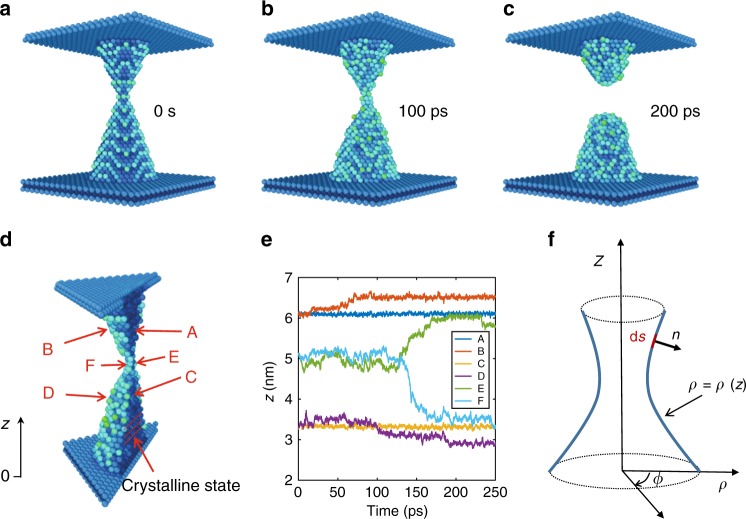
Fig. 2 MD simulation of surface diffusion. a–c MD simulation results of a Ag nanoscale CF between two electrode plates at increasing times, namely t = 0, 100 ps, and 200 ps (Supplementary Movies 1–2). The color indicates the free energy per atom with lighter blue representing atoms with higher free energy, hence higher diffusivity. To accelerate the surface diffusion process, the system temperature is set to 800 K, which is still below melting temperature of Ag. d Cross-section view of the CF at 100 ps, indicating stable bulk atoms with low free energy and crystalline states, hence negligible diffusion, whereas surface atoms show higher energy and diffusivity, thus resulting in the morphological evolution and rupture of the filament. e Typical traces of individual atoms along z direction for bulk atoms (A, C), surface atoms (B, D), and bottleneck atoms (E, F) in d. Bulk atoms show constant positions, while the surface atoms migrate toward their closest electrodes. Atoms in the CF bottleneck region also show a high tendency to migration to either the top or bottom electrode. (see Supplementary Note 2 and Supplementary Fig. 2 for more analysis). f CF geometry considered in the model of the surface diffusion. For simplicity, isotropic surface diffusion and axisymmetric (along z) CF surface are assumed. ρ(z) defines the geometry of the filament surface by rotating around the z axis, and n defines the surface evolution of a surface piece ds in unit time in outward normal direction
Fig. 2 MD simulation of surface diffusion. a–c MD simulation results of a Ag nanoscale CF between two electrode plates at increasing times, namely t = 0, 100 ps, and 200 ps (Supplementary Movies 1–2). The color indicates the free energy per atom with lighter blue representing atoms with higher free energy, hence higher diffusivity. To accelerate the surface diffusion process, the system temperature is set to 800 K, which is still below melting temperature of Ag. d Cross-section view of the CF at 100 ps, indicating stable bulk atoms with low free energy and crystalline states, hence negligible diffusion, whereas surface atoms show higher energy and diffusivity, thus resulting in the morphological evolution and rupture of the filament. e Typical traces of individual atoms along z direction for bulk atoms (A, C), surface atoms (B, D), and bottleneck atoms (E, F) in d. Bulk atoms show constant positions, while the surface atoms migrate toward their closest electrodes. Atoms in the CF bottleneck region also show a high tendency to migration to either the top or bottom electrode. (see Supplementary Note 2 and Supplementary Fig. 2 for more analysis). f CF geometry considered in the model of the surface diffusion. For simplicity, isotropic surface diffusion and axisymmetric (along z) CF surface are assumed. ρ(z) defines the geometry of the filament surface by rotating around the z axis, and n defines the surface evolution of a surface piece ds in unit time in outward normal directionCC BY · PubMed Central
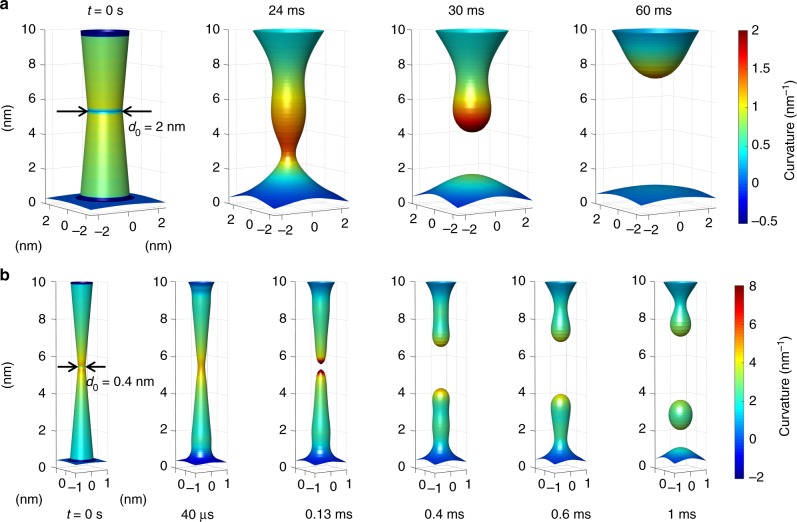
Fig. 3 Morphological changes induced by surface diffusion. a Simulation results of the surface diffusion equations, indicating the rearrangement of a Ag CF with initial diameter d0 = 2 nm at increasing times, namely t = 0, 24 ms, 30 ms, and 60 ms. b Same as a, but for a CF with an initial diameter d0 = 0.4 nm at times t = 0, 40 μs, 0.13 ms, 0.4 ms, 0.6 ms, and 1 ms. For both cases, the CF length is 10 nm, equivalent to the thickness of the insulating layer between two planar electrodes. The color in the figures indicates the surface curvature, where surface points with higher curvature are more likely to induce surface diffusion, thus providing a suitable spot for CF rupture. The CF lifetime decreases from around 20 ms (a) to about 0.13 ms (b) as d0 is reduced from 2 nm to 0.4 nm. The ovulation effect in b, where nano-clusters result from the disconnection of a thin CF, is consistent with in situ TEM observations of Ag nano-clusters evolving from Ag nanoscale CFs17,26,34
Fig. 3 Morphological changes induced by surface diffusion. a Simulation results of the surface diffusion equations, indicating the rearrangement of a Ag CF with initial diameter d0 = 2 nm at increasing times, namely t = 0, 24 ms, 30 ms, and 60 ms. b Same as a, but for a CF with an initial diameter d0 = 0.4 nm at times t = 0, 40 μs, 0.13 ms, 0.4 ms, 0.6 ms, and 1 ms. For both cases, the CF length is 10 nm, equivalent to the thickness of the insulating layer between two planar electrodes. The color in the figures indicates the surface curvature, where surface points with higher curvature are more likely to induce surface diffusion, thus providing a suitable spot for CF rupture. The CF lifetime decreases from around 20 ms (a) to about 0.13 ms (b) as d0 is reduced from 2 nm to 0.4 nm. The ovulation effect in b, where nano-clusters result from the disconnection of a thin CF, is consistent with in situ TEM observations of Ag nano-clusters evolving from Ag nanoscale CFs17,26,34CC BY · PubMed Central
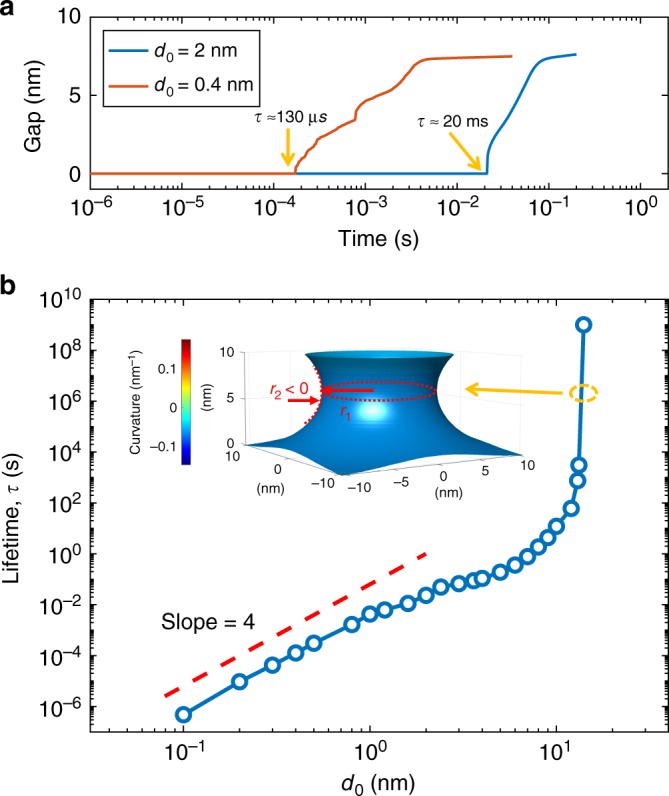
Fig. 4 CF size-lifetime scaling law. a Filament gap length as a function of the relaxation time. The increase of the gap length from zero marks the moment of CF disruption which we defined as lifetime τ. b Filament disruption time as a function of initial filament diameter d0. The size-time scaling for thin filament (d0 ≪ 10 nm, h = 10 nm) well agrees with Herring’s law τ~d0⁴ with a slope of 4, while, on the other hand, for thick filament (d0 > 10 nm), the lifetime more rapidly increases with the lateral size as a stable capillary bridge is formed, marking an increase of the lifetime from microseconds to years with increasing filament diameter. Inset: snapshot of a stable capillary bridge formed from filament with initial diameter d0 = 14 nm. The stability of this shape originates from the two principle radii of surface curvature having equal modulus and opposite signs. In the bottleneck point, the horizontal radius of the surface curve r1 > 0, whereas the vertical radius r2 < 0, resulting in the surface curvature κ tending to zero
Fig. 4 CF size-lifetime scaling law. a Filament gap length as a function of the relaxation time. The increase of the gap length from zero marks the moment of CF disruption which we defined as lifetime τ. b Filament disruption time as a function of initial filament diameter d0. The size-time scaling for thin filament (d0 ≪ 10 nm, h = 10 nm) well agrees with Herring’s law τ~d0⁴ with a slope of 4, while, on the other hand, for thick filament (d0 > 10 nm), the lifetime more rapidly increases with the lateral size as a stable capillary bridge is formed, marking an increase of the lifetime from microseconds to years with increasing filament diameter. Inset: snapshot of a stable capillary bridge formed from filament with initial diameter d0 = 14 nm. The stability of this shape originates from the two principle radii of surface curvature having equal modulus and opposite signs. In the bottleneck point, the horizontal radius of the surface curve r1 > 0, whereas the vertical radius r2 < 0, resulting in the surface curvature κ tending to zeroCC BY · PubMed Central
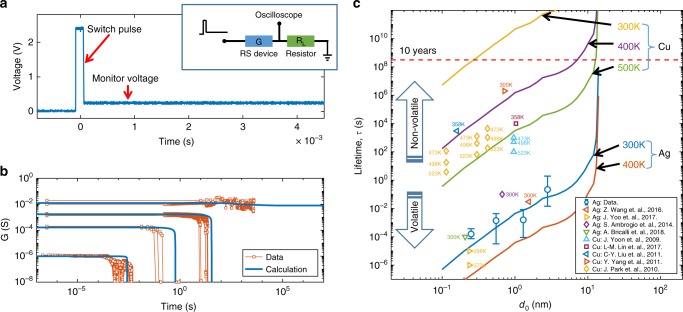
Fig. 5 Universal explanation for volatile and non-volatile switching. a Illustration of the experimental setup for the measurement of the lifetime of Ag filament. The Ag NWs resistive device with conductance G is serially connected with a load resistance RL which limits the current to a maximum value IC. A voltage pulse (2.5 V, 100 μs) is applied to create the Ag filament, followed by a relatively low monitor voltage (0.1 V) to probe the filament evolution. b Measured and calculated conductance for the resistive switching device for different filament sizes. As IC increases, the lifetime of the Ag filament increases as a result of the size-dependent surface diffusion. The largest IC~10mA results in a stable conductance, corresponding to a stable capillary bridge with a large diameter. c Measured and calculated CF lifetime for devices with electrode made of Cu39–43 and Ag17,23,44,45 as a function of the initial diameter d0. At room temperature, the parameter B was estimated as 10−34 m4/s and 10−47 m4/s for Cu and Ag filaments, respectively. The values of the surface activation energy QS was estimated as 1.1 eV and 0.52 eV for Cu and Ag, respectively. Calculations at various temperatures are also shown. The results account for the transition from volatile switching to non-volatile switching in RS devices (Fig. 1d–f) based on the size-dependent lifetime
Fig. 5 Universal explanation for volatile and non-volatile switching. a Illustration of the experimental setup for the measurement of the lifetime of Ag filament. The Ag NWs resistive device with conductance G is serially connected with a load resistance RL which limits the current to a maximum value IC. A voltage pulse (2.5 V, 100 μs) is applied to create the Ag filament, followed by a relatively low monitor voltage (0.1 V) to probe the filament evolution. b Measured and calculated conductance for the resistive switching device for different filament sizes. As IC increases, the lifetime of the Ag filament increases as a result of the size-dependent surface diffusion. The largest IC~10mA results in a stable conductance, corresponding to a stable capillary bridge with a large diameter. c Measured and calculated CF lifetime for devices with electrode made of Cu39–43 and Ag17,23,44,45 as a function of the initial diameter d0. At room temperature, the parameter B was estimated as 10−34 m4/s and 10−47 m4/s for Cu and Ag filaments, respectively. The values of the surface activation energy QS was estimated as 1.1 eV and 0.52 eV for Cu and Ag, respectively. Calculations at various temperatures are also shown. The results account for the transition from volatile switching to non-volatile switching in RS devices (Fig. 1d–f) based on the size-dependent lifetimeCC BY · PubMed Central

Verification

Claims the paper makes

The claims and statistics of this paper haven’t been checked yet.

Free: it reads the open-access text and checks the first 5 claims that cite a source we can check. Create a free account to check every claim.

A few free checks a day · papers already verified open instantly · results are public

Claims other papers make about this one

Each is checked against this paper’s own text: does it say what the citing paper says it does?

Self-check

Percentages, sums and reported differences re-computed from the paper’s own numbers.

The self-check needs the paper’s full text.

Citations

Cites

Show all 61 references

Cited by

See all 356

Metadata

Authors
Wang, W., Wang, M., Ambrosi, E., Bricalli, A., Laudato, M., Sun, Z., Chen, X., & Ielmini, D.
Affiliations
  • Consorzio Nazionale Interuniversitario per la Nanoelettronica (IT)
  • Nanyang Technological University (SG)
Corresponding author
  • Chen, Xiaodong
  • Ielmini, Daniele
Venue
Nature Communications
Published
2019-01-08
Volume
10
Issue
1
Pages
81-81
ISSN
2041-1723 (ISSN-L)
OpenAlex
W2909731512
Cited by
328
References
62
Citations by year
2026: 22 · 2025: 50 · 2024: 45 · 2023: 49 · 2022: 53 · 2021: 42 · 2020: 44 · 2019: 22
FWCI
14.47
Type
journal article
Language
en
Open access
Licence
Locations
  • Nature Communications (publishedVersion, cc-by)
  • Europe PMC (PubMed Central) (publishedVersion, other-oa)
  • PubMed Central (publishedVersion, cc-by)
  • PubMed (publishedVersion)
  • Virtual Community of Pathological Anatomy (University of Castilla La Mancha) (submittedVersion, other-oa)
  • RePEc: Research Papers in Economics (submittedVersion)
  • DOAJ (DOAJ: Directory of Open Access Journals) (submittedVersion)
  • DOAJ (DOAJ: Directory of Open Access Journals) (submittedVersion, cc-by-sa)
  • DR-NTU (Nanyang Technological University) (submittedVersion, cc-by)
Funders
  • European Commission (HORIZON2020)
  • Ministry of Education, India
  • H2020 European Research Council (648635)
Topics
  • Physical Sciences › Engineering › Electrical and Electronic Engineering › Advanced Memory and Neural Computing
  • Physical Sciences › Engineering › Electrical and Electronic Engineering › Ferroelectric and Negative Capacitance Devices
  • Physical Sciences › Materials Science › Materials Chemistry › Phase-change materials and chalcogenides
Keywords
resistive random access memory, conductive filaments, filament lifetime, surface diffusion, self-diffusion, ion transport, non-volatile memory, neuromorphic computing

About these checks

Registry, retraction, Cites and statistics results are computed, not judged, with one exception: a printed reference that no index lists is read once by a model before it counts as a citation error. Claims are extracted by a model and kept only when their quote appears verbatim in the text; each cited source is then checked, with a model’s help, for whether it says what the claim relies on. Those verdicts can be wrong — read the claim’s quote and the cited source before relying on one.

Statistics and arithmetic are recomputed, not judged.

Confidence bands are shown only for fields calibrated on our annotated test set. None is calibrated yet, so no band is shown.

What counts as a claim ›How we measure confidence ›How we check this ›

Are you an author, or do you see a problem with this page? Request a review

How to cite

Cite CoChat for the checks on this page, and the paper for its own findings.

This page
CoChat. (2026). Citation check: Surface diffusion-limited lifetime of silver and copper nanofilaments in resistive switching devices. https://app.cochat.ai/papers/10.1038/s41467-018-07979-0
The paper
Wang, W., Wang, M., Ambrosi, E., Bricalli, A., Laudato, M., Sun, Z., Chen, X., & Ielmini, D. (2019). Surface diffusion-limited lifetime of silver and copper nanofilaments in resistive switching devices. Nature Communications. https://doi.org/10.1038/s41467-018-07979-0

Data sources

Bibliographic data: Semantic Scholar, OpenAlex, Crossref.

Contains information from the Semantic Scholar Academic Graph Datasets, made available under the ODC Attribution License (ODC-BY 1.0).

Semantic Scholar’s data is described in: Kinney, R., et al. (2023). The Semantic Scholar Open Data Platform. arXiv:2301.10140.