

Surface diffusion-limited lifetime of silver and copper nanofilaments in resistive switching devices
Open accessThe DOI matches its Crossref record; 61 of the 62 references it cites were found in a registry or an index.
Abstract
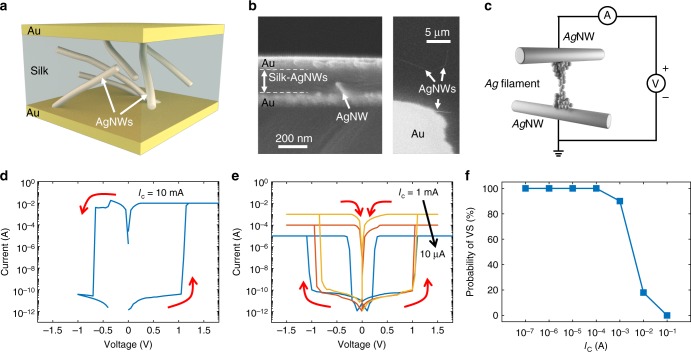
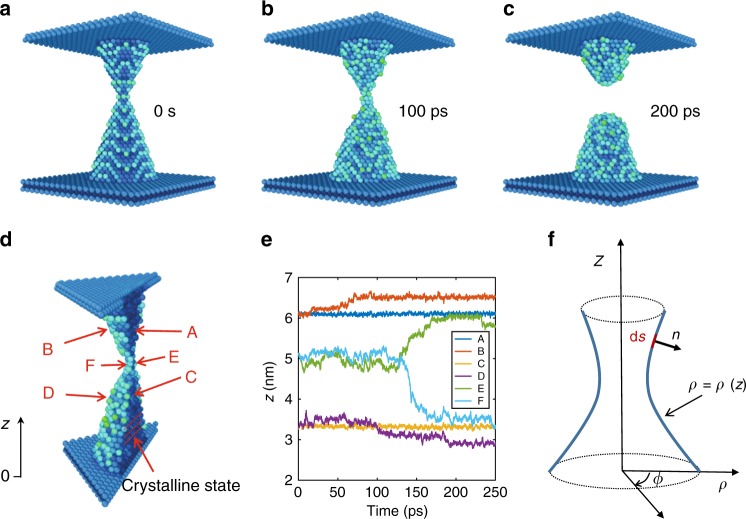
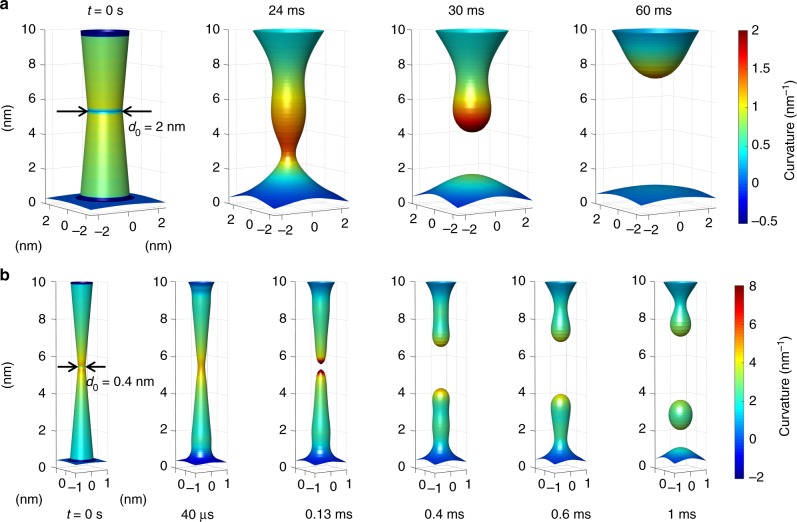
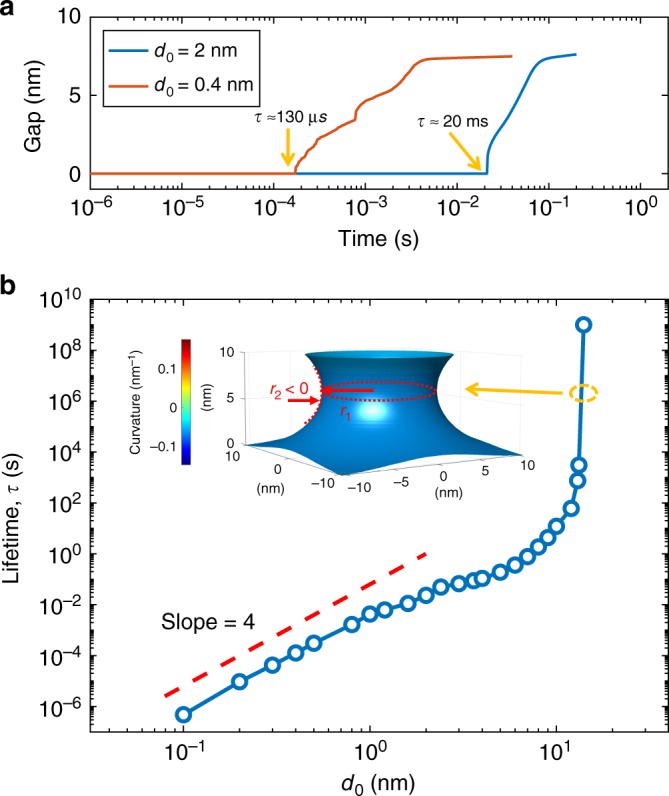
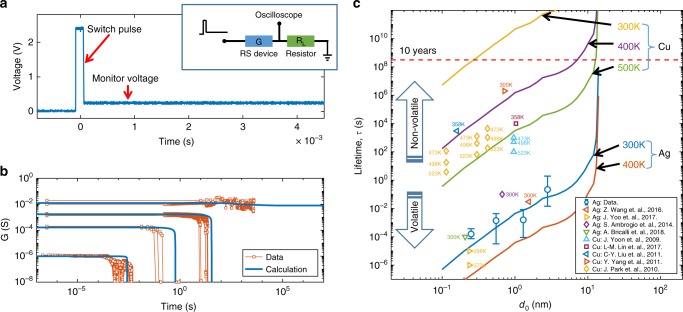
Silver/copper-filament-based resistive switching memory relies on the formation and disruption of a metallic conductive filament (CF) with relatively large surface-to-volume ratio. The nanoscale CF can spontaneously break after formation, with a lifetime ranging from few microseconds to several months, or even years. Controlling and predicting the CF lifetime enables device engineering for a wide range of applications, such as non-volatile memory for data storage, tunable short/long term memory for synaptic neuromorphic computing, and fast selection devices for crosspoint arrays. However, conflictive explanations for the CF retention process are being proposed. Here we show that the CF lifetime can be described by a universal surface-limited self-diffusion mechanism of disruption of the metallic CF. The surface diffusion process provides a new perspective of ion transport mechanism at the nanoscale, explaining the broad range of reported lifetimes, and paving the way for material engineering of resistive switching device for memory and computing applications.
Overview
The claims and statistics of this paper haven’t been checked yet.
Free: it reads the open-access text and checks the first 5 claims that cite a source we can check. Create a free account to check every claim.
Integrity signals
Registry
Cites
Statistics
Figures
Verification
Claims the paper makes
The claims and statistics of this paper haven’t been checked yet.
Free: it reads the open-access text and checks the first 5 claims that cite a source we can check. Create a free account to check every claim.
Claims other papers make about this one
Each is checked against this paper’s own text: does it say what the citing paper says it does?
The source backs part of the claim, not all of it — or backs it for a different population, condition or comparison.
In the citing paper
“The memory decay mechanism in a CBRAM based on dielectric materials is known to be caused by the surface diffusion of metal elements 39 .”
From Enhanced analog synaptic behavior of SiNx/a-Si bilayer memristors through Ge implantation (2020) · cites this paper as [39]
Experimental — accuracy not yet measuredThe source backs part of the claim, not all of it — or backs it for a different population, condition or comparison.
In the citing paper
“The lifetime of nanoscale conductive fi laments in CBRAM devices follows Herring ' s scaling law 40 , where the fi lament lifetime ( τ ) increases as a function of the fi lament size ( d 0 ): τ ~ d 0 4 39 .”
From Enhanced analog synaptic behavior of SiNx/a-Si bilayer memristors through Ge implantation (2020) · cites this paper as [39]
Experimental — accuracy not yet measured
Self-check
Percentages, sums and reported differences re-computed from the paper’s own numbers.
The self-check needs the paper’s full text.
Citations
Cites
Fast Parallel Algorithms for Short-Range Molecular Dynamics
Plimpton, S. (1995) · Journal of Computational Physics · doi:10.1006/jcph.1995.1039 · Cited by 44,721
Nanoionics-based resistive switching memories
Waser, R., & Aono, M. (2007) · Nature Materials · doi:10.1038/nmat2023 · Cited by 4,923
Memristive devices for computing
Yang, J. J., Strukov, D. B., & Stewart, D. R. (2013) · Nature Nanotechnology · doi:10.1038/nnano.2012.240 · Cited by 3,885
Regulation of Synaptic Efficacy by Coincidence of Postsynaptic APs and EPSPs
Markram, H., Lübke, J., Frotscher, M., & Sakmann, B. (1997) · Science · doi:10.1126/science.275.5297.213 · Cited by 3,832
Mullins, W. W. (1957) · Journal of Applied Physics · doi:10.1063/1.1722742 · Cited by 2,629
The mean free path of electrons in metals
Sondheimer, E. H. (1952) · Advances in Physics · doi:10.1080/00018735200101151 · Cited by 2,614
Memristors with diffusive dynamics as synaptic emulators for neuromorphic computing
Wang, Z., Joshi, S., Savel’ev, S. E., Jiang, H., Midya, R., Lin, P., Hu, M., Ge, N., Strachan, J. P., Li, Z., et al. (2017) · Nature Materials · doi:10.1038/nmat4756 · Cited by 2,358
Short-term plasticity and long-term potentiation mimicked in single inorganic synapses
Ohno, T., Hasegawa, T., Tsuruoka, T., Terabe, K., Gimzewski, J. K., & Aono, M. (2011) · Nature Materials · doi:10.1038/nmat3054 · Cited by 1,793
Fully memristive neural networks for pattern classification with unsupervised learning
Wang, Z., Joshi, S., Savel’ev, S., Song, W., Midya, R., Li, Y., Rao, M., Yan, P., Asapu, S., Zhuo, Y., et al. (2018) · Nature Electronics · doi:10.1038/s41928-018-0023-2 · Cited by 1,106
Effect of Change of Scale on Sintering Phenomena
Herring, C. (1950) · Journal of Applied Physics · doi:10.1063/1.1699658 · Cited by 1,045
Cited by
Resistive switching materials for information processing
Wang, Z., Wu, H., Burr, G. W., Hwang, C. S., Wang, K. L., Xia, Q., & Yang, J. J. (2020) · Nature Reviews Materials · doi:10.1038/s41578-019-0159-3 · Cited by 1,214
Tang, J., Yuan, F., Shen, X., Wang, Z., Rao, M., He, Y., Sun, Y., Li, X., Zhang, W., Li, Y., et al. (2019) · Advanced Materials · doi:10.1002/adma.201902761 · Cited by 834
A comprehensive review on emerging artificial neuromorphic devices
Zhu, J., Zhang, T., Yang, Y., & Huang, R. (2020) · Applied Physics Reviews · doi:10.1063/1.5118217 · Cited by 758
Understanding memristive switching via in situ characterization and device modeling
Sun, W., Gao, B., Chi, M., Xia, Q., Yang, J. J., Qian, H., & Wu, H. (2019) · Nature Communications · doi:10.1038/s41467-019-11411-6 · Cited by 482
Wang, M., Luo, Y., Wang, T., Wan, C., Pan, L., Pan, S., He, K., Neo, A., & Chen, X. (2021) · Advanced Materials · doi:10.1002/adma.202003014 · Cited by 451
Self-citationSemiconductor Quantum Dots for Memories and Neuromorphic Computing Systems
Lv, Z., Wang, Y., Chen, J., Wang, J., Zhou, Y., & Han, S.-T. (2020) · Chemical Reviews · doi:10.1021/acs.chemrev.9b00730 · Cited by 364
Ielmini, D., & Ambrogio, S. (2020) · Nanotechnology · doi:10.1088/1361-6528/ab554b · Cited by 321
Self-citationShort-Term Plasticity and Long-Term Potentiation in Artificial Biosynapses with Diffusive Dynamics
Kim, M.-K., & Lee, J.-S. (2018) · ACS Nano · doi:10.1021/acsnano.7b08331 · Cited by 294
Reservoir Computing Using Diffusive Memristors
Midya, R., Wang, Z., Asapu, S., Zhang, X., Rao, M., Song, W., Zhuo, Y., Upadhyay, N., Xia, Q., & Yang, J. J. (2019) · Advanced Intelligent Systems · doi:10.1002/aisy.201900084 · Cited by 279
Banerjee, W., Kashir, A., & Kamba, S. (2022) · Small · doi:10.1002/smll.202107575 · Cited by 277
Wang, Z., Zeng, T., Ren, Y., Lin, Y., Xu, H., Zhao, X., Liu, Y., & Ielmini, D. (2020) · Nature Communications · doi:10.1038/s41467-020-15158-3 · Cited by 223
Self-citationA Review of Resistive Switching Devices: Performance Improvement, Characterization, and Applications
Shi, T., Wang, R., Wu, Z., Sun, Y., An, J., & Liu, Q. (2021) · Small Structures · doi:10.1002/sstr.202000109 · Cited by 200
Memristor-based biomimetic compound eye for real-time collision detection
Wang, Y., Gong, Y., Huang, S., Xing, X., Lv, Z., Wang, J., Yang, J.-Q., Zhang, G., Zhou, Y., & Han, S.-T. (2021) · Nature Communications · doi:10.1038/s41467-021-26314-8 · Cited by 194
In-memory computing with emerging memory devices: Status and outlook
Mannocci, P., Farronato, M., Lepri, N., Cattaneo, L., Glukhov, A., Sun, Z., & Ielmini, D. (2023) · APL Machine Learning · doi:10.1063/5.0136403 · Cited by 192
Self-citationIelmini, D., & Pedretti, G. (2025) · Chemical Reviews · doi:10.1021/acs.chemrev.4c00845 · Cited by 181
Self-citationA chemically mediated artificial neuron
Wang, T., Wang, M., Wang, J., Yang, L., Ren, X., Song, G., Chen, S., Yuan, Y., Liu, R., Pan, L., et al. (2022) · Nature Electronics · doi:10.1038/s41928-022-00803-0 · Cited by 181
Self-citationAdaptive Extreme Edge Computing for Wearable Devices
Covi, E., Donati, E., Liang, X., Kappel, D., Heidari, H., Payvand, M., & Wang, W. (2021) · Frontiers in Neuroscience · doi:10.3389/fnins.2021.611300 · Cited by 177
Self-citationPorous crystalline materials for memories and neuromorphic computing systems
Ding, G., Zhao, J., Zhou, K., Zheng, Q., Han, S.-T., Peng, X., & Zhou, Y. (2023) · Chemical Society Reviews · doi:10.1039/d3cs00259d · Cited by 166
Memristor modeling: challenges in theories, simulations, and device variability
Gao, L., Ren, Q., Sun, J., Han, S., & Zhou, Y. (2021) · Journal of Materials Chemistry C · doi:10.1039/d1tc04201g · Cited by 164
Stochastic Memory Devices for Security and Computing
Carboni, R., & Ielmini, D. (2019) · Advanced Electronic Materials · doi:10.1002/aelm.201900198 · Cited by 145
Self-citationShort-term synaptic plasticity in emerging devices for neuromorphic computing
Li, C., Zhang, X., Chen, P., Zhou, K., Yu, J., Wu, G., Xiang, D., Jiang, H., Wang, M., & Liu, Q. (2023) · iScience · doi:10.1016/j.isci.2023.106315 · Cited by 158
Self-citationA bioinspired analogous nerve towards artificial intelligence
Liao, X., Song, W., Zhang, X., Yan, C., Li, T., Ren, H., Liu, C., Wang, Y., & Zheng, Y. (2020) · Nature Communications · doi:10.1038/s41467-019-14214-x · Cited by 153
Probabilistic computing using Cu0.1Te0.9/HfO2/Pt diffusive memristors
Woo, K. S., Kim, J., Han, J., Kim, W., Jang, Y. H., & Hwang, C. S. (2022) · Nature Communications · doi:10.1038/s41467-022-33455-x · Cited by 153
Simultaneous emulation of synaptic and intrinsic plasticity using a memristive synapse
Sung, S. H., Kim, T. J., Shin, H., Im, T. H., & Lee, K. J. (2022) · Nature Communications · doi:10.1038/s41467-022-30432-2 · Cited by 146
Parylene Based Memristive Devices with Multilevel Resistive Switching for Neuromorphic Applications
Minnekhanov, A. A., Emelyanov, A. V., Lapkin, D. A., Nikiruy, K. E., Shvetsov, B. S., Несмелов, А. А., Rylkov, V. V., Demin, V. A., & Erokhin, V. V. (2019) · Scientific Reports · doi:10.1038/s41598-019-47263-9 · Cited by 134
Functional Materials for Memristor‐Based Reservoir Computing: Dynamics and Applications
Zhang, G., Qin, J., Zhang, Y., Gong, G., Xiong, Z., Ma, X., Lv, Z., Zhou, Y., & Han, S. (2023) · Advanced Functional Materials · doi:10.1002/adfm.202302929 · Cited by 132
Emerging synaptic devices: from two-terminal memristors to multiterminal neuromorphic transistors
Jiang, S., Nie, S., He, Y., Liu, R., Chen, C., & Wan, Q. (2019) · Materials Today Nano · doi:10.1016/j.mtnano.2019.100059 · Cited by 129
Milano, G., Pedretti, G., Fretto, M., Boarino, L., Benfenati, F., Ielmini, D., Valov, I., & Ricciardi, C. (2020) · Advanced Intelligent Systems · doi:10.1002/aisy.202000096 · Cited by 111
Self-citationBrain-inspired computing via memory device physics
Ielmini, D., Wang, Z., & Liu, Y. (2021) · APL Materials · doi:10.1063/5.0047641 · Cited by 110
Self-citationMemristor-Based Artificial Chips
Sun, B. T., Chen, Y., Zhou, G., Cao, Z., Yang, C. S., Du, J., Chen, X., & Shao, J. (2023) · ACS Nano · doi:10.1021/acsnano.3c07384 · Cited by 123
Self-citationVersatile memristor for memory and neuromorphic computing
Guo, T., Pan, K., Jiao, Y., Sun, B. T., Du, C., Mills, J. P., Chen, Z., Zhao, X., Wei, L., Zhou, Y., et al. (2022) · Nanoscale Horizons · doi:10.1039/d1nh00481f · Cited by 122
HfO 2 -based resistive switching memory devices for neuromorphic computing
Brivio, S., Spiga, S., & Ielmini, D. (2022) · Neuromorphic Computing and Engineering · doi:10.1088/2634-4386/ac9012 · Cited by 119
Self-citationZhang, X., Lü, J., Wang, Z., Wang, R., Wei, J., Shi, T., Dou, C., Wu, Z., Zhu, J., Shang, D., et al. (2021) · Science Bulletin · doi:10.1016/j.scib.2021.04.014 · Cited by 116
MOF-derived single-atom catalysts: The next frontier in advanced oxidation for water treatment
Xia, P., Wang, C., He, Q., Ye, Z., & Sirés, I. (2022) · Chemical Engineering Journal · doi:10.1016/j.cej.2022.139446 · Cited by 114
Vertically integrated spiking cone photoreceptor arrays for color perception
Wang, X., Chen, C., Zhu, L. Q., Shi, K., Peng, B., Zhu, Y., Mao, H., Long, H., Ke, S., Fu, C., et al. (2023) · Nature Communications · doi:10.1038/s41467-023-39143-8 · Cited by 114
Nanomaterials for Flexible Neuromorphics
Ding, G., Li, H., Zhao, J., Zhou, K., Zhai, Y., Lv, Z., Zhang, M., Yan, Y., Han, S., & Zhou, Y. (2024) · Chemical Reviews · doi:10.1021/acs.chemrev.4c00369 · Cited by 114
Halide Perovskites‐Based Diffusive Memristors for Artificial Mechano‐Nociceptive System
Im, I. H., Baek, J. H., Kim, S. J., Kim, J., Park, S. H., Kim, J. Y., Yang, J. J., & Jang, H. W. (2023) · Advanced Materials · doi:10.1002/adma.202307334 · Cited by 99
Recent Progress in Synaptic Devices Based on 2D Materials
Sun, L., Wang, W. J., & Yang, H. (2020) · Advanced Intelligent Systems · doi:10.1002/aisy.201900167 · Cited by 94
Self-citationOrganic and perovskite memristors for neuromorphic computing
Park, H., & Lee, T. (2021) · Organic Electronics · doi:10.1016/j.orgel.2021.106301 · Cited by 93
Tunable stochastic memristors for energy-efficient encryption and computing
Woo, K. S., Han, J., Yi, S., Thomas, L., Park, H., Kumar, S., & Hwang, C. S. (2024) · Nature Communications · doi:10.1038/s41467-024-47488-x · Cited by 92
Recent advances in optical and optoelectronic data storage based on luminescent nanomaterials
Yu, J., Luo, M., Lv, Z., Huang, S., Hsu, H., Kuo, C., Han, S., & Zhou, Y. (2020) · Nanoscale · doi:10.1039/d0nr06719a · Cited by 90
From Memristive Materials to Neural Networks
Guo, T., Sun, B. T., Ranjan, S., Jiao, Y., Wei, L., Zhou, Y., & Wu, Y. A. (2020) · ACS Applied Materials & Interfaces · doi:10.1021/acsami.0c10796 · Cited by 90
Atomic Scale Dynamics Drive Brain-like Avalanches in Percolating Nanostructured Networks
Pike, M. D., Bose, S. K., Mallinson, J. B., Acharya, S. K., Shirai, S., Galli, E., Weddell, S. J., Bones, P. J., Arnold, M. D., & Brown, S. A. (2020) · Nano Letters · doi:10.1021/acs.nanolett.0c01096 · Cited by 82
Reconfigurable Low-Power TiO 2 Memristor for Integration of Artificial Synapse and Nociceptor
Sahu, M. C., Jena, A. K., Mallik, S. K., Roy, S., Sahoo, S., Ajimsha, R. S., Misra, P., & Sahoo, S. (2023) · ACS Applied Materials & Interfaces · doi:10.1021/acsami.3c02727 · Cited by 88
Integration and Co-design of Memristive Devices and Algorithms for Artificial Intelligence
Wang, W., Song, W., Yao, P., Li, Y., Van Nostrand, J., Qiu, Q., Ielmini, D., & Yang, J. J. (2020) · iScience · doi:10.1016/j.isci.2020.101809 · Cited by 84
Self-citationOn the resistive switching mechanism of parylene-based memristive devices
Minnekhanov, A. A., Shvetsov, B. S., Николаевич, М. М., Nikiruy, K. E., Kukueva, E. V., Presnyakov, M. Y., Форш, П. А., Rylkov, V. V., Erokhin, V. V., Demin, V. A., et al. (2019) · Organic Electronics · doi:10.1016/j.orgel.2019.06.052 · Cited by 85
Volatile Resistive Switching Memory Based on Ag Ion Drift/Diffusion Part I: Numerical Modeling
Wang, W. J., Laudato, M., Ambrosi, E., Bricalli, A., Covi, E., Lin, Y., & Ielmini, D. (2019) · IEEE Transactions on Electron Devices · doi:10.1109/ted.2019.2928890 · Cited by 83
Self-citationOptically Modulated Threshold Switching in Core–Shell Quantum Dot Based Memristive Device
Wang, J., Lv, Z., Xing, X., Li, X., Wang, Y., Chen, M., Pang, G., Qian, F., Zhou, Y., & Han, S. (2020) · Advanced Functional Materials · doi:10.1002/adfm.201909114 · Cited by 80
Wu, E., Wang, Y., Huo, S., Xu, J., Sheng, M. W., Liu, H., Zhong, L. S., Junfeng, G., Xie, Y., & Pan, C. (2025) · Advanced Functional Materials · doi:10.1002/adfm.202518764 · Cited by 79
Neuromorphic Motion Detection and Orientation Selectivity by Volatile Resistive Switching Memories
Wang, W. J., Covi, E., Milozzi, A., Farronato, M., Ricci, S., Sbandati, C., Pedretti, G., & Ielmini, D. (2020) · Advanced Intelligent Systems · doi:10.1002/aisy.202000224 · Cited by 75
Self-citationBousoulas, P., Sakellaropoulos, D., Papakonstantinopoulos, C., Kitsios, S., Arvanitis, C., Bagakis, E., & Tsoukalas, D. (2020) · Nanotechnology · doi:10.1088/1361-6528/aba3a1 · Cited by 74
Li, H., Huang, X., Yuan, J., Lu, Y., Wan, T., Li, Y., Xue, K., He, Y., Xu, M., Tong, H., et al. (2020) · Advanced Electronic Materials · doi:10.1002/aelm.202000309 · Cited by 74
A new opportunity for the emerging tellurium semiconductor: making resistive switching devices
Yang, Y., Xu, M., Jia, S., Wang, B., Xu, L., Wang, X., Liu, H., Liu, Y., Guo, Y., Wang, L., et al. (2021) · Nature Communications · doi:10.1038/s41467-021-26399-1 · Cited by 73
Ji, Y., Wang, L., Long, Y., Wang, J., Zheng, H., Yu, Z. G., Zhang, Y., & Ang, K. (2025) · Nature Communications · doi:10.1038/s41467-025-62306-8 · Cited by 74
A High‐Speed True Random Number Generator Based on a Cu x Te 1− x Diffusive Memristor
Woo, K. S., Kim, J., Han, J., Choi, J. M., Kim, W., & Hwang, C. S. (2021) · Advanced Intelligent Systems · doi:10.1002/aisy.202100062 · Cited by 73
Xia, P., He, T., Sun, Y., Duan, X., Chen, X., Zhu, Z., Wang, C., Liu, Y., He, Q., & Ye, Z. (2024) · ACS Catalysis · doi:10.1021/acscatal.4c02587 · Cited by 69
Self-citationChoi, S. H., Park, S., Seo, S., & Choi, S. (2022) · Science Advances · doi:10.1126/sciadv.abj7866 · Cited by 69
Qin, F. H., Zhang, Y., Song, H. W., & Lee, S. (2023) · Materials Advances · doi:10.1039/d3ma00069a · Cited by 69
Conductive-bridging random-access memories for emerging neuromorphic computing
Cha, J., Yang, S. Y., Oh, J., Choi, S., Park, S., Jang, B. C., Ahn, W., & Choi, S. (2020) · Nanoscale · doi:10.1039/d0nr01671c · Cited by 68
Memristors with Tunable Volatility for Reconfigurable Neuromorphic Computing
Woo, K. S., Park, H., Ghenzi, N., Talin, A. A., Jeong, T.-Y., Choi, J., Oh, S., Jang, Y. H., Han, J., Williams, R. S., et al. (2024) · ACS Nano · doi:10.1021/acsnano.4c03238 · Cited by 67
Prospects and applications of volatile memristors
Kim, D., Jeon, B., Lee, Y., Kim, D., Cho, Y., & Kim, S. (2022) · Applied Physics Letters · doi:10.1063/5.0093964 · Cited by 65
Zhang, T., Wang, L., Ding, W., Zhu, Y., Qian, H., Zhou, J. J., Chen, Y., Li, J., Li, W., Huang, L., et al. (2023) · Advanced Materials · doi:10.1002/adma.202302863 · Cited by 65
Volatile Resistive Switching Memory Based on Ag Ion Drift/Diffusion—Part II: Compact Modeling
Wang, W. J., Laudato, M., Ambrosi, E., Bricalli, A., Covi, E., Lin, Y., & Ielmini, D. (2019) · IEEE Transactions on Electron Devices · doi:10.1109/ted.2019.2928888 · Cited by 66
Self-citationYu, M. J., Son, K. R., Khot, A. C., Kang, D. Y., Sung, J. H., Jang, I. G., Dange, Y. D., Dongale, T. D., & Kim, T. G. (2021) · Journal of Materials Research and Technology · doi:10.1016/j.jmrt.2021.09.044 · Cited by 63
Covi, E., Wang, W. J., Lin, Y., Farronato, M., Ambrosi, E., & Ielmini, D. (2021) · IEEE Transactions on Electron Devices · doi:10.1109/ted.2021.3076029 · Cited by 62
Self-citationLeveraging volatile memristors in neuromorphic computing: from materials to system implementation
Moon, T., Soh, K., Kim, J. S., Kim, J. E., Chun, S. Y., Cho, K., Yang, J. J., & Yoon, J. H. (2024) · Materials Horizons · doi:10.1039/d4mh00675e · Cited by 62
Nanoscale Imaging and Control of Volatile and Non‐Volatile Resistive Switching in VO2
Shabalin, A., del Valle, J., Hua, N., Cherukara, M. J., Holt, M. V., Schuller, I. K., & Shpyrko, O. (2020) · Small · doi:10.1002/smll.202005439 · Cited by 61
Reservoir computing with 3D nanowire networks
Daniels, R. K., Mallinson, J. B., Heywood, Z. E., Bones, P. J., Arnold, M. D., & Brown, S. A. (2022) · Neural Networks · doi:10.1016/j.neunet.2022.07.001 · Cited by 61
Memristive Ion Dynamics to Enable Biorealistic Computing
Zhao, R., Kim, S. J., Xu, Y., Zhao, J., Wang, T., Midya, R., Ganguli, S., Roy, A. K., Dubey, M., Williams, R. S., et al. (2024) · Chemical Reviews · doi:10.1021/acs.chemrev.4c00587 · Cited by 62
A spiking artificial neuron based on one diffusive memristor, one transistor and one resistor
Zhao, R., Wang, T., Moon, T., Xu, Y., Zhao, J., Sud, P., Kim, S. J., Liao, H.-T., Zhuo, Y., Midya, R., et al. (2025) · Nature Electronics · doi:10.1038/s41928-025-01488-x · Cited by 60
Connectome of memristive nanowire networks through graph theory
Milano, G., Miranda, E. A., & Ricciardi, C. (2022) · Neural Networks · doi:10.1016/j.neunet.2022.02.022 · Cited by 57
Im, I. H., Kim, S. J., Baek, J. H., Kwak, K. J., Lee, T. H., Yang, J. W., Lee, D. E., Kim, J. Y., Kwon, H. R., Heo, D. Y., et al. (2022) · Advanced Functional Materials · doi:10.1002/adfm.202211358 · Cited by 56
Lu, Y., Li, H., Li, Y., Li, L., Wan, T., Yang, L., Zuo, W., Xue, K., & Miao, X. (2022) · Advanced Electronic Materials · doi:10.1002/aelm.202200202 · Cited by 56
2D materials and van der Waals heterojunctions for neuromorphic computing
Zhang, Z., Yang, D., Li, H., Li, C., Wang, Z., Sun, L., & Yang, H. (2022) · Neuromorphic Computing and Engineering · doi:10.1088/2634-4386/ac8a6a · Cited by 55
Wang, W. J., Covi, E., Lin, Y., Ambrosi, E., Milozzi, A., Sbandati, C., Farronato, M., & Ielmini, D. (2021) · IEEE Transactions on Electron Devices · doi:10.1109/ted.2021.3095033 · Cited by 54
Self-citationSung, S. H., Jeong, Y., Oh, J. W., Shin, H., Lee, J. H., & Lee, K. J. (2023) · Materials Today · doi:10.1016/j.mattod.2022.11.022 · Cited by 55
Memristive tonotopic mapping with volatile resistive switching memory devices
Milozzi, A., Ricci, S., & Ielmini, D. (2024) · Nature Communications · doi:10.1038/s41467-024-47228-1 · Cited by 53
Self-citationSong, Y. G., Suh, J. M., Park, J. Y., Kim, J. E., Chun, S. Y., Kwon, J. U., Lee, H., Jang, H. W., Kim, S., Kang, C., et al. (2021) · Advanced Science · doi:10.1002/advs.202103484 · Cited by 52
Memristors with Biomaterials for Biorealistic Neuromorphic Applications
Xu, J., Zhao, X., Zhao, X., Wang, Z., Tang, Q., Xu, H., & Liu, Y. (2022) · Small Science · doi:10.1002/smsc.202200028 · Cited by 51
Bio-memristors based on silk fibroin
Zhang, Y., Fan, S., & Zhang, Y. (2021) · Materials Horizons · doi:10.1039/d1mh01433a · Cited by 51
Porphyrin‐Based Metal–Organic Frameworks for Neuromorphic Electronics
Ding, G., Han, S., Kuo, C., Roy, V. A. L., & Zhou, Y. (2022) · Small Structures · doi:10.1002/sstr.202200150 · Cited by 50
Jiang, Y., Wang, D., Lin, N., Shi, S., Zhang, Y., Wang, S., Chen, X., Chen, H., Lin, Y., Loong, K. C., et al. (2023) · Advanced Science · doi:10.1002/advs.202301323 · Cited by 51
Self-citationMemtransistor Devices Based on MoS 2 Multilayers with Volatile Switching due to Ag Cation Migration
Farronato, M., Melegari, M., Ricci, S., Hashemkhani, S., Bricalli, A., & Ielmini, D. (2022) · Advanced Electronic Materials · doi:10.1002/aelm.202101161 · Cited by 50
Self-citationSelf-Selective Resistive Device With Hybrid Switching Mode for Passive Crossbar Memory Application
Wang, Z., Kang, J., Bai, G., Zhong, G., Wang, B., Ling, Y., Chen, Q., Bao, L., Wu, L., Cai, Y., et al. (2020) · IEEE Electron Device Letters · doi:10.1109/led.2020.2992680 · Cited by 49
Electrical Properties and Biological Synaptic Simulation of Ag/MXene/SiO2/Pt RRAM Devices
Lian, X., Shen, X., Fu, J., Gao, Z., Wan, X., Liu, X., Hu, E., Xu, J., & Tong, Y. (2020) · Electronics · doi:10.3390/electronics9122098 · Cited by 49
In materia implementation strategies of physical reservoir computing with memristive nanonetworks
Milano, G., Montano, K., & Ricciardi, C. (2023) · Journal of Physics D Applied Physics · doi:10.1088/1361-6463/acb7ff · Cited by 48
Type-I Core–Shell ZnSe/ZnS Quantum Dot-Based Resistive Switching for Implementing Algorithm
Wang, Z., Wang, Y., Yu, J., Yang, J., Zhou, Y., Mao, J., Wang, R., Zhao, X., Zheng, W., & Han, S. (2020) · Nano Letters · doi:10.1021/acs.nanolett.0c02227 · Cited by 48
150 nm × 200 nm Cross‐Point Hexagonal Boron Nitride‐Based Memristors
Yuan, B., Liang, X., Zhong, L., Shi, Y., Palumbo, F., Chen, S., Hui, F., Jing, X., Villena, M. A., Jiang, L., et al. (2020) · Advanced Electronic Materials · doi:10.1002/aelm.201900115 · Cited by 47
Applications of biomemristors in next generation wearable electronics
Mao, S., Sun, B. T., Zhou, G., Guo, T., Wang, J., & Zhao, Y. X. (2022) · Nanoscale Horizons · doi:10.1039/d2nh00163b · Cited by 47
Polyoxometalate Accelerated Cationic Migration for Reservoir Computing
Zhang, G., Xiong, Z., Gong, Y., Zhu, Z., Lv, Z., Wang, Y., Yang, J., Xing, X., Wang, Z., Qin, J., et al. (2022) · Advanced Functional Materials · doi:10.1002/adfm.202204721 · Cited by 45
Oh, J., Kim, S., Lee, C., Cha, J., Yang, S. Y., Im, S. G., Park, C., Jang, B. C., & Choi, S. (2023) · Advanced Materials · doi:10.1002/adma.202300023 · Cited by 45
Ahn, W., Lee, S., Oh, J., Lee, H., & Choi, S. (2024) · Advanced Materials · doi:10.1002/adma.202413640 · Cited by 44
Carstens, N., Adejube, B., Strunskus, T., Faupel, F., Brown, S. A., & Vahl, A. (2022) · Nanoscale Advances · doi:10.1039/d2na00121g · Cited by 44
Islam, R., Shi, Y., Silva, G. V. D. O., Sachdev, M., & Miao, G. (2024) · ACS Nano · doi:10.1021/acsnano.4c05137 · Cited by 43
In-memory and in-sensor reservoir computing with memristive devices
Lin, N., Chen, J., Zhao, R., He, Y., Wong, K., Qiu, Q., Wang, Z., & Yang, J. J. (2024) · APL Machine Learning · doi:10.1063/5.0174863 · Cited by 42
Gao, M., Xu, G., Zhang, R., Liu, Z., Xia, H., Shao, B., Xue, C., Li, J., Miao, S., Fu, W., et al. (2021) · Analytical Chemistry · doi:10.1021/acs.analchem.0c04226 · Cited by 42
Self-organizing neuromorphic nanowire networks as stochastic dynamical systems
Milano, G., Michieletti, F., Pilati, D., Ricciardi, C., & Miranda, E. A. (2025) · Nature Communications · doi:10.1038/s41467-025-58741-2 · Cited by 40
Resistive switching kinetics and second-order effects in parylene-based memristors
Matsukatova, A. N., Emelyanov, A. V., Minnekhanov, A. A., Несмелов, А. А., Vdovichenko, A. Y., Чвалун, С. Н., Rylkov, V. V., Форш, П. А., Demin, V. A., Kashkarov, P. K., et al. (2020) · Applied Physics Letters · doi:10.1063/5.0030069 · Cited by 40
Soft Biomaterials Based Flexible Artificial Synapse for Neuromorphic Computing
Guo, T., Ge, J., Sun, B. T., Pan, K., Pan, Z., Wei, L., Yan, Y., Zhou, Y., & Wu, Y. A. (2022) · Advanced Electronic Materials · doi:10.1002/aelm.202200449 · Cited by 40
Brain-inspired computing with self-assembled networks of nano-objects
Vahl, A., Milano, G., Kuncic, Z., Brown, S. A., & Milani, P. (2024) · Journal of Physics D Applied Physics · doi:10.1088/1361-6463/ad7a82 · Cited by 39
Metadata
- Authors
- Wang, W., Wang, M., Ambrosi, E., Bricalli, A., Laudato, M., Sun, Z., Chen, X., & Ielmini, D.
- Affiliations
- Consorzio Nazionale Interuniversitario per la Nanoelettronica (IT)
- Nanyang Technological University (SG)
- Corresponding author
- Chen, Xiaodong
- Ielmini, Daniele
- ORCID
- Venue
- Nature Communications
- Published
- 2019-01-08
- Volume
- 10
- Issue
- 1
- Pages
- 81-81
- ISSN
- 2041-1723 (ISSN-L)
- PMC
- PMC6325242
- OpenAlex
- W2909731512
- Semantic Scholar
- 6ff0306bcf898ba6231ed1b1a78e02a4d14c2f9a
- Cited by
- 328
- References
- 62
- Citations by year
- 2026: 22 · 2025: 50 · 2024: 45 · 2023: 49 · 2022: 53 · 2021: 42 · 2020: 44 · 2019: 22
- FWCI
- 14.47
- Type
- journal article
- Language
- en
- Open access
- gold
- doi.org
- Licence
- cc-by
- creativecommons.org/licenses/by/4.0 (tdm)
- creativecommons.org/licenses/by/4.0 (vor)
- Locations
- Nature Communications (publishedVersion, cc-by)
- Europe PMC (PubMed Central) (publishedVersion, other-oa)
- PubMed Central (publishedVersion, cc-by)
- PubMed (publishedVersion)
- Virtual Community of Pathological Anatomy (University of Castilla La Mancha) (submittedVersion, other-oa)
- RePEc: Research Papers in Economics (submittedVersion)
- DOAJ (DOAJ: Directory of Open Access Journals) (submittedVersion)
- DOAJ (DOAJ: Directory of Open Access Journals) (submittedVersion, cc-by-sa)
- DR-NTU (Nanyang Technological University) (submittedVersion, cc-by)
- Funders
- European Commission (HORIZON2020)
- Ministry of Education, India
- H2020 European Research Council (648635)
- Topics
- Physical Sciences › Engineering › Electrical and Electronic Engineering › Advanced Memory and Neural Computing
- Physical Sciences › Engineering › Electrical and Electronic Engineering › Ferroelectric and Negative Capacitance Devices
- Physical Sciences › Materials Science › Materials Chemistry › Phase-change materials and chalcogenides
- Keywords
- resistive random access memory, conductive filaments, filament lifetime, surface diffusion, self-diffusion, ion transport, non-volatile memory, neuromorphic computing
About these checks
Registry, retraction, Cites and statistics results are computed, not judged, with one exception: a printed reference that no index lists is read once by a model before it counts as a citation error. Claims are extracted by a model and kept only when their quote appears verbatim in the text; each cited source is then checked, with a model’s help, for whether it says what the claim relies on. Those verdicts can be wrong — read the claim’s quote and the cited source before relying on one.
Statistics and arithmetic are recomputed, not judged.
Confidence bands are shown only for fields calibrated on our annotated test set. None is calibrated yet, so no band is shown.
What counts as a claim ›How we measure confidence ›How we check this ›
Are you an author, or do you see a problem with this page? Request a review
Data sources
Bibliographic data: Semantic Scholar, OpenAlex, Crossref.
Contains information from the Semantic Scholar Academic Graph Datasets, made available under the ODC Attribution License (ODC-BY 1.0).
Semantic Scholar’s data is described in: Kinney, R., et al. (2023). The Semantic Scholar Open Data Platform. arXiv:2301.10140.
