

Scale-free networks are rare
Open accessThe DOI matches its Crossref record; 69 of the 69 references it cites were found in a registry or an index.
Abstract
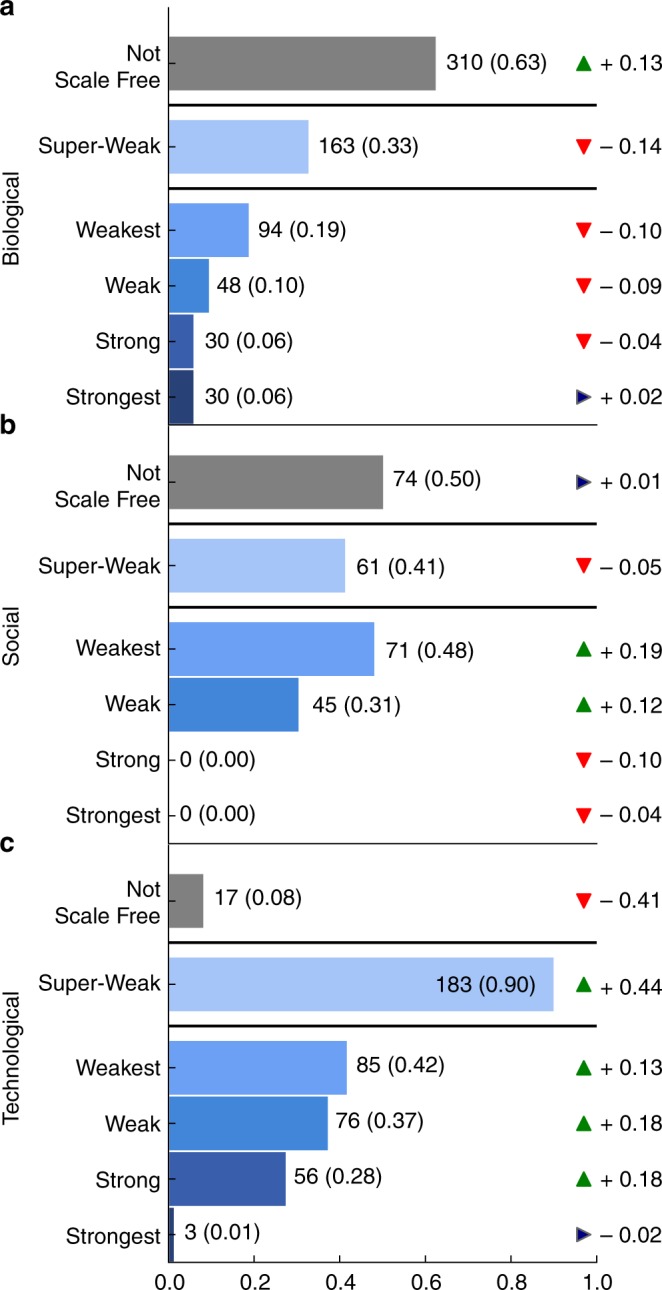
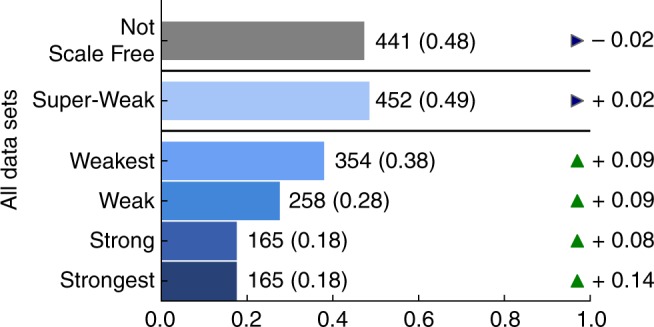
Real-world networks are often claimed to be scale free, meaning that the fraction of nodes with degree k follows a power law k − α , a pattern with broad implications for the structure and dynamics of complex systems. However, the universality of scale-free networks remains controversial. Here, we organize different definitions of scale-free networks and construct a severe test of their empirical prevalence using state-of-the-art statistical tools applied to nearly 1000 social, biological, technological, transportation, and information networks. Across these networks, we find robust evidence that strongly scale-free structure is empirically rare, while for most networks, log-normal distributions fit the data as well or better than power laws. Furthermore, social networks are at best weakly scale free, while a handful of technological and biological networks appear strongly scale free. These findings highlight the structural diversity of real-world networks and the need for new theoretical explanations of these non-scale-free patterns.
Overview
The claims and statistics of this paper haven’t been checked yet.
Free: it reads the open-access text and checks the first 5 claims that cite a source we can check. Create a free account to check every claim.
Integrity signals
Registry
Cites
Statistics
Figures
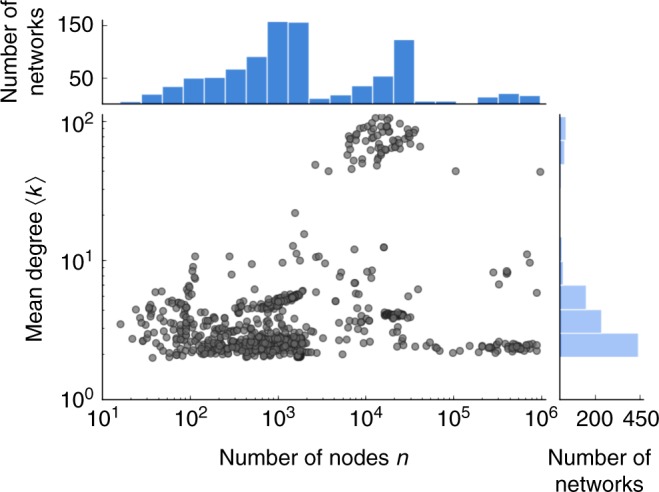
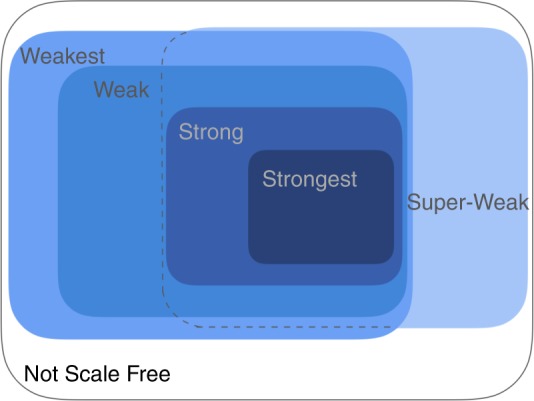
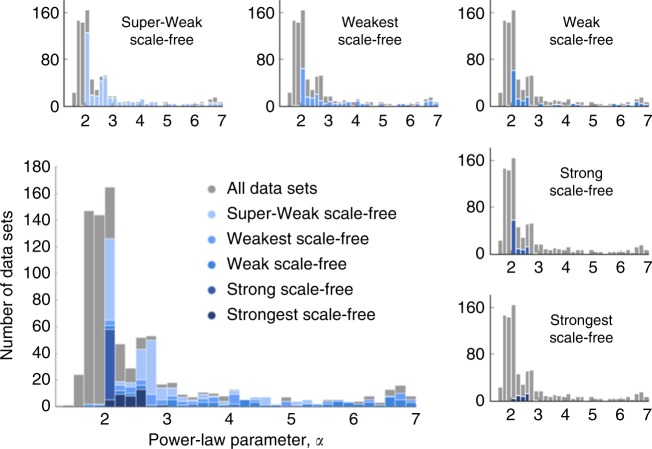
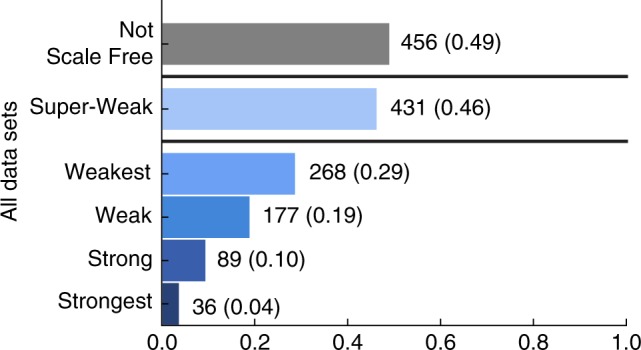
Verification
Claims the paper makes
The claims and statistics of this paper haven’t been checked yet.
Free: it reads the open-access text and checks the first 5 claims that cite a source we can check. Create a free account to check every claim.
Claims other papers make about this one
Each is checked against this paper’s own text: does it say what the citing paper says it does?
The cited source says what the claim attributes to it.
In the citing paper
“A power law connectivity degree distribution is the defining feature of a scale-free network46,47”
From Descending networks transform command signals into population motor control (2024) · cites this paper as [47]
In the citing paper
“meanwhile, serious criticisms [47,48] regarding the statistical significance and mechanistic interpretation of purported scaling laws in a variety of contexts not limited to biochemistry have also been raised.”
From Prebiotic Reaction Networks in Water (2020) · cites this paper as [48]
Self-check
Percentages, sums and reported differences re-computed from the paper’s own numbers.
The self-check needs the paper’s full text.
Citations
Cites
Collective dynamics of ‘small-world’ networks
Watts, D. J., & Strogatz, S. H. (1998) · Nature · doi:10.1038/30918 · Cited by 43,060
Emergence of Scaling in Random Networks
Barabási, A.-L., & Albert, R. (1999) · Science · doi:10.1126/science.286.5439.509 · Cited by 36,135
Community structure in social and biological networks
Girvan, M., & Newman, M. E. J. (2002) · Proceedings of the National Academy of Sciences · doi:10.1073/pnas.122653799 · Cited by 15,502
Power-Law Distributions in Empirical Data
Clauset, A., Shalizi, C. R., & Newman, M. E. J. (2009) · SIAM Review · doi:10.1137/070710111 · Cited by 8,019
Self-citationError and attack tolerance of complex networks
Albert, R., Jeong, H., & Barabási, A.-L. (2000) · Nature · doi:10.1038/35019019 · Cited by 7,534
Likelihood Ratio Tests for Model Selection and Non-Nested Hypotheses
Vuong, Q. H. (1989) · Econometrica · doi:10.2307/1912557 · Cited by 5,929
Newman (2005) · doi:10.1080/00107510500052444 · Cited by 5,749
Epidemic Spreading in Scale-Free Networks
Pastor-Satorras, R., & Vespignani, A. (2001) · Physical Review Letters · doi:10.1103/physrevlett.86.3200 · Cited by 5,731
Lethality and centrality in protein networks
Jeong, H., Mason, S. P., Barabási, A.-L., & Oltvai, Z. N. (2001) · Nature · doi:10.1038/35075138 · Cited by 5,287
Diameter of the World-Wide Web
Albert, R., Jeong, H., & Barabási, A.-L. (1999) · Nature · doi:10.1038/43601 · Cited by 4,260
Epidemic processes in complex networks
Pastor-Satorras, R., Castellano, C., Van Mieghem, P., & Vespignani, A. (2015) · Reviews of Modern Physics · doi:10.1103/revmodphys.87.925 · Cited by 3,697
Spread of epidemic disease on networks
Newman, M. E. J. (2002) · Physical Review E · doi:10.1103/physreve.66.016128 · Cited by 3,218
Dorogovtsev, S. N., & Mendes, J. F. F. (2002) · Advances in Physics · doi:10.1080/00018730110112519 · Cited by 3,171
Price, D. J. D. S. (1965) · Science · doi:10.1126/science.149.3683.510 · Cited by 3,122
Measurement and analysis of online social networks
Mislove, A., Marcon, M., Gummadi, K. P., Druschel, P., & Bhattacharjee, B. (2007) · Proceedings of the 7th ACM SIGCOMM conference on Internet measurement · doi:10.1145/1298306.1298311 · Cited by 3,057
Classes of small-world networks
Amaral, L. A. N., Scala, A., Barthélémy, M., & Stanley, H. E. (2000) · Proceedings of the National Academy of Sciences · doi:10.1073/pnas.200327197 · Cited by 3,051
ON A CLASS OF SKEW DISTRIBUTION FUNCTIONS
SIMON, H. A. (1955) · Biometrika · doi:10.1093/biomet/42.3-4.425 · Cited by 2,771
Dynamical Processes on Complex Networks
Barrat, A., Barthélemy, M., & Vespignani, A. (2008) · doi:10.1017/cbo9780511791383 · Cited by 2,704
Graph evolution: Densification and shrinking diameters
Leskovec, J., Kleinberg, J., & Faloutsos, C. (2007) · ACM Transactions on Knowledge Discovery from Data · doi:10.1145/1217299.1217301 · Cited by 2,461
Hierarchical structure and the prediction of missing links in networks
Clauset, A., Moore, C., & Newman, M. E. J. (2008) · Nature · doi:10.1038/nature06830 · Cited by 2,171
Self-citationHow popular is your paper? An empirical study of the citation distribution
Redner, S. (1998) · The European Physical Journal B · doi:10.1007/s100510050359 · Cited by 1,509
Self-similarity of complex networks
Song, C., Havlin, S., & Makse, H. A. (2005) · Nature · doi:10.1038/nature03248 · Cited by 1,495
Superfamilies of Evolved and Designed Networks
Milo, R., Itzkovitz, S., Kashtan, N., Levitt, R., Shen-Orr, S., Ayzenshtat, I., Sheffer, M., & Alon, U. (2004) · Science · doi:10.1126/science.1089167 · Cited by 1,412
Microbial Hub Taxa Link Host and Abiotic Factors to Plant Microbiome Variation
Agler, M. T., Ruhe, J., Kroll, S., Morhenn, C., Kim, S.-T., Weigel, D., & Kemen, E. M. (2016) · PLOS Biology · doi:10.1371/journal.pbio.1002352 · Cited by 1,397
Why social networks are different from other types of networks
Newman, M. E. J., & Park, J. (2003) · Physical Review E · doi:10.1103/physreve.68.036122 · Cited by 1,354
A Brief History of Generative Models for Power Law and Lognormal Distributions
Mitzenmacher, M. (2004) · Internet Mathematics · doi:10.1080/15427951.2004.10129088 · Cited by 1,188
Power-Law Distribution of the World Wide Web
Adamic, L. A., & Huberman, B. A. (2000) · Science · doi:10.1126/science.287.5461.2115a · Cited by 1,015
Detecting rich-club ordering in complex networks
Colizza, V., Flammini, A., Serrano, M. A., & Vespignani, A. (2006) · Nature Physics · doi:10.1038/nphys209 · Cited by 1,001
The log-dynamic brain: how skewed distributions affect network operations
Buzsáki, G., & Mizuseki, K. (2014) · Nature Reviews Neuroscience · doi:10.1038/nrn3687 · Cited by 981
A random graph model for massive graphs
Aiello, W., Chung, F., & Lu, L. (2000) · Proceedings of the thirty-second annual ACM symposium on Theory of computing · doi:10.1145/335305.335326 · Cited by 917
Biological network comparison using graphlet degree distribution
Pržulj, N. (2007) · Bioinformatics · doi:10.1093/bioinformatics/btl301 · Cited by 837
Universality of citation distributions: Toward an objective measure of scientific impact
Radicchi, F., Fortunato, S., & Castellano, C. (2008) · Proceedings of the National Academy of Sciences · doi:10.1073/pnas.0806977105 · Cited by 828
Epidemic dynamics in finite size scale-free networks
Pastor-Satorras, R., & Vespignani, A. (2002) · Physical Review E · doi:10.1103/physreve.65.035108 · Cited by 697
Modelling dynamical processes in complex socio-technical systems
Vespignani, A. (2012) · Nature Physics · doi:10.1038/nphys2160 · Cited by 652
Meeting Strangers and Friends of Friends: How Random Are Social Networks?
Jackson, M. O., & Rogers, B. W. (2007) · American Economic Review · doi:10.1257/aer.97.3.890 · Cited by 633
Critical Truths About Power Laws
Stumpf, M. P. H., & Porter, M. A. (2012) · Science · doi:10.1126/science.1216142 · Cited by 633
Model Selection and Model Averaging
Claeskens, G., & Hjort, N. L. (2001) · Cambridge University Press eBooks · doi:10.1017/cbo9780511790485 · Cited by 629
Subnets of scale-free networks are not scale-free: Sampling properties of networks
Stumpf, M. P. H., Wiuf, C., & May, R. M. (2005) · Proceedings of the National Academy of Sciences · doi:10.1073/pnas.0501179102 · Cited by 561
Highly optimized tolerance: A mechanism for power laws in designed systems
Carlson, J. M., & Doyle, J. (1999) · Physical Review E · doi:10.1103/physreve.60.1412 · Cited by 549
Towards a Theory of Scale-Free Graphs: Definition, Properties, and Implications
Li, L., Alderson, D., Doyle, J. C., & Willinger, W. (2005) · Internet Mathematics · doi:10.1080/15427951.2005.10129111 · Cited by 519
Evolving protein interaction networks through gene duplication
Pastor-Satorras, R., Smith, E., & Solé, R. V. (2003) · Journal of Theoretical Biology · doi:10.1016/s0022-5193(03)00028-6 · Cited by 429
Citation Statistics from 110 Years of Physical Review
Redner, S. (2005) · Physics Today · doi:10.1063/1.1996475 · Cited by 426
A Random Graph Model for Power Law Graphs
Aiello, W., Chung, F., & Lu, L. (2001) · Experimental Mathematics · doi:10.1080/10586458.2001.10504428 · Cited by 405
Classification of scale-free networks
Goh, K.-I., Oh, E., Jeong, H., Kahng, B., & Kim, D. (2002) · Proceedings of the National Academy of Sciences · doi:10.1073/pnas.202301299 · Cited by 377
Self-Similarity of Complex Networks and Hidden Metric Spaces
Serrano, M. Á., Krioukov, D., & Boguñá, M. (2008) · Physical Review Letters · doi:10.1103/physrevlett.100.078701 · Cited by 332
Onset of synchronization in large networks of coupled oscillators
Restrepo, J. G., Ott, E., & Hunt, B. R. (2005) · Physical Review E · doi:10.1103/physreve.71.036151 · Cited by 312
How Scale-Free Are Biological Networks
Khanin, R., & Wit, E. (2006) · Journal of Computational Biology · doi:10.1089/cmb.2006.13.810 · Cited by 250
Frequency synchronization in a random oscillator network
Ichinomiya, T. (2004) · Physical Review E · doi:10.1103/physreve.70.026116 · Cited by 224
The Powerful Law of the Power Law and Other Myths in Network Biology
Lima-Mendez, G., & van Helden, J. (2009) · Molecular BioSystems · doi:10.1039/b908681a · Cited by 210
Inferring network mechanisms: The Drosophila melanogaster protein interaction network
Middendorf, M., Ziv, E., & Wiggins, C. H. (2005) · Proceedings of the National Academy of Sciences · doi:10.1073/pnas.0409515102 · Cited by 196
Empirical distributions of stock returns: between the stretched exponential and the power law?
Malevergne *, Y., Pisarenko, V., & Sornette, D. (2005) · Quantitative Finance · doi:10.1080/14697680500151343 · Cited by 191
The first-mover advantage in scientific publication
Newman, M. E. J. (2009) · EPL (Europhysics Letters) · doi:10.1209/0295-5075/86/68001 · Cited by 187
Synchronization transition in scale-free networks: Clusters of synchrony
Lee, D. (2005) · Physical Review E · doi:10.1103/physreve.72.026208 · Cited by 152
Tanaka, R. (2005) · Physical Review Letters · doi:10.1103/physrevlett.94.168101 · Cited by 146
Synchronization in large directed networks of coupled phase oscillators
Restrepo, J. G., Ott, E., & Hunt, B. R. (2006) · Chaos: An Interdisciplinary Journal of Nonlinear Science · doi:10.1063/1.2148388 · Cited by 100
Optimal Design, Robustness, and Risk Aversion
Newman, M. E. J., Girvan, M., & Farmer, J. D. (2002) · Physical Review Letters · doi:10.1103/physrevlett.89.028301 · Cited by 73
Editorial: The Future of Power Law Research
Mitzenmacher, M. (2005) · Internet Mathematics · doi:10.1080/15427951.2005.10129112 · Cited by 72
Emergence of synchronization in complex networks of interacting dynamical systems
Restrepo, J. G., Ott, E., & Hunt, B. R. (2006) · Physica D Nonlinear Phenomena · doi:10.1016/j.physd.2006.08.026 · Cited by 64
An in-depth analysis of stochastic Kronecker graphs
Seshadhri, C., Pınar, A., & Kolda, T. G. (2013) · Journal of the ACM · doi:10.1145/2450142.2450149 · Cited by 58
Diversity of graphs with highly variable connectivity
Alderson, D. L., & Li, L. (2007) · Physical Review E · doi:10.1103/physreve.75.046102 · Cited by 48
Competition-Induced Preferential Attachment
Berger, N., Borgs, C., Chayes, J., D’Souza, R. M., & Kleinberg, R. (2004) · Lecture notes in computer science · doi:10.1007/978-3-540-27836-8_20 · Cited by 47
Power-law citation distributions are not scale-free
Golosovsky, M. (2017) · Physical review. E · doi:10.1103/physreve.96.032306 · Cited by 43
Exactly scale-free scale-free networks
Zhang, L., SMALL, M. P., & Judd, K. T. (2015) · Physica A Statistical Mechanics and its Applications · doi:10.1016/j.physa.2015.03.074 · Cited by 39
Invasion of Cooperation in Scale-Free Networks: Accumulated versus Average Payoffs
Ichinose, G., & Sayama, H. (2017) · Artificial Life · doi:10.1162/artl_a_00220 · Cited by 31
Characterizing the structural diversity of complex networks across domainsPreprint
Ikehara, K., & Clauset, A. J. (2017) · arXiv (Cornell University) · doi:10.48550/arxiv.1710.11304 · Cited by 31
Self-citationScale-free behavior of networks with the copresence of preferential and uniform attachment rules
Pachon-Pinzon, A. Y., Sacerdote, L., & Yang, S. (2018) · Physica D Nonlinear Phenomena · doi:10.1016/j.physd.2018.01.005 · Cited by 29
Testing the hypothesis of preferential attachment in social network formation
House, T., Read, J. M., Danon, L., & Keeling, M. J. (2015) · EPJ Data Science · doi:10.1140/epjds/s13688-015-0052-2 · Cited by 13
The Effect of Random Edge Removal on Network Degree Sequence
DuBois, T., Eubank, S., & Srinivasan, A. (2012) · The Electronic Journal of Combinatorics · doi:10.37236/2093 · Cited by 10
Generic scale of the "scale-free" growing networksPreprint
Dorogovtsev, S. N., Mendes, J. F. F., & Samukhin, A. N. (2000) · arXiv (Cornell University) · doi:10.48550/arxiv.cond-mat/0011115 · Cited by 5
Research works printed but not linked: 9
- Willinger W Alderson D Doyle JC Mathematics and the internet: a source of enormous confusion and great potential Not. AMS 2009 56 586 599
- Newman, M. Networks: An Introduction (Oxford Univerity Press, Oxford, 2010).
- Gamermann, D., Triana, J. & Jaime, R. A comprehensive statistical study of metabolic and protein-protein interaction network properties. https://arxiv.org/abs/1712.07683 (2017). · arXiv
- A. Barabasi, Network Science (Cambridge University Press, Cambridge, UK, 2016).
- Eikmeier, N. & Gleich, D. F. Proc. 23rd ACM SIGKDD Internat. Conference on Knowledge Discovery and Data Mining (KDD). 817–826 (Halifax, NS, Canada, 2017).
- Mayo, D. G. Error and the Growth of Experimental Knowledge (Science and Its Conceptual Foundations series) (University of Chicago Press, Chicago, IL,1996).
- Lee SH Fricker MD Porter MA Mesoscale analyses of fungal networks as an approach for quantifying phenotypic traits J. Complex Netw. 2017 5 145 159
- Pastor-Satorras R Vespignani A Epidemic dynamics in finite size scale-free networks Phys. Rev. E 2002 65 1 4 11909143
- Easley, D. & Kleinberg, J. Networks, Crowds, and Markets: Reasoning about a Highly Connected World (Cambridge University Press, Cambridge, UK, 2010). · DOI · Paper page
Cited by
Robustness and resilience of complex networks
Artime, O., Grassia, M., De Domenico, M., Gleeson, J. P., Makse, H. A., Mangioni, G., Perc, M., & Radicchi, F. (2024) · Nature Reviews Physics · doi:10.1038/s42254-023-00676-y · Cited by 672
The fractal dimension of complex networks: A review
Wen, T., & Cheong, K. H. (2021) · Information Fusion · doi:10.1016/j.inffus.2021.02.001 · Cited by 213
More is different in real-world multilayer networks
De Domenico, M. (2023) · Nature Physics · doi:10.1038/s41567-023-02132-1 · Cited by 204
Voitalov, I., van der Hoorn, P., van der Hofstad, R., & Krioukov, D. (2019) · Physical Review Research · doi:10.1103/physrevresearch.1.033034 · Cited by 162
“We also juxtapose these validation results against the performance of the PLFit algorithm from [18, 19].”
BackgroundResultInfluentialMetrics for graph comparison: A practitioner’s guide
Wills, P., & Meyer, F. G. (2020) · PLOS ONE · doi:10.1371/journal.pone.0228728 · Cited by 196
Metadata
- Authors
- Broido, A. D., & Clauset, A.
- Affiliations
- University of Colorado Boulder (US)
- Santa Fe Institute (US)
- Corresponding author
- Broido, Anna D.
- Clauset, Aaron
- ORCID
- Clauset, Aaron
- Venue
- Nature Communications
- Published
- 2019-03-04
- Volume
- 10
- Issue
- 1
- Pages
- 1017-1017
- ISSN
- 2041-1723 (ISSN-L)
- PMC
- PMC6399239
- OpenAlex
- W2784007581
- Cited by
- 875
- References
- 65
- Citations by year
- 2026: 67 · 2025: 113 · 2024: 109 · 2023: 103 · 2022: 131 · 2021: 190 · 2020: 117 · 2019: 37
- FWCI
- 54.97
- Type
- journal article
- Language
- en
- Open access
- gold
- doi.org
- Licence
- cc-by
- creativecommons.org/licenses/by/4.0 (tdm)
- creativecommons.org/licenses/by/4.0 (vor)
- Locations
- Nature Communications (publishedVersion, cc-by)
- Europe PMC (PubMed Central) (publishedVersion, cc-by)
- PubMed Central (publishedVersion, cc-by)
- PubMed (publishedVersion)
- arXiv (Cornell University) (submittedVersion)
- CU Scholar (University of Colorado Boulder) (submittedVersion, cc-by)
- DOAJ (DOAJ: Directory of Open Access Journals) (submittedVersion, cc-by-sa)
- DOAJ (DOAJ: Directory of Open Access Journals) (submittedVersion)
- arXiv (Cornell University)
- Funders
- National Science Foundation (1452718)
- National Institutes of Health (1s10od012300-01)
- University of Colorado Boulder
- Topics
- Physical Sciences › Physics and Astronomy › Statistical and Nonlinear Physics › Complex Network Analysis Techniques
- Social Sciences › Economics, Econometrics and Finance › Economics and Econometrics › Complex Systems and Time Series Analysis
- Physical Sciences › Physics and Astronomy › Condensed Matter Physics › Theoretical and Computational Physics
- Keywords
- scale-free networks, power-law degree distribution, lognormal distribution, degree distribution, social networks, technological networks, biological networks, transportation networks, information networks, complex networks
- MeSH terms
- Computer Simulation, Humans, Information Services, Models, Biological, Models, Theoretical, Models, Statistical, Social Networking
About these checks
Registry, retraction, Cites and statistics results are computed, not judged, with one exception: a printed reference that no index lists is read once by a model before it counts as a citation error. Claims are extracted by a model and kept only when their quote appears verbatim in the text; each cited source is then checked, with a model’s help, for whether it says what the claim relies on. Those verdicts can be wrong — read the claim’s quote and the cited source before relying on one.
Statistics and arithmetic are recomputed, not judged.
Confidence bands are shown only for fields calibrated on our annotated test set. None is calibrated yet, so no band is shown.
What counts as a claim ›How we measure confidence ›How we check this ›
Are you an author, or do you see a problem with this page? Request a review
Data sources
Bibliographic data: Semantic Scholar, OpenAlex, Crossref.
Contains information from the Semantic Scholar Academic Graph Datasets, made available under the ODC Attribution License (ODC-BY 1.0).
Semantic Scholar’s data is described in: Kinney, R., et al. (2023). The Semantic Scholar Open Data Platform. arXiv:2301.10140.
