

Shuttling a single charge across a one-dimensional array of silicon quantum dots
Open accessThe DOI matches its Crossref record; 49 of the 50 references it cites were found in a registry or an index.
Abstract
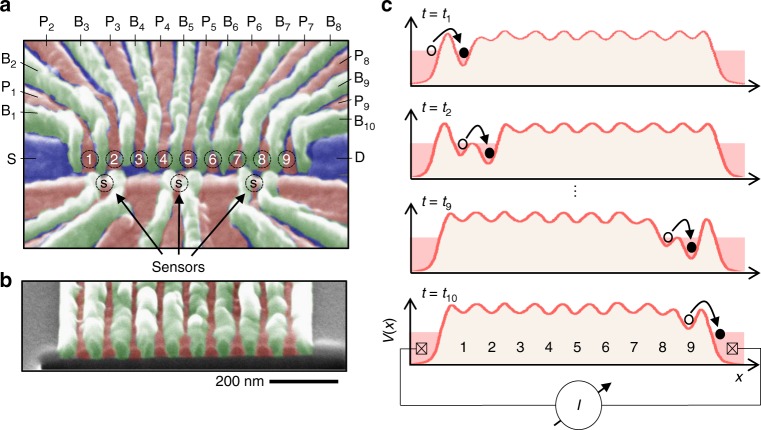
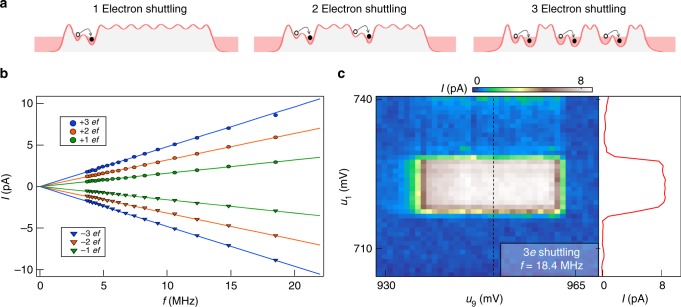
Significant advances have been made towards fault-tolerant operation of silicon spin qubits, with single qubit fidelities exceeding 99.9%, several demonstrations of two-qubit gates based on exchange coupling, and the achievement of coherent single spin-photon coupling. Coupling arbitrary pairs of spatially separated qubits in a quantum register poses a significant challenge as most qubit systems are constrained to two dimensions with nearest neighbor connectivity. For spins in silicon, new methods for quantum state transfer should be developed to achieve connectivity beyond nearest-neighbor exchange. Here we demonstrate shuttling of a single electron across a linear array of nine series-coupled silicon quantum dots in ~50 ns via a series of pairwise interdot charge transfers. By constructing more complex pulse sequences we perform parallel shuttling of two and three electrons at a time through the array. These experiments demonstrate a scalable approach to physically transporting single electrons across large silicon quantum dot arrays.
Overview
The claims and statistics of this paper haven’t been checked yet.
Free: it reads the open-access text and checks the first 5 claims that cite a source we can check. Create a free account to check every claim.
Integrity signals
Registry
Cites
Statistics
Figures
Verification
Claims the paper makes
The claims and statistics of this paper haven’t been checked yet.
Free: it reads the open-access text and checks the first 5 claims that cite a source we can check. Create a free account to check every claim.
Self-check
Percentages, sums and reported differences re-computed from the paper’s own numbers.
The self-check needs the paper’s full text.
Citations
Cites
Coherent Manipulation of Coupled Electron Spins in Semiconductor Quantum Dots
Petta, J. R., Johnson, A. C., Taylor, J. M., Laird, E. A., Yacoby, A., Lukin, M. D., Marcus, C. M., Hanson, M. P., & Gossard, A. C. (2005) · Science · doi:10.1126/science.1116955 · Cited by 3,183
Self-citationHardware-efficient variational quantum eigensolver for small molecules and quantum magnets
Kandala, A., Mezzacapo, A., Temme, K., Takita, M., Brink, M., Chow, J. M., & Gambetta, J. M. (2017) · Nature · doi:10.1038/nature23879 · Cited by 2,982
Electron transport through double quantum dots
van der Wiel, W. G., De Franceschi, S., Elzerman, J. M., Fujisawa, T., Tarucha, S., & Kouwenhoven, L. P. (2002) · Reviews of Modern Physics · doi:10.1103/revmodphys.75.1 · Cited by 1,820
An addressable quantum dot qubit with fault-tolerant control-fidelity
Veldhorst, M., Hwang, J. C. C., Yang, C. H., Leenstra, A. W., de Ronde, B., Dehollain, J. P., Muhonen, J. T., Hudson, F. E., Itoh, K. M., Morello, A., et al. (2014) · Nature Nanotechnology · doi:10.1038/nnano.2014.216 · Cited by 940
A two-qubit logic gate in silicon
Veldhorst, M., Yang, C. H., Hwang, J. C. C., Huang, W., Dehollain, J. P., Muhonen, J. T., Simmons, S., Laucht, A., Hudson, F. E., Itoh, K. M., et al. (2015) · Nature · doi:10.1038/nature15263 · Cited by 919
A quantum-dot spin qubit with coherence limited by charge noise and fidelity higher than 99.9%
Yoneda, J., Takeda, K., Otsuka, T., Nakajima, T., Delbecq, M. R., Allison, G., Honda, T., Kodera, T., Oda, S., Hoshi, Y., et al. (2018) · Nature Nanotechnology · doi:10.1038/s41565-017-0014-x · Cited by 900
A programmable two-qubit quantum processor in silicon
Watson, T. F., Philips, S. G. J., Kawakami, E., Ward, D. R., Scarlino, P., Veldhorst, M., Savage, D. E., Lagally, M. G., Friesen, M., Coppersmith, S. N., et al. (2018) · Nature · doi:10.1038/nature25766 · Cited by 741
Electron spin coherence exceeding seconds in high-purity silicon
Tyryshkin, A. M., Tojo, S., Morton, J. J. L., Riemann, H., Abrosimov, N. V., Becker, P., Pohl, H.-J., Schenkel, T., Thewalt, M. L. W., Itoh, K. M., et al. (2012) · Nature Materials · doi:10.1038/nmat3182 · Cited by 713
High-Fidelity Preparation, Gates, Memory, and Readout of a Trapped-Ion Quantum Bit
Harty, T. P., Allcock, D. T. C., Ballance, C. J., Guidoni, L., Janacek, H. A., Linke, N. M., Stacey, D. N., & Lucas, D. M. (2014) · Physical Review Letters · doi:10.1103/physrevlett.113.220501 · Cited by 632
Interfacing spin qubits in quantum dots and donors—hot, dense, and coherent
Vandersypen, L. M. K., Bluhm, H., Clarke, J. S., Dzurak, A. S., Ishihara, R., Morello, A., Reilly, D. J., Schreiber, L. R., & Veldhorst, M. (2017) · npj Quantum Information · doi:10.1038/s41534-017-0038-y · Cited by 624
Research works printed but not linked: 1
- Xue, X. et al. Benchmarking gate fidelities in a Si/SiGe two-qubit device. Preprint at https://arxiv.org/abs/1811.04002 (2018). · arXiv
Cited by
Items 101–200 of 283
Tuning Arrays with Rays: Physics-Informed Tuning of Quantum Dot Charge States
Ziegler, J., Luthi, F., Ramsey, M., Borjans, F., Zheng, G., & Zwolak, J. P. (2023) · Physical Review Applied · doi:10.1103/physrevapplied.20.034067 · Cited by 42
“0 [37].”
Roadmap on atomic-scale semiconductor devices
Schofield, S. R., Fisher, A. J., Ginossar, E., Lyding, J. W., Silver, R. M., Fei, F., Namboodiri, P. N., Wyrick, J., Masteghin, M. G., Cox, D., et al. (2025) · Nano Futures · doi:10.1088/2399-1984/ada901 · Cited by 34
High-Fidelity Spin Qubit Shuttling via Large Spin-Orbit Interactions
Bosco, S., Zou, J., & Loss, D. (2024) · PRX Quantum · doi:10.1103/prxquantum.5.020353 · Cited by 36
Coherent transport of spin by adiabatic passage in quantum dot arrays
Gullans, M. J., & Petta, J. R. (2020) · Physical review. B./Physical review. B · doi:10.1103/physrevb.102.155404 · Cited by 22
Self-citationSemiconductor Quantum Computing: Toward a CMOS quantum computer on chip
Nikandish, G., Blokhina, E., Leipold, D. R., & Staszewski, R. B. (2021) · IEEE Nanotechnology Magazine · doi:10.1109/mnano.2021.3113216 · Cited by 27
“The quantum dot arrays can also be realized using electrically controllable exchange interaction between spins in adjacent quantum dots [79], [80].”
BackgroundMajorana zero modes in Y-shape interacting Kitaev wires
Pandey, B., Kaushal, N., Álvarez, G., & Dagotto, E. R. (2023) · npj Quantum Materials · doi:10.1038/s41535-023-00584-5 · Cited by 25
“Recently, the realization of MZMs was also proposed in quantum-dot-superconductor linear arrays 12 – 14 .”
BackgroundFerromagnetism in quantum dot plaquettes
Buterakos, D. L., & Sarma, S. D. (2019) · Physical review. B./Physical review. B · doi:10.1103/physrevb.100.224421 · Cited by 20
Paired electron motion in interacting chains of quantum dots
Szafran, B. (2020) · Physical review. B./Physical review. B · doi:10.1103/physrevb.101.075306 · Cited by 19
Thermodynamic Uncertainty Relations for Coherent Transport
Brandner, K., & Saito, K. (2025) · Physical Review Letters · doi:10.1103/6nww-8wcp · Cited by 44
Perspective on exchange-coupled quantum-dot spin chains
Kandel, Y. P., Qiao, H., & Nichol, J. M. (2021) · Applied Physics Letters · doi:10.1063/5.0055908 · Cited by 20
Split-gate cavity coupler for silicon circuit quantum electrodynamics
Borjans, F., Croot, X., Putz, S., Mi, X., Quinn, S., Pan, A., Kerckhoff, J., Pritchett, E., Jackson, C. A. C., Edge, L. F., et al. (2020) · Applied Physics Letters · doi:10.1063/5.0006442 · Cited by 21
Self-citationA quantum dot crossbar with sublinear scaling of interconnects at cryogenic temperature
Bavdaz, P. L., Eenink, H. G. J., van Staveren, J., Lodari, M., Almudever, C. G., Clarke, J. S., Sebasatiano, F., Veldhorst, M., & Scappucci, G. (2022) · npj Quantum Information · doi:10.1038/s41534-022-00597-1 · Cited by 18
Automated Extraction of Capacitive Coupling for Quantum Dot Systems
Ziegler, J., Luthi, F., Ramsey, M., Borjans, F., Zheng, G., & Zwolak, J. P. (2023) · Physical Review Applied · doi:10.1103/physrevapplied.19.054077 · Cited by 33
“These approaches have been key for the initialization and control of larger QD arrays [21, 22].”
BackgroundQuantum computing using floating electrons on cryogenic substrates: Potential and challenges
Jennings, A., Zhou, X., Grytsenko, I., & Kawakami, E. (2024) · Applied Physics Letters · doi:10.1063/5.0179700 · Cited by 30
Electron cascade for distant spin readout
van Diepen, C. J., Hsiao, T.-K., Mukhopadhyay, U., Reichl, C., Wegscheider, W., & Vandersypen, L. M. K. (2021) · Nature Communications · doi:10.1038/s41467-020-20388-6 · Cited by 30
Single-Shot Readout of Multiple Donor Electron Spins with a Gate-Based Sensor
Hogg, M., Pakkiam, P., Gorman, S. K., Timofeev, A. V., Chung, Y., Gulati, G. K., House, M. G., & Simmons, M. Y. (2023) · PRX Quantum · doi:10.1103/prxquantum.4.010319 · Cited by 21
“…1 relaxation times in donor qubits (we measured 9 s for D3 at 2.5 Tesla, and up to 30 s has been demonstrated [31]) and recent advances navigating charge states in large qubit arrays [30, 32], 15 qubits similar to D3 could be measured sequentially by the same sensor within the T 1 relaxation time.”
BackgroundInfluentialSarkar, S., & Dubi, Y. (2022) · Nano Letters · doi:10.1021/acs.nanolett.2c00976 · Cited by 18
Two-dimensional vertex-decorated Lieb lattice with exact mobility edges and robust flat bands
Wang, Y., Zhang, L., Wan, Y., He, Y., & Wang, Y. (2023) · Physical review. B./Physical review. B · doi:10.1103/physrevb.107.l140201 · Cited by 25
“Vij = 2V [cos(2πα1i + θ1) + cos(2πα2j + θ2)], while the potentials of the blue ones are fixed, where the virtual gate method could be used to remove signal couplings between the neighboring gates [102, 108].”
MethodNontrivial fusion of Majorana zero modes in interacting quantum-dot arrays
Pandey, B., Okamoto, S., & Dagotto, E. R. (2024) · Physical Review Research · doi:10.1103/physrevresearch.6.033314 · Cited by 20
Compromise-free scaling of qubit speed and coherence
Carballido, M. J., Svab, S., Eggli, R. S., Patlatiuk, T., Kwon, P. C., Schuff, J., Kaiser, R. M., Camenzind, L. C., Li, A., Ares, N., et al. (2025) · Nature Communications · doi:10.1038/s41467-025-62614-z · Cited by 39
“These remain feasible even for in-plane effective masses approaching that of the LH 49,53,54 .”
Parallel entangling gate operations and two-way quantum communication in spin chains
Yousefjani, R., & Bayat, A. (2021) · Quantum · doi:10.22331/q-2021-05-26-460 · Cited by 18
“Thus, several proposals have been put forward to mediate the interaction between distant qubits using a shuttled particle [11, 31, 47], a traveling wave packet [12, 18, 48, 59], a shared spatially extended mode [24, 52] or a spin chain data-bus [9, 16, 65, 66].”
BackgroundSpin-Valley Qubit Dynamics in Exchange-Coupled Silicon Quantum Dots
Buterakos, D. L., & Sarma, S. D. (2021) · PRX Quantum · doi:10.1103/prxquantum.2.040358 · Cited by 25
Autonomous Estimation of High-Dimensional Coulomb Diamonds from Sparse Measurements
Chatterjee, A., Ansaloni, F., Rasmussen, T., Brovang, B., Fedele, F., Bohuslavskyi, H., Krause, O., & Kuemmeth, F. (2022) · Physical Review Applied · doi:10.1103/physrevapplied.18.064040 · Cited by 18
“Among these is the development of techniques to deal with the high-dimensional controlvoltage spaces [6, 7, 9, 10] that qubits based on gatecontrolled quantum dots are required to navigate.”
BackgroundAn automated approach for consecutive tuning of quantum dot arrays
Liu, H., Wang, B., Wang, N., Sun, Z., Yin, H., Li, H.-O., Cao, G., & Guo, G. (2022) · Applied Physics Letters · doi:10.1063/5.0111128 · Cited by 22
Coupling of a hole double quantum dot in planar germanium to a microwave cavity
Kang, Y., Li, Z.-H., Kong, Z., Li, F.-G., Hao, T.-Y., Wei, Z.-C., Deng, S.-Y., Wang, B., Li, H.-O., Wang, G., et al. (2024) · Physical Review Applied · doi:10.1103/physrevapplied.22.024054 · Cited by 18
Interplay of exchange and superexchange in triple quantum dots
Deng, K., & Barnes, E. (2020) · Physical review. B./Physical review. B · doi:10.1103/physrevb.102.035427 · Cited by 17
Crosstalk analysis for simultaneously driven two-qubit gates in spin qubit arrays
Heinz, I., & Burkard, G. (2022) · Physical review. B./Physical review. B · doi:10.1103/physrevb.105.085414 · Cited by 18
Jang, W., Kim, J., Cho, M.-K., Chung, H., Park, S., Eom, J., Umansky, V., Chung, Y., & Kim, D. (2020) · npj Quantum Information · doi:10.1038/s41534-020-00295-w · Cited by 17
Robust photon-mediated entangling gates between quantum dot spin qubits
Warren, A., Güngördü, U., Kestner, J. P., Barnes, E., & Economou, S. E. (2021) · Physical review. B./Physical review. B · doi:10.1103/physrevb.104.115308 · Cited by 21
“[14] A.”
BackgroundMachine Learning Optimization of Majorana Hybrid Nanowires
Thamm, M., & Rosenow, B. (2023) · Physical Review Letters · doi:10.1103/physrevlett.130.116202 · Cited by 16
Valley-Free Silicon Fins Caused by Shear Strain
Adelsberger, C., Bosco, S., Klinovaja, J., & Loss, D. (2024) · Physical Review Letters · doi:10.1103/physrevlett.133.037001 · Cited by 15
Discrete time crystal in the gradient-field Heisenberg model
Li, B., Dyke, J. S. V., Warren, A., Economou, S. E., & Barnes, E. (2020) · Physical review. B./Physical review. B · doi:10.1103/physrevb.101.115303 · Cited by 14
Electron cascade for distant spin readout
van Diepen, C. J., Hsiao, T.-K., Mukhopadhyay, U., Reichl, C., Wegscheider, W., & Vandersypen, L. M. K. (2021) · RePEc: Research Papers in Economics · doi:10.3929/ethz-b-000460924 · Cited by 14
Knörzer, J., van Diepen, C. J., Hsiao, T.-K., Giedke, G., Mukhopadhyay, U., Reichl, C., Wegscheider, W., Cirac, J. I., & Vandersypen, L. M. K. (2022) · Physical Review Research · doi:10.1103/physrevresearch.4.033043 · Cited by 19
“Here this crosstalk has already been compensated for with virtual gates [9,18,19,28].”
BackgroundSingle-Electron Occupation in Quantum Dot Arrays at Selectable Plunger Gate Voltage
Meyer, M., Déprez, C., Meijer, I. N., Unseld, F. K., Karwal, S., Sammak, A., Scappucci, G., Vandersypen, L. M. K., & Veldhorst, M. (2023) · Nano Letters · doi:10.1021/acs.nanolett.3c03349 · Cited by 17
“30 − 32 However, significant variations remain observable in current devices, 14,33,34 and it is an open question whether sufficient uniformity can be reached through material development alone.”
BackgroundOh, S. W., Denisov, A. O., Chen, P., & Petta, J. R. (2021) · AIP Advances · doi:10.1063/5.0056648 · Cited by 17
Self-citationMeasurement of Tunnel Coupling in a Si Double Quantum dot Based on Charge Sensing
Zhao, X., & Hu, X. (2022) · Physical Review Applied · doi:10.1103/physrevapplied.17.064043 · Cited by 19
Single-electron pump in a quantum dot array for silicon quantum computers
Utsugi, T., Lee, N., Tsuchiya, R., Mine, T., Mizokuchi, R., Yoneda, J., Kodera, T., Saito, S., Hisamoto, D., & Mizuno, H. (2023) · Japanese Journal of Applied Physics · doi:10.35848/1347-4065/acac36 · Cited by 13
Pipeline quantum processor architecture for silicon spin qubits
Patomäki, S. M., González-Zalba, M. F., Fogarty, M. A., Cai, Z., Benjamin, S. C., & Morton, J. J. L. (2024) · npj Quantum Information · doi:10.1038/s41534-024-00823-y · Cited by 28
“Charge shuttling errors are expected to be minimized when the pulsing rate is slow compared to the inter-dot tunnel coupling 37,51 , where non-adiabatic Landau-Zener (LZ) transitions are minimal.”
Charge Sensing the Parity of an Andreev Molecule
van Driel, D., Roovers, B., Zatelli, F., Bordin, A., Wang, G., van Loo, N., Wolff, J. C., Mazur, G. P., Gazibegović, S., Badawy, G., et al. (2024) · PRX Quantum · doi:10.1103/prxquantum.5.020301 · Cited by 21
“[59, 60].”
Toward Hole-Spin Qubits in Si p -MOSFETs within a Planar CMOS Foundry Technology
Bellentani, L., Bina, M., Bonen, S., Secchi, A., Bertoni, A., Voinigescu, S. P., Padovani, A., Larcher, L., & Troiani, F. (2021) · Physical Review Applied · doi:10.1103/physrevapplied.16.054034 · Cited by 13
Single-electron control in a foundry-fabricated two-dimensional qubit arrayPreprint
Ansaloni, F., Chatterjee, A., Bohuslavskyi, H., Bertrand, B., Hutin, L., Vinet, M., & Kuemmeth, F. (2020) · arXiv (Cornell University) · doi:10.48550/arxiv.2004.00894 · Cited by 13
Zhou, Z. G., Li, Y., Wu, Z., Ma, X., Fan, S., & Huang, S. (2024) · Journal of Semiconductors · doi:10.1088/1674-4926/24050043 · Cited by 16
A random-walk benchmark for single-electron circuits
Reifert, D., Kokainis, M., Ambainis, A., Kashcheyevs, V., & Ubbelohde, N. (2021) · Nature Communications · doi:10.1038/s41467-020-20554-w · Cited by 15
Microwave-Resonator-Detected Excited-State Spectroscopy of a Double Quantum Dot
Chen, M.-B., Jiang, S.-L., Wang, N., Wang, B.-C., Lin, T., Gu, S.-S., Li, H.-O., Cao, G., & Guo, G.-P. (2021) · Physical Review Applied · doi:10.1103/physrevapplied.15.044045 · Cited by 12
Jang, W., Cho, M.-K., Kim, J., Chung, H., Umansky, V., & Kim, D. (2020) · Applied Physics Letters · doi:10.1063/5.0031231 · Cited by 11
Flopping-mode electron dipole spin resonance in the strong-driving regime
Teske, J. D., Butt, F., Cerfontaine, P., Burkard, G., & Bluhm, H. (2023) · Physical review. B./Physical review. B · doi:10.1103/physrevb.107.035302 · Cited by 15
Flying Spin Qubits in Quantum Dot Arrays Driven by Spin-Orbit Interaction
Fernández-Fernández, D., Ban, Y., & Platero, G. (2024) · Quantum · doi:10.22331/q-2024-11-21-1533 · Cited by 15
“Examples of them are electromagnetic cavities [35], surface acoustic waves [36], bucket brigade [37–39], or conveyor modes [40–43], which facilitate the exchange of information between computing nodes [44–46].”
Photon Enhanced Interaction and Entanglement in Semiconductor Position-Based Qubits
Giounanlis, P., Blokhina, E., Leipold, D. R., & Staszewski, R. B. (2019) · Applied Sciences · doi:10.3390/app9214534 · Cited by 10
Opinion: Democratizing Spin Qubits
Tahan, C. (2021) · Quantum · doi:10.22331/q-2021-11-18-584 · Cited by 9
“It also makes it harder to dynamically compensate for such gates [61, 62].”
BackgroundExtended Hubbard model describing small multidot arrays in bilayer graphene
Knothe, A., & Burkard, G. (2024) · Physical review. B./Physical review. B · doi:10.1103/physrevb.109.245401 · Cited by 12
Heteroatomic Doping Induces High‐Low Spin Isomers in Atomically Precise Au Nanoclusters
Yang, J., Zhou, J., Yu, X., Pei, W., Zhou, S., & Zhao, J. (2025) · Advanced Functional Materials · doi:10.1002/adfm.202507144 · Cited by 11
Qubit-controlled directional edge states in waveguide QED
Pakkiam, P., Kumar, N. P., Pletyukhov, M., & Fedorov, A. (2023) · npj Quantum Information · doi:10.1038/s41534-023-00722-8 · Cited by 11
“4a (such as SiGe or CMOS), the tunable tunnel couplings and on-site potentials enable a fully configurable array that can account for local defects [22, 23].”
BackgroundComputational Materials Insights Into Solid-State Multiqubit Systems
Philbin, J. P., & Narang, P. (2021) · PRX Quantum · doi:10.1103/prxquantum.2.030102 · Cited by 9
Parity-dependent state transfer for direct entanglement generation
Roy, F., Romeiro, J. H., Koch, L., Tsitsilin, I., Schirk, J., Glaser, N. J., Bruckmoser, N., Singh, M., Haslbeck, F. X., Huber, G. B. P., et al. (2025) · Nature Communications · doi:10.1038/s41467-025-57818-2 · Cited by 19
“Here, we experimentally demonstrate Perfect State Transfer and multi-qubit entanglement generation on a chain of six superconducting transmon qubits with tunable couplers, controlled via parametric drives.”
Dephasing and error dynamics affecting a singlet-triplet qubit during coherent spin shuttling
Foster, N., Henshaw, J., Rudolph, M., Luhman, D. R., & Jock, R. (2025) · npj Quantum Information · doi:10.1038/s41534-025-00996-0 · Cited by 13
“Coherent spin transfer Two established approaches for spin shuttling are conveyor mode 25,35,36 and bucket brigade mode 3,17,18,26,37,38 .”
Robustness of electron charge shuttling: Architectures, pulses, charge defects, and noise thresholds
Jeon, M., Benjamin, S. C., & Fisher, A. J. (2025) · Physical review. B./Physical review. B · doi:10.1103/physrevb.111.195302 · Cited by 12
Partial Landau-Zener transitions and applications to qubit shuttling
Lima, J. R. F., & Burkard, G. (2025) · Physical review. B./Physical review. B · doi:10.1103/y4xf-zjjx · Cited by 16
End-to-end entanglement in a polar-molecule array under intrinsic decoherence
Liao, Y.-Y. (2022) · Physical Review A · doi:10.1103/physreva.105.062802 · Cited by 9
Cryogenic Controller for Electrostatically Controlled Quantum Dots in 22-nm Quantum SoC
Staszewski, R. B., Esmailiyan, A., Wang, H., Koskin, E., Giounanlis, P., Wu, X., Kozioł, A. E., Sokolov, A., Bashir, I., Asker, M., et al. (2022) · IEEE Open Journal of the Solid-State Circuits Society · doi:10.1109/ojsscs.2022.3213528 · Cited by 10
“ing [11], photonic [12], ion traps [13], and semiconductor qubits [14], [15], [16], [17], [18], [19], [20], [21], [22], [23], [24], [25], [26], [27], [28], [29], [30], [31] (see our discus-”
Zhang, X., Zhu, Z., Ong, N. P., & Petta, J. R. (2024) · Physical Review Applied · doi:10.1103/physrevapplied.21.014019 · Cited by 9
“To date, some approaches to achieve long-range qubit entanglement include coherently shuttling electrons using gate-voltage pulses [5, 6] or surface acoustic waves [7– 10], coupling spin qubits with a much larger coupling quantum dot (QD) [11], or using a microwave cavity as a mediator [12–16].”
BackgroundSelf-citationLu, Y., Liu, J., Jiang, H., & Liao, Z. (2024) · Quantum Science and Technology · doi:10.1088/2058-9565/ad3f46 · Cited by 8
“For quantum dot arrays, the switchable coherent coupling between two neighboring sites is usually provided by the tunnel barrier of electrostatic potential, which can be tuned through control gate [44, 74, 81].”
BackgroundA random-walk benchmark for single-electron circuits
Reifert, D., Kokainis, M., Ambainis, A., Kashcheyevs, V., & Ubbelohde, N. (2021) · RePEc: Research Papers in Economics · Cited by 8
Learning Coulomb Diamonds in Large Quantum Dot Arrays
Krause, O., Chatterjee, A., Kuemmeth, F., & van Nieuwenburg, E. (2022) · SciPost Physics · doi:10.21468/scipostphys.13.4.084 · Cited by 12
“The compensated control voltages are sometimes referred to as virtual gates in the literature [15] and use of this technique was paramount in the recently achieved hand-tuned control over 8 and 9 qubits [2, 3].”
MethodKrzywda, J. A., & Cywiński, Ł. (2025) · Physical review. B./Physical review. B · doi:10.1103/physrevb.111.115305 · Cited by 11
“…chains of many tunnel-coupled quantum dots are connecting the registers, relies on sequential adiabatic transfer between neighboring quantum dots [11–15]: the de-tuning between two tunnel-coupled quantum dots is changed slowly enough for the electron to move adiabati-cally from one dot to…”
Current-induced hole spin polarization in a quantum dot via a chiral quasi bound state
Mantsevich, V. N., & Smirnov, D. S. (2022) · Nanoscale Horizons · doi:10.1039/d1nh00685a · Cited by 7
Spatial transfer of entangled states in the correlated quantum dots system
Maslova, N. S., Mantsevich, V. N., Arseyev, P. I., & Sokolov, I. M. (2022) · Laser Physics Letters · doi:10.1088/1612-202x/ac6250 · Cited by 7
“Another experiment [33] demonstrates charge shuttling of a single electron across a linear array of nine series-coupled silicon QDs.”
BackgroundControlled quantum dot array segmentation via highly tunable interdot tunnel coupling
Nurizzo, M., Jadot, B., Mortemousque, P.-A., Thiney, V., Chanrion, E., Dartiailh, M., Ludwig, A., Wieck, A. D., Bäuerle, C., Urdampilleta, M., et al. (2022) · Applied Physics Letters · doi:10.1063/5.0105635 · Cited by 8
Gate reflectometry in dense quantum dot arrays
Ansaloni, F., Bohuslavskyi, H., Fedele, F., Rasmussen, T., Brovang, B., Berritta, F., Heskes, A., Li, J., Hutin, L., Venitucci, B., et al. (2023) · New Journal of Physics · doi:10.1088/1367-2630/acc126 · Cited by 18
“…as sensor dot) to nearby charge rearrangements can be further utilized by applying compensated control voltages, i.e. linear combinations of native gate voltages V 1 , 2 , 3 , 4 such that changes applied to compensated voltages do or do not change the chemical potential of the sensor dot [40, 41].”
Low-dissipation data bus via coherent quantum dynamics
Lewis, D., Moutinho, J. P., Costa, A. T., Omar, Y., & Bose, S. (2023) · Physical review. B./Physical review. B · doi:10.1103/physrevb.108.075405 · Cited by 9
Long-range two-hybrid-qubit gates mediated by a microwave cavity with red sidebands
Abadillo-Uriel, J. C., King, C., Coppersmith, S. N., & Friesen, M. G. (2021) · Physical Review A · doi:10.1103/physreva.104.032612 · Cited by 8
Spin Qubits Confined to a Silicon Nano-Ridge
Klos, J., Sun, B., Beyer, J., Kindel, S., Hellmich, L., Knoch, J., & Schreiber, L. R. (2019) · Applied Sciences · doi:10.3390/app9183823 · Cited by 8
Secchi, A., & Troiani, F. (2023) · Physical review. B./Physical review. B · doi:10.1103/physrevb.107.155411 · Cited by 9
A Scalable One Dimensional Silicon Qubit Array with Nanomagnets
Simion, G., Mohiyaddin, F. A., Li, R., Shehata, M., Stuyck, N. D., Elsayed, A., Ciubotaru, F., Kubicek, S., Jussot, J., Chan, B. T., et al. (2020) · Technical digest - International Electron Devices Meeting/Technical digest · doi:10.1109/iedm13553.2020.9372067 · Cited by 6
SWAP Gate for Spin Qubits Based on Silicon Devices Integrated with a Micromagnet
Ni, M., Ma, R.-L., Kong, Z., Xue, X., Zhu, S.-K., Wang, C., Li, A.-R., Chu, N., Liao, W.-Z., Cao, G., et al. (2025) · Nano Letters · doi:10.1021/acs.nanolett.4c05540 · Cited by 22
Pomorski, K. D. (2020) · Advances in intelligent systems and computing · doi:10.1007/978-3-030-63089-8_3 · Cited by 6
Scalable parity architecture with a shuttling-based spin qubit processor
Ginzel, F., Fellner, M., Ertler, C., Schreiber, L. R., Bluhm, H., & Lechner, W. (2024) · Physical review. B./Physical review. B · doi:10.1103/physrevb.110.075302 · Cited by 17
“Shuttling can be realized either in the conveyor-mode where a sliding potential well smoothly displaces the qubit [15, 16], or as a bucket brigade by coherent tunneling between adjacent QDs [17–19].”
BackgroundImage-charge detection of electrons on helium in an on-chip trapping device
Belianchikov, M., Morais, N., & Konstantinov, D. (2025) · Physical Review Applied · doi:10.1103/physrevapplied.23.054026 · Cited by 6
Generating Shuttling Procedures for Constrained Silicon Quantum Dot Array
Sato, N., Sekiguchi, T., Utsugi, T., & Mizuno, H. (2025) · IEEE Transactions on Quantum Engineering · doi:10.1109/tqe.2025.3542462 · Cited by 6
“In silicon quantum computers, there are many previous studies on the implementation of shuttling [5] [6] [7] [8] [9] [10] [11] [12] [13] [14], which is the premise of this paper.”
BackgroundTopological spin textures enabling quantum transmission
Zou, J., Bosco, S., Klinovaja, J., & Loss, D. (2025) · Physical Review Research · doi:10.1103/tzmn-rz7b · Cited by 8
Elongated quantum dot as a distributed charge sensor
Patomäki, S. M., Williams, J., Berritta, F., Lainé, C., Fogarty, M. A., Leon, R. C. C., Jussot, J., Kubicek, S., Chatterjee, A., Govoreanu, B., et al. (2024) · Physical Review Applied · doi:10.1103/physrevapplied.21.054042 · Cited by 10
“(E1)] are imported to COMSOL as shapes, and defined as a perfect hollow conductor, which is maintained at zero bias.”
Estakhri, N. M., Warren, A., Economou, S. E., & Barnes, E. (2024) · Physical Review Research · doi:10.1103/physrevresearch.6.043029 · Cited by 7
“This combined with techniques such as coherent spin shuttling [36, 37] provides a route to reach larger QD processors.”
MethodNoise classification in three-level quantum networks by Machine Learning
Mukherjee, S., Penna, D., Cirinnà, F., Paternostro, M., Paladino, E., Falci, G., & Giannelli, L. (2024) · Machine Learning Science and Technology · doi:10.1088/2632-2153/ad9193 · Cited by 13
“In addition, we will investigate the interplay with relaxation [80, 84] and extend the diagnostics to more complex probes, such as interacting multiqubit systems [49], quantum dot chains [85], strongly [86] and ultrastrongly coupled [74, 75] circuit-QED architectures.”
Certain exact many-body results for Hubbard model ground states testable in small quantum dot arrays
Buterakos, D. L., & Sarma, S. D. (2023) · Physical review. B./Physical review. B · doi:10.1103/physrevb.107.014403 · Cited by 5
Signatures of discrete time-crystallinity in transport through quantum dot arraysPreprint
Sarkar, S., & Dubi, Y. (2021) · arXiv (Cornell University) · Cited by 5
Coupling between a Si/SiGe Resonant Exchange Qubit and a High-Impedance Microwave Resonator
Jiang, S.-L., Jiang, T.-Y., Ye, S.-K., Cai, R., Hao, T.-Y., Xu, Y.-Q., Li, Z.-H., Kang, Y., Wang, B., Li, H.-O., et al. (2025) · Physical Review Letters · doi:10.1103/31wk-5yqp · Cited by 8
Weight-four parity checks in a spin-shuttling architecture
Undseth, B., Meggiato, N., Wu, Y.-H., Katiraee-Far, S. R., Tryputen, L., de Snoo, S. L., Esposti, D. D., Scappucci, G., Greplová, E., & Vandersypen, L. M. K. (2026) · Nature · doi:10.1038/s41586-026-10766-3 · Cited by 33
“In this device, direct charge sensing with S1 is possible only up to bus stop 1, so we pioneer a remote-tuning procedure that allows us to populate and virtualize control of the distant bus stops as well as tune single-and two-qubit operations without local charge sensing.”
Combining multiplexed gate-based readout and isolated CMOS quantum dot arrays
Hamonic, P., Nurizzo, M., Nath, J., Dartiailh, M., El-Homsy, V., Fragnol, M., Martínez, B., Julliard, P.-L., Paz, B. C., Ouvrier-Buffet, M., et al. (2025) · Nature Communications · doi:10.1038/s41467-025-61556-w · Cited by 8
“For arrays with capacitive cross couplings, virtual gates are required to achieve accurate tuning 6 – 8 ,15, 16 .”
Suppressing Si Valley Excitation and Valley-Induced Spin Dephasing for Long-Distance Shuttling
Oda, Y., Losert, M. P., & Kestner, J. P. (2025) · Physical Review Letters · doi:10.1103/s624-dvvs · Cited by 13
Circuit-QED based time-averaged dispersive readout of a semiconductor charge qubit
Lin, T. C., Gu, S., Xu, Y.-Q., Jiang, S.-L., Wang, N., Wang, B., Li, H.-O., Cao, G., & Guo, G. (2022) · Applied Physics Letters · doi:10.1063/5.0108206 · Cited by 4
Linear arrays of InGaAs quantum dots on nanostructured GaAs-on-Si substrates
Tejedor, P., García‐Tabarés, E., Galiana, B., Vázquez, L., & García, B. J. (2023) · Applied Surface Science · doi:10.1016/j.apsusc.2023.156518 · Cited by 5
Compiling the surface code to crossbar spin qubit architectures
Pataki, D., & Pályi, A. (2025) · Physical review. B./Physical review. B · doi:10.1103/physrevb.111.115307 · Cited by 8
Short two-qubit pulse sequences for exchange-only spin qubits in two-dimensional layouts
Chadwick, J. D., Guerreschi, G. G., Luthi, F., Mądzik, M. T., Mohiyaddin, F. A., Prabhu, P., Schmitz, A. T., Litteken, A., Premaratne, S., Bishop, N. C., et al. (2025) · Physical Review A · doi:10.1103/physreva.111.052616 · Cited by 8
Two-qubit sweet spots for capacitively coupled exchange-only spin qubits
Feng, M., Zaw, L. H., & Koh, T. S. (2021) · npj Quantum Information · doi:10.1038/s41534-021-00449-4 · Cited by 7
Secchi, A., & Troiani, F. (2022) · Entropy · doi:10.3390/e25010082 · Cited by 4
“The sector of α, which relates the plunger gates to the dots’ chemical potentials is the lever-arm matrix [29].”
BackgroundKondo enhancement of current-induced spin accumulation in a quantum dot
Mantsevich, V. N., & Smirnov, D. S. (2023) · Physical review. B./Physical review. B · doi:10.1103/physrevb.108.035409 · Cited by 4
Noise induced dynamics of two-qubit entangled Bell’s states
Maslova, N. S., Arseyev, P. I., Sokolov, I. M., & Mantsevich, V. N. (2023) · Journal of Physics and Chemistry of Solids · doi:10.1016/j.jpcs.2023.111638 · Cited by 5
Lu, Y. (2024) · Physical Review A · doi:10.1103/physreva.110.033720 · Cited by 4
Devi, S., Ahluwalia, P. K., & Chand, S. (2020) · Pramana · doi:10.1007/s12043-020-1927-8 · Cited by 4
Optimal Control of the Operating Regime of a Single-Electron Double Quantum Dot
Reiher, V., & Bérubé-Lauzière, Y. (2023) · IEEE Transactions on Quantum Engineering · doi:10.1109/tqe.2023.3324841 · Cited by 5
“However, although high-fidelity initialization, manipulation, and readout of small numbers of spins isolated within quantum dots have been demonstrated [4], [9], [10], [11], [12], [13], the fabrication of 2-”
Background
Metadata
- Authors
- Mills, A. R., Zajac, D. M., Gullans, M. J., Schupp, F. J., Hazard, T. M., & Petta, J. R.
- Affiliations
- Princeton University (US)
- Corresponding author
- Petta, J. R.
- Venue
- Nature Communications
- Published
- 2019-03-05
- Volume
- 10
- Issue
- 1
- Pages
- 1063-1063
- ISSN
- 2041-1723 (ISSN-L)
- PMC
- PMC6401174
- OpenAlex
- W2891368223
- Semantic Scholar
- dc0a1fb362dccf128728ff4f00fa229e4a0cc98a
- Cited by
- 283
- References
- 50
- Citations by year
- 2026: 17 · 2025: 35 · 2024: 44 · 2023: 40 · 2022: 46 · 2021: 39 · 2020: 39 · 2019: 22
- FWCI
- 16.08
- Type
- journal article
- Language
- en
- Open access
- gold
- doi.org
- Licence
- cc-by
- creativecommons.org/licenses/by/4.0 (tdm)
- creativecommons.org/licenses/by/4.0 (vor)
- Locations
- Nature Communications (publishedVersion, cc-by)
- Europe PMC (PubMed Central) (publishedVersion, cc-by)
- PubMed Central (publishedVersion, cc-by)
- PubMed (publishedVersion)
- arXiv (Cornell University) (submittedVersion)
- RePEc: Research Papers in Economics (submittedVersion)
- DOAJ (DOAJ: Directory of Open Access Journals) (submittedVersion, cc-by-sa)
- DOAJ (DOAJ: Directory of Open Access Journals) (submittedVersion)
- arXiv (Cornell University)
- Funders
- National Science Foundation (1420541, 1409556)
- Gordon and Betty Moore Foundation (GBMF4535, DMR-1420541)
- Princeton University (DMR-1420541)
- Division of Materials Research (DMR- 1420541, DMR-1409556, 1420541)
- Army Research Office (W911NF-15-1-, W911NF, W911NF-15-1-0149, W911NF-15)
- Topics
- Physical Sciences › Physics and Astronomy › Condensed Matter Physics › Quantum and electron transport phenomena
- Physical Sciences › Physics and Astronomy › Atomic and Molecular Physics, and Optics › Semiconductor Quantum Structures and Devices
- Physical Sciences › Materials Science › Materials Chemistry › Diamond and Carbon-based Materials Research
- Keywords
- electron shuttling, silicon quantum dots, quantum state transfer, spin qubits, scalable quantum computing, pulse sequences
About these checks
Registry, retraction, Cites and statistics results are computed, not judged, with one exception: a printed reference that no index lists is read once by a model before it counts as a citation error. Claims are extracted by a model and kept only when their quote appears verbatim in the text; each cited source is then checked, with a model’s help, for whether it says what the claim relies on. Those verdicts can be wrong — read the claim’s quote and the cited source before relying on one.
Statistics and arithmetic are recomputed, not judged.
Confidence bands are shown only for fields calibrated on our annotated test set. None is calibrated yet, so no band is shown.
What counts as a claim ›How we measure confidence ›How we check this ›
Are you an author, or do you see a problem with this page? Request a review
Data sources
Bibliographic data: Semantic Scholar, OpenAlex, Crossref.
Contains information from the Semantic Scholar Academic Graph Datasets, made available under the ODC Attribution License (ODC-BY 1.0).
Semantic Scholar’s data is described in: Kinney, R., et al. (2023). The Semantic Scholar Open Data Platform. arXiv:2301.10140.
