

Shuttling a single charge across a one-dimensional array of silicon quantum dots
Open accessThe DOI matches its Crossref record; 49 of the 50 references it cites were found in a registry or an index.
Abstract
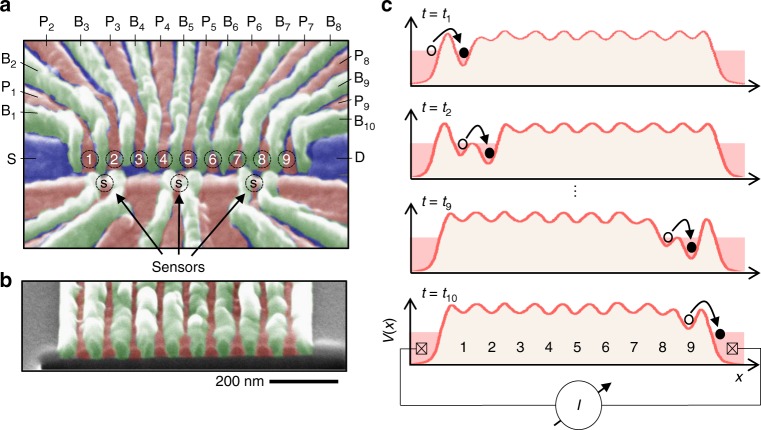
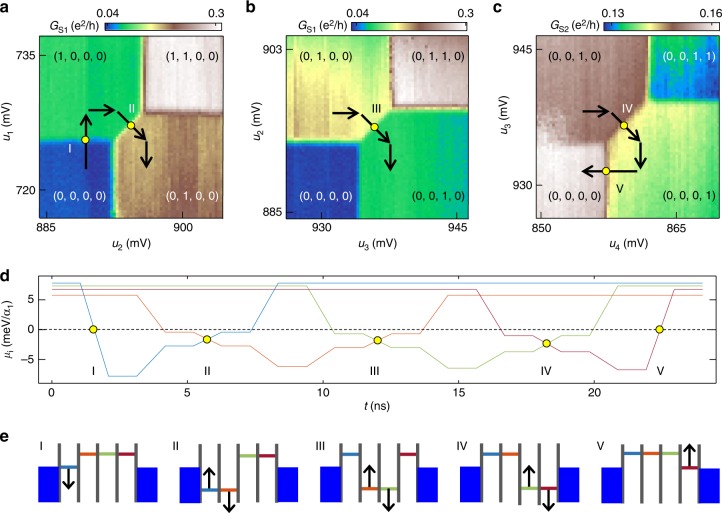
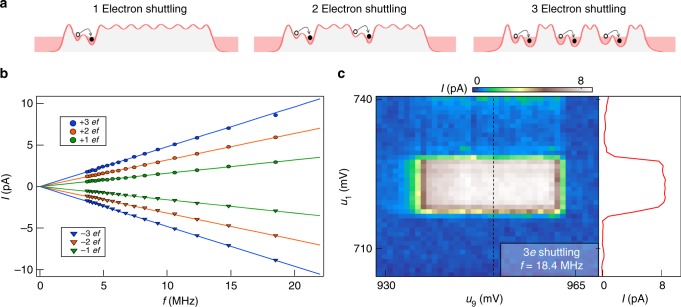
Significant advances have been made towards fault-tolerant operation of silicon spin qubits, with single qubit fidelities exceeding 99.9%, several demonstrations of two-qubit gates based on exchange coupling, and the achievement of coherent single spin-photon coupling. Coupling arbitrary pairs of spatially separated qubits in a quantum register poses a significant challenge as most qubit systems are constrained to two dimensions with nearest neighbor connectivity. For spins in silicon, new methods for quantum state transfer should be developed to achieve connectivity beyond nearest-neighbor exchange. Here we demonstrate shuttling of a single electron across a linear array of nine series-coupled silicon quantum dots in ~50 ns via a series of pairwise interdot charge transfers. By constructing more complex pulse sequences we perform parallel shuttling of two and three electrons at a time through the array. These experiments demonstrate a scalable approach to physically transporting single electrons across large silicon quantum dot arrays.
Overview
The claims and statistics of this paper haven’t been checked yet.
Free: it reads the open-access text and checks the first 5 claims that cite a source we can check. Create a free account to check every claim.
Integrity signals
Registry
Cites
Statistics
Figures
Verification
Claims the paper makes
The claims and statistics of this paper haven’t been checked yet.
Free: it reads the open-access text and checks the first 5 claims that cite a source we can check. Create a free account to check every claim.
Self-check
Percentages, sums and reported differences re-computed from the paper’s own numbers.
The self-check needs the paper’s full text.
Citations
Cites
Coherent Manipulation of Coupled Electron Spins in Semiconductor Quantum Dots
Petta, J. R., Johnson, A. C., Taylor, J. M., Laird, E. A., Yacoby, A., Lukin, M. D., Marcus, C. M., Hanson, M. P., & Gossard, A. C. (2005) · Science · doi:10.1126/science.1116955 · Cited by 3,183
Self-citationHardware-efficient variational quantum eigensolver for small molecules and quantum magnets
Kandala, A., Mezzacapo, A., Temme, K., Takita, M., Brink, M., Chow, J. M., & Gambetta, J. M. (2017) · Nature · doi:10.1038/nature23879 · Cited by 2,982
Electron transport through double quantum dots
van der Wiel, W. G., De Franceschi, S., Elzerman, J. M., Fujisawa, T., Tarucha, S., & Kouwenhoven, L. P. (2002) · Reviews of Modern Physics · doi:10.1103/revmodphys.75.1 · Cited by 1,820
An addressable quantum dot qubit with fault-tolerant control-fidelity
Veldhorst, M., Hwang, J. C. C., Yang, C. H., Leenstra, A. W., de Ronde, B., Dehollain, J. P., Muhonen, J. T., Hudson, F. E., Itoh, K. M., Morello, A., et al. (2014) · Nature Nanotechnology · doi:10.1038/nnano.2014.216 · Cited by 940
A two-qubit logic gate in silicon
Veldhorst, M., Yang, C. H., Hwang, J. C. C., Huang, W., Dehollain, J. P., Muhonen, J. T., Simmons, S., Laucht, A., Hudson, F. E., Itoh, K. M., et al. (2015) · Nature · doi:10.1038/nature15263 · Cited by 919
A quantum-dot spin qubit with coherence limited by charge noise and fidelity higher than 99.9%
Yoneda, J., Takeda, K., Otsuka, T., Nakajima, T., Delbecq, M. R., Allison, G., Honda, T., Kodera, T., Oda, S., Hoshi, Y., et al. (2018) · Nature Nanotechnology · doi:10.1038/s41565-017-0014-x · Cited by 900
A programmable two-qubit quantum processor in silicon
Watson, T. F., Philips, S. G. J., Kawakami, E., Ward, D. R., Scarlino, P., Veldhorst, M., Savage, D. E., Lagally, M. G., Friesen, M., Coppersmith, S. N., et al. (2018) · Nature · doi:10.1038/nature25766 · Cited by 741
Electron spin coherence exceeding seconds in high-purity silicon
Tyryshkin, A. M., Tojo, S., Morton, J. J. L., Riemann, H., Abrosimov, N. V., Becker, P., Pohl, H.-J., Schenkel, T., Thewalt, M. L. W., Itoh, K. M., et al. (2012) · Nature Materials · doi:10.1038/nmat3182 · Cited by 713
High-Fidelity Preparation, Gates, Memory, and Readout of a Trapped-Ion Quantum Bit
Harty, T. P., Allcock, D. T. C., Ballance, C. J., Guidoni, L., Janacek, H. A., Linke, N. M., Stacey, D. N., & Lucas, D. M. (2014) · Physical Review Letters · doi:10.1103/physrevlett.113.220501 · Cited by 632
Interfacing spin qubits in quantum dots and donors—hot, dense, and coherent
Vandersypen, L. M. K., Bluhm, H., Clarke, J. S., Dzurak, A. S., Ishihara, R., Morello, A., Reilly, D. J., Schreiber, L. R., & Veldhorst, M. (2017) · npj Quantum Information · doi:10.1038/s41534-017-0038-y · Cited by 624
Research works printed but not linked: 1
- Xue, X. et al. Benchmarking gate fidelities in a Si/SiGe two-qubit device. Preprint at https://arxiv.org/abs/1811.04002 (2018). · arXiv
Cited by
Burkard, G., Ladd, T. D., Pan, A., Nichol, J. M., & Petta, J. R. (2023) · Reviews of Modern Physics · doi:10.1103/revmodphys.95.025003 · Cited by 715
Self-citationMaterials challenges and opportunities for quantum computing hardware
de Leon, N. P., Itoh, K. M., Kim, D., Mehta, K. K., Northup, T. E., Paik, H., Palmer, B. S., Samarth, N., Sangtawesin, S., & Steuerman, D. W. (2021) · Science · doi:10.1126/science.abb2823 · Cited by 710
“Arrays of ~10 quantum dots have been demonstrated in both silicon and GaAs as a pre-liminary step toward larger-scale integration ( 191 , 192 ).”
BackgroundSemiconductor qubits in practice
Chatterjee, A., Stevenson, P., De Franceschi, S., Morello, A., de Leon, N. P., & Kuemmeth, F. (2021) · Nature Reviews Physics · doi:10.1038/s42254-021-00283-9 · Cited by 359
Two-qubit silicon quantum processor with operation fidelity exceeding 99%
Mills, A. R., Guinn, C. R., Gullans, M. J., Sigillito, A. J., Feldman, M. M., Nielsen, E., & Petta, J. R. (2022) · Science Advances · doi:10.1126/sciadv.abn5130 · Cited by 329
Self-citationScaling silicon-based quantum computing using CMOS technology
Gonzalez-Zalba, M. F., de Franceschi, S., Charbon, E., Meunier, T., Vinet, M., & Dzurak, A. S. (2021) · Nature Electronics · doi:10.1038/s41928-021-00681-y · Cited by 272
Resonant microwave-mediated interactions between distant electron spins
Borjans, F., Croot, X. G., Mi, X., Gullans, M. J., & Petta, J. R. (2020) · Nature · doi:10.1038/s41586-019-1867-y · Cited by 228
Self-citationSemiconductor quantum computation
Zhang, X., Li, H.-O., Cao, G., Xiao, M., Guo, G.-C., & Guo, G.-P. (2019) · National Science Review · doi:10.1093/nsr/nwy153 · Cited by 176
“Using a device with the sameelectrodestructure,in2018,Mills etal .demonstrated shuttling a single charge across this linear array [175].”
MethodHeinrich, A. J., Oliver, W. D., Vandersypen, L. M. K., Ardavan, A., Sessoli, R., Loss, D., Jayich, A. B., Fernandez-Rossier, J., Laucht, A., & Morello, A. (2021) · Nature Nanotechnology · doi:10.1038/s41565-021-00994-1 · Cited by 173
Review of performance metrics of spin qubits in gated semiconducting nanostructures
Stano, P., & Loss, D. (2022) · Nature Reviews Physics · doi:10.1038/s42254-022-00484-w · Cited by 165
Shared control of a 16 semiconductor quantum dot crossbar array
Borsoi, F., Hendrickx, N. W., John, V., Meyer, M., Motz, S., van Riggelen, F., Sammak, A., de Snoo, S. L., Scappucci, G., & Veldhorst, M. (2024) · Nature Nanotechnology · doi:10.1038/s41565-023-01491-3 · Cited by 165
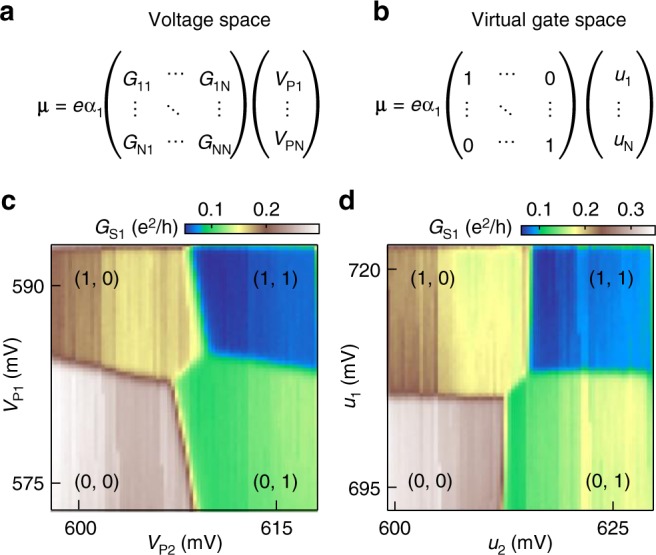
“Such virtual gates are defined to eliminate crosstalk with the charge sensors and to independently control the on-site energies 23,24 (Supplementary Fig.”
BackgroundMethodProbing single electrons across 300-mm spin qubit wafers
Neyens, S., Zietz, O. K., Watson, T. F., Luthi, F., Nethwewala, A., George, H. C., Henry, E., Islam, M., Wagner, A. J., Borjans, F., et al. (2024) · Nature · doi:10.1038/s41586-024-07275-6 · Cited by 178
“16,17) and 2D (refs.”
Engineering topological states in atom-based semiconductor quantum dots
Kiczynski, M., Gorman, S. K., Geng, H., Donnelly, M. B., Chung, Y., He, Y., Keizer, J. G., & Simmons, M. Y. (2022) · Nature · doi:10.1038/s41586-022-04706-0 · Cited by 193
Quantum dot arrays in silicon and germanium
Lawrie, W. I. L., Eenink, H. G. J., Hendrickx, N. W., Boter, J. M., Petit, L., Amitonov, S. V., Lodari, M., Paquelet Wuetz, B., Volk, C., Philips, S. G. J., et al. (2020) · Applied Physics Letters · doi:10.1063/5.0002013 · Cited by 140
Noisy intermediate-scale quantum computers
Cheng, B., Deng, X., Gu, X. Q., He, Y., Hu, G., Huang, P., Li, J., Lin, B., Lu, D., Lu, Y., et al. (2023) · Frontiers of Physics · doi:10.1007/s11467-022-1249-z · Cited by 182
Universal logic with encoded spin qubits in silicon
Weinstein, A. J., Reed, M. D., Jones, A. M., Andrews, R. W., Barnes, D., Blumoff, J. Z., Euliss, L. E., Eng, K., Fong, B. H., Ha, S. D., et al. (2023) · Nature · doi:10.1038/s41586-023-05777-3 · Cited by 124
“Demonstrations with silicon qubits include single-spin control via electron-dipole-spin resonance [8], initialization and read-out of entangled spin states [9], entangling operations between two single-spin qubits using exchange [10–12], and charge shuttling in arrays as large as nine dots [13, 14].”
MethodCoherent spin qubit transport in silicon
Yoneda, J., Huang, W., Feng, M., Yang, C. H., Chan, K. W., Tanttu, T., Gilbert, W., Leon, R. C. C., Hudson, F. E., Itoh, K. M., et al. (2021) · Nature Communications · doi:10.1038/s41467-021-24371-7 · Cited by 163
“Strategies for quantum information transfer in semiconductor spin qubits include sequential application of spin SWAP gates [25–27], coherent coupling of stationary qubits mediated by flying qubits such as photons in a cavity [28–30] or, as proposed in the literature [31,32] and explored here experimentally, physically…”
BackgroundLoading a quantum-dot based “Qubyte” register
Volk, C., Zwerver, A. M. J., Mukhopadhyay, U., Eendebak, P. T., van Diepen, C. J., Dehollain, J. P., Hensgens, T., Fujita, T., Reichl, C., Wegscheider, W., et al. (2019) · npj Quantum Information · doi:10.1038/s41534-019-0146-y · Cited by 115
Probing quantum devices with radio-frequency reflectometry
Vigneau, F., Fedele, F., Chatterjee, A., Reilly, D. J., Kuemmeth, F., González-Zalba, M. F., Laird, E. A., & Ares, N. (2023) · Applied Physics Reviews · doi:10.1063/5.0088229 · Cited by 183
Coherent transfer of quantum information in a silicon double quantum dot using resonant SWAP gates
Sigillito, A. J., Gullans, M. J., Edge, L. F., Borselli, M., & Petta, J. R. (2019) · npj Quantum Information · doi:10.1038/s41534-019-0225-0 · Cited by 113
Self-citationCoherent spin-state transfer via Heisenberg exchange
Kandel, Y. P., Qiao, H., Fallahi, S., Gardner, G. C., Manfra, M. J., & Nichol, J. M. (2019) · Nature · doi:10.1038/s41586-019-1566-8 · Cited by 113
Low-overhead fault-tolerant quantum computing using long-range connectivity
Cohen, L. Z., Kim, I. H., Bartlett, S. D., & Brown, B. J. (2022) · Science Advances · doi:10.1126/sciadv.abn1717 · Cited by 98
“Recently, however, there has been ∗ b.brown@sydney.edu.au significant progress in developing long-ranged entangling gate operations in a variety of quantum processing systems, including those based on superconductors [14], semiconductors [15–17] and trapped ions [18, 19].”
BackgroundConveyor-mode single-electron shuttling in Si/SiGe for a scalable quantum computing architecture
Seidler, I., Struck, T., Xue, R., Focke, N., Trellenkamp, S., Bluhm, H., & Schreiber, L. R. (2022) · npj Quantum Information · doi:10.1038/s41534-022-00615-2 · Cited by 151
A shuttling-based two-qubit logic gate for linking distant silicon quantum processors
Noiri, A., Takeda, K., Nakajima, T., Kobayashi, T., Sammak, A., Scappucci, G., & Tarucha, S. (2022) · Nature Communications · doi:10.1038/s41467-022-33453-z · Cited by 123
Hollmann, A., Struck, T., Langrock, V., Schmidbauer, A., Schauer, F., Leonhardt, T., Sawano, K., Riemann, H., Abrosimov, N. V., Bougeard, D., et al. (2020) · Physical Review Applied · doi:10.1103/physrevapplied.13.034068 · Cited by 88
“In particular, electrons trapped in electrostatically defined quantum dots (QDs) in Si/Si x Ge 1 − x stand out by the excellent control of both the QD energies and the tunnel barriers [14,15], both of which are important for universal multiqubit manipulation.”
Single-electron operations in a foundry-fabricated array of quantum dots
Ansaloni, F., Chatterjee, A., Bohuslavskyi, H., Bertrand, B., Hutin, L., Vinet, M., & Kuemmeth, F. (2020) · Nature Communications · doi:10.1038/s41467-020-20280-3 · Cited by 86
“The systematic loading of such extended arrays with individual electrons, as well as the controlled movement of electrons along the array, can be facilitated by virtual control channels similar to those used in linear arrays 24,33 .”
BackgroundOptimized cavity-mediated dispersive two-qubit gates between spin qubits
Benito, M., Petta, J. R., & Burkard, G. (2019) · Physical review. B./Physical review. B · doi:10.1103/physrevb.100.081412 · Cited by 97
Self-citationSun, Y., Shi, J., Wang, Z., Wang, H., Zhang, S., Wu, Y., Wang, H., Li, S., & Jiang, Z. (2022) · Journal of the American Chemical Society · doi:10.1021/jacs.1c12790 · Cited by 82
Large, Tunable Valley Splitting and Single-Spin Relaxation Mechanisms in a Si/SixGe1-x Quantum Dot
Holland, A., Struck, T., Langrock, V., Schmidbauer, A., Schauer, F., Leonhardt, T., Sawano, K., Riemann, H. P., Abrosimov, N. V., Bougeard, D., et al. (2020) · University of Regensburg Publication Server (University of Regensburg) · doi:10.5283/epub.43347 · Cited by 71
Single-Electron Double Quantum Dots in Bilayer Graphene
Banszerus, L., Möller, S., Icking, E., Watanabe, K., Taniguchi, T., Volk, C., & Stampfer, C. (2020) · Nano Letters · doi:10.1021/acs.nanolett.9b05295 · Cited by 70
Langrock, V., Krzywda, J. A., Focke, N., Seidler, I., Schreiber, L. R., & Cywiński, Ł. (2023) · PRX Quantum · doi:10.1103/prxquantum.4.020305 · Cited by 97
“The charge of a single electron has already been transferred in Si/SiGe over a distance of nine tunnel-coupled QDs [37] using Landau-Zener charge transitions [34, 38–40].”
BackgroundMethodThe SpinBus architecture for scaling spin qubits with electron shuttling
Künne, M., Willmes, A., Oberländer, M., Gorjaew, C., Teske, J. D., Bhardwaj, H., Beer, M., Kammerloher, E., Otten, R., Seidler, I., et al. (2024) · Nature Communications · doi:10.1038/s41467-024-49182-4 · Cited by 133
Charge Detection in an Array of CMOS Quantum Dots
Chanrion, E., Niegemann, D. J., Bertrand, B., Spence, C., Jadot, B., Li, J., Mortemousque, P.-A., Hutin, L., Maurand, R., Jehl, X., et al. (2020) · Physical Review Applied · doi:10.1103/physrevapplied.14.024066 · Cited by 62
“We can envision to use this SLQD as a readout site in quantum protocols exploiting spin shuttling at one end of the array for qubit readout [17, 18] or in 3D structures [19, 20].”
MethodSite-Selective Quantum Control in an Isotopically Enriched Si28/Si0.7Ge0.3 Quadruple Quantum Dot
Sigillito, A. J., Loy, J. C., Zajac, D. M., Gullans, M. J., Edge, L. F., & Petta, J. R. (2019) · Physical Review Applied · doi:10.1103/physrevapplied.11.061006 · Cited by 66
Self-citation12-Spin-Qubit Arrays Fabricated on a 300 mm Semiconductor Manufacturing Line
George, H. C., Mądzik, M. T., Henry, E., Wagner, A. J., Islam, M. M., Borjans, F., Connors, E. J., Corrigan, J., Curry, M., Harper, M. K., et al. (2024) · Nano Letters · doi:10.1021/acs.nanolett.4c05205 · Cited by 139
“To achieve this electron occupation, we use an arbitrary waveform generator to generate sweep and step signals on calibrated virtual plunger gates [31, 32] of two neighboring quantum dots, while observing the current changes through the nearby SET, creating charge stability diagrams.”
Jnane, H., Undseth, B., Cai, Z., Benjamin, S. C., & Koczor, B. (2022) · Physical Review Applied · doi:10.1103/physrevapplied.18.044064 · Cited by 92
“We focus on tunnel couplings t c larger than 20 µ eV, as these have been experimentally reported for silicon charge shuttling [63].”
BackgroundColloquium : Advances in automation of quantum dot devices control
Zwolak, J. P., & Taylor, J. M. (2023) · Reviews of Modern Physics · doi:10.1103/revmodphys.95.011006 · Cited by 87
“In this approach, particular shapes and characteristics of data traces are assumed, and optimization occurs via fitting real data to a set of templates and extracting effective model parameters through this mechanism (Mills et al., 2019a).”
BackgroundMethodAdiabatic quantum state transfer in a semiconductor quantum-dot spin chain
Kandel, Y. P., Qiao, H., Fallahi, S., Gardner, G. C., Manfra, M. J., & Nichol, J. M. (2021) · Nature Communications · doi:10.1038/s41467-021-22416-5 · Cited by 78
“(4) with Jmax= 120MHz to a final state ψf .”
BackgroundComputer-automated tuning procedures for semiconductor quantum dot arrays
Mills, A. R., Feldman, M. M., Monical, C., Lewis, P. J., Larson, K. W., Mounce, A. M., & Petta, J. R. (2019) · Applied Physics Letters · doi:10.1063/1.5121444 · Cited by 76
Self-citationOptimizing quantum gates towards the scale of logical qubits
Klimov, P. V., Bengtsson, A., Quintana, C., Bourassa, A., Hong, S., Dunsworth, A., Satzinger, K. J., Livingston, W. P., Sivak, V., Niu, M. Y., et al. (2024) · Nature Communications · doi:10.1038/s41467-024-46623-y · Cited by 97
Fast High-Fidelity Single-Shot Readout of Spins in Silicon Using a Single-Electron Box
Oakes, G. A., Ciriano-Tejel, V. N., Wise, D. F., Fogarty, M. A., Lundberg, T., Lainé, C., Schaal, S., Martins, F., Ibberson, D. J., Hutin, L., et al. (2023) · Physical Review X · doi:10.1103/physrevx.13.011023 · Cited by 90
“[62,63].”
Electric-field control and noise protection of the flopping-mode spin qubit
Benito, M., Croot, X., Adelsberger, C., Putz, S., Mi, X., Petta, J. R., & Burkard, G. (2019) · Physical review. B./Physical review. B · doi:10.1103/physrevb.100.125430 · Cited by 61
“Site-selective single-qubit control [5–7], two-qubit operations with high fidelity [8–13], electron shuttling [14], and strong coupling to microwave photons [15, 16] have been demonstrated.”
BackgroundSelf-citationShuttling an Electron Spin through a Silicon Quantum Dot Array
Zwerver, A.-M., Amitonov, S. V., de Snoo, S. L., Mądzik, M. T., Rimbach-Russ, M., Sammak, A., Scappucci, G., & Vandersypen, L. M. K. (2023) · PRX Quantum · doi:10.1103/prxquantum.4.030303 · Cited by 91
Xue, R., Beer, M., Seidler, I., Humpohl, S., Tu, J., Trellenkamp, S., Struck, T., Bluhm, H., & Schreiber, L. R. (2024) · Nature Communications · doi:10.1038/s41467-024-46519-x · Cited by 98
How to Wire a 1000 -Qubit Trapped-Ion Quantum Computer
Malinowski, M., Allcock, D. T. C., & Ballance, C. J. (2023) · PRX Quantum · doi:10.1103/prxquantum.4.040313 · Cited by 54
Fully Tunable Longitudinal Spin-Photon Interactions in Si and Ge Quantum Dots
Bosco, S., Scarlino, P., Klinovaja, J., & Loss, D. (2022) · Physical Review Letters · doi:10.1103/physrevlett.129.066801 · Cited by 70
Spin shuttling in a silicon double quantum dot
Ginzel, F., Mills, A., Petta, J. R., & Burkard, G. (2020) · Physical review. B./Physical review. B · doi:10.1103/physrevb.102.195418 · Cited by 57
Self-citationCoherent spin qubit shuttling through germanium quantum dots
van Riggelen, F., Wang, C.-A., de Snoo, S. L., Lawrie, W. I. L., Hendrickx, N. W., Rimbach-Russ, M., Sammak, A., Scappucci, G., Déprez, C., & Veldhorst, M. (2024) · Nature Communications · doi:10.1038/s41467-024-49358-y · Cited by 69
Coherent Multispin Exchange Coupling in a Quantum-Dot Spin Chain
Qiao, H., Kandel, Y. P., Deng, K., Fallahi, S., Gardner, G. C., Manfra, M. J., Barnes, E., & Nichol, J. M. (2020) · Physical Review X · doi:10.1103/physrevx.10.031006 · Cited by 62
“We tune the confinement potential using “virtual gates” [26, 30, 39–41] such that each dot contains only one electron.”
MethodCrosstalk analysis for single-qubit and two-qubit gates in spin qubit arrays
Heinz, I., & Burkard, G. (2021) · Physical review. B./Physical review. B · doi:10.1103/physrevb.104.045420 · Cited by 61
A machine learning approach for automated fine-tuning of semiconductor spin qubits
Teske, J. D., Humpohl, S., Otten, R., Bethke, P., Cerfontaine, P., Dedden, J., Ludwig, A., Wieck, A. D., & Bluhm, H. (2019) · Applied Physics Letters · doi:10.1063/1.5088412 · Cited by 68
Flopping-mode electric dipole spin resonance
Croot, X., Mi, X., Putz, S., Benito, M., Borjans, F., Burkard, G., & Petta, J. R. (2020) · Physical Review Research · doi:10.1103/physrevresearch.2.012006 · Cited by 62
“9% [1], twoqubit gate fidelities improve [2–6], and the field accelerates towards large multiqubit arrays [7,8], developing the tools necessary for efficient and scalable spin control is critical [9].”
BackgroundSelf-citationEfficient Orthogonal Control of Tunnel Couplings in a Quantum Dot Array
Hsiao, T.-K., van Diepen, C. J., Mukhopadhyay, U., Reichl, C., Wegscheider, W., & Vandersypen, L. M. K. (2020) · Physical Review Applied · doi:10.1103/physrevapplied.13.054018 · Cited by 55
“In the literature so far, the relationship between virtual plunger and barrier gates P′ and B′ and the physical plunger and barrier gates P and B is expressed via a crosstalk matrix of the form [10,13,14] ⎛ ⎜⎜⎜⎜⎜⎜⎜⎜⎝ P′ 1 P′ 2 P′ 3 P′ 4 B′ 12 B′ 23 B′ 34 ⎞ ⎟⎟⎟⎟⎟⎟⎟⎟⎠ = ⎛ ⎜⎜⎜⎜⎜⎜⎝ 1 α12 α13 α14 α15 α16 α17 α21 1 α23 α24…”
Spin-EPR-pair separation by conveyor-mode single electron shuttling in Si/SiGe
Struck, T., Volmer, M., Visser, L., Offermann, T., Xue, R., Tu, J., Trellenkamp, S., Cywiński, Ł., Bluhm, H., & Schreiber, L. R. (2024) · Nature Communications · doi:10.1038/s41467-024-45583-7 · Cited by 86
Integration of Quantum Technologies into Metaverse: Applications, Potentials, and Challenges
Tuli, E. A., Lee, J., & Kim, D. (2024) · IEEE Access · doi:10.1109/access.2024.3366527 · Cited by 56
“In the physical layer, quantum gates can be implemented in several ways, such as superconducting circuits using Josephson junctions [37], [38], trapped atomic ions [39], [40] or silicon quantum dots [41], [42].”
BackgroundSingle-photon emission from single-electron transport in a SAW-driven lateral light-emitting diode
Hsiao, T.-K., Rubino, A., Chung, Y., Son, S., Hou, H., Pedrós, J., Nasir, A., Éthier-Majcher, G., Stanley, M. J., Phillips, R. T., et al. (2020) · Nature Communications · doi:10.1038/s41467-020-14560-1 · Cited by 55
Autonomous Tuning and Charge-State Detection of Gate-Defined Quantum Dots
Darulová, J., Pauka, S., Wiebe, N., Chan, K. W., Gardener, G. C., Manfra, M. J., Cassidy, M. C., & Troyer, M. (2020) · Physical Review Applied · doi:10.1103/physrevapplied.13.054005 · Cited by 63
Generic transport formula for a system driven by Markovian reservoirs
Jin, T., Filippone, M., & Giamarchi, T. (2020) · Physical review. B./Physical review. B · doi:10.1103/physrevb.102.205131 · Cited by 46
Gate‐Controlled Quantum Dots Based on 2D Materials
Jing, F., Zhang, Z., Qin, G., Luo, G., Cao, G., Li, H., Song, X., & Guo, G. (2022) · Advanced Quantum Technologies · doi:10.1002/qute.202100162 · Cited by 47
CMOS Integrated Circuits for the Quantum Information Sciences
Anders, J., Babaie, M., Bardin, J. C., Bashir, I., Billiot, G., Blokhina, E., Bonen, S., Charbon, E., Chiaverini, J., Chuang, I. L., et al. (2023) · IEEE Transactions on Quantum Engineering · doi:10.1109/tqe.2023.3290593 · Cited by 63
“D [116], [117] or 2-”
High-fidelity single-spin shuttling in silicon
Smet, M. D., Matsumoto, Y., Zwerver, A.-M., Tryputen, L., de Snoo, S. L., Amitonov, S. V., Katiraee-Far, S. R., Sammak, A., Samkharadze, N., Gül, Ö., et al. (2025) · Nature Nanotechnology · doi:10.1038/s41565-025-01920-5 · Cited by 138
“Successful charge transfer was realized across nine dots [39] and spin-flip probabilities per hop below 0.01% were observed in both GaAs [40] and Si / SiGe quantum dot arrays [12, 41].”
InfluentialProtocol for a resonantly driven three-qubit Toffoli gate with silicon spin qubits
Gullans, M. J., & Petta, J. R. (2019) · Physical review. B./Physical review. B · doi:10.1103/physrevb.100.085419 · Cited by 49
“Concurrent with these developments have been improvements in scaling up to large arrays of individually controllable quantum dots coupled through nearest-neighbor exchange interactions [12–17], with prospects for long-range spin-spin coupling using superconducting resonators [18– 20].”
BackgroundSelf-citationSingle-photon emission from single-electron transport in a SAW-driven lateral light-emitting diode
Hsiao, T.-K., Rubino, A., Chung, Y., Son, S., Hou, H., Pedrós, J., Nasir, A., Éthier-Majcher, G., Stanley, M., Phillips, R. T., et al. (2019) · Apollo (University of Cambridge) · doi:10.17863/cam.48008 · Cited by 39
Tunable Coupling and Isolation of Single Electrons in Silicon Metal-Oxide-Semiconductor Quantum Dots
Eenink, H. G. J., Petit, L., Lawrie, W. I. L., Clarke, J. S., Vandersypen, L. M. K., & Veldhorst, M. (2019) · Nano Letters · doi:10.1021/acs.nanolett.9b03254 · Cited by 39
Scalable, High-Fidelity All-Electronic Control of Trapped-Ion Qubits
Löschnauer, C., Toba, J. M., Hughes, A. C., King, S. A., Weber, M., Srinivas, R., Matt, R., Nourshargh, R., Allcock, D. T. C., Ballance, C. J., et al. (2025) · PRX Quantum · doi:10.1103/h4wk-v31j · Cited by 134
Long-Distance Superexchange between Semiconductor Quantum-Dot Electron Spins
Qiao, H., Kandel, Y. P., Fallahi, S., Gardner, G. C., Manfra, M. J., Hu, X., & Nichol, J. M. (2021) · Physical Review Letters · doi:10.1103/physrevlett.126.017701 · Cited by 44
Bøttcher, C. G. L., Harvey, S. P., Fallahi, S., Gardner, G. C., Manfra, M. J., Vool, U., Bartlett, S. D., & Yacoby, A. (2022) · Nature Communications · doi:10.1038/s41467-022-32236-w · Cited by 53
Is all-electrical silicon quantum computing feasible in the long term?
Ferraro, E., & Prati, E. (2020) · Physics Letters A · doi:10.1016/j.physleta.2020.126352 · Cited by 42
“Another fundamental aspect is related to the realization of devices able to interconnect remote sites composing the quantum circuit to transfer information [67, 68].”
BackgroundHow Valley-Orbit States in Silicon Quantum Dots Probe Quantum Well Interfaces
Dodson, J. P., Ercan, H. E., Corrigan, J., Losert, M. P., Holman, N., McJunkin, T., Edge, L. F., Friesen, M. G., Coppersmith, S. N., & Eriksson, M. A. (2022) · Physical Review Letters · doi:10.1103/physrevlett.128.146802 · Cited by 44
Kim, C. W., Nichol, J. M., Jordan, A. N., & Franco, I. (2022) · PRX Quantum · doi:10.1103/prxquantum.3.040308 · Cited by 43
“[47, 48] Recent experimental achievements include quantum teleportation between distant electron spins,[49] and rapid shuttling of single electron across a large QD array,[47] all demonstrating the high controllability of the QD platform.”
BackgroundSimulated coherent electron shuttling in silicon quantum dots
Buonacorsi, B., Shaw, B. D., & Baugh, J. (2020) · Physical review. B./Physical review. B · doi:10.1103/physrevb.102.125406 · Cited by 42
“[20] AR Mills, DM Zajac, MJ Gullans, FJ Schupp, TM Hazard, and JR Petta, “Shuttling a single charge across a one-dimensional array of silicon quantum dots,” Nature Communications 10, 1063 (2019).”
BackgroundInfluentialSingle-Electron Currents in Designer Single-Cluster Devices
Gunasekaran, S., Reed, D. A., Paley⧓, D. W., Bartholomew, A. K., Venkataraman, L., Steigerwald, M. L., Roy, X., & Nuckolls, C. P. (2020) · Journal of the American Chemical Society · doi:10.1021/jacs.0c04970 · Cited by 32
Enhanced Spin Coherence while Displacing Electron in a Two-Dimensional Array of Quantum Dots
Mortemousque, P.-A., Jadot, B., Chanrion, E., Thiney, V., Bäuerle, C., Ludwig, A., Wieck, A. D., Urdampilleta, M., & Meunier, T. (2021) · PRX Quantum · doi:10.1103/prxquantum.2.030331 · Cited by 32
Harnessing Photoluminescent Properties of Carbon Nitride Nanosheets in a Hierarchical Matrix
Han, D., Ni, D., Zhou, Q. X., Ji, J., Lv, Y., Shen, Y., Liu, S., & Zhang, Y. (2019) · Advanced Functional Materials · doi:10.1002/adfm.201905576 · Cited by 31
Algorithm for automated tuning of a quantum dot into the single-electron regime
Lapointe-Major, M., Germain, O., Lemyre, J. C., Lachance-Quirion, D., Rochette, S., Lemyre, F. C., & Pioro-Ladrière, M. (2020) · Physical review. B./Physical review. B · doi:10.1103/physrevb.102.085301 · Cited by 40
Conditional teleportation of quantum-dot spin states
Qiao, H., Kandel, Y. P., Manikandan, S. K., Jordan, A. N., Fallahi, S., Gardner, G. C., Manfra, M. J., & Nichol, J. M. (2020) · RePEc: Research Papers in Economics · Cited by 31
Advances and Challenges in Heavy-Metal-Free InP Quantum Dot Light-Emitting Diodes
Jiang, X., Fan, Z., Luo, L., & Wang, L. (2022) · Micromachines · doi:10.3390/mi13050709 · Cited by 30
“The conventional QDs include II-VI group (ZnS [2], ZnSe [3], CdS [4], CdSe [5]), III-V group (InP [6], GaAs [7], and InAs [8]), IV group (carbon dots [9] and silicon dots [10]), and perovskite QDs (CH3NH3PbBr3 [11]).”
BackgroundQuantum device fine-tuning using unsupervised embedding learning
van Esbroeck, N. M., Lennon, D. T., Moon, H., Nguyen, V., Vigneau, F., Camenzind, L. C., Yu, L., Zumbühl, D. M., Briggs, G. A. D., Sejdinović, D., et al. (2020) · New Journal of Physics · doi:10.1088/1367-2630/abb64c · Cited by 45
“During this stage, virtual gate electrodes can be used to independently control the electrochemical potential of each quantum dot [11, 12].”
MethodElectrical Control of Uniformity in Quantum Dot Devices
Meyer, M., Déprez, C., van Abswoude, T. R., Meijer, I. N., Liu, D., Wang, C.-A., Karwal, S., Oosterhout, S. D., Borsoi, F., Sammak, A., et al. (2023) · Nano Letters · doi:10.1021/acs.nanolett.2c04446 · Cited by 33
“28 28 − 30 This raises the question whether material 4 and fabrication development 20,28,31,32 will suffice to reach the required uniformity to operate large qubit arrays.”
Enhanced quantum state transfer by circumventing quantum chaotic behavior
Xiang, L., Chen, J., Zhu, Z., Song, Z., Bao, Z., Zhu, X., Jin, F., Wang, K., Xu, S., Zou, Y., et al. (2024) · Nature Communications · doi:10.1038/s41467-024-48791-3 · Cited by 46
“20 and 21 for the optimized couplings).”
Conditional teleportation of quantum-dot spin states
Qiao, H., Kandel, Y. P., Manikandan, S. K., Jordan, A. N., Fallahi, S., Gardner, G. C., Manfra, M. J., & Nichol, J. M. (2020) · Nature Communications · doi:10.1038/s41467-020-16745-0 · Cited by 43
Adiabatic electron charge transfer between two quantum dots in presence of 1 / f noise
Krzywda, J. A., & Cywiński, Ł. (2020) · Physical review. B./Physical review. B · doi:10.1103/physrevb.101.035303 · Cited by 38
“Consequently, scaling up the “electron conveyer belts” to systems of N ∼ 100 quantum dots from recently demonstrated N = 9 case [20] will require lowering of the charge noise amplitude, or using higher tunnel couplings, for which the transfer can be done more quickly without triggering the noiseless nonadiabatic Landa…”
InfluentialСукачев, Д. Д. (2020) · Physics-Uspekhi · doi:10.3367/ufne.2020.11.038888 · Cited by 28
Krzywda, J. A., & Cywiński, Ł. (2021) · Physical review. B./Physical review. B · doi:10.1103/physrevb.104.075439 · Cited by 35
“However, recently tc ≈ 40μeV was achieved in Si/SiGe across an array of quantum dots with rxy ∼ 10nm and ∆x≈ 70nm [25].”
BackgroundInfluentialDesigns for a two-dimensional Si quantum dot array with spin qubit addressability
Tadokoro, M., Nakajima, T., Kobayashi, T., Takeda, K., Noiri, A., Tomari, K., Yoneda, J., Tarucha, S., & Kodera, T. (2021) · Scientific Reports · doi:10.1038/s41598-021-98212-4 · Cited by 37
Effects of interface steps on the valley-orbit coupling in a Si/SiGe quantum dot
Tariq, B., & Hu, X. (2019) · Physical review. B./Physical review. B · doi:10.1103/physrevb.100.125309 · Cited by 28
Braiding-based quantum control of a Majorana qubit built from quantum dots
Boross, P., & Pályi, A. (2024) · Physical review. B./Physical review. B · doi:10.1103/physrevb.109.125410 · Cited by 44
Photon statistics of a double quantum dot micromaser: Quantum treatment
Agarwalla, B. K., Kulkarni, M., & Segal, D. (2019) · Physical review. B./Physical review. B · doi:10.1103/physrevb.100.035412 · Cited by 27
Lee, N., Tsuchiya, R., Shinkai, G., Kanno, Y., Mine, T., Takahama, T., Mizokuchi, R., Kodera, T., Hisamoto, D., & Mizuno, H. (2020) · Applied Physics Letters · doi:10.1063/1.5141522 · Cited by 26
Signatures of discrete time-crystallinity in transport through an open Fermionic chain
Sarkar, S., & Dubi, Y. (2022) · Communications Physics · doi:10.1038/s42005-022-00925-z · Cited by 35
Losert, M. P., Oberländer, M., Teske, J. D., Volmer, M., Schreiber, L. R., Bluhm, H., Coppersmith, S. N., & Friesen, M. G. (2024) · PRX Quantum · doi:10.1103/prxquantum.5.040322 · Cited by 35
“Experimentally, high-fidelity charge shuttling of electrons has now been demonstrated in silicon over distances of ∼ 20 µ m [22, 25, 26], while phase-coherent shuttling has been demonstrated over distances of ∼ 400 nm [21].”
Probing the Variation of the Intervalley Tunnel Coupling in a Silicon Triple Quantum Dot
Borjans, F., Zhang, X., Mi, X., Cheng, G., Yao, N., Jackson, C. A. C., Edge, L. F., & Petta, J. R. (2021) · PRX Quantum · doi:10.1103/prxquantum.2.020309 · Cited by 24
“Considering efforts to transport spins down large quantum dot arrays [12], spatial variations in the valley phase difference δφij could be especially problematic.”
BackgroundSelf-citationNon-Hermitian many-body topological excitations in interacting quantum dots
Hyart, T., & Lado, J. L. (2022) · Physical Review Research · doi:10.1103/physrevresearch.4.l012006 · Cited by 31
Bridging the Reality Gap in Quantum Devices with Physics-Aware Machine Learning
Craig, D., Moon, H., Fedele, F., Lennon, D. T., van Straaten, B., Vigneau, F., Camenzind, L. C., Zumbühl, D. M., Briggs, G. A. D., Osborne, M. A., et al. (2024) · Physical Review X · doi:10.1103/physrevx.14.011001 · Cited by 35
Looped Pipelines Enabling Effective 3D Qubit Lattices in a Strictly 2D Device
Cai, Z., Siegel, A. C., & Benjamin, S. C. (2023) · PRX Quantum · doi:10.1103/prxquantum.4.020345 · Cited by 41
“Various modes such as ‘bucket brigade’ [64] and ‘con-veyor’ [65] have been explored, and high fidelity shut-tling steps on the timescale of nanoseconds is expected to be possible [12, 66–69] with the corresponding shuttling speed being tens of m s − 1 .”
Crawford, O., Cruise, J. R., Mertig, N., & González-Zalba, M. F. (2023) · npj Quantum Information · doi:10.1038/s41534-023-00679-8 · Cited by 31
“The purpose of the junction is to create a shuttling path for electrons [33, 65] at the edges of the 1d submodules to be moved around the junction in the x′ and y′ directions on demand using the appropriate gate voltages sequence.”
MethodGate reflectometry for probing charge and spin states in linear Si MOS split-gate arrays
Hutin, L., Lundberg, T., Chatterjee, A., Crippa, A., Li, J., Maurand, R., Jehl, X., Sanquer, M., González-Zalba, M. F., Kuemmeth, F., et al. (2019) · Technical digest - International Electron Devices Meeting/Technical digest · doi:10.1109/iedm19573.2019.8993580 · Cited by 24
Relaxation of single-electron spin qubits in silicon in the presence of interface steps
Hosseinkhani, A., & Burkard, G. (2021) · Physical review. B./Physical review. B · doi:10.1103/physrevb.104.085309 · Cited by 23
Siu, T. C., Wong, J. Y., Hight, M. O., & Su, T. A. (2021) · Physical Chemistry Chemical Physics · doi:10.1039/d1cp00809a · Cited by 23
Spin Entangled State Transfer in Quantum Dot Arrays: Coherent Adiabatic and Speed‐Up Protocols
Ban, Y., Chen, X., Kohler, S., & Platero, G. (2019) · Advanced Quantum Technologies · doi:10.1002/qute.201900048 · Cited by 26
Two-qubit logic gates based on the ultrafast spin transfer in π-conjugated graphene nanoflakes
Zhang, Y., Liu, J., Jin, W., Lefkidis, G., Hübner, W., & Li, C. (2022) · Carbon · doi:10.1016/j.carbon.2022.03.012 · Cited by 23
Metadata
- Authors
- Mills, A. R., Zajac, D. M., Gullans, M. J., Schupp, F. J., Hazard, T. M., & Petta, J. R.
- Affiliations
- Princeton University (US)
- Corresponding author
- Petta, J. R.
- Venue
- Nature Communications
- Published
- 2019-03-05
- Volume
- 10
- Issue
- 1
- Pages
- 1063-1063
- ISSN
- 2041-1723 (ISSN-L)
- PMC
- PMC6401174
- OpenAlex
- W2891368223
- Semantic Scholar
- dc0a1fb362dccf128728ff4f00fa229e4a0cc98a
- Cited by
- 283
- References
- 50
- Citations by year
- 2026: 17 · 2025: 35 · 2024: 44 · 2023: 40 · 2022: 46 · 2021: 39 · 2020: 39 · 2019: 22
- FWCI
- 16.08
- Type
- journal article
- Language
- en
- Open access
- gold
- doi.org
- Licence
- cc-by
- creativecommons.org/licenses/by/4.0 (tdm)
- creativecommons.org/licenses/by/4.0 (vor)
- Locations
- Nature Communications (publishedVersion, cc-by)
- Europe PMC (PubMed Central) (publishedVersion, cc-by)
- PubMed Central (publishedVersion, cc-by)
- PubMed (publishedVersion)
- arXiv (Cornell University) (submittedVersion)
- RePEc: Research Papers in Economics (submittedVersion)
- DOAJ (DOAJ: Directory of Open Access Journals) (submittedVersion, cc-by-sa)
- DOAJ (DOAJ: Directory of Open Access Journals) (submittedVersion)
- arXiv (Cornell University)
- Funders
- National Science Foundation (1420541, 1409556)
- Gordon and Betty Moore Foundation (GBMF4535, DMR-1420541)
- Princeton University (DMR-1420541)
- Division of Materials Research (DMR- 1420541, DMR-1409556, 1420541)
- Army Research Office (W911NF-15-1-, W911NF, W911NF-15-1-0149, W911NF-15)
- Topics
- Physical Sciences › Physics and Astronomy › Condensed Matter Physics › Quantum and electron transport phenomena
- Physical Sciences › Physics and Astronomy › Atomic and Molecular Physics, and Optics › Semiconductor Quantum Structures and Devices
- Physical Sciences › Materials Science › Materials Chemistry › Diamond and Carbon-based Materials Research
- Keywords
- electron shuttling, silicon quantum dots, quantum state transfer, spin qubits, scalable quantum computing, pulse sequences
About these checks
Registry, retraction, Cites and statistics results are computed, not judged, with one exception: a printed reference that no index lists is read once by a model before it counts as a citation error. Claims are extracted by a model and kept only when their quote appears verbatim in the text; each cited source is then checked, with a model’s help, for whether it says what the claim relies on. Those verdicts can be wrong — read the claim’s quote and the cited source before relying on one.
Statistics and arithmetic are recomputed, not judged.
Confidence bands are shown only for fields calibrated on our annotated test set. None is calibrated yet, so no band is shown.
What counts as a claim ›How we measure confidence ›How we check this ›
Are you an author, or do you see a problem with this page? Request a review
Data sources
Bibliographic data: Semantic Scholar, OpenAlex, Crossref.
Contains information from the Semantic Scholar Academic Graph Datasets, made available under the ODC Attribution License (ODC-BY 1.0).
Semantic Scholar’s data is described in: Kinney, R., et al. (2023). The Semantic Scholar Open Data Platform. arXiv:2301.10140.
