

The DOI matches its Crossref record; 59 of the 60 references it cites were found in a registry or an index.
Forming global estimates of self-performance from local confidence
Open accessAbstract
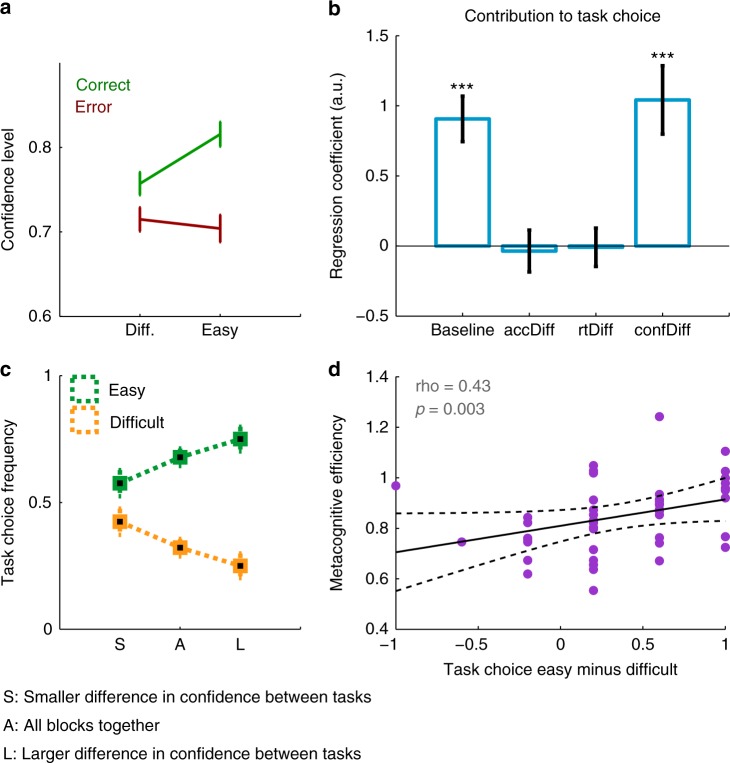
Metacognition, the ability to internally evaluate our own cognitive performance, is particularly useful since many real-life decisions lack immediate feedback. While most previous studies have focused on the construction of confidence at the level of single decisions, little is known about the formation of “global” self-performance estimates (SPEs) aggregated from multiple decisions. Here, we compare the formation of SPEs in the presence and absence of feedback, testing a hypothesis that local decision confidence supports the formation of SPEs when feedback is unavailable. We reveal that humans pervasively underestimate their performance in the absence of feedback, compared to a condition with full feedback, despite objective performance being unaffected. We find that fluctuations in confidence contribute to global SPEs over and above objective accuracy and reaction times. Our findings create a bridge between a computation of local confidence and global SPEs, and support a functional role for confidence in higher-order behavioral control.
Overview
The claims and statistics of this paper haven’t been checked yet.
Run the check — free, no account needed. It reads the open-access text and checks the sources it cites.
Integrity signals
Registry
Cites
Statistics
Figures
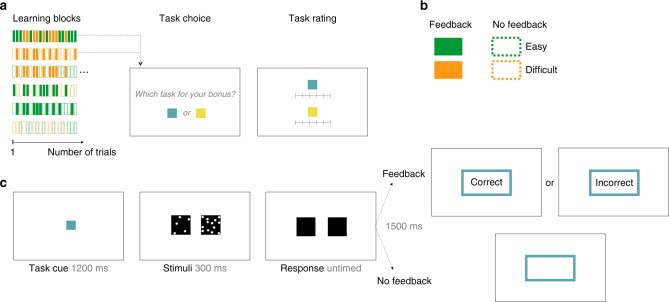
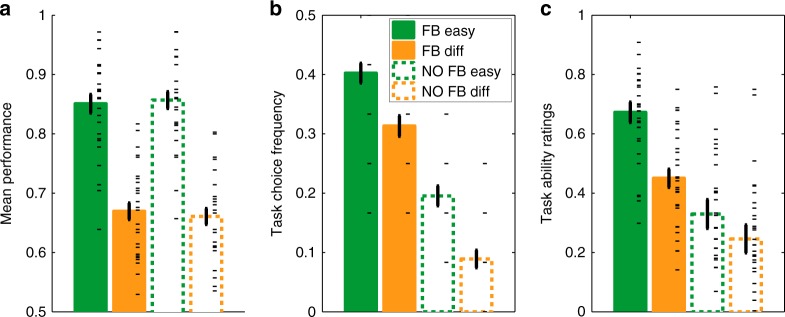
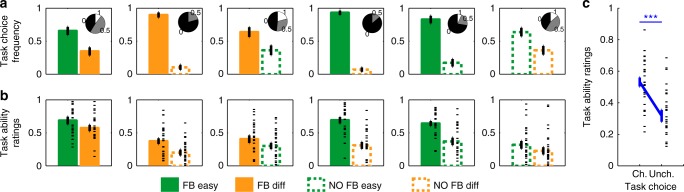
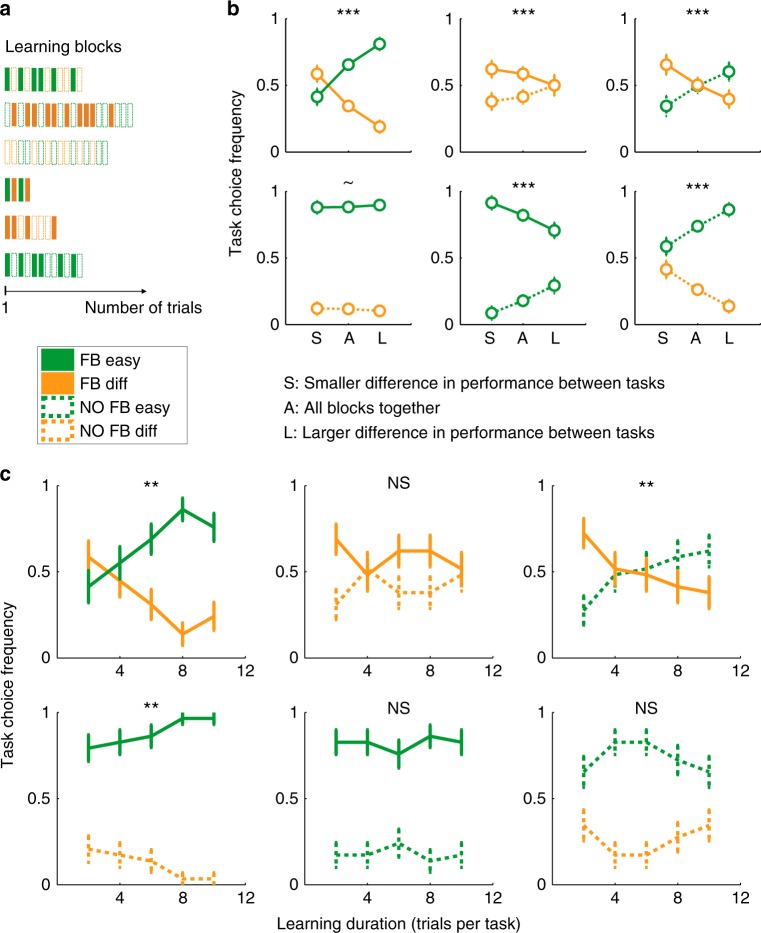
Verification
Claims the paper makes
The claims and statistics of this paper haven’t been checked yet.
Run the check — free, no account needed. It reads the open-access text and checks the sources it cites.
Claims other papers make about this one
Each is checked against this paper’s own text: does it say what the citing paper says it does?
The cited source says what the claim attributes to it.
In the citing paper
“One fruitful approach considers global confidence as a higher-order prior on estimates of (local) propositional confidence (Boldt et al. 2019, Marcke et al. 2022), which can be naturally modeled as a probability distribution over expected success (Rouault et al. 2019).”
From Metacognition and Confidence: A Review and Synthesis (2024) · cites this paper as Rouault et al. 2019
The cited source says what the claim attributes to it.
In the citing paper
“Global confidence was informed by local confidence fluctuations during the previous block, and using fMRI, it was found that vmPFC and precuneus integrate local confidence over longer timescales to track aggregate self-performance (Rouault & Fleming 2020, Wittmann et al. 2016).”
From Metacognition and Confidence: A Review and Synthesis (2024) · cites this paper as Rouault et al. 2019
Self-check
Percentages, sums and reported differences re-computed from the paper’s own numbers.
The self-check needs the paper’s full text.
Citations
Cites
Self-efficacy: Toward a unifying theory of behavioral change
Bandura, A. (1977) · Psychological Review · doi:10.1037/0033-295x.84.2.191 · Cited by 43,925
Self-efficacy: Toward a unifying theory of behavioral change
Bandura, A. (1978) · Advances in Behaviour Research and Therapy · doi:10.1016/0146-6402(78)90002-4 · Cited by 10,586
A neural system for error detection and compensation
Gehring, W. J., Goss, B., Coles, M. G. H., Meyer, D. E., & Donchin, E. (1993) · Psychological Science · doi:10.1111/j.1467-9280.1993.tb00586.x · Cited by 2,862
Does low self-esteem predict depression and anxiety? A meta-analysis of longitudinal studies.
Sowislo, J. F., & Orth, U. (2013) · Psychological Bulletin · doi:10.1037/a0028931 · Cited by 2,123
jsPsych: A JavaScript library for creating behavioral experiments in a Web browser
de Leeuw, J. R. (2014) · Behavior Research Methods · doi:10.3758/s13428-014-0458-y · Cited by 1,899
Model-based influences on humans’ choices and striatal prediction errors
Daw, N. D., Gershman, S. J., Seymour, B., Dayan, P., & Dolan, R. J. (2011) · Neuron · doi:10.1016/j.neuron.2011.02.027 · Cited by 1,779
Self-citationFleming, S. M., & Lau, H. C. (2014) · Frontiers in Human Neuroscience · doi:10.3389/fnhum.2014.00443 · Cited by 1,408
Self-citationRepresentation of Confidence Associated with a Decision by Neurons in the Parietal Cortex
Kiani, R., & Shadlen, M. N. (2009) · Science · doi:10.1126/science.1169405 · Cited by 1,027
Chandler, J., Mueller, P., & Paolacci, G. (2014) · Behavior Research Methods · doi:10.3758/s13428-013-0365-7 · Cited by 950
Maniscalco, B., & Lau, H. (2012) · Consciousness and Cognition · doi:10.1016/j.concog.2011.09.021 · Cited by 883
Cited by
Sorted by citations
Items 101–134 of 134
Fornix and Uncinate Fasciculus Support Metacognition-Driven Cognitive OffloadingPreprint
Zheng, Y., Gilbert, S. J., Li, Y., & Kwok, S. C. (2024) · Qeios · doi:10.32388/m01fud · Cited by 1
Self-compassion is linked to positive affect and buffers declines in self-esteem in low performersPreprint
Weis, J. F., Krach, S., Paulus, F. M., & Stolz, D. S. (2025) · bioRxiv (Cold Spring Harbor Laboratory) · doi:10.1101/2025.11.11.687618 · Cited by 1
Prieto, F., Lorca-Vyhmeister, A. A., CALCAGNI, S. C., Silva, J. R., Goupil, L., & Gabriel Reyes, M. (2023) · doi:10.31234/osf.io/r3zm4
Colin, S., Geraci, C., Leybaert, J., et al. (2021) · Odile Jacob eBooks · doi:10.3917/oj.conse.2021.01.0275
Agnoli, S., Mahncke, H. W., Grant, S.-J., Milberg, W., Esterman, M. S., & DeGutis, J. (2023) · doi:10.31234/osf.io/z9p3a
Learning to discriminate the eye-of-origin during continuous flash suppressionPreprint
Sarı, İ. D., Recht, S., & Lunghi, C. (2024) · doi:10.31234/osf.io/4dea3
Exogenous and Endogenous Sources of Uncertainty Inform Global Performance MonitoringPreprint
Chancel, M., Filevich, E., & Faivre, N. (2024) · SSRN Electronic Journal · doi:10.2139/ssrn.4784806
Metacognition in decision making across domains and modalities: evidence from three studiesPreprint
Mazancieux, A., Hat, K., Rutiku, R., Wierzchoń, M., & Sandberg, K. (2024) · OSF Preprints (OSF Preprints) · doi:10.31219/osf.io/v6psx · Cited by 2
Metacognitive biases in anxious-depression and compulsivity extend across perception and memoryPreprint
Seow, T. X. F., Fleming, S. M., & Hauser, T. U. (2024) · doi:10.31234/osf.io/avyph
Self-citationSoto, D., Lallier, M., Desender, K., & Elosegi, P. (2025) · Psychonomic Bulletin & Review · doi:10.3758/s13423-025-02720-7
Zhang, G.-L., Zhang, J., Li, H., Liu, W., & Zhang, X. (2025) · BMC Psychology · doi:10.1186/s40359-025-03089-x
Information-Theoretic Measures of Metacognition: Bounds and Relation to Group Performance
Meyen, S., Göppert, F., Schrenk, C., Ulrike Von Luxburg, A., & Franz, V. H. (2025) · Open Mind · doi:10.1162/opmi.a.40 · Cited by 4
How local and global metacognition relate to overt and covert narcissism in adolescentsPreprint
Liu, C., Shi, J., Luo, T., & Hu, X. (2025) · Research Square · doi:10.21203/rs.3.rs-8214411/v1
Self-Reflection Protects Behavior from Volatile Beliefs Linked to Paranoia
Suthaharan, P., Castiello, S., Ang, Y., & Corlett, P. (2026) · Computational Psychiatry · doi:10.5334/cpsy.150 · Cited by 1
Dissociating accuracy and metacognition in nutritional judgements
Hoogervorst, K., Bavato, F., Tyrer, A., & Allen, M. (2026) · Cognition · doi:10.1016/j.cognition.2026.106744
Towards a unified view of metacognition : Insights from metamemory
Mazancieux, A. (2020) · theses.fr (ABES) · doi:10.70675/f37dcebbz4e30z4da4za014z74039ef3666f
Sound propagation and quantum-limited damping in an ultracold two-dimensional Fermi gas
Bohlen, M. (2020) · theses.fr (ABES) · doi:10.70675/28e5341dzd84cz41fezb48bz2ea33c27b403
The Role of Metacognition in Occupational Pursuits : Evidence from Laboratory Experiments
Cavalan, Q. (2023) · theses.fr (ABES) · doi:10.70675/7fb86a89zd36fz4d73zae75zb74f435a571f
Multiple Oscillatory Neural Rhythms Support Metacognitive Access of Working MemoryPreprint
Di, Y., An, X., & Li, H.-H. (2026) · bioRxiv (Cold Spring Harbor Laboratory) · doi:10.64898/2026.04.08.717328
Metacognition and post-decisional processing in clinical decision-making
Katyal, S., & Fleming, S. M. (2026) · La Presse Médicale · doi:10.1016/j.lpm.2026.104369
Self-citationHow local and global metacognition shape emotion recognition across the adult lifespan
Despres, M., Bertrand, E., Piolino, P., Cognat, E., & Narme, P. (2026) · Cognition & Emotion · doi:10.1080/02699931.2026.2707486
Phon-Amnuaisuk, P., Teckentrup, V., Fittipaldi, S., Crossen, R. J., Fox, C. A., Hanlon, A. K., Katyal, S., Fleming, S. M., & Gillan, C. M. (2026) · eLife · doi:10.7554/elife.112173
Self-citationPhon-Amnuaisuk, P., Teckentrup, V., Fittipaldi, S., Crossen, R. J., Fox, C. A., Hanlon, A. K., Katyal, S., Fleming, S. M., & Gillan, C. M. (2026) · eLife · doi:10.7554/elife.112173.1
Self-citationCheng, J., Cheng, X., Zhou, J., Deng, J., Feng, S., Sun, Y., Gong, K., Liu, K.-Z., Liu, C., Lei, W., et al. (2026) · Cognitive development · doi:10.1016/j.cogdev.2026.101763
Li, Y., Chen, X., Shi, J., Jian-yuan, W., Yang, C., Luo, L., & Hu, X. (2026) · Acta Psychologica · doi:10.1016/j.actpsy.2026.107715
Di, Y., An, X., & Li, H.-H. (2026) · Current Biology · doi:10.1016/j.cub.2026.08.041
Social feedback informs generalisation of control beliefs
Fielder, J. C., Viding, E. M., Huys, Q. J. M., & Steinbeis, N. (2026) · Cognition · doi:10.1016/j.cognition.2026.106704
Halaj, A., Seow, T. X. F., & David, A. S. (2026) · Schizophrenia Research · doi:10.1016/j.schres.2026.09.028
Mavroudis, I. A., Das, O., Petridis, F. E., & Kazis, D. (2026) · Brain Science · doi:10.3390/brainsci16101026
Xu, A., Frömer, R., Wolff, W., & Shenhav, A. (2026) · Affective Science · doi:10.1007/s42761-026-00411-7 · Cited by 9
Physicians’ metacognition in medical decision-making
Lakhlifi, C., Kouzy, R., Lejeune, F., Beuzon, N., Mawet, J., Roos, C., Khamassi, M., Rohaut, B., & Rouault, M. (2026) · Neuroscience of Consciousness · doi:10.1093/nc/niag064
Self-citationOtomo, Y., & Kawachi, Y. (2026) · Frontiers in Psychology · doi:10.3389/fpsyg.2026.1900905
Metadata
- Authors
- Rouault, M., Dayan, P., & Fleming, S. M.
- Affiliations
- Wellcome Centre for Human Neuroimaging (GB)
- Corresponding author
- Rouault, Marion
- Venue
- Nature Communications
- Published
- 2019-03-08
- Volume
- 10
- Issue
- 1
- Pages
- 1141-1141
- ISSN
- 2041-1723 (ISSN-L)
- PMC
- PMC6408496
- OpenAlex
- W2921883422
- Cited by
- 134
- References
- 60
- Citations by year
- 2026: 22 · 2025: 16 · 2024: 26 · 2023: 27 · 2022: 18 · 2021: 15 · 2020: 9 · 2019: 1
- FWCI
- 6.25
- Type
- journal article
- Language
- en
- Open access
- gold
- doi.org
- Locations
- Nature Communications (publishedVersion, cc-by)
- Europe PMC (PubMed Central) (publishedVersion, other-oa)
- PubMed Central (publishedVersion, cc-by)
- PubMed (publishedVersion)
- HAL (submittedVersion, cc-by)
- RePEc: Research Papers in Economics (submittedVersion)
- DOAJ (DOAJ: Directory of Open Access Journals) (submittedVersion, cc-by-sa)
- DOAJ (DOAJ: Directory of Open Access Journals) (submittedVersion)
- UCL Discovery (University College London) (submittedVersion)
- MPG.PuRe (Max Planck Society) (submittedVersion)
- Funders
- Wellcome Trust (203147/Z/16/Z, Z/17/Z, 203147, 206648/Z/17/Z, 206648, 203147/Z/16/)
- Gatsby Charitable Foundation
- Agence Nationale de la Recherche (ANR-17-EURE-0017)
- Max-Planck-Gesellschaft (203147/Z/16/Z, 206648/Z/17/Z)
- Topics
- Life Sciences › Neuroscience › Cognitive Neuroscience › Neural and Behavioral Psychology Studies
- Life Sciences › Neuroscience › Cognitive Neuroscience › Memory Processes and Influences
- Social Sciences › Decision Sciences › General Decision Sciences › Decision-Making and Behavioral Economics
- Keywords
- metacognition, decision confidence, feedback, reaction time, behavioral control
- MeSH terms
- Metacognition, Adult, Decision Making, Female, Humans, Judgment, Male, Middle Aged, Pattern Recognition, Visual, Psychological Tests, Psychomotor Performance, Reaction Time, Self Concept, Feedback, Psychological
About these checks
Registry, retraction, Cites and statistics results are computed, not judged, with one exception: a printed reference that no index lists is read once by a model before it counts as a citation error. Claims are extracted by a model and kept only when their quote appears verbatim in the text; each cited source is then checked, with a model’s help, for whether it says what the claim relies on. Those verdicts can be wrong — read the claim’s quote and the cited source before relying on one.
Statistics and arithmetic are recomputed, not judged.
Confidence bands are shown only for fields calibrated on our annotated test set. None is calibrated yet, so no band is shown.
What counts as a claim ›How we measure confidence ›How we check this ›
Are you an author, or do you see a problem with this page? Request a review
