

The DOI matches its Crossref record; 59 of the 60 references it cites were found in a registry or an index.
Forming global estimates of self-performance from local confidence
Open accessAbstract
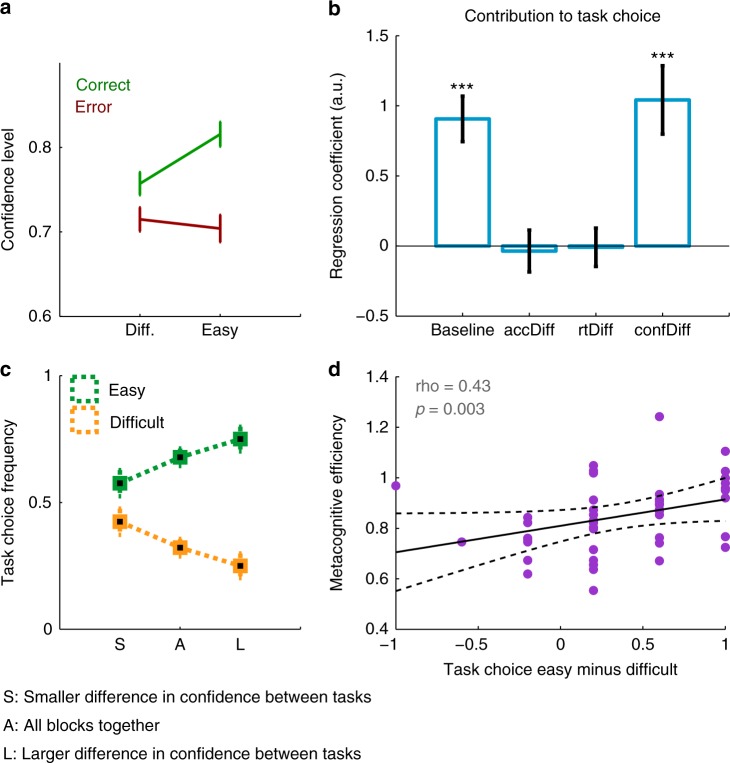
Metacognition, the ability to internally evaluate our own cognitive performance, is particularly useful since many real-life decisions lack immediate feedback. While most previous studies have focused on the construction of confidence at the level of single decisions, little is known about the formation of “global” self-performance estimates (SPEs) aggregated from multiple decisions. Here, we compare the formation of SPEs in the presence and absence of feedback, testing a hypothesis that local decision confidence supports the formation of SPEs when feedback is unavailable. We reveal that humans pervasively underestimate their performance in the absence of feedback, compared to a condition with full feedback, despite objective performance being unaffected. We find that fluctuations in confidence contribute to global SPEs over and above objective accuracy and reaction times. Our findings create a bridge between a computation of local confidence and global SPEs, and support a functional role for confidence in higher-order behavioral control.
Overview
The claims and statistics of this paper haven’t been checked yet.
Run the check — free, no account needed. It reads the open-access text and checks the sources it cites.
Integrity signals
Registry
Cites
Statistics
Figures
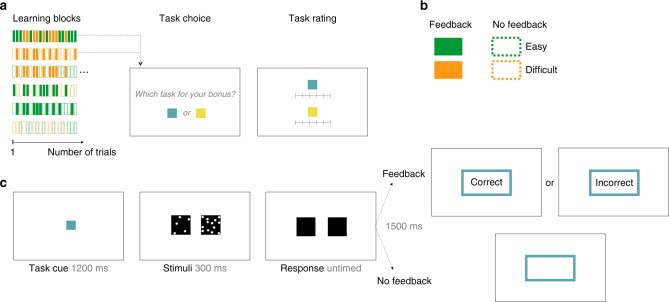
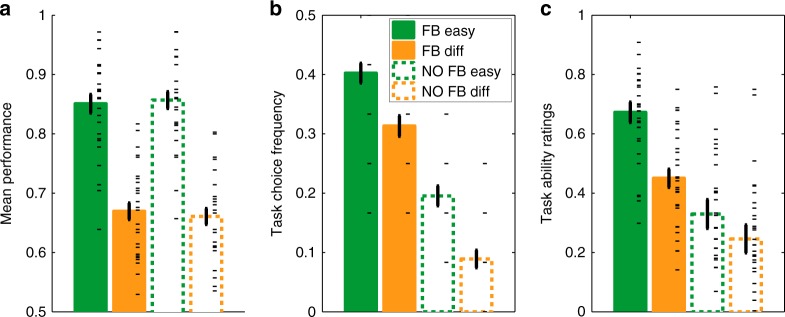
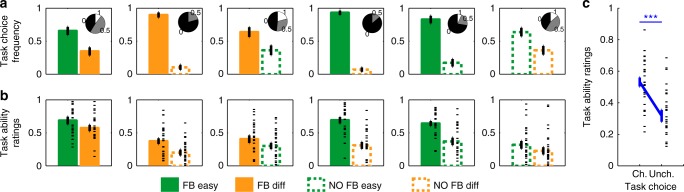
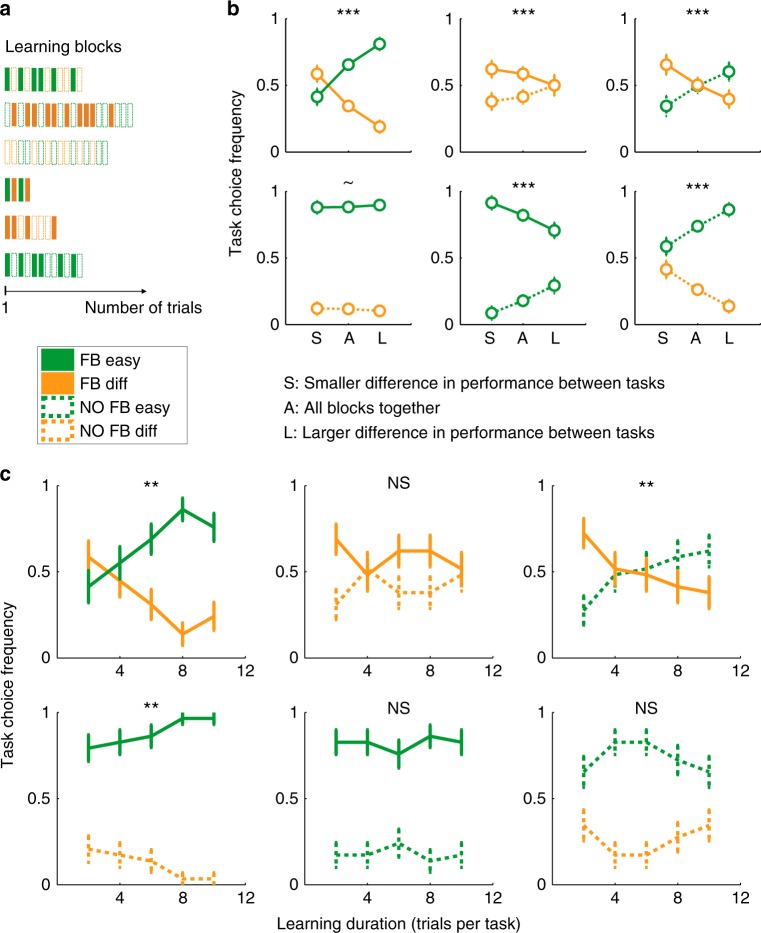
Verification
Claims the paper makes
The claims and statistics of this paper haven’t been checked yet.
Run the check — free, no account needed. It reads the open-access text and checks the sources it cites.
Claims other papers make about this one
Each is checked against this paper’s own text: does it say what the citing paper says it does?
The cited source says what the claim attributes to it.
In the citing paper
“One fruitful approach considers global confidence as a higher-order prior on estimates of (local) propositional confidence (Boldt et al. 2019, Marcke et al. 2022), which can be naturally modeled as a probability distribution over expected success (Rouault et al. 2019).”
From Metacognition and Confidence: A Review and Synthesis (2024) · cites this paper as Rouault et al. 2019
The cited source says what the claim attributes to it.
In the citing paper
“Global confidence was informed by local confidence fluctuations during the previous block, and using fMRI, it was found that vmPFC and precuneus integrate local confidence over longer timescales to track aggregate self-performance (Rouault & Fleming 2020, Wittmann et al. 2016).”
From Metacognition and Confidence: A Review and Synthesis (2024) · cites this paper as Rouault et al. 2019
Self-check
Percentages, sums and reported differences re-computed from the paper’s own numbers.
The self-check needs the paper’s full text.
Citations
Cites
Self-efficacy: Toward a unifying theory of behavioral change
Bandura, A. (1977) · Psychological Review · doi:10.1037/0033-295x.84.2.191 · Cited by 43,925
Self-efficacy: Toward a unifying theory of behavioral change
Bandura, A. (1978) · Advances in Behaviour Research and Therapy · doi:10.1016/0146-6402(78)90002-4 · Cited by 10,586
A neural system for error detection and compensation
Gehring, W. J., Goss, B., Coles, M. G. H., Meyer, D. E., & Donchin, E. (1993) · Psychological Science · doi:10.1111/j.1467-9280.1993.tb00586.x · Cited by 2,862
Does low self-esteem predict depression and anxiety? A meta-analysis of longitudinal studies.
Sowislo, J. F., & Orth, U. (2013) · Psychological Bulletin · doi:10.1037/a0028931 · Cited by 2,123
jsPsych: A JavaScript library for creating behavioral experiments in a Web browser
de Leeuw, J. R. (2014) · Behavior Research Methods · doi:10.3758/s13428-014-0458-y · Cited by 1,899
Model-based influences on humans’ choices and striatal prediction errors
Daw, N. D., Gershman, S. J., Seymour, B., Dayan, P., & Dolan, R. J. (2011) · Neuron · doi:10.1016/j.neuron.2011.02.027 · Cited by 1,779
Self-citationFleming, S. M., & Lau, H. C. (2014) · Frontiers in Human Neuroscience · doi:10.3389/fnhum.2014.00443 · Cited by 1,408
Self-citationRepresentation of Confidence Associated with a Decision by Neurons in the Parietal Cortex
Kiani, R., & Shadlen, M. N. (2009) · Science · doi:10.1126/science.1169405 · Cited by 1,027
Chandler, J., Mueller, P., & Paolacci, G. (2014) · Behavior Research Methods · doi:10.3758/s13428-013-0365-7 · Cited by 950
Maniscalco, B., & Lau, H. (2012) · Consciousness and Cognition · doi:10.1016/j.concog.2011.09.021 · Cited by 883
Cited by
Sorted by citations
Metacognition and Confidence: A Review and Synthesis
Fleming, S. M. (2024) · Annual Review of Psychology · doi:10.1146/annurev-psych-022423-032425 · Cited by 256
“One fruitful approach considers global confidence as a higher-order prior on estimates of (local) propositional confidence (Marcke et al., 2022, Boldt et al., 2019), which can be naturally modeled as a probability distribution over expected success (Rouault et al., 2019).”
Self-citationHow Local and Global Metacognition Shape Mental Health
Seow, T. X. F., Rouault, M., Gillan, C. M., & Fleming, S. M. (2021) · Biological Psychiatry · doi:10.1016/j.biopsych.2021.05.013 · Cited by 159
“Local subjective confidence ratings were found to predict global self-beliefs over and above objective performance (80).”
BackgroundInfluentialSelf-citationAdvances in modeling learning and decision-making in neuroscience
Collins, A. G. E., & Shenhav, A. (2021) · Neuropsychopharmacology · doi:10.1038/s41386-021-01126-y · Cited by 113
Formation of global self-beliefs in the human brain
Rouault, M., & Fleming, S. M. (2020) · Proceedings of the National Academy of Sciences · doi:10.1073/pnas.2003094117 · Cited by 76
“We have recently obtained behavioral evidence that human subjects build global SPEs by learning from local confidence over multiple instances when external feedback is withheld (3).”
InfluentialSelf-citationHow do confidence and self-beliefs relate in psychopathology: a transdiagnostic approach
Hoven, M., Luigjes, J., Denys, D. A. J. P., Rouault, M., & van Holst, R. J. (2023) · Nature Mental Health · doi:10.1038/s44220-023-00062-8 · Cited by 82
Self-citationHaddara, N., & Rahnev, D. (2022) · Psychological Science · doi:10.1177/09567976211032887 · Cited by 82
“, 2006), whereas others have shown no difference between feedback and nofeedback groups (Goldhacker et al., 2014; Petrov et al., 2006; Rouault et al., 2019; Shibata et al., 2009).”
BackgroundConsensus Goals in the Field of Visual Metacognition
Rahnev, D., Balsdon, T., Charles, L., de Gardelle, V., Denison, R., Desender, K., Faivre, N., Filevich, E., Fleming, S. M., Jehee, J., et al. (2022) · Perspectives on Psychological Science · doi:10.1177/17456916221075615 · Cited by 63
“Another aspect is determining which cues contribute to global and prospective confidence estimates (Lee et al., 2021; Mamassian, 2020; Mei et al., 2020; Rouault et al., 2019; Siedlecka et al., 2016) and how they may interact with “local” confidence in a single decision.”
Self-citationDogmatism manifests in lowered information search under uncertainty
Schulz, L., Rollwage, M., Dolan, R. J., & Fleming, S. M. (2020) · Proceedings of the National Academy of Sciences · doi:10.1073/pnas.2009641117 · Cited by 76
“Over a longer time horizon, and in the absence of external feedback (49), such a self-reinforcing feedback loop might in turn lead dogmatic individuals to think that their initial judgments are already sufficiently optimal and that investing in acquiring more information is unnecessary.”
BackgroundSelf-citationMetacognition in functional cognitive disorder
Bhome, R., McWilliams, A., Price, G. W., Poole, N. A., Howard, R. J., Fleming, S. M., & Huntley, J. D. (2022) · Brain Communications · doi:10.1093/braincomms/fcac041 · Cited by 67
Self-citationMcWilliams, A., Bibby, H., Steinbeis, N., David, A. S., & Fleming, S. M. (2023) · Cognition · doi:10.1016/j.cognition.2023.105389 · Cited by 64
“We note here we are unable to relate these global estimates to objective fluctuations in local performance, unlike alternative task-based approaches to global metacognition (Lee, De Gardelle, & Mamassian, 2021; Rouault et al., 2019).”
BackgroundSelf-citationThe future of metacognition research: Balancing construct breadth with measurement rigor
Katyal, S., & Fleming, S. M. (2024) · Cortex · doi:10.1016/j.cortex.2023.11.002 · Cited by 63
“As a step towards this goal, Rouault et al. (2019) modelled global self-estimates of performance as the probabilistic combination of multiple instances of local confidence and performance feedback.”
BackgroundInfluentialSelf-citationAction information contributes to metacognitive decision-making
Wokke, M. E., Achoui, D., & Cleeremans, A. (2020) · Scientific Reports · doi:10.1038/s41598-020-60382-y · Cited by 56
Computational mechanisms underlying the dynamics of physical and cognitive fatigue
Matthews, J., Pisauro, M. A., Jurgelis, M., Müller, T., Vassena, E., Chong, T. T. ‐., & Apps, M. A. J. (2023) · Cognition · doi:10.1016/j.cognition.2023.105603 · Cited by 62
Frömer, R., & Shenhav, A. (2021) · Neuroscience & Biobehavioral Reviews · doi:10.1016/j.neubiorev.2021.12.006 · Cited by 57
Brain dynamics for confidence-weighted learning
Meyniel, F. (2020) · PLoS Computational Biology · doi:10.1371/journal.pcbi.1007935 · Cited by 55
“It is the confidence that accompanies probability estimates on a trial-by-trial basis, thus it is not “global” or related to self-confidence [58].”
BackgroundA shared brain system forming confidence judgment across cognitive domains
Rouault, M., Lebreton, M. P., & Pessiglione, M. (2022) · Cerebral Cortex · doi:10.1093/cercor/bhac146 · Cited by 49
Self-citationTowards a common conceptual space for metacognition in perception and memory
Mazancieux, A., Pereira, M., Faivre, N., Mamassian, P., Moulin, C. J. A., & Souchay, C. (2023) · Nature Reviews Psychology · doi:10.1038/s44159-023-00245-1 · Cited by 44
Manipulating Prior Beliefs Causally Induces Under- and Overconfidence
Marcke, H. V., Denmat, P. L., Verguts, T., & Desender, K. (2024) · Psychological Science · doi:10.1177/09567976241231572 · Cited by 44
“Our findings are closely linked to global decision confidence (Rouault et al., 2019): the general, subjective feeling about the ability to perform a task, spanning a broader timescale than trial-specific local confidence.”
BackgroundLee, A. L. F., de Gardelle, V., & Mamassian, P. (2021) · Psychonomic Bulletin & Review · doi:10.3758/s13423-020-01869-7 · Cited by 32
Low self-esteem and the formation of global self-performance estimates in emerging adulthood
Rouault, M., Will, G., Fleming, S. M., & Dolan, R. J. (2022) · Translational Psychiatry · doi:10.1038/s41398-022-02031-8 · Cited by 35
“We leveraged a recently developed behavioral paradigm probing the formation of subjective self-performance estimates [8, 9].”
InfluentialSelf-citationResponse-Related Signals Increase Confidence But Not Metacognitive Performance
Filevich, E., Koß, C., & Faivre, N. (2020) · eNeuro · doi:10.1523/eneuro.0326-19.2020 · Cited by 29
Expectations about precision bias metacognition and awareness.
Olawole‐Scott, H., & Yon, D. (2023) · Journal of Experimental Psychology General · doi:10.1037/xge0001371 · Cited by 28
“For example, previous work has found that agents readily form beliefs about the difficulty of different tasks even in the absence of explicit feedback—and can use these global performance estimates to guide decisions about which goals to pursue (Rouault et al., 2019).”
InfluentialDemystifying unsupervised learning: how it helps and hurts
Bröker, F., Holt, L. L., Roads, B. D., Dayan, P., & Love, B. C. (2024) · Trends in Cognitive Sciences · doi:10.1016/j.tics.2024.09.005 · Cited by 32
Self-citationA Bayesian inference model for metamemory.
Hu, X., Zheng, J., Su, N., Fan, T., Yang, C., Yin, Y., Fleming, S. M., & Luo, L. (2021) · Psychological Review · doi:10.1037/rev0000270 · Cited by 24
“First, during the learning phase, participants might continue to update their beliefs about memory ability based on the processing experience in each trial (Mueller, Dunlosky, & Tauber, 2014; Rouault et al., 2019).”
MethodSelf-citationHoven, M., Rouault, M., van Holst, R., & Luigjes, J. (2023) · Psychological Medicine · doi:10.1017/s003329172300209x · Cited by 28
“Both are measures of global metacognition. performance and metacognition (Rouault et al., 2019).”
BackgroundMethodResultInfluentialSelf-citationCognition in elite soccer players: a general model
Habekost, T., Ovesen, J., & Madsen, J. B. (2024) · Frontiers in Psychology · doi:10.3389/fpsyg.2024.1477262 · Cited by 27
Metacognition and confidence: A review and synthesisPreprint
Fleming, S. M. (2023) · doi:10.31234/osf.io/ge7tz · Cited by 27
Self-citationReliable, rapid, and remote measurement of metacognitive bias
Fox, C. A., McDonogh, A., Donegan, K. R., Teckentrup, V., Crossen, R. J., Hanlon, A. K., Gallagher, E., Rouault, M., & Gillan, C. M. (2024) · Scientific Reports · doi:10.1038/s41598-024-64900-0 · Cited by 30
“Future research should consider using alternative measures for global metacognition, such as task-level choices, which may be less proximal to local confidence ratings 2,16 .”
MethodSelf-citationDistorted learning from local metacognition supports transdiagnostic underconfidence
Katyal, S., Huys, Q. J. M., Dolan, R. J., & Fleming, S. M. (2025) · Nature Communications · doi:10.1038/s41467-025-57040-0 · Cited by 42
“We modelled the dynamics of global SPEs by building on a model developed by Rouault et al. 8 .”
InfluentialSelf-citationNeurocomputational mechanisms of affected beliefs
Müller‐Pinzler, L., Czekalla, N., Mayer, A. V., Schröder, A., Stolz, D. S., Paulus, F. M., & Krach, S. (2022) · Communications Biology · doi:10.1038/s42003-022-04165-3 · Cited by 26
Optimal metacognitive decision strategies in signal detection theory
Maniscalco, B., Charles, L., & Peters, M. A. K. (2024) · Psychonomic Bulletin & Review · doi:10.3758/s13423-024-02510-7 · Cited by 25
“However, many studies use more expansive confidence rating scales; common examples include 4-point scales (e.g. Charles et al., 2020), 6-point scales (e.g. Boldt & Yeung, 2015) and semi-continuous scales (e.g. Rahnev & Fleming, 2019; Rouault et al., 2019).”
Flexible use of confidence to guide advice requests
Carlebach, N., & Yeung, N. (2022) · Cognition · doi:10.1016/j.cognition.2022.105264 · Cited by 23
Neural and computational underpinnings of biased confidence in human reinforcement learning
Ting, C.-C., Salem-Garcia, N., Palminteri, S., Engelmann, J. B., & Lebreton, M. P. (2023) · Nature Communications · doi:10.1038/s41467-023-42589-5 · Cited by 24
Ptasczynski, L. E., Steinecker, I., Sterzer, P., & Guggenmos, M. (2022) · PLoS Computational Biology · doi:10.1371/journal.pcbi.1010580 · Cited by 19
Controllability boosts neural and cognitive signatures of changes-of-mind in uncertain environments
Rouault, M., Weiss, A., Lee, J. K., Drugowitsch, J., Chambon, V., & Wyart, V. (2022) · eLife · doi:10.7554/elife.75038 · Cited by 24
Self-citationMetacognitive Computations for Information Search: Confidence in ControlPreprint
Schulz, L., Fleming, S. M., & Dayan, P. (2021) · bioRxiv (Cold Spring Harbor Laboratory) · doi:10.1101/2021.03.01.433342 · Cited by 18
Self-citationInteroceptive and metacognitive facets of fatigue in multiple sclerosis
Rouault, M., Pereira, I., Galioulline, H., Fleming, S. M., Stephan, K. E., & Manjaly, Z. (2023) · European Journal of Neuroscience · doi:10.1111/ejn.16048 · Cited by 21
“This exploration is relevant because metacognition can operate across different levels of abstraction, from ‘local’ confidence in individual perceptual decisions to global beliefs about general abilities such as self-efficacy (Rouault et al., 2019).”
BackgroundSelf-citationChildren’s subjective uncertainty-driven sampling behaviour
de Eccher, M., Mundry, R., & Mani, N. (2024) · Royal Society Open Science · doi:10.1098/rsos.231283 · Cited by 16
Multitasking costs on metacognition in a triple-task paradigm
Konishi, M., Berberian, B., de Gardelle, V., & Sackur, J. (2021) · Psychonomic Bulletin & Review · doi:10.3758/s13423-021-01967-0 · Cited by 16
Confidence guides priority between forthcoming tasks
Aguilar-Lleyda, D., & de Gardelle, V. (2021) · Scientific Reports · doi:10.1038/s41598-021-97884-2 · Cited by 12
Affective Bias Through the Lens of Signal Detection Theory
Locke, S. M., & Robinson, O. J. (2021) · Computational Psychiatry · doi:10.5334/cpsy.58 · Cited by 14
“However, how observers come to form an estimate of their own perceptual sensitivity is not well understood and rarely discussed (Rouault et al., 2019; Rouault & Fleming, 2020).”
BackgroundManipulating prior beliefs causally induces under- and overconfidence
Van Marcke, H., Le Denmat, P., Verguts, T., & Desender, K. (2022) · doi:10.1101/2022.03.01.482511 · Cited by 13
Survey measures of metacognitive monitoring are often false
Double, K. S. (2025) · Behavior Research Methods · doi:10.3758/s13428-025-02621-6 · Cited by 12
“Self-reports of ability are conceptually and empirically similar to the notion of confidence as individuals appear to form global beliefs about their competence based on local confidence (Rouault et al., 2019).”
Agnoli, S., Zuberer, A., Nanni‐Zepeda, M., McGlinchey, R. E., Milberg, W., Esterman, M. S., & Degutis, J. M. (2023) · Depression and Anxiety · doi:10.1155/2023/2925551 · Cited by 12
“These negative biases in perception and memory are resilient to feedback and inform more negative global self-performance estimates [4, 24, 25]).”
Hu, X., Yang, C., & Luo, L. (2022) · Journal of Experimental Psychology General · doi:10.1037/xge0001257 · Cited by 10
Lund, A. E., Corrêa, C. M. C., Fardo, F., Fleming, S. M., & Allen, M. (2023) · doi:10.31234/osf.io/p97s5 · Cited by 11
Self-citationMetacognitive biases in anxiety-depression and compulsivity extend across perception and memory
Seow, T. X. F., Fleming, S. M., & Hauser, T. U. (2025) · PLOS mental health. · doi:10.1371/journal.pmen.0000259 · Cited by 17
“Third, we and others have recently shown that the expression of confidence may reflect an internal hierarchy, ranging from local confidence in single decisions to higher-level global assessments such as self-esteem [22,35,36].”
Self-citationFrom local to global estimations of confidence in perceptual decisions.
Cavalan, Q., Vergnaud, J., & de Gardelle, V. (2023) · Journal of Experimental Psychology General · doi:10.1037/xge0001411 · Cited by 11
Metacognitive sensitivity and symptoms of mental disorder: A systematic review and meta-analysis
Hohendorf, M., & Bauer, M. (2023) · Frontiers in Psychology · doi:10.3389/fpsyg.2023.991339 · Cited by 15
Domain-specific updating of metacognitive self-beliefs
Hoogervorst, K., Banellis, L., & Allen, M. (2024) · Cognition · doi:10.1016/j.cognition.2024.105965 · Cited by 9
“…studies highlight the formation of global estimates from local confidence judgments across various perceptual tasks, suggesting a complex interaction between local sensory experiences and global self-performance assessments (Lee, de Gardelle, & Mamassian, 2021; Rouault, Dayan, & Fleming, 2019).”
BackgroundParadoxical relationship between subjective and objective cognition: the role of sleep
Costa, A. N., McCrae, C. S., Cowan, N., & Curtis, A. F. (2022) · Journal of Clinical Sleep Medicine · doi:10.5664/jcsm.10070 · Cited by 9
“To explain these findings at a cognitive level, fragmented sleep might leave participants without the resources needed to accurately monitor their performance, 50 and thus in those that actually perform best, there are worse subjective ratings of performance (or vice versa).”
Haddara, N., & Rahnev, D. (2020) · doi:10.31234/osf.io/p8zyw · Cited by 9
Sherman, M. T., & Seth, A. K. (2024) · Neuroscience of Consciousness · doi:10.1093/nc/niae020 · Cited by 9
The role of decision confidence in advice-taking and trust formationPreprint
Pescetelli, N., & Yeung, N. (2019) · doi:10.31234/osf.io/sjgf7 · Cited by 8
Effects of expected task difficulty on metacognitive confidence and multitaskingPreprint
Sherman, M. T., & Seth, A. K. (2021) · doi:10.31234/osf.io/3gfp2 · Cited by 8
Going ‘meta’: a systematic review of metacognition and functional neurological disorder
Sadnicka, A., Strudwick, A.-M., Grogan, J. P., Manohar, S., & Nielsen, G. (2024) · Brain Communications · doi:10.1093/braincomms/fcaf014 · Cited by 7
“10-12 Other measures have been described for examining metacognition but are yet to be tested in FND. 20 Furthermore, continued refinement of existing metrics and models is anticipated as the assumption that the M-ratio is performance-independent has been challenged.”
Seow, T. X. F., Jelinek, L., Moritz, S., & Hauser, T. U. (2025) · Nature Reviews Psychology · doi:10.1038/s44159-025-00503-4 · Cited by 11
“…provides multiple benefits: it enables an explicit notion of their similarities and differences, uncovers an understanding of their interrelations (potentially through computational modelling 29,32,35 ), and facilitates comparison of how the neural bases of these constructs 23,25,27,28 line up.”
InfluentialAtypical meta-memory evaluation strategy in schizophrenia patients
Zheng, Y., Wang, L., Gerlofs, D. J., Duan, W., Wang, X., Jia, Y., Yan, C., Allé, M. C., Berna, F. S., Wang, J., et al. (2021) · Schizophrenia Research Cognition · doi:10.1016/j.scog.2021.100220 · Cited by 7
Öztel, T., & Balcı, F. (2022) · Quarterly Journal of Experimental Psychology · doi:10.1177/17470218221145314 · Cited by 9
“Together, these findings point to the enhancing effect of internally driven error monitoring and external feedback on the evaluation of overall performance in perceptual decision making (Rouault et al., 2019).”
BackgroundConfidence biases in problem gambling
Friedemann, M., Fox, C. A., Hanlon, A. K., Tighe, D., Yeung, N., & Gillan, C. M. (2024) · Journal of Behavioral Addictions · doi:10.1556/2006.2024.00030 · Cited by 7
Distorted learning from local metacognition supports transdiagnostic underconfidencePreprint
Katyal, S., Huys, Q. J. M., Dolan, R. J., & Fleming, S. M. (2023) · doi:10.31234/osf.io/qcg92 · Cited by 7
Self-citationXu, A., Frömer, R., Wolff, W., & Shenhav, A. (2023) · doi:10.31234/osf.io/5jekt · Cited by 7
Hoogervorst, K., Banellis, L., Fardo, F., Xue, K., Tyrer, A., Rahnev, D., & Allen, M. (2024) · PsyArXiv (OSF Preprints) · doi:10.31234/osf.io/2gwky · Cited by 10
How Sure is the Driver? Modelling Drivers’ Confidence in Left-Turn Gap Acceptance Decisions
Bontje, F., & Zgonnikov, A. (2024) · Computational Brain & Behavior · doi:10.1007/s42113-024-00207-7 · Cited by 9
“However, these findings have been replicated in traditional laboratory setups with simplistic preferential (Brus et al., 2021; De Martino et al., 2013), inferential (Chua & Solinger, 2015; Händel, et al., 2020; Liberman, 2004), or perceptual tasks (Kiani et al., 2014; Rouault et al., 2019).”
Gender and anxiety reveal distinct computational sources of underconfidence
Katyal, S., & Fleming, S. M. (2026) · Psychological Medicine · doi:10.1017/s0033291725102808 · Cited by 5
“Indeed, in the absence of external feedback, confidence provides a summary belief about one ’ s skill or ability (Katyal et al., 2025; Rouault, Dayan, & Fleming, 2019).”
Self-citationJoint contributions of metacognition and self-beliefs to uncertainty-guided checking behavior
Baptista, A., Maheu, M., Mallet, L., & N’Diaye, K. (2021) · Scientific Reports · doi:10.1038/s41598-021-97958-1 · Cited by 5
Intention offloading: Domain-general versus task-specific confidence signals
Sachdeva, C., & Gilbert, S. J. (2024) · Memory & Cognition · doi:10.3758/s13421-024-01529-4 · Cited by 5
“This means that spurious correlations in metacognitive sensitivity might emerge between domains that are driven by variation in task performance rather than metacognitive capacity itself (Rouault et al., 2019).”
BackgroundThe Visualization of Ransomware Infection
VonderLinden, C., Walton, J., Melaragno, A., & Casey, W. (2022) · IEEE Intl Conf on Dependable, Autonomic and Secure Computing, Intl Conf on Pervasive Intelligence and Computing, Intl Conf on Cloud and Big Data Computing, Intl Conf on Cyber Science and Technology Congress (DASC/PiCom/CBDCom/CyberSciTech) · doi:10.1109/dasc/picom/cbdcom/cy55231.2022.9927749 · Cited by 4
“The results were interesting because people typically tend to rank their knowledge higher, however in this survey it was the opposite [35].”
BackgroundReply to: Metacognition, Adaptation, and Mental Health
Seow, T. X. F., Rouault, M., Gillan, C. M., & Fleming, S. M. (2021) · Biological Psychiatry · doi:10.1016/j.biopsych.2021.11.005 · Cited by 4
Self-citationYoshida, K., Sawamura, D., Ogawa, K., Mototani, T., Ikoma, K., & Sakai, S. (2023) · Journal of Cognitive Neuroscience · doi:10.1162/jocn_a_02064 · Cited by 3
“Recent behavioral computation evidence suggests that our decision confidence contributes to the estimation of our global beliefs about our abilities (Rouault, Dayan, & Fleming, 2019).”
BackgroundEstimating self-performance when making complex decisions
Lu, X., Murawski, C., Bossaerts, P. L., & Suzuki, S. (2025) · Scientific Reports · doi:10.1038/s41598-025-87601-8 · Cited by 4
Zheng, Y., Bo, B., Wang, D., Liu, Y., Shi, L., Gilbert, S. J., Li, Y., & Kwok, S. C. (2025) · Scientific Reports · doi:10.1038/s41598-025-18631-5 · Cited by 3
“Some studies suggest that global confidence judgments are derived from and constantly updated by trial-by-trial retrospective decision confidence 52–54 , which correspond to our practice and training stages.”
Preferences for advisor agreement and accuracy
Jaquiery, M., & Yeung, N. (2024) · PLoS ONE · doi:10.1371/journal.pone.0311211 · Cited by 4
Active disambiguation guides inferring controllability and cause in social interactions
Spiering, L., Trier, H. A., O’Reilly, J. X., Kolling, N., Wittmann, M. K., Rushworth, M. F. S., & Scholl, J. (2025) · Nature Communications · doi:10.1038/s41467-025-67853-8 · Cited by 2
“It is clear that establishing the causes of outcomes is dif fi cult; an outcome may be assigned not just to the action that led to it, but also to one ’ s overall skill 9 – 11 , or to other choices 2,4,12 – 14 and stimuli 1,3,15,16 that occurred close in time.”
Clinical and Cognitive Metacognition in Gaming and Gambling Disorder: A Narrative Review
van Holst, R. J., Cornelissen, K., Bockting, C., & Spada, M. M. (2024) · Current Addiction Reports · doi:10.1007/s40429-024-00597-5 · Cited by 4
“These local and global constructs are likely related to even higher-order feelings of confidence about the self, which are relatively more stable over time and general than local confidence, which can be very task-specific [18, 59, 60].”
Metacognitive performance in Functional Cognitive Disorder (FCD): A meta-analysis
Franekova, K., Petridis, F., Ciobica, A. S., Papagiannopoulos, S., Kazis, D. A., & Mavroudis, I. A. (2025) · Acta Neurologica Belgica · doi:10.1007/s13760-025-02969-8 · Cited by 2
“Metacognition encompasses both the real-time monitoring of task performance (local metacognition) and broader, more general appraisals of cognitive abilities (global metacognition) [6].”
Rewards bias self-evaluations of ability
Luo, J., Mende‐Siedlecki, P., & Hackel, L. M. (2025) · Communications Psychology · doi:10.1038/s44271-025-00286-7 · Cited by 2
Blaming luck, claiming skill: Self-attribution bias in error assignment
Okamoto, N., Taylor, M., Kubo, T., Ishii, S., De Martino, B., & Cortese, A. (2025) · PLOS Computational Biology · doi:10.1371/journal.pcbi.1013787 · Cited by 2
What inclines us towards collective decisions
Zein, M. E., Rouault, M., Wurzer, D., Haggard, P., & Deroy, O. D. (2023) · Open Research Europe · doi:10.12688/openreseurope.16160.1 · Cited by 2
Self-citationLopez‐Persem, A., Rouault, M., & Volle, E. (2023) · Physics of Life Reviews · doi:10.1016/j.plrev.2023.11.007 · Cited by 2
Self-citationInteroceptive and metacognitive facets of fatigue in multiple sclerosisPreprint
Rouault, M., Pereira, I., Galioulline, H., Fleming, S. M., Stephan, K. E., & Manjaly, Z. (2023) · medRxiv · doi:10.1101/2023.01.23.23284429 · Cited by 2
Self-citationConfidence-Guided Information SeekingPreprint
Friedemann, M., Bang, D., & Yeung, N. (2023) · SSRN Electronic Journal · doi:10.2139/ssrn.4610715 · Cited by 2
Gender and anxiety reveal distinct computational sources of underconfidencePreprint
Katyal, S., & Fleming, S. M. (2024) · PsyArXiv (OSF Preprints) · doi:10.31234/osf.io/5w2vd · Cited by 4
Self-citationTwo prefrontal-subcortical circuits estimate controllability and reflect its impact on learning
Liu, Y., Spiering, L., Luo, S., Kingston, N., Grohn, J., & Rushworth, M. F. S. (2026) · Neuron · doi:10.1016/j.neuron.2026.07.029 · Cited by 1
Segregated Co-activation Patterns in the Emergence of Decision Confidence During Visual Perception
Jaeger, C., Glim, S., Dimulescu, C., Ries, A., Sorg, C., & Wohlschläger, A. M. (2020) · Frontiers in Systems Neuroscience · doi:10.3389/fnsys.2020.557693 · Cited by 2
“Global estimates of self-performance seem to be influenced by previous confidence estimates and choices on preceding trials, even during the absence of feedback (Benwell et al., 2019; Rouault et al., 2019).”
BackgroundPerceptual and attentional uncertainty impact global performance monitoring
Chancel, M., Filevich, E., & Faivre, N. (2025) · Neuroscience of Consciousness · doi:10.1093/nc/niaf041 · Cited by 1
“Only a handful of recent studies have explored the metacognitive evaluation of a series of events (Lee et al. 2021) and tasks ( Rouault et al. 2019).”
InfluentialLearning to discriminate the eye‐of‐origin during continuous flash suppression
Sarı, İ. D., Recht, S., & Lunghi, C. (2024) · European Journal of Neuroscience · doi:10.1111/ejn.16373 · Cited by 1
“…nicely with a recent line of investigations considering how ‘ local ’ confidence relates to more ‘ global ’ estimates of performance over many trials (Lee et al., 2021; Rouault et al., 2019) and suggests some sort of dissociation between local and global confidence during utrocular discrimination.”
BackgroundTsuda, A., Manalo, E., Miyai, I., & Noda, T. (2024) · Frontiers in Rehabilitation Sciences · doi:10.3389/fresc.2024.1450157 · Cited by 1
“Roualt and colleagues (93) found that individuals prefer tasks they feel con fi dent in, regardless of dif fi culty, and this preference persists even after feedback.”
Deciding for others alters metacognition leading to responsibility aversion
Bao, S. D., Edelson, M. G., & Hare, T. A. (2026) · Science Advances · doi:10.1126/sciadv.ady0441 · Cited by 1
Metacognition and metacognitive monitoring in aging
Pournaghdali, A., Cheng, G. L., Cosentino, S., & Eich, T. S. (2026) · Psychonomic Bulletin & Review · doi:10.3758/s13423-026-02968-7 · Cited by 1
“In healthy young adults, fluctuations in item-level confidence contribute to global self-perfor-mance estimates above and beyond objective task accuracy, indicating that global self-evaluations are partially derived from accumulated confidence information (Rouault et al., 2019).”
Towards an integrative neuroscience of metacognition
Fleming, S. M. (2026) · Nature reviews. Neuroscience · doi:10.1038/s41583-026-01081-x · Cited by 3
“Laboratory studies have found that fluctuations in local confidence from trial to trial significantly predict global confidence estimates 103,104 , with computational modelling indicating that people learn both from exter-nal feedback and local confidence to construct a self-model of their skills…”
Self-citationBhome, R., McWilliams, A., Price, G. W., Poole, N. A., Howard, R. J., Fleming, S. M., & Huntley, J. D. (2022) · Brain Communications · doi:10.1093/braincomms/fcac139 · Cited by 1
“The reasons for this dissociation remain unclear, and understanding this linkage will benefit from novel tasks that allow the relationship between local and global metacognition to be quantified.(4,5) However, the Bayesian model we proposed in our paper sought to accommodate the observed null findings with respect to…”
ResultSelf-citationMatsuyoshi, D., Isato, A., & Yamada, M. (2024) · BMC Psychology · doi:10.1186/s40359-024-01625-9 · Cited by 1
Give it a second try? The influence of feedback and performance in the decision of reattempting
Chung, W. Y., Darriba, Á., Yeung, N., & Waszak, F. (2024) · Cognition · doi:10.1016/j.cognition.2024.105803 · Cited by 1
Guo, D., & Shing, Y. L. (2024) · European Psychologist · doi:10.1027/1016-9040/a000536 · Cited by 1
Metacognitive training facilitates optimal cognitive offloading
Ngai, C., & Gilbert, S. J. (2026) · Cognitive Research Principles and Implications · doi:10.1186/s41235-026-00714-0 · Cited by 6
“…models of metacognition posit a hierarchy of metacognitive representations, from moment-by-moment confidence in individual decisions, up to task-level evaluations of performance and eventually global beliefs such as self-efficiency and self-esteem (Rouault et al., 2019; Seow et al., 2021).”
Revisiting verbal recognition memory in obsessive-compulsive disorder: A computational approach
Solway, A., Lin, Z., & Kaplan, C. M. (2021) · Journal of Psychiatric Research · doi:10.1016/j.jpsychires.2021.04.015 · Cited by 1
Agnoli, S., Zuberer, A., Nanni‐Zepeda, M., Milberg, W., McGlinchey, R. E., Esterman, M. S., & Degutis, J. M. (2022) · doi:10.31234/osf.io/2agtw · Cited by 1
Estimating self-performance when making complex decisionsPreprint
Lu, X., Murawski, C., Bossaerts, P. L., & Suzuki, S. (2023) · doi:10.31234/osf.io/7xatc · Cited by 1
Computational mechanisms underlying the dynamics of physical and cognitive fatiguePreprint
Matthews, J., Pisauro, M. A., Jurgelis, M., Mueller, T., Vassena, E., Chong, T. T. ‐., & Apps, M. A. J. (2023) · doi:10.31234/osf.io/n3mj2 · Cited by 1
Metadata
- Authors
- Rouault, M., Dayan, P., & Fleming, S. M.
- Affiliations
- Wellcome Centre for Human Neuroimaging (GB)
- Corresponding author
- Rouault, Marion
- Venue
- Nature Communications
- Published
- 2019-03-08
- Volume
- 10
- Issue
- 1
- Pages
- 1141-1141
- ISSN
- 2041-1723 (ISSN-L)
- PMC
- PMC6408496
- OpenAlex
- W2921883422
- Cited by
- 134
- References
- 60
- Citations by year
- 2026: 22 · 2025: 16 · 2024: 26 · 2023: 27 · 2022: 18 · 2021: 15 · 2020: 9 · 2019: 1
- FWCI
- 6.25
- Type
- journal article
- Language
- en
- Open access
- gold
- doi.org
- Locations
- Nature Communications (publishedVersion, cc-by)
- Europe PMC (PubMed Central) (publishedVersion, other-oa)
- PubMed Central (publishedVersion, cc-by)
- PubMed (publishedVersion)
- HAL (submittedVersion, cc-by)
- RePEc: Research Papers in Economics (submittedVersion)
- DOAJ (DOAJ: Directory of Open Access Journals) (submittedVersion, cc-by-sa)
- DOAJ (DOAJ: Directory of Open Access Journals) (submittedVersion)
- UCL Discovery (University College London) (submittedVersion)
- MPG.PuRe (Max Planck Society) (submittedVersion)
- Funders
- Wellcome Trust (203147/Z/16/Z, Z/17/Z, 203147, 206648/Z/17/Z, 206648, 203147/Z/16/)
- Gatsby Charitable Foundation
- Agence Nationale de la Recherche (ANR-17-EURE-0017)
- Max-Planck-Gesellschaft (203147/Z/16/Z, 206648/Z/17/Z)
- Topics
- Life Sciences › Neuroscience › Cognitive Neuroscience › Neural and Behavioral Psychology Studies
- Life Sciences › Neuroscience › Cognitive Neuroscience › Memory Processes and Influences
- Social Sciences › Decision Sciences › General Decision Sciences › Decision-Making and Behavioral Economics
- Keywords
- metacognition, decision confidence, feedback, reaction time, behavioral control
- MeSH terms
- Metacognition, Adult, Decision Making, Female, Humans, Judgment, Male, Middle Aged, Pattern Recognition, Visual, Psychological Tests, Psychomotor Performance, Reaction Time, Self Concept, Feedback, Psychological
About these checks
Registry, retraction, Cites and statistics results are computed, not judged, with one exception: a printed reference that no index lists is read once by a model before it counts as a citation error. Claims are extracted by a model and kept only when their quote appears verbatim in the text; each cited source is then checked, with a model’s help, for whether it says what the claim relies on. Those verdicts can be wrong — read the claim’s quote and the cited source before relying on one.
Statistics and arithmetic are recomputed, not judged.
Confidence bands are shown only for fields calibrated on our annotated test set. None is calibrated yet, so no band is shown.
What counts as a claim ›How we measure confidence ›How we check this ›
Are you an author, or do you see a problem with this page? Request a review
