

The DOI matches its Crossref record; 37 of the 38 references it cites were found in a registry or an index.
Accelerating dynamics of collective attention
Open accessAbstract
With news pushed to smart phones in real time and social media reactions spreading across the globe in seconds, the public discussion can appear accelerated and temporally fragmented. In longitudinal datasets across various domains, covering multiple decades, we find increasing gradients and shortened periods in the trajectories of how cultural items receive collective attention. Is this the inevitable conclusion of the way information is disseminated and consumed? Our findings support this hypothesis. Using a simple mathematical model of topics competing for finite collective attention, we are able to explain the empirical data remarkably well. Our modeling suggests that the accelerating ups and downs of popular content are driven by increasing production and consumption of content, resulting in a more rapid exhaustion of limited attention resources. In the interplay with competition for novelty, this causes growing turnover rates and individual topics receiving shorter intervals of collective attention.
Overview
The claims and statistics of this paper haven’t been checked yet.
Run the check — free, no account needed. It reads the open-access text and checks the sources it cites.
Integrity signals
Registry
Cites
Statistics
Figures
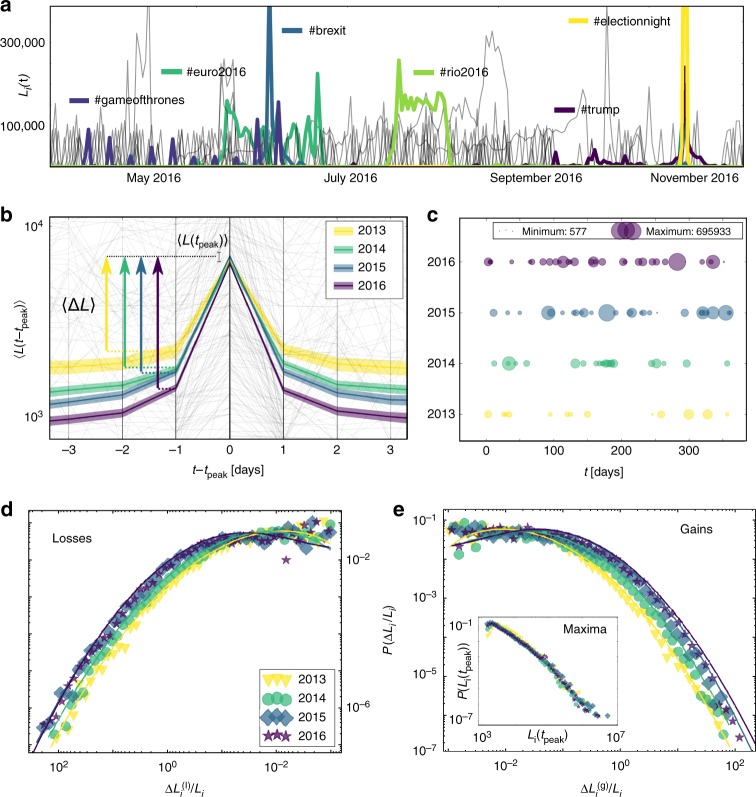
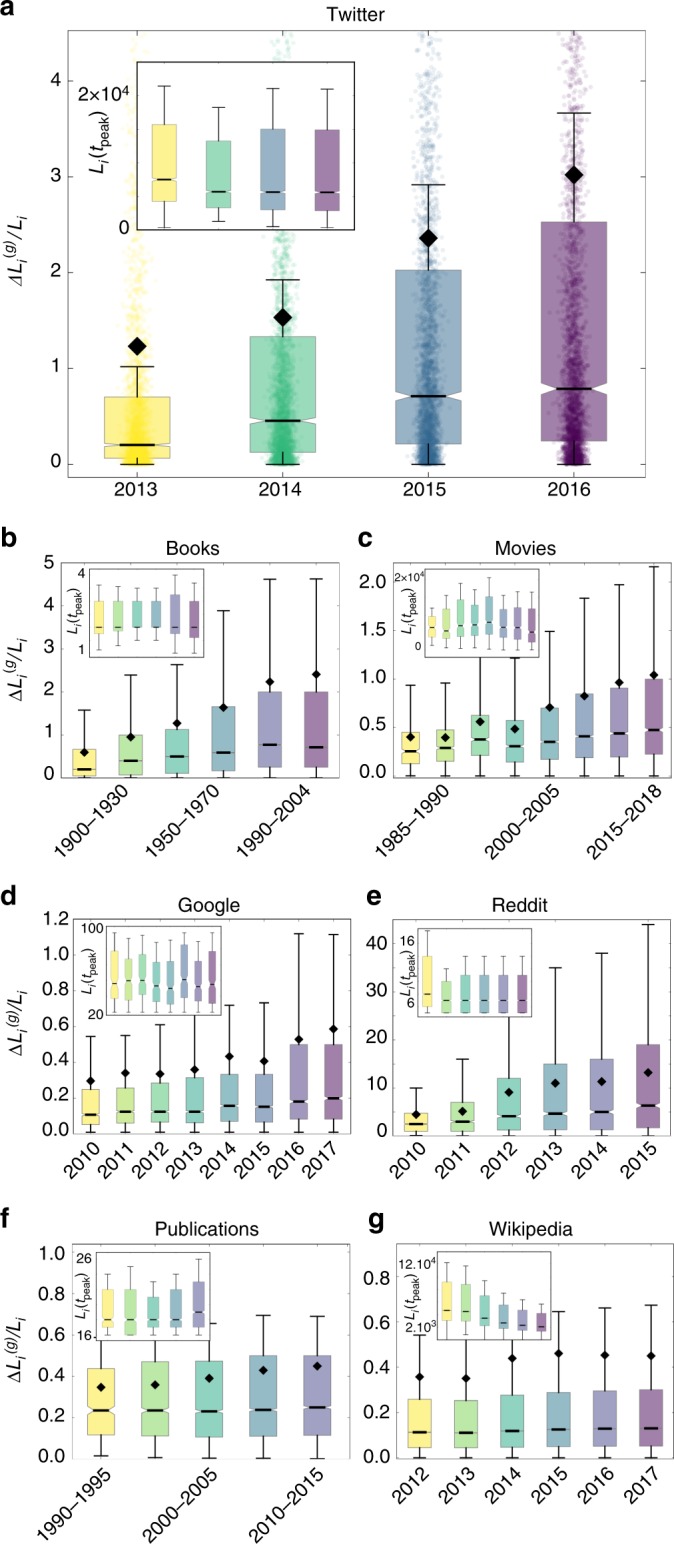
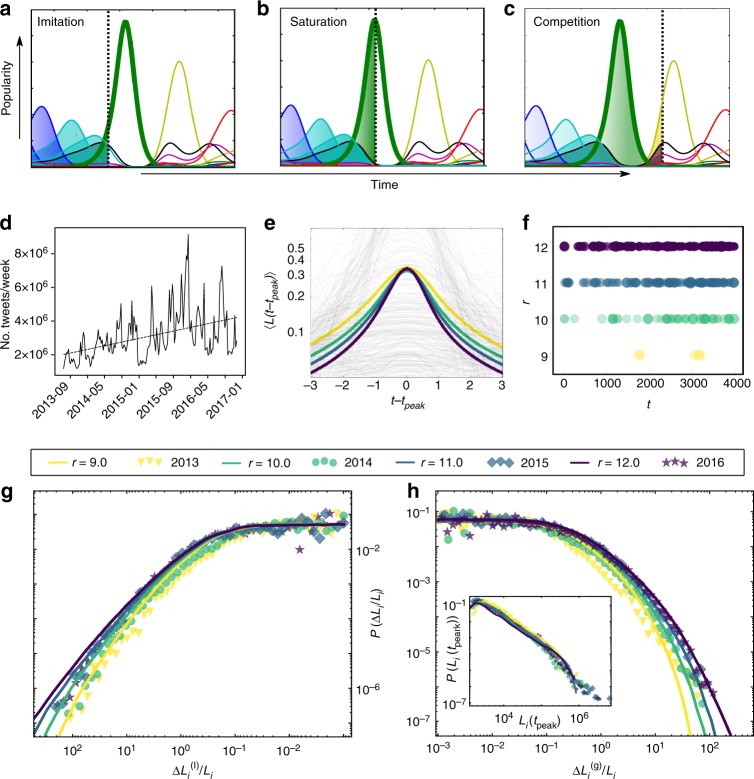
Verification
Claims the paper makes
The claims and statistics of this paper haven’t been checked yet.
Run the check — free, no account needed. It reads the open-access text and checks the sources it cites.
Claims other papers make about this one
Each is checked against this paper’s own text: does it say what the citing paper says it does?
In the citing paper
“The datasets used in this work have been collected, analyzed and validated in previous works [2-4].”
From Modeling echo chambers and polarization dynamics in social networks (2020) · cites this paper as [3]
Self-check
Percentages, sums and reported differences re-computed from the paper’s own numbers.
The self-check needs the paper’s full text.
Citations
Cites
Rogers, E. M., Singhal, A., & Quinlan, M. M. (2019) · Routledge eBooks · doi:10.4324/9780203710753-35 · Cited by 37,670
The spread of true and false news online
Vosoughi, S., Roy, D., & Aral, S. (2018) · Science · doi:10.1126/science.aap9559 · Cited by 8,847
Power-Law Distributions in Empirical Data
Clauset, A., Shalizi, C. R., & Newman, M. E. J. (2009) · SIAM Review · doi:10.1137/070710111 · Cited by 8,019
Self-organized criticality: An explanation of the 1/ f noise
Bak, P., Tang, C., & Wiesenfeld, K. A. (1987) · Physical Review Letters · doi:10.1103/physrevlett.59.381 · Cited by 7,644
The Kolmogorov-Smirnov Test for Goodness of Fit
Massey, F. J. (1951) · Journal of the American Statistical Association · doi:10.1080/01621459.1951.10500769 · Cited by 7,210
Stanton, B. F., & Rogers, E. M. (1963) · Journal of Farm Economics · doi:10.2307/1235767 · Cited by 6,726
Cramming More Components Onto Integrated Circuits
Moore, G. E. (1998) · Proceedings of the IEEE · doi:10.1109/jproc.1998.658762 · Cited by 5,954
Lazer, D. M. J., Baum, M. A., Benkler, Y., Berinsky, A. J., Greenhill, K. M., Menczer, F., Metzger, M. J., Nyhan, B., Pennycook, G., Rothschild, D., et al. (2018) · Science · doi:10.1126/science.aao2998 · Cited by 4,160
The Kolmogorov-Smirnov Test for Goodness of Fit
Massey, F. J. (1951) · Journal of the American Statistical Association · doi:10.2307/2280095 · Cited by 3,690
Quantitative Analysis of Culture Using Millions of Digitized Books
Michel, J.-B., Shen, Y. K., Aiden, A. P., Veres, A., Gray, M. K., The Google Books Team, Pickett, J. P., Hoiberg, D., Clancy, D., Norvig, P., et al. (2010) · Science · doi:10.1126/science.1199644 · Cited by 3,235
Research works printed but not linked: 4
- Salganik, M. J. Bit by Bit: Social Research in the Digital Age (Princeton, NJ: Princeton University Press, 2017).
- Simon, H. A. Designing organizations for an information-rich world. In M. Greenberge (Ed.), Computers communications, and the public interest (pp. 37-52) (Baltimore, MD: John Hopkins Press, 1971).
- Requested at: https://journals.aps.org/datasets. Accessed July 5, 2018.
- Rogers, E. M. Communication Technology, vol. 1 (New York: Simon and Schuster, 1986).
Cited by
Sorted by citations
Items 101–200 of 304
The brain digitalization: it's all happening so fast!
Boulos, L. (2024) · Frontiers in Human Dynamics · doi:10.3389/fhumd.2024.1475438 · Cited by 9
Grietens, K. P., Kingori, P., Friesen, P., Gerrets, R. P., Douglas‐Jones, R., & Kuhn, G. (2022) · Science & Technology Studies · doi:10.23987/sts.115410 · Cited by 6
Zaman, F. A., Isom, N., Chang, A., Wang, Y. G., Abdelhamid, A., Khan, A., Makan, M., Abdelghany, M., Wu, X., & Liu, K. (2023) · European Heart Journal - Digital Health · doi:10.1093/ehjdh/ztad077 · Cited by 6
Chang, A., Wu, X., & Liu, K. (2024) · Biophysics Reviews · doi:10.1063/5.0176850 · Cited by 6
NFTracer: Tracing NFT Impact Dynamics in Transaction-Flow Substitutive Systems With Visual Analytics
Cao, Y., Shi, Q., Shen, L., Chen, K., Wang, Y., Zeng, W., & Qu, H. (2024) · IEEE Transactions on Visualization and Computer Graphics · doi:10.1109/tvcg.2024.3402834 · Cited by 7
Chan, H. F., Bodiuzzman, S. M., & Torgler, B. (2020) · Journal of Informetrics · doi:10.1016/j.joi.2020.101077 · Cited by 6
On the Potentials of Artificial Intelligence in Marketing – The Case of Robotic Process Automation
Perret, J. K., & Heitkamp, M. (2021) · International Journal of Applied Research in Management and Economics · doi:10.33422/ijarme.v4i4.768 · Cited by 6
Terrorist attacks sharpen the binary perception of “Us” vs. “Them”
Jović, M., Šubelj, L., Golob, T., Makarovič, M., Yasseri, T., Krstićev, D. B., Škrbić, S., & Levnajić, Z. (2023) · Scientific Reports · doi:10.1038/s41598-023-39035-3 · Cited by 9
Time Pressure Reduces Misinformation Discrimination Ability But Does Not Alter Response BiasPreprint
Sultan, M., Tump, A. N., Geers, M., Lorenz-Spreen, P., Herzog, S. M., & Kurvers, R. H. J. M. (2022) · doi:10.31234/osf.io/brn5s · Cited by 6
Self-citationGrüning, D. J. (2022) · Futures & Foresight Science · doi:10.1002/ffo2.137 · Cited by 8
Social Media Is a Threat for Democracy! A Political Perspective for Analysing and Diminishing Harm
Castelló, I., Colleoni, E., Scherer, A. G., & Trittin‐Ulbrich, H. (2025) · Journal of Management Studies · doi:10.1111/joms.70053 · Cited by 5
Is it getting harder to make a hit? Evidence from 65 years of US music chart history
Lech, M. E., Lehmann, S., & Juul, J. L. (2025) · EPJ Data Science · doi:10.1140/epjds/s13688-025-00571-9 · Cited by 5
Self-citationExploring cognitive inertia in opinion dynamics using an activity-driven model
Pranesh, S., & Gupta, S. (2024) · Chaos Solitons & Fractals · doi:10.1016/j.chaos.2024.115879 · Cited by 5
Neo, R. (2022) · Social Media + Society · doi:10.1177/20563051221077014 · Cited by 5
Jayles, B., Sire, C., & Kurvers, R. H. J. M. (2020) · doi:10.31234/osf.io/4n8bh · Cited by 5
Junk news bubbles modelling the rise and fall of attention in online arenas
Castaldo, M., Venturini, T., Frasca, P., & Gargiulo, F. (2021) · New Media & Society · doi:10.1177/1461444820978640 · Cited by 32
Fazzari, L., Vardi, R., Jarić, I., Correia, R. A., Marta Coll, M., & Sbragaglia, V. (2024) · Biological Invasions · doi:10.1007/s10530-024-03420-4 · Cited by 4
Bublitz, C. (2025) · Human Rights Review · doi:10.1007/s12142-025-00751-0 · Cited by 5
Müller, F. (2021) · Springer eBooks · doi:10.1007/978-3-658-32640-1_3 · Cited by 4
The Human Governance Problem: Complex Systems and the Limits of Human Cognition
Atreides, K. (2023) · Filozofia i Nauka · doi:10.37240/fin.2023.11.1.4 · Cited by 4
Shape patterns in popularity series of video games
da Cunha, L. R., Pessa, A. A. B., & Mendes, R. S. (2024) · Chaos Solitons & Fractals · doi:10.1016/j.chaos.2024.115081 · Cited by 4
Nabożny, A., Balcerzak, B., Wierzbicki, A., Morzy, M., & Chlabicz, M. (2021) · JMIR Medical Informatics · doi:10.2196/26065 · Cited by 7
Cognitive forces shape the dynamics of word usage across multiple languages
Pintos, A. P., Shalóm, D. E., Tagliazucchi, E., Mindlin, G. B., & Trevisan, M. A. (2022) · Chaos Solitons & Fractals · doi:10.1016/j.chaos.2022.112327 · Cited by 4
Chemophobia and passion: why chemists should desire Marcel Proust
Chalupa, R., & Nesměrák, K. (2022) · Monatshefte für Chemie - Chemical Monthly · doi:10.1007/s00706-022-02945-5 · Cited by 4
Stelz, L., Scholten, J., Sándor, B., & Gros, C. (2021) · The European Physical Journal B · doi:10.1140/epjb/s10051-021-00173-0 · Cited by 4
Antecedents of Binge-Scrolling Short-form Videos
Karunakaran, R., R, G., Ram, M. K., & S, A. (2022) · 2022 International Conference on Innovations in Science and Technology for Sustainable Development (ICISTSD) · doi:10.1109/icistsd55159.2022.10010460 · Cited by 3
A Law of One's Own: The Inefficacy of the DMCA for Non-Consensual Intimate Media
Qiwei, L., Zhang, S., Pratt, S. P., Kasper, A. T., Gilbert, É., & Schoenebeck, S. Y. (2025) · CHI Conference on Human Factors in Computing Systems · doi:10.1145/3706598.3713334 · Cited by 3
From activism to polarization: temporal dynamics of #MeToo politicization on Twitter/X
Suk, J., Zhang, Y., Wang, R., Yang, D., Levin, S. H., Seo, J. M., & Dong, X. (2025) · Information Communication & Society · doi:10.1080/1369118x.2025.2581014 · Cited by 4
Zollo, S., Sangiorgio, E., Etta, G., Marco, N. D., Cinelli, M., Cerqueti, R., & Quattrociocchi, W. (2026) · Technological Forecasting and Social Change · doi:10.1016/j.techfore.2026.124668 · Cited by 6
Mining for Meaning : using computational text analysis for social inquiry
Bodell, M. H. (2024) · Institute for Analytical Sociology dissertation series · doi:10.3384/9789180756181 · Cited by 4
Yüce, A. E. (2024) · Psikiyatride Guncel Yaklasimlar - Current Approaches in Psychiatry · doi:10.18863/pgy.1433144 · Cited by 3
Incorporating Word Significance into Aspect-Level Sentiment Analysis
Mokhosi, R., Qin, Z., Liu, Q., & Shivachi, C. S. (2019) · Applied Sciences · doi:10.3390/app9173522 · Cited by 3
On the Dual Nature of Adoption Processes in Complex Networks
Iacopini, I., & Latora, V. (2021) · Frontiers in Physics · doi:10.3389/fphy.2021.604102 · Cited by 3
Quantifying the drivers behind collective attention in information ecosystems
Calleja-Solanas, V., Pigani, E., Palazzi, M. J., Solé‐Ribalta, A., Suweis, S. S., Borge‐Holthoefer, J., & Meloni, S. (2021) · Journal of Physics Complexity · doi:10.1088/2632-072x/ac35b6 · Cited by 4
On the dynamics of reporting data: A case study of UFO sightings
Antonio, F. J., Itami, A. S., Dalmedico, J. F., & Mendes, R. S. (2022) · Physica A Statistical Mechanics and its Applications · doi:10.1016/j.physa.2022.127807 · Cited by 3
Collective attention dynamic induced by novelty decay
Li, Z., Tang, X., & Zhen-jie, H. (2022) · The European Physical Journal B · doi:10.1140/epjb/s10051-022-00385-y · Cited by 3
Improving the learning effectiveness of educational videos
Salim, F. A., & Ferreira, J. M. M. (2023) · IEEE Global Engineering Education Conference (EDUCON) · doi:10.1109/educon54358.2023.10125215 · Cited by 3
Redler, J., Rolke, L., & Giuliano, G. (2023) · Europäische Kulturen in der Wirtschaftskommunikation · doi:10.1007/978-3-658-40705-6_4 · Cited by 3
Sun, H., & Xu, J. (2023) · Journal of Broadcasting & Electronic Media · doi:10.1080/08838151.2023.2298276 · Cited by 3
Fading of collective attention shapes the evolution of linguistic variants
Shalóm, D. E., Sigman, M., Mindlin, G. B., & Trevisan, M. A. (2019) · Physical review. E · doi:10.1103/physreve.100.020102 · Cited by 3
El autor como marca o las inestabilidades de la fama: el caso Rowling
Cordón-García, J.-A., & Rico, M. M. (2019) · Ocnos Revista de Estudios sobre Lectura · doi:10.18239/ocnos_2019.18.3.2053 · Cited by 3
Pescetelli, N., Rutherford, A., & Rahwan, I. (2020) · doi:10.31234/osf.io/b8q2c · Cited by 2
Automated Interpretation of Myocardial Perfusion Images
Sengupta, P. P., & Tokodi, M. (2022) · JACC. Cardiovascular imaging · doi:10.1016/j.jcmg.2022.04.017 · Cited by 3
Online Attention Dynamics in Social Media
Castaldo, M., Frasca, P., & Venturini, T. (2023) · doi:10.1002/9781119857433.ch18 · Cited by 3
On Collective Dynamics of Academic Journals: Polarization, Fluctuation, and Robustness
Cai, N., Liu, L., & Cao, J. (2025) · IEEE Transactions on Computational Social Systems · doi:10.1109/tcss.2025.3546474 · Cited by 2
Critical ignoring when information abundance is detrimental to democracy
Lewandowsky, S., & Hertwig, R. (2025) · Current Opinion in Psychology · doi:10.1016/j.copsyc.2025.102128 · Cited by 5
Beyond Desynchronization: The Impact of Social Jetlag on Tourists’ Venturesomeness
Fan, X., Yang, Y., & Li, C. (2025) · Journal of Travel Research · doi:10.1177/00472875251385074 · Cited by 2
Saito, R., Takano, R., Pertiwi, P. P., Khoiriyah, M., Aotani, A., Miura, H., Muramoto, T., & Murao, O. (2026) · Journal of Disaster Research · doi:10.20965/jdr.2026.p0181 · Cited by 1
Dominance or Fair Play in Social Networks? A Model of Influencer Popularity Dynamics
Galante, F., Ravazzi, C., Vassio, L., Garetto, M., & Leonardi, E. (2026) · Lecture notes in computer science · doi:10.1007/978-3-032-13821-7_26 · Cited by 2
Elishar-Malka, V., & Ariel, Y. (2026) · Journalism and Media · doi:10.3390/journalmedia7020116 · Cited by 2
Attracting Attention in the Age of Digital Addiction
Bulur, N. (2026) · IGI Global eBooks · doi:10.4018/979-8-3373-6665-4.ch010 · Cited by 2
It’s just a tiny label… or not? How AI labels can backfire in communication
Berner, M., & Dickel, P. (2026) · Journal of Marketing Communications · doi:10.1080/13527266.2026.2697265 · Cited by 2
The Disinformation Age: Toward a Net Assessment of the United Kingdom’s Cognitive Domain
Ottewell, P. (2022) · Expeditions with MCUP · doi:10.36304/expwmcup.2022.03 · Cited by 2
Can God Be an AI With Robo-Priests?
Michael, M. G., Michael, K., & Bookman, T. (2023) · IEEE Transactions on Technology and Society · doi:10.1109/tts.2023.3238960 · Cited by 2
Нестик, Т. А., Bochkarev, V. V., & Levina, V. (2023) · Communications in computer and information science · doi:10.1007/978-3-031-33728-4_9 · Cited by 2
Bunjamin, T. S., Aprilian, E. E., Ananda, A. S., & Polla, J. R. (2024) · Riwayat Educational Journal of History and Humanities · doi:10.24815/jr.v7i1.36874 · Cited by 2
The rising entropy of English in the attention economy
Pilgrim, C., Guo, W., & Hills, T. T. (2024) · Communications Psychology · doi:10.1038/s44271-024-00117-1 · Cited by 2
Zhang, G., Wu, J., Jeon, G., Wang, P., Chen, Y., Wang, Y., & Tan, M. (2024) · IEEE Transactions on Computational Social Systems · doi:10.1109/tcss.2024.3414586 · Cited by 3
Highly engaging events reveal semantic and temporal compression in online community discourse
Desiderio, A., Mancini, A., Cimini, G., & Clemente, R. D. (2025) · PNAS Nexus · doi:10.1093/pnasnexus/pgaf056 · Cited by 8
Singer, M. F., & Jones, O. E. (2025) · Societies · doi:10.3390/soc15050134 · Cited by 2
Reducing echo chamber effects: an allostatic regulator for recommendation algorithms
Henry, N., Pedersen, M., Williams, M. N., Martin, J. L. B., & Donkin, L. (2025) · Journal of Psychology and AI · doi:10.1080/29974100.2025.2517191 · Cited by 3
Similar but… The Trend of Xenophobia in Hungary and Poland
Surányi, R., & Sik, E. (2025) · Central and Eastern European Migration Review · doi:10.54667/ceemr.2025.24 · Cited by 2
Kowalczyk, D. K., & Hansen, L. K. (2020) · Technical University of Denmark, DTU Orbit (Technical University of Denmark, DTU) · Cited by 2
Upscaling human activity data: A statistical ecology approach
Tovo, A., Stivanello, S., Maritan, A., Suweis, S. S., Favaro, S., & Formentin, M. (2021) · PLoS ONE · doi:10.1371/journal.pone.0253461 · Cited by 2
Professional Impact in the Construction Industry
Mair, K. (2021) · Structural integrity · doi:10.1007/978-3-030-82430-3_27 · Cited by 2
A Computational Turn in Policy Process Studies: Coevolving Network Dynamics of Policy Change
Stauffer, M., Mengesha, I., Seifert, K., Krawczuk, I., Fischer, J., & Serugendo, G. D. M. (2022) · Complexity · doi:10.1155/2022/8210732 · Cited by 2
To Engage, Inform, and Inspire
Houran, J. (2023) · Journal of Scientific Exploration · doi:10.31275/20233131 · Cited by 2
The Online Vaccine Debate: Study of a Visual Analytics System
Ninkov, A., & Sedig, K. (2020) · Informatics · doi:10.3390/informatics7010003 · Cited by 2
An Intelligent Social Collective with Facebook-Based Communication
Maleszka, M. (2021) · Lecture notes in computer science · doi:10.1007/978-3-030-77967-2_36 · Cited by 2
Diffusion approximation of a network model of meme popularity
Oliveira, K. A., Unicomb, S., & Gleeson, J. P. (2023) · Physical Review Research · doi:10.1103/physrevresearch.5.023079 · Cited by 1
The Everyday Use of Digital Technology
Turner, P. (2023) · Human-computer interaction series · doi:10.1007/978-3-031-32454-3_1 · Cited by 1
Oladeji, A. D., Popoola, B. O., & Olanrewaju, M. K. (2024) · Jurnal Penelitian dan Pengembangan Sains dan Humaniora · doi:10.23887/jppsh.v8i1.78202 · Cited by 1
Temler, M., Paterson, H. M., & MacCann, C. (2024) · Discover Psychology · doi:10.1007/s44202-024-00252-0 · Cited by 1
Zhang, G., Wu, J., Jeon, G., & Wang, P. (2024) · Expert Systems · doi:10.1111/exsy.13766 · Cited by 3
AUDIO BRANDING GUIDANCE MODEL IN THE CASE OF SMALL AND MEDIUM-SIZED BUSINESSES
Kisieliauskas, J., Šiburkis, J., & Bakanauskas, P. (2024) · Baltic Journal of Economic Studies · doi:10.30525/2256-0742/2024-10-4-32-43 · Cited by 1
The Impact of Ad Length on Ad Effectiveness: Do Micro Ads Work?
Fossen, B. L., Kim, P., & Chae, I. (2025) · Journal of Marketing · doi:10.1177/00222429251350657 · Cited by 1
A brief theoretical examination of late modern cultural reality
Clausen, A. K. (2025) · Theory & Psychology · doi:10.1177/09593543251378107 · Cited by 1
Social media impact on public attention: Paris Olympics case study
Zhang, M., & Liao, Y. (2025) · PLoS ONE · doi:10.1371/journal.pone.0336136 · Cited by 1
Extracting socio-psychological perceptions for analysis of travel behaviours
Xu, Y., Krishnakumari, P., Yorke‐Smith, N., & Hoogendoorn, S. P. (2025) · Travel Behaviour and Society · doi:10.1016/j.tbs.2025.101197 · Cited by 1
Choi, S., Liu, A., Lee, S. E., Yoon, H.-C., & Kam, J. (2025) · Humanities and Social Sciences Communications · doi:10.1057/s41599-025-06398-z · Cited by 2
Gao, M., Zhang, J., & Zhang, J. (2025) · International Journal of Educational Technology in Higher Education · doi:10.1186/s41239-025-00575-5 · Cited by 6
Mapping the pulse of environmental discourse: fifteen years of Reddit and Google trends
Yee, T. B. L., Carrasco, L. R., & Jaidka, K. (2026) · Quality & Quantity · doi:10.1007/s11135-026-02640-1 · Cited by 1
Engineering collective attention in the age of artificial intelligence
Zhu, R. (2026) · Discover Artificial Intelligence · doi:10.1007/s44163-026-01084-8 · Cited by 1
Skonieczny, K. (2026) · Journal of Philosophy of Education · doi:10.1093/jopedu/qhag006 · Cited by 1
Balázs, L. (2026) · Social Sciences · doi:10.3390/socsci15070433 · Cited by 2
Trajkovski, G. P., & Fabregat, E. (2022) · Advances in educational technologies and instructional design book series · doi:10.4018/978-1-7998-9644-9.ch011 · Cited by 1
Nardi, A. (2022) · Studi e saggi · doi:10.36253/978-88-5518-501-1 · Cited by 3
CRM für das eigene Verhalten als Führungskraft
Rall, M., & Langewand, S. (2022) · Erfolgskonzepte Praxis- & Krankenhaus-Management · doi:10.1007/978-3-662-60288-1_5 · Cited by 1
Carpio, A. J., García, M. D. L. N. G., Baptista, J. S., & Rodrigues, F. (2022) · Studies in systems, decision and control · doi:10.1007/978-3-031-12547-8_1 · Cited by 1
Backer behaviors – changing investment dynamics in equity crowdfunding markets
Olsson, O. (2023) · Baltic Journal of Management · doi:10.1108/bjm-06-2022-0210 · Cited by 1
Consumer Preferences and Attitudes in Debt Collection: A Cross-Generational Investigation
Goetze, M., Herdt, C., Conrad, R., & Stricker, S. (2023) · International Journal of Marketing Studies · doi:10.5539/ijms.v15n2p1 · Cited by 4
How position in the network determines the fate of lexical innovations on Twitter
Tarrade, L., Chevrot, J., & Magué, J.-P. (2024) · PLOS complex systems. · doi:10.1371/journal.pcsy.0000005 · Cited by 6
Method for Mitigating Attention to Inappropriate Content Based on Attention Dynamics Model
Hirakura, N. (2025) · IEEE Access · doi:10.1109/access.2025.3561496 · Cited by 1
Fractional stochastic model of citation dynamics with memory and volatility
Okamura, K. (2025) · Physical review. E · doi:10.1103/l2xd-43n9
How Often Should I Access My Online Social Networks?
Hargreaves, E. M., Menasché, D., & Neglia, G. (2019) · IEEE/ACM International Symposium on Modeling, Analysis, and Simulation On Computer and Telecommunication Systems · doi:10.1109/mascots.2019.00028 · Cited by 1
Digitalisierung und Demokratie
Herzog, L. M. (2020) · Franz Steiner Verlag eBooks · doi:10.25162/9783515128278 · Cited by 1
Über die Bedürfnisse innovationsaffiner Konsumenten bzgl. E-Mobilität in Deutschland
Lucas, C. (2022) · Schriftenreihe Logistik und Supply Chain Management · doi:10.20378/irb-58363 · Cited by 1
Information Foraging in the Attention Economy Drives the Rising Entropy of EnglishPreprint
Pilgrim, C., Guo, W., & Hills, T. T. (2023) · RePEc: Research Papers in Economics · Cited by 1
Meaning and attention intertwined: Experimental and experience-sampling findingsPreprint
Tam, K. Y. Y., van Tilburg, W. A. P., Chan, C. S., & Inzlicht, M. (2024) · PsyArXiv (OSF Preprints) · doi:10.31234/osf.io/f5t9u · Cited by 1
Commentary on Sources of Attention-Deficit/Hyperactivity Overdiagnosis Among U.S. Adults
Weber, S. R. (2025) · Healthcare · doi:10.3390/healthcare13182367 · Cited by 2
Metadata
- Authors
- Lorenz-Spreen, P., Mønsted, B. M., Hövel, P., & Lehmann, S.
- Affiliations
- Max Planck Institute for Human Development (DE)
- Technical University of Denmark (DK)
- University College Cork (IE)
- University of Copenhagen (DK)
- Corresponding author
- Hövel, Philipp
- Lehmann, Sune
- Venue
- Nature Communications
- Published
- 2019-04-15
- Volume
- 10
- Issue
- 1
- Pages
- 1759-1759
- ISSN
- 2041-1723 (ISSN-L)
- PMC
- PMC6465266
- OpenAlex
- W2939088842
- Cited by
- 304
- References
- 38
- Citations by year
- 2026: 46 · 2025: 51 · 2024: 40 · 2023: 43 · 2022: 45 · 2021: 41 · 2020: 32 · 2019: 6
- FWCI
- 14.47
- Type
- journal article
- Language
- en
- Open access
- gold
- doi.org
- Locations
- Nature Communications (publishedVersion, cc-by)
- Europe PMC (PubMed Central) (publishedVersion, cc-by)
- PubMed Central (publishedVersion, cc-by)
- PubMed (publishedVersion)
- Research at the University of Copenhagen (University of Copenhagen) (publishedVersion, cc-by)
- Arrow@dit (Dublin Institute of Technology) (acceptedVersion)
- RePEc: Research Papers in Economics (submittedVersion)
- Cork Open Research Archive (University College Cork, Ireland) (submittedVersion, cc-by)
- DOAJ (DOAJ: Directory of Open Access Journals) (submittedVersion)
- DOAJ (DOAJ: Directory of Open Access Journals) (submittedVersion, cc-by-sa)
- Technical University of Denmark, DTU Orbit (Technical University of Denmark, DTU) (submittedVersion, other-oa)
- MPG.PuRe (Max Planck Society) (submittedVersion, other-oa)
- Funders
- Deutsche Forschungsgemeinschaft
- Topics
- Physical Sciences › Physics and Astronomy › Statistical and Nonlinear Physics › Complex Network Analysis Techniques
- Social Sciences › Economics, Econometrics and Finance › Economics and Econometrics › Complex Systems and Time Series Analysis
- Social Sciences › Communication › Digital Media and Philosophy
- Keywords
- collective attention, attention dynamics, cultural artifacts, popularity, social media
- MeSH terms
- Attention, Humans, Models, Theoretical, Information Dissemination, Social Media
About these checks
Registry, retraction, Cites and statistics results are computed, not judged, with one exception: a printed reference that no index lists is read once by a model before it counts as a citation error. Claims are extracted by a model and kept only when their quote appears verbatim in the text; each cited source is then checked, with a model’s help, for whether it says what the claim relies on. Those verdicts can be wrong — read the claim’s quote and the cited source before relying on one.
Statistics and arithmetic are recomputed, not judged.
Confidence bands are shown only for fields calibrated on our annotated test set. None is calibrated yet, so no band is shown.
What counts as a claim ›How we measure confidence ›How we check this ›
Are you an author, or do you see a problem with this page? Request a review
