

The DOI matches its Crossref record; 37 of the 38 references it cites were found in a registry or an index.
Accelerating dynamics of collective attention
Open accessAbstract
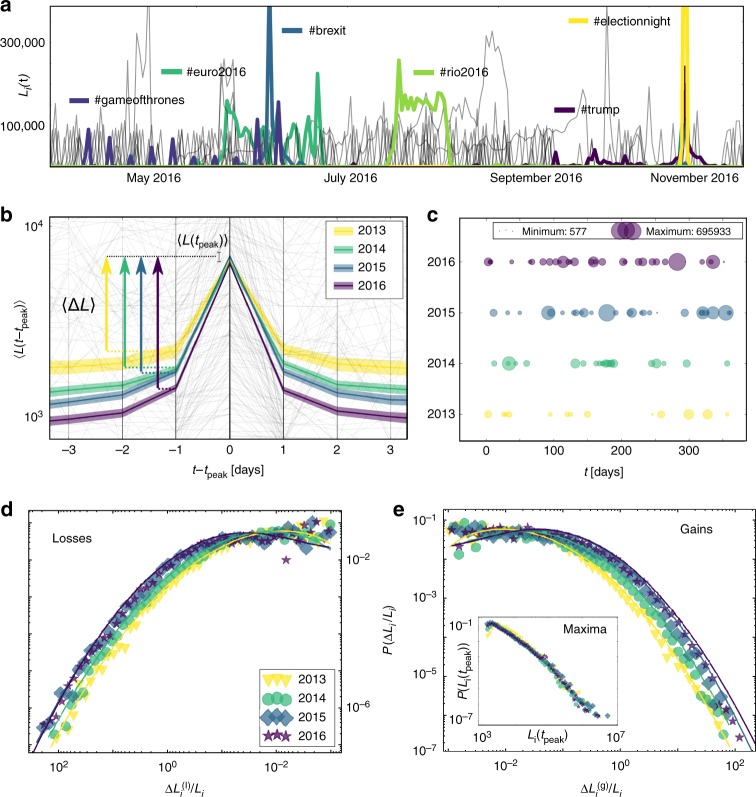
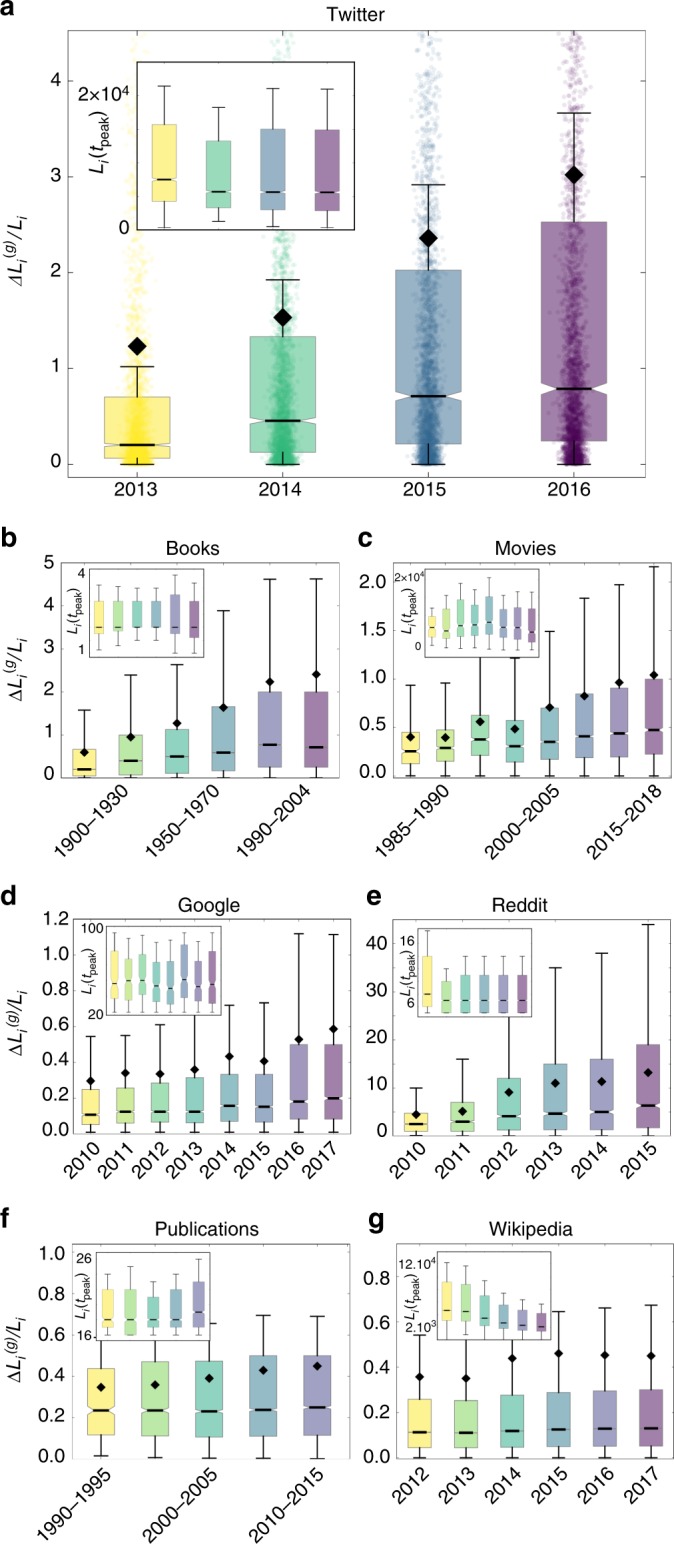
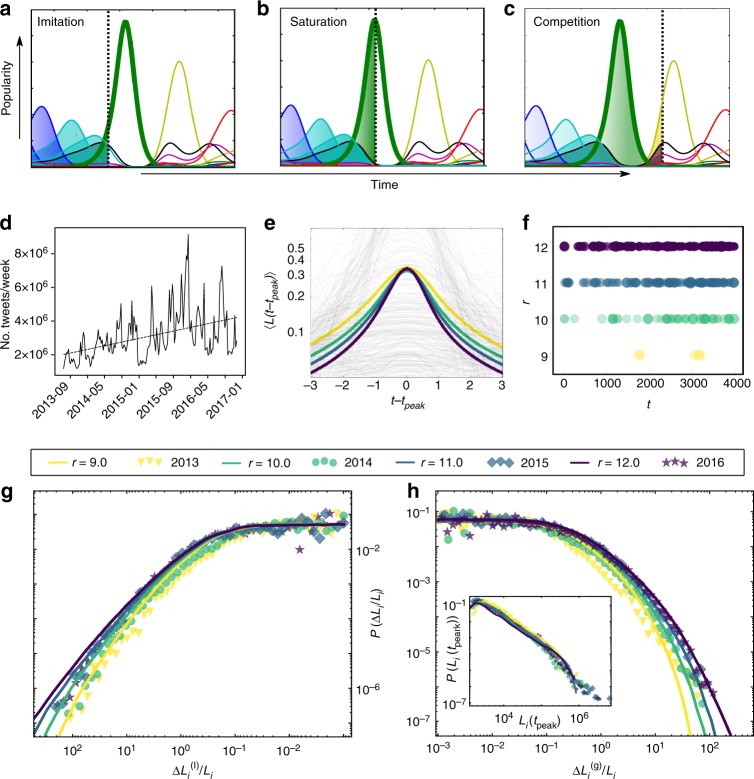
With news pushed to smart phones in real time and social media reactions spreading across the globe in seconds, the public discussion can appear accelerated and temporally fragmented. In longitudinal datasets across various domains, covering multiple decades, we find increasing gradients and shortened periods in the trajectories of how cultural items receive collective attention. Is this the inevitable conclusion of the way information is disseminated and consumed? Our findings support this hypothesis. Using a simple mathematical model of topics competing for finite collective attention, we are able to explain the empirical data remarkably well. Our modeling suggests that the accelerating ups and downs of popular content are driven by increasing production and consumption of content, resulting in a more rapid exhaustion of limited attention resources. In the interplay with competition for novelty, this causes growing turnover rates and individual topics receiving shorter intervals of collective attention.
Overview
The claims and statistics of this paper haven’t been checked yet.
Run the check — free, no account needed. It reads the open-access text and checks the sources it cites.
Integrity signals
Registry
Cites
Statistics
Figures
Verification
Claims the paper makes
The claims and statistics of this paper haven’t been checked yet.
Run the check — free, no account needed. It reads the open-access text and checks the sources it cites.
Claims other papers make about this one
Each is checked against this paper’s own text: does it say what the citing paper says it does?
In the citing paper
“The datasets used in this work have been collected, analyzed and validated in previous works [2-4].”
From Modeling echo chambers and polarization dynamics in social networks (2020) · cites this paper as [3]
Self-check
Percentages, sums and reported differences re-computed from the paper’s own numbers.
The self-check needs the paper’s full text.
Citations
Cites
Rogers, E. M., Singhal, A., & Quinlan, M. M. (2019) · Routledge eBooks · doi:10.4324/9780203710753-35 · Cited by 37,670
The spread of true and false news online
Vosoughi, S., Roy, D., & Aral, S. (2018) · Science · doi:10.1126/science.aap9559 · Cited by 8,847
Power-Law Distributions in Empirical Data
Clauset, A., Shalizi, C. R., & Newman, M. E. J. (2009) · SIAM Review · doi:10.1137/070710111 · Cited by 8,019
Self-organized criticality: An explanation of the 1/ f noise
Bak, P., Tang, C., & Wiesenfeld, K. A. (1987) · Physical Review Letters · doi:10.1103/physrevlett.59.381 · Cited by 7,644
The Kolmogorov-Smirnov Test for Goodness of Fit
Massey, F. J. (1951) · Journal of the American Statistical Association · doi:10.1080/01621459.1951.10500769 · Cited by 7,210
Stanton, B. F., & Rogers, E. M. (1963) · Journal of Farm Economics · doi:10.2307/1235767 · Cited by 6,726
Cramming More Components Onto Integrated Circuits
Moore, G. E. (1998) · Proceedings of the IEEE · doi:10.1109/jproc.1998.658762 · Cited by 5,954
Lazer, D. M. J., Baum, M. A., Benkler, Y., Berinsky, A. J., Greenhill, K. M., Menczer, F., Metzger, M. J., Nyhan, B., Pennycook, G., Rothschild, D., et al. (2018) · Science · doi:10.1126/science.aao2998 · Cited by 4,160
The Kolmogorov-Smirnov Test for Goodness of Fit
Massey, F. J. (1951) · Journal of the American Statistical Association · doi:10.2307/2280095 · Cited by 3,690
Quantitative Analysis of Culture Using Millions of Digitized Books
Michel, J.-B., Shen, Y. K., Aiden, A. P., Veres, A., Gray, M. K., The Google Books Team, Pickett, J. P., Hoiberg, D., Clancy, D., Norvig, P., et al. (2010) · Science · doi:10.1126/science.1199644 · Cited by 3,235
Research works printed but not linked: 4
- Salganik, M. J. Bit by Bit: Social Research in the Digital Age (Princeton, NJ: Princeton University Press, 2017).
- Simon, H. A. Designing organizations for an information-rich world. In M. Greenberge (Ed.), Computers communications, and the public interest (pp. 37-52) (Baltimore, MD: John Hopkins Press, 1971).
- Requested at: https://journals.aps.org/datasets. Accessed July 5, 2018.
- Rogers, E. M. Communication Technology, vol. 1 (New York: Simon and Schuster, 1986).
Cited by
Sorted by citations
Items 201–300 of 304
Real-time Internet Control of Situated Human AgentsPreprint
Pescetelli, N., Cebrián, M., & Rahwan, I. (2020) · doi:10.31234/osf.io/xn7sr
Everything you always wanted to know about time management (but didn’t have time to ask)
Aeon, B. (2020) · Spectrum Research Repository (Concordia University)
Information Seeking as an Evolutionary Game
Brede, M. (2021) · Springer proceedings in complexity · doi:10.1007/978-3-030-81854-8_10
Mitigating the Climate Crisis Through Lakota Teachings
Cordova, I. M., Smith, A. J., & Ye, M. L. (2020)
Co-organising hackathons with students: opportunities and best practices
Correia, N. N. (2021) · Compass Journal of Learning and Teaching · doi:10.21100/compass.v14i2.1216
A shift from science to politics : a content analysis of COVID-19 Videos on YouTube (Preprint)Preprint
Shi, C.-F., So, M., Stelmach, S., Earn, A., Earn, D. J. D., & Dushoff, J. G. (2021) · doi:10.2196/preprints.33948
Bilder, soziale Medien und das Politische
(2021) · transcript Verlag eBooks · doi:10.1515/9783839450406
Bilder, soziale Medien und das Politische
Kanter, H., Brandmayr, M. C. 2. J., & Köffler, N. M. (2021) · Image · doi:10.14361/9783839450406
Digitalisierung und Demokratie
Mechnich, J., & Kallinich, D. (2019) · Journal für politische Bildung · doi:10.46499/1254.1679
Zeitdruck als kulturübergreifender Stressor
Immerfall, S. (2021) · Springer eBooks · doi:10.1007/978-3-658-27789-5_11
Zeitdruck als kulturübergreifender Stressor
Immerfall, S. (2020) · Springer eBooks · doi:10.1007/978-3-658-27825-0_11-1
Burstier Events: Analysing Human Memory Over a Century of Events Using The New York TimesPreprint
Austerweil, J. L., Pilgrim, C., & Cao, K. (2022) · doi:10.31234/osf.io/yt2bn
Fabregat, E., & Kperogi, F. A. (2022) · Howard Journal of Communications · doi:10.1080/10646175.2022.2108355
Coelho, R., & Dias, S. (2022) · Springer series in design and innovation · doi:10.1007/978-3-031-06809-6_19
Reconstructing social sensitivity from evolution of content volume in Twitter
Pinto, S., Trevisan, M. A., & Balenzuela, P. (2022) · Physical review. E · doi:10.1103/physreve.106.064308
Music Industry Trend Forecasting Based on MusicBrainz Metadata
Kopel, M., & Kreisich, D. (2022) · Lecture notes in computer science · doi:10.1007/978-3-031-21967-2_47
Good, Bad or Ugly: On the Quality of Economic Journalism
Müller, H. (2023) · Springer eBooks · doi:10.1007/978-3-031-31030-0_3
Brinch, I., & Ulvestad, J. (2023) · Rhetorica Scandinavica · doi:10.52610/rhs.v27i85.291
Turner, P. (2023) · Human-computer interaction series · doi:10.1007/978-3-031-32454-3_5
A model of phase-coupled delay equations for the dynamics of word usage
Pintos, A. P., Shalóm, D. E., Tagliazucchi, E., Mindlin, G. B., & Trevisan, M. A. (2023) · Chaos Solitons & Fractals · doi:10.1016/j.chaos.2023.113876
Making journals more relevant than ever
Galandiuk, S. (2023) · Surgery · doi:10.1016/j.surg.2023.09.010
THE IMPERATIVE OF OPINION: A PRAGMATIC SOCIOLOGY OF CRITIQUE IN ‘ACTUALITÉ POLITIQUE’
Werneck, A., Talone, V. D. G., & Gualande, A. (2023) · Sociologia & Antropologia · doi:10.1590/2238-38752023v13312
Innovatives Eyetracking zur Optimierung von Customer Touchpoints
Zweigle, T. M. (2023) · Springer eBooks · doi:10.1007/978-3-658-42294-3_13
Otomo, N., Mizuno, M., Sasahara, K., & Sano, Y. (2024) · Research Square · doi:10.21203/rs.3.rs-3856163/v1
Use of a Student-Ally in Emergency Remote Teaching
González-Urbina, L., & Sanfratello, A. (2024) · The journal of college science teaching · doi:10.1080/0047231x.2023.2292398
Delay model for the dynamics of information units in the digital environment
Pinto, S., Pintos, A. P., Balenzuela, P., & Trevisan, M. A. (2024) · Frontiers in Complex Systems · doi:10.3389/fcpxs.2024.1359092
Zuure, J. (2024) · doi:10.5463/thesis.580
The formation of inaccurate cognitive destination image from a memory process perspective
Shi, Y., Huang, Z., & Zhang, J. (2024) · Current Issues in Tourism · doi:10.1080/13683500.2024.2355570
Daudi, A. (2024) · doi:10.24834/isbn.9789178774890 · Cited by 1
Stilistische Tipps für Content-Manager*innen
Müller, T. (2024) · Quick Guide · doi:10.1007/978-3-658-45814-0_6
The HERISTEM (STEM in Heritage Sciences) Project: Communicating Archaeology During the Pandemic
Vuković, J., Klindžić, R. Š., Babić, S., & Novaković, P. (2024) · Interdisciplinary Contributions to Archaeology/Interdisciplinary contributions to archaeology · doi:10.1007/978-3-031-71276-0_12
Wie GenZ die Patient Journey verändert
Bergen, I. (2024) · Springer eBooks · doi:10.1007/978-3-662-69213-4_8
Zunahme der Katastrophen durch den Klimawandel?
Bouwer, L. M., & Trümper, S. (2024) · doi:10.37307/b.978-3-503-23843-9.04
Characterizing Collective Attention on Online Chats: A Three-Pronged Approach
Caetano, J. A., Marques-Neto, H. T., & Almeida, V. A. F. (2024) · Lecture notes in computer science · doi:10.1007/978-981-96-0567-5_5 · Cited by 2
Predictive Model of Cultural Product Search Interest Based on Collective Memory Hawkes Process
Li, K., Yu, Z., Zhang, Y., Xi, J., & Guo, B. (2024) · International Conference on Behavioral, Economic, and Socio-Cultural Computing · doi:10.1109/besc64747.2024.10780717
Vaih-Baur, C., & Droese, S. (2024) · The Journal of Social Science · doi:10.30520/tjsosci.1558456
4 Phasen der Nachhaltigkeitskommunikation
Wolf, K. (2024) · SDG - Forschung, Konzepte, Lösungsansätze zur Nachhaltigkeit · doi:10.1007/978-3-658-45227-8_12
Disinformation in group chat social media network
Shan, Y. (2025) · Journal of Economic Behavior & Organization · doi:10.1016/j.jebo.2025.106891 · Cited by 1
Otomo, N., Sasahara, K., Mizuno, M., & Sano, Y. (2025) · Journal of Computational Social Science · doi:10.1007/s42001-025-00380-0
Whither Global South’s Copyright Scholar(ship): Lost in the “Citation Game”?
Vyas, L. (2025) · GRURRR. Gewerblicher Rechtsschutz und Urheberrecht, Rechtsprechungs-Report/GRUR-DVD/GRUR-CD/IIC/Gewerblicher Rechtsschutz und Urheberrecht/Gewerblicher Rechtsschutz und Urheberrecht. Internationaler Teil · doi:10.1007/s40319-025-01572-x
Detection of anomalous spatio-temporal patterns of app traffic in response to catastrophic events
Medina, S., Babul, S., LaRock, T., Sahasrabuddhe, R., Lambiotte, R., & Pedreschi, N. (2025) · EPJ Data Science · doi:10.1140/epjds/s13688-025-00546-w
From Inattention to Attentiveness: Learning to Listen When Nature Speaks
Østergaard, E. (2025) · Phänomenologische Erziehungswissenschaft · doi:10.1007/978-3-658-47518-5_11 · Cited by 1
Stichpunktnachrichten als neue textbasierte Vermittlungsform
Treppner, T., Ollrog, M.-C., & Hanisch, M. (2025) · Europäische Kulturen in der Wirtschaftskommunikation · doi:10.1007/978-3-658-47591-8_5
Hochscherf, T., Kronewald, E., & Möller, C. (2025) · Zeitschrift für Politikwissenschaft · doi:10.1007/s41358-025-00423-y
Waldherr, A., Righetti, N., Gallagher, R. J., Klinger, K., Stoltenberg, D., Kumar, S., Ridley, D., & Welles, B. F. (2025) · Social Science Computer Review · doi:10.1177/08944393251364290
Multiplatform Early Predictors of Academic Articles' Visibility and Citations
C?rdova S?nchez, J., Hirose, T., Shi, H., Horv?t, E.-?., & Romero, D. M. (2025) · Deep Blue (University of Michigan) · doi:10.1145/3715928.3737492
A Strategy to Suppress Attention to Multiple Disseminators of Inappropriate Content
Hirakura, N. (2025) · International Symposium on Autonomous Decentralized Systems · doi:10.1109/isads66912.2025.00011
Timing and cross-platform presence shape the online dissemination of science
Córdova, J., Horvát, E.-Á., & Romero, D. M. (2025) · EPJ Data Science · doi:10.1140/epjds/s13688-025-00580-8
TikTok may be bad for privacy, but is it also harming our cognitive abilities?
McCormick, C. R. (2023) · doi:10.64628/aam.jffs7nup4
Reducing polarization in social networks with adversarial opinion perturbations
Zhang, L., Gong, L., & Huang, C. (2025) · Chaos Solitons & Fractals · doi:10.1016/j.chaos.2025.117294
Momentary symbols: Tracing the visual expressions of collectives
Johansen, E. B., Doerr, N., & Nielsen, M. W. (2025) · Acta Sociologica · doi:10.1177/00016993251379164
Huber, N. P. (2025) · Springer eBooks · doi:10.1007/978-3-658-48348-7_1
Adam, M., Rohr, J. K., Greuel, M., Nguyen, K., Aziz, M. A. E., Gates, J., Überreiter, C., Supady, A., & Bärnighausen, T. (2025) · Scientific Reports · doi:10.1038/s41598-025-26894-1
Games und Gamification. Zum Einsatz von Spielen und Spielelementen in der Lehre
Hebbel-Seeger, A. (2025) · Springer eBooks · doi:10.1007/978-3-658-48999-1_25
Additional file 2 of From science to politics: COVID-19 information fatigue on YouTube
Shi, C.-F., So, M. C., Stelmach, S., Earn, A., Earn, D. J. D., & Dushoff, J. G. (2022) · Figshare · doi:10.6084/m9.figshare.19642132
Additional file 6 of From science to politics: COVID-19 information fatigue on YouTube
Shi, C.-F., So, M. C., Stelmach, S., Earn, A., Earn, D. J. D., & Dushoff, J. G. (2022) · Figshare · doi:10.6084/m9.figshare.19642144
Additional file 3 of From science to politics: COVID-19 information fatigue on YouTube
Shi, C.-F., So, M. C., Stelmach, S., Earn, A., Earn, D. J. D., & Dushoff, J. G. (2022) · Figshare · doi:10.6084/m9.figshare.19642135
Additional file 1 of From science to politics: COVID-19 information fatigue on YouTube
Shi, C.-F., So, M. C., Stelmach, S., Earn, A., Earn, D. J. D., & Dushoff, J. G. (2022) · Figshare · doi:10.6084/m9.figshare.19642126
Additional file 4 of From science to politics: COVID-19 information fatigue on YouTube
Shi, C.-F., So, M. C., Stelmach, S., Earn, A., Earn, D. J. D., & Dushoff, J. G. (2022) · Figshare · doi:10.6084/m9.figshare.19642138
Additional file 5 of From science to politics: COVID-19 information fatigue on YouTube
Shi, C.-F., So, M. C., Stelmach, S., Earn, A., Earn, D. J. D., & Dushoff, J. G. (2022) · Figshare · doi:10.6084/m9.figshare.19642141
Ideological polarization in static networks: A multidimensional approach for opinion alignment
Ciocco, F. D., Pérez-Martínez, H., Gómez‐Gardeñes, J., Soriano‐Paños, D., & Balenzuela, P. (2025) · Chaos Solitons & Fractals · doi:10.1016/j.chaos.2025.117048
Accumulation of psychological problems in UK cities; A quantile regression approach
Finnemann, A., Freichel, R., van der Maas, H. L. J., Borsboom, D., & Wiers, R. W. H. J. (2025) · Cities · doi:10.1016/j.cities.2025.106630
Once Upon a Legend: Purpose as a Gate for Serendipity amid UnpredictabilityPreprint
Trincanato, E., Balzano, M., & Vagnoni, E. (2025) · SSRN Electronic Journal · doi:10.2139/ssrn.5917604
Kroll, J., Oppitz, L., & Walter, N. (2026) · Mental Health & Prevention · doi:10.1016/j.mhp.2026.200480
Lei, X., Qie, X., Li, Y., & Hai, M. (2026) · Research Square · doi:10.2139/ssrn.6212342
Koch, T., & Keilmann, J. (2026) · Journal of Communication Management · doi:10.1108/jcom-03-2025-0094
Der Gamechanger: Storytelling – Die Macht der Geschichten
Stiller, M. (2026) · Springer eBooks · doi:10.1007/978-3-658-50772-5_2
Risbakk, J., & Skogstad, M. R. (2026) · Communications in computer and information science · doi:10.1007/978-3-032-17272-3_17
Sentiment Analysis of Social Media Algorithms Influencing Public Opinion and Polarization
Raut, A., Singh, D., Chhura, B., Pathak, J., Patil, R. V., & Atugade, S. (2025) · International Conference on Science Technology Engineering and Mathematics (ICONSTEM) · doi:10.1109/iconstem65670.2025.11374798
Ricardo, H., Andersen, E., Masaling, N. A. P., & Chowanda, A. (2025) · IEEE International Conference on Cryptography, Informatics, and Cybersecurity (ICoCICs) · doi:10.1109/icocics68032.2025.11383935
Valadbeigi, Y. (2026) · Systems Research and Behavioral Science · doi:10.1002/sres.70035
Sihidi, I. T. (2026) · IGI Global eBooks · doi:10.4018/979-8-3373-6566-4.ch006
The temporal architecture of deliberation under emerging technologiesPreprint
Rudd, M. A. (2026) · SSRN Electronic Journal · doi:10.2139/ssrn.6630139
Rahmenbedingungen für Bibliotheken
Ball, R., & Rippberger, A. (2026) · Springer eBooks · doi:10.1007/978-3-658-50976-7_4
Competitive social mobilization in threshold models of collective action
Ishikawa, B. Y. S., & Fontanari, J. F. (2026) · Physica A Statistical Mechanics and its Applications · doi:10.1016/j.physa.2026.131642
The temporal dynamics of public attention to aviation safety events
Sun, J., Dou, Z., & Gao, Y. (2026) · Journal of Safety Research · doi:10.1016/j.jsr.2026.05.003 · Cited by 1
Learning via short videos impairs memory accuracy and reduces brain synchrony
Wei, M., Li, Y., Ni, H., 李正隆, Liu, J., & Dong, G.-H. (2026) · Communications Psychology · doi:10.1038/s44271-026-00476-x · Cited by 2
Pogrebna, G., & Hills, T. T. (2026) · Cambridge University Press eBooks · doi:10.1017/9781108939010.035
Austerweil, J. L., Pilgrim, C., & Cao, K. (2026) · Cambridge University Press eBooks · doi:10.1017/9781108939010.045
Teng, J., & Lee, S.-M. (2026) · Archives of Psychiatric Nursing · doi:10.1016/j.apnu.2026.152164 · Cited by 3
Brain rot in the digital age: Sleep loss, circadian disruption, and neurocognitive vulnerability
Ekici, F., Atılgan, M. C., Kaya, S., & Selvı, Y. (2026) · Chronobiology International · doi:10.1080/07420528.2026.2686763
Sarkar, R. (2026) · IGI Global eBooks · doi:10.4018/979-8-3373-8307-1.ch001
Decision processes underlying effort avoidance and their relationship with metacognition
Yoshida, K., Saito, R., Hayashi, R., Watanabe, S., & Okada, H. (2026) · Imaging Neuroscience · doi:10.1162/imag.a.1332
Modeling and Analyzing Collective Attention in Online Chats
Caetano, J. A., Marques-Neto, H. T., & Almeida, V. A. F. (2026) · ACM Transactions on Social Computing · doi:10.1145/3833212
Mechanisms of change: How focus events reshape online meaning-making
Bodell, M. H., & Menshikova, A. (2026) · Poetics · doi:10.1016/j.poetic.2026.102108 · Cited by 2
The gerontocracy of science: attention dynamics in the age of exponential growth
Houssard, A., Gargiulo, F., Venturini, T., Tubaro, P., & Bona, G. D. (2026) · npj Complexity · doi:10.1038/s44260-026-00073-3
Shaw, F. A., Wang, X., Mokhtarian, P. L., & Watkins, K. E. (2026) · Transportation Research Part A Policy and Practice · doi:10.1016/j.tra.2026.105126
Competing for Attention: A Stochastic Analysis of Influencer Popularity Dynamics
Galante, F., Ravazzi, C., Vassio, L., Garetto, M., & Leonardi, E. (2026) · IEEE Transactions on Computational Social Systems · doi:10.1109/tcss.2026.3715706
Collective Attention Beyond Institutions: A Precision-Based Account of Digital Inference
H, D. S. R., & Vasudevan, A. (2026) · Computation · doi:10.3390/computation14080170
El tratamiento informativo del fenómeno italian brainrot en medios internacionales
Delgado, F. O., Delgado-Laguna, I., & Escalada, S. M. (2026) · VISUAL REVIEW International Visual Culture Review / Revista Internacional de Cultura Visual · doi:10.62161/revvisual.v18.6253
Long Tail-Based Thematic Evolution Analysis of Asynchronous Online Video Learning Comments
Deng, S., Liu, F., Ou, J., He, T., & Cao, X. (2026) · International Conference on Computer Science and Technologies in Education (CSTE) · doi:10.1109/cste69562.2026.11649720
Multi-meme spreading dynamics based on users’ memory-based interest preferences
Wu, Q., Liu, Y., Liu, Z., & Tang, M. (2026) · International Journal of Modern Physics C · doi:10.1142/s0129183127501415
Zhou, Q., Duan, X., & Yu, G. (2026) · Information Processing & Management · doi:10.1016/j.ipm.2026.105094
Mazumder, A., & Mandal, K. (2026) · Women s Studies in Communication · doi:10.1080/07491409.2026.2720943
Reporting Non-Consensual Intimate Imagery: An Audit Study of Deepfakes
Qiwei, L., Zhang, S., Kasper, A. T., Eaton, A. A., Ashkinaze, J., Schoenebeck, S. Y., & Gilbert, É. (2026) · Proceedings of the ACM on Human-Computer Interaction · doi:10.1145/3816990 · Cited by 11
Sun, Y., Xiong, S., Zhang, Z., Liu, Z., & Lin, W. (2026) · Information Processing & Management · doi:10.1016/j.ipm.2026.105210
Mali, N., Shankar, P., Wankhede, T., & Tarwate, N. (2026) · International Conference on Computing Communication Control and automation · doi:10.1109/iccubea69821.2026.11702361
Modelling the feedback-driven dynamics of news coverage and engagement on social media
Sangiorgio, E., Marco, N. D., Loru, E., Cinelli, M., Cerqueti, R., & Quattrociocchi, W. (2026) · Proceedings of the Royal Society A Mathematical Physical and Engineering Sciences · doi:10.1098/rspa.2026.0159
Martins, D., Zagalo, N., & Oliveira, A. P. (2026) · Communications in computer and information science · doi:10.1007/978-3-032-31642-4_5
Metadata
- Authors
- Lorenz-Spreen, P., Mønsted, B. M., Hövel, P., & Lehmann, S.
- Affiliations
- Max Planck Institute for Human Development (DE)
- Technical University of Denmark (DK)
- University College Cork (IE)
- University of Copenhagen (DK)
- Corresponding author
- Hövel, Philipp
- Lehmann, Sune
- Venue
- Nature Communications
- Published
- 2019-04-15
- Volume
- 10
- Issue
- 1
- Pages
- 1759-1759
- ISSN
- 2041-1723 (ISSN-L)
- PMC
- PMC6465266
- OpenAlex
- W2939088842
- Cited by
- 304
- References
- 38
- Citations by year
- 2026: 46 · 2025: 51 · 2024: 40 · 2023: 43 · 2022: 45 · 2021: 41 · 2020: 32 · 2019: 6
- FWCI
- 14.47
- Type
- journal article
- Language
- en
- Open access
- gold
- doi.org
- Locations
- Nature Communications (publishedVersion, cc-by)
- Europe PMC (PubMed Central) (publishedVersion, cc-by)
- PubMed Central (publishedVersion, cc-by)
- PubMed (publishedVersion)
- Research at the University of Copenhagen (University of Copenhagen) (publishedVersion, cc-by)
- Arrow@dit (Dublin Institute of Technology) (acceptedVersion)
- RePEc: Research Papers in Economics (submittedVersion)
- Cork Open Research Archive (University College Cork, Ireland) (submittedVersion, cc-by)
- DOAJ (DOAJ: Directory of Open Access Journals) (submittedVersion)
- DOAJ (DOAJ: Directory of Open Access Journals) (submittedVersion, cc-by-sa)
- Technical University of Denmark, DTU Orbit (Technical University of Denmark, DTU) (submittedVersion, other-oa)
- MPG.PuRe (Max Planck Society) (submittedVersion, other-oa)
- Funders
- Deutsche Forschungsgemeinschaft
- Topics
- Physical Sciences › Physics and Astronomy › Statistical and Nonlinear Physics › Complex Network Analysis Techniques
- Social Sciences › Economics, Econometrics and Finance › Economics and Econometrics › Complex Systems and Time Series Analysis
- Social Sciences › Communication › Digital Media and Philosophy
- Keywords
- collective attention, attention dynamics, cultural artifacts, popularity, social media
- MeSH terms
- Attention, Humans, Models, Theoretical, Information Dissemination, Social Media
About these checks
Registry, retraction, Cites and statistics results are computed, not judged, with one exception: a printed reference that no index lists is read once by a model before it counts as a citation error. Claims are extracted by a model and kept only when their quote appears verbatim in the text; each cited source is then checked, with a model’s help, for whether it says what the claim relies on. Those verdicts can be wrong — read the claim’s quote and the cited source before relying on one.
Statistics and arithmetic are recomputed, not judged.
Confidence bands are shown only for fields calibrated on our annotated test set. None is calibrated yet, so no band is shown.
What counts as a claim ›How we measure confidence ›How we check this ›
Are you an author, or do you see a problem with this page? Request a review
