

The DOI matches its Crossref record; 37 of the 38 references it cites were found in a registry or an index.
Accelerating dynamics of collective attention
Open accessAbstract
With news pushed to smart phones in real time and social media reactions spreading across the globe in seconds, the public discussion can appear accelerated and temporally fragmented. In longitudinal datasets across various domains, covering multiple decades, we find increasing gradients and shortened periods in the trajectories of how cultural items receive collective attention. Is this the inevitable conclusion of the way information is disseminated and consumed? Our findings support this hypothesis. Using a simple mathematical model of topics competing for finite collective attention, we are able to explain the empirical data remarkably well. Our modeling suggests that the accelerating ups and downs of popular content are driven by increasing production and consumption of content, resulting in a more rapid exhaustion of limited attention resources. In the interplay with competition for novelty, this causes growing turnover rates and individual topics receiving shorter intervals of collective attention.
Overview
The claims and statistics of this paper haven’t been checked yet.
Run the check — free, no account needed. It reads the open-access text and checks the sources it cites.
Integrity signals
Registry
Cites
Statistics
Figures
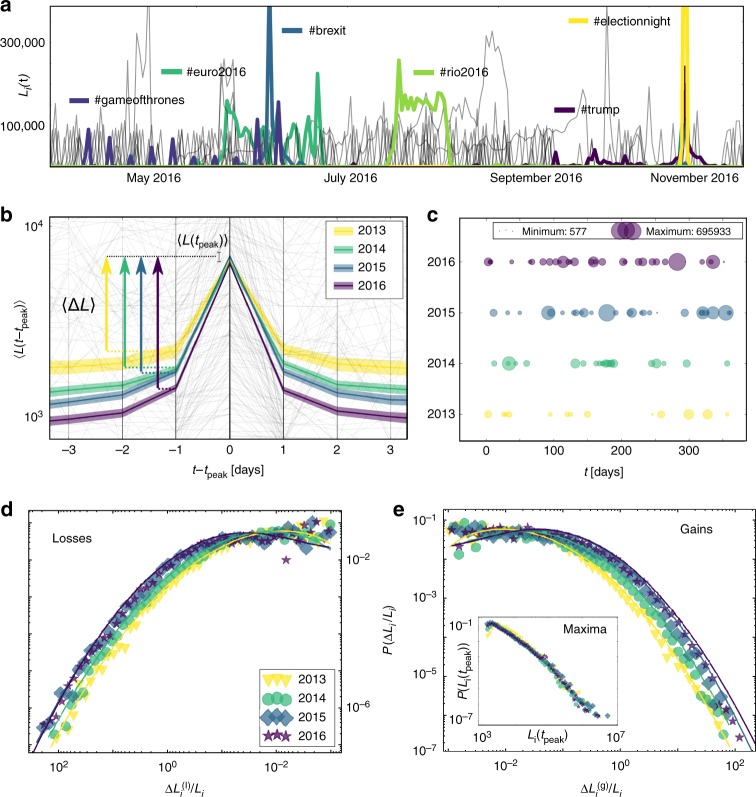
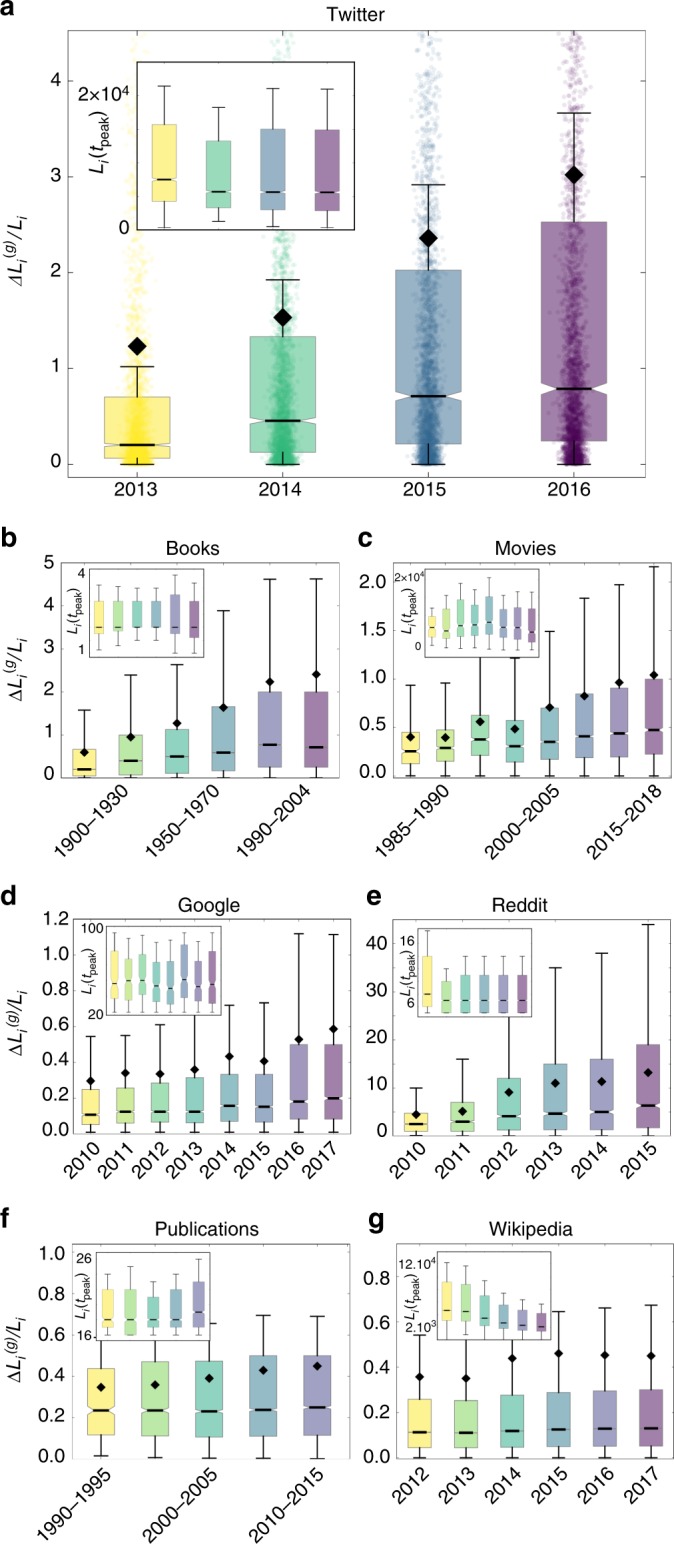
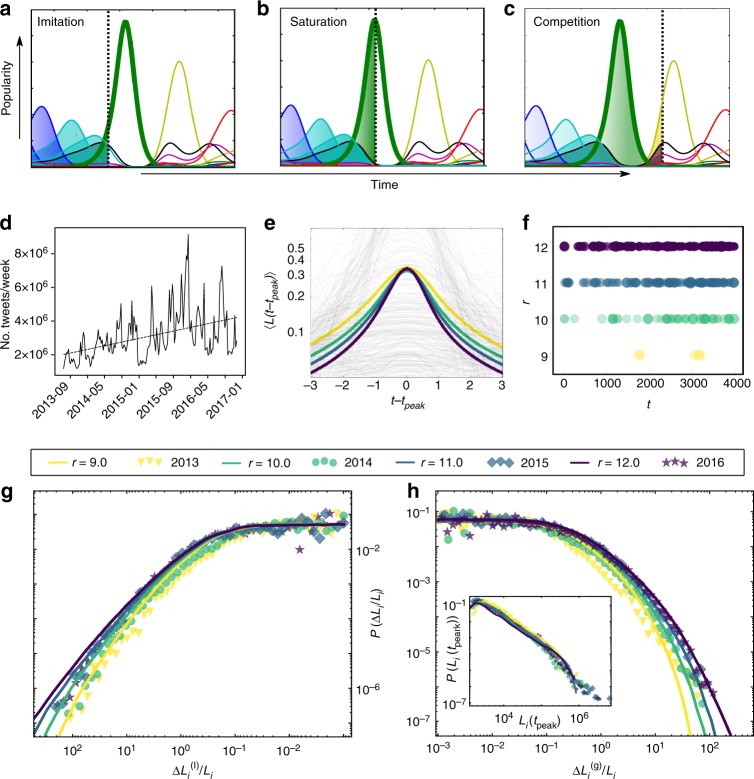
Verification
Claims the paper makes
The claims and statistics of this paper haven’t been checked yet.
Run the check — free, no account needed. It reads the open-access text and checks the sources it cites.
Claims other papers make about this one
Each is checked against this paper’s own text: does it say what the citing paper says it does?
In the citing paper
“The datasets used in this work have been collected, analyzed and validated in previous works [2-4].”
From Modeling echo chambers and polarization dynamics in social networks (2020) · cites this paper as [3]
Self-check
Percentages, sums and reported differences re-computed from the paper’s own numbers.
The self-check needs the paper’s full text.
Citations
Cites
Rogers, E. M., Singhal, A., & Quinlan, M. M. (2019) · Routledge eBooks · doi:10.4324/9780203710753-35 · Cited by 37,670
The spread of true and false news online
Vosoughi, S., Roy, D., & Aral, S. (2018) · Science · doi:10.1126/science.aap9559 · Cited by 8,847
Power-Law Distributions in Empirical Data
Clauset, A., Shalizi, C. R., & Newman, M. E. J. (2009) · SIAM Review · doi:10.1137/070710111 · Cited by 8,019
Self-organized criticality: An explanation of the 1/ f noise
Bak, P., Tang, C., & Wiesenfeld, K. A. (1987) · Physical Review Letters · doi:10.1103/physrevlett.59.381 · Cited by 7,644
The Kolmogorov-Smirnov Test for Goodness of Fit
Massey, F. J. (1951) · Journal of the American Statistical Association · doi:10.1080/01621459.1951.10500769 · Cited by 7,210
Stanton, B. F., & Rogers, E. M. (1963) · Journal of Farm Economics · doi:10.2307/1235767 · Cited by 6,726
Cramming More Components Onto Integrated Circuits
Moore, G. E. (1998) · Proceedings of the IEEE · doi:10.1109/jproc.1998.658762 · Cited by 5,954
Lazer, D. M. J., Baum, M. A., Benkler, Y., Berinsky, A. J., Greenhill, K. M., Menczer, F., Metzger, M. J., Nyhan, B., Pennycook, G., Rothschild, D., et al. (2018) · Science · doi:10.1126/science.aao2998 · Cited by 4,160
The Kolmogorov-Smirnov Test for Goodness of Fit
Massey, F. J. (1951) · Journal of the American Statistical Association · doi:10.2307/2280095 · Cited by 3,690
Quantitative Analysis of Culture Using Millions of Digitized Books
Michel, J.-B., Shen, Y. K., Aiden, A. P., Veres, A., Gray, M. K., The Google Books Team, Pickett, J. P., Hoiberg, D., Clancy, D., Norvig, P., et al. (2010) · Science · doi:10.1126/science.1199644 · Cited by 3,235
Research works printed but not linked: 4
- Salganik, M. J. Bit by Bit: Social Research in the Digital Age (Princeton, NJ: Princeton University Press, 2017).
- Simon, H. A. Designing organizations for an information-rich world. In M. Greenberge (Ed.), Computers communications, and the public interest (pp. 37-52) (Baltimore, MD: John Hopkins Press, 1971).
- Requested at: https://journals.aps.org/datasets. Accessed July 5, 2018.
- Rogers, E. M. Communication Technology, vol. 1 (New York: Simon and Schuster, 1986).
Cited by
Sorted by citations
Pennycook, G., & Rand, D. G. (2021) · Trends in Cognitive Sciences · doi:10.1016/j.tics.2021.02.007 · Cited by 1,360
“An important limitation of such approaches is that they are 'opt in' – that is, people have to actively choose to engage with the inoculation technique (often for a fairly substantial amount of time – at least in terms of the internet attention span [102]).”
Baumgartner, J., Zannettou, S., Keegan, B., Squire, M., & Blackburn, J. (2020) · Proceedings of the International AAAI Conference on Web and Social Media · doi:10.1609/icwsm.v14i1.7347 · Cited by 881
Art and the science of generative AI
Epstein, Z., Hertzmann, A., the Investigators of Human Creativity, Akten, M., Farid, H., Fjeld, J., Frank, M. R., Groh, M., Herman, L., Leach, N., et al. (2023) · Science · doi:10.1126/science.adh4451 · Cited by 788
Citizens Versus the Internet: Confronting Digital Challenges With Cognitive Tools
Kozyreva, A., Lewandowsky, S., & Hertwig, R. (2020) · Psychological Science in the Public Interest · doi:10.1177/1529100620946707 · Cited by 479
Modeling echo chambers and polarization dynamics in social networks
Baumann, F., Lorenz-Spreen, P., Sokolov, I. M., & Starnini, M. (2020) · Physical Review Letters · doi:10.1103/physrevlett.124.048301 · Cited by 427
Self-citation21st-Century Readers: Developing Literacy Skills in a Digital World
OECD (2021) · PISA · doi:10.1787/a83d84cb-en · Cited by 337
Political Agenda Setting in the Hybrid Media System: Why Legacy Media Still Matter a Great Deal
Langer, A. I., & Gruber, J. B. (2020) · The International Journal of Press/Politics · doi:10.1177/1940161220925023 · Cited by 245
How behavioural sciences can promote truth, autonomy and democratic discourse online
Lorenz-Spreen, P., Lewandowsky, S., Sunstein, C. R., & Hertwig, R. (2020) · Nature Human Behaviour · doi:10.1038/s41562-020-0889-7 · Cited by 223
Self-citationDoes time management work? A meta-analysis
Aeon, B., Faber, A., & Panaccio, A. (2021) · PLOS ONE · doi:10.1371/journal.pone.0245066 · Cited by 172
European attitudes to refugees after the Russian invasion of Ukraine
Moise, A. D., Dennison, J., & Kriesi, H. (2023) · West European Politics · doi:10.1080/01402382.2023.2229688 · Cited by 150
Schulte, P. A., Streit, J. M. K., Sheriff, F., Delclos, G. L., Felknor, S. A., Tamers, S. L., Fendinger, S., Grosch, J. W., & Sala, R. M. (2020) · Annals of Work Exposures and Health · doi:10.1093/annweh/wxaa051 · Cited by 111
What Holds Attention? Linguistic Drivers of Engagement
Berger, J. A., Moe, W. W., & Schweidel, D. A. (2023) · Journal of Marketing · doi:10.1177/00222429231152880 · Cited by 129
Societal extinction of species
Jarić, I., Roll, U., Bonaiuto, M., Brook, B. W., Courchamp, F., Firth, J. A., Gaston, K. J., Heger, T., Jeschke, J. M., Ladle, R. J., et al. (2022) · Trends in Ecology & Evolution · doi:10.1016/j.tree.2021.12.011 · Cited by 103
Emergence of Polarized Ideological Opinions in Multidimensional Topic Spaces
Baumann, F., Lorenz-Spreen, P., Sokolov, I. M., & Starnini, M. (2021) · Physical Review X · doi:10.1103/physrevx.11.011012 · Cited by 104
Self-citationKümpel, A. S. (2021) · Communication Theory · doi:10.1093/ct/qtab012 · Cited by 82
Firth, J., Torous, J. B., López‐Gil, J. F., Linardon, J., Milton, A. C., Lambert, J. D., Smith, L., Jarić, I., Fabian, H., Vancampfort, D., et al. (2024) · World Psychiatry · doi:10.1002/wps.21188 · Cited by 109
A topic modeled unsupervised approach to single document extractive text summarization
Srivastava, R., Singh, P., Rana, K. P. S., & Kumar, V. (2022) · Knowledge-Based Systems · doi:10.1016/j.knosys.2022.108636 · Cited by 83
Historical language records reveal a surge of cognitive distortions in recent decades
Bollen, J., ten Thij, M., Breithaupt, F. A., Barron, A. T. J., Rutter, L. A., Lorenzo‐Luaces, L., & Scheffer, M. (2021) · Proceedings of the National Academy of Sciences · doi:10.1073/pnas.2102061118 · Cited by 80
Exploring the Impact of Internet Use on Memory and Attention Processes
Firth, J. A., Torous, J. B., & Firth, J. (2020) · International Journal of Environmental Research and Public Health · doi:10.3390/ijerph17249481 · Cited by 96
Macroscopic patterns of interacting contagions are indistinguishable from social reinforcement
Hébert-Dufresne, L., Scarpino, S. V., & Young, J.-G. (2020) · Nature Physics · doi:10.1038/s41567-020-0791-2 · Cited by 71
Perspectives on adaptive dynamical systems
Sawicki, J., Berner, R., Loos, S. A. M., Anvari, M., Bader, R., Barfuß, W., Botta, N., Brede, N., Franović, I., Gauthier, D. J., et al. (2023) · Chaos An Interdisciplinary Journal of Nonlinear Science · doi:10.1063/5.0147231 · Cited by 72
Self-citationThe Political Economy of Attention
Pedersen, M. A., Albris, K., & Seaver, N. (2021) · Annual Review of Anthropology · doi:10.1146/annurev-anthro-101819-110356 · Cited by 94
Monetization Of Digital Content: Drivers Of Revenue On Q&A Platforms
Ye, H. J., Yang, X., Wang, X., & Stratopoulos, T. C. (2021) · Journal of Management Information Systems · doi:10.1080/07421222.2021.1912934 · Cited by 58
Augner, C., Vlasak, T., & Barth, A. (2023) · Journal of Psychiatric Research · doi:10.1016/j.jpsychires.2023.10.032 · Cited by 51
Contributions to attention based marketing: Foundations, insights, and challenges
Orquin, J. L., & Wedel, M. (2020) · Journal of Business Research · doi:10.1016/j.jbusres.2020.02.012 · Cited by 45
Social media sentiment, model uncertainty, and volatility forecasting
Lehrer, S., Xie, T., & Zhang, X. (2021) · Economic Modelling · doi:10.1016/j.econmod.2021.105556 · Cited by 45
Lin, H., Pennycook, G., & Rand, D. G. (2022) · Cognition · doi:10.1016/j.cognition.2022.105312 · Cited by 51
van Kersbergen, K., & Vis, B. (2022) · Government Information Quarterly · doi:10.1016/j.giq.2022.101707 · Cited by 45
Modelling opinion dynamics under the impact of influencer and media strategies
Helfmann, L., Conrad, N. D., Lorenz-Spreen, P., & Schütte, C. (2023) · Scientific Reports · doi:10.1038/s41598-023-46187-9 · Cited by 38
Self-citationCollective Attention and Collective Intelligence: The Role of Hierarchy and Team Gender Composition
Woolley, A. W., Chow, R. M., Mayo, A. T., Riedl, C., & Chang, J. W. (2022) · Organization Science · doi:10.1287/orsc.2022.1602 · Cited by 37
Transience of public attention in conservation science
Jarić, I., Correia, R. A., Bonaiuto, M., Brook, B. W., Courchamp, F., Firth, J. A., Gaston, K. J., Heger, T., Jeschke, J. M., Ladle, R. J., et al. (2023) · Frontiers in Ecology and the Environment · doi:10.1002/fee.2598 · Cited by 42
Spreading dynamics of information on online social networks
Meng, F., Xie, J., Sun, J., Xu, C., Zeng, Y., Wang, X., Jia, T., Huang, S., Deng, Y., & Hu, Y. (2025) · Proceedings of the National Academy of Sciences · doi:10.1073/pnas.2410227122 · Cited by 41
Venturini, T. (2022) · Theory Culture & Society · doi:10.1177/02632764211070962 · Cited by 35
From science to politics: COVID-19 information fatigue on YouTube
Shi, C.-F., So, M., Stelmach, S., Earn, A., Earn, D. J. D., & Dushoff, J. G. (2022) · BMC Public Health · doi:10.1186/s12889-022-13151-7 · Cited by 32
Lifecycle-Aware Online Video Caching
Li, T., Braud, T., Li, Y., & Hui, P. (2020) · IEEE Transactions on Mobile Computing · doi:10.1109/tmc.2020.2984364 · Cited by 30
de Ágreda, Á. G., Feijóo, C., & Salazar-García, I.-A. (2021) · El Profesional de la Informacion · doi:10.3145/epi.2021.mar.16 · Cited by 35
Nature Exposure is Associated With Reduced Smartphone Use
Minor, K., Glavind, K. L., Schwartz, A. J., Danforth, C. M., Lehmann, S., & Bjerre-Nielsen, A. (2023) · Environment and Behavior · doi:10.1177/00139165231167165 · Cited by 31
Self-citationEvaluating the effect of viral posts on social media engagement
Sangiorgio, E., Marco, N. D., Etta, G., Cinelli, M., Cerqueti, R., & Quattrociocchi, W. (2025) · Scientific Reports · doi:10.1038/s41598-024-84960-6 · Cited by 46
Technology and democracy: a paradox wrapped in a contradiction inside an irony
Lewandowsky, S., & Pomerantsev, P. (2021) · Memory Mind & Media · doi:10.1017/mem.2021.7 · Cited by 28
Effectiveness of dismantling strategies on moderated vs. unmoderated online social platforms
Artime, O., d’Andrea, V., Gallotti, R., Sacco, P. L., & Domenico, M. D. (2020) · Scientific Reports · doi:10.1038/s41598-020-71231-3 · Cited by 27
Online conferences for better learning
Lortie, C. J. (2020) · Ecology and Evolution · doi:10.1002/ece3.6923 · Cited by 26
Modularity and composite diversity affect the collective gathering of information online
Pescetelli, N., Rutherford, A., & Rahwan, I. (2021) · Nature Communications · doi:10.1038/s41467-021-23424-1 · Cited by 32
Time pressure reduces misinformation discrimination ability but does not alter response bias
Sultan, M., Tump, A. N., Geers, M., Lorenz-Spreen, P., Herzog, S. M., & Kurvers, R. H. J. M. (2022) · Scientific Reports · doi:10.1038/s41598-022-26209-8 · Cited by 36
Self-citationBødker, H., & Morris, H. E. (2021) · Routledge eBooks · doi:10.4324/9781003090304 · Cited by 26
Nursing student perceptions of required online educational programs utilized outside the classroom
Schuler, M., Tyo, M. B., & Barnett, K. (2021) · Nurse Education Today · doi:10.1016/j.nedt.2021.105048 · Cited by 24
A pace of life indicator. Development and validation of a General Acceleration Scale
Bergener, J., & Santarius, T. (2021) · Time & Society · doi:10.1177/0961463x20980645 · Cited by 21
The romance of leadership: Rekindling the fire through replication of Meindl and Ehrlich
Hammond, M. M., Schyns, B., Lester, G. V., Clapp‐Smith, R., & Thomas, J. S. (2021) · The Leadership Quarterly · doi:10.1016/j.leaqua.2021.101538 · Cited by 21
How do scientific papers from different journal tiers gain attention on social media?
Cao, R., Liu, X. F., Fang, Z., Xu, X.-K., & Wang, X. (2022) · Information Processing & Management · doi:10.1016/j.ipm.2022.103152 · Cited by 26
Social media and ADHD: implications for clinical assessment and treatment
Hartnett, Y., & Cummings, E. M. (2023) · Irish Journal of Psychological Medicine · doi:10.1017/ipm.2023.40 · Cited by 25
Analytical sociology amidst a computational social science revolution
Jarvis, B. F., Keuschnigg, M., & Hedström, P. (2021) · Routledge eBooks · doi:10.4324/9781003024583-4 · Cited by 24
News Flashpoints: Networked Journalism and Waves of Coverage of Social Problems
Waisbord, S., & Russell, A. (2020) · Journalism & Mass Communication Quarterly · doi:10.1177/1077699020917116 · Cited by 19
Grüning, D. J., & Lechner, C. M. (2022) · Journal of Personality Assessment · doi:10.1080/00223891.2022.2057318 · Cited by 19
An ecological approach to structural flexibility in online communication systems
Palazzi, M. J., Solé‐Ribalta, A., Calleja-Solanas, V., Meloni, S., Plata, C. A., Suweis, S. S., & Borge‐Holthoefer, J. (2021) · Nature Communications · doi:10.1038/s41467-021-22184-2 · Cited by 23
Collaborative Creativity in TikTok Music Duets
O’Toole, K. (2023) · CHI Conference on Human Factors in Computing Systems · doi:10.1145/3544548.3581380 · Cited by 24
Polarization and Consensus in a Voter Model under Time-Fluctuating Influences
Mobilia, M. (2023) · Physics · doi:10.3390/physics5020037 · Cited by 19
Strategic disinformation outperforms honesty in competition for social influence
Kurvers, R. H. J. M., Hertz, U., Karpus, J., Balode, M. P., Jayles, B., Binmore, K., & Bahrami, B. (2021) · iScience · doi:10.1016/j.isci.2021.103505 · Cited by 21
Bartal, A., Pliskin, N., & Tsur, O. (2020) · PLoS ONE · doi:10.1371/journal.pone.0230811 · Cited by 17
Fariello, G., Jemielniak, D., & Sulkowski, A. J. (2021) · New Media & Society · doi:10.1177/14614448211062070 · Cited by 17
Diffusion of Scientific Articles across Online Platforms
Zakhlebin, I., & Horvát, E.-Á. (2020) · Proceedings of the International AAAI Conference on Web and Social Media · doi:10.1609/icwsm.v14i1.7341 · Cited by 16
A quantitative study of non-linearity in storytelling
Piper, A., & Toubia, O. (2023) · Poetics · doi:10.1016/j.poetic.2023.101793 · Cited by 20
Bojić, L., Ilić, V., Prodanović, V., & Vuković, V. (2025) · Chinese Political Science Review · doi:10.1007/s41111-025-00326-x · Cited by 21
Hurricanes and hashtags: Characterizing online collective attention for natural disasters
Arnold, M., Dewhurst, D. R., Alshaabi, T., Minot, J. R., Adams, J. L., Danforth, C. M., & Dodds, P. S. (2021) · PLoS ONE · doi:10.1371/journal.pone.0251762 · Cited by 14
Fake news and participatory propaganda
Lewandowsky, S. (2022) · Routledge eBooks · doi:10.4324/9781003154730-23 · Cited by 15
A complex networks approach to ranking professional Snooker players
O’Brien, J. D., & Gleeson, J. P. (2020) · Journal of Complex Networks · doi:10.1093/comnet/cnab003 · Cited by 13
Gong, X., Huskey, R., Xue, H., Shen, C., & Frey, S. (2023) · Journal of Communication · doi:10.1093/joc/jqad014 · Cited by 14
Bertotti, M. L., & Modanese, G. (2019) · Mathematical and Computer Modelling of Dynamical Systems · doi:10.1080/13873954.2019.1660997 · Cited by 13
Bacile, T. J. (2022) · The Journal of Marketing Theory and Practice · doi:10.1080/10696679.2022.2144382 · Cited by 14
The evolution of online news headlines
Nickl, P. L., Moussaïd, M., & Lorenz-Spreen, P. (2025) · Humanities and Social Sciences Communications · doi:10.1057/s41599-025-04514-7 · Cited by 12
Self-citationIdeology and polarization set the agenda on social media
Loru, E., Galeazzi, A., Bonetti, A., Sangiorgio, E., Marco, N. D., Cinelli, M., Falkenberg, M., Baronchelli, A., & Quattrociocchi, W. (2025) · Scientific Reports · doi:10.1038/s41598-025-19776-z · Cited by 26
Scientometric engineering: Exploring citation dynamics via arXiv eprints
Okamura, K. (2022) · Quantitative Science Studies · doi:10.1162/qss_a_00174 · Cited by 13
Popularity of Video Games and Collective Memory
Mendes, L. O., da Cunha, L. R., & Mendes, R. S. (2022) · Entropy · doi:10.3390/e24070860 · Cited by 14
Building a dynamic theory of citizens’ awareness of European Cohesion Policy interventions
Cunico, G., Aivazidou, E., & Mollona, E. (2020) · European Journal of Operational Research · doi:10.1016/j.ejor.2020.07.017 · Cited by 12
Woon, L. S., Smith, D., Allison, S. C., Looi, J. C., & Bastiampillai, T. J. (2025) · Australasian Psychiatry · doi:10.1177/10398562251315006 · Cited by 11
Quantifying the potentiality for polarization in opinion networks
Carballosa, A., Crego, Á., & Muñuzuri, A. P. (2023) · Chaos Solitons & Fractals · doi:10.1016/j.chaos.2023.113697 · Cited by 11
Competition Dynamics in the Meme Ecosystem
Ford, T. W., Krohn, R., & Weninger, T. (2023) · ACM Transactions on Social Computing · doi:10.1145/3596213 · Cited by 10
Pine, R., Mbinta, J. F., Morenga, L. T., & Fleming, T. M. (2023) · JMIR Serious Games · doi:10.2196/46697 · Cited by 10
Schulte-Cloos, J., & Anghel, V. (2023) · Political Communication · doi:10.1080/10584609.2023.2291538 · Cited by 15
DeGroot-Based Opinion Formation Under a Global Steering Mechanism
Conjeaud, I., Lorenz-Spreen, P., & Kalogeratos, A. (2024) · IEEE Transactions on Computational Social Systems · doi:10.1109/tcss.2023.3330293 · Cited by 10
Self-citationvon Fedak, V., & Langlais, M. R. (2024) · Psi Chi Journal of Psychological Research · doi:10.24839/2325-7342.jn29.2.129 · Cited by 10
Tiersen, F., & Calvo, R. A. (2021) · Lecture notes in computer science · doi:10.1007/978-3-030-78465-2_35 · Cited by 12
Quantifying uncertainty in a predictive model for popularity dynamics
O’Brien, J. D., Aleta, A., Moreno, Y., & Gleeson, J. P. (2020) · Physical review. E · doi:10.1103/physreve.101.062311 · Cited by 12
(2021) · doi:10.31234/osf.io/ar96c · Cited by 12
Jayles, B., Sire, C., & Kurvers, R. H. J. M. (2021) · Journal of The Royal Society Interface · doi:10.1098/rsif.2021.0231 · Cited by 11
Followers do not dictate the virality of news outlets on social media
Sangiorgio, E., Cinelli, M., Cerqueti, R., & Quattrociocchi, W. (2024) · PNAS Nexus · doi:10.1093/pnasnexus/pgae257 · Cited by 14
The dynamics of the Reddit collective action leading to the GameStop short squeeze
Desiderio, A., Aiello, L. M., Cimini, G., & Alessandretti, L. (2025) · npj Complexity · doi:10.1038/s44260-025-00029-z · Cited by 13
Successive Cohorts of Twitter Users Show Increasing Activity and Shrinking Content Horizons
Wolf, F., Lorenz-Spreen, P., & Lehmann, S. (2022) · Journal of Quantitative Description Digital Media · doi:10.51685/jqd.2022.014 · Cited by 8
Self-citationA two-phase model of collective memory decay with a dynamical switching point
Igarashi, N., Okada, Y., Sayama, H., & Sano, Y. (2022) · Scientific Reports · doi:10.1038/s41598-022-25840-9 · Cited by 12
Desa, G., Dunham, I. M., Jeong, N., Basu, S., & Kleinrichert, D. (2023) · Journal of Social Entrepreneurship · doi:10.1080/19420676.2023.2213734 · Cited by 8
Aull, L. L. (2023) · Cambridge University Press eBooks · doi:10.1017/9781009231299 · Cited by 10
The speed of news in Twitter (X) versus radio
Brannon, W., & Roy, D. K. (2024) · Scientific Reports · doi:10.1038/s41598-024-61921-7 · Cited by 12
Solís, L. (2024) · Environmental Communication · doi:10.1080/17524032.2023.2299353 · Cited by 7
Healthier information ecosystems: A definition and agenda
Introne, J. E., McKernan, B., Corsbie-Massay, C. L., Rohlinger, D. A., & Tripodi, F. B. (2024) · Journal of the Association for Information Science and Technology · doi:10.1002/asi.24949 · Cited by 7
Artificial intelligence and economic psychology: toward a theory of algorithmic cognitive influence
Fernández, F. R. (2025) · AI & Society · doi:10.1007/s00146-025-02592-4 · Cited by 13
Dewhurst, D. R., Alshaabi, T., Kiley, D., Arnold, M., Minot, J. R., Danforth, C. M., & Dodds, P. S. (2020) · EPJ Data Science · doi:10.1140/epjds/s13688-020-0220-x · Cited by 9
Neutral theory for competing attention in social networks
Plata, C. A., Pigani, E., Azaele, S., Calleja-Solanas, V., Palazzi, M. J., Solé‐Ribalta, A., Borge‐Holthoefer, J., Meloni, S., & Suweis, S. (2021) · Physical Review Research · doi:10.1103/physrevresearch.3.013070 · Cited by 7
Information cocooning and polarization of opinions in a mobile population
Dong, J., Dai, Q., Li, H., & Yang, J. (2024) · Physica A Statistical Mechanics and its Applications · doi:10.1016/j.physa.2024.130322 · Cited by 7
Hausmann, A., Väisänen, T., Toivonen, T., & Cortés-Capano, G. (2025) · Sustainability Science · doi:10.1007/s11625-025-01639-1 · Cited by 7
BeeMe: Real-Time Internet Control of Situated Human Agents
Pescetelli, N., Cebrián, M., & Rahwan, I. (2020) · Computer · doi:10.1109/mc.2020.2996824 · Cited by 7
Rising tension in the Himalayas: A geospatial analysis of Chinese border incursions into India
Brethouwer, J.-T., Fokkink, R., Greene, K., Lindelauf, R. H. A., Tornquist, C., & Subrahmanian, V. S. (2022) · PLoS ONE · doi:10.1371/journal.pone.0274999 · Cited by 6
Khader, O., Alrubaiaan, R., Abdunabi, F., Gyasudeen, K. S., Rad, F. A. A., & Prasad, S. (2024) · Special Care in Dentistry · doi:10.1111/scd.13041 · Cited by 6
Metadata
- Authors
- Lorenz-Spreen, P., Mønsted, B. M., Hövel, P., & Lehmann, S.
- Affiliations
- Max Planck Institute for Human Development (DE)
- Technical University of Denmark (DK)
- University College Cork (IE)
- University of Copenhagen (DK)
- Corresponding author
- Hövel, Philipp
- Lehmann, Sune
- Venue
- Nature Communications
- Published
- 2019-04-15
- Volume
- 10
- Issue
- 1
- Pages
- 1759-1759
- ISSN
- 2041-1723 (ISSN-L)
- PMC
- PMC6465266
- OpenAlex
- W2939088842
- Cited by
- 304
- References
- 38
- Citations by year
- 2026: 46 · 2025: 51 · 2024: 40 · 2023: 43 · 2022: 45 · 2021: 41 · 2020: 32 · 2019: 6
- FWCI
- 14.47
- Type
- journal article
- Language
- en
- Open access
- gold
- doi.org
- Locations
- Nature Communications (publishedVersion, cc-by)
- Europe PMC (PubMed Central) (publishedVersion, cc-by)
- PubMed Central (publishedVersion, cc-by)
- PubMed (publishedVersion)
- Research at the University of Copenhagen (University of Copenhagen) (publishedVersion, cc-by)
- Arrow@dit (Dublin Institute of Technology) (acceptedVersion)
- RePEc: Research Papers in Economics (submittedVersion)
- Cork Open Research Archive (University College Cork, Ireland) (submittedVersion, cc-by)
- DOAJ (DOAJ: Directory of Open Access Journals) (submittedVersion)
- DOAJ (DOAJ: Directory of Open Access Journals) (submittedVersion, cc-by-sa)
- Technical University of Denmark, DTU Orbit (Technical University of Denmark, DTU) (submittedVersion, other-oa)
- MPG.PuRe (Max Planck Society) (submittedVersion, other-oa)
- Funders
- Deutsche Forschungsgemeinschaft
- Topics
- Physical Sciences › Physics and Astronomy › Statistical and Nonlinear Physics › Complex Network Analysis Techniques
- Social Sciences › Economics, Econometrics and Finance › Economics and Econometrics › Complex Systems and Time Series Analysis
- Social Sciences › Communication › Digital Media and Philosophy
- Keywords
- collective attention, attention dynamics, cultural artifacts, popularity, social media
- MeSH terms
- Attention, Humans, Models, Theoretical, Information Dissemination, Social Media
About these checks
Registry, retraction, Cites and statistics results are computed, not judged, with one exception: a printed reference that no index lists is read once by a model before it counts as a citation error. Claims are extracted by a model and kept only when their quote appears verbatim in the text; each cited source is then checked, with a model’s help, for whether it says what the claim relies on. Those verdicts can be wrong — read the claim’s quote and the cited source before relying on one.
Statistics and arithmetic are recomputed, not judged.
Confidence bands are shown only for fields calibrated on our annotated test set. None is calibrated yet, so no band is shown.
What counts as a claim ›How we measure confidence ›How we check this ›
Are you an author, or do you see a problem with this page? Request a review
