

A gut microbiome signature for cirrhosis due to nonalcoholic fatty liver disease
Open accessThe DOI matches its Crossref record; 62 of the 62 references it cites were found in a registry or an index.
Abstract
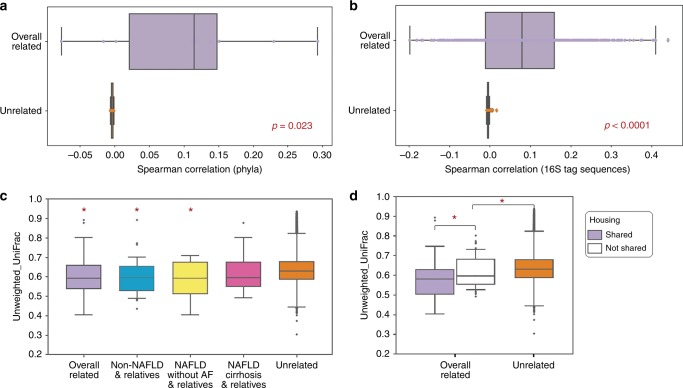
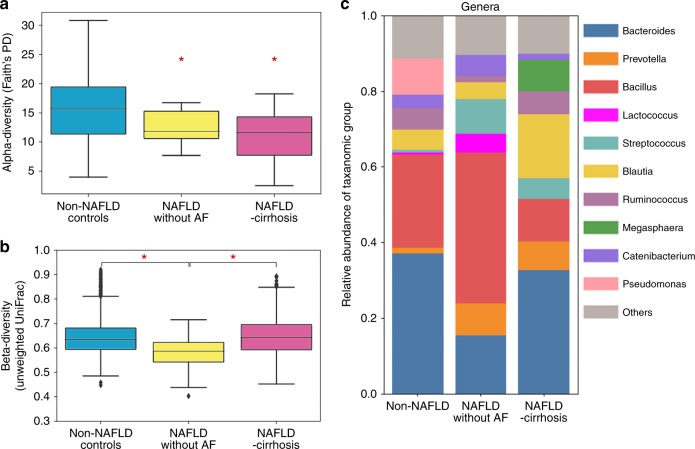
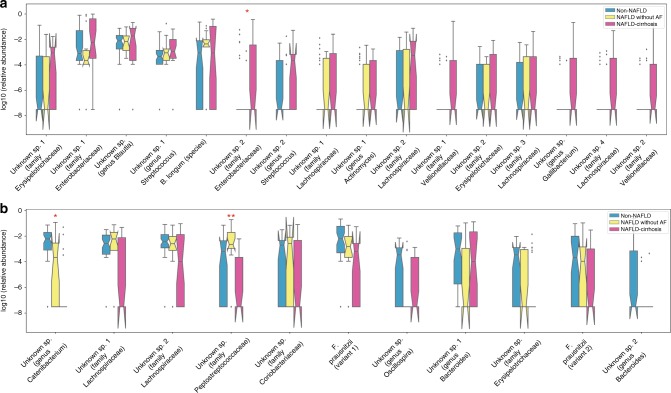
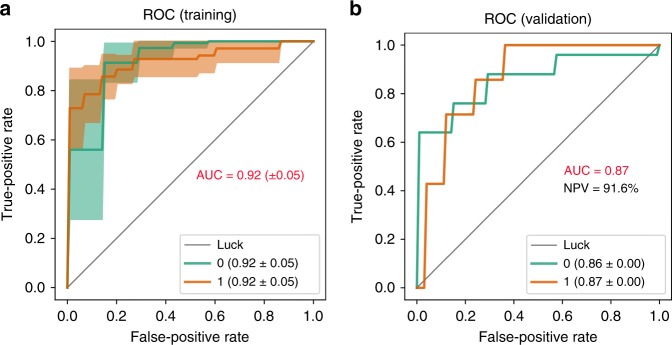
The presence of cirrhosis in nonalcoholic-fatty-liver-disease (NAFLD) is the most important predictor of liver-related mortality. Limited data exist concerning the diagnostic accuracy of gut-microbiome-derived signatures for detecting NAFLD-cirrhosis. Here we report 16S gut-microbiome compositions of 203 uniquely well-characterized participants from a prospective twin and family cohort, including 98 probands encompassing the entire spectrum of NAFLD and 105 of their first-degree relatives, assessed by advanced magnetic-resonance-imaging. We show strong familial correlation of gut-microbiome profiles, driven by shared housing. We report a panel of 30 features, including 27 bacterial features with discriminatory ability to detect NAFLD-cirrhosis using a Random Forest classifier model. In a derivation cohort of probands, the model has a robust diagnostic accuracy (AUROC of 0.92) for detecting NAFLD-cirrhosis, confirmed in a validation cohort of relatives of proband with NAFLD-cirrhosis (AUROC of 0.87). This study provides evidence for a fecal-microbiome-derived signature to detect NAFLD-cirrhosis.
Overview
The claims and statistics of this paper haven’t been checked yet.
Free: it reads the open-access text and checks the first 5 claims that cite a source we can check. Create a free account to check every claim.
Integrity signals
Registry
Cites
Statistics
Figures
Verification
Claims the paper makes
The claims and statistics of this paper haven’t been checked yet.
Free: it reads the open-access text and checks the first 5 claims that cite a source we can check. Create a free account to check every claim.
Claims other papers make about this one
Each is checked against this paper’s own text: does it say what the citing paper says it does?
The source backs part of the claim, not all of it — or backs it for a different population, condition or comparison.
In the citing paper
“These changes are positively correlated with NASH severity and fibrosis in patient cohorts and experimental NASH models (16, 79–82).”
From Hepatic Stellate Cell-Immune Interactions in NASH (2022) · cites this paper as [80]
Experimental — accuracy not yet measuredIn the citing paper
“the composition of the microbiome was altered in all these patients regardless of the lack of statistically significant changes in diversity”
From Cholestasis induced by bile duct ligation promotes changes in the intestinal microbiome in mice (2019) · cites this paper as [48]
In the citing paper
“previous studies where the diversity of the microbiome was significantly lower in NAFLD patients without fibrosis, whereas the diversity in patients with advanced fibrosis was ‘restored’ to comparable levels to healthy individuals48.”
From Cholestasis induced by bile duct ligation promotes changes in the intestinal microbiome in mice (2019) · cites this paper as [48]
In the citing paper
“which abundance is increased in NASH patients when compared to obese47 and in NAFLD/cirrhotics48.”
From Cholestasis induced by bile duct ligation promotes changes in the intestinal microbiome in mice (2019) · cites this paper as [48]
Self-check
Percentages, sums and reported differences re-computed from the paper’s own numbers.
The self-check needs the paper’s full text.
Citations
Cites
Breiman, L. (2001) · Machine Learning · doi:10.1023/a:1010933404324 · Cited by 133,538
A core gut microbiome in obese and lean twins
Turnbaugh, P. J., Hamady, M., Yatsunenko, T., Cantarel, B. L., Duncan, A., Ley, R. E., Sogin, M. L., Jones, W. J., Roe, B. A., Affourtit, J. P., et al. (2009) · Nature · doi:10.1038/nature07540 · Cited by 7,823
Self-citationHuman gut microbiome viewed across age and geography
Yatsunenko, T., Rey, F. E., Manary, M. J., Trehan, I., Dominguez-Bello, M. G., Contreras, M., Magris, M., Hidalgo, G., Baldassano, R. N., Anokhin, A. P., et al. (2012) · Nature · doi:10.1038/nature11053 · Cited by 7,815
Self-citationGlobal burden of NAFLD and NASH: trends, predictions, risk factors and prevention
Younossi, Z., Anstee, Q. M., Marietti, M., Hardy, T., Henry, L., Eslam, M., George, J., & Bugianesi, E. (2018) · Nature Reviews Gastroenterology & Hepatology · doi:10.1038/nrgastro.2017.109 · Cited by 5,249
Mechanisms of NAFLD development and therapeutic strategies
Friedman, S. L., Neuschwander-Tetri, B. A., Rinella, M., & Sanyal, A. J. (2018) · Nature Medicine · doi:10.1038/s41591-018-0104-9 · Cited by 4,354
Chalasani, N., Younossi, Z., Lavine, J. E., Diehl, A. M., Brunt, E. M., Cusi, K., Charlton, M., & Sanyal, A. J. (2012) · Hepatology · doi:10.1002/hep.25762 · Cited by 3,803
Genetic variation in PNPLA3 confers susceptibility to nonalcoholic fatty liver disease
Romeo, S., Kozlitina, J., Xing, C., Pertsemlidis, A., Cox, D., Pennacchio, L. A., Boerwinkle, E., Cohen, J. C., & Hobbs, H. H. (2008) · Nature Genetics · doi:10.1038/ng.257 · Cited by 3,416
Estes, C., Razavi, H., Loomba, R., Younossi, Z., & Sanyal, A. J. (2018) · Hepatology · doi:10.1002/hep.29466 · Cited by 2,399
Self-citationAlterations of the human gut microbiome in liver cirrhosis
Qin, N., Yang, F., Li, A., Prifti, E., Chen, Y., Shao, L., Guo, J., Le Chatelier, E., Yao, J., Wu, L., et al. (2014) · Nature · doi:10.1038/nature13568 · Cited by 2,177
Best practices for analysing microbiomes
Knight, R., Vrbanac, A., Taylor, B. C., Aksenov, A., Callewaert, C., Debelius, J., Gonzalez, A., Kosciolek, T., McCall, L.-I., McDonald, D., et al. (2018) · Nature Reviews Microbiology · doi:10.1038/s41579-018-0029-9 · Cited by 2,030
Self-citation
Research works printed but not linked: 1
- Classification LiawA and Regression by randomForest R. News 2002 2 18 22
Cited by
Items 301–348 of 348
Gut microbiota signatures in Schistosoma japonicum infection-induced liver cirrhosis patientsPreprint
Gui, Q., Zhu, F., Xiao, C., Lu, H., Zhang, Q., Xu, J. M., Jin, H., & Yang, Y. (2020) · Research Square · doi:10.21203/rs.3.rs-68447/v1
Ke, S., Pollock, N. R., Xu-wen, W., Chen, X., Daugherty, K., Lin, Q., Xu, H. X., Garey, K. W., Gonzales-Luna, A. J., Liu, Y., et al. (2020) · Research Square · doi:10.21203/rs.3.rs-65421/v1
Genetic and Environmental Effects on Liver Diseases
Li, Y. (2021) · University of Groningen research database (University of Groningen / Centre for Information Technology) · doi:10.33612/diss.182480991
O PROCESSO DE TRABALHO EM SAÚDE E A EDUCAÇÃO PERMANENTE: DESAFIOS E POSSIBILIDADES
Freire, F. D. F. D. S., Melo, F. N. D. P., Melo, D. F. C., Holanda, D. X. T., Soares, M. K. P., Oliveira, A. K. D. S., Veríssimo, F. A. D. S., & Gomes, A. M. D. A. (2021) · Brazilian Journals Editora eBooks · doi:10.35587/brj.ed.0000642
Welyczko, N. (2019) · Gastrointestinal Nursing · doi:10.12968/gasn.2019.17.4.12
Rau, M. (2022) · Springer eBooks · doi:10.1007/978-3-662-62484-5_9
Porras, D. (2021) · Buleria (Universidad de León) · doi:10.18002/10612/13641
Gorban, V. V., Matveeva, E. V., Витальевна, Г. Е., & Kameneva, E. S. (2022) · Meditsinskiy sovet = Medical Council · doi:10.21518/2079-701x-2022-16-15-134-143
Recent Updates in the Prevention of Nonalcoholic Fatty Liver Disease
El‐Kassas, M., Awad, A., & Méndez‐Sánchez, N. (2023) · Gene Expression · doi:10.14218/ge.2022.00005s · Cited by 1
Jia, S. H., & Zhang, J. K. (2023) · PubMed Central · doi:10.3760/cma.j.cn501113-20220829-00447
Candian, D. C. F. (2023) · Digital Library of Theses and Dissertations (Universidade de São Paulo) · doi:10.11606/t.5.2023.tde-22082023-142604
Microbiome: Human Nutrition and Psychology
Tewari, S., Sarkar, L., Pramanik, P., Mukherjee, P., Pattanayak, A., & Mahreen, K. F. (2023) · International Journal of Indian Psychology · doi:10.25215/1103.110 · Cited by 1
Yan, L., Xu, X., & Lu, D. (2024) · Research Square · doi:10.21203/rs.3.rs-4161333/v1
Oral and gut microbiota in cardio-metabolic disease: insights from drug- and diet-induced dysbiosis
Manosalva, A. G. L. (2024) · University of Groningen research database (University of Groningen / Centre for Information Technology) · doi:10.33612/diss.1000115280
Chen, L., Lei, Y., Lu, H., & Wang, Y. (2024) · Food Science and Human Wellness · doi:10.26599/fshw.2024.9250208
“Since cumulative evidence for a pivotal role of gut microbiota in NAFLD pathogenesis, the gut microbiome is one primitive objective for therapeutic aiming to ease NAFLD [35].”
Double Trouble: Metabolic Dysfunction-Associated Fatty Liver Disease in Fraternal Twins
Bondurant, J., & Paul, S. (2024) · Journal of Pediatric Health Care · doi:10.1016/j.pedhc.2024.10.012
Correlation study on gut microbiota and myosteatosis in patients with liver cirrhosis
Zhao, N., Bai, J., Li, X., Xu, G. Z., Fu, X., Li, J., Niu, L., Yao, J., & Zhou, X. (2025) · Frontiers in Nutrition · doi:10.3389/fnut.2025.1513973
Hornero‐Ramirez, H. (2024) · theses.fr (ABES) · doi:10.70675/25440a39ze2faz44d5z8b45z12f82a1ab67b · Cited by 1
Saviano, A., & Serfaty, L. (2025) · EMC - Hépatologie · doi:10.1016/s1155-1976(25)46793-x
Yu, P., Zhao, A., Zhan, M., Zhang, L., Yang, C., Zhao, Y., & Yang, X. (2025) · Foods · doi:10.3390/foods14193367
“As the “second genome” of the human body, gut microbiota can play a critical role in regulating obesity and energy metabolism homeostasis through influencing microbial communities and their metabolites [7–11].”
Li, T., Ma, C., Ruan, J., Tsai, S., Chen, P.-C., Hong, S., Lin, Y., Hsu, T.-L., Yeh, H., Tsai, H., et al. (2025) · Clinical and Translational Gastroenterology · doi:10.14309/ctg.0000000000000957
“Although several diversity indices have been reported to identify the likelihood of MASLD with cirrhosis, assessing models incorporating speci fi c gut microbiota species for MASLD progression remain limited (6).”
Liu, X., Liu, D., Tan, C., & Feng, W. (2023) · Figshare · doi:10.6084/m9.figshare.24873066
Liu, X., Liu, D., Tan, C., & Feng, W. (2024) · Figshare · doi:10.6084/m9.figshare.24873179
The Current Landscape of Microbial Biomarkers in Gastrointestinal Disease
Kim, S. G., Zhao, M. Y., Lam, C., & Jacobs, J. P. (2025) · Gastroenterology Clinics of North America · doi:10.1016/j.gtc.2025.10.003
Aoyama, T., Iwata, N., Kawamoto, S., Kato, M., Kani, K., Kasai, K., Goto, K., Yoshimoto, Y., Ichimura‐Shimizu, M., Watanabe, S., et al. (2026) · Biomedicines · doi:10.3390/biomedicines14020442
Abdou, H. A., & Omar, S. A. (2026) · ASIDE Gastroenterology · doi:10.71079/aside.gi.031826446
“Patients with MASLD exhibit altered gut microbial composition, with increased abundance of pro-inflammatory taxa, including Enterobacteriaceae and Proteobacteria, and decreased abundance of beneficial commensals, including Faecalibacterium prausnitzii and Akkermansia muciniphila [60, 61].”
Effect of nonalcoholic fatty liver disease on post-myocardial infarction cardiac remodeling
Biquard, L. (2022) · theses.fr (ABES) · doi:10.70675/4f4848d2z6a02z4576z9fc3zff58e2f5c501
Rôle de REG3A dans la maladie métabolique du foie d'origine nutritionnelle
Nguyen, T.-S. (2024) · theses.fr (ABES) · doi:10.70675/2c0ffdcfz96ccz43b0z8e03zb358f83e528d
Ageing liver in the era of MASLD: risks, mechanisms and treatment opportunities
Alqahtani, S. A., Schneider, C. V., & Schattenberg, J. M. (2026) · Frontline Gastroenterology · doi:10.1136/flgastro-2026-103677
Comparison of Mucosal and Faecal Microbiomes in Patients With Cirrhosis
Stokes, C. S., Turk, T., Lammert, F., & Appenrodt, B. (2026) · Gastroenterology Research and Practice · doi:10.1155/grp/6847983
“The aetiology of chronic liver disease has previously been re-ported to play a critical role in determining the direction of microbiome alterations in patients with end-stage liver disease [7, 12].”
Liu, J., He, S., Zhang, H., Mai, H., Li, X., Liang, H., Cui, P., Lan, L., Liao, W., Huang, Q., et al. (2026) · BMC Gastroenterology · doi:10.1186/s12876-026-04890-7
Gewirtz, M. A., Zhang, Y., Vaidy, N., Redekar, N. R., Minerva, N., Haddad, J. A., Oringher, J. L., Afruza, R., Chakraborty, M., Menkart, M. G., et al. (2026) · Frontiers in Microbiology · doi:10.3389/fmicb.2026.1851892
“Accordingly, many studies (Jiang et al., 2015; Caussy et al., 2019; Dubinkina et al., 2017; Leclercq et al., 2014; Shen et al., 2023; Bajaj et al., 2014; Shao et al., 2018) have examined microbial alterations across various liver diseases.”
Tan, H. Y., Hwang, I. Y., Jayabalan, N., Lee, H. L., Ong, L. J. Y., Lim, C. T., Chang, M. W., & Toh, Y. (2026) · Advanced Healthcare Materials · doi:10.1002/adhm.71442
“Although animal models have been used to study gut microbiome-liver crosstalk [19, 20], microfluidic multi-organ culture systems offer a more controlled and human-relevant platform for evaluating engineered microbes in liver steatosis by enabling compartmentalized coculture, real-time metabolite…”
Frăsinariu, O. E., Ștreangă, V., Rugina, A. L., Mîndru, D. E., Vintilă, T. C., Bădulescu, O. V., Bararu‐Bojan, I., Lupu, V. V., Ignat, A., Mihai, A., et al. (2026) · Pharmaceuticals · doi:10.3390/ph19071113
“Pathway reconstruction further linked this metabolite to specific gut microbial species, providing proof-of-concept that integrating metagenomic and metabolomic data can uncover functional host–microbiota relationships associated with MASLD progression [107].”
Peng, Y., Xu, J., Lu, H., Bi, Y.-M., Qi, L., Chen, Y.-G., Zhong, J.-H., Schlegel, A., & Li, L.-Q. (2026) · Frontiers in Cellular and Infection Microbiology · doi:10.3389/fcimb.2026.1877450
López-Bermudo, L. (2025) · RIO (Universidad Pablo de Olavide)
Ramos, S. F., Fogelson, K. A., Muti, V. B., Aron, A. T., Salido, R. A., Richter, R. A., Mannochio-Russo, H., Hu, J., Hosseini, M., Loomba, R. S., et al. (2026) · mSystems · doi:10.1128/msystems.00720-26
“We ran BIRDMAn on the Caussy et al. 16S and fecal metabolomics human data set (Qiita ID: 11635) to identify differences between individuals with non-MAFLD and MAFLD using the same method as for the 16S in this study (16).”
InfluentialSelf-citationRelación entre la microbiota intestinal y el desarrollo de enfermedades metabólicas
Vinces, J. A. V. (2026) · Polo del Conocimiento · doi:10.23857/pc.v11i2.12453
Pan, Y., Zhang, R., & Chen, Y. (2026) · Food Science and Biotechnology · doi:10.1007/s10068-026-02283-w
Hui, H., Huang, W., Song, T., Song, Y., Zhang, X., Wang, R., Yang, J., Wu, S., Li, X., & Peng, J. (2026) · Phytomedicine · doi:10.1016/j.phymed.2026.158817
Liu, W., Lan, Y., Chen, X., Wei, H., Zhang, T., & Wang, Y. (2026) · Frontiers in Microbiology · doi:10.3389/fmicb.2026.1971785
A role for SerpinB3 and Oncostatin M in the progression of NASH
Protopapa, F. (n.d.) · Institutional Research Information System University of Turin (University of Turin)
Gut microbiota shaping fatty liver disease progression
Wysokińska, M., Mysza, M., Uryga, A., & Kolodziejczyk, A. A. (2026) · Life Science Alliance · doi:10.26508/lsa.202603756
“In addition, Streptococcus , including Streptococcus salivarius , Streptococcus parasanguinis , and representatives of Enterobacteriaceae and Megasphaera , are enriched in MASH patients and have been proposed as microbial markers of disease severity (38, 48, 84).”
Zhong, J., Zheng, S., Zhao, X., Mei, C., Yang, Y., & Ye, Y. (2026) · Results in Chemistry · doi:10.1016/j.rechem.2026.103994
Metadata
- Authors
- Caussy, C., Tripathi, A., Humphrey, G., Bassirian, S., Singh, S., Faulkner, C., Bettencourt, R., Rizo, E., Richards, L., Xu, Z. Z., Downes, M. R., Evans, R. M., Brenner, D. A., Sirlin, C. B., Knight, R., & Loomba, R.
- Affiliations
- Lyon 1 Université (FR)
- University of California San Diego (US)
- Salk Institute for Biological Studies (US)
- Corresponding author
- Loomba, Rohit
- ORCID
- Venue
- Nature Communications
- Published
- 2019-03-29
- Volume
- 10
- Issue
- 1
- Pages
- 1406-1406
- ISSN
- 2041-1723 (ISSN-L)
- PMC
- PMC6440960
- OpenAlex
- W2933882285
- Semantic Scholar
- dc1353940b2207d2f56ef8785e43a3bffcb3ac34
- Cited by
- 338
- References
- 62
- Citations by year
- 2026: 31 · 2025: 40 · 2024: 44 · 2023: 37 · 2022: 62 · 2021: 65 · 2020: 45 · 2019: 14
- FWCI
- 15.38
- Type
- journal article
- Language
- en
- Open access
- gold
- doi.org
- Licence
- cc-by
- creativecommons.org/licenses/by/4.0 (tdm)
- creativecommons.org/licenses/by/4.0 (vor)
- Locations
- Nature Communications (publishedVersion, cc-by)
- Europe PMC (PubMed Central) (publishedVersion, cc-by)
- PubMed Central (publishedVersion, cc-by)
- PubMed (publishedVersion)
- HAL (submittedVersion)
- RePEc: Research Papers in Economics (submittedVersion)
- DOAJ (DOAJ: Directory of Open Access Journals) (submittedVersion)
- DOAJ (DOAJ: Directory of Open Access Journals) (submittedVersion, cc-by-sa)
- eScholarship (California Digital Library) (submittedVersion)
- Funders
- John A. Hartford Foundation (K23-DK090303)
- Hartford Foundation for Public Giving
- American Gastroenterological Association (K23DK090303)
- Georgia Clinical and Translational Science Alliance (UL1TR001442)
- National Institutes of Health (UL1TR001442, UL1TR001442 of CTSA, Grant UL1TR001442, Grant UL1TR001442 of CTSA)
- National Heart, Lung, and Blood Institute (R01HL105278, P01HL088093)
- National Institute of Diabetes and Digestive and Kidney Diseases (R37DK057978, K23DK090303)
- National Institute of Environmental Health Sciences (P42ES010337)
- National Center for Advancing Translational Sciences
- Topics
- Life Sciences › Biochemistry, Genetics and Molecular Biology › Molecular Biology › Gut microbiota and health
- Health Sciences › Medicine › Hepatology › Liver Disease Diagnosis and Treatment
- Health Sciences › Medicine › Hepatology › Liver Disease and Transplantation
- Keywords
- non-alcoholic fatty liver disease, liver cirrhosis, gut microbiota, diagnostic biomarkers, familial correlation, shared housing, random forest, liver-related mortality
- MeSH terms
- Gastrointestinal Microbiome, Bacteria, Family, Feces, Female, Humans, Liver Cirrhosis, Male, ROC Curve, Non-alcoholic Fatty Liver Disease
About these checks
Registry, retraction, Cites and statistics results are computed, not judged, with one exception: a printed reference that no index lists is read once by a model before it counts as a citation error. Claims are extracted by a model and kept only when their quote appears verbatim in the text; each cited source is then checked, with a model’s help, for whether it says what the claim relies on. Those verdicts can be wrong — read the claim’s quote and the cited source before relying on one.
Statistics and arithmetic are recomputed, not judged.
Confidence bands are shown only for fields calibrated on our annotated test set. None is calibrated yet, so no band is shown.
What counts as a claim ›How we measure confidence ›How we check this ›
Are you an author, or do you see a problem with this page? Request a review
Data sources
Bibliographic data: Semantic Scholar, OpenAlex, Crossref.
Contains information from the Semantic Scholar Academic Graph Datasets, made available under the ODC Attribution License (ODC-BY 1.0).
Semantic Scholar’s data is described in: Kinney, R., et al. (2023). The Semantic Scholar Open Data Platform. arXiv:2301.10140.
