

The rise in ocean plastics evidenced from a 60-year time series
Open accessThe DOI matches its Crossref record; 33 of the 34 references it cites were found in a registry or an index.
Abstract
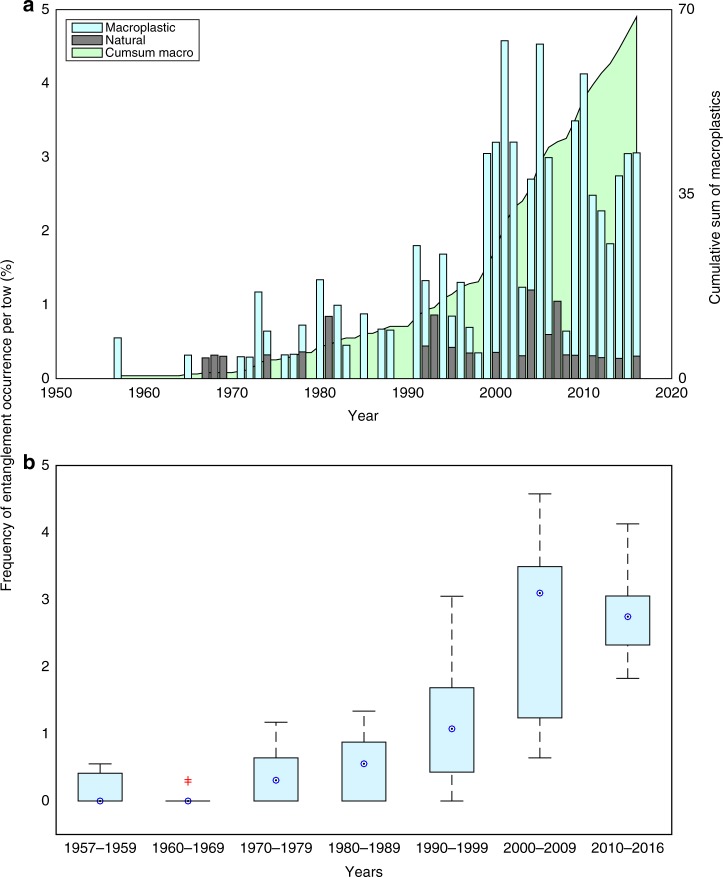
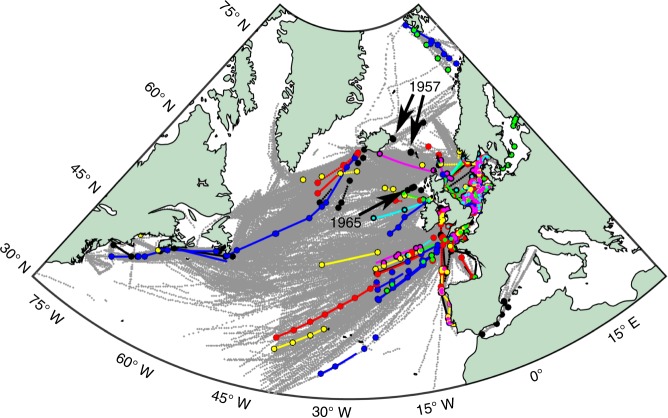
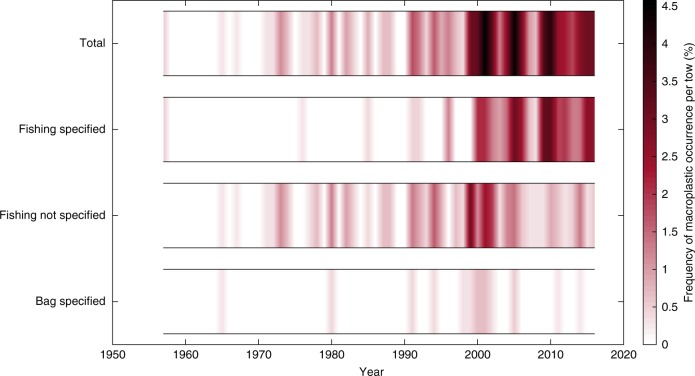
Plastic production has increased exponentially since its use became widespread in the 1950s. This has led to increased concern as plastics have become prevalent in the oceanic environment, and evidence of their impacts on marine organisms and human health has been highlighted. Despite their prevalence, very few long-term (>40 years) records of the distribution and temporal trends of plastics in the world’s oceans exist. Here we present a new time series, from 1957 to 2016 and covering over 6.5 million nautical miles, based on records of when plastics have become entangled on a towed marine sampler. This consistent time series provides some of the earliest records of plastic entanglement, and is the first to confirm a significant increase in open ocean plastics in recent decades.
Overview
The claims and statistics of this paper haven’t been checked yet.
Free: it reads the open-access text and checks the first 5 claims that cite a source we can check. Create a free account to check every claim.
Integrity signals
Registry
Cites
Statistics
Figures
Verification
Claims the paper makes
The claims and statistics of this paper haven’t been checked yet.
Free: it reads the open-access text and checks the first 5 claims that cite a source we can check. Create a free account to check every claim.
Self-check
Percentages, sums and reported differences re-computed from the paper’s own numbers.
The self-check needs the paper’s full text.
Citations
Cites
The Proceedings of the National Academy of Sciences
Richards, J. W. (1915) · Science · doi:10.1126/science.42.1074.161 · Cited by 13,983
Plastic waste inputs from land into the ocean
Jambeck, J. R., Geyer, R., Wilcox, C., Siegler, T. R., Perryman, M., Andrady, A., Narayan, R., & Law, K. L. (2015) · Science · doi:10.1126/science.1260352 · Cited by 13,163 · cited 1×
“As the global population continues to increase, plastic waste will continue to grow 31 .”
BackgroundLost at sea: where is all the plastic?
Thompson, R. C., Olsen, Y., Mitchell, R. P., Davis, A., Rowland, S. J., John, A. W. G., McGonigle, D., & Russell, A. E. (2004) · Science · doi:10.1126/science.1094559 · Cited by 7,765
Self-citation(2015) · Springer eBooks · doi:10.1007/978-3-319-16510-3 · Cited by 3,502
Plastic and Human Health: A Micro Issue?
Wright, S. L., & Kelly, F. J. (2017) · Environmental Science & Technology · doi:10.1021/acs.est.7b00423 · Cited by 3,413 · cited 1×
“Since this period, there has been a rapid increase in plastic production for a wide range of uses, and a number of environmental impacts have been highlighted 3,6 – 8 .”
BackgroundPlastic debris in the open ocean
Cózar, A., Echevarría, F., González-Gordillo, J. I., Irigoien, X., Úbeda, B., Hernández-León, S., Palma, Á. T., Navarro, S., García-de-Lomas, J., Ruiz, A., et al. (2014) · Proceedings of the National Academy of Sciences · doi:10.1073/pnas.1314705111 · Cited by 3,133 · cited 4×
“This dataset presents some of the earliest records of open ocean plastic entanglement, and con fi rms a signi fi cant increase in open ocean plastics since the 1990s 7,14 – 17 .”
BackgroundInfluentialWhat a Waste : A Global Review of Solid Waste Management
Hoornweg, D., & Bhada-Tata, P. (2012) · doi:10.1596/17388 · Cited by 3,129
Plastics, the environment and human health: current consensus and future trends
Thompson, R. C., Moore, C. J., vom Saal, F. S., & Swan, S. H. (2009) · Philosophical Transactions of the Royal Society B: Biological Sciences · doi:10.1098/rstb.2009.0053 · Cited by 3,032
Self-citationPlastic accumulation in the North Atlantic subtropical gyre
Law, K. L., Morét-Ferguson, S., Maximenko, N. A., Proskurowski, G., Peacock, E. E., Hafner, J., & Reddy, C. M. (2010) · Science · doi:10.1126/science.1192321 · Cited by 1,377
Plastics in the Marine Environment
Law, K. L. (2017) · Annual Review of Marine Science · doi:10.1146/annurev-marine-010816-060409 · Cited by 1,059
Research works printed but not linked: 4
- Shomura, R. S. & Yoshida, H. O. Proceedings of the workshop on the fate and impact of marine debris. NOAA Technical Memorandum NMFS (1985).
- Harper P Fowler JA Plastic pellets in New Zealand storm-killed prions (Pachyptila spp). 1958–1977 Notornis 1987 34 65 70
- Balazs, G. Impact of ocean debris on marine turtles: entanglement and ingestion. In Proc. Workshop on the Fate and Impact of Marine Debris, 27–29 November 1984, Honolulu, Hawaii (ed. R. S. Shomura, H. O. Yoshida) 387–429. Technical Memorandum NOAA-TM-NMFS-SWFC-54. (Washington, DC: Natl1985).
- ICES, Fisheries Overviews—Greater North Sea Ecoregion 2016 pp. 1–22 (2016).
Cited by
Items 401–467 of 467
Migration and plasticity effects on climate change
Saleem, M. S., Abas, N., Umer, M., & Haider, A. (2024) · Elsevier eBooks · doi:10.1016/b978-0-443-19066-7.00007-2 · Cited by 1
Alvarez, E. (2025) · Marine Pollution Bulletin · doi:10.1016/j.marpolbul.2024.117499 · Cited by 1
Recycling of Marine Plastic Waste
Moubarak, M., Schlummer, M., Loos, H. M., Ragaert, K., Geem, K. M. V., & Buettner, A. (2025) · Springer handbooks · doi:10.1007/978-3-031-66209-6_36 · Cited by 1
Enrichment of Microbes Potentially Degrading Polyethylene Using a Microcosm Approach
Barral, A. M., & Stenson, B. (2020) · Fine Focus · doi:10.33043/ff.6.1.84-101 · Cited by 1
“Due to its non-degradable nature, plastic has been accumulating in the environment at exponentially increasing rates since mass production began in the 1940s (1, 3).”
BackgroundPlastic pollution in rivers and lakes—An indicator of an even bigger consequence of global change?
Hart, P. J. B., & Arlinghaus, R. (2021) · Fish and Fisheries · doi:10.1111/faf.12557 · Cited by 1
Legal and cooperative mechanisms for conserving marine birds
Kim, M. A., Harrison, C. S., & Tasker, M. L. (2022) · Elsevier eBooks · doi:10.1016/b978-0-323-88539-3.00011-x · Cited by 1
Application of Material Flow Analysis: Mapping Plastics Within the Fishing Sector in Norway
Deshpande, P. C., & Tippett, A. W. (2023) · Springer eBooks · doi:10.1007/978-3-031-22245-0_17 · Cited by 1
Planet’s ocean-plastics problem detailed in 60-year data set
Warren, M. (2019) · Nature · doi:10.1038/d41586-019-01252-0 · Cited by 1
Delgado-Gallardo, J. (2023) · Cronfa (Swansea University) · doi:10.23889/suthesis.63499 · Cited by 1
Morton, B. (2019) · Marine Pollution Bulletin · doi:10.1016/j.marpolbul.2019.06.040
Quantifying land-based sources of plastic pollution in South Africa
Weideman, E. A. (2020) · Open University of Cape Town (University of Cape Town)
Ingestion of macroplastics by common dolphinfish (Coryphaena hippurus) in the Atlantic Ocean
Costa, E. F. S., Dias, J. F., & Madureira, L. A. S. P. (2021) · Ocean and Coastal Research · doi:10.1590/2675-2824069.20-002efsc · Cited by 1
Cultivating solutions: oyster farmers’ responses to environmental change in British Columbia
Mallows, C. J. (2021) · UVic’s Research and Learning Repository (University of Victoria) · Cited by 1
Sustainable plastic materials management
Muñoz, J. F. V., Sánchez, J. Á. A., Felices, B. L., & García-Arca, D. (2021) · Elsevier eBooks · doi:10.1016/b978-0-12-824342-8.00016-x · Cited by 1
Halbach, M., Vogel, M., Tammen, J. K., Rüdel, H., Koschorreck, J., & Scholz‐Böttcher, B. M. (2021) · SSRN Electronic Journal · doi:10.2139/ssrn.3978614
Alternative Approaches for Scalable Artificial Photosynthesis via Sustainable Redox Processes
Soo, H. S. (2022) · Royal Society of Chemistry eBooks · doi:10.1039/9781839164828-00175
Haward, M. (2020) · Edward Elgar Publishing eBooks · doi:10.4337/9781788119368.00017
Buckle, P. (2022) · International Journal of Jungian Studies · doi:10.1163/19409060-bja10013
Wicked Problem of Waste Management in the Arctic Region
Akhmetzyanov, B. Z., Osipov, V. S., & Галимовна, Н. Р. (2022) · Springer eBooks · doi:10.1007/978-981-16-9250-5_38-1
Boyd, D. (2023) · Queensland University of Technology · doi:10.5204/thesis.eprints.242130 · Cited by 2
Kalonde, P. K., Mwapasa, T., Mthawanji, R., Chidziwitsano, K., Morse, T., Torguson, J. S., Jones, C. M., Quilliam, R. S., Feasey, N., Henrion, M., et al. (2023) · Research Square · doi:10.21203/rs.3.rs-3244445/v1
Markley, L. A. T., Grünzner, M., & Walker, T. R. (2024) · Cambridge Prisms Plastics · doi:10.1017/plc.2024.4.pr5
Markley, L., Grünzner, M., & Walker, T. R. (2024) · Cambridge Prisms Plastics · doi:10.1017/plc.2024.4.pr6
Markley, L. A. T., Grünzner, M., & Walker, T. R. (2023) · Cambridge Prisms Plastics · doi:10.1017/plc.2024.4.pr3
Markley, L., Grünzner, M., & Walker, T. R. (2023) · Cambridge Prisms Plastics · doi:10.1017/plc.2024.4.pr2
Drifting plastics, the forensics of current and future pollutionPreprint
Okabe, A., Sato, H., Koizumi, K., Taguchi, H., Okada, M., Kodera, Y., Kusui, T., Suzuki, N., Takatama, K., Chung, S.-Y., et al. (2024) · Research Square · doi:10.21203/rs.3.rs-4703998/v1
Patchaiyappan, A., Singh, A., Bautès, N., & Abimannan, A. (2024) · Environmental Science and Pollution Research · doi:10.1007/s11356-024-35014-x
“Plastic pollution continues to soar globally despite significant environmental regulations enforced by the policy makers, and it continues to haunt the environment over time, as a larger portion of it ends up in polluting the marine coastal ecosystems (Ostle et al. 2019).”
Agro-Industrial Alchemy: Transforming Waste into Wealth with Bio-Based Plastics
Hernández‐Domínguez, E., Mundo, M. D. L. L. S., Soto, R. A. G., & Huicochea, E. F. (2025) · IntechOpen eBooks · doi:10.5772/intechopen.1006837
NEAT, F. C. (2025) · Springer eBooks · doi:10.1007/978-3-031-82857-7_32 · Cited by 2
Microplastic Pollution Status of Major Highland Agricultural Watersheds in Gangwon
lim, C., Ju, S., Kim, Y., & Yoon, Y. (2025) · JOURNAL OF ENVIRONMENTAL ANALYSIS, HEALTH AND TOXICOLOGY · doi:10.36278/jeaht.28.2.102
Current Prospectives of Algal Polyhydroxybutyrate Production: A Sustainable Approach
Madhumitraa, P., Sangamithira, S. K. S., Kavin, G., Ramesh, M., Nivetha, S., & Arthe, R. (2025) · Sustainable landscape planning and natural resources management · doi:10.1007/978-3-031-85550-4_6
Structure-dependent mechanisms for plastic degradation in the marine environment
Maciulis, N. A., Bingaman, J. M., & Scott, S. L. (2025) · Elsevier eBooks · doi:10.1016/b978-0-12-822324-6.00007-4
Plastics in the sea: An overview
Mladinich, K., Shumway, S. E., Vondolia, G. K., & Ward, J. E. (2025) · Elsevier eBooks · doi:10.1016/b978-0-12-822324-6.00005-0
Aquatic Ecosystems: Biodiversity and Conservation
Nogueira, M. G., & Kane, D. D. (2025) · Water · doi:10.3390/w17152321 · Cited by 2
Newly hatched Florida sea turtles are consuming dangerous quantities of floating plastic
Duffy, D. J., & Eastman, C. B. (2020) · doi:10.64628/aai.wngqshywm
플라스틱 재생원료의 사용 확대를 위한 재질별 국내 수요 및 공급 여건 분석
홍, 인., 김, 도., Phae, C., & 김, 대. (2025) · Journal of Korea Society of Waste Management · doi:10.9786/kswm.2025.42.5.227
Wang, J., & Ma, X. (2025) · International Environmental Agreements Politics Law and Economics · doi:10.1007/s10784-025-09704-x
The untold story of Sea Caves: Lost and found anthropogenic debris in confined marine environments
Savva, I., Cai, L. L., Marcou, M., & Angel, D. L. (2025) · Marine Pollution Bulletin · doi:10.1016/j.marpolbul.2025.119065
Andrade, H., Glüge, J., Herzke, D., Ashta, N. M., Nayagar, S. M., & Scheringer, M. (2021) · Figshare · doi:10.6084/m9.figshare.15040927
Exploration of influencing factors for crisis management in the recycled plastic market
Hong, I., Kim, D., & Phae, C. (2026) · Journal of Material Cycles and Waste Management · doi:10.1007/s10163-025-02463-6
Evaluation of Diminishing Seabird Abundance Trends: Implications for Monitoring
Sheetal, Sihag, S., Nimbrayan, P. K., & Kumari, N. (2026) · Wetlands: ecology, conservation and management · doi:10.1007/978-3-032-17125-2_9
Iqbal, S., Rana, N., Riasat, M., Younas, R., Bashir, N. H., & Naeem, M. (2025) · Pakistan Journal of Zoological Sciences · doi:10.65139/ktdty338
Bornt, K. R., de Lestang, S., How, J., Linge, K. L., Hovey, R., & Langlois, T. J. (2026) · SSRN Electronic Journal · doi:10.2139/ssrn.6313715
Bautista-Romero, C., Gil-Delgado, J. A., Rodríguez-Sierra, C. M., & Bernat‐Ponce, E. (2026) · Water Air & Soil Pollution · doi:10.1007/s11270-026-09238-1
“Over 60% of manufactured plastics end up in landfills or the environment, where their slow degradation, persisting for centuries, leads to steady accumulation (Li et al., 2021; MacLeod et al., 2021; Ostle et al., 2019; Roch-man et al., 2019; Thompson et al., 2005, 2009).”
Domain-adapted discovery of PET depolymerisation routes using in-house curated scientific literature
Sivan, D., Zafar, S., Satheeshkumar, K., Kumar, T. K. M., Moorthy, K., Misnon, I. I., Yang, C.-C., & Jose, R. (2026) · Chemical Communications · doi:10.1039/d6cc00581k
Tallec, K. (2019) · theses.fr (ABES) · doi:10.70675/1290bd49z5e0dz44dbzb65ez1eee9a488d2e · Cited by 8
Bringer, A. (2021) · theses.fr (ABES) · doi:10.70675/67e0ddc7za7a9z4aecza992z39ba4e245024 · Cited by 2
Justino, A. K. S. (2022) · theses.fr (ABES) · doi:10.70675/dc18727dz376bz400ez8444z3da275a51f68
Deep learning-guided design of hydrolases for crystalline PET depolymerizationPreprint
Wu, B., Li, M., Zhang, J. C., Li, J., Wang, X., Zhong, B., Liu, J. S., Liu, Y., Yang, T., Yang, T., et al. (2026) · bioRxiv (Cold Spring Harbor Laboratory) · doi:10.64898/2026.06.04.730138
Design and Implementation of an Innovative Seabin-Based Trash Collector with Trash Detection System
Gonzales, S. R. B., Enano, K. T. T., Arias, K. M. L. C., Mendoza, H. M., Mariveles, R. R. C., Abrenica, E. S., Angeles, M. R., & Retumban, J. D. (2026) · International Conference on Innovative Research in Applied Science, Engineering and Technology (IRASET) · doi:10.1109/iraset68627.2026.11538460
“Long-term time-series observations further demonstrate a significant increase in macroplastic presence in ocean waters over the past six decades [6].”
Costa, A. M., Fernandes, A. C., Daniel, D., & Nunes, B. (2026) · Aquatic Toxicology · doi:10.1016/j.aquatox.2026.107910
Rana, S., Khan, M. S., Tushar, M. T. H., Shakib, I. A., Sunny, Z. A., Sumi, S. N., Chowdhury, S., Jahan, I., Shimul, S. A., & Nahid, S. A. A. (2026) · Anthropocene Coasts · doi:10.1007/s44218-026-00141-0
“Consequently, marine plastic pollution is now recognized as one of the most critical environmental challenges of the twenty-first century (Ostle et al. 2019).”
Newly Plastic Pollution in the OceanPreprint
Okabe, A., Koizumi, K., Sato, H., Taguchi, H., Okada, M., Kodera, Y., Chung, S.-Y., Kwon, B. G., Nishimura, M., Menteşe, S., et al. (2026) · Research Square · doi:10.21203/rs.3.rs-10444715/v1
Hodge, A. A., Gabe‐Thomas, E., Hopkins, F. E., Saha, M., & Jha, A. N. (2026) · Marine Policy · doi:10.1016/j.marpol.2026.107244
All-optical Mie void sensor for complex nanoplastic mixtures
Ludescher, D., Schwab, J., Arslan, S., Kubacki, E., Ubl, M., Retsch, M., Giessen, H. W., & Hentschel, M. (2026) · Nature Communications · doi:10.1038/s41467-026-76199-8 · Cited by 1
“In contrast, Fourier-transform infrared and Raman spectroscopy are widely regarded as the gold standard for polymer identi fi cation, as they probe molecular fi ngerprints that allow direct determination of polymer type 35 – 38 .”
Investigating the Effects of Modified Zeolite Y on the Degradation of Polypropylene
Fabris, C., Sarotto, E., Berdiell, I. C., Cordero‐Lanzac, T., Crespo, I., Prodinger, S., Arstad, B., Jouve, A., Bordiga, S., Bracco, P., et al. (2026) · ChemSusChem · doi:10.1002/cssc.70909 · Cited by 1
Alejo-Plata, M. D. C., González-Acosta, A. F., González-Fernández, C., & Ruiz‐Campos, G. (2026) · Environmental Biology of Fishes · doi:10.1007/s10641-026-01888-8
“…tract, leading the organism to malnutrition (by induced fake satiation) and eventual star-vation causing significant physical and physiological damage, and lower energy intake (Azzarello and Van-Vleet 1987; Wang et al. 2016; De Sá et al. 2019; Ostle et al. 2019; Salerno et al. 2020; Bhuyan 2022).”
Li, H., Liu, Y., Yang, Q., Ji, Y., Yan, Q., Ding, R., & Peng, Y. (2026) · Polyhedron · doi:10.2139/ssrn.7301876
Climate warming accelerates plastic degradation and secondary microplastic formationPreprint
Wei, X., Zhou, L., Wang, X., Lefevre, G., Bescond, M., Bao, R., Richaud, E., & MacLeod, M. (2026) · Research Square · doi:10.21203/rs.3.rs-10907129/v1
Hayashi, R., & Shuto, T. (2026) · Journal of the Marine Biological Association of the United Kingdom · doi:10.1017/s0025315426101544
“In the Anthropocene, plastic debris has become an increasingly dominant component of marine surface waters, with long-term datasets documenting pronounced increases over the past decades (Ostle et al., 2019).”
Horton, A. A. (2026) · Journal of Hazardous Materials · doi:10.1016/j.jhazmat.2026.143529
Raju, M. H., & Ibnat, A. (2026) · Marine Pollution Bulletin · doi:10.1016/j.marpolbul.2026.120348
Exponential-growth underestimation: Semantic framing and information availability
Feder, A., Katzir, M., Halali, E., & Pinhas, M. (2026) · Acta Psychologica · doi:10.1016/j.actpsy.2026.107957
Metadata
- Authors
- Ostle, C., Thompson, R. C., Broughton, D., Gregory, L., Wootton, M., & Johns, D. G.
- Affiliations
- Marine Biological Association of the United Kingdom (GB)
- University of Plymouth (GB)
- Corresponding author
- Ostle, Clare
- Venue
- Nature Communications
- Published
- 2019-04-16
- Volume
- 10
- Issue
- 1
- Pages
- 1622-1622
- ISSN
- 2041-1723 (ISSN-L)
- PMC
- PMC6467903
- OpenAlex
- W2939234172
- Semantic Scholar
- f49456e6d0d8281a906dfb50d54f234111126082
- Cited by
- 469
- References
- 34
- Citations by year
- 2026: 36 · 2025: 59 · 2024: 91 · 2023: 61 · 2022: 72 · 2021: 67 · 2020: 70 · 2019: 12
- FWCI
- 16.55
- Type
- journal article
- Language
- en
- Open access
- gold
- doi.org
- Licence
- cc-by
- creativecommons.org/licenses/by/4.0 (tdm)
- creativecommons.org/licenses/by/4.0 (vor)
- Locations
- Nature Communications (publishedVersion, cc-by)
- Europe PMC (PubMed Central) (publishedVersion, cc-by)
- PubMed Central (publishedVersion, cc-by)
- PubMed (publishedVersion)
- Marine Biological Association (acceptedVersion)
- PEARL (University of Plymouth) (submittedVersion)
- RePEc: Research Papers in Economics (submittedVersion)
- DOAJ (DOAJ: Directory of Open Access Journals) (submittedVersion)
- DOAJ (DOAJ: Directory of Open Access Journals) (submittedVersion, cc-by-sa)
- Funders
- National Science Foundation (DFO CA F5955- 150026/001/HAL, 1657887, UK NC-R8/H12/100)
- Department for Environment, Food and Rural Affairs, UK Government (DEFRA UK ME-5308, ME5308)
- Natural Environment Research Council (UK NC-R8/H12/100, NE/R015953/1, SAH01001, NC-R8/H12/100, DEFRA UK ME-5308)
- Topics
- Physical Sciences › Environmental Science › Pollution › Microplastics and Plastic Pollution
- Physical Sciences › Environmental Science › Pollution › Oil Spill Detection and Mitigation
- Physical Sciences › Earth and Planetary Sciences › Oceanography › Marine Plankton and Biogeochemistry
- Keywords
- ocean plastic, plastic entanglement, marine plastic pollution, plastic production, temporal trends, long-term time series, open ocean, marine litter
About these checks
Registry, retraction, Cites and statistics results are computed, not judged, with one exception: a printed reference that no index lists is read once by a model before it counts as a citation error. Claims are extracted by a model and kept only when their quote appears verbatim in the text; each cited source is then checked, with a model’s help, for whether it says what the claim relies on. Those verdicts can be wrong — read the claim’s quote and the cited source before relying on one.
Statistics and arithmetic are recomputed, not judged.
Confidence bands are shown only for fields calibrated on our annotated test set. None is calibrated yet, so no band is shown.
What counts as a claim ›How we measure confidence ›How we check this ›
Are you an author, or do you see a problem with this page? Request a review
Data sources
Bibliographic data: Semantic Scholar, OpenAlex, Crossref.
Contains information from the Semantic Scholar Academic Graph Datasets, made available under the ODC Attribution License (ODC-BY 1.0).
Semantic Scholar’s data is described in: Kinney, R., et al. (2023). The Semantic Scholar Open Data Platform. arXiv:2301.10140.
