

The DOI matches its Crossref record; 53 of the 53 references it cites were found in a registry or an index.
Heterochronic faecal transplantation boosts gut germinal centres in aged mice
Open accessAbstract
Ageing is a complex multifactorial process associated with a plethora of disorders, which contribute significantly to morbidity worldwide. One of the organs significantly affected by age is the gut. Age-dependent changes of the gut-associated microbiome have been linked to increased frailty and systemic inflammation. This change in microbial composition with age occurs in parallel with a decline in function of the gut immune system; however, it is not clear whether there is a causal link between the two. Here we report that the defective germinal centre reaction in Peyer’s patches of aged mice can be rescued by faecal transfers from younger adults into aged mice and by immunisations with cholera toxin, without affecting germinal centre reactions in peripheral lymph nodes. This demonstrates that the poor germinal centre reaction in aged animals is not irreversible, and that it is possible to improve this response in older individuals by providing appropriate stimuli.
Overview
The claims and statistics of this paper haven’t been checked yet.
Run the check — free, no account needed. It reads the open-access text and checks the sources it cites.
Integrity signals
Registry
Cites
Statistics
Figures
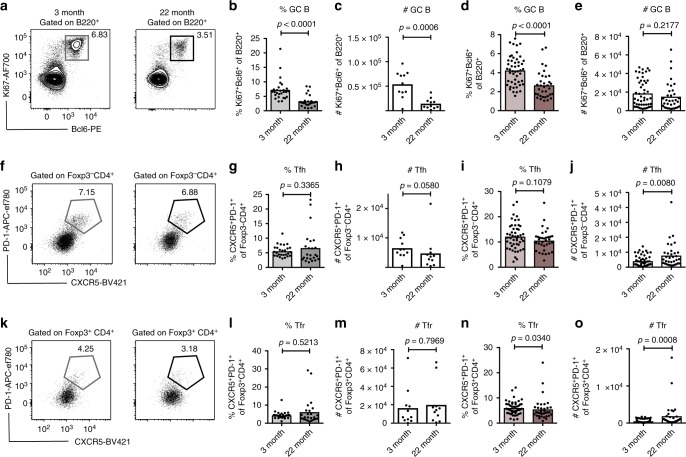
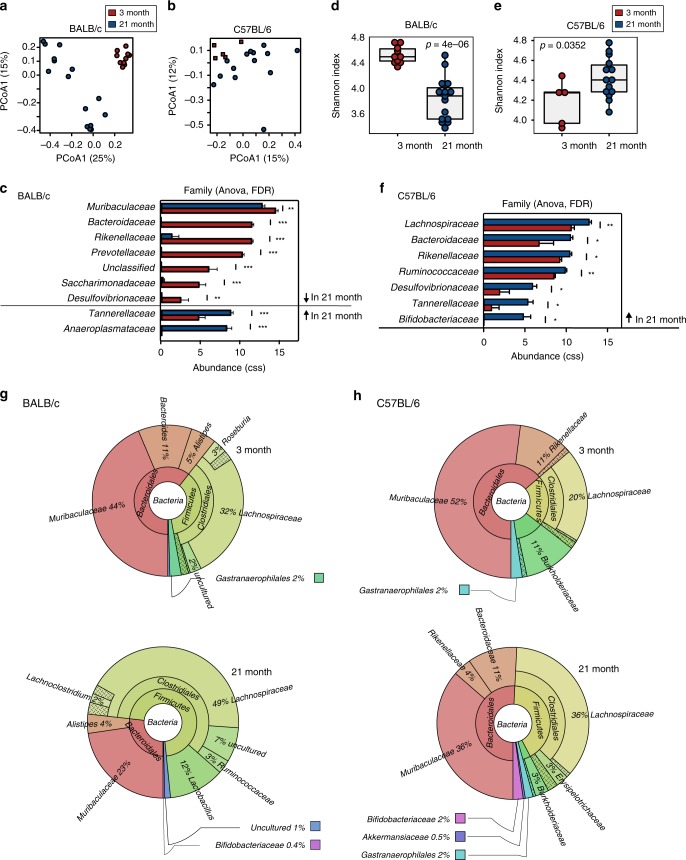
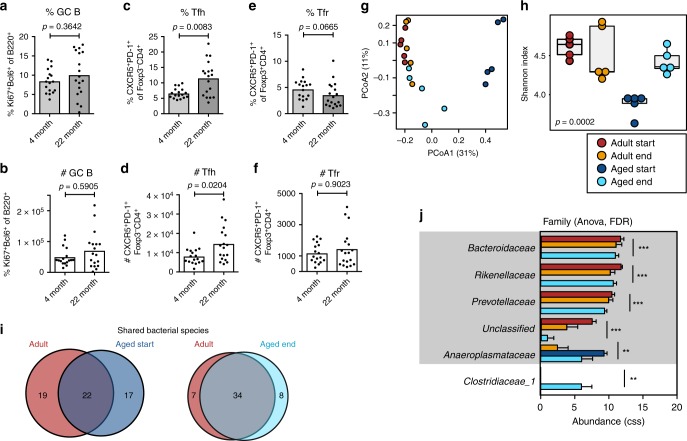
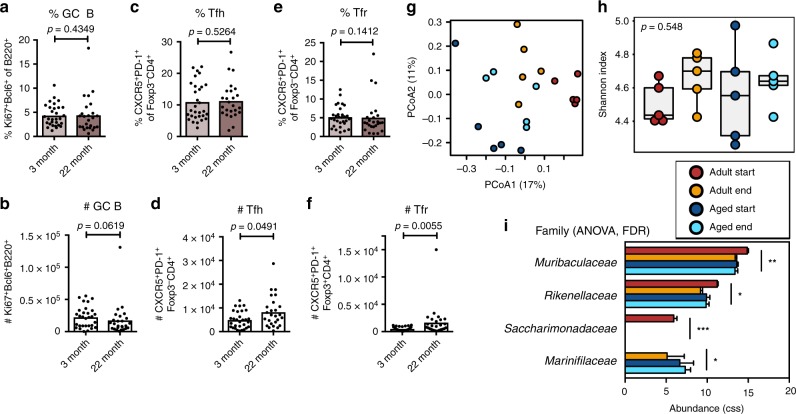
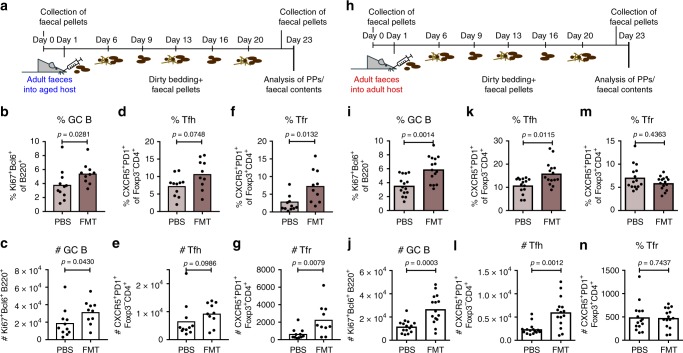
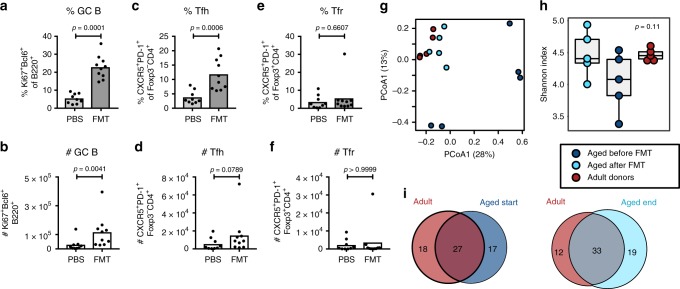
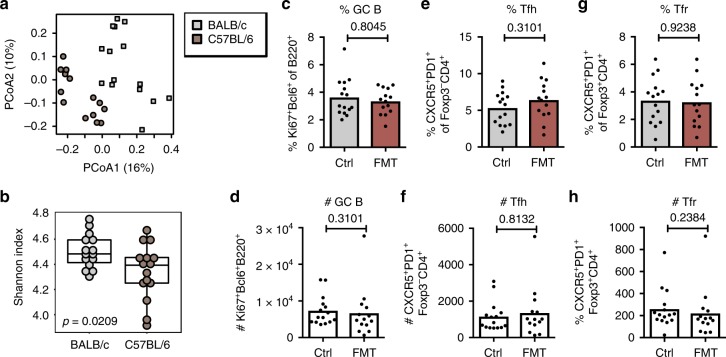
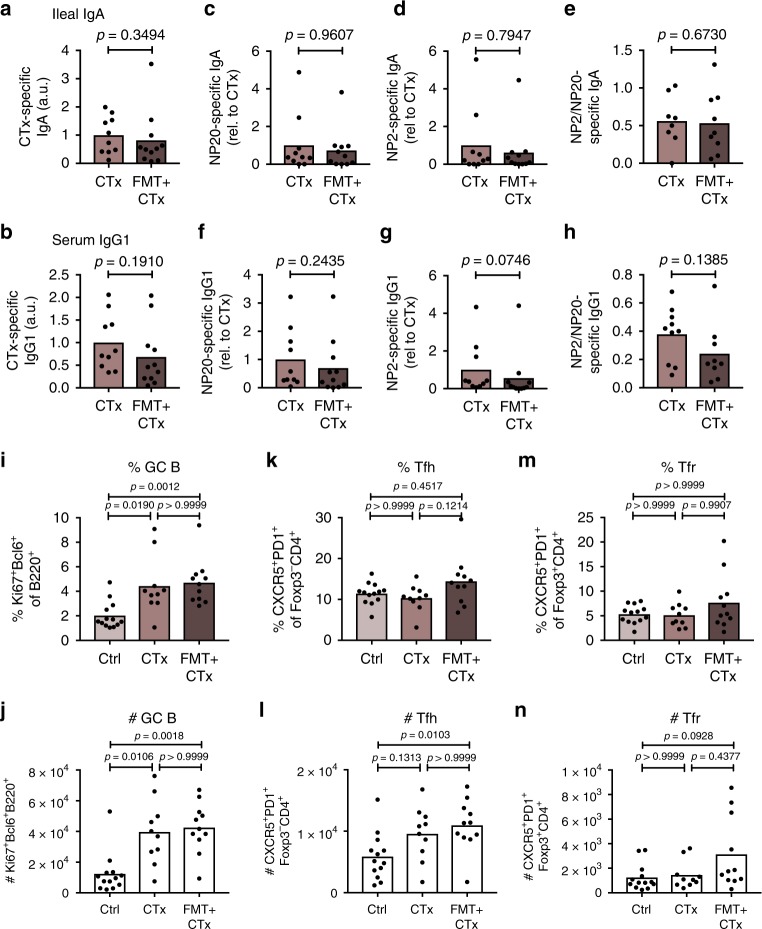
Verification
Claims the paper makes
The claims and statistics of this paper haven’t been checked yet.
Run the check — free, no account needed. It reads the open-access text and checks the sources it cites.
Claims other papers make about this one
Each is checked against this paper’s own text: does it say what the citing paper says it does?
The source backs part of the claim, not all of it — or backs it for a different population, condition or comparison.
In the citing paper
“These changes can adversely affect the host metabolism and immunity [25–27, 40, 64, 86, 110, 112, 118] and are associated with the development of cardiovascular, autoimmune, metabolic, and neurodegenerative disorders [17, 90, 122, 132].”
From Fecal microbiota transfer between young and aged mice reverses hallmarks of the aging gut, eye, and brain (2022) · cites this paper as [112]
Experimental — accuracy not yet measuredThe source backs part of the claim, not all of it — or backs it for a different population, condition or comparison.
In the citing paper
“the defective germinal center reaction in Peyer's patches of aged mice can be rescued by FMT from younger animals without affecting germinal center reactions in peripheral lymph nodes.”
From Hallmarks of aging: An expanding universe (2023) · cites this paper as [288]
Experimental — accuracy not yet measuredThe source backs part of the claim, not all of it — or backs it for a different population, condition or comparison.
In the citing paper
“| Dysbiosis | Mouse | Fecal microbiota transplantation | Improved germinal centre reactions in lymph nodes | 288 |”
From Hallmarks of aging: An expanding universe (2023) · cites this paper as [288]
Experimental — accuracy not yet measuredIn the citing paper
“Similar beneficial effects have been reported in aged mice receiving microbiota from young mice to extend life span [8, 61] or halt the functional decline in the mucosal immune system [112].”
From Fecal microbiota transfer between young and aged mice reverses hallmarks of the aging gut, eye, and brain (2022) · cites this paper as [112]
Self-check
Percentages, sums and reported differences re-computed from the paper’s own numbers.
The self-check needs the paper’s full text.
Citations
Cites
QIIME allows analysis of high-throughput community sequencing data
Caporaso, J. G., Kuczynski, J., Stombaugh, J., Bittinger, K., Bushman, F. D., Costello, E. K., Fierer, N., Peña, A. G., Goodrich, J. K., Gordon, J. I., et al. (2010) · Nature Methods · doi:10.1038/nmeth.f.303 · Cited by 34,887
The SILVA ribosomal RNA gene database project: improved data processing and web-based tools
Quast, C., Pruesse, E., Yilmaz, P., Gerken, J., Schweer, T., Yarza, P., Peplies, J., & Glöckner, F. O. (2012) · Nucleic Acids Research · doi:10.1093/nar/gks1219 · Cited by 33,055
Role of the microbiota in immunity and inflammation.
Belkaid, Y., & Hand, T. W. (2014) · Cell · doi:10.1016/j.cell.2014.03.011 · Cited by 5,385
Gut microbiota composition correlates with diet and health in the elderly
Claesson, M. J., Jeffery, I. B., Conde, S., Power, S. E., O’Connor, E. M., Cusack, S., Harris, H. M. B., Coakley, M., Lakshminarayanan, B., O’Sullivan, O., et al. (2012) · Nature · doi:10.1038/nature11319 · Cited by 3,314
Interactive metagenomic visualization in a Web browser
Ondov, B., Bergman, N. H., & Phillippy, A. M. (2011) · BMC Bioinformatics · doi:10.1186/1471-2105-12-385 · Cited by 2,123
Composition, variability, and temporal stability of the intestinal microbiota of the elderly
Claesson, M. J., Cusack, S., O'Sullivan, O., Greene-Diniz, R., de Weerd, H., Flannery, E., Marchesi, J. R., Falush, D., Dinan, T., Fitzgerald, G., et al. (2011) · Proceedings of the National Academy of Sciences · doi:10.1073/pnas.1000097107 · Cited by 1,754
Through Ageing, and Beyond: Gut Microbiota and Inflammatory Status in Seniors and Centenarians
Biagi, E., Nylund, L., Candela, M., Ostan, R., Bucci, L., Pini, E., Nikkïla, J., Monti, D., Satokari, R., Franceschi, C., et al. (2010) · PLoS ONE · doi:10.1371/journal.pone.0010667 · Cited by 1,483
Cattaneo, A., Cattane, N., Galluzzi, S., Provasi, S., Lopizzo, N., Festari, C., Ferrari, C., Guerra, U. P., Paghera, B., Muscio, C., et al. (2017) · Neurobiology of Aging · doi:10.1016/j.neurobiolaging.2016.08.019 · Cited by 1,382
Thevaranjan, N., Puchta, A., Schulz, C., Naidoo, A., Szamosi, J. C., Verschoor, C. P., Loukov, D., Schenck, L. P., Jury, J., Foley, K. P., et al. (2017) · Cell Host & Microbe · doi:10.1016/j.chom.2017.03.002 · Cited by 1,322
The twilight of immunity: emerging concepts in aging of the immune system
Nikolich-Žugich, J. (2018) · Nature Immunology · doi:10.1038/s41590-017-0006-x · Cited by 1,240
Cited by
Sorted by citations
Items 101–107 of 107
Xia, R., Ge, J., & Shuai, Y. (2026) · Journal of Agricultural and Food Chemistry · doi:10.1021/acs.jafc.5c15443
T cell control of the intestinal barrier and gut microbiota during ageing
Heras, M. M. G. D. L., & Mittelbrunn, M. (2026) · Trends in Immunology · doi:10.1016/j.it.2026.05.001
Wang, R., Tabrizian, T., Wang, D., English, J., Ayer, A., Gal, M., Yang, W., Wu, Z., Mao, K., Novaj, A., et al. (2026) · Nature Aging · doi:10.1038/s43587-026-01170-7
“We surveyed the composition of the fecal microbiome, particularly given previous evidence that some features of intestinal function could be restored by fecal transplants from young to old mice 51 , whereas fecal transplantation from old to young led to impaired intestinal permeability 52 .”
Mu, K., He, M., Liao, R., Shao, C., Xie, P., Xie, J., Liu, Y., Ju, Z., Zhong, K., Yuan, Y., et al. (2026) · Nutrients · doi:10.3390/nu18162641
Wang, D., Shi, X., & Zhang, Y. (2026) · Ageing Research Reviews · doi:10.1016/j.arr.2026.103307
The Hallmarks of Aging: From Molecular Mechanisms to Clinical Translation
Chmielewski, P. P., & Strzelec, B. (2026) · International Journal of Molecular Sciences · doi:10.3390/ijms27188080
“Microbiota from young donors can improve immune, reproductive, behavioral, or survival-related outcomes in aged or progeroid recipients [142–145].”
Lamanna, A., Zhou, Z., Boussoufa, B., Pansart, E., Garcia, P., Heurtaux, T., Buttini, M., Coowar, D., Marcon, G., & Williams, E. G. (2026) · bioRxiv (Cold Spring Harbor Laboratory) · doi:10.64898/2026.09.28.752290
Metadata
- Authors
- Stebegg, M., Silva-Cayetano, A., Innocentin, S., Jenkins, T. P., Cantacessi, C., Gilbert, C., & Linterman, M. A.
- Affiliations
- Babraham Institute (GB)
- University of Cambridge (GB)
- Corresponding author
- Linterman, Michelle A.
- ORCID
- Venue
- Nature Communications
- Published
- 2019-06-04
- Volume
- 10
- Issue
- 1
- Pages
- 2443-2443
- ISSN
- 2041-1723 (ISSN-L)
- PMC
- PMC6547660
- OpenAlex
- W2948768639
- Cited by
- 107
- References
- 53
- Citations by year
- 2026: 12 · 2025: 9 · 2024: 16 · 2023: 17 · 2022: 17 · 2021: 18 · 2020: 14 · 2019: 3
- FWCI
- 4.30
- Type
- journal article
- Language
- en
- Open access
- gold
- doi.org
- Locations
- Nature Communications (publishedVersion, cc-by)
- Europe PMC (PubMed Central) (publishedVersion, cc-by)
- PubMed Central (publishedVersion, cc-by)
- PubMed (publishedVersion)
- Minerva Access (University of Melbourne) (submittedVersion, cc-by)
- Apollo (University of Cambridge) (submittedVersion, cc-by)
- RePEc: Research Papers in Economics (submittedVersion)
- DOAJ (DOAJ: Directory of Open Access Journals) (submittedVersion, cc-by-sa)
- DOAJ (DOAJ: Directory of Open Access Journals) (submittedVersion)
- Apollo (cc-by)
- Funders
- Wellcome Trust
- European Commission (675395)
- Directorate for Biological Sciences
- Biotechnology and Biological Sciences Research Council (BBS/E/B/000C0407, BBS/E/B/000C0427)
- H2020 European Research Council (637801)
- Topics
- Life Sciences › Biochemistry, Genetics and Molecular Biology › Molecular Biology › Gut microbiota and health
- Life Sciences › Immunology and Microbiology › Immunology › T-cell and B-cell Immunology
- Life Sciences › Biochemistry, Genetics and Molecular Biology › Aging › Genetics, Aging, and Longevity in Model Organisms
- Keywords
- Peyer's patches, gut-associated lymphoid tissue, gut microbiota, immunosenescence, frailty, systemic inflammation, aged mice
- MeSH terms
- Gastrointestinal Microbiome, Fecal Microbiota Transplantation, Aging, Animals, Cholera Toxin, Female, Immunoglobulin A, Immunization, Nitrophenols, Peyer's Patches, Phenylacetates, Germinal Center, Mice, Dysbiosis
About these checks
Registry, retraction, Cites and statistics results are computed, not judged, with one exception: a printed reference that no index lists is read once by a model before it counts as a citation error. Claims are extracted by a model and kept only when their quote appears verbatim in the text; each cited source is then checked, with a model’s help, for whether it says what the claim relies on. Those verdicts can be wrong — read the claim’s quote and the cited source before relying on one.
Statistics and arithmetic are recomputed, not judged.
Confidence bands are shown only for fields calibrated on our annotated test set. None is calibrated yet, so no band is shown.
What counts as a claim ›How we measure confidence ›How we check this ›
Are you an author, or do you see a problem with this page? Request a review
